
 Published on and written by Cyril Jarnias
Traveling the British Virgin Islands without renting a car is possible, but it requires a bit of advance planning. The archipelago relies on a mix of ferries, minibuses, taxis, and free shuttles, with no real “European-style” bus network. The result: to enjoy the beaches, coves, and small island capitals hassle-free, it’s best to understand exactly how this public transport system works—fragmented, sometimes makeshift, but generally effective for those who know how to use it.
This guide summarizes essential information from local authorities, operators, and on-the-ground feedback. It helps you plan your trips by combining sea and land transportation, island by island.
Understanding the context: a stunning archipelago, a modest network
The British Virgin Islands are a small volcanic territory with pronounced relief and a limited population. The small size of the islands, the rugged topography, and the insular nature largely explain the lack of land-based transportation infrastructure.
The road network, though dense, consists mainly of narrow, winding roads that are sometimes poorly maintained. Driving is on the left with mostly left-hand-drive vehicles, making overtaking tricky. Signage is limited, visibility is poor, and roads become very slippery in rainy weather.
In this context, formal public transportation is scarce. No structured public bus network, no trains, no trams. Getting around is organized mainly around three pillars: taxis (often shared), informal safari minibuses, and ferries between islands. To these are added a few free shuttles and park-and-ride services on Tortola.
Another key point: the archipelago uses the US dollar, English is the main language, and transport payments are almost exclusively in cash. No Uber or ride-hailing platforms here.
Overview of transportation modes: sea, road, and a bit of air
To understand how to get around, you first need to distinguish between three major levels of transport.
At sea, public and private ferries form the backbone of connections between islands and with neighboring US islands. They are supplemented by water taxis, which are more flexible but more expensive.
Travel between islands is mainly done via regulated taxis, minibuses, and open-backed vans called “safaris,” which operate as shared transport without fixed schedules or official stops. A few free bus lines, funded by the authorities, provide a structured network on the main inhabited islands.
In the air, a few planes and charters sometimes connect islands or link to major regional hubs, but this can hardly be called everyday public transport for tourists. It remains a useful supplement for certain routes.
Cost estimates
Cost-of-living and operator data provide a fairly accurate idea of the budgets to plan for.
| Trip type / ticket | Indicative range (USD) | Remarks |
|---|---|---|
| Single local transport ticket (bus/minibus) | 3 to 10 | Tortola / Virgin Gorda, depending on distance |
| Example single ticket | ≈ 4 | Average estimate in town (Road Town) |
| Monthly public transport pass | 100 to 300 | Cost-of-living data; rarely used by tourists in practice |
| Taxi start fare (pickup) | 5 | Indicative opening fare |
| Taxi per km (estimate) | 1 | To be compared with official zone-based rates |
| Example 8 km in town | ≈ 39 | Estimate for Road Town |
| Gasoline (1 liter) | 0.82 to 1.33 | Depending on source and location (Road Town at high end) |
| Ferry BVI ↔ USVI (round trip adult) | 45 to 52 | St. Thomas – Tortola / Virgin Gorda |
| Ferry BVI ↔ USVI (one-way adult) | 25 to 30 | Charlotte Amalie – Road Town |
| Inter-island ferry BVI (round trip) | 55 to 65 | Road Town – Jost Van Dyke / Virgin Gorda… |
Local transport costs less than in many Western countries, but remains about 35 to 40% higher than the US average, mainly due to fuel prices.
Getting around by road: taxis, “safaris,” and minibuses
The absence of a formal bus network does not mean it’s impossible to get around without a car. There is a patchwork of services that together act as public transportation.
Taxis: ubiquitous, regulated… and sometimes expensive
On Tortola and Virgin Gorda, taxis remain the simplest means of transport for a newly arrived visitor. They wait at the exit of Terrance B. Lettsome International Airport (EIS) on Beef Island, at ferry ports, near the Road Town cruise terminal, and at major tourist sites.
Taxis are regulated by the Taxi and Livery Commission. Licensed vehicles are identifiable by a “Taxi” sign and license plates starting with “TX.” Drivers must be registered and follow an official rate schedule set by regulation.
A few figures give an idea of costs, especially from Beef Island airport:
| Trip (1 passenger / 2 / 3) | Indicative fare (USD) |
|---|---|
| Airport (Beef Island) → Road Town | 27 / 14 / 12 per person |
| Airport → Cane Garden Bay or West End | 50 / 25 / 20 per person |
| Ferry terminal → Road Town (center) | ≈ 15 for a short shared trip |
| Airport (Beef Island) → Road Town (another source) | ≈ 27 for one person |
These prices give an idea of the actual cost: a taxi is comfortable, often punctual, but quickly becomes expensive if you make multiple trips, especially alone. Since fares are generally per person rather than per vehicle, a couple or group quickly reduces the per-person cost.
On Virgin Gorda, local trips are more affordable: a ride within “The Valley” is around $3 per person, while a trip to Leverick Bay or Gun Creek costs about $20 for a group of four.
Before getting into a taxi, it is strongly recommended to confirm the price with the driver to avoid any misunderstandings. Fares are regulated, but surcharges may apply, including a night surcharge of about 30% between 11 p.m. and 7 a.m. For children, those under 3 often travel free, and a half-fare is typically applied for ages 4 to 10, in line with official rate charts.
Minibuses and “safari trucks”: the informal buses
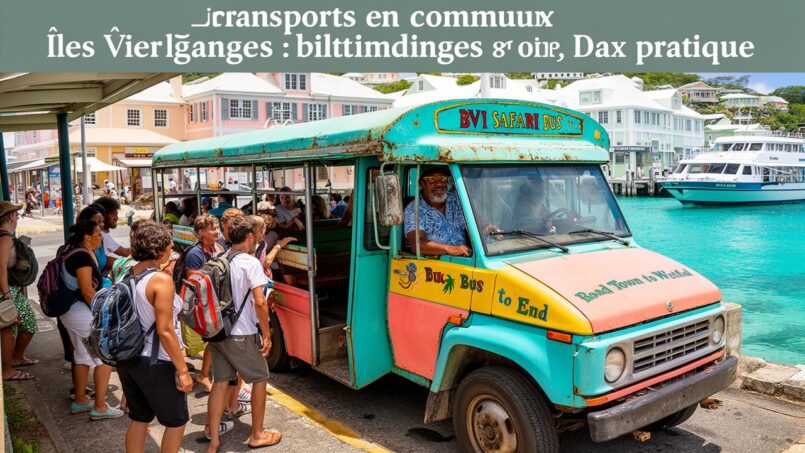
In the absence of public bus lines, private minibuses and open-backed safari-style vans play a key role, especially for locals… and for travelers who know how to use them.
On Tortola, these vehicles run along the main roads between the north and west, notably via an identified operator, Scato’s Bus Service. Its buses run Monday to Friday from 7:30 a.m. until nightfall. They operate in “hail and ride” mode: no marked stops, no displayed schedules, no route maps. To board, simply wave clearly at the driver as he approaches.
The principle is simple: the vehicle follows a main route, picks up and drops off passengers on demand, and departs when it is sufficiently full or when the driver decides. Fares are modest: generally between $2 and $5 for a trip on Tortola, up to $10 for longer distances reported by some sources.
Maximum passenger capacity of independent safari buses operating on Virgin Gorda.
In any case, the lack of signs, ticketing, or official website makes things difficult for the occasional visitor. The best strategy is to ask your accommodation or locals for advice: where to wait, how much to pay, which vehicle to take. Once aboard, it is essential to clearly tell the driver your destination.
Park and Ride and urban buses in Road Town
To ease congestion in downtown Road Town, the authorities have set up a “Park and Ride” service. The idea: leave your vehicle at a peripheral parking lot and take a shuttle to the center.
The service is coordinated by the Ministry of Transport, Works, and Utilities. It runs on weekdays, Monday to Friday, from 6 a.m. to 6 p.m., with departures every 15 minutes from a series of parking lots, supermarkets, schools, gas stations, and key locations like Dr. D. Orlando Smith Hospital or Tortola Pier Park.
Alongside this, a Green Line connects several strategic points in Road Town, with about 17 stops, including a terminus at the hospital parking lot. These shuttles are designed primarily for residents and workers, but a resourceful visitor can use them to get around the capital, provided they inquire about the parking areas served.
Free interurban shuttles: Tortola, Virgin Gorda, Jost Van Dyke, Anegada
Another interesting feature: a network of free shuttles, funded by the government, operates on several islands. These services, highlighted by an official information officer, have more structured schedules than private minibuses.
A free shuttle runs Monday to Friday, from 6 a.m. to 6 p.m. It connects the “Green Line” near the Festival Grounds in Road Town with the “Yellow Line” opposite the Dr. D. Orlando Smith Hospital parking lot. Though designed for daily commuting, it is useful for travelers wanting to get to the city center without taking a taxi.
On Jost Van Dyke, the free shuttle runs Monday to Friday, from 6:30 a.m. to 7 p.m., on two routes: one between Little Harbour Hill and Great Harbour, the other between White Bay and Great Harbour. Departure times are aligned with the New Horizon Ferry schedule, with typical round trips at 6:30 a.m., 8:30 a.m., 11:30 a.m., 1:30 p.m., and 4:30 p.m. The last trip leaves at 6:30 p.m. from the ferry dock.
On Virgin Gorda, two free lines run Monday to Friday, from 7 a.m. to 6 p.m. The first connects the Spanish Town dock to Hansom Bay, Copper Mine, The Baths, South Valley and back. The second does the reverse, passing through The Valley. An additional daily shuttle also connects Leverick Bay to The Valley.
Finally, on Anegada, a shuttle serves during the day (7:45 a.m.–5 p.m.) the loop between The Settlement (the village), the ferry dock, Cow Wreck Beach Bar, Anegada Beach Club, and back. Departures are around 7:45 a.m., 8:30 a.m., 4:15 p.m., and 5 p.m.
For these services, official information is communicated notably via a government information officer (public phone and email), showing that, even without a classic bus network, a form of public service is beginning to take shape.
Ferries: the true “backbone” of public transportation
In an archipelago, the sea acts as a highway network. In the British Virgin Islands, it is clearly the ferries that play the role of the most reliable and structured public transportation.
Main routes and key ports
Three hubs dominate the BVI side: Road Town, West End (Soper’s Hole), and Trellis Bay (Beef Island) on Tortola. Added to these are the terminals at Spanish Town (Virgin Gorda), Great Harbour (Jost Van Dyke), and Setting Point (Anegada). On the USVI side, the ports of Charlotte Amalie and Red Hook (St. Thomas), as well as Cruz Bay (St. John), serve as gateways.
Road Town is the main hub, with ferries departing to Virgin Gorda, Anegada, a few small islands, and the USVI. West End is the only port on Tortola with direct connections to Jost Van Dyke. Trellis Bay, minutes from EIS airport, is the best option for a quick trip to Virgin Gorda via the North Sound Express or Speedy’s boats.
A few typical travel times help visualize distances:
| Sea route | Approximate duration |
|---|---|
| Road Town → Charlotte Amalie (St. Thomas) | 50 to 60 minutes |
| Road Town → Red Hook (St. Thomas) | 45 minutes direct |
| West End → Red Hook | 35 minutes |
| West End → Great Harbour (Jost Van Dyke) | 25 minutes |
| Road Town → Anegada (via Virgin Gorda) | 60 to 75 minutes |
| Trellis Bay → Spanish Town (Virgin Gorda) | 15 to 20 minutes |
| Spanish Town → St. Thomas (Charlotte Amalie) | 90 minutes |
Companies and their connections
Several operators share the market, with overlapping networks.
The main sea routes between Tortola (BVI) and the US Virgin Islands (USVI) are operated by three companies: Road Town Fast Ferry, Native Son Ferry, and Smith’s Ferry Service. They alternate their runs on the Road Town – Charlotte Amalie (St. Thomas) line, generally with 3 to 4 daily departures in each direction for a crossing of about 50 to 60 minutes. Other routes, such as Road Town – Red Hook and West End – Red Hook (St. Thomas), are also served with travel times of 35 to 45 minutes. Schedules typically run from early morning to late afternoon.
Between Tortola and Virgin Gorda, Speedy’s Ferry dominates. From Road Town, multiple daily connections link Spanish Town, with a crossing of about half an hour. From Trellis Bay, transfers are even faster (fifteen to twenty minutes), with a range of departures from early morning to evening, and even late runs on weekends.
To Anegada, Smith’s Ferry provides service from Road Town, generally three times a week, with a pickup stop at Virgin Gorda. The direct Road Town – Anegada crossing takes about an hour.
Jost Van Dyke is linked to West End by daily ferries, and on certain dates by services also connecting to St. John or Red Hook (notably via Inter Island Boat Services).
Alongside these major routes, more occasional services connect Peter Island, Cooper Island, Scrub Island, Marina Cay, and North Sound (Saba Rock, Bitter End). Some are operated by commercial companies (Speedy’s, North Sound Express), others directly by hotels and resorts, often free for guests.
Formalities, customs, and taxes
As soon as you cross the maritime border between BVI and USVI, the ferry stops being a simple floating bus and becomes a border crossing. A passport is required for any trip between the two territories, and authorities recommend allowing 2.5 to 3 hours to account for immigration lines, formalities, and possible baggage checks.
As of January 1, 2025, paper forms have been eliminated. All travelers must fill out an online form (ED card) on the official portal 36 to 72 hours before arrival. Ferry passengers must provide the vessel’s registration number. This advance step speeds up border crossings.
Several taxes and fees are also added, not always included in the ferry ticket: an environmental fee of $10 upon arrival, a USVI port fee of about $10, and a BVI departure tax of about $20 ($15 for residents) when leaving the archipelago by sea. Baggage fees may apply depending on the company.
Ferry ticket prices vary by route, season, and operator. For instance, according to a 2026 fare table from one operator, a one-way ticket between Tortola and St. Thomas costs about $60 for an adult, $50 for a child or senior, and a round trip $100 for an adult. Other companies offer trips from $25 one-way, but then exit and entry taxes must be added to the total cost.
Reliability and practical tips
Ferries in the archipelago are generally considered punctual and comfortable, with a good safety record. But schedules can change, especially in low season or during tropical storms. Authorities and operators stress the need to check departure schedules the week before travel and reconfirm the day before.
Some services only run on certain days (e.g., direct Virgin Gorda – USVI connections on Thursday or Saturday) and tickets may be subject to a minimum number of passengers for the run to proceed. In that case, the operator offers a reschedule or refund.
In practice, the best strategy is to:
– allow plenty of time between an international flight and a ferry (or vice versa);
– prioritize departures from Trellis Bay if you are arriving or departing from EIS airport, thanks to the fast connections to Virgin Gorda;
– plan your day trips around the first and last ferries, especially for Jost Van Dyke or Anegada.
Water taxis and charters: the custom solution
For those seeking more flexibility—late arrivals, direct connections to a remote resort, large groups—private water taxis have become an essential supplement to public ferries.
Companies like Chillout Charters, The Last Mile Water Taxi, or Dolphin Water Taxi offer personalized transfers between BVI and USVI and between islands within the same archipelago. They often use fast boats seating 10 to 12, capable of docking at small piers or directly in front of some hotels.
The main advantage is flexibility in departure times, direct routes with no transfers, and often crew assistance with customs and immigration formalities, reducing waiting times. The major downside is the cost, significantly higher than a regular ferry, though for a group the expense can be shared.
Some regular ferry companies have also developed their own charter offerings. Speedy’s, for example, offers a small boat (Speedy’s Sprinter) for private trips between Virgin Gorda and Beef Island, with packages around $300 to $450 one way, depending on the destination (Spanish Town or North Sound) and time (night surcharge after 10 p.m.).
Accessibility and reduced mobility: a major weak point
For travelers with reduced mobility, it must be said clearly: the archipelago remains far from the accessibility standards of a major European or North American city.
Buildings, sidewalks, and roads are rarely adapted, ramps are the exception, and crosswalks may be poorly marked or very far apart. Add to that steep slopes, absent or very uneven sidewalks, and roads where drivers do not easily yield to pedestrians, even at marked crossings.
Public transport (minibuses, taxis) is not equipped to accommodate wheelchairs, lacking ramps or tie-down systems. Ferry accessibility varies by company and vessel, with no systematic guarantee.
Airports have basic assistance devices. Affected individuals must absolutely notify their needs to the airline before the flight, and on the ground, arrange private accommodations: adapted vehicle, custom excursions, possibly assistance from specialized providers or newer resorts that have invested in accessible facilities.
In summary, a traveler in a wheelchair or with walking difficulties must:
– contact hotels, ferry companies, and local operators in advance to verify actual possibilities;
– prioritize accommodations that advertise accessible rooms and services;
– allow extra time for all travel and transfers.
Road safety and everyday risks
The overall risk level related to transport in the British Virgin Islands is described as low by authorities, but several points deserve attention.
On the road, be especially vigilant about speeding, reckless overtaking, lack of nighttime lighting, and the possible presence of livestock. Also be wary of dangerous practices like nighttime rodeos or occasional drag racing, as well as poor observance of pedestrian crossings. For your safety, seat belts are mandatory, and using a cell phone while driving is prohibited unless in hands-free mode.
As a pedestrian, it’s best to stick to well-lit, busy areas, especially at night, and do not hesitate to take a taxi to avoid long walks on narrow or non-existent shoulders.
Safety is generally good on commercial ferries, which are subject to standards. For private boats, water taxis, or charters, it is wise to check the operator’s reputation, equipment condition, and presence of safety gear. In case of distress at sea or on outlying islands, the volunteer organization Virgin Islands Search and Rescue (VISAR) responds. They can be reached via an emergency number and on VHF channel 16.
Episodes of heavy swells, storms, or cyclones can disrupt all modes of transport, including ferries and air links. Since the archipelago faces a hurricane season each year, monitoring alerts from the local disaster management service and the National Hurricane Center is an essential precaution.
How to choose your mode of transport based on your trip
Faced with this patchwork of solutions, how do you find your way when planning a stay or land-based cruise in the British Virgin Islands?
For a short stay based on a single main island (e.g., Tortola), the simplest combination remains ferry (from St. Thomas or another island) + local taxi, using minibuses only if a local or your host guides you. Within Road Town, the free shuttle and Park and Ride can supplement, especially on weekdays.
For a “multi-island” trip including Virgin Gorda, Jost Van Dyke, or Anegada, ferries are essential. You must then build your itinerary around the first and last boats, checking the days of service to Anegada or direct connections to the USVI.
For a group or family, per-person taxis can become more competitive than other options. Renting a car may prove more economical, but involves driving on sometimes tricky roads. It is important to weigh the high costs of fuel and rental against repeated taxi fares.
For off-peak hours (late arrival of a flight, direct transfer to a remote resort) or to avoid multiple changes, a private water taxi can save valuable time, at a higher budget.
Finally, for residents and long-term travelers, the growing presence of free shuttles and minibuses offers a basic public transport foundation, which could expand in the future with the community bus project mentioned by authorities.
In practice: a few habits to adopt
Without turning this guide into a survival manual, a few tried-and-true habits will help you get the most out of public transportation in the British Virgin Islands.
Always confirm your ferry trips as close to the date as possible, and arrive with a comfortable margin, especially if there is a border crossing on arrival or departure. Remember to complete your immigration formalities online before boarding.
On the road, only get into clearly marked taxis. Always discuss and confirm the fare with the driver before departure and prioritize cash payment. Note that ride-sharing is common practice, so do not be surprised if the taxi picks up other passengers along the way.
To use safari minibuses, observe locals‘ habits for a day or two: where they wait, how they signal, how much they pay. Locals and hoteliers remain the best source of information on pick-up points and implicit schedules.
If you rely on free shuttles on Virgin Gorda, Jost Van Dyke, or Anegada, time your movements around the scheduled round trips tied to ferry arrivals, which structure the day.
For persons with reduced mobility, a trip requires extremely careful planning. This includes obtaining written confirmations from carriers and accommodations, and, if possible, using local support such as agencies, guides, or specialized providers.
Finally, keep in mind that in an island archipelago, weather, breakdowns, and unexpected events carry more weight than in a large city with a metro. The key here is to accept a degree of flexibility and slowness, ultimately considering the journeys themselves as an integral part of the trip.
By combining ferries, taxis, minibuses, free shuttles, and, if needed, water taxis, it is entirely possible to explore the British Virgin Islands without ever touching a steering wheel. Provided, of course, you know how this transport system—fragmented yet vital for daily life—actually works.
Disclaimer: The information provided on this website is for informational purposes only and does not constitute financial, legal, or professional advice. We encourage you to consult qualified experts before making any investment, real estate, or expatriation decisions. Although we strive to maintain up-to-date and accurate information, we do not guarantee the completeness, accuracy, or timeliness of the proposed content. As investment and expatriation involve risks, we disclaim any liability for potential losses or damages arising from the use of this site. Your use of this site confirms your acceptance of these terms and your understanding of the associated risks.

Cyril Jarnias is an independent expert in international wealth management with over 20 years of experience. As an expatriate himself, he is dedicated to helping individuals and business leaders build, protect, and pass on their wealth with complete peace of mind.
On his website, cyriljarnias.com, he shares his expertise on international real estate, offshore company formation, and expatriation.
Thanks to his expertise, he offers sound advice to optimize his clients' wealth management. Cyril Jarnias is also recognized for his appearances in many prestigious media outlets such as BFM Business, les Français de l’étranger, Le Figaro, Les Echos, and Mieux vivre votre argent, where he shares his knowledge and know-how in wealth management.





