
 Published on and written by Cyril Jarnias
Moving to the British Virgin Islands isn’t just about changing scenery for a postcard paradise. It means entering a tightly knit island society shaped by a complex history, deep spirituality, a slower pace of life, and, simultaneously, a cutting-edge, globalized business environment. Understanding these cultural differences before packing your bags prevents many misunderstandings, whether at the office, on the street, or at the beach.
A Tiny Archipelago… But Deeply Globalized
The British Virgin Islands form a small Caribbean archipelago of barely 150–151 km² and over 80 km of coastline. There are more than 60 islands and islets, only about fifteen of which are inhabited, with four main islands: Tortola, Virgin Gorda, Anegada, and Jost Van Dyke. The capital, Road Town, is on Tortola, which concentrates most of the population and economic activity.
Despite its small size, the territory has about 37,000 to 39,000 inhabitants, with over 120 nationalities represented in its workforce. This cultural mix is due to the growth of its offshore financial center and the importance of tourism, which can account for nearly half of its GDP. The British Virgin Islands thus combine a strong local community identity with a role as an international financial hub governed by sophisticated regulations.
For a newcomer, this creates a dual reality: in daily life, you live in a close-knit society where “everyone knows everyone” and gossip—the famous “coconut telegraph”—spreads fast. At the same time, you often work with counterparts based in London, Singapore, or Dubai, within complex legal structures (BVI Business Companies, funds, family offices, trusts) regulated by a legal system inspired by English common law.
A Society Shaped by the History of Slavery and Emancipation
To understand the local culture, keep in mind that the majority of the population is descended from African slaves. Slavery structured the plantation economy (notably sugar cane) before its abolition in the 19th century, commemorated today during the grand Emancipation Festival in early August. The memory of this period, along with the struggles for political rights—such as the 1949 march that led to the restoration of the Legislative Council—remains strong.
The archipelago’s history is preserved and celebrated through various cultural aspects: fungi music, dances, stories, and traditional dishes inherited from the slavery era like saltfish, peas soup with pig tail, or callaloo. This Afro-Caribbean culture, a source of identity pride, is highlighted at events such as the Emancipation Festival or the Carrot Bay Cultural Fiesta, which celebrate food, music, donkey races, and local crafts.
For an expat, this means taking the commemorations of slavery and emancipation seriously, being cautious in remarks about race or colonial history, and understanding that tensions between “locals” and visitors perceived as arrogant are sometimes rooted in this long history.
A Slower Time Culture: “Island Time”
One of the first differences expats notice is the relationship with time. People often refer to “Island Time” to describe this more relaxed way of managing schedules and deadlines. Daily life, administrative formalities, some services, or appointments operate at a slower pace than in Europe or North America. Delays—sometimes significant—are not uncommon, and punctuality is not treated with the same rigidity.
This slowness is not negligence but the expression of a value system where relationships, family, well-being, and the tropical climate take precedence over constant urgency. Residents live surrounded by peaceful beaches, green hills, and steady warmth, which encourages taking one’s time.
A Tropical Resident
To avoid hitting a wall of misunderstanding, the expat must accept adjusting their expectations: build in margins in your schedule, avoid getting upset over a shifted appointment, and distinguish what belongs to social life (where flexibility dominates) from the business world, where more marked punctuality is expected, especially in finance and law.
Politeness, Respect, and the Importance of Greetings
In daily interactions, politeness is a cardinal value. Entering a shop, an office, or getting into a taxi without greeting can be seen as disrespectful. The phrases “Good morning,” “Good afternoon,” or “Good evening” are practically mandatory before any request.
In this community-minded society, ignoring social rituals can make an expat appear cold or haughty, especially since painful memories of visitors perceived as arrogant or rude influence this perception.
Respect for elders and authority figures is also very strong. The use of “Mr,” “Mrs,” or “Miss” remains common, especially toward older people or those holding official positions. This formality is accompanied by great informality in other areas (dress outside work, friendliness, humor).
Official English, Local Creole: A Dual Language to Master
English is the official language, used in administration, justice, media, schools, and business. But in daily life, you very often hear a local English creole—BVI Creole or Virgin Islands Creole English—with its specific pronunciation, grammar, and vocabulary, heavily influenced by African, European, and maritime sources.
Jamaican Creole is expressed through specific phrases such as “lime” (to hang out, spend time together), “wash belly” (youngest sibling), and greetings like “Wah gwaan?” (“What’s up?”) or “Everything irie” (“All good”). It is also characterized by a sing-song cadence, often elliptical sentences, and frequent use of double negatives.
For a French-speaking expat, the good news is that standard English remains the norm in formal situations. But expect an adjustment period to the creole: at first, some conversations between local colleagues or on the street will seem hard to follow. Making an effort to learn a few phrases and grasp the general tone is a mark of respect and a real plus for integration.
Religiosity, Festivals, and Highly Spiritual Public Holidays
Over 90% of the population identifies as Christian, with many denominations (Methodists, Anglicans, Adventists, Catholics, Pentecostals, etc.). The Constitution itself opens with a national profession of faith in God, and public prayers before official events are common.
Churches play a crucial social role, often complementing public action in terms of solidarity, mutual aid, and community organizing. For an expat, it is common to be invited to services, parish fairs, harvest festivals where people bring fruits, vegetables, and pastries to church, or gospel concerts. Without ever being required to practice, a foreigner will benefit from respecting these rituals and understanding their weight in collective life.
The territory’s public holidays reflect its spiritual and identity heritage, mixing religious feasts (Good Friday, Easter Monday, Whit Monday), monarchical celebrations (Sovereign’s Birthday), and national commemorations (Virgin Islands Day, Heroes and Foreparents Day). The Emancipation Festival, marking the proclamation of slaves’ freedom in 1834, is the most important event, with several days of parades, races, concerts, and celebrations.
An overview of some important holidays helps grasp this combination of religion, historical memory, and local pride:
| Holiday | Main Nature | Key Cultural Particularity |
|---|---|---|
| New Year’s Day | Civic & festive | Grand celebrations (“Old Year’s Night”) at Trellis Bay, Jost Van Dyke, etc. |
| Good Friday | Christian religious | Ban on alcohol sales until evening |
| Easter Monday | Religious & festive | Easter Festival on Virgin Gorda (parade, music, Calypso Monarch election) |
| Virgin Islands Day | National identity | Promotion of national consciousness and Virgin Islands identity |
| Emancipation Monday / Tuesday / Wednesday | Historical & cultural | Heart of the Emancipation Festival, parades, races, and parties |
| Heroes and Foreparents Day | National memory | Tribute to the builders of society across all sectors |
| Christmas Day & Boxing Day | Religious & cultural | Strong Christian roots + British tradition of “Christmas boxes” |
For an expat working locally, it’s useful to anticipate the sharp drop in activity around these dates, especially during the Emancipation Festival, when the archipelago literally lives in party mode.
A Hyper-Modern Economy, a Highly Regulated Work Culture
Behind the image of turquoise lagoons lies a particularly sophisticated legal and regulatory framework. Local law draws heavily from English common law, with an independent judiciary, a commercial court specializing in international financial disputes, and the possibility of final appeal to the Privy Council in London. The territory is known for its rigor in financial regulation, notably through the Financial Services Commission and the International Tax Authority, which work to combat money laundering and align the jurisdiction with international standards.
The labor code sets the legal weekly working hours at 40 hours.
| Type of Hours Worked | Minimum Legal Compensation |
|---|---|
| Hours beyond 40 per week | 1.5 times the base hourly wage |
| Weekend hours | 2 times the base hourly wage |
| Holiday hours | 2 times the base hourly wage |
Employers are required to accurately record hours, breaks, and wages paid, and to comply with a minimum wage set and revised by the state. Discriminatory work practices—whether based on sex, race, religion, age, disability, or sexual orientation—are prohibited, as is harassment.
For an expat working in the financial sector, strict adherence to procedures and compliance is essential, with obtaining required licenses and approvals being fundamental. At the same time, you’ll discover a certain organizational flexibility, with telework policies being formalized, flexible work hours, and sometimes programs encouraging volunteerism during work time, reflecting the importance placed on work-life balance.
Office Life: Hierarchy, Relationships, and Communication Style
Professional life in the British Virgin Islands combines two sometimes contradictory traits: high technical and regulatory demands, and a warm Caribbean relational culture.
Hierarchy is generally well-defined. Decisions come from the top, and bypassing your direct superior can be very poorly received. Senior figures lead meetings, and more junior staff speak with respect, avoiding direct confrontation. In many offices, a newcomer is expected to be patient, observe customs, and take time to build a trusting relationship with their manager.
Professional communication often favors an indirect approach, where informal exchanges about personal life precede business discussions. Relationships are as crucial as the content of the file. Getting straight to the point can be perceived as abrupt. Participating in social events (lunches, after-work drinks, sports or charity activities) is essential to building trust.
The use of titles and last names (“Mr,” “Ms,” “Dr”) dominates initially, especially with older or higher-ranking counterparts. It is often up to them to decide when to move to first names. When in doubt, it is safer to err on the formal side.
Dress Code: More Conservative Than You Might Expect
The stereotype of swim trunks and tank tops everywhere is far from accurate. Society in the British Virgin Islands is conservative about clothing in public spaces. Wearing a swimsuit, even with a pareo, is reserved for the beach, pool, or boat. In town, villages, while shopping or going to a restaurant, “normal” clothes are expected: shorts or pants, a shirt or proper t-shirt, dress or skirt, shoes or sandals. Going shirtless in a convenience store or walking in a bikini on a sidewalk can be considered both rude and, in some cases, against local rules.
Dirty or torn clothing is only tolerated for outdoor activities. Nudism and topless sunbathing are poorly accepted. You’ll need to adapt your wardrobe, especially for workdays and outings in town.
In professional settings, attire follows a kind of “business casual tropical”. Very strict suits like in major financial capitals aren’t necessary most of the time, especially outside the core financial district. However, collared shirt, dress pants or skirt, modest dresses, closed-toe shoes or dressy sandals remain the norm, with light fabrics suitable for the climate.
A simplified overview helps clarify:
| Context | Expected Attire |
|---|---|
| Beach / Pool / Boat | Swimsuit, swim trunks, sandals or barefoot |
| Street, shops, transport | Shorts/pants + t-shirt or shirt, dress or skirt, shoes/sandals |
| Casual restaurant | “Island casual”: clean shorts, light shirt, summer dress, neat sandals |
| Upscale restaurant | Chinos or linen pants, collared shirt, dress or more elegant outfit, dress shoes |
| Office (finance, law, etc.) | Business casual: collared shirt, pants, modest dress or skirt, closed-toe shoes or dressy sandals |
In some very formal places—courthouse, schools—codes are extremely strict: tattoos to be covered, visible piercings prohibited, open-toe shoes forbidden, hair heavily regulated. An expat who will visit these institutions should inquire carefully in advance.
Family, Gender, and Women’s Place in Society
Family holds a central place in local culture, including in relation to work. Employers tend to be understanding about family obligations: children’s medical appointments, caring for elderly parents, attending school or religious events. Beaches, water activities, and family gatherings dominate leisure time.
Women hold the majority of permanent secretary positions in several British Virgin Islands government ministries.
A public policy framework dedicated to gender equality has existed since 2011, with an Office of Gender Affairs responsible for promoting equality, raising awareness, and reviewing laws from a gender parity perspective. Local NGOs, such as the Family Support Network or the ZONTA Club, work alongside public authorities on domestic violence, women’s economic empowerment, and their participation in decision-making.
For expatriate women, these dynamics mean that even though some patriarchal reflexes persist, the territory is not stagnant: access to positions of power is progressing, pay equity is on the table, and society now thinks of itself through the lens of goals like sustainable development and women’s rights.
Cost of Living, Consumption, and Relationship to Money
The cost of living for an expat is high, estimated at around $3,000 per month for everyday expenses, not including high-end housing. Food reflects import costs: many products come by boat or plane, which is reflected in the grocery bill. Many restaurants charge around $30–$50 per person for a meal, while more affordable options—rotis, roadside grills, small eateries—offer meals at more reasonable prices.
A table gives an idea of the range of food prices:
| Type of Meal / Product | Indicative Price Range (USD) |
|---|---|
| Roti (chicken, goat, conch, etc.) | 8 – 12 |
| Johnny cake (unit) | 1 – 2 |
| Plate of fish fry | 15 – 20 |
| Grilled fish dish | 20 – 25 |
| Burger at a simple restaurant | 10 – 15 |
| Full meal at a good restaurant | 30 – 50 (per person, excluding drinks) |
The archipelago uses the US dollar as its currency, simplifying life for North American expats and further anchoring the economy in the US sphere of influence. Bank cards are widely accepted, but it’s wise to keep cash for small shops, markets, or street stalls.
The financial center is often perceived as a tax haven due to the absence of income, inheritance, and capital gains taxes for offshore companies. However, local professionals highlight a different reality, emphasizing strict compliance, transparency, and constantly evolving regulations to combat illicit financial flows.
Social Life, Leisure, and “Small Island, Big Heart”
When it comes to leisure, the British Virgin Islands don’t offer the same range of options as a metropolis: few or no movie theaters, large shopping malls, theaters, or “urban” entertainment facilities. Social life revolves more around the sea, beaches, beach bars, restaurants, sports clubs, associations, and community or religious events.
The British Virgin Islands offer a paradise for water sports enthusiasts, with a vibrant maritime culture and varied activities.
The archipelago is recognized as one of the best sailing destinations in the world, with events like the Spring Regatta marking the year.
Social life on the water comes alive at famous spots like Foxy’s or the Soggy Dollar Bar.
Exploring the underwater world is a big part of daily life for residents and visitors alike.
Accessible water activities to fully enjoy the archipelago’s crystal-clear waters.
The most popular sport is not cricket, but basketball, a nod to American influence. There are also rugby, soccer, fishing tournaments, beach cleanups, and village fairs—all opportunities for an expat ready to participate to integrate.
Residents are generally described as warm, welcoming, but wary of behavior deemed disrespectful. Getting involved in community organizations, supporting local businesses, choosing locally owned accommodations over large international resorts—these help build a more balanced relationship between expats and the local community.
Local Cuisine: Much More Than a Postcard Backdrop
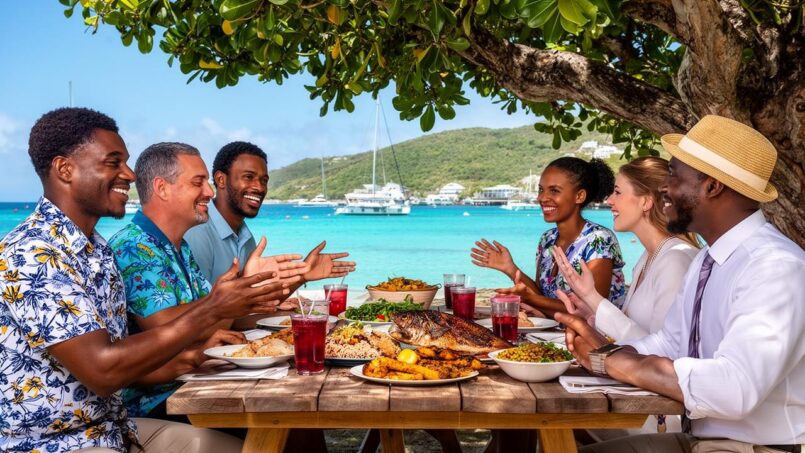
The cuisine of the British Virgin Islands is one of the areas where the cross-influences—African, European, Caribbean, and Indo-Asian—are most perceptible. Iconic dishes often include fish, seafood, corn, root vegetables, leafy greens, and spices like curry, nutmeg, or jerk blends.
Among the must-tries are:
Bahamian cuisine is a blend of African, Caribbean, and European influences. Among its iconic dishes are “fish and fungi,” the national dish of fish braised in a spicy tomato sauce, served with a cornmeal and okra polenta. Callaloo soups are made with callaloo leaves (or spinach), okra, coconut milk, and vegetables, sometimes with meat or shellfish. Johnny cakes are small fried or baked breads, eaten alone or with cheese or salted cod. Rotis and patties, of Indo-Caribbean origin, are filled pastries with meat, conch, vegetables, or fish. Finally, seafood like conch, whelk, and local lobster are prepared grilled, fried, or in stew.
Traditional drinks range from bush tea (an infusion of local herbs) to maubi (a bitter bark-based drink), along with fresh fruit juices (guava, mango, soursop) and festive preparations like guava berry wine. The signature cocktail, the Painkiller, blends rum, pineapple and orange juice, coconut cream, and grated nutmeg.
Local cuisine surprises with its fusion character, blending Asian, Mediterranean, and Caribbean influences. For an authentic experience, opt for roadside stalls and markets.
Social Codes, Safety, and Responsibilities of the Newcomer
Local society emphasizes a respectful and responsible attitude, whether toward people or the fragile island environment. A few implicit principles stand out:
– Greet and say goodbye in shops or restaurants;
– Ask permission before photographing people;
– Avoid flaunting ostentatious jewelry and wads of cash;
– Don’t leave belongings unattended on the beach or in the car;
– Choose official taxis and avoid poorly lit areas at night.
The territory is generally safe for residents and tourists. However, basic caution is advisable, as everywhere, due to minor crimes like theft and opportunistic acts.
On the environmental side, ecological awareness is growing, with initiatives like Green VI, which promotes a cleaner, greener island, or public programs favoring solar energy. Visitors and expats are encouraged to limit single-use plastics, use reef-safe sunscreen, avoid touching corals or disturbing marine life, and report any observed degradation.
Integration: Finding Your Place Between Local Community and Expat Networks
With a workforce made up of over 120 nationalities, a significant portion of the working population is foreign, often employed in offshore finance, tourism, or specialized services (healthcare, education, engineering). Yet society remains deeply rooted in a strong local identity.
For an expat, integration often involves several levers:
To successfully integrate, it is recommended to join clubs (sailing, diving, gym, basketball, rugby), participate in charity events, festivals, and school fairs, and frequent markets, fairs, and neighborhood parties rather than sticking to expat enclaves. Learning a few Creole expressions and common greetings, as well as respecting public holidays, religious celebrations, and the importance of churches in social life, are also essential keys.
Expat networks—online groups, associations, parties—can be useful for practical support (housing, schooling, administrative procedures) but it would be a shame to limit yourself to them. The islands have a “big heart”: in return, they expect those who settle to show curiosity, humility, and a willingness to contribute.
In Summary: A Delicate Balance to Master
Living in the British Virgin Islands means learning to navigate between several worlds: a history marked by slavery and emancipation, deep religiosity, a culture of conviviality and stretched time, a hyper-sophisticated economy focused on international finance, a highly structured legal and social framework, and a nature as magnificent as it is fragile.
For an expat, the main cultural differences to anticipate revolve around:
Time management is more flexible outside of professional settings. Social interactions are marked by the importance of greetings, politeness, and respect for elders. Religion and historical festivals shape the calendar and public life. Although English is the official language, familiarizing yourself with Mauritian Creole is an asset (note: this seems a copy-paste error from another context; likely should say local Creole instead). Dress code is generally more conservative than the beachy image suggests. Professional hierarchy is pronounced and embedded in a strong relational culture. Finally, the cost of living is high, but offset by a quality of life centered on nature, the sea, and community.
Those who accept to play the game—slow down, greet, listen, learn, respect—discover an archipelago that is not just about its palm trees: a resilient society, proud of its heritage, open but wary, where you can find, beyond a good job or an idyllic climate, a true adopted community.
Disclaimer: The information provided on this website is for informational purposes only and does not constitute financial, legal, or professional advice. We encourage you to consult qualified experts before making any investment, real estate, or expatriation decisions. Although we strive to maintain up-to-date and accurate information, we do not guarantee the completeness, accuracy, or timeliness of the proposed content. As investment and expatriation involve risks, we disclaim any liability for potential losses or damages arising from the use of this site. Your use of this site confirms your acceptance of these terms and your understanding of the associated risks.

Cyril Jarnias is an independent expert in international wealth management with over 20 years of experience. As an expatriate himself, he is dedicated to helping individuals and business leaders build, protect, and pass on their wealth with complete peace of mind.
On his website, cyriljarnias.com, he shares his expertise on international real estate, offshore company formation, and expatriation.
Thanks to his expertise, he offers sound advice to optimize his clients' wealth management. Cyril Jarnias is also recognized for his appearances in many prestigious media outlets such as BFM Business, les Français de l’étranger, Le Figaro, Les Echos, and Mieux vivre votre argent, where he shares his knowledge and know-how in wealth management.





