
 Published on and written by Cyril Jarnias
The history of the country in the British Virgin Islands resembles a long archipelago of ruptures and continuities. From ancient Amerindian villages buried under vegetation to office towers specializing in offshore companies, passing through sugarcane fields worked by African slaves, the territory has changed its face several times. Yet some threads remain: the centrality of the sea, the weight of the land, the place of exile and arrival, and a complex relationship with British power.
The history of Barbados is structured into five major periods: the pre-Columbian era, the beginnings of European presence, British colonial rule with the plantation economy, the post-slavery emancipation era, and finally the construction of the modern state focused on tourism and finance. Each of these stages has redefined the landscape, population composition, and power relations within society.
From the First Amerindian Inhabitants to the Arrival of Europeans
Long before European maps mentioned the “Virgin Islands,” the archipelago was already integrated into a vast Caribbean world populated by several waves of migration from the south.
The oldest traces date back to around 1500 BC, in the form of seasonal fishing camps. Archaeologists speak of “Amerindian” presence rather than permanent occupation, as nothing yet proves the existence of fixed villages on the islands of the current territory. It is known, however, that the first identified groups, the Ciboney (or Ortoiroid), lived by fishing and gathering, used very rudimentary stone tools, and practiced neither pottery nor organized agriculture.
After the first archaic peoples, the Igneri, linked to the Saladoid culture, settled. They introduced pottery, manioc cultivation, and round communal houses. They were followed by the Taíno (called “Arawaks” in colonial sources), who came from South America. The Taíno developed complex village societies, mastered ceramics and agriculture, and built ceremonial ball courts, like those discovered at Belmont on Tortola or at Salt River Bay in Saint Croix.
Estimates place the arrival of the Arawaks in the archipelago around the turn of the era. Some researchers suggest settlement around 100 BC, while others, such as historian Vernon Pickering, opt for a later date around 200 AD. In any case, they occupied the islands durably until the 15th century, before being gradually supplanted by the Kalinago (Caribs), a more warlike people from the Lesser Antilles. This transition marked a turning point: the Arawaks, reputed to be farmers and relatively peaceful, were dominated by groups more skilled in warfare and navigation.
The fate of the indigenous populations abruptly shifted with European penetration. In 1493, during his second voyage, he sighted the archipelago and gave it a name that would endure: “Santa Ursula y las Once Mil Vírgenes,” in reference to Saint Ursula and her virgin companions. The name was soon shortened to “las Vírgenes,” then integrated into English as “Virgin Islands.” Columbus also baptized “Virgin Gorda”—“the fat virgin”—one of the islands he considered the most imposing.
Christopher Columbus, explorer
The Spanish crown then claimed sovereignty by “discovery,” but never established a permanent colony. The islands served mainly as a waypoint, anchorage, or fishing ground for settlers from Puerto Rico. Paralyzed by attacks, decimated by imported diseases and military campaigns, the Amerindian population collapsed. By the end of the 16th century, European accounts ceased to mention indigenous people residing in what would become the British Virgin Islands. In 1596, most of the native inhabitants had been killed or fled to other islands.
Pirates, Privateers, and Settlers: The Difficult Gestation of a European Territory
While the Iberian empires consolidated their large continental bases, the Virgin Islands archipelago became a gray zone, both a margin of trade routes, a makeshift refuge, and a strategic stake between rival powers. Spaniards, English, French, Dutch, and Danes vied for control of these scattered islands that served as hiding places for privateers and pirates.
The Dutch, led by privateer Joost van Dyk, were the first to settle permanently in the early 17th century at Soper’s Hole (Tortola). They developed a settlement based on cotton and tobacco barter, and erected fortifications. Later, the Dutch West India Company founded an establishment at Virgin Gorda around 1631, attracted by suspected copper deposits.
This Dutch phase took place in a very unstable context. English privateers attacked, Spanish raids targeted Dutch installations, and the Company eventually sought to cede some islands to private individuals, while developing strongholds for the African slave trade. Tortola was sold in the 1650s to a private individual, Willem Hunthum, marking the Company’s gradual withdrawal.
A royal patent of 1628 granted these lands to the Earl of Carlisle, but without effective colonization. It was in 1672, during the Third Anglo-Dutch War, that England militarily seized Tortola. Governor Sir William Stapleton claimed the capture in the name of the crown, dismantled Dutch fortifications, and moved the cannons to St. Kitts. The Netherlands never managed to recover the territory, despite several diplomatic attempts.
Gradually, England and then the United Kingdom confirmed their grip: Anegada and Virgin Gorda were annexed, competing claims (including those of German merchants from Brandenburg who had purchased rights from Willem Hunthum) were dismissed in the name of “right of conquest” and old royal patents. By the end of the 17th century, the future territory of the British Virgin Islands was thus firmly integrated into the English colonial sphere, even though its population remained sparse and its institutions rudimentary.
The Rise of Sugarcane and African Slavery
Once British control was secured, the nature of the colony transformed. From a transit space for privateers and smugglers, the country became a plantation territory. Sugarcane, an extremely lucrative crop in the Caribbean, would impose its logic on the landscape and society.
From the late 17th century, British planters settled on Tortola and, to a lesser extent, on Virgin Gorda. The Dutch had already experimented with cotton and tobacco cultivation; the British increasingly bet on sugarcane, which surpassed cotton in exports from the second half of the 18th century. The local economy then definitively shifted into the slave system.
Year of the first explicit mention of slaves on the territory, with the capture of 67 people by English privateer John Wentworth.
The number of enslaved people grew rapidly with the expansion of plantations. A few figures suffice to show the scale of the phenomenon:
| Year (approx.) | Recorded Black Population | Majority Status |
|---|---|---|
| 1717 | 547 | Essentially slaves |
| 1724 | 1,430 | Slaves |
| 1756 | 6,121 | Slaves |
| 1788 (estimate) | 10,200 | Likely an overestimate, but majority slaves |
| 1834 | 5,792 | Slaves at the time of abolition |
This surge in the servile population contrasts with the evolution of white settlers, whose numbers stagnated and then declined. By the end of the 19th century, they numbered only a few dozen on the territory, whereas they had been about 1,300 at the beginning of the century. Demographics thus reversed the numerical power balance, but not the power structure itself.
Life on the plantations was marked by brutality: exhausting work in the cane fields and boiling houses, full days under the sun, frequent corporal punishment, meager food rations, and rudimentary housing in small huts. Local laws, passed by an assembly dominated by planters, institutionalized the legal inferiority of enslaved people, provided severe penalties for any rebellion, and forbade, for example, a slave from owning other slaves or cultivating certain commercial crops.
Despite a legal system denying their rights, some slaves, especially in fragile economies, were able to acquire customary rights to small plots of land for their subsistence. Over time, they developed forms of ownership, accumulating livestock and goods, thus building a significant patrimony by the early 19th century, in contradiction with their legal status.
At the same time, voices were raised against the worst abuses. The Quaker community, established from 1727 to 1768, denounced the cruelty of slavery, campaigned for greater “humanity,” and contributed to the emergence of a free Black population larger than elsewhere in the region. A few philanthropists or religious figures denounced particularly violent masters, such as Arthur William Hodge, a Tortola planter eventually hanged for the murder of slaves—an exceptional event in the British Empire.
Revolts, Rumors of Freedom, and the Abolition of Slavery
Faced with the violence of the system, the resistance of enslaved people was constant, even if it took varied forms: escapes into the hills to join maroon communities, sabotage of equipment, work slowdowns, more organized conspiracies. The shadow of the Haitian Revolution loomed over the entire region at the end of the 18th century, fueling hope among the oppressed and fear among planters alike.
In the British Virgin Islands, several episodes marked the colony’s social history. In 1790, a first major revolt erupted on the estates of Isaac Pickering. It was triggered by a persistent rumor: the British Parliament had supposedly decided to free the slaves, but the planters were hiding this news. The uprising was quickly crushed and its leaders executed, but the episode revealed a growing climate of mistrust and the existence of informal information channels within the servile community.
In 1823, on the Josiah’s Bay plantation, slaves defied their master’s authority with notable audacity. Their attitude demonstrated that they had become aware of the importance of their labor power in an already fragile economy, which significantly strengthened their implicit bargaining power.
In the 1830s, on the eve of abolition, a more ambitious conspiracy was foiled: in 1831, according to authorities, slaves planned to kill all white men and flee to Haiti. The plan, discovered in time, caused great panic, requests for military aid from Saint Thomas, and several executions. But the colonial order was already shaking at its foundations.
In London, the abolitionist movement had borne fruit. After the ban on the slave trade in 1807, Parliament passed the law in 1833 that gradually ended slavery throughout the empire. On August 1, 1834, 5,792 people were officially freed in the British Virgin Islands. At that time, there was already a significant free Black population (probably around 2,000 people), resulting notably from individual manumissions, purchases of freedom, and Quaker policy.
Number of hours of unpaid labor per week imposed on former slaves under the apprenticeship system.
For the owners, the end of the system was an economic shock. They received compensation from the British government—nearly £72,940 for the territory—far from the total estimated value of the slaves a few decades earlier (over £360,000 in 1798). But above all, they lost a human capital considered central, in a context where sugar revenues were already beginning to decline.
For the former slaves, freedom did not mean prosperity. Without capital, without systematic access to land, confronted with the limited diversification of the economy, many remained dependent on agricultural labor for the same planter families, but within a precarious contractual framework. Nevertheless, thanks to falling land prices and the sale of over-indebted estates, some succeeded in buying parcels, giving birth to a mosaic of small free farmers that deeply marked the rural society of the British Virgin Islands.
Natural Disasters, Sugar Crisis, and Economic Marginalization
Hardly had the post-slavery transition begun when a series of exogenous shocks further weakened the plantation economy. Climatic hazards struck hard first: a great drought extended from about 1837 to 1847, ruining crops already limited by often ungenerous soils. During this same period, devastating hurricanes followed one after another. The hurricane of 1837 alone destroyed 17 sugar mills; other major cyclones struck in 1842, 1852, 1867, and 1871, sweeping away buildings, plantations, and embryonic roads.
On the commercial front, plantations now had to face formidable competition: that of Europe-produced beet sugar. The British Sugar Duties Act of 1846, which equalized taxation on imported sugar regardless of origin, caused world prices to collapse. The islands, already weakened, could not compete. The territory’s sugar exports, which averaged around £10,000 per year before 1845, fell below £3,000, then below £1,000 by 1852.
In 1846, the bankruptcy of the large trading house Reid, Irving & Co., which served as an informal bank, deprived planters of credit. In 1848, the colony’s president reported that nearly all landowners were in financial difficulty, worsening the existing economic pressure.
In this context, the free Black population, which had hoped for tangible improvement after abolition, faced a bitter reality: low wages, land that was difficult to acquire, and taxes deemed unjust. To compensate for falling customs revenues, authorities multiplied taxes on rural activities, especially on livestock. This was the spark for a new uprising.
In 1853, a tax on cattle, applied to small Black livestock farmers, came into effect… on the anniversary of emancipation. The arrogance of the symbol added to the harshness of the measure. A crowd of 1,500 to 2,000 people gathered in Road Town to protest. During a meeting with President John Chads, a protester was wounded by a gunshot, triggering an explosion of anger. Plantations were burned, masters’ houses destroyed, and nearly all whites (except for four people) fled the island. Colonial order was only restored with the arrival of troops from Saint Thomas and Antigua, and the uprising resulted in several heavy sentences, including three executions.
Price in pounds sterling at which confiscated lands were sold per acre in the 1860s, enabling former slaves to access property.
Over the second half of the 19th century, the strategic importance of the British Virgin Islands diminished. The colonial administration was streamlined; the functions of president and local council were gradually drained of substance, then entirely abolished in 1901 in favor of a commissioner appointed by the Governor of the Leeward Islands. Public services declined, education progressed slowly despite the creation of several schools, infrastructure remained nearly nonexistent. Many inhabitants chose emigration: to Saint Thomas, now Danish, to the Dominican Republic, Cuba, or Puerto Rico, in search of better wages in agriculture or public works.
Quiet Nationalism and Political Rebirth in the 20th Century
In the first half of the 20th century, the country experienced a kind of political hibernation. Administration was carried out remotely, from Antigua, through a commissioner with extensive powers. The territory itself survived mainly on a small-farming economy, artisanal fishing, and seasonal migrations. World War II diverted British attention from these islands deemed marginal.
In 1949, following a dispute between fisherman Theodolph H. Faulkner and a colonial doctor, a protest movement organized in the British Virgin Islands. Respected figures like Isaac “Glanny” Fonseca and Carlton de Castro gathered over 1,500 residents for a march to the commissioner’s office in Road Town, Tortola. This massive mobilization, expressing resentment against colonial indifference and living conditions, aimed to present a petition of grievances.
This mobilization impressed London. In 1950, a new constitution was granted, re-establishing a partially elected Legislative Council. Granted, the text remained very limited, to the point that a local jurist would later call it a “minimalist” document, but the door had been opened. The British Virgin Islands declined to join the West Indies Federation, preferring an autonomous path, and obtained the distinct status of a crown colony in 1960.
In 1967, a new constitution for the British Virgin Islands created the post of head of government, the “Chief Minister.” H. Lavity Stoutt, a major political figure, held this role and drove the territory’s modernization, particularly in education. His action was symbolized by the construction of a community college, designed to anchor training locally and reduce dependence on abroad, which would later bear his name.
Over the following decades, the constitution was amended several times to expand local powers. In 2007, a revised text replaced the old titles: the Chief Minister became “Premier,” the Executive Council became “Cabinet,” and the Legislative Council evolved into the “House of Assembly.” The country remains a British dependency, with a governor appointed by London, but now manages most of its internal affairs within a parliamentary framework.
From Land to Sea: From Market Gardening to Financial and Tourist Hub
If politics changed slowly, the economy transformed rapidly from the 1960s onward. Food crops, livestock, and fishing continued to exist, but no longer sufficed to meet the aspirations of a fast-growing population. Local authorities, supported by colonial development aid programs, then bet on two pillars: tourism and financial services.
Tourism initially appeared as a supplementary activity, encouraged by a Hotel Aid Law passed in 1953. The improvement of infrastructure—construction of roads (only 12 miles of paved roads in 1958), opening of an airport on Beef Island, bridge connecting this island to Tortola—gradually facilitated access for foreign visitors. Investors like Laurance Rockefeller, who funded national park and resort projects, helped create an image of a high-end destination.
Tourism directly contributes nearly 27% of the archipelago’s GDP.
A table helps visualize the growth of this sector through a few indicators:
| Year | Total Number of Visitors | Estimated Share of GDP (direct) | Related Jobs (direct + indirect) |
|---|---|---|---|
| 2006 | 825,603 | – | – |
| 2008 | 934,000+ | – | – |
| 2013 | – | $274 million (≈ 27% of GDP) | 8,850 (≈ 90% of jobs) |
| 2015 | 922,372 | – | – |
The second pillar, more discreet for the general public but equally structuring, is offshore finance. From the 1970s, lawyers and businessmen perceived the potential offered by the territory’s legal status: flexible legislation, ties to British common law, low taxation, political stability. A New York lawyer was reportedly among the first to take advantage of a double taxation agreement to domicile companies in the British Virgin Islands.
The true boom of the territory as an offshore financial center occurred in the 1980s–1990s. The government actively promoted the registration of international companies. The US invasion of Panama in 1989 redirected financial flows to jurisdictions perceived as safer, such as the British Virgin Islands. Law firms, such as Mossack Fonseca, encouraged their clients to register their entities there. An insurance law of 1994 further strengthened the territory’s attractiveness by guaranteeing a high level of confidentiality for businesses.
By the turn of the 2000s, the place taken by this sector was impressive. A report by the firm KPMG estimated that between 41 and 45% of the world’s offshore companies were then registered in the country, representing about 400,000 active companies. License fees and charges related to these registrations accounted for over 50% of public revenue. In 2013, services—mainly finance and tourism—accounted for nearly 90% of GDP, with a per capita income approaching $42,000, placing the territory among the most prosperous in the Caribbean.
A third table helps measure the scale of the economic transformation:
| Sector | Approximate Share of GDP / Revenue | Key Observations |
|---|---|---|
| Services (total) | 88–93% of GDP | Includes finance, tourism, administration, commerce |
| Financial services | > 50% of national revenue | About 51% of public revenue via offshore licenses |
| Tourism | 40–45% of GDP and revenue | Major destination for sailing and cruises |
| Agriculture | ≈ 0.6% of labor force | Production mainly for local consumption |
| Industry / manufacturing | Marginal | Rum, construction materials, shipbuilding |
This relative prosperity comes at a cost: dependence on sectors sensitive to international crises, exposure to criticism over the role of “tax haven,” regulatory pressures from London, Washington, or major international organizations. Investigations, such as those leading to the publication of the Pandora Papers, or commissions of inquiry into local governance, show that issues of transparency and regulation remain at the heart of political news.
Identity, Memory, and Social Continuities
Behind these economic changes, the demographic and cultural structure of the country retains the deep mark of slave and colonial history. Today, about 86% of the population is of African descent, a direct consequence of the slave trade and plantation economy. People of European origin constitute a minority, although their numbers have increased with the arrival of residents and investors since the 1960s. Added to this is a significant proportion of migrants from other Caribbean islands, so that about half of the residents were born abroad.
This diversity expresses itself in a Creole culture blending West African, British, Dutch, Danish, French, Amerindian, and more recently North American heritages. English is the official language, but a local English-based creole, Virgin Islands Creole English, dominates informal exchanges. Recent immigration also spreads Spanish and various French-based creoles.
The traditional ‘fungi’ or ‘quelbe’ music, played by ‘scratch bands,’ combines African rhythms and European melodies. Its often humorous lyrics serve as social commentary. Local cuisine, with the dish fungi (cornmeal and okra porridge), callaloo, pea soups, salted cod, dumplings, and rotis, reflects the blending of cultures and the constraints of island life. Rum production, as at the Callwood Distillery, is a direct legacy of the sugar history.
The dominant religion is Christianity, with a strong Methodist, Anglican, and Catholic presence. Here again, history matters: missions played a crucial role in spreading literacy, providing guidance to enslaved and then freed populations, but also in the gradual contestation of the colonial order.
Above all, the memory of slavery and emancipation remains very vivid. Every year, a multi-day festival in August celebrates the freedom won in 1834, with parades, music, competitions, and cultural events. The list of national heroes adopted by the government includes figures directly linked to these struggles: Pereen Georges, whose testimony helped convict the murderous planter Arthur Hodge; Shelly Martin, leader of a slave uprising; or Theodolph Faulkner, Isaac Fonseca, and Carlton de Castro, architects of the 1949 march that reignited local political demands.
A Territory Between Relative Autonomy and Acknowledged Dependence
Today, the country functions as a parliamentary democracy within the framework of a British Overseas Territory. The head of state remains the sovereign of the United Kingdom, represented by a governor, but the local government, led by a Premier, manages most internal affairs. The House of Assembly, composed of members elected from territorial constituencies and “at large” representatives, votes on laws.
The inhabitants of these territories have been full British citizens since 2002. Although defense, internal security, and major external relations fall under the United Kingdom, a “letter of entrustment” grants local authorities autonomy to act internationally in specific areas such as tourism or financial regulation.
This institutional architecture reflects a historical compromise: on one hand, the desire to benefit from the protection, monetary stability (with the use of the US dollar), and market access guaranteed by the British and American link; on the other, a growing desire to control its own affairs, fueled by a history marked as much by colonial neglect as by domination. Recent episodes, such as the 2021–2022 governance inquiry or the idea occasionally raised in the past of a rapprochement with the US Virgin Islands, show that this debate remains open.
Conclusion: An Archipelago of Layered Histories
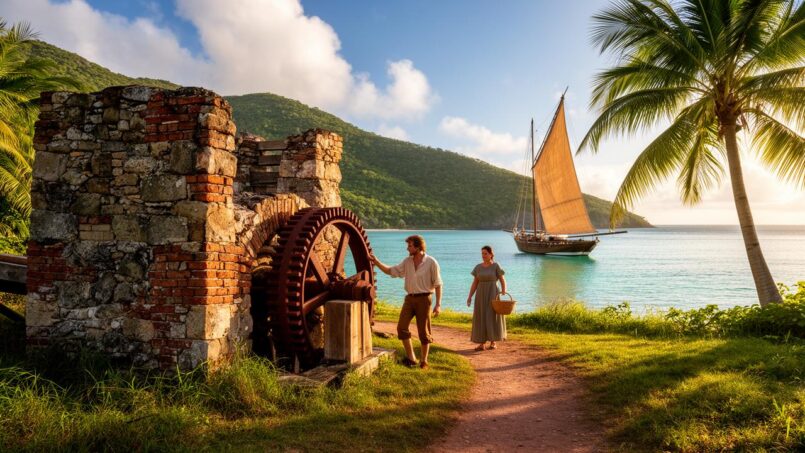
The history of the country in the British Virgin Islands cannot be reduced either to the postcard image of turquoise lagoons or to the stereotype of the tax haven. It is first and foremost made of sediments: traces of Amerindian camps near the beaches of Tortola, ruins of windmills at Mount Healthy, remnants of copper mines at Virgin Gorda, plantation registers, accounts of slave revolts, petitions from farmers against fiscal pressure, minutes of a peaceful march in 1949, and legal texts governing the incorporation of globalized companies.
From subsistence fishing practiced by the first Ciboney to luxury yachts sailing through the Drake Channel, from the sugarcane economy to the flows of stocks and bonds circulating through offshore holdings, the territory’s trajectory illustrates the ability of small island societies to adapt to changing contexts, sometimes to their advantage, often under constraint.
But these rapid changes come with persistent questions about wealth distribution, social justice, memory of the past, and preservation of an environment that hurricanes regularly remind of its fragility. In this ongoing debate between openness to the world and defense of a distinct identity, the weight of history remains central. It is what fuels emancipation festivals, inspires artists, structures political demands, and illuminates the economic choices of an archipelago that has already changed its face several times, without ever ceasing to be, deeply, Caribbean.
Disclaimer: The information provided on this website is for informational purposes only and does not constitute financial, legal, or professional advice. We encourage you to consult qualified experts before making any investment, real estate, or expatriation decisions. Although we strive to maintain up-to-date and accurate information, we do not guarantee the completeness, accuracy, or timeliness of the proposed content. As investment and expatriation involve risks, we disclaim any liability for potential losses or damages arising from the use of this site. Your use of this site confirms your acceptance of these terms and your understanding of the associated risks.

Cyril Jarnias is an independent expert in international wealth management with over 20 years of experience. As an expatriate himself, he is dedicated to helping individuals and business leaders build, protect, and pass on their wealth with complete peace of mind.
On his website, cyriljarnias.com, he shares his expertise on international real estate, offshore company formation, and expatriation.
Thanks to his expertise, he offers sound advice to optimize his clients' wealth management. Cyril Jarnias is also recognized for his appearances in many prestigious media outlets such as BFM Business, les Français de l’étranger, Le Figaro, Les Echos, and Mieux vivre votre argent, where he shares his knowledge and know-how in wealth management.





