
 Published on and written by Cyril Jarnias
Vast forests, thousands of lakes, the midnight sun, the Northern Lights, and the world’s largest archipelago: Finland concentrates a diversity of landscapes and experiences into a single territory, making it a unique destination in Europe. Whether you’re a fan of raw nature, design, maritime history, or Christmas magic, the country is full of places to discover.
To grasp the Finnish soul, several sites are essential: the Archipelago National Park and the Archipelago Trail in the southwest, the vast expanses of Lapland with Rovaniemi and its snowy villages, the cultural capitals Helsinki and Turku, the ‘land of a thousand lakes’ region, and the central culture of the sauna.
This article proposes a comprehensive journey through these key places, relying on precise data from reports and studies, to help build a truly representative itinerary of Finland.
The Archipelago National Park, a marine jewel in the southwest
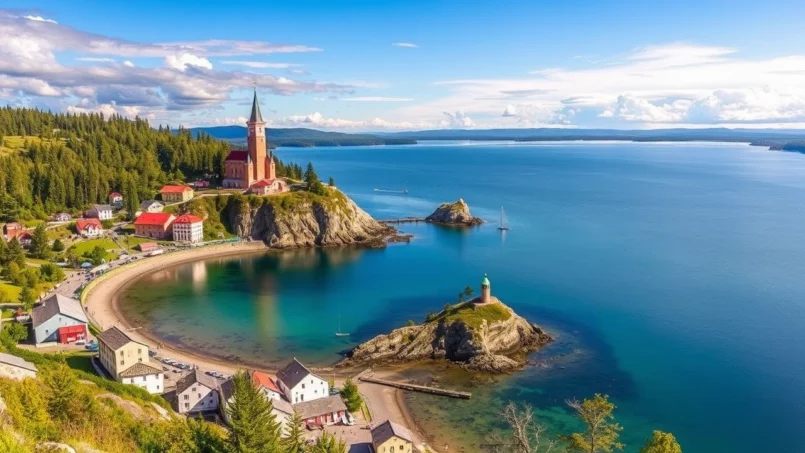
Off the southwest coast, between mainland Finland and the Åland Islands, stretches a labyrinth of islets, reefs, and large inhabited islands: this is the Archipelago Sea, the heart of the world’s largest archipelago with nearly 40,000 islands and islets. At the center of this marine world lies the Archipelago National Park, one of Finland’s major natural sites.
A unique marine park, protected by UNESCO
Established in 1983, the Archipelago National Park covers about 500 km² of land scattered across the sea, mainly islands smaller than 1 km². It includes roughly 2,000 islets and skerries within the park, out of a total of 8,400 in the wider cooperative zone. The whole area is part of a UNESCO-recognized biosphere reserve, and the park also received the PAN Parks certificate in 2007, a guarantee of a high level of environmental protection and sustainable tourism.
The park unfolds to the east of the Åland islands and south of the large islands of Korpo, Nagu, Pargas, and Kimitoön. It spans several former municipalities – Nagu, Korpo, Houtskär, Iniö, Hitis, and the southern part of Pargas – and is managed by Metsähallitus, the public agency responsible for state lands in Finland.
One of the park’s key objectives is to protect both natural landscapes and the cultural landscape. For example, it preserves areas of traditional agriculture, grazed meadows, and fishermen’s farms, distinguishing this marine park from other, more strictly ‘wild’ areas.
A summary overview helps visualize this territory:
| Characteristic | Data |
|---|---|
| Region | Southwest Finland |
| Land area | Approx. 500 km² |
| Number of islets in the park | ≈ 2,000 (out of 8,400 in the cooperative zone) |
| Year of establishment | 1983 |
| International status | UNESCO Biosphere Reserve, PAN Parks certificate (2007) |
| Annual visitors (e.g., 2009) | ≈ 53,500 |
| Managing body | Metsähallitus |
| Main objectives | Nature + cultural landscape protection, traditional agriculture |
A landscape shaped by the sea… and time
The archipelago bears traces of very ancient human occupation. It is known that communities were already living here by the end of the Neolithic period, around 2000 BC, taking advantage of a Baltic Sea that was then saltier and rich in cod, with colonies of gray seals and seabirds. Sites like Bötesberget in Dragsfjärd, dated to around 6000 BC, show that some islets now part of the park were once isolated offshore islands.
The Bronze Age and then the Iron Age left many traces: prehistoric hillforts, ancient settlements, but especially about forty stone burial cairns. These rock piles, sometimes nicknamed the ‘Devil’s sauna stove’ in Finnish folklore, still dominate large islets like Nötö or Hitis.
The region’s land rises by 3 to over 4 mm per year due to post-glacial rebound, slowly changing the coastline.
From the 13th century, new Swedish settlers arrived in the archipelago. In the Middle Ages, nearly half the villages in the park’s current cooperative zone were already occupied. The population would later experience phases of growth and decline: wars, the bubonic plague in the early 18th century, revival thanks to advances in fishing in the 19th century, then exodus to the mainland in the early 20th century. Since the 1970s, the archipelago has experienced a new lease on life, driven by the rise of summer tourism and second homes.
Remarkable biodiversity, from seals to sea eagles
Despite a often harsh marine environment, the fauna of the Archipelago National Park is particularly rich. Researchers have recorded 25 mammal species, including common species like the mountain hare, red fox, bank vole, but also mink, raccoon dog, and moose.
Seals play an iconic role: the gray seal population has recovered in recent years, while the more sensitive ringed seal remains in decline. The management of resting and breeding areas – with strict prohibitions on landing or diving on certain islets – aims precisely to protect these marine mammals.
Below the surface, the Baltic harbors a fish fauna typical of these brackish waters: Baltic herring, perch, pike, bream, European flounder, four-horned sculpin, and lesser weever.
But it is especially the birds that attract nature enthusiasts. Over 130 nesting species have been observed in the park. Among the most common: Arctic tern, common murre, herring gull, great cormorant, common eider, Eurasian oystercatcher, sandpiper, white wagtail, and mute swan. Rarer species – like the Arctic skua, barnacle goose, osprey, or golden eagle – also frequent these islands. The white-tailed eagle, a majestic sea raptor, is even considered the park’s emblematic animal.
Active wildlife management has proven effective. In the 1990s, a large-scale eradication campaign of the American mink, a predator of ground nests, allowed a clear rebound in ground-nesting bird populations. Similar actions in the Vänö archipelago since 2006 have yielded comparable results. On the island of Örö, a former military stronghold now converted into a tourist destination, it’s the butterflies that fascinate naturalists: rare and threatened species are recorded there.
For an overview, we can summarize the biodiversity with a few key figures:
| Group | Some notable examples | Key indicators |
|---|---|---|
| Land mammals | Mountain hare, red fox, raccoon dog, mink, moose | 25 recorded species |
| Marine mammals | Gray seal, ringed seal | Gray seal increasing, ringed seal declining |
| Fish | Baltic herring, perch, pike, flounder, four-horned sculpin | Typical Baltic fauna |
| Common birds | Arctic tern, eider, gulls, cormorants, oystercatcher | >130 nesting species |
| Rarer birds | Barnacle goose, Arctic skua, golden eagle, Eurasian eagle-owl | White-tailed eagle symbol of the park |
| Insects (e.g., Örö) | Rare butterflies | Reservoir of threatened biodiversity |
Islands to discover: history, viewpoints, and nature trails
To visit the Archipelago National Park is actually to explore a mosaic of islands with very diverse characters. Some are small rocky islets barely emerged, others host permanent hamlets, disused schools, interpretive trails, or old fortifications.
Among the most memorable destinations are:
– Berghamn: famous for its spectacular sea views from the rocks, one of the most photographed panoramas in the archipelago. It features an old fisherman’s cottage turned into an exhibition on local maritime life, traditionally maintained landscapes, and a nature trail.
– Jurmo: a virtually treeless moraine island, an extension of the glacial Salpausselkä ridge system. It is a prime birdwatching location, with a station dedicated to migration monitoring. Several trails cross the island. The western part is closed to the public from April 1st to July 31st to protect nesting. You can also discover archaeological remains: stone “monk’s rings,” old mills, chapels, traces of a Russian airfield from WWI, as well as a village still inhabited year-round.
– Jungfruskär: often called the ‘pearl of the Archipelago Sea’, it retains the memory of a flourishing past with a chapel, a primary school in the 1930s, and up to 43 fishing families. Used by the Finnish military until 1977, it lost its last permanent residents in 1983 but remains accessible for hiking.
– Örö: long a closed military island, reopened to the public in 2015 and since become one of the archipelago’s most popular destinations. Its fortifications from the time of Peter the Great’s naval fortress (1910s), its sand and gravel beaches, maritime meadows, wealth of butterflies, and two large marked trails make it an ideal stop for a few days.
– Dalskär and Stora Hästö: two islands featuring underwater trails. At Dalskär, a ‘statue trail’ submerged 3–4 meters deep allows for discovery of sculptures while free diving. Stora Hästö offers a subaquatic loop for more experienced divers.
– Högsåra and Högland: the first, accessible by car ferry from the mainland, is known for its Sandvik sandy beach. The second peaks at 41 m and offers a superb view from its observation tower, as well as thematic trails on the life of fisher-farmers.
Islands served by regular connections (Jurmo, Berghamn, Holma, Örö, etc.) are accessible via a network of public water shuttles. The ports of Prostvik and Pärnäs in Nagu, or Kasnäs in Kimitoön, serve as easily accessible gateways by road and bus.
Rules, safety, and ‘Everyman’s Right’
Finland is famous for its ‘Everyman’s Right’ (jokamiehenoikeudet), which allows anyone to move freely in nature, pick berries and mushrooms, or fish with a rod and line, as long as a few basic rules are respected. In the Archipelago National Park, these rights apply but are regulated by a specific decree, ratified in 2001 and available as a booklet.
Movement (walking, skiing, boating) is generally free, except in protected areas like seal refuges. Simple rod-and-line fishing is permitted with the national fishing fee, but trolling or net fishing requires a permit from Metsähallitus. Picking berries and mushrooms is allowed, but it is forbidden to collect protected plants, shrubs, trees, or wild grasses.
Fire is only allowed in designated fireplaces, using wood provided on-site. During forest fire warning periods, consulting the Finnish Meteorological Institute’s warnings is a de facto obligation: any open flame is then prohibited, except in closed fireplaces. Camping is restricted to designated sites, as is the use of tent-saunas on only a few specific islands.
Particular attention is paid to waste: Metsähallitus does not provide ‘general waste’ bins, to encourage each visitor to take their trash back to the mainland. However, an association, Keep the Archipelago Tidy, maintains collection points on some islands like Jurmo, Björkö, Bodö, or Berghamn.
Safety at sea is also a major issue. Weather conditions can change very quickly, hence the recommendation to plan your route well, carry detailed nautical charts (series D), check your phone coverage, and inform someone ashore of your sailing plan. Rocks covered in algae or moss become extremely slippery in rain or spray. Ticks carrying diseases are present in damp grass, encouraging the use of covering clothing. In an emergency, call 112, with the option to use the 112 Finland app to automatically send your location to rescue services.
What to do in the park?
The Archipelago National Park lends itself to a wide range of activities. People come for sailing or kayaking, hiking on the 14 trails (from 300 m to 5 km on different islands), bird and seal watching, diving or snorkeling on the designated circuits, and also exploring small island museums. Information cabins exist, for example on Berghamn (fishing traditions) and Jurmo (island nature and history).
Accommodation options are varied: bivouacking at authorized sites, camping, overnight stays in ‘wilderness huts’ like at Konungsskär, or more comfortable lodging on inhabited islands, often combined with a sauna and a private dock overlooking the sea.
The Archipelago Trail: the grand loop of the archipelago in 2 to 5 days
For those who want to experience the magic of the archipelago without owning a boat, the Archipelago Trail – sometimes called the Archipelago Road or ‘archipelago ring’ – is one of the most iconic road trip experiences in Finland.
A 250 km loop of bridges and ferries
Approximately 250 km long, this loop connects the city of Turku to Naantali by drawing a large circle amidst the islands, thanks to a mix of road bridges and 8 to 9 ferry crossings. It can be traveled by car, motorcycle, bicycle, bus, or even partly on foot for the most adventurous.
Most ferries are free, as is common in Finland for essential public connections. Only one crossing, between Houtskär and Iniö, charges for cars (€42 per vehicle in 2023, for example). The route typically takes 2 to 5 days, depending on whether you just want to ‘tick off’ the loop or stop at length on the islands.
A shorter version of the circuit, accessible in 1 to 2 days to discover the Finnish archipelago.
A circuit of about 120 km, featuring three ferry crossings and passing through five main municipalities: Turku, Raisio, Naantali, Pargas, and Kaarina.
Allows you to visit 15 inhabited islands, offering an authentic glimpse of life in the archipelago.
To plan your trip well, it’s best to check ferry timetables in advance, especially for the longest crossings, and to book your accommodation several weeks ahead during the peak summer season.
Turku, Pargas, Naantali: the gateways to the archipelago
The route usually starts in Turku, considered Finland’s oldest city. Situated at the mouth of the Aura River, it combines a medieval castle, cathedral, museums, traditional market halls, and a university atmosphere. It is the ideal starting point to reach the string of islands extending to the southwest.
Further south, Pargas, nicknamed the ‘capital of the Archipelago Sea’, is the main urban center of the islands. It offers several notable sites: a large open-pit limestone quarry 150 meters deep, a picturesque old town (Gamla Malm), a historic church, and the ArtBank, a gallery housing a permanent exhibition dedicated to Salvador Dalí.
Naantali closes the loop. This small coastal town with pastel wooden houses is famous for its resort-like atmosphere, lively harbor, and especially Moomin World, a theme park dedicated to Tove Jansson’s famous characters on Kailo Island. The official summer residence of the President of the Republic, Kultaranta, is also located there. Spa hotels, charming inns, and small guesthouses welcome travelers returning from the archipelago.
A table helps visualize some notable stops on this circular route:
| Stop / Place | Major tourist features |
|---|---|
| Turku | Finland’s oldest city, castle, cathedral, old Aura riverside, museums, and market halls |
| Kuusisto | Ruins of an old episcopal castle destroyed in the 16th century |
| Pargas (Parainen) | ‘Capital of the Archipelago Sea’, limestone quarry, old town Gamla Malm, ArtBank |
| Sattmark | Café in a former 1750 cottage, eco-cabin rentals |
| Nagu (Nauvo) | Lively marina nicknamed the ‘Riviera’, restaurants, hotels, and historic stone labyrinths |
| Seili (Själö) | Former leper colony then psychiatric asylum, 1733 wooden church |
| Korpo (Korppoo) | Center of the Archipelago, hotel-gallery, Archipelago Visitor Center |
| Houtskär | Pretty island town, early 18th-century wooden church |
| Mossala | Island resort, cabins, camping, nature trail |
| Iniö | Archipelago of 1,000 islets with 10 inhabited year-round, trail to Kasberget, 40 m viewpoint |
| Gustavs (Kustavi) | Craft village, seaside restaurants, ferry base to Åland |
| Taivassalo / Louhisaari | Mannerheim’s birthplace manor, small medieval church, and stone bridge |
| Naantali | Wooden old town, Moomin World, presidential summer residence, large spa hotels |
Traveling the Archipelago Trail also highlights the importance of cycling in Finland. Many travelers indeed choose to do the loop on two wheels, enjoying lightly trafficked roads, free ferries for cyclists, and ever-changing maritime landscapes. Some legs – for example between Kasnäs and Högsåra island, or from Nagu to Berghamn – are perfectly suited for day trips.
Finnish Lapland: Northern Lights, vast expanses, and Arctic villages
Nearly 1,000 km further north, Lapland occupies the upper third of the country. The largest but also least densely populated region of Finland, it is home to about 3.5% of the national population (around 180,000 inhabitants) in a territory where reindeer – nearly 200,000 – outnumber humans.
An accessible far north
Most of Finnish Lapland lies beyond the Arctic Circle. Yet, thanks to a good domestic flight network, it is one of the most accessible Arctic regions in the Nordic world: regular flights serve, for example, Rovaniemi, Ivalo, Kittilä, or Kuusamo from Helsinki.
The landscape alternates rounded hills (fells), boreal forests, peatlands, lakes, and tundra in the northernmost areas. Seasonal contrasts are extreme: midnight sun in summer, polar night (kaamos) in winter, explosion of autumn colors (ruska) in September, not to mention the high season for the Northern Lights from late August to April.
The main tourist destinations are distributed as follows:
Main towns, villages, and resorts to discover the landscapes, winter activities, and Sami culture.
Administrative capital of Lapland and ‘official hometown of Santa Claus’ with Santa Claus Village and Santa Park.
Northern resorts and villages, popular for aurora viewing and proximity to Sami culture.
Major downhill skiing and winter sports resorts.
Extreme northwest, where auroral activity is statistically most regular and skies among the darkest in Europe.
Northern Lights and glass igloos
Seeing the Northern Lights is one of the main travel drivers to Lapland. The viewing season generally extends from late August / early September until late March / early April, with a peak probability when nights are long and the sky is dark. The periods around the equinoxes (late September and March) are often particularly favorable in terms of solar activity.
In practice, success depends on three factors: geomagnetic activity, sky darkness (absence of light pollution), and sufficiently clear weather. It is partly to meet these constraints that Finland invented a now-iconic tourist concept: glass igloos. These domes or panoramic suites, with large glass surfaces and heated roofs, allow viewing the night sky in warmth, without the risk of snow accumulating on the windows.
The country now offers the greatest variety of such accommodations in the world: glass igloos, domes, panoramic cabins, small floating or mobile ‘aurora huts’, glass suites deep in the forest or by lakes. They can be found around Rovaniemi, Levi, Saariselkä, Ivalo, Inari, Kemi, but also further south, for example in the lake region or on the Kvarken coast.
Behind the dream images, it’s wise to keep realistic expectations. In most cases, the aurora appears to the naked eye as a milky or grayish veil that undulates; the vivid colors (green, pink, purple) appear mainly in photos thanks to long exposures. Furthermore, igloo complexes often comprise dozens of units, with minimal outdoor lighting for safety reasons, creating a light halo. Travelers passionate about photography may prefer to go out into total darkness, away from streetlights, even if they use the igloo as a base for rest.
Several accommodations offer ‘aurora alarms’: a system that discreetly wakes guests when auroras are spotted by staff or automated systems. To maximize chances, it is recommended to stay at least three to four nights in the region and to combine igloo stays with guided safaris by bus, snowmobile, snowshoes, or dog sled to renowned dark areas.
Winter activities and Arctic experiences
Lapland is not just about the lights in the sky. From December to March, the region becomes a vast winter playground. You can enjoy downhill skiing in resorts like Levi, Ylläs, Saariselkä, or Ruka, cross-country skiing on hundreds of kilometers of groomed trails, snowmobiling, snowshoeing, ice fishing, ice floating, or safaris by dog sled or reindeer sled.
Rovaniemi offers Santa Claus Village, open year-round, where you can meet Santa Claus, cross the Arctic Circle, visit an official post office handling hundreds of thousands of letters, and explore snow and ice parks. Kemi, for its part, offers the SnowCastle hotel, rebuilt each winter from ice and snow, and excursions aboard tourist icebreakers like the Sampo to sail the Bay of Bothnia.
The summer period, from May to August, offers a completely different face: midnight sun, hiking in the great national parks of the north like Urho Kekkonen or Pallas‑Yllästunturi, wildlife watching (free-ranging reindeer, semi-domesticated reindeer, brown bear viewing hides on the Russian border, moose, raptors), canoeing on rivers, mountain biking or fatbiking, stays in isolated cabins on lake shores.
Helsinki and major cities: design, museums, and maritime fortresses
Official capital of the Republic of Finland, Helsinki concentrates a significant share of the country’s iconic cultural sites. Located on an archipelago of about 300 islands, largely bordered by water and parks – nearly 40% of its area is green – it combines historical heritage, contemporary architecture, design culture, and easy access to nature.
Suomenlinna, the island fortress
It’s impossible to mention ‘must-see sites’ without bringing up Suomenlinna, a gigantic maritime fortress built starting in 1748 on a chain of six islands at the entrance to Helsinki’s harbor. Listed as a UNESCO World Heritage site in 1991 for the value of its military architecture, it successively served as a stronghold for Sweden, Russia, and then independent Finland.
Today, about 900 residents live there year-round, and it even houses a semi-open prison colony. Accessible by a 15 to 25-minute ferry ride from Market Square, Suomenlinna is explored on foot via a network of paths winding between bastions, barracks, cannons, tunnels, and old docks. Several museums enhance the experience, including:
Discover the fascinating history of the maritime fortress through its four main museums, each offering a unique perspective on the site’s military and cultural past.
Traces the history of the fortress through a permanent exhibition and a 25-minute film shown in multiple languages.
Focuses on the last 100 years of Finnish military history.
Located in the former residence of the fortress commander.
A WWII-era submarine open for visits in summer.
Museums, architecture, and creative scenes
Helsinki also stands out for the density of its cultural institutions. Three major art museums structure the national artistic life:
– the Ateneum, home to the country’s largest collection of classical art, with paintings by Edelfelt, Gallen‑Kallela, Schjerfbeck, but also works by Gauguin, Cézanne, or Van Gogh;
– Kiasma, the contemporary art museum in an undulating building designed by American architect Steven Holl, collecting nearly 8,000 works mainly by Finnish artists since the 1970s;
– Amos Rex, a private museum inaugurated in 2018 under the Lasipalatsi Square, known for its emerging concrete domes, which have become a popular urban playground.
In addition, there are the National Gallery in the broad sense, the Sinebrychoff Art Museum specializing in European Old Masters from the 14th‑19th centuries, the National Museum of Finland (closed for renovation until 2027), the Helsinki City Museum, the Helsinki Art Museum (HAM) located in the former Tennis Palace, and the Finnish Museum of Photography in the old Cable Factory building.
Designated a creative quarter since 2005, the Design District spans over 25 streets across four Helsinki neighborhoods. It brings together nearly 200 shops, galleries, and studios showcasing Finnish design, from furniture to fashion. You’ll find both historic iconic brands (Marimekko, Artek, Iittala, Arabia) and a new generation of sustainable designers and concept stores. This district played a key role in Helsinki being named World Design Capital in 2012.
White cathedrals, rock churches, and urban saunas
In the center, the silhouette of Helsinki Lutheran Cathedral, with its green dome and wide granite staircase facing Senate Square, is the main urban landmark. Nearby, the red-brick Uspenski Orthodox Cathedral with golden cupolas recalls the city’s Russian heritage. Both are free to enter.
Another singular monument is Temppeliaukio Church, built in 1969 directly into the exposed granite of the Töölö district. Its copper dome and rock-hewn walls carved from the bedrock provide exceptional acoustics, making it both a place of worship and a highly sought-after concert venue.
Along the waterfront, complexes like Löyly and Allas Sea Pool embody the revival of bathing culture. They offer saunas (traditional or otherwise), access to the cold waters of the Gulf of Finland, swimming pools, and provide iconic views of the city and Suomenlinna fortress, blending modernity and tradition.
Beyond Helsinki: old towns, lakes, and nearby forests
Around the capital, several towns and sites complete the discovery of southern Finland.
To the east, Porvoo, the country’s second-oldest town, is known for its red riverside warehouses and its cobblestone old town, made up of 18th and 19th-century wooden houses. Its 15th-century Gothic cathedral, rebuilt after several fires, and its hilly alleys make it a much-appreciated setting.
Northwest of Helsinki, Nuuksio National Park and the Finnish Nature Centre Haltia offer a concentration of Finnish nature less than an hour by public transport from the center. Deep forests, lakes, cliffs, marked trails, and barbecue huts allow immersion in the silence of the woods, while Haltia presents all of the country’s national parks in a large construction of solid wood, a showcase of Finnish ecological architecture.
Further away, Turku and its estuarine region, already mentioned with the Archipelago Trail, but also Savonlinna and its Olavinlinna castle, Tampere and its network of public saunas, or Rauma and its UNESCO-listed wooden old town, are among the most notable urban stops.
The land of a thousand lakes and wooden cottages: the heart of Finnish culture
While the archipelago and Lapland impress with their spectacular scale, the most intimate face of Finland is undoubtedly found in ‘Lakeland’, the vast expanse of lakes, islands, and forests covering the center and east of the country. The nation counts over 180,000 lakes, and some regions like Jyväskylä alone have more than 3,700. The longest and deepest, Lake Päijänne, winds through the heart of this landscape, while Lake Saimaa, further southeast, forms one of the most complex freshwater labyrinths in Europe, home to the very rare Saimaa ringed seal.
The mökki tradition: the cottage as a second home
Along these lakeshores stretch countless ‘mökki’ – wooden cottages, more or less rustic or luxurious. Owning or renting a small house by the water, equipped with a sauna and a dock with a rowboat, is part of the founding myths of Finnish identity. The high season generally starts at Midsummer and continues until the end of July, a period when families retreat to the water’s edge to fish, barbecue, swim, read, and pick berries and mushrooms in the surrounding forests.
Cabin rental offerings range from rudimentary experiences without electricity or running water to luxury villas with hot tubs and high-end amenities. To find the ideal option, it’s advisable to use specialized booking platforms that list thousands of cottages.
Activities follow the rhythm of the seasons. In summer, it’s time for canoeing, paddleboarding, water skiing, hiking, and foraging. In winter, when the lake freezes, the same places become playgrounds for skating, ice fishing, snowshoeing, cross-country skiing, or even saunas followed by dips in a hole cut in the ice.
Festivals, nature, and culture inland
Lakeland is not just a human desert dotted with isolated chalets. Cities like Tampere, Kuopio, Savonlinna, or Lahti structure the territory and offer museums, festivals, restaurants, and cultural services. Savonlinna hosts an internationally renowned opera festival each summer in the courtyard of its medieval Olavinlinna castle, while Kuhmo, further north, lives to the rhythm of chamber music.
Finnish national parks, like Koli National Park with its iconic views over Lake Pielinen that shaped the national romantic imagination, and Repovesi National Park in the south, offering an alternation of lakes, forests, and cliffs with a suspension bridge. The heritage also includes UNESCO-listed historic industrial sites like the old Verla groundwood and board mill, and places of worship such as the old wooden church of Petäjävesi.
For many foreign visitors, a stay in this region, even a brief one, is the best way to ‘live like a Finn’: daily sauna, swims in a lake reputed clean enough to sometimes be drinkable, walks in the woods without meeting a soul, stargazing far from any light pollution.
Sauna culture: the common thread of all travels in Finland
It’s impossible to finish this tour of Finland’s must-see sites without returning in more detail to what connects practically all these places – archipelago, cities, Lapland, lake region: the sauna. Present everywhere, from Helsinki apartment building basements to the most remote cabins of Lapland, through design public saunas by the sea or cottage complexes, the sauna forms the heart of Finnish sociability.
UNESCO intangible heritage and mass practice
Finland is estimated to have between 2 and over 3.3 million saunas for a population of about 5.6 million inhabitants. In other words, there is almost a sauna for every family, sometimes even two (one in the city, one at the cottage). In 2020, this culture was inscribed on UNESCO’s list of intangible cultural heritage of humanity, recognizing its importance as a living practice.
The first Finnish saunas, dating from around 7000 BC, were pits dug in the ground. They later evolved into wooden huts, then into various variants: the smoke sauna without a chimney (savusauna), the sauna with a wood stove and flue, and finally the electric sauna from the 1950s onward. Historically, the sauna was a multi-purpose place used for washing, childbirth, healing the sick, and preparing the deceased.
Even today, nearly 90% of Finns report going to the sauna at least once a week. An old proverb summarizes its quasi-sacred status well: ‘Behave in the sauna as you would in church.’
The ritual generally follows the same pattern: shower, first entry into the hot room heated between 70°C and 100°C, splashing water on the stove stones (kiuas) to produce the steam of ‘löyly’, a session possibly with birch branches (vihta or vasta) to stimulate circulation, exiting to cool off in the fresh air, in a lake, or in the snow, then returning to the heat. This cycle is repeated two to three times, or more. Afterwards, relaxation time: a drink, snack, conversations.
Beyond physical well-being – muscle relaxation, improved sleep, beneficial effect on circulation – the sauna plays a major social role. It is a space where hierarchies fade: boss and employee, minister and citizen, everyone sits at the same level, often naked or simply draped in a towel, reinforcing the idea of equality. Major political or business decisions are said to have sometimes been made in the muffled heat of a sauna rather than around a meeting table.
Social role of the sauna
For the traveler, enjoying the sauna in different regions – smoky by a lake in Lakeland, floating on a barge in the archipelago, urban and design in Helsinki, combined with snow dips in Lapland – helps connect the grand landscapes described above. A stay in Finland without a sauna would miss an essential element of what makes the country unique.
Weaving an itinerary through the must-see sites
Finland’s must-see tourist sites, when placed end to end, outline a true journey across all the facets of the country. One could imagine, for example:
For a comprehensive trip to Finland, plan a few days in Helsinki for its museums, Design District, Suomenlinna fortress, and its saunas. Then, do a 3-4 day loop on the Archipelago Trail (by car or bike) to discover villages like Nagu and the Archipelago National Park. Follow with a week in Lapland to visit Rovaniemi, Santa Claus Village, sleep in a glass igloo in Levi or Inari, and hunt for the Northern Lights. Finish with a few days of relaxation in Lakeland, staying in a traditional mökki (cottage) with a private sauna to enjoy lake activities like fishing and swimming.
This sequence is just one example. Some may prefer to focus on a single major theme – for example, the archipelago and coastline, or Lapland and Arctic phenomena – and return later for other regions. What emerges nonetheless from the data and traveler experience is that, despite its reputation as a ‘cold and distant’ country, Finland is an easy territory to explore, endowed with reliable infrastructure, a strong commitment to sustainable tourism, and a discreet yet solid culture of hospitality.
Whether it’s following the rocky ridges of the Southwest islands, skiing under the auroras, jumping into a lake after a hot sauna, or sipping coffee in a Helsinki design café, these must-see sites offer a common feeling: that of a country where nature remains the reference point, but where people have invented unique ways of living with it rather than against it.
Disclaimer: The information provided on this website is for informational purposes only and does not constitute financial, legal, or professional advice. We encourage you to consult qualified experts before making any investment, real estate, or expatriation decisions. Although we strive to maintain up-to-date and accurate information, we do not guarantee the completeness, accuracy, or timeliness of the proposed content. As investment and expatriation involve risks, we disclaim any liability for potential losses or damages arising from the use of this site. Your use of this site confirms your acceptance of these terms and your understanding of the associated risks.

Cyril Jarnias is an independent expert in international wealth management with over 20 years of experience. As an expatriate himself, he is dedicated to helping individuals and business leaders build, protect, and pass on their wealth with complete peace of mind.
On his website, cyriljarnias.com, he shares his expertise on international real estate, offshore company formation, and expatriation.
Thanks to his expertise, he offers sound advice to optimize his clients' wealth management. Cyril Jarnias is also recognized for his appearances in many prestigious media outlets such as BFM Business, les Français de l’étranger, Le Figaro, Les Echos, and Mieux vivre votre argent, where he shares his knowledge and know-how in wealth management.





