
 Published on and written by Cyril Jarnias
Traveling by public transport in Senegal means diving into the heart of the country’s daily life. Between the black and yellow taxis of Dakar, the colorful cars rapides, the new electric BRT buses, the Regional Express Train (TER), and the ferries to Casamance, the options are dense, varied, and undergoing rapid modernization. This practical guide concretely brings together everything you need to know to get around, understand the networks, estimate costs, and avoid the main pitfalls.
Understanding the Transport Landscape in Senegal
Senegal has a relatively developed road network for West Africa. Paved roads connect all major cities, and Dakar is the endpoint of several major trans-African routes, including the Cairo–Dakar corridors, the Trans-Sahelian, and the West African Coastal Highway. Built upon this road network is a galaxy of public transport, ranging from urban taxis to modern trains, including intercity buses and boats.
Estimated number of people using public transport daily in the Dakar region.
This pressure has led to chronic traffic jams, skyrocketing travel times, and the saturation of certain modes. It is in this context that the state and its partners have launched large-scale projects: the TER, the electric Bus Rapid Transit (SunuBRT), restructuring of the classic bus network, renewal of informal fleets, and modernization of roads and bridges, particularly towards Casamance.
Getting Around Dakar: Taxis, Buses, BRT, and TER
Most visitors first experience Senegalese transport in Dakar. The capital concentrates almost all possible modes, from the most traditional to the most high-tech.
Urban Taxis: A Dakar Staple
The taxi remains the number one go-to for many foreigners living in or passing through Dakar. They are easily recognizable by their yellow and black (or blue and yellow) bodies and the number painted on the door. They are very numerous and generally inexpensive, but meters rarely work: negotiation is therefore the rule.
For typical trips within the city, the usual price range is around 1,500 to 3,500 CFA francs, with higher prices after midnight. Between central Plateau neighborhoods and coastal areas (Mamelles, Fann, Ngor, Almadies), common price benchmarks are often cited: for example, Plateau–Ngor/Almadies can range from 2,000 to 3,000 CFA francs, while a short trip between neighboring districts is often negotiated for 1,000 CFA francs.
Outside Dakar, in other major Senegalese cities, the price of a simple ride is more around 500 CFA francs. The logic remains the same: no meter, you discuss the price before getting in. It is recommended to have small change, as drivers don’t always have change for large bills.
For trips from Blaise Diagne International Airport (AIBD) to Dakar, fares are significantly higher, typically ranging from 18,000 to 25,000 CFA francs. It is recommended to use dedicated services like Allo Taxi or opt for pre-booked transfers. These solutions allow you to fix the price in advance and avoid risks associated with unofficial taxis.
Traditional Buses: Dakar Dem Dikk, AFTU, Cars Rapides
The capital has a dense bus network, but it is known to be complex for a newcomer to grasp. Several service families coexist.
The public operator Dakar Dem Dikk (DDD) is the official concessionaire of the urban network. Its blue buses serve over a thousand stops on about 45 lines in and around Dakar, with a fleet of more than 400 vehicles. Historically, the company has transported up to 40 to 50 million passengers per year and positions itself as the most structured offer: numbered routes, identified stops, clearly displayed first and last departure times (generally between 5:30/6:00 AM and 8:30/9:00 PM).
The fares are very affordable: in Dakar, a public bus ride often costs around 150 to 275 CFA francs, about ten times less than an equivalent taxi ride. The company also offers monthly passes: around 10,000 CFA francs for students and 15,000 CFA francs for adults, making it a particularly economical solution for regular users.
Alongside Dakar Dem Dikk, many lines are operated by private cooperatives grouped within the AFTU. Their minibuses, often called Tata, are omnipresent and remain one of the most widely used means of transport by Dakar residents today. Routes are sometimes indicated on the windshield, but the network’s readability remains limited. Fares for the multicolored informal buses (formerly strictly cars rapides) can go as low as 50–100 CFA francs for very short urban trips.
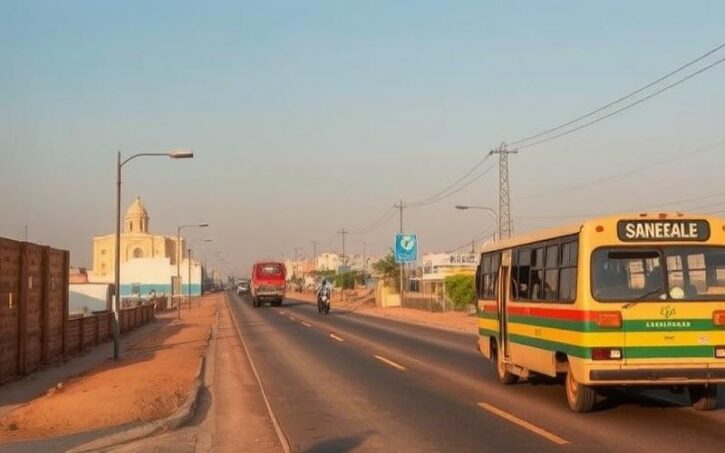
The iconic blue and yellow cars rapides and Ndiaga Ndiaye buses, historical symbols of popular mobility in Dakar since the 1970s, are being gradually replaced as part of modernization programs. Although still visible and recognizable by their religious slogans and Sufi motifs, their safety and mechanical compliance are regularly criticized.
SunuBRT: The High-Service Electric Bus
A major new addition to the Dakar landscape, the SunuBRT Bus Rapid Transit marks a break from the traditional bus model. It is a system of 100% electric buses running on an 18.3 km corridor with dedicated lanes, 23 equipped stations, and planned connectivity with other modes.
The BRT is designed to transport up to 300,000 passengers per day at full capacity, with a fleet of about 121 to 144 articulated electric buses. Frequency can drop to a bus every 6 minutes during peak hours, with extended service hours throughout the day. The buses are powered by electricity partly from solar sources, and the infrastructure includes amenities for pedestrians and cyclists (sidewalks, bike lanes, lighting).
The Dakar Regional Express Train contract guarantees a minimum of 100,000 passengers per day to secure private investment.
The project was designed as the backbone of Dakar’s public transport system, connected to 32 feeder lines and TER stations. It earned the city an international sustainable transport award, notably for its massive use of electricity, expected emission reductions, and integration of gender and safety issues (lighting, measures against violence towards women, hiring of female drivers).
The Regional Express Train (TER): The Fast Rail Option
Another pillar of Dakar’s transport modernization, the Regional Express Train connects downtown Dakar to Diamniadio and, eventually, to the international airport. The full line will be 55 km, with 36 km already in operation between Dakar and Diamniadio and 19 km under construction to Blaise-Diagne.
The trains, Coradia Polyvalent type, run on a standard double-track electrified line (25 kV) with a modern signaling system (ERTMS level 2). Each four-car train can carry more than 500 passengers, in first and second class, at a maximum speed of 160 km/h. With a frequency of up to one train every 10 minutes during the day, the TER has drastically reduced travel time between Dakar and the new suburban centers, from nearly 1h30 by bus to about 45–50 minutes by train.
The fares are zoned:
| TER Zone | Section Covered | 2nd Class Fare (CFA) | 1st Class Fare (CFA) |
|---|---|---|---|
| Zone 1 | Dakar – Thiaroye | 500 | 2,500 |
| Zone 2 | Thiaroye – Bargny | 1,000 (2 zones) | 2,500 |
| Zone 3 | Bargny – Diamniadio | 1,500 (3 zones) | 2,500 |
Children under 4 travel for free, and weekly or monthly passes are available, with discounts for youth. The extension to the airport should further improve accessibility to the platform and streamline the connection between Dakar, Diamniadio, and the air hub.
Intercity Transport: Connecting Major Cities
Leaving the Dakar region to explore the rest of the country involves a different transport universe, dominated by shared taxis, long-distance buses, and ferries.
“Seven-Seaters” and Bush Taxis: The Road Backbone
The famous seven-seaters are Peugeot 504 or 404 station wagons converted to seat seven passengers. They are the most common way to travel from city to city: Kaolack, Saint-Louis, Tambacounda, Kédougou, Ziguinchor… Each locality has its “garage” (bus station) from where these shared taxis depart.
The principle is simple: the vehicle does not leave the garage until all seven seats are sold. You can potentially buy several seats to leave faster or be more comfortable. Once on the road, the seven-seater usually drives non-stop to its destination, except for breakdowns or police checks.
Fares are regulated for standard routes, although negotiation can come into play regarding luggage. Some approximate price benchmarks for intercity trips:
| Seven-seater Route | Approximate Fare (CFA / seat) |
|---|---|
| Dakar – Saint-Louis | 4,500 |
| Dakar – Kaolack | 3,500 |
| Dakar – Tambacounda | 9,000 |
| Tambacounda – Kédougou | 6,000 |
| Tambacounda – Kolda | 5,500 |
| Dakar – Mbour | 2,500 to 3,500 |
To this price is often added a baggage fee (bagou), around 500 CFA francs, negotiable depending on the size of the bag. A rule of thumb advises not paying more than 10% of the ticket price for a reasonable suitcase. In major stations like “Pompiers” in Dakar, it is common for a coxer (tout) to direct you to a vehicle; their role is semi-informal and they earn their income from tips and commissions.
Comfort is basic and air conditioning is non-existent, but this mode of transport remains unbeatable for exploring the country at low cost and immersing yourself in Senegalese daily life. It is highly recommended to leave early in the morning (around 6–7 AM) to limit waiting times and avoid night driving, which is much riskier.
Intercity Buses: From “Beez” to Structured Companies
On the main routes, intercity bus companies offer a more comfortable and often safer alternative to seven-seaters. Dakar Dem Dikk, via its brand Sénégal Dem Dikk or Africa Dem Dikk, serves about twenty major cities (Thiès, Touba, Saint-Louis, Kaolack, Ziguinchor, etc.), sometimes with two departures per day on the busiest routes.
Long-distance buses in Senegal, such as those operated by Niokolo Transport or Salam Voyages on routes to the east (Tambacounda, Kédougou), are typically air-conditioned coaches. They have two rows of two seats with assigned numbers, luggage compartments, and sometimes offer overnight departures for the longest trips.
Booking can be done at the bus station, but the trend is towards digitalization: the Yobuma app or Dakar Dem Dikk’s “dem dikk” app allow booking and paying for tickets in advance, provided you have a local SIM card and an Orange Money account. Departures are sometimes limited to one bus per day, and tickets sell out fast: it’s better to plan a few days ahead.
Prices remain reasonable given the distances covered. As a general guide:
| Intercity Route (bus) | Indicative Fare (CFA) |
|---|---|
| Dakar – Saint-Louis (~270 km) | ~5,500 |
| Dakar – Ziguinchor (bus or ferry) | 5,000 to 15,000 (depending on class or operator) |
| Tambacounda – Dakar (overnight bus) | ~6,000 |
In return, you must accept a certain unpredictability: delays of several hours at departure, breakdowns in the countryside, road quality varying greatly depending on the section and season.
Ferries to Casamance and the Islands
To reach Casamance from Dakar without crossing The Gambia by road, the Dakar–Ziguinchor ferry is a both practical and iconic option. Operated by COSAMA, this territorial continuity service connects the capital to Ziguinchor in about 15 hours, combining sea and river navigation (about 324 km including 50 km on the Casamance River).
Details regarding departures, duration, and fares for the ferry connecting Dakar to Ziguinchor.
Departures occur several times a week in the evening from Dakar, arriving in Ziguinchor late morning the next day. The return trip follows the same principle.
Fares vary based on three criteria: the chosen cabin category and the passenger’s status (Senegalese resident, foreign resident, or non-resident).
| Class / Seat (Aline Sitoé Diatta) | Resident (CFA) | Non-Resident (CFA) |
|---|---|---|
| 1st class (2-person cabin) | 26,500 | 30,500 |
| 2nd class (4-person cabin) | 24,500 | 28,500 |
| 3rd class (8-person cabin) | 12,500 | 18,500 |
| 4th class (pullman seat) | 5,000 | 15,500 |
| Infant (0–4 years) | Free | Free |
| Child (5–12 years) | -50% | -50% |
It is possible to board a vehicle (car or motorcycle) for an additional fee. The crossing is generally safer than the road at night, even though memories of the Joola shipwreck in 2002 remain present and have led to strengthened safety standards.
From Dakar, sea shuttles also connect to the island of Gorée, a highly visited historical site, and the island of N’Gor, a major surfing spot. Crossings are frequent for Gorée, managed by the Autonomous Port of Dakar, with separate fares for Senegalese citizens, African residents, and international tourists. For N’Gor, small pirogues provide the connection in about ten minutes for around 1,000 CFA francs round trip.
Fares, Tickets, and Payment Methods
One of the great advantages of Senegalese public transport remains its moderate cost, especially for buses and shared taxis.
In major cities, a short trip in a car rapide or AFTU minibus often costs less than 200 CFA francs. A classic Dakar Dem Dikk bus ticket typically costs around 150–275 CFA francs. On an intercity scale, you can connect two major cities hundreds of kilometers apart for 4,000 to 10,000 CFA francs, depending on distance and comfort level.
Here is a summary overview of the typical price ranges:
| Mode of Transport | Scale of Use | Typical Price Range |
|---|---|---|
| Urban taxi (Dakar) | 1–10 km | 1,000 – 3,500 CFA francs |
| Taxi (medium-sized city) | 1–5 km | ~500 CFA francs |
| Car rapide / short minibus | Intra-neighborhood trip | 50 – 200 CFA francs |
| Urban bus (DDD) | Urban route | ~150 – 275 CFA francs |
| Intercity seven-seater | 100–500 km | 3,500 – 9,000 CFA francs |
| Comfortable intercity bus | 200–700 km | 5,000 – 15,000 CFA francs |
| TER (1 zone) | Dakar peri-urban | 500 CFA francs (2nd cl.), 2,500 (1st) |
| BRT (urban trip) | Guédiawaye–downtown corridor | A few hundred CFA francs |
| Ferry Dakar–Ziguinchor | Long distance | 5,000 – 30,500 CFA francs (depending on class) |
The rise of digital payments is gradually transforming ticketing. Orange Money and other mobile money solutions are widely used to book intercity buses (via Yobuma, for example) or buy TER/BRT tickets. However, cash remains king in most taxis, minibuses, and road garages; it’s therefore better to always have small bills on hand.
The state offers financial aid for transport: a 50% discount for students (aged 12-30) and seniors (aged 60+) on certain networks. Free or reduced-fare schemes are also planned for people with disabilities and very low-income individuals, particularly in Bus Rapid Transit (BRT) and Regional Express Train (TER) projects.
Safety, Accessibility, and Best Practices
Quality and safety in Senegalese transport show strong disparities depending on the mode and location.
Roads can be dangerous, especially at night, due to insufficient lighting, poorly maintained vehicles, pedestrians and animals on the roadway, and risky driving behavior. Serious accidents, like the bus crash in the Kaffrine region, regularly remind users of their vulnerability.
In this context, some advice is essential:
To travel safely in Senegal, it is recommended to avoid road travel at night, especially on intercity routes. Prioritize structured transport operators (like Dakar Dem Dikk, recognized bus companies, TER, BRT, or official ferries) for long trips. Before boarding, check the vehicle’s apparent condition (tires, overloading, presence of seat belts). In very crowded buses and packed stations (like the maritime terminal to Gorée or the Pompiers bus station), always keep your personal belongings close due to reported pickpocketing.
Accessibility for people with reduced mobility remains limited on the vast majority of the fleet (classic taxis, seven-seaters, minibuses). The new systems (TER, BRT, recent buses), on the other hand, incorporate specific amenities: level platforms, reserved spaces, access ramps, audio and visual information. Blaise Diagne Airport is also equipped with assistance devices (wheelchairs, accompaniment).
Dakar is experiencing an increase in petty theft, particularly in tourist areas and stations. It is advisable to avoid conspicuous valuables, spread out your money, stay vigilant in crowds, and avoid walking alone at night in poorly lit areas.
Major Reforms and Ongoing Projects
Beyond the daily experience of users, Senegalese transport is at the heart of a vast transformation strategy led by the state and many international donors (World Bank, African Development Bank, European agencies…).
Modernizing the Urban Bus Network
The Dakar Public Transport Restructuring Project (RTC) plans to deploy 400 modern buses on 14 new lines and 11 reorganized lines, with about 30 km of refurbished roadways, restructured intersections, 144 stops, and 15 terminals. The goal is to offer a clear, fast, comfortable bus service well-connected to mass transit projects (TER, BRT), to serve nearly 435,000 daily passengers.
This is the estimated amount in CFA francs of the transport modernization operation in Senegal, involving the state and several international partners.
Extending Road and Rail Infrastructure
In the 2026 finance bill, Senegal sets high ambitions for the transport sector. Several hundred billion CFA francs are allocated to the Ministry of Infrastructure and the Ministry of Land and Air Transport, in order to:
Target reduction in travel time for goods on the Dakar–Bamako corridor
These projects aim to facilitate economic exchange, reduce logistics costs, improve safety, and support regional integration, particularly with Mali, Guinea-Bissau, The Gambia, and Mauritania.
Innovating in Energy, Traffic Flow, and Multimodality
The future of Senegalese transport is not limited to roads and rails. Several public-private partnership projects plan for example:
– a biomethane production plant from waste, to fuel part of Dakar’s buses with cleaner fuel;
– a modern system of “smart” traffic lights to optimize traffic flow;
– development centered around the Petersen BRT terminal, with a greener neighborhood better connected to active mobility modes;
– a 100% electric cable car project in Diamniadio to connect areas of the new city to the TER station.
All of this contributes to an overall vision where the different modes – BRT, TER, classic buses, taxis, and neighborhood transport – are designed as complementary rather than competitive.
Practical Tips for Using Transport in Senegal Effectively
Beyond the numbers and projects, a few simple principles greatly facilitate life as a user, whether a resident or traveler.
Speaking some French – and, if possible, a few words of Wolof – makes a big difference, especially for negotiating taxis, understanding directions in garages, or asking for directions in bus stations. On bus lines where maps are rare, the most effective method is often to ask fellow passengers or the conductor directly.
In Dakar, a trip estimated at 20 minutes can easily take 40 minutes or more during rush hour. For long trips, plan a full day for a few hundred kilometers, including waiting times (vehicle filling, luggage loading) and potential road incidents.
Finally, traveling by public transport allows you to understand Senegalese society from the inside: conversations on buses, solidarity among passengers during mishaps, social mixing on ferries, constant improvisation in garages… Provided you respect a few rules of caution and patience, it’s one of the best ways to experience the country differently than through the windows of an air-conditioned 4×4.
In Summary
Public transport in Senegal forms a hybrid system, halfway between tradition and accelerated modernization. Alongside negotiated taxis, historic cars rapides, and seven-seaters that still crisscross all regions, more structured networks are emerging: electric BRT, TER, reorganized urban buses, modernized ferries, with a growing role for digital payments and social fare policies.
The current offering is very diverse and adaptable to different budgets, but it still requires some resourcefulness and flexibility from users. The future, with the realization of major projects and strengthened regulation, suggests a more readable, intermodal, and inclusive network, prioritizing travel efficiency, safety, accessibility, and environmental respect.
In the meantime, this guide provides the keys to navigating this changing landscape, fully enjoying the human richness and opportunities for discovery that Senegalese public transport offers on a daily basis.
Disclaimer: The information provided on this website is for informational purposes only and does not constitute financial, legal, or professional advice. We encourage you to consult qualified experts before making any investment, real estate, or expatriation decisions. Although we strive to maintain up-to-date and accurate information, we do not guarantee the completeness, accuracy, or timeliness of the proposed content. As investment and expatriation involve risks, we disclaim any liability for potential losses or damages arising from the use of this site. Your use of this site confirms your acceptance of these terms and your understanding of the associated risks.

Cyril Jarnias is an independent expert in international wealth management with over 20 years of experience. As an expatriate himself, he is dedicated to helping individuals and business leaders build, protect, and pass on their wealth with complete peace of mind.
On his website, cyriljarnias.com, he shares his expertise on international real estate, offshore company formation, and expatriation.
Thanks to his expertise, he offers sound advice to optimize his clients' wealth management. Cyril Jarnias is also recognized for his appearances in many prestigious media outlets such as BFM Business, les Français de l’étranger, Le Figaro, Les Echos, and Mieux vivre votre argent, where he shares his knowledge and know-how in wealth management.





