
 Published on and written by Cyril Jarnias
Buying a house or apartment “by the sea” in the Czech Republic is, in reality, a geographical absurdity: the Czech Republic is a landlocked country with no access to the sea. Yet, the demand for properties offering a resort-like atmosphere—by a lake, a large reservoir, a river, or in a highly attractive natural environment—is very real. In practice, when agencies talk about “seaside style” in the country, they are referring to waterfront land and houses, inland marinas, developed dykes, or recreational areas related to swimming, sailing, or tourism.
This real estate market is dynamic and highly regulated. It is possible to acquire a property offering a view of the water, access to a lake or dam, a beach or dock, as well as tourist rental potential. It is essential to consider the growing influence of climate risks in this type of investment.
Understanding the Paradox: Landlocked Country, Coastal Dreams
The first thing to keep in mind is that the Czech Republic has no coastline. Therefore, “seaside” opportunities are concentrated around large lakes and reservoirs (Slapy, Lipno, Orlík, etc.), developed riverbanks, or artificial bodies of water used for boating. A recent listing exemplifies this: a compound by Lake Slapy in the Příbram region: a combined plot of over 33,000 m², with a small shared border with the lake, a dock for six yachts, and even an unfinished steel yacht, listed for around €160,000.
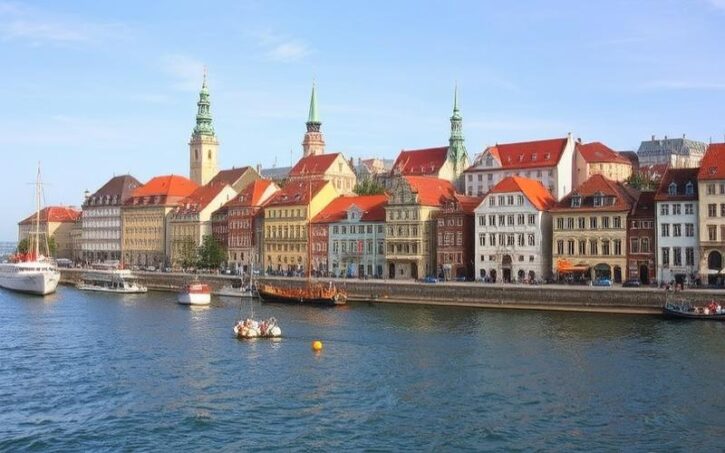
This type of property illustrates the Czech real estate reality: it is not a villa facing the Adriatic, but the acquisition of a large plot, a house, or a cottage benefiting from direct water access, docks, and even nautical infrastructure. The atmosphere is that of a “mini inland riviera,” with swimming, boating, and seasonal tourism, but within the country’s own legal, tax, and climatic framework.
A Real Estate Market Under Immense Pressure, Even Far from the Sea
Even without a coastline, the Czech real estate market is among the tightest in Europe. Since 2015, prices have exploded: +120% nationwide since 2015, with a 25 to 30% rise during the spring 2020–winter 2021 period alone, driven by historically low interest rates and a severe housing shortage.
The residential property price index showed an annual increase of nearly 9.9% in the first quarter of 2025.
For waterfront or recreational area properties, the effect is twofold. On one hand, these locations benefit from a premium for amenities (swimming, sailing, fishing, scenery); on the other, the general shortage of housing and buildable land leads to upward pressure across all segments.
An overview of average price levels by major city (all property types combined) provides market context:
| City / Region | Approximate Average Price (€/m²) | Summary Comment |
|---|---|---|
| Prague | 4,800 – 8,000+ | Capital, most expensive market, strong foreign demand |
| Brno | ≈ 5,200 | Tech and university hub, rapidly rising prices |
| Ostrava | ≈ 2,200 | More affordable, higher rental yields |
| Plzeň | 3,400 – 3,800 | Industrial city, good accessibility |
| Karlovy Vary | 1,700 – 2,000 | Spa town, international clientele |
| České Budějovice | 3,000 – 3,500 | Proximity to recreational areas (Lipno, Šumava) |
| Liberec | 2,800 – 3,200 | Mountain and nature region, “green” appeal |
“Seaside-style” properties are mostly found outside major centers, but price dynamics remain influenced by proximity to Prague or large cities, major roads, and tourist areas.
Who Can Buy and Under What Legal Framework?
One of the country’s advantages for a foreign investor—whether aiming to live year-round by a lake or rent to tourists—lies in the legal openness of the market.
Since joining the European Union in 2004, regulations have significantly relaxed:
– Any foreigner, whether an EU national or not, can buy an apartment, house, or land in the Czech Republic;
– It is not necessary to obtain a residence permit or citizenship to become an owner;
– The foreign buyer in principle has the same rights as a Czech citizen for residential properties.
The main restrictions concern the acquisition of agricultural land, forests, and properties located in sensitive areas (military perimeters, strict nature reserves, listed properties, border zones). For a plot or house by a lake, these constraints are generally less applicable, unless the property is in a specifically environmentally protected area.
The basic framework is set by the Czech Civil Code and the Cadastral Act (Act No. 256/2013). Any transaction must be registered in the Land Registry (Katastr nemovitostí) to take effect, making it the reference source for verifying ownership, area, easements, mortgages, and any disputes.
Process of Buying a Waterfront Property
Buying a vacation property does not fundamentally differ from a standard purchase, but a few points require extra vigilance (water access, land use, flood risk, right-of-way easements, etc.). The general process, however, remains the same.
Key Transaction Steps
1. Research and Property Selection
Locate attractive lakes and dams (Slapy, Lipno, Orlík, etc.), analyze specialized listings (Czech platforms, dedicated waterfront property sites, international portals). A pre-approval for financing is highly recommended to define your budget.
2. Visit and Technical Inspection
The physical inspection is crucial, especially for a vacation house subject to frost, humidity, and water level variations. Hiring an independent technical inspector helps identify hidden defects (basement dampness, weakened structure, insufficient insulation, non-compliant utilities, etc.).
Your lawyer must consult the Land Registry to confirm several crucial points: the owner’s identity, the exact area of the land and buildings, and the existence of any mortgages, seizures, or restrictive legal measures. They must also verify easements (such as a right of way, dock access, or buried pipes) and ensure the property’s use complies with regulations (buildability, recreational zone permits, absence of environmental disputes).
3. Checking the Cadastre and Legal Due Diligence
It is crucial to distinguish between the actual livable area and the area declared in listings. A discrepancy of 5 m² can represent a loss of several hundred thousand crowns if the price exceeds 100,000 CZK/m².
4. Reservation Contract
At this stage, many buyers make mistakes. The classic pitfall is a reservation contract signed only with the agency (bilateral contract): the seller is then not bound and can withdraw or sell to a third party without penalty. The safe model is a tripartite contract (buyer–seller–agency) including:
– Penalties for unjustified withdrawal by either party;
– Precise description of what is included (dock, mooring rings, furniture, nautical equipment, outbuildings, etc.);
– Financing clauses (seller’s acceptance of mortgage, deadlines for obtaining the loan).
To secure the transaction, the deposit and the main price should never be paid directly into the seller’s personal account. The recommended practice is to deposit funds into an escrow account managed by a lawyer, notary, or bank. The funds are only released and transferred to the seller after the definitive registration of your ownership rights in the Land Registry.
6. Purchase Contract (Kupní smlouva)
Drafted in Czech (with a possible bilingual version), signed with notarized signature authentication. The contract must:
– List all relevant plots and structures;
– Specify ancillary rights (dock, mooring spot, access to a private or shared beach, access road);
– Include clauses on mortgages, release of any existing encumbrances, key handover deadlines;
– Provide for penalties for delayed handover.
7. Registration with the Land Registry and Protection Period
The notary or lawyer files the contract with the Land Registry. A protection period of approximately 20 days opens, during which the operation is verified. The complete process generally takes around 30 days. You only become the owner upon completion of this registration, not at the signing of the contract.
Essential steps and checks upon arrival at your houseboat rental.
Establishing a detailed document: reading of water and electricity meters, condition of the dock, shoreline, garden, and inventory of included furniture and nautical equipment.
Initiating necessary insurance: home, liability, and possibly specific coverage for nautical installations.
Specifics of Waterfront Properties
A “seaside-style” property is often associated with specificities that must be clearly identified in the contract:
– Ownership and Use of the Shoreline: In the Czech Republic, the notion of ownership of the bed or banks of a public lake or reservoir can be complex. It is essential to verify:
– Whether the shoreline strip belongs to the owner or the state;
– Whether access is private or shared;
– Whether the dock is permitted, registered, and transferable with the property.
– Right-of-Way Easements: Neighbors or fishermen may have a right of passage along the shore. This type of easement affects privacy and resale value.
– Moorings and Docks: An administrative permit is often required to moor boats or build a dock. It is not necessarily granted for life and must be examined as part of the sale.
– Local Regulations: Some tourist municipalities may limit parking, nautical activities, short-term rentals, or construction by the lake.
How to Finance the Purchase: Mortgage and Down Payment
A mortgage loan is the standard path to finance a vacation home. The current context is rather favorable: after a peak around 6–6.5% in 2023, rates have fallen back to around 4.5–5% in 2025, with the Central Bank (ČNB) policy having lowered its key rate to 3.5%.
General Conditions for Foreigners
Major Czech banks – Česká spořitelna, Komerční banka, ČSOB, Raiffeisenbank, Hypoteční banka, Fio banka – lend to foreigners, albeit with stricter requirements than for residents:
To obtain a mortgage, a personal down payment of 20% is generally required, but it can rise to 25-30% for non-residents or income in foreign currencies. Proof of stable income is required, with sworn translations if necessary, and exchange rate risk must be considered for salaries in EUR or USD. The debt-to-income limit is set by the ČNB, generally between 8.5 and 9.5 times the annual income, with more favorable conditions for those under 36. The loan term can be up to 20-30 years, with fixed-rate periods of 3 to 10 years.
For a 8 million CZK property by a lake, a 30% down payment (2.4 million CZK) and a loan of 5.6 million CZK over 25 years at 4.5% will result in a significant monthly payment; it is imperative to accurately simulate your repayment capacity, especially since rental yields on recreational properties are very seasonal.
Role of the Mortgage Broker
For a foreign buyer, working with a mortgage broker who knows the local market well is often decisive. They can:
We assist you at every stage of your mortgage project in the Czech Republic, for a simplified and secure process.
We compare offers from several banks for you to find the financing best suited to your situation.
We help you optimize the down payment level and the loan-to-value (LTV) ratio based on your profile.
We assist you in preparing your application (translations, tax documents, employment contracts, etc.).
We negotiate certain fees and conditions for you, such as early repayment penalties or application fees.
The essential point is to obtain at least a pre-approval for financing before signing a binding reservation contract. Otherwise, the risk is losing part of the deposit (3–5% of the price) if the bank refuses the loan and the contract does not include a sufficiently protective conditional clause.
Taxation: A Framework Rather Favorable to Owners
The Czech Republic stands out for its rather moderate property taxation for individuals.
Purchase and Annual Taxes
– Transfer Tax: The former 4% tax on property acquisition was abolished in 2020. This is an immediate gain for the buyer, saving the equivalent of 4% of the price.
– Land Registry Fees: Registering your right in the Land Registry costs 2,000 CZK (1,600 CZK for electronic filing). Who pays (buyer or seller) must be explicitly settled in the contract.
– Annual Property Tax: It is very low compared to most Western European countries. The revenue from this tax represents barely 0.10% of private capital stock. It is calculated based on area, property type, and municipal coefficients, not market value. For a 50 m² apartment in Prague, the bill is around a few hundred crowns. For a waterfront house with a large plot, the amount remains moderate but should be simulated.
The new owner must file a property tax declaration the year following the purchase. The administration then automatically recalculates the amounts, unless there is a major change like an expansion or plot division.
Rental Income and Capital Gains
If you rent out your lakeside house:
Rental income is subject to income tax. Two declaration options are possible: a flat-rate deduction of 30% for expenses or the declaration of actual costs (maintenance, repairs, loan interest, insurance…). For short-term rentals with services (hotel-like), income falls under the self-employment regime, involving payment of social and health insurance contributions, but potentially allowing higher flat-rate deductions (40 to 60%) under conditions.
In case of resale, the capital gain can be completely exempt:
– If the property was your primary residence for at least two years before the sale;
– Or if you held it for at least five to ten years depending on the acquisition date (with an extended period for recent purchases);
– Or if you reinvest the sale proceeds into another home meeting your own needs, while complying with declaration rules.
There are no inheritance taxes for close heirs (spouse, children) on real estate. For other heirs, a flat rate of 15% may apply.
Renting Your “Seaside” Property: Short-Term or Classic Rental?
Many buyers of a waterfront house consider making it a mixed-use property: personal use part of the year, tourist rental the rest of the time. However, the Czech legal framework clearly distinguishes between residential rental and Airbnb-type accommodation services.
Long-Term Rental (Over 48 Hours)
A classic residential rental:
– Does not require a business license;
– Falls under the Civil Code on residential leases;
– Is taxed as rental income (section 9 of the tax law);
– Requires a written contract, a security deposit capped at six months’ rent, a three-month notice period to terminate an indefinite lease.
This formula works well if you rent your property seasonally for several consecutive weeks/months (e.g., long summer or winter stays), but without hotel-like services (daily cleaning, breakfast, etc.).
Short-Term Rental (48 Hours or Less)
Under Czech law, short-term rental with services (accommodation, laundry, regular cleaning, possibly catering) is considered an accommodation activity, therefore a commercial activity. This implies:
– Obtaining a business license for accommodation services;
– Registering with the municipality to pay the accommodation tax;
– Reporting all non-European guests to the Foreign Police within three days;
– Complying with building use regulations (the property must be authorized as an accommodation unit according to the building permit, not just as a dwelling).
Violations are heavily penalized: up to 500,000 CZK fine for operating without a license, up to 1 million CZK for using the property contrary to its designated purpose in the building permit, additional fines for failure to report foreign guests.
Starting in 2025, the e‑Turista electronic system is set to become mandatory for all short-term hosts, with prior registration required before listing ads online. Municipalities will have the power to set caps on rental days, capacity limits, and even quotas for properties authorized for short-term rentals.
In highly touristic areas like Prague, new regulations are limiting the growth of platforms like Airbnb. In nature tourism regions (lakes, etc.), political pressure is currently lower, but the general trend is toward more transparency and a better-defined legal framework.
Rental Yields: What to Expect
Nationally, gross yields on residential real estate typically range between 3 and 5% depending on the city, with:
– Around 3% in Prague,
– Up to 5–6% in cities like Ostrava or Ústí nad Labem,
– 5–7% for student housing or certain specific segments.
For a purely recreational property by a lake, the yield will often be:
– Higher in peak season (weekly rentals, strong summer demand, higher rates);
– Lower over the year due to off-season vacancy;
– Very dependent on the spot’s quality (distance from Prague or Brno, accessibility, lake reputation, quality of nautical infrastructure).
The profitability calculation should therefore be based on several prudent scenarios and include all expenses (garden maintenance, dock upkeep, winter heating, specific insurance, etc.).
Climate, Floods, and Physical Risks: A Central Issue for Waterfront Properties
Buying a house by the water in a landlocked country does not mean being safe from climate risks. On the contrary, available data shows that floods have been by far the costliest climate risk in the Czech Republic over the past decades.
Between 1980 and 2023, extreme weather events generated approximately 8.5 million euros in economic losses (2023 value). Nearly 78% of these losses were flood-related. Major episodes (1997, 2002, 2010, 2013) affected a large part of the territory, as did an exceptional tornado event in 2021.
Only about 12% of the economic losses from these events are covered by insurance, leaving many property owners highly exposed.
Impact on Property Value
Studies conducted in Europe and North America converge on several points:
Average discount on homes in a 100-year flood zone, according to real estate market studies.
For a property by a lake or river, a major flood can impact the structure, banks, dock, and even lead to a review of mooring permits. Conversely, in a well-protected and resilient location, the high amenity value (view, water access, activities) can partly offset the risk in long-term valuation.
Tools for Mapping Risk
The Czech Republic recently benefits from advanced climate risk mapping tools, notably through the Danube‑ADAPT project, which produced a climate risk map for the country. Developed by the Czech Smart City Cluster and the Global Change Research Institute (CzechGlobe), this platform provides information on:
– Risks of extreme heat, heavy rainfall, and flooding;
– Local vulnerability;
– Recommended adaptation strategies.
For a prudent buyer, it is relevant to: carefully evaluate listings, compare prices, analyze guarantees, verify seller reputation, and read sales terms carefully.
Before acquiring land or a house by the water, it is crucial to consult flood zone maps. Then cross-reference this data with local risk prevention plans (PPR), historical flood archives, and gather information from area residents.
Insurance, Financing, and “Stranded” Assets
Climate risks impact not only the owner but also insurers and banks:
– High exposure can raise insurance premiums, or even make insurability difficult or very costly;
– Some banks become more reluctant to finance highly exposed properties, fearing their collateral will lose value after a loss event;
– In extreme cases, an uninsurable or unfinanceable property can become a “stranded” asset, difficult to sell and use as loan collateral.
To reduce this vulnerability, savvy investors now integrate resilience criteria into their decisions: choosing a less exposed site, elevation, flood protections, adapted materials, good land management practices (drainage, vegetation, etc.). In the long term, a property’s ability to meet Environmental, Social, and Governance (ESG) criteria will become a determining factor in its value.
Hidden Costs and Common Mistakes to Avoid
Buying a vacation home in the Czech Republic can turn into a financial nightmare if certain precautions are not taken. Testimonies from poorly assisted buyers mention losses ranging from several hundred thousand to several million crowns, often for avoidable reasons.
Among the recurrent mistakes:
Several critical mistakes can compromise a real estate purchase: signing a reservation contract that only binds the buyer, paying the deposit to a non-escrow account, neglecting to verify the cadastral area and land boundaries, omitting to check for any condominium fees and debts, accepting clauses waiving recourse for hidden defects, and underestimating building permit acquisition times, which can take several years and be subject to unforeseen environmental constraints.
Therefore, support from a truly independent lawyer—not one proposed by the agency or seller—is a minimum safety condition.
Where to Look for an “Inland Riviera” Type Property?
There is no “Czech coast,” but several regions concentrate opportunities:
Overview of the main attractive regions for buying second homes or rental investments, based on landscape and activities.
Like Slapy or Orlík, they attract an affluent clientele from the capital. Prices are high but rental potential is significant, with demand for second homes, private docks, and small marinas.
Large artificial lake near the Austrian border, popular for sailing, water sports, and cross-country skiing. The urban center of České Budějovice (average prices: 3,000–3,500 €/m²) is within reasonable distance.
Certain picturesque stretches of the Vltava or Elbe offer charming villages. Particular attention must be paid to flood risk assessment before any investment.
Example: the Liberec region, which focuses on carbon neutrality and promotes ambitious wood construction (target of 25% wood housing by 2035). Attracts buyers sensitive to ecology and mountain landscapes.
For investors willing to move away from Prague, some regions still combine affordable prices and appreciation potential:
| Region / City | Main Assets for a “Leisure / Nature” Project | Relative Price Level |
|---|---|---|
| Lipno Region | Lake, water sports, proximity to Austria, four-season tourism | Medium to High |
| Příbram / Slapy | Proximity to Prague, boating, second homes | Rather High |
| Zlín | More affordable prices, family-oriented, surrounding nature | Affordable |
| Liberec | Proximity to nature parks, sustainability strategy, green tourism | Medium |
| Karlovy Vary | Spa, international clientele, nature, nearby lakes and rivers | Medium, sometimes low |
Underlying Trends That Will Influence Your Investment
Even when aiming for a very emotional project—a house by the water—it is useful to keep in mind some structural trends in the Czech market.
Demographics and Aging
The share of people aged 65 and over increased from 13.3% in 1993 to 20.5% in 2023, and projections indicate that by 2040, there will be more than twice as many seniors as children under 15. Many households are turning to smaller, easier-to-maintain homes, sometimes in nature regions.
Vacation homes designed with step-free access, few stairs, and located near good medical infrastructure can constitute a long-term outlet for resale or rental, appealing to a clientele of Czech or foreign seniors.
Urbanization and Remote Work
Nearly three-quarters of Czechs already live in urban areas, and the share of the urban population continues to grow. But, since the pandemic, there has also been a movement towards the countryside: rural housing demand up 80%, widespread remote work (up to 60% of companies authorized it at the peak of Covid).
A hybrid lifestyle model is emerging, combining life in a pleasant, well-connected small town or village, with remote work several days a week and occasional trips to Prague or Brno. A property located near a lake within two hours of the capital can meet this growing demand.
Energy and Sustainability
The surge in energy prices and EU climate policy are boosting the appeal of low-energy houses:
– National subsidies (New Green Savings) that can reach over 500,000 CZK for certain energy renovations;
– 70% increase in rooftop solar installations in 2023;
– New European standards on building energy performance.
A vacation home that is well-insulated, equipped with solar panels, efficient heating, will benefit not only from reduced operating costs but also better future valuation. Banks, subject to ESG criteria and the European green taxonomy, will be increasingly inclined to finance such properties.
Should We Fear a Bubble?
With prices that have climbed 120% since 2015, some analysts consider the market—particularly older apartments in Prague—to be “unjustifiably expensive.” It is one of the least affordable markets in Europe relative to income: a Czech household must spend about 13.3 years of salary to buy a standard 70 m² apartment, compared to 7.9 years in Poland or 8.1 in Austria.
The Czech National Bank closely monitors this price/income imbalance. Nevertheless, most experts anticipate more of a slowdown in growth (3–6% per year in major cities) than a collapse, due to:
Number of homes lacking in the Czech Republic, half of which are in Prague, contributing to a structural deficit.
For a long-term financed vacation home purchase, the key is therefore to: choose a favorable location and a property that meets your and your family’s needs.
– Not speculate on a quick resale gain;
– Prioritize an investment horizon of at least 5 to 10 years;
– Choose a quality location (water, accessibility, sustainable tourist appeal, good resilience to climate risks).
In Summary: Strategy for a Successful Czech “Seaside” Project
Embarking on the purchase of a house or land by the water in the Czech Republic means combining a search for quality of life with a long-term asset decision in a country without a coastline but with a strong culture of lakes, rivers, and outdoor activities.
The most solid strategy consists of:
Accept the paradox: your “sea” will often be a large lake or dam, very lively in summer but calm off-season. Meticulously secure the legal dimension (cadastre, easements, dock permits, land use) and financial dimension (mortgage, insurance). Integrate flood and climate risk into your analysis, using tools like the Danube‑ADAPT maps. Realistically consider rental potential, understanding the legal boundary between a classic lease and tourist accommodation. Finally, take advantage of favorable taxation (no acquisition tax, low property tax, capital gains exemptions) while remaining attentive to regulatory changes.
Within this framework, the Czech Republic can offer, despite the lack of a coast, genuine opportunities for those dreaming of a waterfront base in the heart of Europe, in a market that is both dynamic, relatively transparent, and increasingly well-equipped to integrate the challenges of climate and sustainability.
Disclaimer: The information provided on this website is for informational purposes only and does not constitute financial, legal, or professional advice. We encourage you to consult qualified experts before making any investment, real estate, or expatriation decisions. Although we strive to maintain up-to-date and accurate information, we do not guarantee the completeness, accuracy, or timeliness of the proposed content. As investment and expatriation involve risks, we disclaim any liability for potential losses or damages arising from the use of this site. Your use of this site confirms your acceptance of these terms and your understanding of the associated risks.

Cyril Jarnias is an independent expert in international wealth management with over 20 years of experience. As an expatriate himself, he is dedicated to helping individuals and business leaders build, protect, and pass on their wealth with complete peace of mind.
On his website, cyriljarnias.com, he shares his expertise on international real estate, offshore company formation, and expatriation.
Thanks to his expertise, he offers sound advice to optimize his clients' wealth management. Cyril Jarnias is also recognized for his appearances in many prestigious media outlets such as BFM Business, les Français de l’étranger, Le Figaro, Les Echos, and Mieux vivre votre argent, where he shares his knowledge and know-how in wealth management.





