
 Published on and written by Cyril Jarnias
Investing in real estate in Portugal is increasingly attracting foreigners, whether to settle down, prepare for retirement, diversify assets, or seek rental yield. But behind the postcards of Lisbon, Porto, or the Algarve, the Portuguese market combines three types of risks that feed off each other: legal and cadastral complexity, often underestimated costs and taxes, and above all, for non-residents, a currency risk that is far too often overlooked.
Beware of currency risk: a profitable investment in euros can become a very bad deal in the investor’s currency. This article identifies the pitfalls to avoid before buying a property.
Don’t confuse asking price, real value… and price in your currency
The first instinct to correct is taking the asking price as an objective fact. In Portugal, the gap between asking price, market value, and final price paid in the buyer’s currency can be considerable.
The market is described as opaque, with no centralized MLS, and agents who primarily represent the seller. Prices in tourist areas such as Alfama, Baixa, Chiado, Bairro Alto, or Príncipe Real in Lisbon, as well as downtown Porto or many municipalities in the Algarve, often include a “tourist premium” that can reach 20 to 40% above long-term rental value. In other words, you’re mainly paying for the tourist storytelling and pressure from foreign demand, not the economic soundness of the property.
For everyone financing from abroad, it’s important to remember it’s not about “paying €300,000”, but about paying the equivalent of those €300,000 in dollars, pounds, Swiss francs, dirhams, or rands — and that amount in your local currency can change dramatically between the reservation and the signing of the deed.
When a 1% currency move becomes €3,000 to €6,000 in extra cost
The numbers are relentless. On a property worth €300,000, a variation of just 1% in the exchange rate represents a €3,000 difference. Two percent is already €6,000 added to or subtracted from your budget, without the seller having moved their price by a single cent.
A British investor reserves a property for €300,000 when the pound is strong at 1.40 GBP/EUR, costing £214,286. Shortly after, at the time of the fund transfer, the rate drops to 1.36, bringing the bill to £220,588. The property hasn’t changed, but the buyer loses over £6,000 due to currency fluctuation.
Another benchmark: a US investor transferring $300,000 to buy in euros. An unfavorable 2% move in the USD/EUR rate forces them to add $6,000 to get the same amount in euros. And this type of movement can happen in a few days, or even a few hours.
A profitable investment in euros can be disastrous in your currency
Research on international real estate shows that over a few years, currency performance can easily dominate the performance of the real estate asset itself. A year in which rents are stable and the property’s value rises by 3% or 4% in local currency can turn into a net loss of 10% to 20% in the investor’s currency if the exchange rate turns against them.
Japanese investors in UK real estate suffered a -16% loss in yen despite positive rental returns of 4% in the UK, due to a sharp decline of the yen against the British pound.
The parallel with a purchase in Portugal is direct: a “successful” investment in euros, with rental income collected and moderate capital appreciation, can translate into a mediocre or negative performance once converted into dollars, pounds, or another currency.
How currency exchange adds to “standard” surcharges
The problem is that this currency volatility is added to already heavy entry costs. Between IMT (transfer tax), stamp duty, notary and registration fees, legal fees, surveyor fees, and agency fees, you can easily reach 7% to 10%, or even 10% to 12% of the purchase price in fees and taxes.
A simple order of magnitude for a property at €500,000:
| Cost item | Indicative range |
|---|---|
| IMT (transfer tax) | ~€13,000 to €32,000 |
| Stamp duty on purchase (0.8%) | ~€4,000 |
| Notary + registration fees | ~€1,000 to €2,000 |
| Legal fees | ~1% to 1.5% (€5,000–€7,500) |
| Miscellaneous (surveys, translations, certificates…) | ~€1,000 to €3,000 |
| Total estimated fees / taxes | ~€40,000 to €50,000 (8–10%) |
If on top of that you add a 2% adverse move on the exchange rate at the time of purchase, the bill can become irrational: a property “tightly negotiated” in euros turns into a trap in the original currency.
Understanding currency risk: three distinct exposures
The currency risk that weighs on a real estate purchase in Portugal breaks down into three components, each with different implications for the investor.
1. Transaction risk: purchase, rents, resale
The first risk, and the most directly experienced, is the impact of exchange rate variations on the cash flows related to the transaction itself.
It affects: It affects:
– the initial purchase (down payment, payment of price at signing),
– recurring flows (fees, local taxes, maintenance, management, possibly rents collected if the investor then converts them into their currency),
– the resale (conversion of the sale price into the original currency).
Bad timing on transfers for properties of €300,000 or more can lead to losses of several thousand to tens of thousands of euros
2. Translation risk: the value of your assets
The second corresponds to the impact of exchange rate variations on the valuation of your foreign real estate assets in your overall balance sheet. Even without selling, a portfolio denominated in euros can lose significant value in the reference currency of the assets (e.g., the dollar or the pound).
For an investor with multiple properties abroad, the accounting effects of exchange rate fluctuations can be just as important as transaction risk. A moderate appreciation of the Portuguese market can be completely erased by an unfavorable currency movement.
3. Economic risk: what you cannot hedge
Finally, there is a more subtle risk, called “economic”: the one where the fundamental performance of the property (occupancy rates, rents, costs) is itself influenced by exchange rates and the macroeconomic environment. For example, a strong appreciation of the euro can make European destinations less attractive for certain tourists, weigh on seasonal occupancy rates, and therefore on your rental income.
Unlike transaction or translation risks, which are largely manageable with financial tools, this economic risk is very difficult to neutralize: it is tied to the very structure of your investment.
First major mistake: basing your entire project on today’s exchange rate
One of the most common mistakes among foreign buyers in Portugal is spotting a property, looking at the day’s exchange rate, telling themselves “it fits my budget,” and then setting the machine in motion: promise, deposit, bank procedures, sale of assets in the home country… without any hedging strategy.
Between that moment and the signing of the final deed, weeks or even months can go by. Yet currency markets trade continuously; rates move by the second. What was “doable” on the day of the visit can prove untenable once the funds are ready.
Possible consequences:
If you cannot raise the required amount in your starting currency, several serious consequences may occur.
You might be forced to draw on other assets, take on more debt, or abandon the project.
This can lead to canceled agreements, loss of deposits, and friction with the seller and intermediaries.
In some cases, the inability to honor commitments can lead to legal disputes.
In areas where properties sell quickly, some buyers feel compelled to lock in a property based on the day’s exchange rate, with no plan B. This is typically the situation where a few percent currency move can turn a “good deal” into a decision to regret.
Impact on the overall budget
The reality is that currency risk radically changes your real budget. You cannot ignore the question “how far does my currency allow me to go?” while including not only the base price, but also taxes, fees, and a safety margin.
Moreover, the exchange rate doesn’t just play at entry. If your income stays in your starting currency while all your current expenses (IMI taxes, maintenance, management, renovations) are in euros, a persistently strong euro increases the cost of holding the property. And at exit, a sale during a period of a weak currency can seriously reduce the net capital gain in your own currency.
Second mistake: settling for your bank for transfers
Most investors, especially on their first purchase, instinctively use their “everyday” bank to transfer funds to Portugal. It’s convenient, the relationship already exists… but it’s rarely optimal.
Several problems add up:
Banks apply uncompetitive exchange rates (retail rates with high spreads), international fees (fixed commissions and/or percentages), hidden margins in the rate, and offer virtually no hedging tools for individuals.
In contrast, currency specialists dedicated to real estate transfers, who are regulated and accustomed to large amounts, generally offer:
– rates much closer to the interbank rate,
– more transparent pricing,
– the ability to set up forward contracts,
– guidance on staggering transfers or securing a budget in euros.
On a purchase of €300,000 or €500,000, the rate difference between a major traditional bank and a specialist can easily amount to several thousand euros. It’s all the more absurd to bear because this cost does nothing to improve the quality of the property or the legal security of the transaction.
Third mistake: ignoring hedging tools (forwards, options, euro-denominated structure)
Institutional investors never leave the impact of currencies on their performance to chance. They use a whole range of instruments that also exist, in adapted forms, for individuals.
Forward contracts: locking in your price in euros
The simplest, and by far the most widely used, is the currency forward contract. It is an over-the-counter (OTC) agreement with a currency provider to buy a given amount of euros at a future date, at a rate set today.
Concretely, you agree, for example, to buy €300,000 in three months’ time at a specified rate. So you know in advance how much that will be in your currency. No more nasty surprises if markets go wild in the meantime.
Key features:
– legally binding contract,
– no immediate disbursement of the principal amount (depending on the provider, a margin or security deposit may be required),
– eliminates exchange rate uncertainty on the amount covered,
– if the market rate becomes more favorable by the date, you cannot benefit from it… but that’s the price of certainty.
Many professional real estate portfolio managers almost systematically use forwards to neutralize the portion of currency risk they do not wish to bear.
Options: protecting yourself while keeping flexibility
Another available tool: currency options. They give the right (but not the obligation) to buy (or sell) a currency at a certain rate on a future date. If the market moves in your favor, you let the option expire and benefit from the better rate; if it moves against you, you exercise the option.
In exchange for this flexibility, you pay an upfront premium. For an individual investor, this product is less common, but some providers can offer it for significant amounts.
The “natural hedge”: borrowing or structuring in euros
Another way to reduce exposure is to build a financial structure aligned with the currency of the property:
– financing in euros through a Portuguese or European bank,
– building up a savings pool in euros over time,
– a company or wealth structure denominated in euros.
This approach does not eliminate currency risk, but it contains it by converting modest flows over several years (loan repayments, gradual contributions) rather than the entire purchase price in one go. Additionally, receiving rent in euros to repay a euro loan creates a cash flow balance in the same currency.
Why define a clear currency policy
Whether you invest directly or through a vehicle, the experience of professional managers shows the value of an explicit currency policy:
– identify which exposures are hedged (purchase, rental flows, anticipated resale…) and which are not,
– define risk limits or maximum budget in currency,
– choose the authorized instruments (forwards, swaps, options, local debt…),
– regularly monitor the effectiveness of the strategy (did the hedges neutralize the risk as expected?),
– communicate clearly with stakeholders (spouse, partners, investors) on what is being done and why.
Without this discipline, many end up “gambling” with currencies, hoping the market will go their way. Statistically, that’s a costly strategy.
Fourth mistake: underestimating Portuguese costs and taxes
Even setting currency aside, many foreign buyers make the same error: calculating their budget solely on the asking price, forgetting that the Portuguese state and intermediaries take a significant slice of the pie at entry, during ownership, and at exit.
At purchase: IMT, stamp duty, and fees
IMT is the biggest surprise for many. It is the transfer tax due before signing the deed. Its calculation is progressive, with different rates depending on the use (primary residence, secondary, investment) and caps that can go up to 7.5%. For non-residents, a recent reform provides for a flat rate of 7.5% in certain cases.
Beyond IMT:
Stamp duty on real estate acquisition is 0.8% of the higher of the price or tax value.
Simulation errors or bad advice on IMT and stamp duty can cost €10,000 to €30,000 more than planned. Not doing a precise simulation via the Portuguese tax portal is a frequent mistake.
During ownership: IMI, AIMI, fees, and maintenance
Every year, the owner pays IMI, the municipal property tax, calculated on the VPT (taxable property value), often much lower than the market price, but not negligible. Rates vary by municipality, generally between 0.3% and 0.45% of the VPT.
For a property with a €400,000 market value, the annual IMI can be between €1,200 and €2,000, depending on the actual VPT and the rate set by the municipality.
For very high net worth portfolios, AIMI applies to the real estate portion exceeding €600,000, with a rate of 0.7% between €600,001 and €1,000,000, then 1% beyond, calculated on the VPT. Many ‘premium’ foreign buyers discover it after the purchase.
Then you need to account for:
– condominium fees, sometimes high in buildings with services,
– routine maintenance (1% to 2% of the property’s value per year is a prudent baseline),
– insurance, possible property management fees,
– energy costs, often high in old, poorly insulated buildings.
At resale: agents, capital gains, repatriation of funds
When selling, the bill is still steep:
– estate agent commission: often 3% to 5% of the sale price,
– capital gains tax: 50% of the gain is included in taxable income and taxed at the progressive rate (marginal rates can go up to 48%), resulting in an effective tax on the gain of approximately 6.5% to 24%,
– legal and notary fees related to the sale.
And once again, the exchange rate plays its own part: a comfortable capital gain in euros can be wiped out in the original currency if the move in the foreign exchange market is unfavorable.
Fifth mistake: neglecting legal and cadastral due diligence
The Portuguese legal side is more complex than it seems. Registers are not always perfectly aligned, cadastral descriptions can be outdated or incomplete, “tolerated” but unlegalized extensions are common, and a significant share of real estate disputes stems from errors in registries or poorly formalized transfers.
Four essential documents
Before any promise to purchase, four documents must be obtained and analyzed:
Land verification is based on the Certidão Permanente (land registry extract showing owner, mortgages, easements, and seizures). The Caderneta Predial provides the cadastral description and tax property value. The Licença de Utilização, issued by the town hall, certifies habitability or intended use. Finally, the Certificado Energético is mandatory for any sale or rental.
The lawyer’s job is to ensure that these documents are consistent with each other and with the physical reality of the property: areas, number of floors, outbuildings, pools, terraces… Any difference must be clarified before signing.
Registry, cadastre, and reality: an unstable triangle
The Portuguese system is based on two “maps”:
– the Registo Predial (land registry) which publishes rights (ownership, mortgages, usufruct, easements…),
– the cadastral/tax matrix, intended for taxation.
These two sets of information are not always harmonized. Old descriptions, changes in cadastral references, undeclared modifications… The causes of divergence are numerous. The law provides mechanisms for correction and merging of files when there are duplicates or inconsistencies, but in practice, these situations can block a sale or financing for months.
Specific points of attention:
Common examples of title defects: incomplete chain of title (unsettled successions, unregistered donations), extensions or alterations without permits (pool, veranda, extra floor), property boundary disputes especially in rural or peri-urban areas, and mortgages, easements, or liens not cleared from the registers.
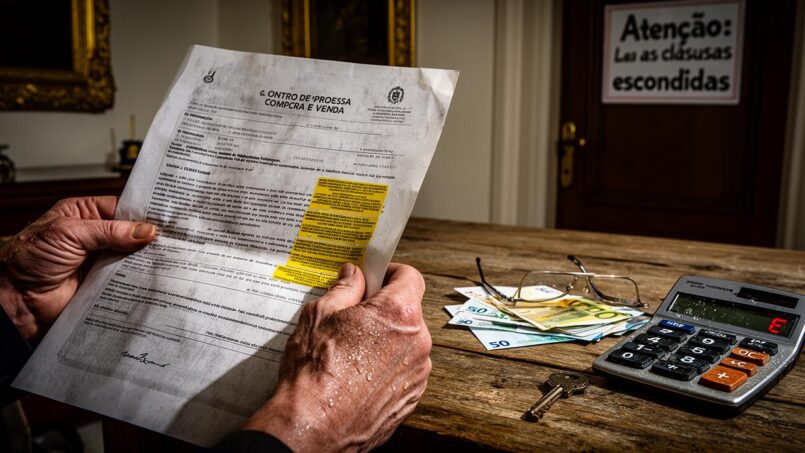
The mistake is to sign a CPCV (Promise of Purchase) relying solely on documents provided by the seller or agency, without independent verification, and then to discover these problems after the fact, when the deposit (often 10% to 20%, or even 30%) is already committed.
Off-plan: a minefield
Off-plan purchases multiply these risks. Frequently encountered problems include:
– significant delivery delays,
– changes in specifications (materials, finishes, areas),
– lack of licenses at the time of key handover,
– developer bankruptcy,
– structural defects or hidden faults,
– disputes over compliance with plans and specifications.
The Contrato-Promessa de Compra e Venda (CPCV) requires a deposit of 15% to 25% of the price, reducing the buyer’s leverage. The law requires a bank guarantee or insurance for payments >€5,000, and payments must follow verifiable construction milestones, not arbitrary dates.
Recommended best practices:
– check the developer: commercial register extract, balance sheet, litigation history (via the court portal),
– verify the existence of a construction license (Licença de Construção) and its compliance with the urban plan,
– require an independent financial guarantee covering insolvency or non-completion,
– structure delays and penalty clauses in the CPCV (0.5% to 1% of the price per month of delay is a benchmark),
– do not pay more than 30% before substantial progress of works,
– have all termination clauses verified, especially those that allow the developer to withdraw while retaining part or all of the deposit.
Sixth mistake: forgetting that Portugal is a market heavily targeted by scammers
The boom in foreign demand, combined with the complexity of the system, has made Portugal a prime hunting ground for real estate scams. The schemes vary, but follow recurring patterns:
– fake owners or “exclusive” intermediaries,
– pressure to make a quick down payment, often outside the standard notarial or banking circuit,
– properties that are too good and too cheap to be true,
– falsified or incomplete documents,
– off-plan projects that will never materialize.
Portuguese authorities have documented fraudulent networks that embezzled millions of euros from investors, particularly in the Algarve and major cities. The typical victim profile? A foreign investor, buying remotely or on a short visit, eager to “not miss the deal,” unfamiliar with local procedures, and ready to trust a convincing contact.
Portuguese authorities
The golden rule to protect yourself is simple: no large payment (beyond a small symbolic reservation fee, supervised by a lawyer) should be made without double verification:
– of the title deed (via the land registry),
– of the seller’s identity and legal capacity,
– of the payment channel (clearly identified notarial or bank escrow account, never a personal, unverifiable account).
Seventh mistake: neglecting the fit between project and rental regulations (AL)
Many investors bet on short-term tourist rentals (Alojamento Local, AL) to make their property profitable. Yet this segment is now one of the most regulated and monitored.
Key trends to keep in mind:
The end of the national freeze allows new license applications, except in ‘containment zones’ (Lisbon, Porto, etc.). Owners must take out liability insurance per unit, on penalty of license revocation. From 2026, Airbnb, Booking, and Vrbo will be required to check RNAL numbers and remove unlicensed listings. Fines of several tens of thousands of euros penalize violations.
In short: buying an apartment in the historic center of Lisbon or Porto “to do Airbnb” without first checking the possibility of obtaining or keeping an AL license is akin to Russian roulette. Thousands of owners risk losing this possibility in the coming years, with a direct impact on expected profitability.
How to structure a real estate project in Portugal while managing risks
Faced with this accumulation of risks — currency, tax, legal, scams, rental regulations — you need to reverse the classic process. Rather than falling in love with a property and then figuring out how to finance and secure it, it’s healthier to:
To succeed in your real estate purchase abroad, follow these steps: 1. Precisely define your investment profile (primary residence, standard rental, tourist rental, etc.). 2. Establish an overall budget including the price, fees and taxes (base of 10%), and a cushion of 7% to 15% for contingencies. 3. Develop a currency strategy with a specialist before viewing properties: calculate the euro envelope and the equivalent in your currency, set a rate via a forward if necessary, and plan the transfers. 4. Hire an independent lawyer who speaks your language from the start to check agencies, documents (registry, cadastre, licenses) and review contracts. 5. Do not accept any scheme that bypasses the notary or official banking channels for large payments. 6. For a rental project, especially tourist, check current and future local regulations, simulate profitability under a conservative scenario (occupancy rates, rates, taxes), and consider the possibility that tourist rental may become impossible, verifying profitability under long-term rental.
Currency risk: the blind spot that can ruin a good deal
Returning to currency risk helps understand the overall challenge: even if you perfectly master the other dimensions (price, due diligence, taxes, regulations), a total lack of currency strategy can alone be enough to compromise the profitability of the operation.
Typical currency-related mistakes:
Do not buy based on an unsecured rate, do not delay transfers hoping for a better rate only to end up paying more in a rush, do not convert all rents to your original currency without building a euro cushion for future expenses, and do not ignore the impact on asset value and debt ratios in your reference currency.
Faced with these risks, the following steps are particularly effective:
– talk to an FX specialist as soon as the idea of buying becomes serious, not after signing a promise to purchase,
– compare rates and fees of your bank with those of specialized providers,
– use forward contracts to lock in your euro cost,
– consider borrowing partially in euros or structuring the investment to create euro/euro flows (rents and expenses).
Conclusion: in Portugal, vigilance begins well before the first visit
Investing in real estate in Portugal is not in itself a bad idea. The country offers real assets: quality of life, tourist appeal, some developing regions, dynamic rental markets in major cities. But succeeding with your investment requires accepting a simple reality: this is not an easygoing market where you can improvise.
The pitfalls are numerous:
Inflated prices in tourist areas, confusion between asking price and real value, chronic underestimation of fees and taxes, legal and cadastral risk from sloppy due diligence, an environment conducive to scams targeting foreigners, shifting rental regulations (especially for AL), and currency risk that can wipe out gains or push the project into the red.
The best protection remains a professional approach: preparation, detailed simulations, guidance from experts (lawyer, currency specialist, possibly an engineer or building surveyor), and a refusal of shortcuts that seem to “save time”.
In Portugal more than elsewhere, what ends up costing dearly is generally not what you thought you were saving at the start, but what you neglected to check while there was still time.
Have a wealth project or a question? Contact us now to speak with a wealth management expert.
Disclaimer: The information provided on this website is for informational purposes only and does not constitute financial, legal, or professional advice. We encourage you to consult qualified experts before making any investment, real estate, or expatriation decisions. Although we strive to maintain up-to-date and accurate information, we do not guarantee the completeness, accuracy, or timeliness of the proposed content. As investment and expatriation involve risks, we disclaim any liability for potential losses or damages arising from the use of this site. Your use of this site confirms your acceptance of these terms and your understanding of the associated risks.

Cyril Jarnias is an independent expert in international wealth management with over 20 years of experience. As an expatriate himself, he is dedicated to helping individuals and business leaders build, protect, and pass on their wealth with complete peace of mind.
On his website, cyriljarnias.com, he shares his expertise on international real estate, offshore company formation, and expatriation.
Thanks to his expertise, he offers sound advice to optimize his clients' wealth management. Cyril Jarnias is also recognized for his appearances in many prestigious media outlets such as BFM Business, les Français de l’étranger, Le Figaro, Les Echos, and Mieux vivre votre argent, where he shares his knowledge and know-how in wealth management.