
 Published on and written by Cyril Jarnias
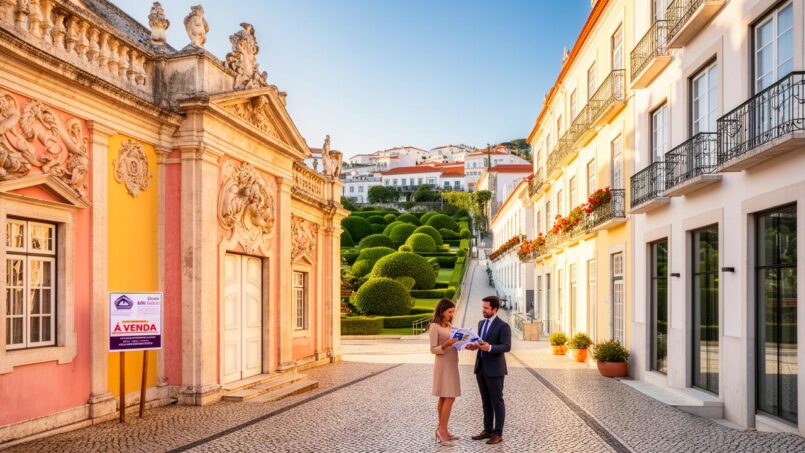
Sandwiched between Lisbon, Sintra, and Oeiras, the city of Queluz is quietly establishing itself as one of the most strategic real estate markets in the greater Lisbon region. For investors, it offers a rare compromise: the accessibility of a well-connected suburb, prices still lower than in Lisbon, a rising quality of life, and a vast urban renewal program already funded. All of this in a Portuguese context where housing supply is desperately lacking and prices continue to rise faster than the European average.
A Local Market Boosted by a Strained National Context
To understand the potential of real estate in Queluz, one must first look at what is happening across Portugal. The country has experienced one of the steepest price increases in Europe: home values have surged by approximately 17 to 19% year-on-year in certain recent periods, well above the eurozone average. The European Commission even considers the Portuguese residential market to be among the most overvalued in the EU, with prices 30 to 35% above the European average.
Number of new homes needed by 2035 to fill the structural deficit in Ireland.
In this context, major centers like Lisbon and Porto have seen values skyrocket, driven by domestic and international investment. The result: more and more buyers are turning to well-served neighboring municipalities, where prices remain more affordable but accessibility is excellent. This is precisely Queluz’s positioning.
How Much Does Real Estate Cost in Queluz Today?
Data from platforms like Properstar and local price tables paint a fairly consistent picture: real estate in Queluz is significantly cheaper than in central Lisbon neighborhoods, while showing clear signs of appreciation.
Average and Median Prices: Apartments and Houses
Figures from Properstar and other sources complement each other to provide a realistic range:
| Property Type | Median Price (€/m²) | Average Price (€/m²) |
|---|---|---|
| Apartment (all sizes) | 2,878 | 3,144 |
| House (all sizes) | 3,486 | 3,426 |
| Overall Market (aggregate) | — | 3,109 |
| Alternative Estimate (local market) | — | ≈ 1,800 |
The gaps in the data (notably the level around 1,800 €/m² for some segments) are explained by the diversity of the housing stock: small units in the city center, properties needing renovation, older buildings with potential, as well as more premium operations or high-end houses in the Queluz e Belas area.
The average apartment price in Lisbon is around 3,100 €/m², a figure well below the 5,000 €/m² reached in several central neighborhoods. This market remains accessible and offers a credible appreciation margin for investors.
By Property Size: Studios, Two-Bedrooms, Three-Bedrooms…
Statistics by typology confirm a classic phenomenon: smaller units are more expensive per square meter, while larger homes sometimes offer a better price-to-size ratio.
| Typology | Median Price (€/m²) |
|---|---|
| Studio | 3,310 |
| 1-bedroom | 2,977 |
| 2-bedroom | 2,869 |
| 3-bedroom | 2,838 |
| 4-bedroom | 2,734 |
| Typology | Average Price (€/m²) |
|---|---|
| Studio | 3,320 |
| 1-bedroom | 3,344 |
| 2-bedroom | 3,093 |
| 3-bedroom | 3,081 |
| 4-bedroom | 3,444 |
An interesting peculiarity stands out: in recent average data, 4-bedroom units rise above other typologies, a sign that an offering of larger, more quality apartments (or better located) is pulling the average up. For an investor, this indicates that there is solvent demand for well-positioned large three- and four-bedroom units, often sought after by families.
Houses: A More Dispersed but Dynamic Market
Houses most often have larger surfaces and varied configurations. Prices vary significantly depending on the number of rooms.
| Typology | Median Price (€/m²) |
|---|---|
| 3-bedroom | 2,849 |
| 4-bedroom | 3,787 |
| 5-bedroom | 4,610 |
| 6-bedroom | 2,837 |
| Typology | Average Price (€/m²) |
|---|---|
| 3-bedroom | 3,315 |
| 4-bedroom | 3,758 |
| 5-bedroom | 3,746 |
| 6-bedroom | 4,216 |
Large houses (5 or 6 bedrooms) can reach high levels per square meter, especially when they are high-end properties with gardens, pools, or integrated into premium residential complexes in the Queluz e Belas area. Thus, in the Queluz area, we find houses easily exceeding one million euros, and even beyond 2.5 million for residences of several hundred square meters with large plots and top-of-the-line features.
Some Concrete Price Benchmarks
To gauge the terrain, a few listing examples illustrate the granularity of the local market:
| Property (excerpt from listing) | Size | Price | Approx. Price/m² |
|---|---|---|---|
| Apartment 170 m² with garage, double glazing, fireplace | 170 m² | €490,000 | ≈ €2,882/m² |
| House 767 m² with garden and pool | 767 m² | €2,500,000 | ≈ €3,259/m² |
| Quinta 640 m² on large plot | 640 m² | €950,000 | ≈ €1,484/m² |
| Renovated 1-bedroom 98 m² | 98 m² | €155,000 | ≈ €1,582/m² |
| 6-bedroom 327 m² in gated community with pool, gardens | 327 m² | €2,100,000 | ≈ €6,422/m² |
| 2-bedroom 56 m² with balcony, rented for €797.52/month | 56 m² | €204,000 | ≈ €3,643/m² |
| 3-bedroom 84 m² with elevator | 84 m² | €370,000 | ≈ €4,405/m² |
| Renovated 2-bedroom 69 m² | 69 m² | €235,000 | ≈ €3,406/m² |
These figures confirm a very heterogeneous market, ranging from small units to renovate or already rented (sometimes below €2,000/m²) to very premium products exceeding €4,000/m², especially in gated communities or around Belas Clube de Campo.
A City in Transformation: Urban Rehabilitation and Major Projects
One of Queluz’s major assets for an investor lies in the depth of the requalification programs undertaken by the municipality of Sintra, to which the city belongs. The urban rehabilitation area of Queluz/Belas (ARU of Queluz e Belas) is at the heart of this strategy.
Queluz/Belas ARU: €23 Million to Transform the City
The municipality has adopted a strategic program for this ARU, with a projected investment volume of approximately €23 million. The goal is clear: revitalize the centers of Queluz and Belas, improve public spaces, enhance vacant areas, rehabilitate buildings, and strengthen landscape connections around the national palace and the Jamor and Carenque watercourses.
Among the flagship projects is the “Eixo Verde e Azul” (Green and Blue Axis), which will follow the Jamor valley, connecting Queluz to Belas and all the way to the river mouth in Caxias. This corridor will include bike lanes, pedestrian paths, and new green spaces. This project alone mobilizes about €11 million in planned expenditure.
Interventions include the rehabilitation of the Matinha de Queluz and Bairro Almeida Araújo neighborhoods, the expansion of the Felício Loureiro Urban Park, and the reclamation of the areas around Queluz Palace. These projects plan to reduce the role of cars and create continuous pedestrian routes.
Requalification of Major Thoroughfares and Station Surroundings
On the ground, several concrete projects are already underway or planned. One of the most structuring concerns the requalification of Avenida António Enes and the southern accesses to Queluz station. A contract of €1.343 million (of which €1.11 million is borne by the municipality and €233,000 by the water services SMAS) provides for, over 365 days of work, a complete overhaul of roads, sidewalks, living spaces, lighting networks, water and sanitation, as well as the replacement of waste collection equipment.
The operation takes place in two phases, covering the avenue, the southern esplanade of the station, and several adjacent streets. It is accompanied by temporary traffic measures, but in the long term should significantly improve safety, accessibility, and the attractiveness of this central sector, which already concentrates the municipal market, shops, and services.
Other interventions target key routes such as Avenida da República and streets in the center, with work on paving, road resurfacing, and pedestrian arrangements to promote soft mobility.
Queluz Palace, Parks, and Green Axes: An Urban Repositioning
Beyond the roads, the urban strategy around the Queluz Palace is particularly interesting for an investor aiming for the medium/long term. The municipality is working on a detailed rehabilitation plan for the palace’s special protection zone, with proposals to:
To requalify Queluz’s urban landscape, it is proposed to extend the Felício Loureiro urban park southward and northward to form a green belt. It also involves linking the park, the palace, the Bairro Almeida Araújo, and Quinta Nova through a coherent landscape network. Finally, a reconfiguration of the arrival at the Palace’s Terreiro is planned, with a reduction of the car’s presence on Avenida Engenheiro Duarte Pacheco and a strengthening of pedestrian continuities toward the palace gardens and the Matinha de Queluz.
These transformations, combined with the creation of new bike lanes along the Ribeira de Carenque up to the future municipal park of Serra da Carregueira, are intended to correct the historical deficit of green spaces in Queluz and reposition the city as a greener, more livable, and better-connected territory.
Tax Incentives for Rehabilitation
The ARU of Queluz e Belas is not limited to nice urban plans. It comes with a set of very concrete tax benefits for investors who embark on renovation:
| Benefit within the Queluz/Belas ARU | Detail |
|---|---|
| IMI exemption (municipal property tax) | For rehabilitated buildings |
| Reduced VAT on work | Rate of 6% on renovation |
| Reduction of municipal taxes | Up to 80% on certain fees |
For an investor who acquires an old building or an apartment to renovate in the center of Queluz, these mechanisms can make a significant difference in the economic balance of a rehabilitation operation, substantially improving the net yield over time.
Renting in Queluz: Yields Driven by the Gap with Lisbon
The rental market in Queluz reflects this intermediate positioning between large suburb and well-equipped independent city. The cost of living gap with Lisbon is one of the main drivers of demand.
Rental Levels: From Studio to Four-Bedroom
According to available data, the average rent in Queluz is around €1,361 per month, all categories combined, with a range from about €293 to €2,700 depending on size, condition, location, and level of furnishing. More detailed statistics give the following orders of magnitude:
| Type of Housing | Average Monthly Rent |
|---|---|
| 1-bedroom center | ≈ €600 |
| 1-bedroom outside center | ≈ €450 |
| 3-bedroom family | ≈ €1,200 |
| Overall average rent (all properties) | ≈ €1,361 |
Concretely, recent listings show for example:
Overview of monthly rent ranges for apartments in Paris, by type and location.
City center: approximately €950 to €1,100.
Between €1,000 and €1,300, depending on proximity to train stations and property condition.
Approximately €1,350 to €1,750, sometimes with parking included.
Can reach €1,600 to over €2,000, often renovated and furnished.
This range allows targeting various segments: students, young professionals, families, or even shared housing to optimize yields on large spaces.
A Cost of Living Approximately 20% Lower than Lisbon
One of the most powerful arguments in favor of Queluz for tenants – and therefore, indirectly, for landlords – is the cost differential compared to Lisbon. It is estimated that living in Queluz costs about 20% less than in the heart of the capital.
Several concrete examples illustrate this gain:
A family of four, originally from Lisbon, reduced their housing budget by about €300 per month by moving from a 3-bedroom at €1,600 in Lisbon to a more spacious 3-bedroom at €1,100 in Queluz. Meanwhile, a single resident reported saving €150 per month on groceries, with a food bill of around €200. Additionally, public transport is affordable, with a bus or train ticket costing about €1.50 per ride and offering competitive travel times to Lisbon.
These factors fuel a relocation movement from Lisbon to Queluz, especially for households that do not need to be in the center daily or can telework part of the week. For a rental investor, this translates into sustained demand, less volatile than in tourist hyper-centers.
Example of Gross Yield on a Rented Two-Bedroom
Among the listings, a two-bedroom of 56 m² with a balcony is offered at €204,000, and rented for €797.52 per month until September 2025. This gives an annual gross rent of about €9,570, or a gross yield close to 4.7%. In a context of a market appreciating and tax incentives within the ARU, this type of product can become even more attractive after optimization work or upon lease renegotiation.
Accessibility and Quality of Life: The “Well-Connected Suburb” Advantage
Investing in real estate in Queluz is not just about buying cheap square meters: it is betting on an extremely well-connected location, an environment that is strengthening, and a level of safety above the national average.
Road and Rail Connections
Queluz is integrated into a dense transport network. By car, the city is connected to Lisbon, Sintra, Cascais, and Oeiras via:
– the IC19, a major axis between Lisbon and Sintra;
– the CREL (A9) and other ring roads (IC16, IC17, CRIL, A5) providing quick access to major highways;
– regional roads to employment hubs (Taguspark, Oeiras industrial zones, etc.).
The Queluz-Belas, Monte Abraão, and Barcarena train stations allow reaching central Lisbon (Rossio) in under 20 minutes. Many properties are advertised as only a 5-minute walk from these stations, a major asset for their rental appeal.
Services, Shops, Schools, and Healthcare
The center of Queluz offers a very complete range: local shops, cafes, restaurants, schools, pharmacies, a municipal market, and administrative services (including a future Loja do Cidadão integrated into the market building, 100% funded at €550,000 through the recovery plan). In the immediate vicinity, there are national supermarket chains (Continente, Pingo Doce, Auchan), health centers, urban parks like Felício Loureiro or Casal da Barota, sports clubs, and pools.
The Queluz e Belas area also benefits from its proximity to Belas Clube de Campo, a vast private housing development renowned for its quality of life, its 18-hole golf course, sports facilities, the João de Deus school, local shops, and 24/7 security. Road links to the airport or Cascais beaches remain reasonable (around 15 to 30 minutes depending on traffic).
Safety: A Crime Rate Below Average
Crime statistics place Queluz below the Portuguese national average. The overall rate is about 25% lower than the country as a whole, with:
– approximately 18 property crime incidents per 1,000 inhabitants;
– approximately 2 cases of violent crime per 1,000 inhabitants.
This reassuring safety profile is an important argument for families and seniors, but also for investors targeting long-term rentals, especially near Queluz Palace and its gardens, considered one of the safest sectors.
Investment Opportunities: From Small Apartments to Entire Buildings
The offering in Queluz is broad enough to allow several strategies: traditional long-term rental, building rehabilitation, premium heritage product in Belas Clube de Campo, or even development on vacant land.
One-, Two-, and Three-Bedroom Apartments: The Core of the Rental Market
The bulk of the housing stock consists of 1- to 3-bedroom apartments, often in buildings from the 70s-90s, sometimes fully renovated. Typical sizes (60 to 80 m²), still affordable rents, and proximity to train stations make them the ideal foundation for a rental strategy.
Examples of listings reveal renovated two-bedrooms, sometimes already rented long-term (until 2031 for a fully furnished two-bedroom on Rua Bastos Nunes at €809/month), or three-bedrooms with elevators, shared gardens, or terraces, positioned at rents between €1,300 and €1,700.
For the investor, the key is to combine:
– good proximity to train stations/shops;
– exposure and natural light (often highlighted in listings);
– quality of renovation (insulation, double glazing, modern kitchens and bathrooms);
– potential for future rent increase upon expiration of an old lease.
Buildings and Properties to Rehabilitate
Several properties in Queluz offer interesting layouts for more ambitious strategies:
Two distinct properties with strong investment and value-addition potential.
A freehold building of 275 m² with two street frontages. Includes three 3-bedroom apartments (one duplex with balcony) and a 2+1 bedroom on the ground floor with patio and fruit trees.
A 431 m² building to renovate/rebuild in Queluz, on 2 floors + attic. Contains 1 commercial unit, 5 apartments, and 93.5 m² of outbuildings (garages, patio). Potential for upward extension subject to municipal approval, ideal for development or rental residences.
This type of asset fits perfectly within the framework of the ARU: the investor can benefit from significant tax relief while riding the wave of requalification of the historic center. The rental demand for modern, well-designed homes close to the Palace, the market, and train stations is real.
Land and Development Potential
The supply of land is more limited but not non-existent. For example:
– a plot of 1,024 m² near Queluz, 18 minutes from Lisbon;
– two parcels, one of 680 m², allowing for villa or small building projects.
Some properties, sold under the label “palacete” on large plots in urban zones, offer opportunities for conversion into boutique hotels, coliving, or serviced residences. These projects are subject to heritage constraints, especially if the property is located within the protection perimeter of the Palace.
Belas Clube de Campo and High-End Properties
Within the Queluz e Belas perimeter, the high-end segment is dominated by Belas Clube de Campo, a residential complex designed by André Jordan, regularly cited as one of the best places to live in Portugal. The houses there offer:
– large plots (often between 1,300 and 10,000 m²);
– private pool, sometimes heated;
– tennis or squash courts, gyms, home cinemas;
– cutting-edge technology (home automation, photovoltaic panels, hydraulic central heating);
– high-quality construction (effective insulation, noble materials).
Prices can reach several million dollars or euros for the most prestigious villas, with built areas of 600 to 900 m² and garages for multiple vehicles. These properties cater more to a high-net-worth and international clientele seeking primary or secondary residences rather than classic rentals, but some can work as premium long-term rentals or high-end furnished rentals, with high rents.
Financing: How a Non-Resident Can Buy in Queluz
One of the great advantages of the Portuguese market, and therefore of Queluz, is the relative ease of access to credit for foreigners. Portuguese banks are accustomed to working with non-residents, including for rental investments.
Typical Credit Conditions for Non-Residents
The main points emerging from studies on real estate financing in Portugal are as follows:
| Parameter | Common Practices for Non-Residents |
|---|---|
| Loan-to-Value (LTV) | 60 to 75% (sometimes 80% for the best cases) |
| Minimum Down Payment | Generally 30% of the price, sometimes 25 to 40% |
| Loan Term | 20 to 30 years (up to 35 years for some profiles) |
| Indicative Interest Rate | Approximately 3.5 to 4.5% in recent period |
| Debt-to-Income Ratio | 30 to 35% (can go up to 40 to 50% depending on bank) |
| Maximum Age at Loan Maturity | 75 to 80 years |
The process requires obtaining a Portuguese tax number (NIF), opening a local bank account, and providing complete documentation (passport, proof of income, bank statements, possibly balance sheets for self-employed, etc.). Specialized brokers can facilitate this process and put about fifteen banks in competition (Millennium BCP, Caixa Geral de Depósitos, Novobanco, BPI, Santander, Bankinter, Banco CTT, UCI, etc.).
Percentage of personal contribution recommended for purchasing an apartment in Queluz, representing €60,000 to €90,000 for a property worth €200,000 to €300,000.
Queluz in the Portuguese Tourism and Rental Dynamic
Queluz is not a tourist hotspot like Lisbon or the Algarve, but the presence of the National Palace, gardens, and future green axes makes it a developing cultural and leisure hub in the metropolitan area. The impact of the rise of tourism in Portugal is felt indirectly in this type of city.
The strong tourist demand has led to stricter regulation of short-term rentals (Alojamento Local) in historic centers. In the periphery, pressure is lower, offering an opportunity to develop a flexible furnished rental offering (medium/long stay) aimed at teleworkers, families in transition, or expats, with less volatility and regulatory risk than in the hyper-center.
For Queluz, the most relevant strategy generally remains long-term or medium-term rental rather than pure tourist rental. Demand is fueled by:
– flows of workers commuting to Lisbon or Sintra;
– families seeking a balance between price and quality of life;
– students and young professionals who prefer a well-connected but cheaper city than Lisbon.
In the future, the improvement of green spaces, cycling connections, and the Palace’s surroundings should strengthen Queluz’s image as a pleasant city to live in, which in turn can support rents and property values.
Investment Strategies Suitable for Queluz
Given the price data, urban dynamics, and financing conditions, several approaches stand out as particularly relevant.
1. Small or Medium Apartment for Long-Term Rental
This is the simplest and most straightforward strategy. The investor:
– targets a studio, one-bedroom, or small two-bedroom in the center or within a 10-minute walk of a train station;
– ensures quality renovation, as “turnkey” properties rent faster and for more money;
– sets the rent within the market range, benefiting from the gap with Lisbon;
– benefits from stable demand from an active and family population.
With purchase prices often between €150,000 and €300,000 for this type of property, and monthly rents of €800 to €1,300, one can aim for gross yields typically between 4 and 6%, with a perspective of capital appreciation related to the gradual catch-up with Lisbon.
2. Old Building to Renovate in an ARU
A more technical but potentially more lucrative strategy:
Acquiring a multi-unit building (e.g., commercial + apartments) allows benefiting from the ARU regime (Buy-Rehabilitate-Rent). This scheme offers a property tax exemption, reduced VAT on work, and reduced municipal taxes, significantly lowering the cost of rehabilitation. It is then possible to reconfigure the homes into typologies suited to the market (2-bed/3-bed) for rental.
This approach allows pooling certain costs (roofing, facade, networks) and creating a homogeneous, modern product in a revitalizing city center. However, it requires a good grasp of the regulatory framework, relationships with the municipality, and project management.
3. Premium Heritage Product in the Belas Area
For investors seeking a prestige asset rather than a pure yield product, the villas of Belas Clube de Campo or large quintas in the vicinity constitute an alternative to the most expensive neighborhoods of Lisbon or Cascais.
One then bets on: collective efforts, determination, and commitment from everyone to achieve a common goal. (Note: This sentence seems out of context in the original French; I will preserve it as a literal translation, though it may be a textual error. The following bullet points seem to be the intended continuation.)
– on the scarcity of the product: large plot, front-line golf, high-end features;
– on security and services of the condominium;
– on a clientele of wealthy locals and internationals, often seeking primary or secondary residences.
In the Lisbon-Sintra-Cascais corridor, the gross rental yield may be more modest in case of partial vacancy. However, the perspective of capital appreciation is interesting, especially given the anticipation of rising land values and urbanization in this area.
4. Lisbon/Queluz Arbitrage: Capturing Demand Leaving the Capital
Finally, a portfolio strategy consists of fully capitalizing on the price level gap between Lisbon and Queluz. As prices in the Lisbon center drift away from median purchasing power, there is a spillover effect on neighboring municipalities. Investing in Queluz is betting on this sprawl, targeting:
– households leaving Lisbon but wanting to stay within a 20-minute train ride;
– teleworkers who choose larger, greener homes;
– families for whom safety and proximity to schools are priorities.
This movement is reinforced by public policies: green axis projects, new parks, improved accessibility, opening of services like the Loja do Cidadão, massive investment in public space rehabilitation. All these factors tend to reduce the perception gap between “suburb” and “desirable city.”
In Summary: Queluz, a Market at a Crossroads
Investing in real estate in Queluz means positioning oneself in a market still undervalued compared to Lisbon but driven by powerful structural forces: a national housing shortage, pent-up demand from urban middle classes, heavy urban requalification programs, improvement of soft mobility and green spaces, and attractive tax benefits in rehabilitation zones.
The average price per square meter for a well-located apartment in Porto is around €3,000.
For an investor, the key will be to choose the right strategy – classic rental apartment, building to transform, premium villa – taking into account their time horizon, risk tolerance, and ability to manage a rehabilitation project. But one thing is clear: on the fringe of the capital, Queluz ticks more and more boxes to become one of the preferred playgrounds for real estate investors seeking an intelligent compromise between yield, security, and value-add potential.
Disclaimer: The information provided on this website is for informational purposes only and does not constitute financial, legal, or professional advice. We encourage you to consult qualified experts before making any investment, real estate, or expatriation decisions. Although we strive to maintain up-to-date and accurate information, we do not guarantee the completeness, accuracy, or timeliness of the proposed content. As investment and expatriation involve risks, we disclaim any liability for potential losses or damages arising from the use of this site. Your use of this site confirms your acceptance of these terms and your understanding of the associated risks.

Cyril Jarnias is an independent expert in international wealth management with over 20 years of experience. As an expatriate himself, he is dedicated to helping individuals and business leaders build, protect, and pass on their wealth with complete peace of mind.
On his website, cyriljarnias.com, he shares his expertise on international real estate, offshore company formation, and expatriation.
Thanks to his expertise, he offers sound advice to optimize his clients' wealth management. Cyril Jarnias is also recognized for his appearances in many prestigious media outlets such as BFM Business, les Français de l’étranger, Le Figaro, Les Echos, and Mieux vivre votre argent, where he shares his knowledge and know-how in wealth management.





