
 Published on and written by Cyril Jarnias
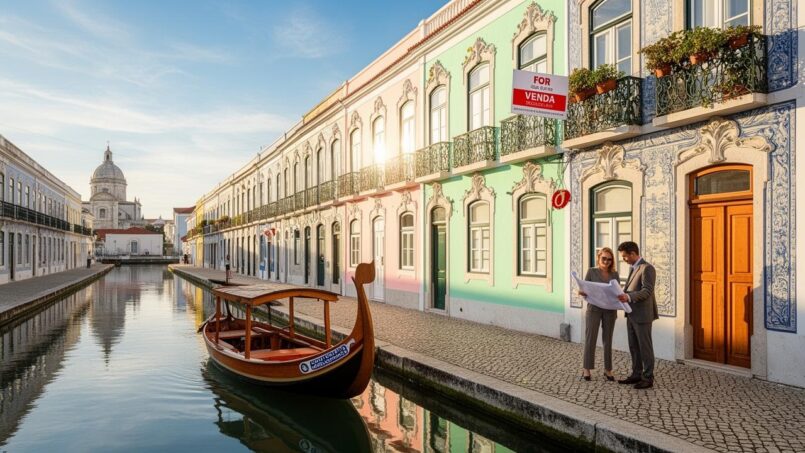
Aveiro is no longer just the “Venice of Portugal” visited for its moliceiros and Art Nouveau façades. The city is becoming a true urban, technological, and logistics laboratory, with a real estate market that is skyrocketing but has not yet reached the levels of Lisbon or Porto. For an investor, this is a rare combination: strong appreciation dynamics, a diversified economy, solid rental demand… and prices that are still affordable by national standards.
This article provides a comprehensive analysis of the Aveiro real estate market, including current data on prices and rents, rental yields, as well as the major urban, port, and technology projects shaping the city’s future development.
Aveiro, Between Lagoon, Atlantic Port, and Tech Hub
Aveiro stretches along the Ria de Aveiro on Portugal’s west coast. Its canals wind through the center, crossed by moliceiros—those former seaweed-harvesting boats now dedicated to tourist rides. But behind the postcard lies a territory of innovation and logistics accelerating rapidly.
The city combines several key advantages for medium-to-long-term real estate investment.
Located just a ten-minute drive from the beaches of Costa Nova, Barra, and São Jacinto, the city also offers excellent access to major urban centers: less than an hour to Porto and Coimbra, and about two and a half hours to Lisbon. This accessibility is enhanced by rail links and a modernized highway network (A25, A17). You therefore enjoy the tranquility of a medium-sized city while remaining perfectly connected to Portugal’s main destinations and a nearby international airport.
Then there’s its economy: the Port of Aveiro is one of the country’s major ports, specializing in industrial bulk but committed to a logistics upgrade, while the industrial fabric is highly diversified (agri-food, ceramics, chemicals, metallurgy, construction, software). The presence of technology companies like PT Inovação and SAPO, and especially the University of Aveiro, plays a driving role in regional development, particularly in telecoms, digital, and the environment.
Total budget in millions of euros for the Aveiro STEAM City program, of which 4.9 million is EU-funded.
A Real Estate Market in Strong Growth, Still Affordable
The real estate market in Aveiro is clearly in a catch-up phase. Prices have risen sharply but remain below those of Portugal’s major metropolitan areas.
According to the latest available data:
– The average asking price in Aveiro city is around 3,377 €/m².
– At the district level, the average price is lower, approximately 2,106–2,360 €/m².
– Prices have increased by about 19.1% since early 2022, with an 8% rise for houses and 11% for apartments over the last recorded twelve months.
The average price per square meter in Aveiro has doubled over this period.
So we are in an interesting window: a market already dynamic, supported by solid fundamentals (economy, university, port, innovation…), but where price levels still leave room for future increases.
Prices by Property Type and Overall Yield
Aggregated data for the city and district of Aveiro provide an idea of the entry ticket and average yields.
Average Yields and Prices in the Aveiro District
| Property Type | Average Price (€) | Average Monthly Rent (€) | Average Gross Yield |
|---|---|---|---|
| Studio | 184,250 | 750 | 4.88% |
| 1-Bedroom | 229,430 | 900 | 4.71% |
| 2-Bedroom | 295,000 | 1,000 | 4.07% |
| 3-Bedroom | 325,000 | 1,100 | 4.06% |
| 4-Bedroom + | 340,000 | 1,600 | 5.65% |
At the city level, the average gross rental yield for apartments is around 4.12%, with a range of 3.8% to 5.5% depending on type and location. In the city center, market studies indicate yields of 4.5% to 5%, while the entire district averages 4.4%–6.5%, with some inland municipalities exceeding 7%.
For very well-optimized rental properties, yields are slightly lower than those seen in markets like Lisbon or Porto. However, such investments often offer a more comfortable risk-return profile, combined with lower acquisition prices, thus providing a different and potentially more accessible proposition.
Average Budget in Aveiro City
The city’s average figures are telling:
| Indicator | Aveiro City |
|---|---|
| Average property price | €362,500 |
| Average monthly rent | €980 |
| Average yield | 3.99%–4.12% |
| Time to “pay off” the property (gross rent) | ~30.8 years |
In short, the market is not a “golden goose” with extravagant yields, but it offers a good compromise between likely appreciation, reasonable liquidity, and regular rental income.
Where to Invest in Aveiro: Historic Center, Modern Neighborhoods, Coast, or Hinterland
The region’s great strength is the variety of micro-markets. Between the historic urban center, new residential developments, tourist coastal villages, and the rural interior, investors can tailor their strategy (yield, capital gains, second home, short-term rental, student co-living…).
Historic Center and City Core (Glória e Vera Cruz)
Aveiro’s center, especially the parish of Glória e Vera Cruz, is the most sought-after and most expensive area: around 3,179 €/m². You’ll find old buildings with high ceilings, azulejos, Art Nouveau façades, and dense urban life along the canals.
Strengths: charm, everything within walking distance, high tourist and urban demand, excellent liquidity. It is also the preferred area for furnished annual rentals or medium-term rentals (digital nomads, researchers, young professionals).
Indicative prices:
| Product Type | Indicative Price (€/m²) |
|---|---|
| Renovated / recent apartments | 2,200 – 3,000 |
| Old properties needing renovation | 1,200 – 2,000 |
| Well-located central apartments (average) | ≈ 2,000 |
Small units (studios, 1-bedrooms) are especially popular with investors, as they rent quickly to students, young professionals, or medium-stay tourists. On the downside, you have to contend with sometimes aging condominiums, structural work (roofs, façades), and parking hassles.
Recent Residential Neighborhoods Around the Center
10–15 minutes from the center, new residential developments offer modern buildings with elevators, good energy performance, secure parking, balconies or terraces. They target families, teleworkers, and first-time buyers.
Real estate prices generally range between 2,200 and 3,000 €/m², influenced by the quality of finishes, services (garage, garden, orientation), and proximity to public transportation. These areas offer notable interest for rental investors.
– simpler management (recent buildings, fewer structural issues),
– controlled costs,
– stable demand (local families, executives, teleworkers).
Residential Neighborhoods in the City: Esgueira, Aradas, Santa Joana, São Bernardo
As central prices rise, bordering parishes gain popularity. This is particularly true of Esgueira, Aradas, Oliveirinha, Santa Joana, São Bernardo, where buyers find more space for a given budget, often with easy access to the center.
Some price benchmarks (source: Idealista, 2023 data):
| Neighborhood | Average Price (€/m²) |
|---|---|
| Esgueira | 2,337 |
| Aradas | 1,986 |
| Santa Joana | 1,545 |
| São Bernardo | 1,544 |
| Oliveirinha | 1,485 |
These softer prices, combined with reasonable proximity to the center, make them good playgrounds for mixed strategies: primary residence plus student room rental, co-living, buy-renovate-sell…
The Beaches: Costa Nova, Praia da Barra, São Jacinto
For a second home or a pleasure-oriented project, the coastal strip is essential.
The price per square meter for character properties with lagoon views or waterfront in Costa Nova, potentially exceeding €4,500 on the front line.
– Praia da Barra, dominated by Portugal’s tallest lighthouse (Farol da Barra), offers large beaches, a surf vibe, restaurants, and shops within walking distance. Apartments with views are around 2,500–4,000 €/m², houses can reach 3,500–4,500 €/m².
– São Jacinto, accessible by ferry from Aveiro, is a peaceful village bordering a nature reserve and dunes. Prices are more contained (1,800–2,500 €/m²), sometimes with houses with land. It is an ideal niche for those wanting to combine preserved nature, an eco-friendly project, and more intimate seasonal rentals.
Seaside real estate investment involves high seasonality for rentals and requires more demanding property management (concierge, variable check-in times, increased maintenance due to salt and wind). In the medium term, land supply tension is anticipated, which may also represent a capital gain potential.
Hinterland and Bairrada: Space, Charm, and Controlled Budget
Inland, the Bairrada region (Anadia, Oliveira do Bairro, Águeda) and more remote areas like Sever do Vouga offer a different equation: large spaces, houses with land, vineyards, thermal spas, and a per-square-meter cost often between 800 and 1,500 €/m², sometimes less for properties needing renovation.
Quintas with land frequently fall within the €150,000–300,000 range. Projects can include a main house, a rural guesthouse, or an active retirement with a vegetable garden or horses. However, one must account for:
– a slower pace of life,
– the need for a vehicle,
– sometimes extensive renovation work (insulation, windows, sanitation).
For investors comfortable with renovation, these areas represent an interesting “trade-off” compared to coastal zones, with significant value creation potential.
A Rental Market Driven by University, Tourism, and Expats
One of Aveiro’s major strengths for an investor is the diversity of rental demand.
Traditional Rental and Student Cohabitation
The University of Aveiro plays a central role. It attracts a significant annual flow of Portuguese and international students, as well as researchers, teachers, and administrative staff. The neighborhoods of the center, Santiago, Glória, Esgueira, Aradas, are particularly popular.
Market indicators are solid:
– High demand for studios and 1-bedroom apartments near the center and bus/train stops.
– Shared rooms (co-living) go quickly at the start of the academic year.
– Housing near the train station, Forca-Vouga, Glória, or the campus is considered a safe bet.
– Annual occupancy rates typically range between 85% and 92% in well-positioned student zones.
Indicative rents:
| Rental Type | Indicative Monthly Rent |
|---|---|
| Room in shared accommodation | €300 – €450 |
| Well-located 1-bedroom apartment | €650 – €900 |
| Average overall rent in Aveiro | ≈ €980 |
| Average rent per m² (city) | ≈ €11.3/m² |
Gross yields in central neighborhoods, according to various sources, range between 4.5% and 5%, with a tendency toward 5.3% for the city and up to 6.5% at the district level. The key advantage lies in low vacancy, especially if the property is furnished, well-maintained, and equipped with modern amenities (fiber internet, good heating, soundproofing).
Short-Term and Mid-Term Rentals
Tourism in Aveiro has exploded in recent years: canal cruises, religious and Art Nouveau heritage, gastronomy (fish, seafood, famous “ovos moles“), surrounding beaches, surfing at Furadouro and Torreira… Added to this is a growing presence of teleworkers and digital nomads.
Overview of key data regarding the tourist and seasonal rental market
Analysis of the number of active listings and booking frequency on the platform.
Mapping of areas with the highest concentration of this type of accommodation.
Evolution of average rates charged by season and property type.
Distribution between apartments, entire houses, and private rooms.
Average number of occupied nights per year and peak demand periods.
Estimation of revenue generated for owners and contribution to the local economy.
– Median annual revenue around €20,000 per property.
– Average monthly revenue ≈ €1,712.
– ADR (average nightly rate) between €95 and €97.
– Median occupancy rate between 55% and 56%, with approximately 204 nights booked per year.
Seasonality is marked, with a highly profitable peak in August and a low in February. Aveiro’s market ranks rather low nationally in terms of pure short-term rental yield, especially since the increase in supply (+21.1% in listings in one year, +63.9% in three years).
Aveiro rental market analysis
In clear terms, short-term rentals can be profitable, especially in the city center and on the coast, but they require:
– professional management,
– a strategy to smooth seasonality (mid-term stays off-season),
– a good understanding of the strict Alojamento Local (AL) regulations in Aveiro.
In practice, many investors now favor mid-term rentals (1 to 11 months) that combine:
– more stability,
– fewer constraints than short-term AL,
– and a diverse clientele (international students, researchers, digital nomads, employees on assignment).
Yields: Aveiro vs. Other Portuguese Markets
Compared to other university and coastal cities, Aveiro offers a rather balanced profile.
| Location | Average Rental Yield |
|---|---|
| Aveiro city | ≈ 3.99% – 4.12% |
| Aveiro district | ≈ 4.4% – 6.5% |
| Ílhavo | ≈ 5.7% |
| Santa Maria da Feira | ≈ 5.4% |
| Lisbon (overall) | ≈ 3.9% – 4.8% |
| Cascais (prime) | up to 5.7% |
| Coimbra (center/periphery) | ≈ 6.0% – 7.5% |
| Algarve (average) | ≈ 4.7% (high seasonality) |
Aveiro therefore does not deliver the highest gross yields in the country, but it positions itself advantageously when factoring in the likelihood of capital gains, demand stability, and quality of life.
Landmark Projects Supporting Real Estate Value
Beyond the numbers, what truly distinguishes Aveiro from simple “beach” towns are the major infrastructure and innovation projects unfolding there. They form a long-term growth foundation from which real estate investors will benefit.
Modernization of the Port of Aveiro and Energy Transition
The port is at the heart of this dynamic. Several major projects are underway:
– A strategic modernization and energy transition project worth €1.74 billion, including the construction of a 60 kV high-voltage power line between Gafanha da Nazaré and the port. Objective: strengthen the port’s electrical grid, meet growing energy needs, and enable shore-side power supply for ships (On Shore Power Supply – OPS), thereby reducing greenhouse gas emissions.
– This initiative is part of the energy transition strategy approved by the Port of Aveiro Administration in 2021 and aligns the port with the goals of the European Green Deal: –55% emissions by 2030 and carbon neutrality by 2050. It also prepares for the gradual electrification of port equipment and the attraction of new businesses.
The overall envelope of €5M funds the requalification of Avenida Marginal and dredging of the fishing port to strengthen climate resilience and modernize infrastructure.
In the medium term, the port also plans to lift the draft constraint currently limiting access for large vessels (container ships, cruise ships), through work on the south breakwater and access channel. A project for a new container terminal (ZALI Terminal) connected to 12 railway lines heading to the European hinterland is on the table. This would strengthen Aveiro’s logistics role, a key link in the TEN‑T Atlantic corridor.
For real estate, these projects mean:
– more local jobs, including skilled ones,
– more businesses connected to the port,
– a strengthened positioning as a logistics hub for the Central region.
All factors that fuel sustained demand for housing, whether for workers, executives, or families.
Aveiro Tech City and the 5G Living Lab: A Magnet for Talent
The Aveiro STEAM City program (€6.1M, of which €4.9M is EU-funded through Urban Innovative Actions) is described as the backbone of the “Aveiro Tech City” strategy. It pursues several objectives:
To succeed in its transformation, a territory must align its digital skills offering with the needs of local businesses, deploy advanced telecommunications infrastructure (5G, fiber, sensors), and position itself as an “open-air laboratory” to test urban solutions, IoT products, and digital services.
Concretely, the Aveiro Living Lab includes:
– 16 km of fiber optic cable connecting 44 communication points distributed across the city (smart lampposts, wall boxes),
– 25 reconfigurable radio units supporting multiple communication technologies,
– a 5G network covering 5 km², including the city center and the university campus,
– a set of use cases in mobility (buses equipped with V2X, radars, LiDAR, cameras, smart parking), environment (air quality measurement stations), and energy (electrification of tourist moliceiros, charging stations at 10 quays).
This setup attracts startups and scaleups: the second edition of the Aveiro Urban & 5G Challenges received 59 applications, with 15 projects tested in the Living Lab. Over 40 companies and R&D centers have already developed projects on this platform, gaining technological readiness levels (TRL). Result: Aveiro is becoming a recognized “digital cluster”, capable of attracting international companies and highly skilled talent.
The figures for the “Education & Training” dimension are equally impressive.
– 42 schools equipped with Tech Labs,
– over 500 teachers trained,
– 22,600 students involved,
– 3 bootcamps, 59 interns (out of 450 applicants), with a 75% integration rate into the local job market.
For the real estate investor, this translates into: the need to adopt a strategic approach and thoroughly understand the market to maximize returns.
– a very diverse tenant base (students, engineers, developers, researchers),
– an upscale shift in the socio-economic fabric,
– a city perceived as innovative and attractive, a factor in property appreciation over the medium to long term.
Nature, Climate Resilience, and Quality of Life
Aveiro does not forget its fragile lagoon environment. Projects like NBSInfra (Nature-Based Solutions) aim to renature center–periphery connections, secure water management, create soft mobility paths, preserve biodiversity, and enhance climate resilience. The city wants to move from manual flood management to an integrated approach linking blue and green infrastructure.
This focus on resilience and quality planning increases residential appeal: more green spaces (Jardim do Rossio, Parque de Santa Joana), bike lanes, leisure parks… all arguments for families, active seniors, expats, and digital nomads, who increasingly prefer well-designed medium-sized cities over congested metropolises.
Tax Framework, Yields, and Financing: What the Investor Needs to Know
Investing in real estate in Aveiro requires mastering a minimum of Portuguese taxation and financing rules.
Taxation at Purchase and Holding
The main taxes are common throughout the country, but a few provisions deserve mention given Aveiro’s prices.
– IMT (property transfer tax): for a primary residence, IMT is due above approximately €106,346 of taxable value. The rate is progressive, up to a cap of 7.5% above €1,150,853. For first-time buyers under 35, the exemption threshold rises to €330,539 under a specific scheme (“IMT Jovem”).
– Stamp duty on acquisition: 0.8% of the purchase price (partial exemption possible under IMT Jovem).
– IMI (property tax): for urban properties, between 0.3% and 0.45% of the cadastral value (VPT), set by the municipality. In Aveiro, this generally remains moderate, especially since the VPT is often 3 to 4 times lower than the market value. Exemptions possible (up to 3 years for primary residence or rental, even permanent for very low-income households).
For a non-resident investor, rental income is generally taxed at 25% of net income, with an effective rate often reduced to between 15% and 22% after deductions. For residents, reduced regimes exist, especially for rentals at so-called “moderate” rents.
Long-Term Rentals and Tax Incentives
The Portuguese government seeks to encourage long-term rentals at controlled prices. Under recent measures, rental income of €2,300/month or less can benefit from a flat tax rate of 10% (instead of 25%) if the lease lasts at least 3 years. For companies, only 50% of such income is then taken into account for the tax base.
For investments in 1- or 2-bedroom apartments in Aveiro (rents €600–900), this scheme improves net yield. It also allows for a reduced VAT rate of 6% on renovation work for residential buildings.
Short-Term Rentals (Alojamento Local): Regulations and Risks
Short-term tourist rentals (Alojamento Local – AL) are governed by a specific legal framework (Decree-Law 128/2014, amended by DL 76/2024). Key points:
Operating a tourist accommodation (AL) in Portugal, especially in Aveiro, is subject to strict regulations. It requires an AL license and registration via the Balcão do Empreendedor portal, with a RNAL number to display. Processing time is 60 to 90 days. Condominiums can oppose the establishment of an AL. National capacity limits apply (9 rooms, 27 guests). Inspections are active and fines for non-compliance are heavy, up to €40,000 for an individual. The compliance rate in Aveiro is estimated at 95.3%.
In Aveiro, regulations are described as “strict”. Before basing a business plan on short-term rentals, it is therefore essential:
– to check local rules (possible containment zones),
– to assess competition (over 1,000 active listings),
– and to consider a Plan B (switching to mid- or long-term rental).
Bank Financing: Conditions for Residents and Non-Residents
Portuguese banks finance foreigners without difficulty, provided standard ratios are met:
– For residents buying their primary residence: 80–90% LTV, i.e., 10–20% down payment.
– For non-residents: 60–70% LTV most often, i.e., 30–40% down payment.
Rates remain reasonable by European standards, around 4.0–4.5% for new fixed or mixed-rate loans, sometimes slightly lower for good profiles. Loans extend up to 25–30 years, with a term aligned with the borrower’s age (often ending before age 70–80).
A foreign investor will need to: comply with local regulations, evaluate investment risks, consider tax aspects, analyze the target market and establish strategic partnerships.
– obtain a NIF (Portuguese tax number),
– open a local bank account,
– provide income proof, bank statements, and usually a credit report from their home country.
Ancillary costs (application, notary, mortgage registration, stamp duty on the loan at 0.6%) bring total transaction costs generally between 6% and 10% of the purchase price.
Investment Strategies in Aveiro: Some Typical Profiles
Depending on whether the goal is a second home, rental yield, or capital gains, the areas and products to target vary.
Second Home with Resale Potential
In this scenario, the most consistent sectors are the coast (Costa Nova, Barra, São Jacinto) and certain parts of the historic center, with the idea of enjoying the property for several weeks a year and capitalizing on a medium-term resale.
On the coast, one must accept:
– tourist seasonality,
– higher land costs,
– management of marine climate effects (corrosion, maintenance).
In exchange, one gets a rare product, therefore potentially very strong in value, especially if renovation is done carefully and heritage constraints are respected.
“Yield + Capital Gains” Strategy in the City
For a classic rental investor aiming for both regular income and capital appreciation, the city center and neighborhoods like Glória, Esgueira, Aradas, Santa Joana, São Bernardo are natural candidates.
A typical strategy:
To optimize your rental investment, target 1- or 2-bedroom apartments near the university, train station, or the Ria. Prioritize recent or well-renovated buildings to limit the risk of unpleasant technical surprises. For this type of property, offer 9- to 12-month leases suitable for students or recent graduates. Finally, if permissible and profitable, consider a few weeks of short-term rentals during the summer.
Target gross yields typically range between 4% and 6%, with good visibility on demand.
Renovation of Older Buildings
The historic center and some district villages are full of old buildings offering good margins after renovation. Acquisition prices can start at 1,200–2,000 €/m² for properties needing rehabilitation, with renovation costs estimated between 1,200 and 2,000 €/m² depending on condition and finish level.
The potential is twofold:
This is the price range in euros per square meter at which renovated, clean apartments can be resold.
Be careful not to underestimate:
– humidity typical of coastal cities,
– the need for structural inspections (roof, façade, foundations),
– heritage conservation standards in protected areas.
A complete diagnosis by a local professional familiar with Aveiro building pathologies is essential before any offer.
Long-Term in the Countryside: Bairrada, Sever do Vouga, etc.
For a more patient profile seeking space, nature, and slow but robust appreciation, the municipalities of Anadia, Oliveira do Bairro, Águeda, Sever do Vouga or nearby rural areas offer yields sometimes higher than Aveiro city, with much lower entry prices.
Possible scenarios:
– main house + guest rooms,
– quinta to develop for event rentals or remote work retreat,
– purchase of several small lots to renovate to build a portfolio.
The key remains analyzing connectivity (fiber, 4G), services (schools, healthcare, shops), and resale potential.
Process for Foreigners and Due Diligence Best Practices
Foreigners can freely purchase property in Portugal. The typical procedure for investing in real estate in Aveiro follows a few essential steps:
1. Obtain a NIF (tax identification number). 2. Open a Portuguese bank account. 3. Sign a promissory contract (CPCV) after necessary checks. 4. Sign the final deed before a notary, with registration at the Conservatória do Registo Predial and declaration to the Autoridade Tributária.
Before committing, several verifications are crucial:
Inspecting an old house in a coastal area requires a complete inspection by an experienced professional. They must check the structure, humidity risks, roof condition, and installations, paying particular attention to coastal specifics such as salt corrosion and seepage. For older properties, it is crucial to verify compliance with conservation rules and assess the potential for upgrades, especially for electricity and insulation.
– Renovation cost analysis: obtain detailed quotes from several contractors, including for invisible work (insulation, networks, structure), and include a safety cushion (10–20% of the budget).
– Check planning permissions: previous extensions or modifications must be legal. Any regularization can be costly in time and money.
– Precise rental market study: do not rely solely on averages. Compare listings and achieved rents in the same street/neighborhood, for strictly comparable properties (size, condition, furnishings).
Finally, accounting for annual holding costs (IMI, condominium fees, insurance, maintenance, possible property management) is essential to verify the solidity of net yield.
Conclusion: Why Aveiro Deserves a Place in a Real Estate Portfolio
Investing in real estate in Aveiro means betting on a mid-sized city that combines characteristics rarely found together:
– A strategic port undergoing modernization and energy transition, connected to a dynamic hinterland and major logistics projects.
– A top-tier university and a booming tech ecosystem, thanks to Aveiro Tech City and the 5G Living Lab, sustainably enhancing attractiveness for talent.
– A high quality of life (lagoon, beaches, heritage, gastronomy), appealing to students, families, expats, and teleworkers alike.
– A rapidly rising real estate market, yet still significantly more affordable than Lisbon, Porto, or the Algarve.
– Decent rental yields (4–6% on average) with diversified demand and limited vacancy in good areas.
The Portuguese real estate market is structurally bullish, supported by a housing deficit, strong local and international demand, and public policies favoring renovation and long-term rentals. The city of Aveiro has strong potential, being less exposed to speculation than the major capitals while benefiting from current trends such as teleworking, business relocation, and the appeal of pleasant, well-connected mid-sized cities.
For an investor willing to make the effort to understand its micro-markets, to focus on property quality, and to secure a rental strategy (especially regarding AL), investing in real estate in Aveiro can prove to be a particularly relevant choice, at the crossroads of reasonable yield and likely long-term capital appreciation.
Disclaimer: The information provided on this website is for informational purposes only and does not constitute financial, legal, or professional advice. We encourage you to consult qualified experts before making any investment, real estate, or expatriation decisions. Although we strive to maintain up-to-date and accurate information, we do not guarantee the completeness, accuracy, or timeliness of the proposed content. As investment and expatriation involve risks, we disclaim any liability for potential losses or damages arising from the use of this site. Your use of this site confirms your acceptance of these terms and your understanding of the associated risks.

Cyril Jarnias is an independent expert in international wealth management with over 20 years of experience. As an expatriate himself, he is dedicated to helping individuals and business leaders build, protect, and pass on their wealth with complete peace of mind.
On his website, cyriljarnias.com, he shares his expertise on international real estate, offshore company formation, and expatriation.
Thanks to his expertise, he offers sound advice to optimize his clients' wealth management. Cyril Jarnias is also recognized for his appearances in many prestigious media outlets such as BFM Business, les Français de l’étranger, Le Figaro, Les Echos, and Mieux vivre votre argent, where he shares his knowledge and know-how in wealth management.





