
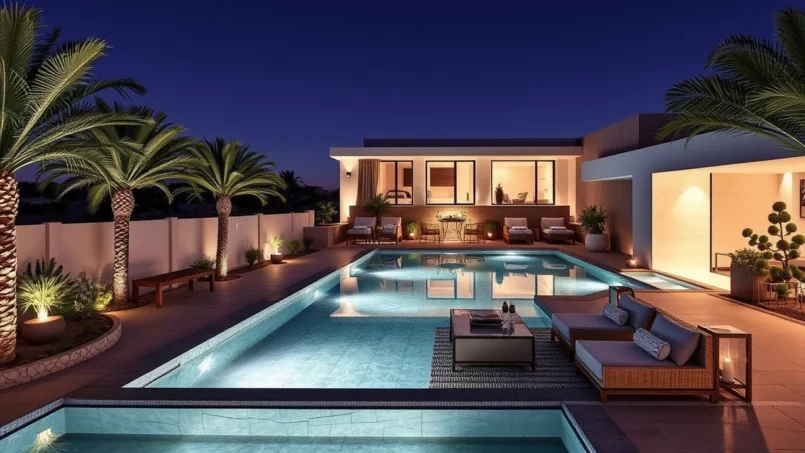
 Published on and written by Cyril Jarnias
Tunisia’s luxury property market is undergoing a significant transformation. Fueled by a tourism boom, an upscaling of the residential offering, and price positioning far below other Mediterranean destinations, it is once again attracting Tunisian and foreign investors. But behind the villas of Sidi Bou Said, the riads of Carthage, or the gated communities of Gammarth lies a legal and financial environment more complex than it appears.
This article covers the essentials of the high-end market: price trends, the most sought-after areas, buyer profiles, examples of properties, potential rental yields, as well as the legal framework, applicable taxation, and main risks to anticipate for any investment.
A Recovering Market, Boosted by Tourism and a “Value” Positioning in the Mediterranean
The Tunisian real estate market is gradually emerging from a turbulent decade marked by political crises, terrorism, and then the pandemic. Figures, however, show remarkable resilience, especially in the residential segment.
Over the 2011–2021 period, residential prices more than doubled in nominal value, with an increase of over 100% nationwide. After deducting inflation, the real growth is around 20%, indicating moderate but steady appreciation, rather than the speculative boom seen in other countries.
Recent years confirm this upward trend, particularly in prime areas:
In 2025, the average apartment price in Tunisia reached 329 TND per square foot, an annual increase of 6.82%.
The capital concentrates most of this upward pressure. In Tunis, the median apartment price jumped 16% year-on-year in the third quarter of 2025, to 377 TND per square foot, while houses increased by 19% to 308 TND per square foot. Sousse followed with +12% for apartments and +6% for houses.
Beyond these figures, Tunisia positions itself as a “good deal” compared to other Mediterranean markets. In the most sought-after neighborhoods of Tunis and its northern suburbs, luxury units typically trade between $1,000 and $1,500 per square meter, while Spain, Italy, or Greece far exceed these levels in comparable settings (sea view, climate, tourist appeal).
This is the percentage increase in the national average apartment price in 2024, reaching approximately 3,345 TND/m².
Tunisia vs. Morocco: A Significant Cost Differential
For foreign investors comparing several Maghreb countries, the price gap with Morocco is particularly telling, especially for modern urban residential property (often the support for “affordable luxury” products).
The table below illustrates this differential for purchasing and renting apartments, across all price ranges but with a direct impact on the profitability of high-end products.
| Indicator | Tunisia (local value) | Equivalent in MAD* | Difference vs. Morocco |
|---|---|---|---|
| Purchase price per m² city center (2025) | 2,992.84 TND | 9,401.80 MAD | – 48.2% |
| Purchase price per m² outside center (2025) | 1,723.31 TND | 5,413.65 MAD | – 53.1% |
| Monthly rent 1 bed. city center (2025) | 669.66 TND | 2,103.67 MAD | – 54.7% |
| Monthly rent 1 bed. outside center (2025) | 446.41 TND | 1,402.36 MAD | – 33.8% |
| Average monthly net salary | 971.40 TND | 3,051.58 MAD | – 35.9% |
| Mortgage interest rate (20 years) | 11.04% | — | + 55% vs. Morocco |
Conversion provided by the comparative tables.
Acquisition and living costs are therefore significantly lower than in Morocco, but so are salaries. In other words, Tunisian luxury is primarily driven by high purchasing power clienteles (foreigners, diaspora, local elites) and much less by the national middle class.
Geography of Luxury: From Northern Tunis to the Shores of Hammamet and Djerba
The Tunisian high-end segment is extremely concentrated in a few territories, particularly around Tunis and along the Mediterranean coast.
Tunis, La Marsa, Carthage, Gammarth: The Beating Heart of the High-End Market
The capital and its northern suburbs form the epicenter of the luxury market. This is where diplomats, international organization executives, businesspeople, and a part of the diaspora are found.
Berges du Lac I and II are among the most sought-after neighborhoods: polders developed since the 1980s, they host embassies, major corporations, bank headquarters, and new upscale residences. Apartments there generally range from 110 to 150 m², with 2 or 3 bedrooms, at prices varying between 3,800 and 5,000 TND/m² for the high-end segment.
The areas of La Marsa, Carthage, and Gammarth carry the postcard image of Tunisian luxury: villas with pools, tree-filled gardens, sea views, quick access to beaches and the Gammarth Marina, just about fifteen minutes from the international airport.
In these “expat bubble” pockets, prices can climb to 12,000 TND/m² for the rarest properties (unobstructed sea view, generous plot, remarkable architecture). Apartments in Jardins de Carthage, a high-end residential area south of the archaeological site, typically trade between 4,100 and 5,200 TND/m².
The table below summarizes some price benchmarks for the main luxury hubs.
| Area / Product | Indicative Price Range (TND/m²) |
|---|---|
| La Marsa / Sidi Bou Said (villas, houses) | 4,000 – 6,500 (up to 12,000 for exceptional) |
| Berges du Lac (luxury apartments) | 3,800 – 5,000 |
| Jardins de Carthage (apartments) | 4,100 – 5,200 |
| Tunis center & northern neighborhoods (apt.) | 2,500 – 5,000 |
| Ain Zaghouan & south Tunis (apt.) | 700 – 1,500 |
This differential illustrates the intensity of the location premium for the ultra-high-end.
Sidi Bou Said, Carthage, Gammarth: Concrete Examples of Prestige Villas
Property listings well illustrate the level of amenities expected in this segment.
In Sidi Bou Said, a grand luxury villa of 2,300 m² on an equivalent plot comprises 17 rooms (8 bedrooms, 7 bathrooms). Its architecture blends traditional Arab elements and contemporary Art Deco. It features an indoor pool, a garden, a large terrace with sea view, underfloor heating, central air conditioning, double glazing, a 24/7 security system, a garage, and parking. Located near the beach, shops, restaurants, and the marina, its price is $3,100,200.
Also in Sidi Bou Said, another high-end villa recently put on the market offers 17,868 square feet (approx. 1,660 m²), 11 bedrooms and 3 bathrooms, a private pool, garden, garage, comprehensive video surveillance system, and Art Deco architecture. The terrace overlooks the surroundings, and the house includes a fitted kitchen and a master suite. Asking price: $1,550,100.
In Carthage, a traditional Arab-style villa of over 700 m² located 80 meters from the beach illustrates the “heritage luxury” niche. Entirely built in marble and furnished, it unfolds a ground floor with a Moroccan salon, a Tunisian-Andalusian living room, a large kitchen with dining area, separate dining room, guest room, shower room, laundry; on the upper floor, a second living room, four bedrooms (three with sea view), a master suite with terrace, kitchenette, and an independent studio. The property benefits from a six-car garage, garden with fountain, terrace, and independent access from the beach and to the upper floor.
In Gammarth, on a golf course, a 400 m² Provençal villa on a 1,000 m² plot is listed at $1,446,800. It has two levels with reception, suites, and terraces, a full basement with spa, and a pool overlooking the lake. The Gammarth-La Marsa area is one of the most exclusive in the country, offering luxury residences, parks, and proximity to beaches.
Hammamet, Sousse, Monastir, Djerba: The High-End Coastal Stretch
Beyond Greater Tunis, luxury is concentrated in very distinct coastal pockets.
In Hammamet, a premier resort 65 km southeast of Tunis, houses typically trade between 2,000 and 5,000 TND/m². The heart of the high-end segment is around Yasmine Hammamet and the surrounding hills: large villas with private pools, mountain or sea views, extensive plots.
An example in Douikhela, 2 km from Yasmine Hammamet, illustrates this niche: a 4-bedroom villa with 3 bathrooms on a 26,000 m² plot, less than 10 years old, with double-glazed windows, armored door, central heating, fireplace, air conditioning, pool, garden, terrace, garage, satellite antenna, fitted kitchen, modern television, secure environment. Shops and restaurants are about 1.4 km away. Asking price: $1,360,600.
Sousse and its seaside extension of Port El Kantaoui offer a more “resort-style” luxury: houses between 2,700 and 4,000 TND/m², marinas, an 18-hole golf course, and gated complexes. A villa bordering the El Kantaoui golf course, for example, is marketed at $1,592,000, while 100-room hotel projects can go up to over $3 million. Marina apartments are generally priced between 2,800 and 3,800 TND/m².
Monastir, with its beaches and historic Ribat, offers slightly lower prices (1,800 to 2,800 TND/m²), with an interesting positioning for investors seeking seasonal yield without paying the highest premiums of Tunis or Hammamet.
Finally, Djerba stands out with its traditional “Menzel” houses and its still moderate prices (1,400 to 2,700 TND/m²). The island particularly attracts European winter residents seeking long stays, fueling a market for renovated vernacular houses transformed into charming residences, guest houses, or high-end vacation homes.
Sidi Bou Said: A Niche Ultra-High-End Market and a Hub for Prestige Rentals
Sidi Bou Said represents a sub-market of luxury in its own right, at the crossroads of residential real estate, boutique hospitality, and seasonal rental investment. The village, perched on a cliff overlooking the Mediterranean, is famous for its white facades, blue doors and shutters, and an Andalusian aesthetic codified by the painter Rodolphe d’Erlanger. This architectural heritage, combined with robust materials, makes restoration relatively cost-effective in the long term.
Discover a selection of exceptional villas available for rent, offering high-end amenities for unforgettable stays.
Enjoy a luxurious villa equipped with a private pool, ideal for relaxing moments with family or friends.
Admire breathtaking views from the panoramic terraces of these villas, perfect for outdoor evenings.
Benefit from tailored services such as a chef, a concierge, and dedicated staff for a fully customized stay.
– “Le Luxe Au Jardin De Carthage Villa”: 2 bedrooms, private pool, large terrace and fitted kitchen, 1 km from Sidi Bou Said center, near palaces and museums, about fifteen minutes from Carthage airport;
– “Villa Paradiso”: 3 bedrooms, terrace, kitchenette, near the La Malga Cisterns and several Carthage sites, with a Mediterranean restaurant 400 m away;
– “Dar Indigo Villa”: 3 bedrooms, 3 bathrooms, fitted kitchen, 25 minutes from La Marsa market and 10 minutes from the Institute of Marine Sciences, 1 km from Sidi Bou Said center, about 20 km from the airport. Rates starting from $231 per night;
– “Panoramic 360 Degrees View Sidi Bousaid Villa”: seafront villa, terrace with 360° view, near the port of Sidi Bou Said, rate starting at $76 per night.
Statistics list about 20 villas for rent in Sidi Bou Said, with prices starting at the equivalent of 110 UAE dirhams per night, 690 reviews in total, half of the offerings suitable for families, the other oriented towards teleworking and high-speed internet. This micro-market illustrates the rise of “boutique investment”: investors, often European or from the Gulf, are transforming traditional houses and villas into experiential accommodations, leveraging local heritage, craftsmanship, gastronomy, and art.
Who Buys Tunisian Luxury? Three Main Investor Profiles
An analysis of buyer flows reveals three main profile families in the high-end segment.
European Retirees and Expatriates
Retirees and expatriates mainly from France, Italy, and Germany constitute a stable demand base. Attracted by over 300 days of sunshine per year, a lower cost of living than Europe, and a strong French-speaking presence, they mostly seek:
– Comfortable apartments in the northern neighborhoods of Tunis (Berges du Lac, Ennasr, Jardins de Carthage);
– Houses or villas with gardens in the areas of La Marsa, Carthage, Gammarth, Hammamet, or Djerba;
– Properties that can serve both as a primary residence and a base for teleworking or a seasonal pied-à-terre.
For international retirees receiving their pension in euros or dollars, Tunisian real estate represents an opportunity for purchasing power arbitrage. Their income in strong currency allows them to access the high-end segment of the local market, offering a superior standard of living and prestige.
Strategic Investors from the Gulf
Major investors from Qatar, Saudi Arabia, or the United Arab Emirates target larger-scale projects more: resorts, residential complexes, golf or medical facilities. The “Tunis Sports City” project, led by the Bukhatir Group, is its emblem.
A project estimated at $5 billion will be developed on 250 hectares north of Tunis. It will include luxury villas, an 18-hole golf course, sports academies, hotels, and various facilities. The first phase is planned for 2026. Investors see Tunisia as a moderately costed African and Mediterranean platform, combining proximity to Europe and strong tourism potential.
Digital Nomads and Regional Elites
A third, more recent profile is emerging: remote workers and highly skilled teleworkers. They tend to settle in the northern suburbs of Tunis (La Marsa, Gammarth, Lac) or in cities like Sousse, looking for:
– Good internet connectivity;
– A lively urban environment (cafés, coworking spaces, restaurants);
– Reasonable rents for a “premium” lifestyle compared to their country of origin.
In addition, there are Tunisian elites (executives, professionals, business owners) and members of the diaspora, who invest in villas on the outskirts of Tunis (Soukra, Ariana, Manouba) or second homes on the coast to secure their assets against inflation.
A Luxurious Yet Profitable Market: Rental Figures
One of the major strengths of the Tunisian market, from an investor’s perspective, lies in the level of rental yield, especially when related to the entry price.
In the second quarter of 2025, average gross rental yields stood at 5.43% nationwide, a slight increase compared to previous quarters. Tunis showed the best levels, with yields between 5.77% and 8.21% depending on size and location, and an average of 7.24%. Ariana was around 5.4%, Ben Arous around 5.15%, Nabeul at 3.91%.
The average monthly rent for a studio in Tunis in the second quarter of 2025 was about $358.
In detail, the estimated yield by segment are as follows:
| Market Segment | Estimated Gross Rental Yield |
|---|---|
| Luxury seafront apartments | 4% – 6% |
| Standard vacation apartments | 5% – 8% |
| Urban apartments (classic residential) | 4% – 7% |
| Vacation villas | 6% – 9% (highly seasonal) |
| Renovated traditional houses (boutique) | 7% – 10% |
| Commercial / retail premises | 8% – 12% |
High tourist numbers contribute massively to these figures. The country welcomed about 9.7 million visitors in 2024 (+3.5%), after a spectacular rebound in 2022 and 2023 post-Covid. Tourism revenues reached 7.05 billion TND (approx. $2.4 billion) in 2024, up 7.8% year-on-year, and already nearly 4 billion TND by mid-July 2025 (+8.2% year-on-year). The number of visitors could reach 11 million in 2025.
The strong tourist demand in Tunisia has created a capacity deficit in high-end segments, particularly for standalone villas, apart-hotels, and serviced residences. Owners of luxury properties, located in sought-after areas like the seafront, northern neighborhoods of Tunis, Hammamet, Sousse, or Djerba, benefit directly. They record high occupancy rates and can apply higher daily rates, mainly through platforms like Airbnb or via specialized rental agencies.
Added to this is a relatively favorable tax framework: there is no specific tax on unfurnished rentals, and the taxation of furnished rentals remains generally moderate, even though rental income must be declared and taxed under a progressive scale for non-residents (15 to 35% after a flat-rate deduction of 40% or based on actual expenses with receipts).
Exceptional Properties: Architecture, Size, and Amenities
Tunisian luxury, whether in Tunis, Carthage, Gammarth, Hammamet, or Djerba, rests on four key quality pillars.
Uncompromising Architecture and Design
Many prestige properties are signed by renowned architects, combining contemporary lines and local heritage: Arab arches, patios, zellige tiles, carved woodwork, domes, and terraced levels. Interiors widely feature polished marble, exotic woods, custom wrought iron, indirect lighting, and high-end joinery.
Thus, one finds Arab-Andalusian style villas in Carthage, entirely built in marble, with multiple salons decorated in Tunisian style, or Art Deco villas in Sidi Bou Said all in white curves and large bay windows, integrating the village’s codes.
Generous Volumes and Sophisticated Layout
In most large villas, built-up areas far exceed 400 m². Some go up to 500, 600, or even 1,000 m² of living space, with plots ranging from 700 to several thousand square meters.
A countryside manor illustrating these characteristics may have a total living area of 700 m² on a 7,500 m² plot. The property consists of a 500 m² main house and a 140 m² secondary house. It has three entrance gates, a landscaped garden of 5,200 m², a swimming pool, a stone-paved driveway, a barbecue area, a caretaker’s lodge, and covered parking. The interior includes enfilade suites, a vast covered terrace, and an independent service room.
Urban villas in Gammarth or Soukra, on the other hand, multiply levels (finished basement with games room, gym, professional kitchen, staff rooms; double-height reception ground floor; upper floors dedicated to suites and bedrooms, often with a kitchenette or private living area on each level).
Panoramic Views and Connection to the Landscape
The most expensive properties are almost systematically associated with a view: 180° sea view in Sidi Bou Said or La Marsa, golf courses in Gammarth, mountains in Hammamet, landscaped gardens on the coast of Djerba.
Asking price for the Arabesque-style villa, built on a 720 m² plot with about 540 m² of living space and numerous amenities.
“Resort-Style” Amenities and Services
Swimming pools (indoor, infinity, heated), private spas, hammams, jacuzzis, gyms, private cinemas, summer kitchens, wine cellars, organic vegetable gardens or fish ponds, tennis courts, full home automation: Tunisian high-end adopts the international codes of residential luxury.
A seafront development project, for example, plans for about twenty villas of 270 to 1,000 m² each, with two pools (one of 100 m² infinity), an indoor pool, tennis court, gym, spa, hammam, jacuzzi, pétanque court, organic vegetable garden, fish pond, double enclosed garage, several parking spaces, and video surveillance. Marketing is done off-plan (VEFA – sale of future property) with staggered payments: 20% upon reservation, several intermediate payments, 15% upon delivery, and a security deposit that can go up to 5% of the price.
An Attractive Legal Framework on Paper, Complex in Practice
For a foreign investor, the key issue, beyond the property itself, remains the legal security of ownership and the possibility to exit the investment one day. On this point, Tunisia has considerably modernized its arsenal, though without erasing certain cumbersome aspects.
Property Rights and Restrictions
The basic principle is clear: foreigners can buy residential and commercial properties in authorized urban and tourist areas. However, agricultural land remains strictly reserved for Tunisian citizens, with no possibility of circumvention by direct purchase. Land not covered by an urban development plan is, by default, considered agricultural.
Acquisition by a non-resident is subject to several safeguards:
The acquisition of real estate by a foreigner in Tunisia is subject to several strict conditions: approval from the regional governor is required (with some exceptions in industrial or tourist zones), and the transaction must receive prior approval from the Central Bank of Tunisia to ensure the transfer of funds from abroad via the official banking circuit. Furthermore, the total area that can be owned by foreigners is limited to 10% of a municipality’s territory through a quota system. Finally, purchase is prohibited in certain so-called “sensitive” areas for national security, such as near military sites.
Moreover, a non-resident can directly own only one property; additional acquisitions must go through a local structure (a Tunisian-registered company).
Acquisition Process: An Obstacle Course to Anticipate
The typical process for a foreigner unfolds in several phases:
The acquisition of real estate by a foreigner in Tunisia follows a four-step key process. First, signing a preliminary contract (promise to sell or reservation agreement) involves paying a deposit, usually 10% of the price, subject to obtaining authorizations. Second, submitting a complete file to the governorate, including identification documents, property description, and investment project, with a processing time of 3 to 6 months. Third, a Central Bank check verifies the origin of funds and issues an ‘investment slip’ essential for the future re-export of capital. Finally, the drafting of the final deed by a Tunisian notary (mandatory) is followed by payment of fees, registration at the Land Registry, and inscription in the land register.
According to the World Bank, the property registration procedure requires an average of 5 steps, 35 days, and costs 6.1% of the property value (excluding lawyer fees, banking fees, and potential additional costs related to foreigner status). In practice, the complete cycle between preliminary agreement and title delivery can easily range from 3 to 6 months, sometimes longer for complex cases.
Transaction Costs and Taxation
Entry costs for a high-end investor remain reasonable, but rarely below 9% of the purchase price once all fees are included. The main items can be summarized as follows:
| Cost Item | Order of Magnitude |
|---|---|
| Transfer / Registration Tax | 5% of the price |
| Stamp Duty | 1% |
| Land Registry Fees | 1.5% |
| VAT on new builds (purchased from a developer, often included) | 19% |
| Notary Fees | 1% – 2.5% |
| Agency Commission | 2% – 3% (often paid by the seller but to be verified) |
| Other Fees (translations, legalization, etc.) | Variable |
For holding, an annual property tax applies, typically between 0.2% and 1% of the cadastral value. Upon resale, capital gains are taxed progressively: 10% if ownership is less than 5 years, 5% between 5 and 10 years, full exemption beyond 10 years. There is also a real estate wealth tax of 0.5% for assets exceeding 3 million TND, applicable to properties held in Tunisia and abroad.
Non-residents receiving rental income in France are subject to income tax. The applicable tax rate varies between 15% and 35%. This income benefits from a 40% flat-rate deduction before tax is applied. It is mandatory to file an annual income declaration with the French tax administration.
Financing: An Embryonic Mortgage Market
One of the major limitations of the Tunisian market, including for luxury, remains the weakness of real estate credit:
– Over 70% of housing projects are self-financed;
– Only 4% of households use a loan to build;
– The outstanding mortgage stock is around 12.93 billion TND, barely 9.9% of GDP.
Prevailing interest rates are high: between 5% and 13% depending on the loan type and borrower profile. In 2025, the money market rate was around 7.49%. Terms theoretically range from 10 to 25 years, but private banks ceased offering new loans beyond 15 years in 2025, making them de facto more expensive.
For foreigners, local financing is rare and strictly regulated: required down payments of 40% to 50%, strict income conditions, heavy paperwork. Therefore, many international investors pay cash or finance through their banks in their home country. Developer financing schemes (off-plan with payment schedule) play an important role for new high-end projects.
Advantages and Risks: A “Sweet Spot” That Must Be Earned
Taken together, the previous elements paint an interesting equation, but far from risk-free.
The Strengths of Tunisian Luxury
Among the strengths, one can cite:
Discover the main assets that make Tunisia an attractive destination for real estate investment, combining yield opportunities and a favorable environment.
Access seafront or diplomatic district areas in Tunis for 3,800–6,000 TND/m², a very competitive price on a Mediterranean scale.
Benefit from gross yields often above 5%, potentially reaching 8-9% in niches like vacation villas or charming houses.
Take advantage of a flow of 9.7 to over 11 million annual visitors and a diversification towards wellness, medical, and cultural tourism.
Invest with a framework aligned with international standards: non-discrimination, digitized procedures, and the ‘silence implies consent’ principle.
Access a competent local resource for rental management, renovation, security, and personal services.
Weaknesses Not to Be Underestimated
Conversely, several structural risks weigh on any high-end investment strategy:
Real estate investment in Tunisia presents several major challenges: a context of political instability and administrative slowness affecting predictability; strict exchange controls on the Tunisian dinar complicating capital exit; a limited mortgage market with high rates, reducing liquidity; variable construction quality and legal risks (land titles, permits) requiring rigorous due diligence; and uneven urban infrastructure that can affect the long-term attractiveness of neighborhoods.
Conclusion: A High-Value Luxury Market, Demanding Expertise
The luxury property market in Tunisia offers a rare combination of attractive prices, robust yields, and a high quality of life against a Mediterranean backdrop. From the spectacular villas of Sidi Bou Said to the upscale residences of Berges du Lac, from reinvented farm estates turned into charming homes in Hammamet or Djerba to integrated large-scale projects like Tunis Sports City, opportunities abound for investors ready to commit to a long-term approach.
Investing in real estate abroad is neither an easy market nor a constraint-free Eldorado. Serious preparation is essential, including: guidance from a local lawyer, an experienced notary, and a specialized real estate agent; meticulous verification of property titles; planning for exit (resale, succession, repatriation of funds); and a deep understanding of local tourist and economic dynamics.
For profiles capable of combining patient capital, an appetite for emerging environments, and a structured asset strategy, luxury properties in Tunisia can nonetheless form a solid link in an international portfolio: both an asset for enjoyment (second home, teleworking in the sun) and a yield-bearing instrument, in a country clearly seeking to move upmarket on the map of Mediterranean tourism and real estate.
Disclaimer: The information provided on this website is for informational purposes only and does not constitute financial, legal, or professional advice. We encourage you to consult qualified experts before making any investment, real estate, or expatriation decisions. Although we strive to maintain up-to-date and accurate information, we do not guarantee the completeness, accuracy, or timeliness of the proposed content. As investment and expatriation involve risks, we disclaim any liability for potential losses or damages arising from the use of this site. Your use of this site confirms your acceptance of these terms and your understanding of the associated risks.

Cyril Jarnias is an independent expert in international wealth management with over 20 years of experience. As an expatriate himself, he is dedicated to helping individuals and business leaders build, protect, and pass on their wealth with complete peace of mind.
On his website, cyriljarnias.com, he shares his expertise on international real estate, offshore company formation, and expatriation.
Thanks to his expertise, he offers sound advice to optimize his clients' wealth management. Cyril Jarnias is also recognized for his appearances in many prestigious media outlets such as BFM Business, les Français de l’étranger, Le Figaro, Les Echos, and Mieux vivre votre argent, where he shares his knowledge and know-how in wealth management.





