
 Published on and written by Cyril Jarnias
Renovating a property in Tunisia is no longer just a simple coat of paint. Between the rising cost of materials, new energy efficiency requirements, evolving decor trends, and a fairly strict regulatory framework, a renovation project must be prepared like a full real estate operation. However, when done right, it can significantly increase a property’s value, reduce energy bills, and align with a sustainable approach that echoes national energy transition goals.
France is already highly urbanized with strong housing demand. The government simultaneously encourages upgrading the existing housing stock and reducing the carbon footprint of buildings. Understanding this context is an essential first step for any owner, investor, or foreign buyer considering renovation work.
Understanding the Tunisian Context Before Starting Work
Renovating a property never happens in a vacuum. Market characteristics, the regulatory framework, and major public policies directly influence the cost, feasibility, and even the relevance of certain technical choices.
Tunisia is now mostly urban, with more than two-thirds of the population living in cities. The housing stock, estimated at nearly 2.4 million units in the mid-2010s, is expected to approach 3.2 million by 2030, with an estimated need of around 40,000 new homes per year. In this context, renovating the existing stock becomes a major lever to meet demand without endlessly expanding urban sprawl.
Tunisian public authorities are multiplying reforms to support the housing sector, both institutionally and financially, with a central role played by the Ministry of Equipment and dedicated agencies. At the same time, the country has committed to ambitious climate goals, aiming for a sharp reduction in the carbon intensity of its economy, with over 30% of efforts coming from the building sector.
For an owner, this translates into two very concrete realities. On one hand, a more demanding regulatory environment, especially regarding energy performance and work compliance. On the other, the opportunity to benefit from programs, schemes, and an increasingly rich market of technical solutions adapted to the Tunisian climate, from solar power to sustainable local materials.
Building Diagnosis: Don’t Renovate Blindly
Before talking about colors, tiles, or smart home tech, serious renovation always begins with a thorough inspection of the structure. Many older properties in Tunisia—whether in medinas, in working-class neighborhoods undergoing rehabilitation, or in 1960s–1980s buildings—show typical pathologies found worldwide, but which the climate and local conditions can worsen.
The most common issues when inspecting a home involve foundations, moisture, floors, roofing, basement ventilation, networks (electricity, plumbing), insulation, and the condition of structural wood. Watch for these warning signs: cracks, ground settlement, sloping floors, sticking doors, persistent musty smells, mold stains, blistering paint, or sagging floors. These clues should never be ignored.
In historic centers or in some constructions from the 1950s–1970s, you may still find stone foundations or old concrete, more sensitive to ground movement, water infiltration, and drainage flaws. Near the coast, the salinity of the air and soil can also weaken certain concretes and steels if they are not properly treated or protected.
For any renovation project involving structural changes (load-bearing walls, raising floors, extensions), it is essential to consult with a structural engineer or an experienced project manager. This professional identifies weaknesses, distinguishes cosmetic issues from real risks, and proposes suitable technical solutions (foundation reinforcement, drainage, floor repairs, etc.). In major Tunisian cities like Tunis, Sfax, Sousse, or Nabeul, these experts are numerous, often concentrated in industrial and technology zones.
This diagnostic phase should not be limited to the structural shell. Old electrical systems, sometimes undersized or non-compliant with current standards, pose a fire risk that must be addressed. Aging plumbing networks cause leaks and water damage. The near-total lack of thermal insulation in many buildings leads to excessive energy consumption, even as electricity and gas tariffs, though subsidized, have seen several increases since 2014.
Budgeting a Renovation: From Cost per Square Meter to Material Price Hikes
Once the diagnosis is done, the crucial budgeting stage begins. Construction and renovation costs vary widely depending on location, property type, quality of chosen materials, and work complexity. As a reference, the average construction cost in the capital was around 1,900 Tunisian dinars per square meter in the early 2020s. This figure does not necessarily include all the contingencies of a renovation project, but it gives a rough order of magnitude.
Construction costs vary significantly by region. Urban coastal and sought-after areas (Tunis, La Marsa, Sousse, Gammarth) are more expensive than rural or inland areas, where labor and land cost less, but logistics costs can add up. The overall budget is also influenced by regulatory constraints, local seismic activity, utility connections, and the desired level of finish.
Added to this is a context of strong pressure on materials. Recent years have seen notable price increases, especially for rebar, cement, and bricks. The price of some steels jumped over 15% in one year, with successive adjustments catching many contractors off guard. Bricks and blocks also saw a significant rise, around 17% in some categories. Cement followed the same trend with double-digit increases. These movements, linked to the falling value of the dinar, raw material costs, and global demand, directly impact project costs.
A summary table helps visualize the order of magnitude for some key materials, on an indicative basis.
| Material | Type / Reference | Indicative Price (TND) | Recent Change |
|---|---|---|---|
| Black cement | CPC | ~ 11,500 TND / ton | + ≈ 12% |
| Black cement | HRS | ~ 15,000 TND / ton | + ≈ 12% |
| Black cement | CPA | ~ 13,000 TND / ton | + ≈ 12% |
| Rebar | Ø 6 mm | ~ 2,200 TND / ton | + ≈ 16% |
| Rebar | Ø 10 mm | ~ 21,000 TND / ton | + ≈ 16% |
| Rebar | Ø 12 mm | ~ 27,000 TND / ton | + ≈ 16% |
| Bricks / blocks | Various types | + 17% approx. over one year | + ≈ 17% |
These figures should be updated when putting together a project, but they show one thing: a major structural renovation is highly sensitive to fluctuations in the materials market. Hence the importance of locking down quotes with contractors, planning a contingency margin of around 10 to 20% for unforeseen events, and considering substitute solutions, notably through local or recycled materials, the use of which is developing, for example in pilot projects for roads and buildings using recycled aggregates.
Permits, Urban Planning, and Compliance: A Mandatory Step
In Tunisia, renovation is not just a technical and financial matter. Urban planning law strictly governs work on buildings, whether it involves extensions, changes of use, raising floors, or major transformations. The general principle is simple: as soon as a building or its use is substantially modified, a building permit is required. This permit, issued by the mayor in the form of an order accompanied by approved plans, certifies that the project complies with the urban planning rules applicable to the zone.
Interior refresh work (painting, tiling, identical electrical renovation, roof repairs without structural changes) generally does not require a permit. However, this rule does not apply if the building is located in a protected area, a classified medina, a historic site, or a zone subject to easements. Conversely, a permit is required to create a new opening in a facade, change the volume, alter the use of a space (commercial/residential), or add a floor or terrace.
The procedure involves submitting a complete file to the city hall or, for investment projects, to the single point of contact office located within the Construction Department in Tunis. This file notably includes a written request, architectural plans signed by an architect, proof of ownership (or a lease), a site plan, a municipal tax clearance, a copy of the ID card, and depending on the nature of the project, technical studies (geotechnical, environmental impact for certain collective or commercial programs, alignment decision if the property borders public land, etc.).
Municipal technical services check the plans’ compliance with urban planning rules (height, ground coverage, etc.). For certain buildings (public buildings or multi-story residential buildings), an additional opinion from a safety commission is required. Once the approval is obtained, the permit is notified, and fees are payable according to a national scale. The permit is valid for three years and can be renewed once if the project has not been modified.
At the end of the construction work, another often overlooked but essential step awaits the owner: applying for a certificate of conformity, and then an occupancy permit. This procedure, which involves a control visit by authorities to verify that the built structure matches the approved plans, yields an official document indispensable for selling, professional leasing, or applying for final utility connections. In large cities, where controls are increasingly systematic and the quality of inspection described as very high, skipping these steps exposes you to refusals of occupancy permits, or even costly compliance measures.
Financing the Work: Loans, Banks, and Financial Structuring
Very few owners have all the necessary liquidity for a major renovation. Using credit is therefore the norm, in a country where the share of real estate transactions financed by banks is majority.
The Tunisian banking system, which includes around thirty institutions, offers a range of products tailored to different profiles and projects. For a renovation, several families of financing coexist.
These specific loans finance the renovation or extension of a home. They typically cover up to 80% of the work cost, with a cap (e.g., ~30,000 dinars) and a short repayment term (up to 5 years). Their advantages include simplified procedures, fast setup, and competitive rates. The monthly payment is limited by the borrower’s repayment capacity, often around 40% of their net income.
For larger-scale work, especially when combining renovation and extension, it may be more relevant to use a standard real estate loan. This type of credit, offered by major generalist banks and specialized players like the Banque de l’Habitat, offers much longer terms, up to twenty or twenty-five years, and financing up to 80% of the property’s value (purchase + work). Rates vary by bank, risk profile, and loan type, with some institutions offering floor rates around 3.75% for solid dossiers, while others fall within a wider range.
For limited work (kitchen, bathroom, carpentry), consumer loans or personal loans offer fast setup and great flexibility. However, their rates are generally higher and amounts are capped, making them less suitable for a complete restructuring.
A summary table helps compare the main financing families:
| Type of Financing | Main Purpose | Typical Amount | Common Term | Main Advantages |
|---|---|---|---|---|
| Home improvement loan | Work, renovation, light extension | Up to ≈ 30,000 TND | Up to 5 years | Fast setup, simplified procedures |
| Real estate loan | Purchase + major work / extension | Up to 80% of value | Up to 20–25 years | Lower rates, large amounts, long term |
| Consumer loan | One-off work, equipment purchases | Limited amounts | 1 to 5 years | Speed, reduced paperwork |
Beyond choosing the product, preparing your file well – income proof, tax status, title deed, detailed quotes – speeds up loan approval. It is also wise to anticipate possible rate increases or project delays and to check early repayment conditions, sometimes subject to penalties, sometimes encouraged by interest rebates.
Energy and Comfort: Turning Your Home into a High-Performance Building
Renovating in Tunisia today inevitably means asking the energy question. Buildings already account for more than a quarter of the country’s final consumption, and this share could approach 35% by 2030 due to the combined effects of population growth, urbanization, and household equipment. Authorities aim for a significant reduction in energy demand, and residential buildings are at the heart of this strategy.
For an owner, this reality translates into a double benefit. The first is economic: electricity, gas, and water tariffs are rising regularly, and a poorly insulated home, energy-hungry for air conditioning in summer and heating in winter (especially inland or at higher altitudes), weighs heavily on the budget. The second is asset value: an energy-efficient, well-insulated home equipped with renewable solutions increases in value and will be much more attractive for resale or rental.
Tunisia has several programs to support its energy transition. The PROSOL program finances solar water heaters, while PROSOL ELEC supports the installation of photovoltaic panels for households. A flagship project illustrates this dynamic: it plans to install 60 MWp of rooftop solar for tens of thousands of households, combining subsidized loans with public and private financing.
Concretely, in a renovation project, the energy efficiency levers are numerous. Thermal insulation of roofs, exterior walls, and sometimes ground floors greatly reduces air conditioning needs. Materials vary – mineral wool, wood fiber, cork, sprayed insulation – but the key is to ensure careful implementation adapted to the local climate, especially in the hot, dry south or the humid coastal areas.
Replacing old single-glazed windows with high-performance, well-installed models reduces heat loss and overheating. Smart management of orientation (controlled south-facing openings, west-facing solar protection, cross-ventilation) makes it possible to take advantage of the Mediterranean climate and reduce dependence on air conditioning.
In terms of equipment, solar water heaters remain one of the most robust and cost-effective solutions. On average, they can cover about 60% of annual domestic hot water needs. Combined with efficient, properly sized air conditioning and low-consumption household appliances, they help reduce the overall household energy bill. LED lighting, which uses up to 75% less electricity than conventional bulbs and has a much longer lifespan, has become an easy standard to integrate.
Small-scale photovoltaic panels for self-consumption are gradually developing, especially in urban areas. They require a preliminary study of the roof, its orientation, structure, and connection conditions, but they fit into the national trajectory of energy diversification.
Local Materials and Sustainable Renovation: A Tunisian Opportunity
Ecological renovation is not just about energy. The choice of materials has a major impact on a project’s carbon footprint, durability, and cost. In Tunisia, a growing movement favors the use of local resources – stone, sand, clays, locally produced steel and concrete – and solutions inspired by traditional know-how, updated for modern times.
Using local materials reduces transport distances, thereby limiting emissions and logistics costs. These materials are naturally adapted to the country’s climatic and geological conditions (heat, humidity, salinity). Furthermore, they support national industrial sectors (quarries, cement plants, steel mills) and contribute to regional job creation.
Recent research has, for example, highlighted the potential of clays from the southwest of the country as a high-performance and affordable building material. Mixed and fired at appropriate temperatures, these clays yield elements with good thermal insulation, satisfactory density, and sufficient mechanical properties for use in bricks or blocks, while greatly reducing greenhouse gas emissions compared to imported or energy-intensive materials.
Pilot projects, funded by Europe and ministries, are testing the use of recycled aggregates from construction and demolition waste in roads and urban developments. The goal is to create a circular economy in the building sector, prioritizing smart deconstruction, sorting, recycling, and reuse of materials, rather than landfill or abandonment.
For an owner renovating, this approach can translate into reusing doors, windows, tiles, stones from the existing building, choosing locally made bricks or blocks, and using low-emission paints and varnishes that are healthier for indoor air quality. When replacing a floor or joinery elements, using certified wood and quality local products combines comfort, aesthetics, and environmental responsibility.
Finding and Managing the Right Professionals
Even with a good diagnosis, a realistic budget, and sound technical choices, a renovation can turn into a nightmare if the contractors are not up to the task. The Tunisian construction market is highly fragmented, with a majority of small developers, artisans and small businesses, with sometimes very uneven skills.
To limit risks, it is advisable to use specialized online platforms. These ‘construction marketplaces,’ recently developed, list professionals (companies, artisans, architects, engineering firms). They filter profiles, allow you to submit a project, quickly obtain several quotes, and compare offers, references, and customer reviews.
Apps for connecting with skilled workers, especially in the building sector, are also emerging. They make it easier to find a specific electrician, plumber, painter, or HVAC technician for targeted interventions, supplementing general contracting companies.
For an apartment restructuring, complete villa rehabilitation, or building extension, it is highly recommended to hire an architect and a project manager. The architect assists with administrative procedures, space optimization, and regulatory compliance. The project manager coordinates the various trades, controls costs and deadlines, manages unforeseen events, and ensures standards are met.
A renovation project can be structured around major management phases: defining clear objectives and a functional program, detailed planning (budget, phasing, schedule, conditions of possible occupancy during work), selecting companies and contracting, execution monitoring with regular site visits, managing unforeseen events and changes, then handover with a punch list and its resolution.
The use of digital tools – construction monitoring apps, shared calendars, electronic management of plans and quotes – facilitates transparency, especially for owners living abroad or with limited availability. Regular, structured communication with site visit reports and progress photos is one of the best protections against misunderstandings and uncontrolled overruns.
Styles, Heritage, and Decor: Renovating Without Betraying the Soul of the Place
Tunisia offers exceptional architectural richness, the result of a layering of civilizations – Carthaginian, Roman, Islamic, Ottoman, Colonial, Modern. This diversity is found in the residential building stock, from traditional courtyard houses in the medinas to modernist villas and apartment buildings in colonial neighborhoods. Renovating a property means engaging in a dialogue with this history.
In historic centers, patio houses lend themselves well to renovations that enhance natural light and ventilation. Contemporary interventions draw inspiration from historical logics (central courtyard, through-rooms) while integrating modern amenities (open kitchens, contemporary bathrooms, glass roofs) and current techniques for insulation and moisture treatment, using local materials such as zellige tiles, sculpted plasters, woodwork, and metalwork.
In neighborhoods built during the French protectorate, apartments and houses blend Haussmannian, Art Deco, and Neo-Moorish influences. Moldings, period tiles, delicate wrought-iron staircases constitute heritage in their own right. A smart renovation often involves preserving these strong elements, even restoring them, while modernizing networks, bathrooms, kitchens, and interior insulation so as not to alter the facades.
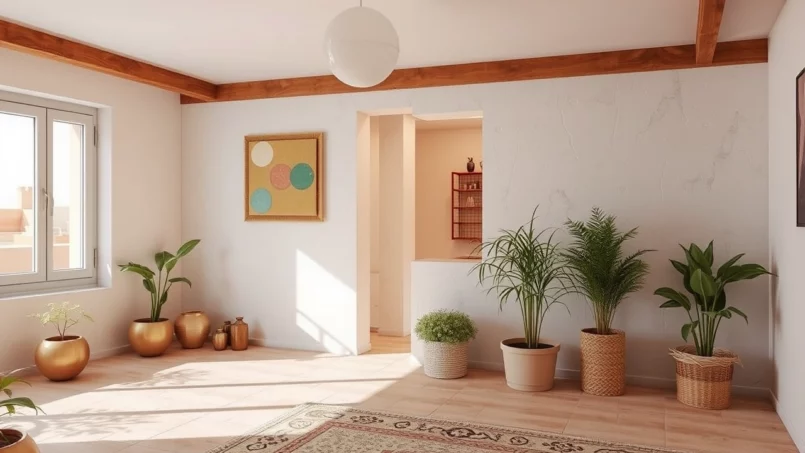
Current Tunisian interiors favor warm, textured atmospheres, with colors like beige, terracotta, deep green, and mineral blue. The local decoration market is growing, with strong demand for artisanal pieces, natural materials, and contemporary lines. Traditional elements (rugs, ceramics, woven textiles) are often integrated into modern, minimalist interiors.
To combine contemporary design with local identity, more and more owners and designers opt for “expressive sobriety”: favoring a few noble materials (stone, wood, worked plaster), a coherent color palette, furniture designed for versatility (banquettes that become extra beds, modular tables, built-in storage), and strong artisanal touches. Technological equipment – connected lighting, controllable air conditioning, discreet sound systems – is integrated almost invisibly.
Renovation or Reconstruction: Making an Informed Choice
Faced with a very deteriorated property, the dilemma quickly arises: is it better to renovate or start over with new construction? The answer depends on many factors, including the building’s heritage value, the quality of the existing structure, urban planning constraints, available budget, and timeline.
Renovation preserves the historical footprint of the place, essential in medinas and traditional villages. It has a better environmental record by reusing the existing structure. If the structure is sound, the operation can also be less costly than demolition-reconstruction, especially when regulatory constraints (height, setbacks, parking) make new construction complex or expensive.
New construction, on the other hand, offers total design freedom, allows for the integration of very high-performance solutions from the outset – external insulation, optimized geometry, advanced solar integration, home automation – and may be more rational if the existing building is severely damaged (insufficient foundations, major structural pathologies, materials containing asbestos, etc.). However, it requires new permits, a high initial investment, and careful coordination with neighborhood constraints, especially in dense urban areas.
A pragmatic method to assess the feasibility of a real estate project is to commission a comparative study upfront. This study, carried out jointly by a structural engineer, an architect, and ideally a construction economist, aims to precisely cost out two scenarios: major renovation and new construction. The analysis must include all associated costs, such as demolition, debris removal, technical studies, permit fees, completion times, and disruptions. The result of each scenario is then compared to the estimated market value of the property once work is completed, providing an objective basis for the decision.
Engaging with Urban and Public Dynamics
Renovating a property in Tunisia also means considering the major urban dynamics in which it is embedded. Since the early 1980s, a public agency, the Urban Rehabilitation and Renovation Agency, has been leading programs to upgrade working-class neighborhoods, especially informal settlements. These programs, partly funded by international donors, have gradually added to the provision of roads, sanitation, water, and electricity, with components supporting housing rehabilitation.
In some neighborhoods, improved infrastructure (drinking water, ONAS sanitation, stable electricity, roads) significantly increases home values. However, owners renovating in these areas must also account for specific constraints such as density, irregular plots, or risks of landslides and flooding, requiring adapted technical solutions.
In coastal tourist cities, where land pressure is high and demand for second homes is strong, renovation projects must also factor in the evolution of the short-term rental market, the expectations of international tourists regarding comfort and amenities, and competition from new developments. A well-renovated property, combining local charm, energy performance, good digital connectivity, and flexible spaces, can serve both personal use and a seasonal rental strategy.
Preparing for the Future: Renovation as a Strategic Investment
Beyond immediate comfort and market value, a well-thought-out renovation in Tunisia fits into a long-term perspective. The country, already heavily dependent on imports to meet its energy needs, has every interest in encouraging efficient buildings equipped with renewable solutions and built with local materials. Households gain purchasing power and resilience to tariff shocks. Cities improve air quality, reduce peak electricity consumption, and can reallocate public resources freed up by lower subsidies.
For an owner, renovating is a strategic choice that positions the home in a market increasingly valuing performance, comfort, good design, urban integration, and respect for architectural identity. Investing time in diagnosis, planning, financing, and rigorous work, overseen by competent professionals, is the best possible investment for a property in Tunisia in the medium term.
Disclaimer: The information provided on this website is for informational purposes only and does not constitute financial, legal, or professional advice. We encourage you to consult qualified experts before making any investment, real estate, or expatriation decisions. Although we strive to maintain up-to-date and accurate information, we do not guarantee the completeness, accuracy, or timeliness of the proposed content. As investment and expatriation involve risks, we disclaim any liability for potential losses or damages arising from the use of this site. Your use of this site confirms your acceptance of these terms and your understanding of the associated risks.

Cyril Jarnias is an independent expert in international wealth management with over 20 years of experience. As an expatriate himself, he is dedicated to helping individuals and business leaders build, protect, and pass on their wealth with complete peace of mind.
On his website, cyriljarnias.com, he shares his expertise on international real estate, offshore company formation, and expatriation.
Thanks to his expertise, he offers sound advice to optimize his clients' wealth management. Cyril Jarnias is also recognized for his appearances in many prestigious media outlets such as BFM Business, les Français de l’étranger, Le Figaro, Les Echos, and Mieux vivre votre argent, where he shares his knowledge and know-how in wealth management.





