
 Published on and written by Cyril Jarnias
Short-term rentals have long since moved beyond being a simple alternative to hotels to become a genuine real estate investment segment in Slovakia. Driven by the growth of tourism, a relatively permissive legal framework, attractive yields in certain regions, and a wave of digitalization led by major platforms, the country has established itself as an interesting playing field for both property owners and investors.
This article provides a comprehensive analysis of the short-term rental market in Slovakia, including the latest data, regional specifics, and planned regulatory changes for the coming years.
A largely favorable legal environment for short-term rentals
The first question any property owner asks concerns the legal framework. In Slovakia, short-term rentals are generally permitted and regulated, without being stifled by drastic national restrictions.
The main legal basis is the Trade Licensing Act (Act No. 455/1991), which considers tourist accommodation as a hospitality services activity, distinct from simple residential leasing. In practice, renting repeatedly for short periods is treated as a commercial activity, requiring a “trade license” for accommodation services.
Registration fees to obtain a trade license to rent a property on Airbnb are approximately 5 euros.
The strongest constraints do not come from the state, but sometimes from homeowners’ associations (HOAs) or housing cooperatives, which may limit or prohibit short-term subletting through their internal bylaws. At this level, the issue is less legal than relational: respecting building rules, informing neighbors, managing noise, and comings and goings.
The city of Bratislava, Slovakia, illustrates a regulatory approach based on taxation rather than prohibition. It does not impose a limit on the number of nights for tourist accommodation rentals. However, it applies a city tax. In the Old Town district (Staré Mesto), the taxable base for this accommodation tax is capped at 60 nights per person per year. This system allows owners to rent beyond this threshold, but regulatory pressure is primarily exerted through taxation, without directly restricting the activity.
At the European level, however, the landscape will become more structured. The European Regulation 2024/1028 on short-term rentals will require Slovakia to establish, by 2026, a registration system for tourist accommodations and a data-sharing framework between platforms and authorities. The future Slovak system envisions a national register of “accommodation units,” with a mandatory registration number to be displayed in listings. Municipalities may eventually gain additional levers: setting a maximum number of rental days, limiting the number of people per square meter, or prohibiting rentals during certain periods.
For hosts already in compliance, this change is less likely to close the market than to gradually filter out undeclared listings. Compliant listings could even benefit from reduced competition.
A dynamic tourism market driving demand
Short-term rentals do not exist in a vacuum: they depend on the vitality of Slovak tourism. From this perspective, the signals are clear: the country is attracting more and more visitors, despite the shock of the pandemic.
After a decade of strong growth (2009-2019) and a sharp collapse in 2020 (-50% in visitors, -60% in revenue), the tourism sector experienced a rapid recovery with an increase of 176.9% followed by 30.7% in 2023. Projections forecast steady growth of about 0.9% per year, reaching 17.5 million arrivals in 2028.
These flows generate significant economic activity. Tourism directly accounts for nearly 3% of GDP from foreign visitors, and around 6.8 billion euros in annual revenue for all tourism services before the pandemic. In 2019, approximately 165,000 people, or 7% of total employment, worked in this sector.
Short-term rentals benefit fully from this. They already represent a quarter of the accommodation supply in the European Union, and Slovakia follows this trend. The country has between 12,000 and 18,000 active short-term rental listings, with a median point around 15,000. On generalist vacation platforms alone, more than 27,000 vacation rentals are recorded.
Several drivers shape this demand:
Overview of trends and strengths in the Slovak tourism sector, highlighting its diversity, seasonality, and evolving clientele.
Historic cities (Bratislava, Košice), mountains (High and Low Tatras), national parks, thermal spas, and lakes.
Winter for skiing and summer for the outdoors, with demand peaks during holidays, Christmas markets, festivals, and sporting events.
Rediscovery of cottages, chalets, and country houses as nature getaways, especially since the health crisis.
Digital nomads, teleworkers on “workation,” and families seeking more space than a hotel.
For property owners, this translates into generally solid occupancy rates, but highly variable depending on location and season.
Attractive but contrasting financial performance
Across the country, vacation rentals often display revenue levels that compete with long-term rentals, provided one accepts more active management and more fluctuating income.
Aggregated data indicates a median price per night between 70 and 95 €, with an average price ranging from 85 to 120 €. Approximately 80% of listings are positioned between 50 and 150 € per night. The most saturated segment is between 60 and 90 €, while properties targeting 100 to 150 € per night for a two-room apartment, or 150 to 250 € for a family chalet, still have room for growth in dynamic markets.
The typical annual occupancy rate for a vacation rental property is between 40% and 60%. The top-performing hosts, with good positioning and optimal management, can reach 55% to 70%, while the least performing ones stagnate around 20% to 30%. The breakeven point is generally reached with an occupancy rate of 30% to 40%, offering a comfortable safety margin for many owners.
Monthly revenues follow this dynamic: most listings generate between 500 and 2,000 € per month, with an average between 800 and 1,600 €. Top properties can reach 2,500 to 4,000 € monthly during peak months, particularly well-placed mountain chalets or certain houses in the Bratislava region.
Maximum monthly revenue for the most sought-after properties during the peak tourist rental season.
Net margins reflect this fluctuation: considering operating costs (cleaning, utilities, platform fees, taxes, maintenance), an owner-managed apartment can generate 200 to 700 € in net monthly profit, approximately 25 to 45% of revenue. For a chalet, this profit can range from 250 to 1,000 € per month, at the cost of heavier and more volatile expenses.
The following table summarizes the main national benchmarks.
| Indicator | Typical Range in Slovakia |
|---|---|
| Median price per night | 70–95 € |
| Average price per night | 85–120 € |
| Main price range (80% of listings) | 50–150 € |
| Average occupancy rate | 40–60 % |
| Top hosts occupancy rate | 55–70 % |
| Average monthly revenue | 800–1,600 € |
| Monthly revenue for 80% of listings | 500–2,000 € |
| Peak for top listings | 2,500–4,000 € |
| Typical net margin | 25–45 % of revenue |
| Breakeven point (occupancy) | 30–40 % |
For an investor, these figures translate into a gross annual yield averaging around 3.5 to 6%, with an average of 4.6% for residential rental property (all forms combined). Short-term rentals in tourist or ski areas can yield 4-6% gross, or even more when the property was purchased at a discount in less expensive areas.
Bratislava: An urban stronghold for short-term rentals
The capital concentrates a major share of the demand. Short-term rental searches show that Bratislava alone accounts for about 40% of queries. There are more than 3,000 to 3,200 active Airbnb listings depending on the season, with a very high proportion of one-bedroom apartments (about 75% of the supply).
Recent figures illustrate the potential: for the period September 2024 – August 2025, Bratislava properties showed an average annual revenue nearing 20,000 € (about 1,670 € per month), with an average daily rate around 82 €. AirDNA and other data sources place the average occupancy rate at about 69% for this period, which is high for a European urban market.
The most saturated districts in Bratislava are the Old Town (Staré Mesto) and Ružinov. Conversely, areas like Karlova Ves or Nové Mesto still present opportunities, benefiting from good access to transport and services. The market is largely driven by international clientele (nearly 77% of guests are foreign), a diversified demand reinforced by proximity to Vienna and Budapest.
The long-term rental dynamic also supports this market. The average price per square meter in the capital is around 2,500 to 2,650 €, and urban rents jumped by more than 20% in 2024. A studio rents for long-term at around 480 € per month on average in the country but easily exceeds 650 € in central Bratislava; a well-located two-room apartment can exceed 1,000 € monthly. Rental pressure is reinforced by slow building permit issuance (about 300 days on average) and the recent decline in construction starts.
The maximum gross yield short-term rentals can achieve in some Bratislava districts like Nové Mesto.
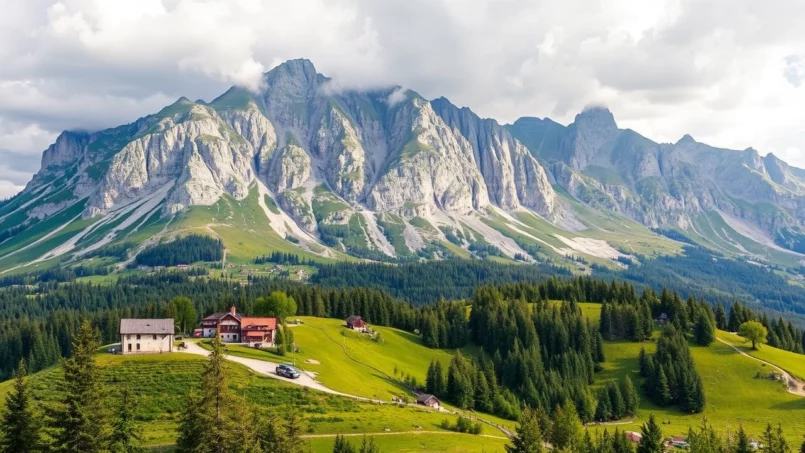
High Tatras and mountains: Jackpot in high season, empty in off-season
In contrast to urban centers, mountain regions – particularly the High Tatras and surrounding areas – rely almost entirely on leisure tourism, with a dual winter-summer seasonality.
Occupancy rates there are on average lower than in Bratislava: around 39% for gateway cities like Poprad, or 13 to 20 points lower than the capital. But this average masks highly profitable peaks: chalets near ski resorts or lakes can exceed 4,000 € in monthly revenue during winter holiday weeks, only to sometimes fall below 500 € in the off-season.
Number of active tourist rental listings recorded in Vysoké Tatry between August 2024 and July 2025
Performance is highly segmented:
| Vysoké Tatry Segment (USD) | Monthly Revenue | Occupancy Rate | Average Price / Night |
|---|---|---|---|
| Top 10% of listings | ≥ $2,272 | ≥ 52 % | ≥ $230 |
| Top 25% of listings | ≥ $1,406 | ≥ 38 % | ≥ $155 |
| Median | ≈ $793 | ≈ 22 % | ≈ $110 |
| Bottom 25% | ≈ $402 | — | — |
| Average high season (e.g., August) | $1,635 | 36.1 % | — |
| Average low season (e.g., April) | $769 | 19.4 % | — |
These figures show that a few very well-placed, well-managed, high-end properties capture a large share of demand, with nightly rates exceeding $230. Conversely, half of the properties operate well below 30% annual occupancy, raising questions about their business model when purchase prices are soaring.
The High Tatras region welcomed over 210,000 visitors in December 2023 alone.
To mitigate vacancy risks, some investors turn to secondary, less saturated areas close to tourist hubs. Around Liptovský Mikuláš (Liptov region) and in gateway towns like Svit, competition is lower, purchase prices are more reasonable, and access to the Jasná ski area or lakes remains good. A well-managed chalet near Jasná can generate about 2,500 € in a single winter month.
The price / traffic contrast is also notable between high-end resort cores (Štrbské Pleso, Tatranská Lomnica, Starý Smokovec) and more affordable areas like downtown Poprad, where apartments rent for 50 to 70 € per night. The price per night gap between the most expensive and most affordable sectors can reach 40 to 80 €.
Senec: A high-potential lakeside micro-market
The Senec district, close to Bratislava and known for its lake and recreational facilities, perfectly illustrates the potential of well-targeted small markets. Recent data for the period November 2024 – October 2025 reveals a still-limited inventory – only 18 active listings – but sometimes spectacular performance.
Most listings are entire houses or homes, often with two bedrooms, designed to host families of 4 (average capacity 4.3 people). Over 70% of properties offer one or two bedrooms. The supply is flexible, with a minimum stay of two nights most common, and nearly 28% of listings open to monthly stays. The cancellation policy is mostly “Flexible.”
The income level is particularly instructive:
| Senec Indicator (USD) | Typical Value |
|---|---|
| Number of active listings | 18 |
| Monthly revenue top 10% | ≥ $2,477 |
| Monthly revenue top 25% | ≥ $1,976 |
| Median monthly revenue | ≈ $1,093 |
| Occupancy rate top 10% | ≥ 78 % |
| Occupancy rate top 25% | ≥ 56 % |
| Median occupancy rate | ≈ 30 % |
| ADR top 10% | ≥ $356 / night |
| Median ADR | ≈ $129 / night |
| Average high season revenue | ≈ $2,008 (46.9% occupancy) |
| Average low season revenue | ≈ $803 (25.9% occupancy) |
The best listings achieve daily rates above $350 and occupancy rates close to 80%, which is remarkable for houses located outside the city center. The clientele is very international (84% foreign visitors), dominated by Germans, and particularly young: 50% of guests belong to post-2000 generations (Gen Z / Alpha). The most requested services remain classic – Wi-Fi, equipped kitchen, free parking – but these figures clearly invite consideration of unsaturated niche lake or spa markets.
Košice, Zvolen and Eastern regions: Price / yield arbitrage
Eastern and central Slovakia offer another form of opportunity: significantly lower purchase prices than Bratislava, with non-negligible tourist and student demand.
In Košice, the country’s second city, short-term rental occupancy rates are around 46%. The historic center (Staré Mesto) is positioned in a price range of 75 to 100 € per night, while districts like Juh remain much more affordable (45 to 65 €). With an average price per square meter of about 1,500 €, gross rental yields (all durations combined) can reach 5.66 to 5.96%, higher than in the capital.
The Zvolen district illustrates the dynamic in rural areas. For the period late 2024 – fall 2025, median rates oscillate between about 80 and 96 € per night, while availability rates vary strongly, from 48% to over 99% depending on the season. This success is based on a strategy combining nature tourism, proximity to secondary ski resorts, and organizing occasional events.
On a broader scale, regions like Prešov or Nitra attract investors with average prices per square meter between 1,200 and 1,500 €, and a 20% increase in demand for leisure properties since 2017, even with a peak 50% increase in cottage searches in a single month in the eastern part of the country. For example, Lake Zemplínska Šírava has become a major attraction, structuring summer demand for waterfront rentals.
Operating costs: The true test of profitability
Behind the impressive revenue figures lie costs that are dangerous to underestimate. For an apartment managed directly by the owner, realistic monthly costs range between 350 and 900 €. For a house, the range climbs to 450–1,200 €, and for a mountain chalet, 500–1,500 €.
The most sensitive expense is cleaning and turnover, especially for short stays. For an apartment, each turnover generally costs between 15 and 40 €. For a house or chalet, the bill can reach 30 to 70 € or more if access is complicated. To this are added:
Routine maintenance of a property is estimated at 0.7% to 1.2% of its value per year.
In practice, an owner managing their own property can expect to spend 40 to 55% of their revenue on operating expenses. If they delegate to a full-service management company, this ratio climbs to between 55 and 70%, with companies typically charging 15 to 25% of revenue as management fees, in exchange for full-service operation (listings, communication, check-in/out, cleaning, price optimization, legal compliance).
Profit per available night, after all expenses, averages between 8 and 22 €. This figure helps put the nightly rates displayed on platforms into perspective and shows that effective cost management is just as crucial as occupancy for securing a yield.
Tax and administrative obligations: A mandatory step
Qualifying short-term rentals as hospitality services implies a series of specific tax obligations.
Income from this activity is subject to personal income tax. For individuals, the first 500 € of annual revenue may be exempt; beyond that, tax brackets (19% then 25% above certain thresholds) apply. If the activity is declared as a trade (trade license), a reduced rate of 15% applies up to 60,000 € in revenue, then 19% above. Taxpayers can choose to deduct documented actual expenses or opt for a flat-rate deduction of 60% of income, capped at 20,000 €.
Since 2025, hospitality services are subject to a reduced VAT rate of 5%. The obligation to register for VAT arises after a certain revenue volume (approximately 50,000 € annually), allowing for the recovery of VAT on certain expenses. Furthermore, purchasing services from companies established in other EU countries (platform commissions, software…) obliges the owner to register as a “VAT-identified person,” with specific reporting obligations.
Platforms like Airbnb and Booking.com are now required, under the European DAC7 directive, to report hosts’ earnings to tax authorities. The era of “gray Airbnb” is therefore coming to an end.
A city tax is levied by municipalities. In Bratislava (Old Town), it amounts to 3.50 € per night per person. Some individuals are exempt: business travelers (upon presentation of a statement), those under 18, very elderly persons, disabled persons, and soldiers on mandatory service. The accommodation provider collects the tax from guests and must remit it according to a defined schedule.
Finally, every host must maintain a register of foreign guests, including identification information and stay dates, and keep it for six years. For non-EU nationals, a declaration to the police must be made within three working days of arrival, via a form or a digital platform like Ubyport, set to be replaced by the e‑Turista system by 2026. Non-compliance exposes hosts to administrative fines.
A diversity of products: Urban apartments, chalets, eco-lodges, and “workations”
One of the strengths of the short-term rental market in Slovakia lies in the variety of properties offered. The offerings cover the entire spectrum: downtown studios, family apartments, vacation homes, mountain chalets, rural cottages, villas, treehouses, tiny houses, unusual accommodations (castles, shipping containers, “botels” on the Danube).
Families and small groups are a key segment, especially in Vysoké Tatry and the Senec district. The most common accommodations are designed for four people and typically include two bedrooms, an equipped kitchen, a garden or balcony, and private parking. They are often equipped with child-friendly amenities like high chairs, playgrounds, trampolines, or pools.
Simultaneously, the rise of telework and digital nomads creates a market for apartments or studios with high-performance Wi-Fi, dedicated workspace, and stays of 30 days or more (nearly 27% of listings in Vysoké Tatry and Senec accept monthly stays). Specialized platforms for monthly stays, like Flatio, have established themselves in this niche, offering dedicated services (insurance, “remote-work friendly” badges after inspection, move-in guarantees).
A growing share of European travelers prioritize sustainable accommodations (energy saving, natural materials, renewable energy). In Slovakia, the public program “Zelená domácnostiam” subsidizes the installation of solar panels and heat pumps. For an investor, these features help reduce operating costs, meet demand, and improve marketing appeal.
Events, seasonality, and pricing strategy
The profitability of a Slovak short-term rental depends largely on the owner’s ability to leverage seasonality and events.
Several recurring demand peaks stand out:
Tourist demand and accommodation supply in Slovakia experience marked seasonal peaks. Year-end holidays (Christmas and New Year) are highly sought after for skiing in the Tatras. Summer, from June to September, attracts visitors to lakes, national parks, and historic cities. Specific events also create congestion: Christmas markets in Bratislava (November-December), the Bratislava Marathon in spring, and especially the Pohoda music festival in Trenčín in early July, which strongly compresses accommodation supply throughout the region. Major concerts or sporting events in the capital have a similar impact.
During these periods, owners often see a 20 to 50% increase in bookings, coupled with a 15 to 40% jump in rates. The most savvy hosts adjust their prices and minimum stays four to eight weeks before these events to maximize revenue while remaining competitive.
Calendar and rate management thus become strategic: opening longer stays during high season to reduce turnover, offering weekly or monthly discounts in low season to limit empty nights, and using AI-based dynamic pricing tools to react precisely to demand. More and more Slovak managers are using these technologies to optimize their average revenue per available night.
Professionalization and delegated management: An expanding service market
The rise of short-term rentals has given birth to a whole ecosystem of specialized management companies. Some, like RS Properties Management, RIVERS REAL ESTATE, PROPERTY MANAGER s.r.o., or LIVE‑IN International, offer “turnkey” solutions that transform often vacant or long-term rented properties into relatively passive income sources for owners.
These companies handle:
Discover the key services offered for comprehensive and worry-free management of your vacation rental property.
Optimized listings on Airbnb, Booking.com, Vrbo, with professional photos, polished descriptions, and social media campaigns.
Full handling of reservations, guest communication, and 24/7 customer support.
Streamlined entry and exit processes via smart locks, temporary codes, biometric systems, and security deposit management.
Coordination of cleaning, routine maintenance, and repairs (direct handling possible, e.g., up to 100 €).
Collection and remittance of city tax, maintenance of mandatory registers, and guidance on local tax aspects.
In return, commissions are typically around 15% of revenue for full short-term management, and about 10% for managing a long-term rental. Some players highlight promises of increased revenue compared to traditional leasing, sometimes with announced gains of 20 to 40%, at the cost of greater operational complexity assumed by the provider.
The professionalization of short-term rentals includes security equipment (noise sensors, exterior cameras), occupancy control, compliant standard contracts, and tailored insurance. This offering is particularly advantageous for non-resident or less available owners, allowing them to access the market without handling daily operational issues.
Key trends: Digitalization, ecology, aging, and segmentation
Beyond the figures, several structural trends influence the future of short-term rentals in Slovakia.
82% of consumers search for and book their accommodation online, highlighting the crucial importance of a digital presence.
Ecology, next, is becoming a real differentiator. Alongside the national “Green for Households” program, funded to the tune of hundreds of millions of euros, the majority of travelers declare themselves sensitive to climate issues. Accommodations that reduce their footprint (renewable energy, good energy performance, ecological materials, water management) can not only lower their operating costs but also justify a more ambitious price positioning, especially with the international clientele.
Demographic aging also influences the overall real estate market. With an increasingly large share of the population over 65 years old, demand for accessible, single-story, or elevator-equipped housing is increasing, especially in cities. Even if this trend plays out more in the long term and in residential property, it is not without impact on the future configuration of properties available for short-term rental.
Finally, customer segmentation is becoming more refined: families, groups of friends, students, professionals on assignment, seniors, digital nomads. Each has different expectations and budget constraints. Owners who adapt their product (property configuration, amenities, communication) to a clear target have a better chance of standing out in a market where simply posting a listing is no longer enough.
Between opportunities and caution: How to approach the Slovak market
Slovakia today offers a rare balance: a short-term rental sector growing at double-digit rates in a still relatively flexible legal environment, gross rental yields often exceeding 4% with peaks of 5-6% in good location / property combinations, and purchase prices that remain, outside Bratislava and prime tourist spots, lower than in many Western European countries.
Metropolises like Bratislava offer stable and high annual revenues (around 20,000 €/property), driven by strong international demand. Mountain regions show very high profitability in peak season but require careful cash flow management due to off-season troughs. Unsaturated micro-markets (lakes, spa towns, small destinations) can generate exceptional performance for the best-positioned properties.
In return, this opportunity requires:
To ensure the profitability and sustainability of a short-term rental, four areas are crucial: mastering local taxation as well as guest register and reporting obligations; rigorously controlling costs, particularly those related to cleaning and maintenance; anticipating and adapting to future European regulations concerning accommodation registers and data transparency; and finally, developing a distinct positioning and digital marketing strategy to stand out among the many similar listings.
In this context, short-term rentals in Slovakia are neither an automatic goldmine nor a saturated market with no future. It is a market in the process of structuring, where the investor capable of anticipating the mutual influences of regulation, technology, and consumption trends still has an interesting window of opportunity. With a rigorous and informed approach, the opportunities are very real, whether in the capital, at the foot of the Tatra peaks, or on the tranquil shores of regional lakes.
Disclaimer: The information provided on this website is for informational purposes only and does not constitute financial, legal, or professional advice. We encourage you to consult qualified experts before making any investment, real estate, or expatriation decisions. Although we strive to maintain up-to-date and accurate information, we do not guarantee the completeness, accuracy, or timeliness of the proposed content. As investment and expatriation involve risks, we disclaim any liability for potential losses or damages arising from the use of this site. Your use of this site confirms your acceptance of these terms and your understanding of the associated risks.

Cyril Jarnias is an independent expert in international wealth management with over 20 years of experience. As an expatriate himself, he is dedicated to helping individuals and business leaders build, protect, and pass on their wealth with complete peace of mind.
On his website, cyriljarnias.com, he shares his expertise on international real estate, offshore company formation, and expatriation.
Thanks to his expertise, he offers sound advice to optimize his clients' wealth management. Cyril Jarnias is also recognized for his appearances in many prestigious media outlets such as BFM Business, les Français de l’étranger, Le Figaro, Les Echos, and Mieux vivre votre argent, where he shares his knowledge and know-how in wealth management.





