
 Published on and written by Cyril Jarnias
The Slovak real estate market has been in a sustained expansion phase for several years, driven by a strong economy, full integration into the Eurozone, and sharply rising tourist appeal. In this context, second homes – chalets, cottages, vacation apartments in the mountains or by lakes – occupy an increasingly visible place, even though they remain a minority compared to primary residences in a country with a homeownership rate nearing 93%.
This article analyzes the second home market in Slovakia by detailing prices, regional dynamics, rental yields, the legal and tax framework, as well as the tourism and societal trends influencing demand.
A Country of Homeowners Where Second Homes Remain a Niche Market
Slovakia stands out in Europe for having one of the highest homeownership rates on the continent: 93.1% of households were owners in 2024. The rental market is undersized: barely 6.9% of households are paying tenants, and the rental housing stock represents just over 5% of the total. This culture of ownership directly influences the structure of the second home segment.
Only 1.2% of Slovaks considering a real estate purchase plan to acquire a second home.
Yet, several converging trends are gradually transforming this segment:
– rising tourism, particularly in mountain and lake regions,
– growth of short-term rental platforms (Airbnb, Vrbo, Booking, etc.),
– seeking a hedge against inflation and financial fluctuations through real assets,
– rise of remote work, making extended stays in rural or semi-rural areas attractive.
The market therefore remains niche in volume, but it is attracting increasing attention from investors, both local and foreign, due to the combination of still affordable prices / good capital appreciation prospects / attractive rental yield in tourist areas.
A Supportive Macroeconomic and Real Estate Environment
Slovakia benefits from a stable environment that reassures investors: a member of the European Union and the Eurozone, a sovereign rating of “A-” with a stable outlook, GDP growth around 2%, unemployment near 5%, and relatively dynamic labor and credit markets. Inflation has slowed after a post-pandemic peak but remains notable, around 4%, which reinforces the appeal of real assets.
On the real estate front, the data speaks volumes:
Overview of trends and average prices in the Slovak residential market over the last decade.
The average residential price reached €2,777/m² in the second quarter of 2025, a yearly increase of 12.79%.
At the national level, the average price per square meter hovers around €2,700 in 2026, with a median around €2,550.
Apartments trade on average around €3,041/m², single-family houses around €2,031/m².
In ten years, prices have more than doubled, rising from about €1,240/m² in 2015 to €2,700/m².
After a correction phase in 2023, prices rebounded quickly thanks to the gradual easing of credit rates and a recovery in demand. Forecasts anticipate continued growth, but at a more moderate pace, below 10% per year by 2026, with a long-term trend close to 3-5% per year.
For second home buyers, this context means the Slovak market is still in an upward phase, but the window for “good deals” is gradually closing, especially in areas already in high demand.
Chalets, Cottages, and Country Houses: A Specific Price Positioning
A recent academic study analyzing over 1,000 properties across Slovakia examined price differences by housing type and location. It notably distinguishes: price differences according to housing type and location.
– urban apartments (primary use),
– single-family houses (urban or rural),
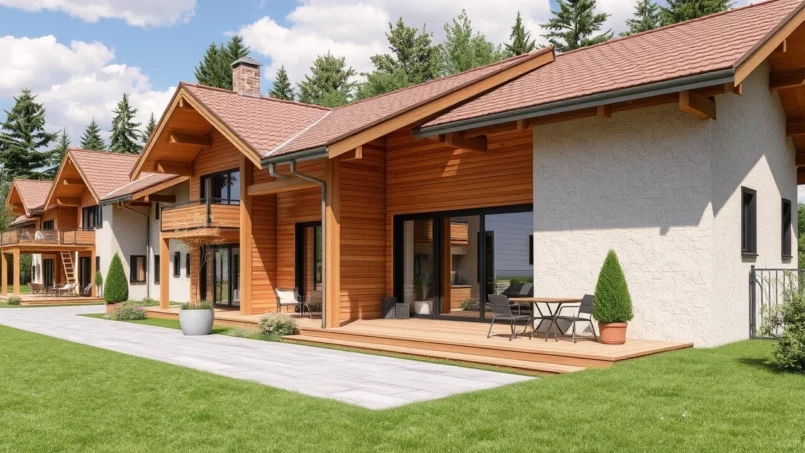
– chalets and weekend houses (short-stay accommodations, typical of the Slovak second home).
The results are enlightening:
– compared to apartments, single-family houses are on average 43% cheaper per m²,
– chalets and recreational houses are about 23% cheaper per m² than apartments.
The price discount on a chalet is about 1% for each additional kilometer it is located from the local business center.
The presence or absence of major infrastructure also plays a key role. In areas lacking a local highway, real estate prices are significantly lower. Conversely, connection to a highway network can lead to an increase of around 20% in price per m².
For an investor, this means “purely rural” second homes remain significantly more affordable than apartments in major cities, but this differential tends to shrink as one gets closer to a well-connected major tourist hub.
Marked Regional Disparities: From Bratislava to Mountain Regions
The Slovak market is extremely polarized. Bratislava and the west of the country, thanks to higher incomes, a dense economic fabric, and strong international appeal, concentrate the highest prices. The center and east of the country remain generally more affordable, with the exception of highly touristic pockets.
Regional Price Comparison
The following table summarizes the average prices per m² by region, all property types combined, in the second quarter of 2025:
| Region | Average Price €/m² (Q2 2025) |
|---|---|
| Bratislava | 3,549 |
| Košice | 2,508 |
| Prešov | 2,178 |
| Žilina | 2,038 |
| Banská Bystrica | 1,714 |
| Trnava | 1,935 |
| Trenčín | 1,690 |
| Nitra | 1,503 |
For second homes, the challenge is to cross-reference these price levels with tourism potential and rental yields.
The Bratislava real estate market is a premium market, particularly for urban apartments. It features few classic second homes, but a promising segment for city-break style short-term rentals, especially in the Old Town (Staré Mesto). Prices there often exceed €4,800/m² and can reach €7,500/m². The average gross rental yield there is about 4%, sometimes less.
– High and Low Tatras / Poprad / Liptovský Mikuláš / Demänovská Dolina: the true heart of the second home market. These areas, close to ski resorts and national parks, are seeing demand for chalets, mountain apartments, and cottages explode, with prices that nonetheless remain lower per m² than Bratislava, but rising sharply.
– Lake regions (Liptovská Mara, Zemplínska Šírava, Orava, Sunny Lakes at Senec): a combination of summer leisure, water sports, and reasonable proximity to urban centers or highways. They are prime targets for family vacation homes, often with gardens and direct water access.
Slovak secondary cities like Žilina, Nitra, Banská Bystrica, Prešov, and Košice present a dynamic and mixed real estate market. This market combines classic residential real estate with rental investment opportunities. A notable segment is that of second homes, which are often oriented toward short urban stays. This demand is driven by activities such as cultural tourism, proximity to ski resorts, and access to spa centers.
Urbanity, Rurality, and the Value of Second Homes
The national statistical study on real estate prices shows that the urban gradient plays a determining role:
– compared to the city center, prices drop by about 38% in peripheral “urban clusters”,
– and by roughly 53% in the countryside.
Second homes located in rural areas therefore benefit from a significant discount at purchase. However, this does not mean these properties are systematically good deals: rental demand can be much more volatile outside major tourist routes or flagship sites (ski resorts, famous lakes, spa areas).
Tourism on the Rise: The Fuel for the Second Home Market
The main engine of demand for second homes in Slovakia is the rise in tourism, particularly in mountain and nature regions. Recent figures are telling:
– tourist arrivals surged by 30.7% in 2023 after a spectacular increase the previous year,
– the number of tourist accommodation establishments increased to over 3,600 units,
– the High Tatras region recorded over 210,000 tourists in one peak season month, a rise of nearly 130% year-on-year.
Number of properties active in short-term rental in Bratislava, generating nearly $1000 in average monthly revenue with a 43% occupancy rate.
The second home market therefore feeds off two complementary tourist segments:
– urban and business tourism (Bratislava, Košice, Banská Bystrica, Prešov), suitable for city-center apartments put up for short-term rental,
– nature and mountain tourism (High Tatras, Liptov, Orava, Zemplínska Šírava, Donovaly), ideal for chalets, cottages, and family villas.
Mountain Vacations: The Laboratory of the Slovak Second Home
With 36 modern ski resorts and an estimated winter tourism growth rate of 5% per year, mountain regions have become the main playground for second home investors. Compared to the French or Austrian Alps, Slovakia offers a significantly lower entry barrier in terms of price, attracting both affluent Slovaks and foreign buyers seeking yield.
Ski and mountain properties typically offer privileged access to ski domains, panoramic views, concierge services for equipment rental and lesson booking, and a warm, friendly atmosphere, often with amenities like fireplaces or spas.
– gross yields between 4% and 6%,
– strong demand during the winter high season and, increasingly, in summer (hiking, biking, wellness).
The most sought-after resorts and localities for this type of second home notably include Vysoké Tatry, Tatranská Lomnica, Štrbské Pleso, Liptovský Mikuláš, Demänovská Dolina, and Donovaly.
The Short-Term Rental Market: A Key Barometer for Second Homes
For a second home buyer aiming for additional income, the dynamics of seasonal rental are essential. Available figures for long-term rentals provide an initial benchmark, even though short-term yields can be higher in tourist spots.
Average Rent Levels by City
The table below shows the average rents for apartments offered for long-term rental in the second quarter of 2025:
| City / Region | Average Monthly Rent (€) |
|---|---|
| Bratislava | 890 |
| Košice | 723 |
| Prešov | 607 |
| Banská Bystrica | 575 |
| Žilina | 626 |
| Nitra | 637 |
| Trnava | 617 |
| Trenčín | 544 |
| Poprad | 563 |
Even though this data concerns primarily residential rental, it gives an order of magnitude for base rent levels. In seasonal markets, revenues can be much higher, but with more variable occupancy.
Average Rental Yields by Region
The residential gross yields, all uses combined, also help position second homes:
| Area | Average Gross Yield (2025) |
|---|---|
| Slovakia (average) | 4.88% |
| Bratislava | 3.92–4.4% |
| Košice | 5.24–6% |
| Nitra | 5.70–7-8% (depending on segment) |
| Banská Bystrica | 5.16% |
| Žilina | ~4.15% |
| Ski / Mountain Areas | 4–6% (vacation rentals) |
Well-located second homes – at the foot of slopes, by the water, or near a national park – tend to position themselves at the high end of these ranges, or even beyond during certain periods of the year. During high season, daily rates for a family apartment (2-3 bedrooms) often range between €90 and €180 per night in tourist cities, and can climb between €150 and €280 in the most sought-after mountain areas.
The average annual occupancy rate is 40 to 45%, but drops significantly outside vacation periods. This strong seasonality requires rigorous calendar management, a dynamic pricing strategy, and often the use of a property management service, whose cost typically represents 8 to 12% of the monthly rent.
A Rather Open Legal Framework for Foreigners, but with Nuances
For non-residents interested in a second home in Slovakia, the regulatory framework is generally favorable.
Acquisition Conditions for Foreigners
The main principles are as follows:
– foreign individuals can freely purchase apartments, houses, chalets, cottages, or villas,
– EU citizens enjoy rights almost identical to Slovaks,
– non-EU nationals can acquire buildings without major difficulty but are restricted in purchasing agricultural land, forests, or plots located in protected natural areas.
The legislation (Act No. 140/2014) governing the acquisition of agricultural land imposes limits, mainly for large plots. For small plots integrated into a chalet, constraints are fewer. It is crucial to check the cadastral classification, as a large attached garden may be legally classified as ‘agricultural land’, leading to specific implications.
Purchasing a property does not, in itself, grant any automatic right to residence or citizenship. A non-resident can buy as a simple tourist but will need to rely on other legal grounds (employment, business, family reunification, etc.) to obtain a residence permit.
Purchase Process and Transaction Costs
The procedure works as in many Central European countries: property selection, negotiation, signing of a purchase contract (kúpna zmluva), registration in the cadastre. The seller’s signatures must be notarized, and the deed must be in Slovak or Czech, possibly accompanied by a sworn translation.
Standard number of days for registration in the cadastre, essential to establish legal ownership.
Transaction costs for the buyer are generally between 3% and 7% of the price: lawyer fees (€500 to €2,000), notary fees, cadastre registration, agency fees (2 to 5% of the price, most often paid by the buyer), loan appraisal, translations, etc. Slovakia does not tax property transfers: there is no real estate transfer tax.
For a second home intended partly for rental, it is advisable to use a lawyer to secure the transaction (verification of charges, existing mortgages, access easements, urban planning compliance, property classification, etc.).
Financing, Taxation, and Profitability of Second Homes
The net yield of a second home depends closely on financing conditions and the tax treatment of rental income and capital gains. Slovakia presents a relatively competitive but complex framework, with several thresholds and special regimes.
Access to Mortgage Credit
Slovak banks grant loans to foreigners, including non-residents, provided they can demonstrate stable and verifiable income. The main observed characteristics are:
– interest rates on new housing loans around 3.6% on average in summer 2025, down significantly from the previous year,
– for non-residents, frequent markup of 0.2 to 0.5 percentage points,
– usual personal contribution of 20 to 30% of the price for a foreign buyer (LTV 70-80%),
– repayment period up to 30 years.
Two major banks accept applications from non-residents without local permanent residence, opening the door to purely international investors. Processing a mortgage application typically takes 4 to 8 weeks.
Taxation of Rental Income and Capital Gains
On the tax front, the main elements to know for an individual are: 1. Taxable income, which determines the amount of tax to be paid. 2. Tax deductions, which can reduce taxable income. 3. Tax credits, which are amounts deducted directly from the tax due. 4. Tax rates, which vary depending on income brackets. 5. Filing obligations, as each individual must file an income tax return each year.
Rental income is taxed according to a progressive income tax scale (19%, 25%, 35%). The first €500 per year is exempt. The deductibility of expenses differs based on the property’s status: for a ‘non-professional’ property, only direct expenses are deductible; for a property registered as a ‘professional asset’, a wider range of costs (depreciation, loan interest, property tax, etc.) can be deducted.
Capital gains from the sale of privately held properties benefit from a significant exemption: beyond five years of ownership, the sale is in principle outside the scope of income tax, provided the property was not explicitly accounted for as a business asset. Below five years, the capital gain (sale price minus acquisition cost) is taxed according to the 19%, 25%, or 35% scales.
VAT (Value Added Tax) is a tax that applies primarily to transactions carried out in a professional capacity. It therefore concerns the economic activities of businesses and the self-employed.
– renting a residential property is generally exempt from VAT,
– para-hotel services (tourist accommodation with services) may be subject to VAT,
– the sale of a new building or one less than five years old is in principle subject to the standard rate of 23%, unless a different option or special regime applies.
Property Tax and Other Recurring Costs
The property tax in Slovakia is low compared to other European countries and is based on area and municipal rate schedules, not market value. For an average-sized apartment in Bratislava, it often ranges between €40 and €200 per year; for a house, between €120 and €450. Municipalities freely set their coefficients, with high local variability.
To these amounts are added insurance premiums (generally €80 to €250/year for an apartment, €180 to €600/year for a house), condominium and routine maintenance fees, and possibly the fees of a property manager if the second home is used for seasonal rental.
Where to Buy a Second Home in Slovakia? Focus on Key Areas
The Slovak second home market is highly segmented. Each region combines a certain level of price, a rental potential, and a different risk profile.
High Tatras and Liptov: The Heart of International Demand
The High Tatras, accessible from Poprad or Liptovský Mikuláš, concentrate the bulk of the demand for ski chalets and mountain apartments. Resorts like Tatranská Lomnica, Starý Smokovec, or Štrbské Pleso benefit from a double effect: rising tourist reputation and massive investments in infrastructure (ski lifts, hotels, spas).
Gross yields in these areas often range between 5 and 7%, with strong demand in the winter high season. Daily rates for a high-end chalet with a sauna and hot tub can easily exceed €250 per night during peak times.
Lakes and Inland Beach Resorts: A Marked Summer Seasonality
Areas like Liptovská Mara, Zemplínska Šírava, Oravská priehrada, or the Sunny Lakes of Senec offer a different profile: second homes there are oriented toward summer vacationing, with swimming, water sports, and hiking. The season is more concentrated, but purchase prices can be more moderate than in the most prestigious ski resorts.
Gross rental yields of lakefront properties, depending on location and ability to attract an international clientele.
Spa Towns and Health Tourism
Towns like Piešťany, famous for its thermal spa, welcome tens of thousands of spa visitors each year, a majority from abroad. Demand for furnished, comfortable long-stay accommodations is structural. For an investor, a second home in this type of resort helps smooth seasonality, as health tourism is more spread out over the year.
University Towns and Regional Centers
Košice, Prešov, Žilina, or Nitra are dynamic university or industrial towns. They combine urban tourism, the presence of large companies (automotive, logistics, IT), and a student population. The second home segment there takes the form of city-center apartments used a few weeks a year by the owner, then rented to students, expatriates, or on a short-term basis the rest of the time.
Rental yields in Košice can reach 5 to 6%, with average rents of about €723 per month.
A Tight Market: Lack of Supply and Price Pressure
While demand fundamentals are solid, the main brake on the balanced development of the second home market lies in supply. New housing construction, across all segments, remains insufficient to meet needs.
In the first half of 2025, only 6,836 dwellings were completed in the entire country, a decrease of nearly 20% year-on-year and 17% below the average of the last ten years. Bratislava saw a spectacular drop in new production, with only 974 dwellings delivered, a decrease of 54% year-on-year.
This is the average number of days needed to obtain a building permit in France, nearly double the OECD average.
This structural shortage of supply fuels price increases, including in secondary segments. It explains why some Slovak towns are now among the least affordable cities in Europe in terms of price-to-income ratio.
For second home buyers, this tension translates into:
– higher entry prices in already tight areas (Tatras, Bratislava, spa resorts),
– a risk of rising renovation costs,
– but also scarcity that supports the long-term value of the asset.
Underlying Trends: Energy Efficiency, Remote Work, and Aging
Beyond the numbers, the Slovak second home market is influenced by several underlying trends.
Strong Demand for Energy-Efficient Housing
Rising energy prices and the national goal of carbon neutrality by 2050 are pushing owners and investors toward more efficient properties. Dwellings with energy certificates A0, A1, or B sell for more and find buyers more easily. Public programs, like “Zelená domácnostiam” (Green for Households), subsidize the installation of renewable equipment; over 86,000 systems have been financed this way.
For a second home, installing photovoltaic panels, improving insulation, or implementing modern heating simultaneously improves its rental appeal and resale value while reducing operating costs.
Remote Work and New Vacation Practices
Remote work allows some workers to move away from major cities without completely severing ties with their employer. This paves the way for extended stays in chalets or country houses, combining remote work and a green lifestyle. Some second homes are now positioning themselves as “workation” spots: good internet connection, workspaces, and a natural setting.
This trend helps support demand in traditionally highly seasonal areas by filling part of the calendar outside school vacation periods.
Aging Population and Demand for Comfort
With a median age of 41.8 years and a share of the population 65 and over expected to double by 2050, Slovakia is aging rapidly. This phenomenon creates growing demand for accessible housing, on one level or with elevators, including in the second home segment: adapted country houses, vacation apartments in resorts with good healthcare and service offerings.
Some serviced senior residences, like “SeniorHouse – Dúbravská oáza”, already illustrate this convergence between residential real estate, health, and leisure.
Conclusion: An Attractive but Selective Market
The second home market in Slovakia is at the crossroads of several dynamics: moderate but stable economic growth, a strong ownership culture, chronic housing supply deficit, rapid rise of tourism – particularly in the mountains and by lakes – and an ongoing structuring of the short-term rental market.
For an investor or an individual considering a second home in the country, several key takeaways emerge:
The Slovak real estate market presents opportunities with prices still below those of Western Europe, despite a strong rise, particularly in tourist areas. Chalets and cottages benefit from a discount compared to urban apartments, but this discount shrinks in sought-after resorts. Gross rental yields of 4 to 6% are accessible in many tourist areas, with higher peaks in some Alpine valleys or dynamic cities. The legal framework is open to foreigners, provided rules on agricultural land are respected and legal advice is sought. The tax framework is favorable, with no transfer tax and a potential exemption on capital gains after five years, provided rental income is properly structured.
In this changing landscape, Slovakia confirms its place as an still “intermediate” market in Europe: neither as expensive nor as mature as classic major Alpine destinations, but already sufficiently developed to offer an interesting risk/return profile for second homes, provided the location is chosen carefully, regulatory aspects are mastered, and a long-term perspective is adopted.
Disclaimer: The information provided on this website is for informational purposes only and does not constitute financial, legal, or professional advice. We encourage you to consult qualified experts before making any investment, real estate, or expatriation decisions. Although we strive to maintain up-to-date and accurate information, we do not guarantee the completeness, accuracy, or timeliness of the proposed content. As investment and expatriation involve risks, we disclaim any liability for potential losses or damages arising from the use of this site. Your use of this site confirms your acceptance of these terms and your understanding of the associated risks.

Cyril Jarnias is an independent expert in international wealth management with over 20 years of experience. As an expatriate himself, he is dedicated to helping individuals and business leaders build, protect, and pass on their wealth with complete peace of mind.
On his website, cyriljarnias.com, he shares his expertise on international real estate, offshore company formation, and expatriation.
Thanks to his expertise, he offers sound advice to optimize his clients' wealth management. Cyril Jarnias is also recognized for his appearances in many prestigious media outlets such as BFM Business, les Français de l’étranger, Le Figaro, Les Echos, and Mieux vivre votre argent, where he shares his knowledge and know-how in wealth management.





