
 Published on and written by Cyril Jarnias
Commercial real estate in Uzbekistan is shifting gears. Long under the radar, the market is now driven by robust economic growth, rapid urbanization, openness to foreign capital, and a series of major urban projects, especially in Tashkent. For an investor, the question is no longer whether opportunities exist, but how to position oneself in a market that is still young, highly dynamic, and sometimes complex.
The market offers opportunities in major urban projects (New Tashkent, Tashkent City) and several segments (offices, retail, warehouses, hospitality). A specific regulatory and tax framework applies to foreign investments.
A High-Growth Economy Driving Urban and Real Estate Development
The appeal of Uzbek commercial real estate is first and foremost based on solid macroeconomic fundamentals. The country is presented as one of the most promising emerging markets in Central Asia, with an economy that has been transforming rapidly since the major reforms launched in 2016.
Real GDP growth rate in 2024, one of the highest in the region.
This dynamism is supported by a population of about 36 million, young (median age around 29), and increasingly urban. The capital, Tashkent, already has nearly 3 million inhabitants and is expected to reach 4 million by 2035, and 5.4 million by 2050. This demographic pressure is driving both residential construction and demand for offices, retail, hotels, warehouses, and logistics facilities.
The authorities have made real estate and infrastructure a major lever of the “Uzbekistan 2030” strategy and the “Global Uzbekistan” program, which aims to attract foreign capital into industry, services, tourism, digital technology, and increasingly, commercial real estate.
New Tashkent: A Giant Laboratory for the City and Investors
Among the flagship projects, the New Tashkent master plan holds a central place. It is a vast urban expansion project to the east of the current agglomeration, on nearly 20,000 hectares of agricultural land located between the Chirchiq and Karasu rivers. The ambition is clear: to create a modern, resilient, and technology-oriented “twin city,” capable of eventually hosting several million inhabitants and becoming a regional business center.
An Urban Project Designed for Economic Growth
The winning plan was developed by the British studio Cross Works, then subjected to a comprehensive strategic review by Buro Happold. This review covered economics, the environment, infrastructure, strategic planning, sustainability, and transport. The set goals illustrate the scale of the project: a first phase for 600,000 inhabitants and, in the long term, an additional demographic capacity of 2.5 million people, with housing for 2 million inhabitants.
The project plans to develop 6,000 hectares by 2045 to create an integrated hub, not just a residential extension. It will host key administrative centers (presidency, ministries), universities, medical and educational clusters, technology parks, an IT park, as well as commercial and business zones. The goal is to form a mosaic of autonomous neighborhoods and a hub for international exchange.
For investors, this programming translates into a multitude of commercial real estate needs: office buildings for administrations and corporate headquarters, technology parks, convenience retail and shopping malls, hotels and hotel residences, clinics and campuses, not to mention the warehouses and logistics platforms needed to supply this new city.
Planning Oriented Towards Sustainability and the “Smart City”
Technical challenges are numerous: integration of irrigation canals, flood risk management, potential oversizing of transport infrastructure, water and energy management in a context of climate change. Buro Happold conducted workshops with the New Tashkent Directorate and the design team to integrate resilience solutions: detailed flood risk analysis, energy strategy, infrastructure revision, adjustment of densities based on demographic projections and purchasing power.
The city is conceived as “walkable” and public transport-oriented, with a design aimed at limiting car dependency, in a country where the number of vehicles in Tashkent has already increased by 34% in four years and could more than double by 2025. The integration of “smart city” technologies is at the heart of the project: smart grids, efficient management of water, energy and traffic, urban sensors, digital services for users.
Tashkent City Design
Among the structuring facilities is a tri-generation plant – a first in Central Asia – intended to provide heating and air conditioning in a centralized and more efficient manner. A significant effort is also planned for greening, with the planting of approximately 200,000 trees and the integration of new canals. Modern wastewater treatment technologies will allow treated water to be reused for irrigation and technical uses, creating a context conducive to the “green” certifications sought by institutional investors.
First Investments and Openness to Private Capital
New Tashkent is a state-led project, via the New City Directorate, but it is open from the outset to private investors. For the first phase, 11 mixed-use complexes, hotels, and restaurants have already been launched, representing an investment of about $490 million. Plots for subsequent phases are to be auctioned, which will gradually open the door to foreign developers and funds.
Number of high-income jobs the new city is projected to create according to economic forecasts.
The political objective is clear: to make New Tashkent a benchmark innovation center in Central Asia, supported by “smart” infrastructure and high ecological standards. For investors, this means projects designed from the outset to international standards, an environment conducive to green financing, and potentially real estate products suited to the requirements of major international users (multinationals, tech giants, institutions).
Tashkent City: Showcase of the New Business Center
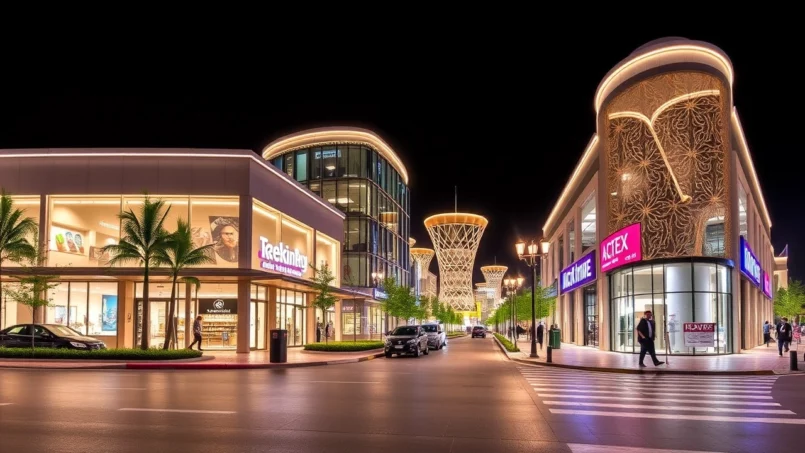
While New Tashkent is still being built on paper and in its initial phase, the Tashkent City International Business Center already offers a concrete glimpse of the new generation of commercial real estate in the country. This 80-hectare mega-project, located in the heart of the capital, is the largest real estate construction site in contemporary Uzbekistan.
An Integrated Business District
Born from a campaign announcement by Shavkat Mirziyoyev in late 2016 and formalized by government decree in 2017, Tashkent City transformed former residential neighborhoods and demolished public buildings into a dense cluster of offices, residences, hotels, retail, and leisure spaces. The commercial concept was entrusted to the American firm Cushman & Wakefield, while the selected architectural design comes from the Turkish firm Tabanlıoğlu Architects.
The Tashkent City project in Uzbekistan is structured into several distinct lots: Gardens Residence, Central Plaza, Hyper Partners Center, Nest One, the Congress + Hilton Complex, the Financial Center, Boulevard Residence, and Tashkent City Park. This diversity of components, mixing housing, offices, retail, hospitality, conference spaces, and parks, perfectly illustrates the contemporary trend toward large mixed-use real estate projects, integrating residential, professional, commercial, and recreational functions within a single urban ecosystem.
The surface areas are significant: Gardens Residence totals nearly 90,000 sqm, Boulevard Residence over 116,000 sqm, while the Financial Center alone brings together over 44,000 sqm intended for the offices of the country’s main banks and Class A buildings. The central park, Tashkent City Park, spans about 187,000 sqm, with the country’s largest fountain and largest amusement park.
A Cluster of Premium Offices, Hotels, and Retail
One of the strengths of Tashkent City lies in its density of high-level commercial assets. The complex houses five international hotels (Hilton, Marriott, Park Inn by Radisson, Holiday Inn, and other ongoing projects), several Class A office towers, conference centers, and a premier retail hub.
Flagship multifunctional complex in Tashkent, combining a shopping mall, a 5-star hotel, a residential tower, and an office building.
The country’s largest shopping mall, targeting 100,000 daily visitors with 300 stores across 100,000 sqm, a 14-screen IMAX cinema, a VR zone, and 2,500 parking spaces.
31-story hotel tower (128 m high) offering luxury accommodation within the complex.
30-story residential building integrated into the project.
29-story Class A building intended for professional activities.
9,200 sqm dedicated space hosting over 20 luxury brands new to Uzbekistan.
The targeted tenant mix for the mall is revealing: approximately 70% of space dedicated to shopping, 15% to food & beverage, 12% to leisure, and 3% to fitness. The distribution of brand origins also illustrates the rapid internationalization of the market: nearly half of the brands are European, followed by CIS, American, Turkish, and local brands. The project aims for international certifications for green construction and seismic resistance (up to 9 on the local scale), which reassures investors.
The table below summarizes some key elements of Tashkent City Mall.
| Indicator | Approximate Value |
|---|---|
| Total Area | 245,000 sqm |
| Gross Leasable Area (GLA) | 100,000 sqm |
| Number of Stores | ~300 |
| Parking Spaces | ~2,500 |
| Targeted Daily Visitors | 100,000 |
| Share Shopping / F&B | 70% / 15% |
| Share Leisure / Fitness | 12% / 3% |
| Share of European Brands | ~47% |
For an investor, this type of asset checks several boxes: prime location, high foot traffic, mix of international and local brands, integration into a booming business district, and appreciation levers linked to the upscaling of Uzbek retail.
Residential, “Smart House,” and Personal Services
Even if the heart of Tashkent City is commercial, the residential component is not negligible. The complex includes nine residential buildings, schools (including the Invento International School kindergarten), sports facilities with pools, supermarkets, and convenience retail. Some residential towers are designed as high-end “Smart House” formats, with integrated hotel services, foreshadowing the rise of a market for upscale residences aimed at expatriates, local executives, and digital nomads.
This functional mix is an important resilience factor. It attracts diverse flows – residents, employees, tourists, customers – and smoothes sectoral risks. It also offers investors the opportunity to position themselves in hybrid products: convertible office floors, apartments usable as serviced apartments, active ground floors combining retail and services.
Offices: A Young Market, with Qualitative Tension
The office segment is one of the drivers of commercial real estate in Tashkent. It is still at an early stage of development but is progressing rapidly, driven by growth in the banking, IT, fintech, distribution, and business services sectors.
Most experts agree: the market for quality offices is “in formation”. The first truly international-standard Class A projects are recent, often concentrated in Tashkent City and a few new clusters. Until recently, most office buildings were renovated Soviet-era buildings, limited by their technical characteristics.
Stock Level, Vacancy, and Rents
The most recent data show a total office stock in Tashkent of about 750,000 sqm, of which nearly 600,000 sqm are classified as “leasable area”. Class B and B+ offices dominate, representing about 69% of supply, while Class A and A+ buildings account for around 22%.
By the end of 2025, approximately 95,000 sqm of offices were vacant in the market, representing a vacancy rate of 16%.
The following table gives an order of magnitude for rents by asset class.
| Office Segment | Average Net Rent (late 2025) | Main Comment |
|---|---|---|
| Class A / A+ | ~$34–35/sq m/month | Rising, strong international demand |
| Class B / B+ | ~$27/sq m/month | Majority segment, very strong demand |
| Prime (high range) | $35–40/sq m/month | Central locations, new towers |
In some new flagship projects, rents significantly exceed these averages. The Trilliant Business Center, for example, charges rents between $40 and $42/sq m/month, while Lot 3 of the Tashkent City Business Center is in the $35 to $40/sq m/month range. Rents in some prime centers reach or exceed $40/sq m/month, with near-zero vacancy rates for the best spaces.
Demand Driven by Services and Digital
Rental demand comes mainly from trading companies, IT companies, banks, financial firms, and telecoms. The most sought-after lot size is between 100 and 300 sqm, which corresponds to the profile of local SMEs, regional subsidiaries of international companies, and growth-stage startups.
The development of digital services and fintech in Tashkent is stimulating demand for flexible offices, coworking spaces, and serviced offices. These turnkey, modular spaces offering shared services (meeting rooms, reception, IT, cafeteria) meet the needs of tech and hybrid companies. This segment, although still emerging, is an indicator of the maturing corporate real estate market.
Infrastructure projects like Orient Business Center, Infinity Business Center, or Gross Plaza illustrate this upscaling. These centers offer modular floor plates, significant underground parking, integrated food & beverage and service offerings, with rents ranging from $25 to over $40/sq m/month depending on floor, size, and fit-out level.
First Cycle of Over-Supply then Adjustment
The rapid development of new premium office towers has, in some areas, led to a sharp increase in vacancy in the very high-end segment. Some analyses thus mention an increase in the Class A vacancy rate from 17% to over 50% in a short period, linked to the simultaneous opening of several large centers.
The apparent supply of Class A offices must be put into perspective. A significant portion of the stock consists of “built-to-suit” (BTS) projects, developed for a single user and thus rarely available on the open rental market. Meanwhile, structural demand continues to grow, driven by the establishment of new foreign companies and the modernization of workspaces for administrations and public companies.
In the medium term, projections suggest a near-quadrupling of the stock of modern offices by 2035, with a target of over 2.1 million sqm. Tashkent is starting from a very low level compared to European or even regional capitals: there are about 137 sqm of modern offices per 1,000 inhabitants, compared to 3,500 sqm in Warsaw or nearly 2,900 sqm in Prague. The gap to be filled is considerable, opening a long window of opportunity for well-positioned projects.
Retail: A Catching-Up Market, Structured by New Malls
The modern retail market has long been the poor cousin of Uzbek commercial real estate. Quality retail space was scarce, limited to a few centers like Samarqand Darvoza or Samarkand Darvoza in Tashkent, as well as ground floors of newly constructed housing.
For a few years now, the situation has been changing rapidly. Available data indicates that 80% of Tashkent’s modern retail space was built after 2014. The total stock of modern leasable space is now around 300,000 to 480,000 sqm depending on the boundaries considered, and is expected to surpass 550,000 to 570,000 sqm in the coming years, driven by several ongoing projects (Tashkent City Mall, Alfraganus Mall, Piramit Mall, Park In Mall, High Town Mall, etc.).
A Relative Deficit of Quality Supply
Relative to population, the stock remains low. With approximately 35 to 165 sqm of modern retail per 1,000 inhabitants in the capital depending on calculation methods, Tashkent is far from the standards of major metropolises, where these ratios are often three times higher. This under-provision of modern shopping malls explains the marked interest of major brands, whether local or international.
Street retail rent on major axes can reach $100/sq m/month, confirming the premium for visibility and pedestrian traffic.
Leases in malls vary greatly depending on location, size, and type of activity, with ranges from about $10 to over $70/sq m/month in some projects.
The Gradual Arrival of Major International Brands
Existing shopping malls already host a considerable array of international brands, often through local franchisees. Among the brands present in Tashkent are LC Waikiki, Mango, Calvin Klein, Armani Exchange, Lacoste, Swarovski, Pandora, DeFacto, Baskin Robbins, but also Kazakh chains like the Magnum hypermarket. New players, especially in fast food and consumer goods, are entering: Papa John’s, Domino’s Pizza, Magento, Fix Price, Merries, Haval, Renault, 3M, Arla Foods, Bi1, Wildberries, etc.
The number of active franchises in Uzbekistan, generating over 18,000 points of sale.
Tashkent City Mall, Catalyst for a New Standard
The opening of Tashkent City Mall marks a decisive step. As the country’s first “super-regional” shopping mall, it aims not only to capture customers from Tashkent and its region but also to become an attraction hub for visitors from other cities and even neighboring countries. Its ability to attract new luxury brands and offer an integrated shopping, leisure, and dining experience should push up the qualitative standards of the entire sector.
Analysts anticipate that this project will serve as a catalyst for the entry of other major international brands, still absent from the market due to a lack of space meeting their criteria in terms of size, design, traffic, security, and certifications.
In this context, investors positioning themselves in retail space in new malls, or in well-located mixed-use developments, can expect gross annual returns on the order of 11–12% for well-operated retail units, a level higher than many more mature markets.
Logistics and Warehouses: The Most Under-Supplied and Taut Segment
If there is one segment where the word “shortage” is not an exaggeration, it is warehouses and logistics platforms. Historically, Uzbekistan mainly had Soviet-era storage buildings, poorly adapted to the requirements of modern supply chains (insufficient ceiling heights, lack of sprinklers, poor insulation, absence of integrated management systems). Most companies preferred to build their own warehouses, and the institutional market was virtually non-existent.
Explosive Growth from a Very Low Base
In recent years, the situation has changed. Between 2023 and 2024, the stock of modern warehouses more than doubled to exceed 500,000 sqm, with growth of around 165% in one year. By the end of Q3 2025, it reached about 555,000 sqm. Despite this explosion in supply, demand remains far superior, to the point that new space is often pre-leased before delivery.
The current ratio of modern warehouse space per capita in Uzbekistan, illustrating a structural deficit.
Vacancy in this segment is close to zero. Some studies mention a vacancy rate of 1.7%, or even 4% depending on the period, indicating an extremely tight market. In some neighboring countries like Kyrgyzstan, the usable stock is almost fully occupied.
Rents Above Regional Benchmarks
This shortage logically translates into high rents. Class A warehouses in Tashkent rent for around $6 to $8/sq m/month, or about $139 to $156/sq m/year, placing Uzbekistan above many CIS markets and even above some areas of the United Arab Emirates, where warehouse rents are around $135/sq m/year. Class B and C warehouses remain significantly cheaper, on average around $3 to $4.6/sq m/month, but offer services incomparable to modern platforms.
Only 20% of the total warehouse stock is used by companies for their own logistics needs.
E‑Commerce as the Driver and Giants Setting Up Shop
E‑commerce is now the main driver of demand for modern warehouses. The Uzbek online commerce market, still modest a few years ago, is set for spectacular growth: some projections mention a $2 billion market by 2027, ten times its 2021 level. This expansion mechanically translates into massive needs for sorting hubs, distribution centers, and cross-docking platforms.
The Uzum Market group estimates its medium-term needs in Uzbekistan at 500,000 sqm of warehouses.
The table below summarizes the recent evolution of the modern warehouse stock.
| Indicator | Approximate Value |
|---|---|
| Modern Stock 2023 (order of magnitude) | ~195,000 sqm |
| Modern Stock end 2024 | ~518,000 sqm (+165% in one year) |
| Modern Stock Q3 2025 | ~555,000 sqm |
| Share of Class A | 16–22% |
| Vacancy Rate (Q3 2025) | ~1.7% |
| Class A Rent (Tashkent) | ~$6–8/sq m/month (≈$150/sq m/year) |
| Class B Rent (Tashkent) | ~$3–4.6/sq m/month |
| Estimated Additional Need | 2.3–2.9 million sqm (“regional” scenario) |
For a logistics-focused investor, this configuration is particularly attractive: low vacancy, high rents, rapid demand growth, massive catch-up to be made. In return, the market suffers from a lack of professional developers, difficulties in accessing land around Tashkent, and a banking system still reluctant to finance this type of asset. The intervention of international developers or joint ventures between local and foreign groups could therefore be a decisive accelerator.
Hospitality and Tourism: A Source of Demand for Commercial Real Estate
Beyond offices, retail, and warehouses, hospitality constitutes a major component of Uzbek commercial real estate. The country is ranked among the fastest-growing tourist destinations by the World Tourism Organization, driven by its historic cities (Samarkand, Bukhara, Khiva), religious sites, architectural heritage, and strategic position on Central Asian routes.
Explosion in Tourist Traffic
The numbers speak for themselves. After about 3 million foreign tourists in the mid-2010s, the country saw this number double in 2018 to reach 5.3 million, then climb to 6.75 million just before the pandemic. After the 2021 low (1.88 million), traffic rebounded: 5.2 million in 2022, nearly 8 million in 2023–2024, and a target set at 11 million visitors for 2025. Meanwhile, domestic tourism has exploded, with tens of millions of internal trips per year.
The average hotel occupancy rate in Uzbekistan, increasing annually by nearly 17%.
An Aggressive Incentive Policy for Hotels and Shopping Malls
Aware of the lag in accommodation capacity, the authorities have implemented a whole range of tax and financial incentives for the construction and renovation of hotels, often coupled with shopping malls of over 5,000 sqm. The measures include massive reductions in land tax and property tax, per-room subsidies for 3 to 5-star hotels meeting certain criteria (minimum number of rooms, eco-label), partial compensation of loan interest, and partial coverage of franchise fees for international hotel brands.
In designated tourist zones in Uzbekistan, taxes on sales, real estate, and salaries can be reduced to 1%. Soft loans are also offered for tourism infrastructure and service projects. This set of measures has facilitated the arrival and expansion of major international hotel chains like Marriott, Hilton, Hyatt, InterContinental, Mövenpick, Mercure, and Wyndham, notably in the Tashkent City complexes and the “Silk Road Samarkand” tourism center.
For the real estate investor, these incentives significantly reduce the carrying cost of assets and improve net profitability, provided the conditions are met (investment amount, eligible sector, location, employment commitment, etc.).
An Open Yet Regulated Legal Framework for Foreign Investors
Uzbekistan has accomplished, in a few years, a profound transformation of its legal framework for foreign investment, including in commercial real estate. The Law on Investments and Investment Activity guarantees a number of rights: protection against nationalization, right to compensation in case of requisition, free repatriation of profits, non-discriminatory treatment compared to domestic investors.
Ownership of Buildings, Not Land
The basic principle remains that land belongs to the state. Foreigners – whether individuals or legal entities – cannot own land, but they can acquire ownership of buildings and structures erected on it, notably through long-term leasehold rights on plots (up to 25 or 49 years depending on the case, or even longer in some special economic zones).
The minimum investment threshold for real estate purchase by foreigners in Tashkent and its region is $400,000.
For commercial real estate held via a limited liability company (LLC or JSC) structure, the most common path for investors is to create a local entity. This entity can hold the rights to the buildings and conclude a long-term lease on the land. Creating an entity involves a minimum charter capital and registration with the authorities but offers flexibility and limited liability.
Tax Advantages and Legal Stability
The tax arsenal includes numerous incentives for foreign direct investment, especially in sectors considered priority (industry, chemicals, construction materials, renewable energy, tourism, IT, etc.). Depending on the amount invested, the share of capital held by foreigners, and location, companies can benefit from temporary exemptions from land tax, property tax, corporate income tax, and other levies.
A key mechanism for investors is the stabilization clause. It guarantees that the tax legislation in force at the time of investment can remain applicable for a period of up to ten years, even if subsequent changes make the regime less favorable. This clause thus offers appreciable visibility in an evolving regulatory environment.
Special Economic Zones (SEZs) and technology parks offer an even more advantageous environment, with long-term exemptions on corporate income tax, land tax, and water usage tax, as well as exemptions from customs duties on imported equipment and certain inputs.
Acquisition Procedure and Transaction Costs
The real estate acquisition process is relatively standardized: negotiation, preliminary agreement, signing of the deed before a notary, registration in the cadastre. Average timelines are between four and eight weeks. Total transaction costs (registration fees, notary, lawyer, translation, agency) generally range between 3% and 6% of the purchase price. VAT, at a rate of 15% for new constructions purchased from a developer, is often included in the listed price.
Flat tax rate on rental income for individuals in Uzbekistan.
The main point of caution for a foreign investor remains the complexity of land law, sometimes informal practices (“grey markets” for office leasing), variability in construction quality, and the need to meticulously verify titles and permits. Solid support from a specialized local legal advisor is essential.
Yields and Investment Horizon: Where to Position in the Cycle?
Available market studies converge on one observation: commercial real estate in Uzbekistan offers attractive gross yields, often in double digits in the most dynamic segments, but at the price of higher regulatory, financial, and operational risk compared to mature markets.
The generally cited orders of magnitude are as follows:
– Well-located offices and retail in Tashkent: gross annual yields around 9 to 12%.
– Street retail on highly frequented axes: payback period of 6 to 7 years, among the shortest.
– Warehouses and industrial assets: gross yields around 8%, with a payback period of 9 to 11 years.
– Residential products: lower rental yields (3–5%), compensated by strong capital appreciation potential.
This is the highest projected annual growth rate for some tourism assets in Uzbekistan over the next five years.
This yield profile therefore combines both generous rental income and potential capital appreciation, which explains why real estate is beginning to be perceived in Uzbekistan not just as a speculative asset but as a true investment asset class.
How to Position on the Market: Avenues and Precautions
For an investor interested in commercial real estate in Uzbekistan, a few avenues appear particularly promising.
In offices, well-located Class A and A+ buildings in Tashkent, particularly in or near Tashkent City and new business clusters, offer an interesting risk/return profile, especially for medium-sized spaces (100–300 sqm) in high demand from tenants. Developments combining full services (coworking, flexible spaces, food & beverage, fitness) are particularly attractive for the IT and financial services sectors.
In retail, new-generation malls such as Tashkent City Mall, Alfraganus Mall, or regional centers in Samarkand and Bukhara constitute platforms of choice for investments in retail space, whether buying to lease or, for operators, opening stores. “Lifestyle center” formats and mixed-use complexes combining shopping, leisure, dining, and accommodation should progress rapidly.
In logistics and construction, an obvious opportunity is the development of Class A warehouses near the airport, freight rail stations, and Tashkent’s ring road. This requires mastering the engineering and technical standards of major shippers and e‑commerce. The trend is toward integrated logistics parks, combining dry and refrigerated storage, customs services, and multimodal platforms.
In hospitality and tourism complexes, the cities of Tashkent, Samarkand, Bukhara, and Khiva benefit from both massive political support, an influx of tourists, and a still patent lack of quality supply, especially for the upper-midscale and upscale segments (3–4 stars) and for concepts like aparthotels and themed resorts.
In return for the opportunities, the investor must contend with several risks: the volatility of the Uzbek soum, the potential evolution of tax regimes and regulations, difficulties in accessing local financing for non-residents, administrative delays, variable construction quality depending on the developer, and a lack of market data transparency. A prudent approach involves working with established local partners, favoring reputable developers, securing long-term property titles, and adopting an investment horizon of at least ten years.
Uzbekistan is still at the beginning of its real estate modernization trajectory. With flagship projects like New Tashkent and Tashkent City, a market for offices, retail, logistics, and hospitality in full catch-up mode, and an increasingly structured legal framework, the country is gradually positioning itself as a new playing field for commercial real estate investors, at the crossroads of Central Asia, Russia, China, and the Middle East. For those willing to grasp its specificities, the window of opportunity remains wide open.
Disclaimer: The information provided on this website is for informational purposes only and does not constitute financial, legal, or professional advice. We encourage you to consult qualified experts before making any investment, real estate, or expatriation decisions. Although we strive to maintain up-to-date and accurate information, we do not guarantee the completeness, accuracy, or timeliness of the proposed content. As investment and expatriation involve risks, we disclaim any liability for potential losses or damages arising from the use of this site. Your use of this site confirms your acceptance of these terms and your understanding of the associated risks.

Cyril Jarnias is an independent expert in international wealth management with over 20 years of experience. As an expatriate himself, he is dedicated to helping individuals and business leaders build, protect, and pass on their wealth with complete peace of mind.
On his website, cyriljarnias.com, he shares his expertise on international real estate, offshore company formation, and expatriation.
Thanks to his expertise, he offers sound advice to optimize his clients' wealth management. Cyril Jarnias is also recognized for his appearances in many prestigious media outlets such as BFM Business, les Français de l’étranger, Le Figaro, Les Echos, and Mieux vivre votre argent, where he shares his knowledge and know-how in wealth management.





