
 Published on and written by Cyril Jarnias
Investing in real estate in Trou-aux-Biches means betting on one of the most sought-after coastal villages in Mauritius, in the heart of the Pamplemousses district. Between a postcard-perfect beach, international tourist traffic, an attractive tax regime, and high demand for quality properties, this market combines many advantages… but also some regulatory and financial specificities that are best understood before diving in.
This article provides a comprehensive analysis of the Trou-aux-Biches real estate market, including prices, rents, yields, and the legal framework for foreigners. It also compares the performance of seasonal rentals, presents concrete examples of properties, and establishes comparisons with other areas of the island and some European benchmarks. The goal is to provide a French-speaking investor with all the necessary elements to evaluate an acquisition in this seaside resort.
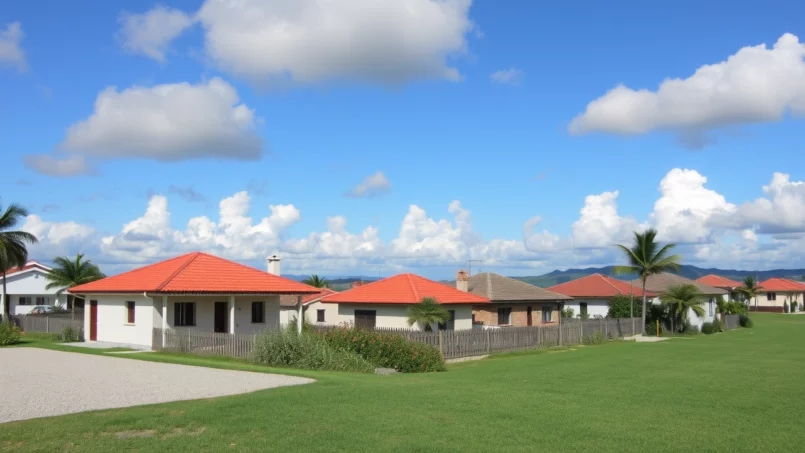
Trou-aux-Biches is a small coastal village in northwest Mauritius, on the coast of the Pamplemousses district. The area is located between Pointe aux Piments to the south and Mont Choisy to the north, and is about twenty minutes from Grand Baie and roughly half an hour from Port Louis. Access is facilitated by the M2 highway and a bus network connecting the village to the capital and other northern localities.
The village has managed to preserve its fishing village atmosphere while becoming a major tourist destination. It is characterized by a fine white sand beach about two kilometers long, bordering a shallow and calm lagoon. Protected by the northwest plateau, the coast is relatively sheltered from the prevailing winds. A few hundred meters from the shore, a well-preserved coral reef hosts rich marine biodiversity, making the site ideal for snorkeling and diving.
The beach at Trou-aux-Biches has already received international recognition and is regularly described as one of the most beautiful on the island. The spectacular sunsets are a major selling point for tourists… and therefore for investors in seasonal rentals.
The village offers a full range of services: supermarkets, shops, restaurants, and bars along the coastal road, as well as diving centers and water sports activities. Schools are located nearby, and clinics and medical centers are found in the northern region. A few kilometers away, Grand Baie concentrates shopping centers (like La Croisette and Grand Baie Coeur de Ville), coworking spaces, vibrant nightlife, and marinas. This setting thus combines the tranquility of a seaside environment, strong tourist appeal, and quick connection to the island’s most dynamic hubs.
To understand the appeal of investing in Trou-aux-Biches, one must place this village in the context of the Mauritian market.
Nationally, real estate is a major economic driver. The Residential Property Price Index grew by over 27% year-on-year in the third quarter of 2024 (about 21% in real terms), according to the Bank of Mauritius. The latter describes robust demand, supported by still favorable financial conditions and a growing economy, with a low perceived risk of a sharp price correction.
More than 5,000 homes were sold to non-citizens between 2005 and 2023 under the major real estate schemes open to foreigners.
The demand map confirms the appeal of the north and west. The districts of Rivière du Rempart and Pamplemousses (which includes Trou-aux-Biches), as well as the coastal region of Black River, account for nearly 80% of sales under schemes for foreigners. The north alone accounts for about half the total volume of these transactions.
In the segment accessible to foreigners, the average listing price exceeded MUR 30.5 million (≈USD 645,000) in 2024, with year-on-year growth exceeding 15%. In the north, apartments sold for an average of MUR 21.3 million (≈USD 450,000) and houses for about MUR 25.5 million.
In euros, prices per square meter illustrate the hierarchy of areas: in Grand Baie, they generally range between EUR 4,500 and EUR 8,000/m² for high-end residential real estate. In the rest of the north, including localities like Trou-aux-Biches or Mont Choisy, the usual ranges are rather between EUR 3,000 and EUR 6,000/m². The west (Flic en Flac – Rivière Noire) displays a similar range, between EUR 3,800 and EUR 7,000/m².
In this context, Trou-aux-Biches positions itself as a premium micro-market: iconic beach, immediate proximity to Grand Baie, numerous new developments, and presence of five-star resorts. The place attracts both purely rental investors and lifestyle buyers planning a future primary or secondary residence.
A very favorable tax and legal framework… but regulated for foreigners
One of the key arguments for investing in real estate in Trou-aux-Biches is the Mauritian tax framework, particularly competitive for non-residents. The country operates on a territorial taxation system, with income tax capped at 15%, VAT at 15%, corporate tax at 15%, and crucially, the absence of several levies often dreaded in Europe: no real estate wealth tax, no annual property tax in the Western sense, no inheritance tax on real estate properties, and no real capital gains tax on resale. In practice, certain structures or specific incomes may be subject to a progressive rate of up to 15%, but it remains a very light environment compared to France.
Access to the real estate market is regulated for non-citizens. Purchase is governed by the Non-Citizen Property Restriction Act and the procedures of the Economic Development Board (EDB). A foreigner cannot freely acquire a standalone house by the sea and must go through specific procedures.
The main acquisition schemes for a foreign investor
Several frameworks have been established to allow non-Mauritians to buy property, often with a residence permit included above a certain investment threshold.
Discover the main services available to meet your needs
Benefit from a diagnosis and personalized advice for your projects.
Get fast and effective assistance for all your questions.
Access training sessions to develop your skills.
Entrust us with creating solutions tailored to your specific requirements.
| Scheme | Principle | Typical Entry Ticket | Key Advantage |
|---|---|---|---|
| IRS (Integrated Resort Scheme) | Large luxury residences integrated into a resort | ≥ USD 375,000 | Residence permit possible |
| RES (Real Estate Scheme) | Smaller-scale projects, often villas or residences | ≥ USD 375,000 (in practice) | Access to more varied and sometimes better-located products |
| PDS (Property Development Scheme) | Replaces IRS/RES, integrating sustainable criteria and services | ≥ USD 375,000 | Permanent residence possible, very wide offering on the north and west coast |
| Smart City Scheme | Integrated towns mixing housing, commerce, offices | ≥ USD 375,000 for residence | Structured urban framework, modern services |
| G+2 | Apartments in buildings of more than two floors | ≥ MUR 6,000,000 (approx. USD 130,000) | Lower entry ticket, not necessarily with permanent residence |
| IHS (Invest Hotel Scheme) | Purchase of villas/rooms within a hotel, with a management lease | Variable amount (often close to EUR 1M for high-end villas) | Managed rental income + hotel benefits |
For a real estate investment in Trou-aux-Biches, the most visible products for foreigners today are mainly apartments or villas under PDS, IRS, G+2, or IHS, integrated into projects like The Essence, KAZBA, Résidence Laelia, or the villas of Trou aux Biches Beachcomber.
Beyond USD 375,000 invested in one of these frameworks, the investor, their spouse, and dependent children under 24 can obtain a Mauritian residence permit. This permit remains valid as long as the property is held.
Property prices in Trou-aux-Biches: from two-bedrooms to prestige villas
The Trou-aux-Biches market covers a fairly broad spectrum: apartments in serviced residences, sea-view penthouses, private villas with pools, village houses, or hotel units under IHS.
Listings provide an idea of the price range, in Mauritian rupees (MUR) as well as in euros.
Examples of properties and sale prices
Several recent listings illustrate the diversity of the offering:
| Property Type | Location / Project | Characteristics | Indicative Price |
|---|---|---|---|
| 3-Bedroom Penthouse | High-end Residence | Sea view, large rooftop terrace | MUR 57,375,000 |
| 2-Bedroom Penthouse | New Residence | Luxury amenities | MUR 35,343,000 |
| 3-Bedroom Villa | Résidence Laelia (13 villas) | PDS scheme, high-end | MUR 28,500,000 |
| 1-Bedroom Apartment | Be Cosy Residence (82.86 m²) | Accessible to foreigners | MUR 9,200,000 |
| 2-Bedroom Apartment | Be Cosy | Mid-market segment | MUR 8,800,000 |
| 2-Bedroom Apartment | Other residence | Affordable segment | MUR 6,500,000–6,700,000 |
| 4-Bedroom Villa | Residential market | MUR 29,582,600 | |
| Villa with pool (4 bd., 280 m²) | Near beach and supermarket | 447 m² plot, contemporary | MUR 27,000,000 |
In foreign currency, on projects primarily intended for foreigners, prices rise quickly:
| Property Type | Project | Indicative Area | Price in EUR |
|---|---|---|---|
| 3-Bedroom Villa (137 m²) | Prestige Residence | Standalone villa | EUR 572,800 |
| Luxury Villa | Gemstone at The Essence | 3 high-end villas | EUR 2,556,100 (set) |
| 2-Bedroom Waterfront Penthouse | Premium Residence | Direct sea view | EUR 575,000 |
| High-end 4-Bedroom Villa | New Residence | Area 287 m² | USD 1,571,300 (~USD 5,475/m²) |
The core market for a foreign buyer, for a nice unit close to the beach, is therefore roughly between EUR 500,000 and EUR 1.5 million, depending on the standard, size, view, and associated services. More compact apartments remain available below EUR 400,000 in some residences (for example around EUR 356,000 for a well-located apartment), while some ultra-premium penthouses or villas easily exceed EUR 2 to 3 million.
Résidence and Villas of Trou aux Biches Beachcomber: a textbook IHS case
Among emblematic developments, the Trou aux Biches Beachcomber Villas hold a special place. These 2 or 3-bedroom villas, integrated into the five-star Trou aux Biches Beachcomber Golf Resort & Spa complex, are marketed under the Invest Hotel Scheme (IHS).
The announced entry tickets are around:
| Villa Type | Estimated Starting Price |
|---|---|
| 2-Bedroom Villa | ~ EUR 990,000 |
| 3-Bedroom Villa | ~ EUR 1,275,000 |
This product well illustrates a hybrid positioning: hotel investment and leisure. The purchaser signs a management lease with New Mauritius Hotels (NMH), which operates their unit as an integral part of the resort. In return, they benefit from:
The investment includes a guaranteed minimum annual return of 3% of the purchase price for the first three years, a 35% share in the net revenue after a 5% reserve for furniture renewal, and semi-annual profit distributions in euros. There are no maintenance charges, as they are fully covered. The investor also benefits from 30 nights per year on a half-board basis for themselves and two guests, as well as 20% discounts on accommodation and certain services within the Beachcomber network.
In practice, this type of structure suits an investor who values both relatively secure income, full management handling, and comfortable personal use, while accepting less flexibility in freely occupying the villa.
The rental market in Trou-aux-Biches: long-term versus seasonal
Investing in real estate in Trou-aux-Biches is not just about buying a property “hoping it will appreciate.” Rental profitability is a pillar of the strategy, and it is essential to distinguish between the long-term market and the short-term market (Airbnb, equivalent platforms).
Market rents for long-term leases
Rental data for Trou-aux-Biches and Mauritius provides a rough order of magnitude for cash-flow projections.
For the island as a whole, the average monthly rents in April 2024 were roughly as follows for apartments:
| Apartment Type | Average Rent (MUR / month) – Mauritius |
|---|---|
| 1 bedroom – central | MUR 35,000 |
| 1 bedroom – non-central | MUR 30,000 |
| 3 bedrooms – central | MUR 55,000 |
| 3 bedrooms – non-central | MUR 45,000 |
In Trou-aux-Biches, house rents, more representative of a holiday investment product, are noticeably higher, with a clear “size” effect:
| House Type | Average Rent (MUR / month) | Rent per m² (approx.) |
|---|---|---|
| 1 bedroom | MUR 28,000 | MUR 252/m² |
| 2 bedrooms | MUR 35,000 | MUR 315/m² |
| 3 bedrooms | MUR 68,000 | MUR 361/m² |
| 4 bedrooms | MUR 82,500 | MUR 375/m² |
| 5+ bedrooms | MUR 112,500 | MUR 417/m² |
Villas show an average rent of MUR 95,000 per month, or about MUR 400/m², while duplexes/townhouses rent for around MUR 48,000 per month.
Gross rental yields in Mauritius range from 3% to 5% for long-term rentals and can reach 5% to 9% for seasonal rentals on well-located properties.
Strong rent progression in the village
In the house market in Trou-aux-Biches, average rents have more than doubled in less than ten years, rising from about MUR 30,000 in 2015 to MUR 65,000 in 2024. This surge reflects increased demand, particularly from expatriates and digital nomads, and limited supply of quality properties in immediate proximity to the beach.
For an investor, the market dynamics support interesting prospects for rent adjustments over time, even if the initial acquisition is made at already high prices.
The explosion of the Airbnb market: detailed data on seasonal rentals
It is probably in the segment of short-term rentals that Trou-aux-Biches stands out the most. An AirROI analysis covering the period January–December 2025 lists 285 active listings in the municipality, for a market described as lightly regulated: at this stage, no “licensed” listing was identified in the sample, whereas in countries like France regulations have tightened significantly.
Composition of the Airbnb stock
The figures show a stock largely geared towards self-contained vacation accommodation rather than rooms in private homes:
| Indicator | Value |
|---|---|
| Number of active listings | 285 |
| Share of entire homes | 93.7% |
| Apartments / condos | 60.4% |
| Houses | 35.4% |
| Others (hotels, unique stays) | 4.3% |
| 2-bedroom listings | 33% |
| 2–3 bedroom listings | 65.6% |
| Average capacity | 4.4 people |
| Listings for 4 people | 29.5% |
| Listings for 4 or 6 people | 56.5% |
The core of the market is thus made up of apartments or villas with 2 to 3 bedrooms accommodating 4 to 6 people, perfectly suited for families and small groups of friends.
Revenues, occupancy rates, and nightly rates
Economic performance shows a market with a contrast between the best operators and less structured hosts. Across all listings, the distribution of monthly revenues looks roughly like this:
| Segment | Monthly Revenue (USD) | Occupancy Rate | Average Daily Rate (ADR) |
|---|---|---|---|
| Top 10% | ≥ USD 4,733 | ≥ 87% | ≥ USD 262 |
| Top 25% | ≥ USD 2,899 | ≥ 71% | ≥ USD 172 |
| Median | ~ USD 1,278 | ~ 46% | ~ USD 92 |
| Bottom 25% | ~ USD 600 | ~ 22% | ~ USD 59 |
Even at the median level, a revenue of around USD 1,278 per month represents an interesting base for a studio or a small two-bedroom, especially for an investment partially financed by a local loan.
The best listings achieve impressive figures for a village of this size, with nearly USD 5,000 in monthly revenue and occupancy rates close to saturation. Several professional hosts illustrate this potential: an operator like Sealodge Mauritius, for example, manages three properties in Trou-aux-Biches for a combined gross revenue exceeding USD 330,000 over twelve months, with an average rating of about 4.9/5.
Sealodge Mauritius, professional operator
Marked seasonality, but less severe than in other destinations
The annual calendar of demand and prices confirms a seasonal profile, but without a complete collapse of activity in the low season.
For 2025, AirROI observes:
– a high season mainly in November, January, and October,
– a relatively dynamic intermediate season for the rest of the year,
– a more pronounced trough in June, August, and September.
The averages by period are instructive:
| Season | Average Monthly Revenue | Average Occupancy | Average ADR |
|---|---|---|---|
| High (Nov., Jan., Oct.) | USD 2,430 | 54.4% | USD 137 |
| Intermediate | USD 2,079 | 47.6% | USD 137 |
| Low (June, Aug., Sept.) | USD 1,585 | 38.4% | USD 128 |
The best performing month of the year can reach up to about USD 2,538 in average revenue, with an occupancy rate of 57% and an average price of USD 146 per night. Conversely, the weakest month still averages around USD 1,295 in revenue, 32% occupancy, and USD 124 per night.
For an investor, seasonal rental in Trou-aux-Biches does not depend solely on a few summer weeks. It benefits from relatively constant international traffic, with a marked peak during the European winter and significant demand present almost year-round.
Length of stay, conditions, and booking lead time
Traveler habits strongly influence rental management strategy.
Data shows that:
– just over half of the listings (51.2%) are available for rent more than 270 days a year,
– most hosts require a minimum stay of 4 to 6 nights (30.4% of listings),
– nearly 29% of accommodations target monthly stays (30 nights and more), an interesting segment for digital nomads or European “snowbirds”,
– the most common booking duration is 31 to 90 days (24.6% of listings), a sign of a medium-term market in full structuration.
The average booking lead time for a tourist stay is 82 days.
Finally, more than 56% of hosts adopt rather strict cancellation policies (moderate or strict), reflecting a professionalization of the market and a desire to secure income.
A very international client profile
Trou-aux-Biches attracts primarily a foreign clientele: 99% of recorded travelers are international visitors.
The main source countries are France and the United Kingdom, which together account for nearly 44% of arrivals on the platform. The dominant languages are logically English and French. Interestingly, half of the travelers belong to the post-2000 generations (Gen Z and Alpha), which testifies to the village’s appeal to a young, connected audience sensitive to “Instagrammable” experiences—a factor influencing the type of properties that perform well (photogenic accommodations, careful design, well-curated outdoor spaces, reliable wifi).
Case study: a small property with high theoretical profitability
A BNBCalc simulation cited for a very simple type of property highlights the potential yield in Trou-aux-Biches for a well-located compact product.
It concerns a 1-bedroom / 1-bathroom apartment, intended for a single occupant, located on Trou Aux Biches Rd Triolet, in the Pamplemousses district. Based on 40 comparable listings, the tool estimates:
Summary of key estimated performance and profitability indicators for the investment.
Estimated annual rental revenue of USD 33,840, with an average rate of USD 83 per night and a target occupancy rate of 71%.
Estimated position around the 49th percentile of revenue in the local market, indicating a median competitive position.
Projected annual net profit around USD 7,728, after deducting operating expenses.
Theoretical cap rate of approximately 8.8% and an estimated cash-on-cash return of 14.4%.
Assumed growth in property value at an annual rate of 3%, contributing to overall return.
These figures are naturally to be handled with caution: they assume optimized management, occupancy in the upper tier of the market, and no major setbacks. But they illustrate that a small property well calibrated to real demand (good connectivity, modern decor, interesting location, key services like wifi, air conditioning, equipped kitchen, parking) can compete, in terms of yield, with heavier investments.
Regional comparisons: where does Trou-aux-Biches rank in the Mauritian hierarchy?
To evaluate an investment in Trou-aux-Biches, it is useful to compare its performance to that of other tourist hubs on the island, particularly in the short-term rental segment.
Several neighboring markets studied based on AirROI data show varied profiles:
| Location | Active Listings | Average Monthly Revenue | Average ADR | Average Occupancy |
|---|---|---|---|---|
| Trou-aux-Biches | 285 | ~ USD 2,000 (depending on season) | ~ USD 130–140 | ~ 46–54% (depending on season) |
| Grande Rivière Noire VCA | 51 | USD 3,857 | USD 238 | 55% |
| Grand River South East | 21 | USD 3,974 | USD 809 | 34% |
| Poste de Flacq | 39 | USD 3,538 | USD 463 | 37% |
Some highly premium markets, like Grand River South East, display spectacular nightly rates but lower occupancy levels. Trou-aux-Biches, on the other hand, combines a larger volume of listings, more accessible prices, and a solid median occupancy rate. It is a “balanced” market profile, less exclusive but more fluid, which increases resale liquidity and the depth of rental demand.
Financing an investment in Trou-aux-Biches: loans, down payments, and acquisition costs
Another crucial aspect for an investor remaining in foreign currency is the possibility of obtaining local financing. In Mauritius, several banks — MCB, SBM, Absa, Bank One, AfrAsia notably — offer mortgage loans to non-residents.
The main market terms are as follows:
The maximum financing quota for the acquisition of a property in Mauritius, expressed as a percentage of the property value.
Overall acquisition costs, for a foreigner purchasing under an eligible scheme, generally range between 8.5% and 11% of the purchase price, including:
| Cost Item | Order of Magnitude |
|---|---|
| Registration duty / transfer tax | 5% of the price (announced increase to 10% by 2025–2026 for some cases) |
| Notary fees | 0.5–2% |
| Additional legal fees | 1–2% |
| Agency commission | About 2% |
A concrete example from a listing shows that the buyer should budget for about 1.3% notary fees, 5% government tax, and 2.3% agency commission on a purchase of MUR 27 million, totaling just under 9% in entry costs.
In Mauritius, there is no annual property tax. The owner is subject to income tax on rental earnings (scale of 0% to 20%), condominium charges (often between EUR 2,000 and EUR 8,000 per year in luxury residences), and, if the rental is managed via a company, VAT on certain services.
Risks and points of caution
While Trou-aux-Biches ticks many positive boxes, a savvy investor should nevertheless keep in mind some risks and constraints.
The first is the cost of entry: the north of Mauritius is classified as a premium zone, with strong price increases and limited land supply. Even if the market is described as relatively liquid, a poorly located, poorly calibrated, or overpriced purchase may take time to resell, especially if the product falls outside the sought-after standards (2–3 bedrooms, beach proximity, pool, services).
Mauritius is located in an area exposed to cyclones, particularly between February and March. Although recent constructions comply with reinforced standards, the investor must factor this risk into their insurance coverage, property design, and season management (plan for cancellations, material damage, and outages).
Third element: the duality and evolution of the regulatory framework. The government has already changed some registration duties (announced increase from 5% to 10%), tightened some access for foreigners (e.g., rule requiring at least 85% of the price to be paid in rupees), and could, in the future, more strictly regulate short-term rentals as has been the case in Paris, Lyon, or Bordeaux. While the Airbnb market in Trou-aux-Biches is currently lightly regulated, there is no guarantee this environment will remain unchanged for 10 or 15 years.
With over 280 Airbnb listings and a continuous flow of real estate projects (PDS and G+2) in the northern coastal strip, the seasonal rental market could face increased competitive pressure, especially outside the high season. This will reinforce selection based on quality, focusing on location, design, services, and customer reviews.
How to strategically approach a real estate investment in Trou-aux-Biches?
Investing in real estate in Trou-aux-Biches requires reconciling four dimensions: regulation, location, product, and business model.
On the regulatory front, it is important to choose the right acquisition scheme (PDS, G+2, IHS…) based on one’s objectives: permanent residence or not, desire to manage the rental oneself or delegate to a hotel operator, holding period, tolerance for exchange rate risk and changes in the law. Guidance from a Mauritian notary, a tax advisor, and an experienced real estate agent is essential to navigate these subtleties.
In Trou-aux-Biches, a property’s value is strongly determined by its immediate proximity to the beach, walking access to shops and restaurants, and ease of connection to Grand Baie and Port Louis. A villa located 100 or 200 meters from the lagoon has a much more advantageous resale profile than accommodation further away, without sea view or quick access to the coast.
The product choice must be aligned with the statistical demand of the market: the AirROI data clearly shows the dominance of 2–3 bedrooms for 4–6 people. Focusing on this segment allows addressing both families, extended couples, and groups of friends, while remaining within reasonable construction, furnishing, and management budgets.
A small apartment in short-term rental on the Trou-aux-Biches market can achieve a theoretical cap rate of 8.8%, illustrating a potentially much higher yield than a long-term rental. This seasonal model, however, requires a greater investment in logistics and marketing: professional photos, review management, multi-platform synchronization, and cleaning and concierge services.
In any case, Trou-aux-Biches stands out as one of the key points on the Mauritian north coast for those wanting to combine an exceptional living environment, potential for appreciation, and sustained rental income. Provided one engages with a deep understanding of the local context, this investment can form a solid pillar of a diversified international portfolio.
Disclaimer: The information provided on this website is for informational purposes only and does not constitute financial, legal, or professional advice. We encourage you to consult qualified experts before making any investment, real estate, or expatriation decisions. Although we strive to maintain up-to-date and accurate information, we do not guarantee the completeness, accuracy, or timeliness of the proposed content. As investment and expatriation involve risks, we disclaim any liability for potential losses or damages arising from the use of this site. Your use of this site confirms your acceptance of these terms and your understanding of the associated risks.

Cyril Jarnias is an independent expert in international wealth management with over 20 years of experience. As an expatriate himself, he is dedicated to helping individuals and business leaders build, protect, and pass on their wealth with complete peace of mind.
On his website, cyriljarnias.com, he shares his expertise on international real estate, offshore company formation, and expatriation.
Thanks to his expertise, he offers sound advice to optimize his clients' wealth management. Cyril Jarnias is also recognized for his appearances in many prestigious media outlets such as BFM Business, les Français de l’étranger, Le Figaro, Les Echos, and Mieux vivre votre argent, where he shares his knowledge and know-how in wealth management.





