
 Published on and written by Cyril Jarnias
Madeira has quietly established itself, in just a few years, as one of the most sought-after real estate markets in Portugal for high-end residences. Long seen primarily as a cruise and hiking destination, the island now enters the same conversation as the Algarve or certain neighborhoods of Lisbon when it comes to prestige villas, panoramic apartments, and “safe haven” heritage investments.
The rise in prices is due to a favorable climate, solid infrastructure, attractive taxation through the International Business Centre, limited supply, the rise of remote work, and an influx of international capital. This has led to a scarcity of premium properties and increased competition among buyers for the best locations.
A Structurally High-End Market
The first thing to understand is that the Madeiran residential market is, by nature, a selective market. Across Portugal, homes over one million euros remain the exception: they represent 8.1% of listings. On Madeira, this proportion rises to 16.0%, exactly double the national average. Thus, along with the Algarve, the island is one of the two territories with the highest share of luxury properties in the country.
Portugal has more than 16,000 homes valued at over one million euros, including about 2,400 above three million.
This positioning is reflected in price levels. Today, the island is the second most expensive region in the country, just after the Lisbon district, for both purchases and rentals. In September 2025, the average sale price reached €580,000, a year-on-year increase of 17%, compared to €435,000 on average nationwide (an 18% increase). On the rental side, the average rent was around €1,400 per month, also well above most mainland regions.
This high cost is not the result of an isolated speculative bubble, but rather the logical consequence of a simple equation: a mountainous island, limited buildable coastline, regulations that still constrain new production, and accelerating international demand.
Analysis of the Corsican real estate market
When Island Exclusivity Meets Global Demand
Madeira is the main Portuguese island for prestige residences, ahead of the Azores. In the third quarter of 2025, about 1,200 so-called “luxury” homes were for sale there. That’s 49% more than the previous year: supply is expanding, driven by recent developments and a wave of renovations of quintas and older buildings.
After a period of euphoria, demand for luxury homes has declined by about 30% year-over-year, and the median price has slightly corrected by 3%, stabilizing around €1.82 million at the end of September 2025. This is a digestion phase, not a market reversal, following several years of strong buyer pressure.
On the premium apartment segment, Madeira once again holds a unique position. The island is the only one to offer a genuine choice of high-end apartments: about 370 “luxury” units are listed, with a median price close to €1.58 million. Most of these are concentrated in Funchal and along the sunny southern coastline, in contemporary buildings with sea views, pools, landscaped gardens, and hotel-style services.
Nearly 47% of searches for properties for sale on Madeira during summer 2025 came from buyers based abroad.
This international clientele doesn’t just represent volume; it also drives prices upward. Nationwide, non-residents purchase on average 39% more expensive homes than Portuguese buyers. On an island with limited supply, this gap mechanically pushes up prices in the most sought-after segments, particularly sea-view villas, upscale apartments in Funchal, and properties with strong short-term rental potential.
Funchal: The Backbone of Madeiran Luxury
Funchal, the island’s capital, concentrates most of the high-end activity. It is where major market trends converge: the appreciation of historic properties, the rise of prestigious new developments, the conversion of buildings into serviced residences, and growing pressure from tourism demand and digital nomads.
A Market Segmented by Neighborhood
The Funchal market can be read almost neighborhood by neighborhood, with significant price differences.
In the old town, the historic heart, prices frequently range between €4,200 and €5,000 per square meter. The architectural cachet, urban atmosphere, proximity to the port, and “signature” restaurants justify these values. For restored properties with contemporary finishes and panoramic terraces overlooking the bay, prices can easily exceed these ranges.
Along Estrada Monumental and the Lido promenade, the urban landscape is marked by recent buildings and high-end apartment blocks, featuring pools, gardens, and views of the Atlantic Ocean. For instance, a 1920s quinta, with 160 m² of living space and perfectly integrated into the urban fabric, is offered there for around €895,000. Nearby, a new luxury apartment block has recently attracted a wealthy clientele, illustrating the continued upscale residential densification in this area.
A bit further west, the São Martinho neighborhood offers a slightly gentler price-to-quality ratio, with values around €3,200 to €3,800/m². This area is very popular with international families and retirees for its balance of tranquility, amenities, and proximity to the center.
This segmentation is reflected in price statistics: over one year, Funchal saw its overall residential market rise by about 17.3%, while the most exclusive homes gained nearly 18.8%. In other words, the high end is not falling behind; it slightly outperforms the overall market.
Villas, Quintas, and Character Homes
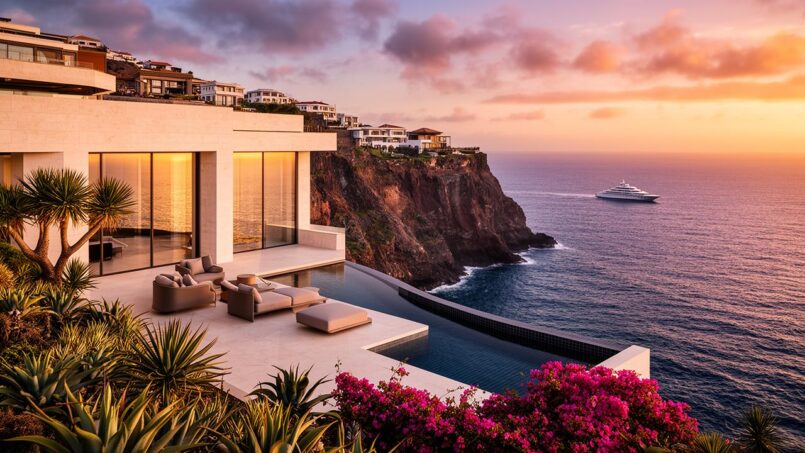
Beyond apartments, Funchal and its immediate surroundings are full of spectacular villas. Some are large traditionally inspired quintas, set on plots of several thousand square meters, just minutes from the center. Others are contemporary villas, built on hillsides, with infinity pools and glass facades opening onto the bay.
For example, there is a villa built in the early 1990s, located at about 340 meters altitude and spread over three levels with generous volumes. Another, more recent property, sits on a plot of over 3,000 m², offering total privacy while remaining minutes from the heart of Funchal. These properties illustrate the niche sought by wealthy clients: panoramic views, generous space, preserved privacy, and quick access to city services.
In the highly sought-after neighborhood sometimes called the “Beverly Hills of Madeira”, a 254 m² home with three bedrooms is positioned around €450,000—a price that reflects both the area’s appeal and the diversity of price ranges, with the real price break occurring above one million.
The South and West: Calheta, Ponta do Sol, São Gonçalo, Santa Cruz
While Funchal concentrates urban activity, it is along the south and southwest coast that the heart of luxury villa supply is increasingly taking shape.
In Calheta, particularly in villages like Jardim do Mar or Arco da Calheta, the market has shifted into a very international dimension. Contemporary single-story villas with pools, three bedrooms, and dominant terraces are designed as much for permanent residence as for high-yield rental operation. A boutique guesthouse in Calheta illustrates this hybrid positioning: a charming bed and breakfast, oriented toward high-value tourism, which can also serve as a secondary residence optimized for rental.
Annual occupancy rate for the best short-term rental properties on Madeira’s west coast, around Calheta.
Ponta do Sol, like Calheta, benefits from maximum sunshine, making it a corridor closely watched by buyers, especially those imagining remote work villas or active retirement homes. Properties specifically set up for digital nomads (very high-speed internet, offices, integrated co-working spaces) rent for 15 to 20% more than standard properties of equivalent size.
East of Funchal, the São Gonçalo neighborhood offers a more traditional luxury, exemplified by classic villas with vast gardens and panoramic views. These properties, such as a five-bedroom villa in the hills, attract not only tourists but also wealthy local families and foreign residents seeking permanent settlement.
In the nearby hinterland, Santa Cruz offers homes in a more rural and verdant setting. On the heights, a three-bedroom house surrounded by pastures and farmland represents an interesting compromise for buyers who prioritize quality of life and space over absolute prestige address, while remaining within the sphere of influence of Funchal and the airport.
Boa Nova and Large Plots: Structured Rarity
One of the clearest signs of the maturity of the luxury market in Madeira lies in a type of product that remains ultra-rare in Western Europe: very large plots near a regional capital, already serviced and intended for custom projects.
Just minutes from Funchal, the selective Boa Nova subdivision offers seven large plots of over 8,000 m² each. This semi-rural site combines tranquility, space, and open views with immediate access to urban amenities: schools, restaurants, services, and the marina.
Investors see it as having dual potential. In the short term, the possibility of building fully customized ultra-luxury villas, with substantial built areas and specifications meeting the most demanding markets. In the longer term, the value of such rare land in one of the most privileged areas of the island, especially as Portugal suffers from a chronic housing shortage and administrative delays in issuing permits.
One plot already benefits from a fully approved construction project that is currently underway. The infrastructure (roads, utilities) is installed, significantly reducing implementation time—a crucial factor in a context where administrative procedures can be lengthy.
For an international investor, this type of land ticks many boxes: prime location, extreme rarity, architectural flexibility, and the ability to build a custom asset that can be valued both as a multi-generational family residence and as an investment product combining personal use and rental for part of the year.
A Spectacular but Normalizing Price Dynamic
On several indicators, Madeira is among the leaders in price increases in Portugal. Over one year, some statistics cite a price increase of around 6.2% island-wide, with peaks of 8.1% in Funchal’s most sought-after neighborhoods. Other sources place the overall annual increase at over 24%, clearly putting Madeira at the top of the most dynamic regions.
That’s the record price increase rate in the top 10% most expensive properties in Saint Barthélemy in April 2024.
However, all signs point to the market entering a phase of moderation rather than overheating. Across Portugal, analysts anticipate for 2026 more contained price increases, on the order of 2 to 6% per year. The surge of recent years is giving way to a “quality first” logic: high-end buyers now prioritize long-term use value, location, construction quality, and return prospects, rather than the prospect of a quick flip.
The construction sector in France faces an estimated shortage of over 90,000 workers.
In this context, luxury properties on Madeira appear as an interesting arbitrage asset: cheaper, at equivalent standing, than some neighborhoods in Lisbon (where the best areas exceed €6,700/m²), while offering solid rental prospects and steadily rising international appeal.
Madeira vs. Other Portuguese Islands and Regions
To measure Madeira’s uniqueness, it’s useful to compare it to the Azores and the most popular mainland regions.
On the neighboring archipelago, São Miguel is the main luxury market, but on a more modest scale: about 89 luxury homes for sale in summer 2025, an increase of 78% in one year, but on volumes that remain small. This inflation in supply has led to a drop in demand of around 45%. The median price of a luxury home on São Miguel is around €1.5 million, well below the Madeiran median of €1.82 million.
Over 50% of searches for properties for sale on some Azores islands come from abroad.
On the mainland, the Algarve (Faro district) remains Madeira’s most credible rival for luxury villas. There, the average sale price is around €550,000 and rents around €1,250. The proportion of properties over one million, at 18.7%, is slightly higher than Madeira’s. However, the island has an image advantage—exotic insularity, a more preserved environment—and a tax advantage through its International Business Centre.
Lisbon offers attractive rental yields on small spaces, but at a high entry price. Madeira, with its mild year-round climate, attracts investors looking for villas with ocean views and gardens, for a different lifestyle.
Profitability, Returns, and the New Digital Nomad Dynamic
For investors, the central question remains the return on capital, whether financial (yield + capital gains) or “intangible” (quality of life, personal use, prestige of the asset).
Available data indicates several orders of magnitude. On high-end short-term rentals:
– In Funchal’s tourist heart, a very well-positioned property achieves gross yields of 5.5% to 6.2%.
– On the west coast around Calheta, the best products approach 7% gross, with occupancy rates close to 78% over the year.
In the long term, standard residential rental in Funchal falls more between 4.2% and 4.8% gross, a level consistent with comparable European markets.
Madeira has established itself as an attractive hub for digital nomads and remote workers, thanks to its climate, moderate time difference, excellent internet connectivity, and a cost of living more affordable than in European capitals. Properties specifically designed for this audience, with fiber optics, integrated co-working spaces, separate studios for work, and concierge services, can rent for 15% to 20% more than standard homes.
For a savvy buyer, profitability therefore goes beyond a simple rent/price ratio; it lies in the property’s ability to capture several demand segments: high-end tourism in peak season, long-stay remote workers in the shoulder season, and occasional personal use. This “mix” often helps smooth seasonality, maximize occupancy, and generate an overall return (financial + usage) far higher than what the gross yield alone might suggest.
Who Buys, and Why?
The profile of luxury buyers in Madeira mirrors the island itself: diverse, but with a few strong constants.
Portuguese buyers remain dominant in purchase volume on the islands, including Madeira. But in the high-end bracket, foreigners are taking an increasing share. Germany, the United Kingdom, and the United States are the top three nationalities interested in Madeira, joined by several other European countries. Non-resident buyers spend on average 39% more than locals on housing, which mechanically reinforces their weight in the luxury segment.
Their motivations combine several elements:
Investing in real estate on Madeira allows you to secure part of your wealth in a tangible asset within a politically stable country. It also offers the opportunity to benefit from a primary or secondary residence in an exceptional climate and natural setting. This strategy enables portfolio diversification away from saturated major metropolises, captures rental potential driven by tourism and remote work, and, in some cases, optimizes taxation through specific schemes available in the archipelago.
Among them are affluent retirees, international senior executives, digital entrepreneurs, but also families seeking a different lifestyle, closer to nature, while maintaining quick access to major European cities via air links.
The Role of Policy, Infrastructure, and Taxation
If Madeira has taken on such a dimension on the map of real estate luxury, it’s not only because of its landscapes. The island relies on a combination of public policies, investments, and fiscal instruments.
The Portuguese government has allocated about €220 million for island development through 2027. Part of these funds aims to strengthen infrastructure (roads, ports, public services), which directly benefits real estate attractiveness. The return of international flight connections, combined with a rise in the quality of hotel offerings, further reinforces the premium destination image.
Madeira has the status of an International Business Centre, offering a competitive and regulated tax framework for companies. While not a tax haven, this environment attracts investors, head offices, family holdings, and an affluent clientele.
Finally, Portugal’s institutional stability, membership in the European Union and the eurozone, and absence of major political upheavals compare favorably with other luxury vacation destinations more exposed to geopolitical risks.
Risks, Limits, and Points of Vigilance
However, investing in Madeiran luxury is not a path without obstacles. Several factors call for caution and careful analysis.
The luxury real estate market is constrained by a structurally limited supply of very large plots and exceptional properties. With only 1,200 luxury homes recorded on the island, this stock is not elastic. In the context of a general housing shortage in Portugal, this scarcity could increase pressure on more affordable segments and fuel political debate regarding high-end second homes.
Second point of vigilance: dependence on tourism and international remote work. While diversification of buyer and tenant profiles reduces risk, a prolonged economic crisis, a tightening of mobility conditions, or a deterioration of the island’s image could impact occupancy rates and, consequently, returns.
Thirdly, the regulatory and urban planning machinery remains heavy. Permit approval times, availability of construction labor, and rising material costs are all parameters that can delay project timelines and erode margins. An investment on a vacant plot in Boa Nova, for example, may offer considerable value creation potential, but requires rigorous management of these operational risks.
Finally, the regulatory environment regarding short-term rentals, in particular, is subject to change. As in many tourist destinations, the question of balance between the residential market and the seasonal market is increasingly pressing. Investors must therefore factor in the possibility of rule changes, quotas, or restrictions in the medium term.
Madeira in the New Global Geography of Luxury Real Estate
On a global level, the luxury residential market is far from slowing down. It was valued at nearly $584 billion in 2025, with a projected trajectory to over $735 billion by 2031, an average annual growth of about 3.9%. This movement is driven by the increasing number of ultra-high-net-worth individuals, the international migration of millionaires, and the testing of new models such as property tokenization.
Madeira is considered a second-tier market, benefiting from the spillover effect of saturated major markets. It attracts wealthy families, already established in metropolitan areas, seeking a secondary residence offering quality of life, safety, scenery, and good connectivity.
The rise of “workcations”—places where one can both live, work remotely, and enjoy a vacation environment—accentuates this trend. The island combines strong digital infrastructure, a time zone compatible with Europe, spectacular natural surroundings, and a cost of living still lower than many capitals.
For an international portfolio, a luxury property on Madeira fulfills several functions:
– geographic diversification within the eurozone,
– partial inflation hedge through a real asset,
– an asset for family use (vacations, remote work),
– a potential source of recurring income through rental.
Toward a Decade of High-End Consolidation
Everything indicates that the coming decade will be one of consolidation for Madeira’s luxury property market. The post-pandemic euphoria, marked by spectacular price increases, seems to be giving way to a more “rational” phase, where well-located, well-designed, and well-managed properties will continue to appreciate, while poorly positioned or average-quality properties may stagnate or correct.
For a buyer or investor, the key approach in the luxury property market is selectivity. In a segment where homes over three million euros are rare, it is crucial to carefully evaluate the neighborhood, orientation, construction quality, accessibility, and rental potential. This thorough analysis helps distinguish a purely “pleasure” asset from an investment that is both enjoyable and high-performing over the long term.
Funchal and its immediate surroundings will remain the beating heart of Madeiran luxury, with a particular focus on historic districts and contemporary waterfronts. Calheta, Ponta do Sol, and the west of the island should continue to gain momentum in the villa + seasonal rental niche. Areas like Boa Nova will embody the most exclusive fringe, reserved for truly custom projects.
In a world where the mobility of capital and people has never been stronger, Madeira has managed to turn its geographic constraints into assets. For those seeking a rare asset, in a stable, natural, and deeply European environment, the market for luxury properties on Madeira now stands as a full-fledged option, more than just an island curiosity off the continent.
A wealth planning project or a question? Contact us now to speak with a wealth management expert.
Disclaimer: The information provided on this website is for informational purposes only and does not constitute financial, legal, or professional advice. We encourage you to consult qualified experts before making any investment, real estate, or expatriation decisions. Although we strive to maintain up-to-date and accurate information, we do not guarantee the completeness, accuracy, or timeliness of the proposed content. As investment and expatriation involve risks, we disclaim any liability for potential losses or damages arising from the use of this site. Your use of this site confirms your acceptance of these terms and your understanding of the associated risks.

Cyril Jarnias is an independent expert in international wealth management with over 20 years of experience. As an expatriate himself, he is dedicated to helping individuals and business leaders build, protect, and pass on their wealth with complete peace of mind.
On his website, cyriljarnias.com, he shares his expertise on international real estate, offshore company formation, and expatriation.
Thanks to his expertise, he offers sound advice to optimize his clients' wealth management. Cyril Jarnias is also recognized for his appearances in many prestigious media outlets such as BFM Business, les Français de l’étranger, Le Figaro, Les Echos, and Mieux vivre votre argent, where he shares his knowledge and know-how in wealth management.





