
 Published on and written by Cyril Jarnias
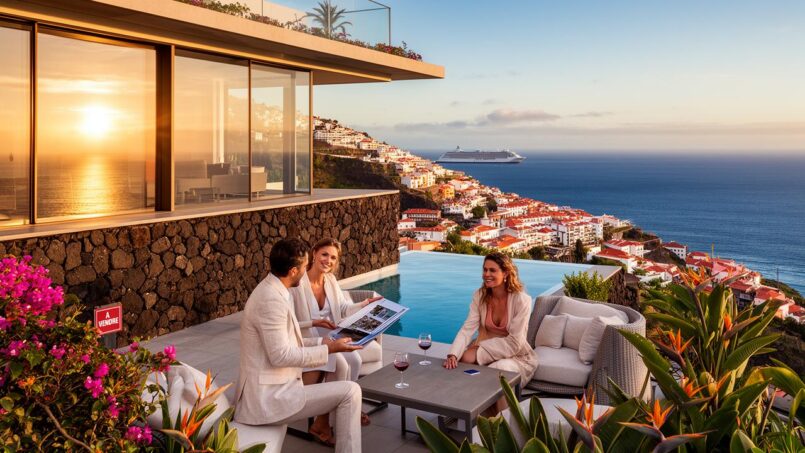
The archipelago has long attracted tourists. Now, it is also winning over second-home buyers and investors, to the point of becoming one of the most pressured markets in all of Portugal. In just a few years, prices have skyrocketed, supply has tightened, seasonal rentals have multiplied, and local and national authorities have begun to tighten the screws.
Behind the idyllic image of villas with swimming pools overlooking the Atlantic lies a complex, dynamic but increasingly regulated market. Buyers are now also factoring climate concerns into their thinking.
Madeira has firmly established itself as a high-end market nationwide. While the average price per square meter in Portugal is around €3,076, the region has crossed several symbolic thresholds. The archipelago shows an average price of about €3,825/m² for houses in February 2026, up 17.3% year-on-year.
The regional average price per home in Madeira reached €300,000 in January 2025.
To measure the scale of this momentum, just compare national and regional trends. Between 2014 and 2025, prices in Portugal more than doubled, with the median rising from €763/m² to €2,111/m². On this already stretched baseline, Madeira did even better, with a 24.54% increase in 2025 alone and an annual appreciation of 17.7% in the third quarter of 2025.
Demand is exploding in a territory where construction is severely limited by geographic constraints (insularity, steep terrain, narrow coastline) and regulatory hurdles (environmental protections, zoning, administrative delays).
Pressure reflected in price figures
Data by property type also reveals a clear gap between listing prices and those actually recorded by the Portuguese statistical institute (INE), a sign of high expectations from sellers.
| Property Type | Average Area (m²) | Median Listing (€/m²) | Median Total Listing Price | INE Price (€/m²) |
|---|---|---|---|---|
| T0 | ~50 | 4,300 | €215,000 | ND |
| T1 | ~61 | 5,574 | €340,000 | 2,239 |
| T2 | ~108 | 3,935 | €425,000 | 2,114 |
| T3 | ~170 | 3,500 | €595,000 | 2,028 |
| T4+ | ~228 | 3,333 | €760,000 | 1,363 |
Listings clearly target international buyers and second-home purchasers willing to pay a premium for views, build quality, and rental potential. Transaction values, which are lower, still indicate room for negotiation, but in a market structurally favoring sellers.
Where to buy a second home in Madeira?
The island is small – roughly 58 km long and 23 km wide – but micro-markets are numerous, with very different profiles, climates, and price levels. Sunshine, accessibility, slope, proximity to the sea or Funchal all significantly affect the cost.
Funchal: beating heart and a “red hot” market
The capital concentrates more than 60% of the island’s housing stock and remains the main draw for second-home buyers. The climate is mild, with plenty of sun and little rain, and the range of services – hospitals, shops, restaurants, schools – is unmatched on the archipelago.
Average prices in Funchal are around €3,901/m², with a wide range depending on the neighborhood. In the most sought-after areas, upscale complexes approach or exceed €6,000/m².
For second homes, demand focuses on T2, T3, and T4 apartments, with typical budgets ranging from €450,000 to €900,000 for apartments, while luxury villas in and around Funchal are more in the €1 million to €3 million range, sometimes higher for iconic waterfront properties.
Several neighborhoods deserve special attention for a second home:
São Martinho, to the west, is prized for its new developments with pools and ocean views, offering high rental yields. The historic center (Sé) attracts with its lively atmosphere and cultural life, despite the noise. Santa Maria Maior and São Pedro combine traditional charm with a residential feel. Finally, Monte, accessible by cable car, offers a lush, cool setting with panoramic views.
New developments are plentiful. For example, new-build units in São Martinho from €825,000 for 2 to 3 bedrooms, high-end residences in the Lido area from €750,000, sometimes with over 1,000 m² for the largest units, or upscale apartments in Sé from €575,000.
On the villa front, listings for contemporary homes over €2.5 million – such as this 392 m² home with an A energy label or a 448 m² villa at €2.6 million – illustrate Funchal’s shift into the category of top-tier seaside capitals.
Calheta, Ponta do Sol, Ribeira Brava: the southwest coast in the spotlight
On the warmer, very sunny southwest coast, a second major second-home hub is emerging: Calheta, Ponta do Sol, and Ribeira Brava.
Calheta has several decisive advantages for a vacation home buyer: one of the island’s warmest climates, golden sand beaches (artificial, with sand imported from Morocco), a marina, a renovated promenade, and above all, targeted development for an affluent clientele, with numerous contemporary villas, boutique hotels, and vacation homes with pools.
Prices reflect this positioning. An average of around €4,234/m² places Calheta among the most expensive municipalities on the island. For contemporary villas with sea views and a pool, entry-level prices generally range from €400,000 to over €1.3 million, with some very high-end properties reaching or exceeding €2 million. A modern 135 m² villa on a large plot of nearly 2,800 m² in Arco da Calheta, for instance, is listed at €995,000.
Ponta do Sol enjoys some of the best sunshine on the island and has gained global fame for its ‘digital nomad village,’ attracting over 9,000 remote workers per year. This dynamic supports strong year-round rental demand and high property prices, averaging around €3,514/m². Properties, whether modern or traditional and well-located, typically sell between €350,000 and €900,000.
Ribeira Brava, another southern municipality, has average prices close to those of Funchal (€3,912/m²), also featuring a segment of luxury villas: a 275 m² home with a pool on a 551 m² plot is listed at €1.45 million.
Santa Cruz, Caniço, Garajau: the eastern side, between airport and expat communities
To the east, Santa Cruz combines several selling points: proximity to the airport, coastline, gardens, nature reserve, good transport links. The municipality also includes Caniço and Garajau, gently sloping neighborhoods with sea views, solid infrastructure, and several international schools.
Average prices in Santa Cruz are around €3,012/m², but properties with views and modern features can be significantly higher. Caniço and Garajau have become expat strongholds, with a typical range of €400,000 to €900,000 for upscale apartments and small villas.
Listings illustrate this trend: a T2 apartment of 90 m² with garden and pool in Caniço is listed at €350,000, while a 104 m² T2 in Garajau reaches €450,000. There is even a 68 m² T1 at €425,000, which says a lot about the real estate pressure in this sector.
Machico, Câmara de Lobos, Santa Cruz town: more “affordable” alternatives
For buyers who find Funchal too expensive, towns like Machico are gaining popularity. Machico is a former fishing village with a beach and small marina, experiencing renewed interest from expats seeking slightly more contained prices. Per-square-meter values range between €2,200 and €2,600, with properties between €120,000 and €300,000 in the more standard segments, while new high-end developments can climb much higher, such as a 60 m² T1 at €330,000, or an 87 m² T2 at €480,000.
Picturesque fishing village 10 km west of Funchal, known as the birthplace of Cristiano Ronaldo.
Average price of €2,995/m². Some opportunities slightly below the capital.
Part of the market has already aligned with the standards of Madeira’s south coast.
Located only 10 km west of Funchal, the capital of Madeira.
Birthplace of global football star Cristiano Ronaldo.
North of the island: gentler prices, rural feel, new “eco” niches
In the north, the steeper terrain, cooler climate, and lower tourist exposure result in more modest values: between €1,500 and €2,000/m² on average on the north coast.
Towns like São Vicente and Santana attract a different clientele: buyers looking for tranquility, land, stone houses to renovate, or “eco” projects. Renovation-ready houses can be found between €70,000 and €200,000, with renovated properties reaching €400,000. Eco-houses in the area are positioned between €1,800 and €2,400/m² for areas of 100 to 160 m².
Santana, famous for its small triangular thatched-roof houses, blends cottages, rustic homes, and land. São Vicente, more rural, offers a mix of modern apartments, renovated villas, and buildable plots.
Finally, Porto Moniz, known for its natural volcanic swimming pools, remains a cooler, peaceful area that is beginning to interest buyers seeking absolute calm and reasonable prices.
Porto Santo: the little sister heating up
Porto Santo, another island in the archipelago, is famous for its long sandy beach and crystal-clear waters. The second-home market is booming: per-square-meter prices recorded the highest annual increase in all of Portugal, at +48.2%. The average is around €2,469/m², but waterfront villas can be listed much higher, such as this single-story contemporary home with a pool, 133 m², listed at €585,000.
What budget for a second home in Madeira?
Despite the price surge, there is still some budget diversity, even though the entry bar keeps rising.
To give an idea, the main price ranges can be summarized as follows:
| Type of property / situation | Indicative price level |
|---|---|
| Ruins / fixer-upper inland | From €50,000 |
| Small house or bungalow (70–110 m²) | €2,200–€2,800/m² |
| Entry-level apartment in town | From €150,000 |
| T1 second home | From €200,000 |
| T2 in good condition | From €250,000 |
| Family T3 | From €350,000 |
| House in good condition | From €400,000 |
| Modern family villa | From €250,000–€300,000 depending on location |
| Contemporary villas in Calheta | €400,000 to €1.3M and up |
| Ocean villas with pool (Funchal, Calheta…) | €4,500–€6,500/m², 180–320 m² |
| Traditional quintas with land | €3,500–€5,000/m², 200–400 m² |
| Luxury waterfront villas | Often €1M to €3M+ |
To this must be added the potential cost of renovation and, for those targeting seasonal rentals, the cost of bringing the property up to standard and obtaining an Alojamento Local (AL) license, which can easily increase the project by 20 to 25%.
Seasonal rentals and yields: a very strong market
The boom in second homes on Madeira is closely linked to the dynamism of the rental market, especially seasonal. For an investor or buyer who plans to rent out their home for part of the year, the island offers a rare combination: a climate conducive to a 12-month season, record tourist numbers, a rise in remote workers, and sharply rising rents.
The most telling indicator is the gross rental yield. Across the archipelago, it averages around 4.9%, with many cases falling between 5 and 8%. In Funchal, estimates indicate 6.61% in the city center and 7.74% on the outskirts.
Some premium residences in Madeira’s western coastal area achieve a gross yield close to 7%.
Figures from the Portuguese Hotel Association (AHP) provide more detail on typical profitability:
– A T1 operated as a seasonal rental in Funchal can generate an annual return of 6 to 8%;
– A T2 with an AL license typically ranges between 7 and 9% gross yield;
– A well-managed villa with a pool and sea view can achieve 9 to 12% gross yield.
Nightly rates in high season speak for themselves: a T1 averages €95 to €150 with 72 to 80% annual occupancy, a T2 between €140 and €220 (70 to 75% occupancy), while a villa with pool and Atlantic view goes for €250 to €450 per night, with 75 to 85% annual occupancy. Even in low season (January-February), occupancy often remains between 55 and 60%, a luxury few European destinations can claim.
Maximum percentage of revenue that the cost of premium property management, including renovation and furnishing, can represent.
A tight rental market… and increasingly regulated
The other side of rental success is growing pressure on permanent residents. Average rents in Madeira have climbed to as much as €1,700 per month, with a monthly increase of over 20% at one point and an annual rise of over 13%. T3 rents in Funchal often range between €1,754 and €2,231 per month, very high relative to local incomes.
The INE recorded that the autonomous region posted the highest annual rent increase in the country (7.4% in October 2025). This context partly explains the political shift in regulating short-term rentals.
Alojamento Local: the rules of the game are changing
Alojamento Local (AL), the Portuguese equivalent of short-term rentals like Airbnb, has seen explosive growth in Madeira, especially in Funchal. The city has about 3,184 active AL establishments, a 182% increase since 2022, representing more than a quarter of total accommodation capacity, with some 6,000 rooms and up to 15,000 beds.
Faced with this inflation, several national reforms were adopted, followed by significant adjustments. The “Mais Habitação” law had tightened the regime (licenses expiring after 5 years, impossibility of transferring licenses upon sale, condominium veto rights, exceptional tax contribution CEAL).
Decree 76/2024 restored permanent and transferable validity of AL licenses nationwide, removed the condominium veto right, abolished the exceptional tax contribution, and aligned the IMI calculation with that of other properties, without specific surcharges.
In return, the state gave municipalities more power: they can now define “containment zones” or sustainable growth zones and oppose new licenses in sectors deemed saturated. Municipalities thus have 60 days – extendable to 90 in containment zones – to refuse an AL registration via the national online portal (Balcão do Empreendedor).
Funchal has already used this power by imposing a six-month suspension on granting new AL licenses for apartments in multi-unit buildings. This suspension does not apply to single-family homes or room rentals, nor to already granted licenses, but it sends a clear signal: the era of unlimited growth in tourist rentals is over.
For second-home owners, it is therefore crucial to analyze the local framework: zoning, possible municipal limitations, insurance requirements (minimum civil liability of €75,000 per claim), safety compliance (smoke detectors, fire extinguishers, emergency exits, etc.), registration of foreign guests via the SIBA platform, and compliance with noise regulations (quiet hours from 11 p.m. to 7 a.m.).
Investors must also consider the general political direction: encouragement to convert ALs into long-term rentals through tax incentives, proposals for rent caps, and a growing discourse on the need to “reclaim” city centers for residents.
Climate, natural hazards, and coastline: buyers’ blind spot?
In the enthusiasm for waterfront villas, many second-home buyers overlook a dimension that is nonetheless central to the market’s future: the archipelago’s climate vulnerability.
The OECD classifies the autonomous region as a territory particularly exposed to coastal erosion linked to climate change. The report emphasizes several major trends: rising sea levels, increased erosion and salinization of coastal areas, greater frequency and intensity of extreme events (torrential rains, floods, heatwaves), and increased pressure on water resources.
The work of the CLIMAAT project, which produced specific climate scenarios for Madeira, is concerning. It forecasts a 5 to 30% decrease in precipitation between 2040 and 2069, and then 20 to 40% between 2070 and 2099, especially at higher altitudes. Temperatures will rise more on the south coast, where the bulk of the second-home market is concentrated.
Water availability is expected to decrease sharply in all seasons, except in summer where more frequent but short, intense rains will not compensate for the deficit. Current infrastructure is deemed inadequate for future needs. At the same time, the increased frequency of “atmospheric rivers” amplifies the risk of extreme precipitation and flash floods.
Madeira is no stranger to shocks. In February 2010, a catastrophic flash flood hit mainly Funchal, causing numerous casualties and over €1.4 billion in damage. Satellite data show that this event triggered the historical peak of suspended matter off the coast, a sign of the extent of erosion and runoff.
Sea-level rise projections are equally alarming for coastal areas. Estimates suggest a loss of 78 to 95% of the total surface area of Madeira’s beaches by the end of the century under average conditions. The “fajãs,” these iconic coastal platforms, are also considered vulnerable. In other words, properties on the frontline of the coast could see their environment radically transformed, or even be threatened in the long term.
Madeira accumulates several risk factors: sea-level rise, erosion, landslides on steep slopes, episodes of extreme rainfall, and lengthening dry periods favoring fires, especially on the south coast, which has high agricultural and residential occupation.
Joana Portugal Pereira, Associate Expert at the IPCC
For real estate, these changes will not translate overnight into a price collapse, but they raise increasingly concrete questions: the longevity of beaches and promenades, insurance, needs for infrastructure adaptation, potential additional costs for coastal protection, stricter urban planning constraints, etc.
Added to this is another issue: the community’s ability to finance damage from extreme events. Between 1980 and 2023, Portugal recorded more than 10,000 deaths related to climate events and economic losses of €16.7 billion (in 2023 values), of which only 3% were covered by insurance. The OECD strongly encourages the establishment of public-private risk-sharing mechanisms, possibly with mandatory catastrophe insurance, adjusted according to exposure. For buyers of coastal villas, the issue of insurance – and its future cost – is therefore far from trivial.
Legal and tax framework: an open but increasingly codified market
From a legal standpoint, Madeira remains a straightforward entry point for foreign buyers. There are no purchase restrictions for non-residents: foreigners have the same property rights as the Portuguese, with the principle of non-discrimination enshrined in the Constitution. Only international sanctions or specific constraints relating to protected, agricultural, or maritime zones may require special authorizations, applicable to all buyers, whether Portuguese or not.
To purchase a second home, a few administrative steps are essential: obtaining a Portuguese tax number (NIF), opening a local bank account, and ideally hiring a lawyer to secure the process (verifying titles, permits, absence of debts or mortgages, etc.). The process, from the promissory purchase agreement (CPCV) to signing the deed (Escritura Pública), typically takes 6 to 8 weeks after offer acceptance.
The down payment typically required by Portuguese banks for a mortgage to a non-resident.
Taxation at purchase and during ownership
The tax aspect is crucial, especially for a second home. Three main components apply at acquisition:
– IMT (municipal property transfer tax), calculated progressively based on the property’s value, location, and use (primary or secondary residence). In Madeira, for a second home, rates range from 1% to 7.5%, with the upper brackets (above approximately €1.15 million) taxed at 7.5%. Land purchases are subject to a flat rate of 6.5%.
– Stamp duty (Imposto do Selo), set at 0.8% of the purchase price (or the tax value if higher).
– Notary and registration fees, typically between €750 and €1,500.
Combined transaction costs (taxes and fees) typically represent this percentage of the purchase price.
Next, every owner pays annual IMI (municipal property tax), calculated on the tax value of the property (VPT). In Madeira, the 11 municipalities apply an average rate of 0.307% for urban properties, within a national framework allowing 0.30% to 0.45%. Rural properties are taxed at 0.8%.
Above a certain real estate wealth threshold, the AIMI surtax (Additional to IMI) applies, levied on the sum of tax values, after a deduction of €600,000 for a single person or €1.2 million for a couple filing jointly. Properties used for commercial or industrial activities are exempt from this surtax.
Resale, capital gains, and inheritance
When reselling a second home, capital gains are taxable. For Portuguese tax residents, only half of the net gain is subject to the progressive income tax rate. For non-residents, a flat rate of 28% applies to the capital gain.
It is possible to be exempt from capital gains tax when selling a primary residence in Portugal, including for non-residents, under several strict conditions. The home sold must have been occupied as the household’s primary residence for at least 12 months before the sale. The sale price must be reinvested in a new primary residence, with a purchase window between 24 months before and 36 months after the sale. This new home must be occupied as a primary residence within one year of acquisition. Finally, the intention to reinvest must be declared in the tax return. This mechanism is an interesting wealth strategy for a gradual anchoring in Portugal.
On the inheritance side, inheritances to a spouse, children, grandchildren, or parents are exempt from inheritance tax, with only a 10% tax due for other beneficiaries. However, non-residents must check the rules of their country of domicile, which may provide for additional taxation.
Social pressure and public response: toward a rebalancing?
Faced with soaring prices and rents, the Madeira region and municipalities have launched a vast affordable housing program. Under the Recovery and Resilience Plan (PRR), €136 million is allocated to housing, including €128.4 million for acquisition and construction, €6 million for rehabilitating occupied housing, and €1.6 million for information systems.
Total number of homes that the public company IHM plans to produce or acquire by 2026 in all municipalities of Madeira.
The city of Funchal, for its part, announces 355 additional homes by 2026, financed by the Institute for Housing and Urban Rehabilitation (IHRU) and the PRR. Public tenders are being prepared for two developments totaling 270 apartments. Parcels will also be made available in Caniçal and Porto Santo for supervised self-build projects.
Current measures do not directly curb second-home purchases, but they indicate that social tension around housing is now a political priority. This carries the risk of future regulations specifically targeting non-resident buyers or the most speculative coastal areas.
The Portuguese government has also announced its intention to increase the IMT rate for non-resident buyers (excluding Portuguese emigrants) as part of the 2026 budget, officially in the name of fairness and accessibility for locals. Legal experts and professionals fear this may reduce the appeal of certain coastal markets, with Madeira at the forefront.
Toward a more selective, quality-oriented market
Despite growing constraints, the second-home market in Madeira remains strong. It benefits from a rare combination: chronic housing shortage, low volume of new construction, inflow of foreign capital, political stability, exceptional climate, good air connectivity, and the rise of remote work.
The luxury segment illustrates this dynamic. High-end property sales surged 75% in 2025, with a clientele mixing investors, collectors of homes in multiple countries, wealthy retirees, and high-income remote workers. Foreign buyers – British, French, German, North American, but also Brazilian or Middle Eastern – are increasingly influential in this segment, even though nationally 95% of transactions are still conducted by Portuguese citizens.
Seasonal rental professionals now adopt a sophisticated approach, integrating into their analyses taxation, operating costs, local regulations, climate outlook, and risks of changes in tourist demand.
For a prospective second-home buyer, the challenge is no longer just “to find a house with a sea view,” but to choose a territory where:
Before investing in a property, check these key points: tourist pressure must remain compatible with a good quality of life; access (roads, cable cars, services, slope) must allow regular use, even in older age; local rules on Alojamento Local must be clear and stable if renting is planned; climate risks (erosion, flooding, landslides) must be limited or offset by credible adaptation measures; and the investment must remain sustainable in the face of possible tax increases or tighter credit conditions.
Madeira remains, perhaps more than ever, a top choice destination for a second home in Europe: climate, landscapes, safety, infrastructure, high-speed internet, and an almost year-round tourist season. But the era when you could buy “by feel,” without looking beyond the ocean view, is over.
The winners of the next decade will likely be those who managed to combine a love-at-first-sight with a clear-eyed reading of deep-seated dynamics: land scarcity, increasing regulation, climate vulnerability, and the transformation of tourism. In this new landscape, a second home in Madeira looks less like a simple vacation pied-à-terre and more like a complex asset, at the crossroads of pleasure, wealth, and risk management.
Have a wealth project or a question? Contact us now to discuss with a wealth management expert.
Disclaimer: The information provided on this website is for informational purposes only and does not constitute financial, legal, or professional advice. We encourage you to consult qualified experts before making any investment, real estate, or expatriation decisions. Although we strive to maintain up-to-date and accurate information, we do not guarantee the completeness, accuracy, or timeliness of the proposed content. As investment and expatriation involve risks, we disclaim any liability for potential losses or damages arising from the use of this site. Your use of this site confirms your acceptance of these terms and your understanding of the associated risks.

Cyril Jarnias is an independent expert in international wealth management with over 20 years of experience. As an expatriate himself, he is dedicated to helping individuals and business leaders build, protect, and pass on their wealth with complete peace of mind.
On his website, cyriljarnias.com, he shares his expertise on international real estate, offshore company formation, and expatriation.
Thanks to his expertise, he offers sound advice to optimize his clients' wealth management. Cyril Jarnias is also recognized for his appearances in many prestigious media outlets such as BFM Business, les Français de l’étranger, Le Figaro, Les Echos, and Mieux vivre votre argent, where he shares his knowledge and know-how in wealth management.





