
 Published on and written by Cyril Jarnias
Madeira is no longer a “well-kept secret” for investors. In just a few years, the Portuguese archipelago has gone from an exotic vacation destination to one of the country’s most dynamic real estate markets. Prices are rising, rents are soaring, foreign demand remains strong, and supply is struggling to keep up. Behind this surge lie several drivers: record tourism, massive influx of remote workers, land scarcity, and rapid transformation of the high-end segment.
The Madeira real estate market is characterized by a convergence of interests between international investors and local households, creating both opportunities and tensions. Public policies are actively seeking solutions to balance this complex dynamic.
Madeira is now clearly in the upper range of Portuguese prices. According to the latest available data, the average real estate price on the archipelago hovers around 2,500 to 3,800 € per m², with official sources (INE) placing the median at 2,512 €/m² in the third quarter and other more recent indicators showing an average of 3,825 €/m² at the start of 2026. In any case, the archipelago ranks above the national average, estimated at around 3,076 €/m² in 2026 and 2,111 €/m² for the median transaction price in 2025.
Percentage of annual increase in median prices per square meter in Madeira at certain points in 2025, exceeding the national average.
This upmarket shift is also reflected in unit prices: the average value of a residential property in Madeira is around 300,000 € (up sharply, +41.2% year-on-year in one survey), while another indicator, for certain property categories, sets an average “threshold” around 600,000 €, rising more than 17% year-on-year. By comparison, the national average price per home is estimated at around 430,000 €.
Madeira compared to other Portuguese regions
Although Madeira remains cheaper than Lisbon or certain areas of the Algarve, it is still one of the most expensive markets in the country, just behind the capital and Faro. Lisbon shows prices above 5,000 €/m² (up to 5,900 €/m² for listings in the city), while Funchal is around 3,800 to 3,900 €/m² for listings and 3,300 to 3,500 €/m² for recent transactions.
Regional comparisons highlight this gap.
| Region / City | Average / Median Price (€/m², order of magnitude) | Main Comment |
|---|---|---|
| Lisbon (city) | 5,000–5,900 | Most expensive market in the country |
| Cascais | ≈ 5,000 | Very high-end coastal |
| Funchal (Madeira) | 3,500–3,900 | 3rd most expensive city after Lisbon and Porto |
| Algarve (Faro, district) | ≈ 3,800 | Strong international pressure |
| Porto (city) | ≈ 3,600–3,900 | Major northern metropolis |
| Madeira (region) | 2,500–3,800 | Above the national average |
| Portugal (national) | 2,100–3,100 | Median and average prices depending on source |
As we can see: Madeira positions itself as an “intermediate premium” market, less expensive than Lisbon or Cascais, but well above regions such as Braga, Coimbra or the interior of the country.
Massive international demand, despite the end of major tax incentives
One of the most striking features of the Madeira real estate market is the very high share of foreign demand, particularly on the main island and in Funchal. Data from real estate portals confirm that the archipelago regularly ranks at the top of Portuguese regions for the proportion of searches coming from abroad.
In some recent periods, approximately 42 to 47% of property searches for sale in Madeira came from non-residents. On Porto Santo, this proportion was around 26%. Nationally, international searches represented about 18.8% of demand in the third quarter of 2024, showing just how “over-endowed” Madeira is in foreign interest.
Percentage of property purchase searches in Funchal at the end of 2023 coming from foreign buyers, the highest share in Portugal.
The dominant nationalities reflect historical ties and new waves of expatriation: Germans, British, and Americans top the searches for Madeira. Across the archipelago, the large established communities include notably Venezuelans, British, and Germans, while at the national level, the main flows of foreign buyers come from France, the United Kingdom, and the United States.
End of the real estate Golden Visa, but continued demand
The end of the real estate route for the Golden Visa and the closure of the Non-Habitual Resident (NHR) tax regime in its original form have certainly reduced Portugal’s appeal for some investors, particularly North Americans. Thus, in 2023, a slight contraction in the share of foreigners in national transactions was observed, falling to 5.1% at the start of 2025, its lowest level since 2021.
Unlike Lisbon or Porto, which are experiencing a decline in foreign interest, Funchal recorded a slight increase in international demand in certain quarters. According to data from agencies like REMAX, the archipelago remains more internationalized than the Azores, with around 30% of transactions carried out by foreigners in some periods, compared to 12–13% in the neighboring archipelago.
Foreign profiles are diverse: Americans, Venezuelans, Russians, New Zealanders, and Northern Europeans are among the main buyers. In the luxury segment, Portuguese buyers remain the majority (around 56%), but 44% of transactions involve foreign clients, especially from the United Kingdom, the United States, Brazil, and Germany.
Remote workers, digital nomads, and new pressure on prices
One of the major upheavals in recent years has been the rise of Madeira as a “digital nomad island”. Since the launch of the Digital Nomad Village in Ponta do Sol in 2021, in partnership with Startup Madeira and the regional government, thousands of remote workers have stayed on the archipelago. Between 2021 and 2023, more than 10,000 digital nomads are estimated to have passed through Madeira and Porto Santo.
These remote workers, often highly mobile, spend on average around 1,800 € per month locally, while the local average income is around 800 €. Statistics suggest their presence injects more than 1.5 million euros per month into the Madeiran economy. They also fuel a specific housing demand: one-to-three-month rentals, furnished apartments with fiber optics, co-living spaces, shared villas.
The average monthly rent for a small unit in popular neighborhoods of central Funchal.
At the regional level, average rent and tensions follow the same trajectory. The most recent figures place the average rent in Madeira around 1,700 € per month, after a monthly surge of over 20% over a given period and an annual increase of more than 13%. The archipelago ranks among the most “under pressure” rental markets in the country, with a rent per square meter (10.44 €/m² for new leases in the first quarter of 2025) significantly higher than the national median (8.22 €/m²).
Relative slowdown, but no fundamental decline
Despite this context of soaring prices, several indicators suggest a start of normalization. Annual rent growth in Portugal has been slowing since 2025, from nearly 10% to just over 5% in the fall. The annual increase in rents in Madeira remains the highest in the country (7.4% in October 2025), but the pace is moderating compared to previous years.
The Portuguese government has set the annual rent increase cap for 2026 at 2.24%. However, landlords who have not made increases for several years may apply cumulative catch-ups that could exceed 11%. At the same time, new tax incentives are being introduced to encourage long-term leases with moderate rents: for rents 20% below the local median, the tax on rental income can be significantly reduced, or even fully exempted.
For now, these measures have not been enough to reverse the structural trend: demand – driven by tourism, expats, retirees, and digital nomads – far exceeds available supply, especially in the most sought-after coastal areas.
Funchal, Calheta, Santa Cruz: a highly contrasting price geography
Within Madeira itself, there are considerable differences between the various municipalities and micro-markets. The south coast concentrates most of the new construction and most expensive properties, while the north remains more affordable, though rising sharply.
Recent listing data clearly show this hierarchy.
| Municipality | Average Listed Price (€/m²) | Comment on Dynamics |
|---|---|---|
| Calheta | ≈ 4,234 | Strong demand for villas with sea views |
| Ribeira Brava | ≈ 3,912 | Fast rise, attractive rental yield |
| Funchal | ≈ 3,901–3,993 | Most expensive and most liquid market |
| Ponta do Sol | ≈ 3,514 | Digital nomad hub, prices accelerating |
| Santa Cruz | ≈ 3,012 | Booming, close to the airport |
| Câmara de Lobos | ≈ 2,995 | More affordable but clearly rising |
| Porto Moniz | ≈ 2,200 | Lower prices, rental yield 5–6% |
| Santana | ≈ 1,800 | Most affordable segment on the island |
In the city, Funchal clearly remains the market driver. The average property price there often exceeds 3,400–3,500 €/m² for transactions, while listings for well-located apartments frequently range between 2,500 and 4,000 €/m². The historic center (Sé, São Pedro, Zona Velha), the coastal neighborhoods of Lido and São Martinho, and the hills of São Gonçalo are particularly sought after, especially for sea views and proximity to amenities.
Price per square meter exceeded by premium contemporary villa complexes in Calheta and Ponta do Sol.
Santa Cruz, where the airport is located, is benefiting from a catch-up dynamic. Prices were historically lower but are rising quickly. Caniço and Garajau, in the same area, attract digital nomads and expats, with prices per square meter around 2,500–3,000 € for properties in good condition.
Centers, suburbs, and the north of the island
Price distribution also reflects the contrast between urban and rural. Urban centers (Funchal, Santa Cruz, Câmara de Lobos, Machico) show the highest levels, while northern municipalities (São Vicente, Santana, Porto Moniz) remain more accessible, often between 1,500 and 2,200 €/m².
A summary table is a recommended tool to measure and clearly visualize differences between various data or elements.
| Area of Madeira | Indicative Range (€/m²) | Dominant Property Type |
|---|---|---|
| Central Funchal | 3,000–4,000 | Recent apartments, high-end projects |
| South Coast (Calheta, Ribeira Brava, Ponta do Sol) | 2,700–3,500+ | Sea-view villas, tourist residences |
| East (Santa Cruz, Machico, Caniço) | 2,000–3,000 | Apartments and family homes |
| North (São Vicente, Santana, Porto Moniz) | 1,500–2,200 | Traditional houses, eco-houses, quintas |
For an investor, this south–north gradient opens up different scenarios: arbitrate between capital appreciation potential and entry ticket, or aim for higher rental yields in areas that are still under-valued but touristically attractive, such as Porto Moniz or São Vicente.
What type of property sells best in Madeira?
The Madeiran market is highly segmented, but certain formats stand out in terms of demand. Statistics on transactions and searches converge: T2, T3, and T4 apartments, as well as T5 houses and luxury villas, attract buyers the most.
Data per square foot allows comparison of price levels by property type.
| Property Type | Indicative Median Price (€/sq ft) | Comment |
|---|---|---|
| Studio | 499 | Most expensive segment per sq ft for flats |
| 2-bedroom Apartment | 434 | Highly sought after by couples/nomads |
| 3-bedroom Apartment | 404 | Most liquid family format |
| 4-bedroom Apartment | 400 | Good size/price compromise |
| 5-bedroom Apartment | 475 | Rarer segment, price per sq ft rises again |
| 4-bedroom House | 400 | Standard detached house format |
| 5-bedroom House | 385 | Slight discount per sq ft, larger volume |
| 6-bedroom House | 362 | Same, more surface area |
| 7–8-bedroom House | 453–454 | High-end, price per sq ft rises again |
We can see that small units (studios, T1) show a particularly high price per square foot, reflecting strong short-term rental demand and scarcity of properties. Large homes, especially those with more than five rooms, regain higher price-per-square-foot levels, corresponding to a luxury or prestige positioning.
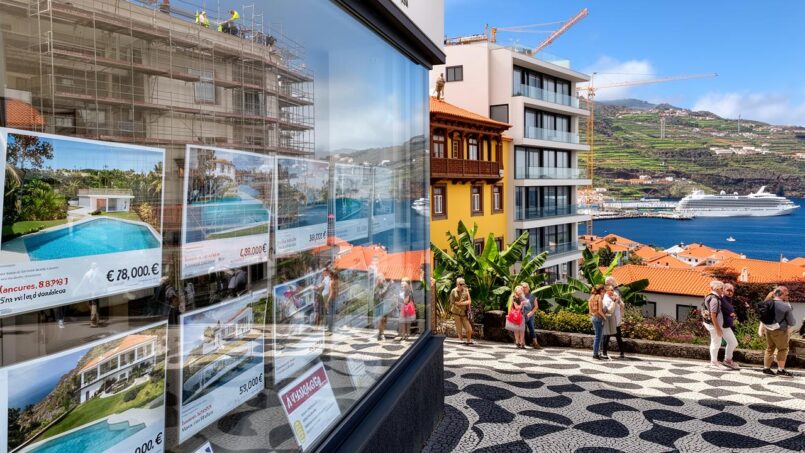
The starting price for a contemporary villa with pool and ocean view in Calheta, Madeira.
High rents… but yields that remain attractive
Despite the high entry cost, rental profitability in Madeira remains one of the market’s strengths. For long-term rentals, average gross yields range between 4 and 6%, levels comparable to or even higher than those seen in other Portuguese regions. In Funchal, estimates report yields reaching 6.6% in the center and nearly 7.7% on the outskirts for certain apartments.
Median rent in euros per square meter for new leases in Portugal in the first quarter of 2025.
The seasonal segment and short-term rentals via platforms like Airbnb or equivalents amplify these rates further. Industry data indicates a market score of 100/100 for Madeira on certain analysis tools (AirDNA), with an average occupancy rate around 74% and an annual revenue that can exceed $27,000 per property operated as tourist rental.
Detailed profitability examples illustrate the situation well.
| Type of Accommodation (Funchal and south coast) | High Season Nightly Rate (approx.) | Annual Occupancy Rate | Estimated Gross Yield |
|---|---|---|---|
| 1-bedroom Apartment | 95–150 € | 72–80% | 6–8% |
| 2-bedroom Apartment (AL) | 140–220 € | 70–75% | 7–9% |
| Villa with pool and sea view | 250–450 € | 75–85% | 9–12% |
Even in low season (January–February), occupancy rates generally remain around 55–60%, which limits income seasonality and enhances the predictability of cash flows for investors.
Luxury: explosion of supply… and product selection
The high-end segment in Madeira is experiencing a genuine acceleration. In 2025, luxury real estate sales there increased by 75%, according to specialized players like Portugal Sotheby’s International Realty, which recorded its highest revenue increases there. In this niche, Madeira even showed the most marked increase in the country for the top 10% of most expensive properties, with an annual progression of 21.7%, while the national average stood at 6.5%.
In the third quarter of 2025, the supply of luxury properties on the Portuguese islands grew rapidly, with around 1,200 villas and 370 premium apartments for sale, concentrated 98% in Madeira and São Miguel. The median price for villas in Madeira exceeded 1.8 million euros, with a slight year-on-year decline of 3%, indicating a market ‘sorting’ phase where only the best-located and best-designed properties find buyers.
Operators speak of a “selection phase“: the time of uniform increases gives way to greater differentiation based on location, architectural quality, energy performance, or services offered (concierge, security, integrated rental management).
New emblematic developments, particularly in Funchal and on the west coast, offer high-end residences with luxurious amenities (infinity pools, private elevators to the beach, large terraces) and high energy performance (A/A+ rating). These projects, such as Savoy Residence | Insular or Madeira Acqua Residences, reinforce the archipelago’s premium appeal.
Structurally limited supply and a construction sector under pressure
If prices are rising so much, it is not only because of demand. Madeira is a mountainous island with buildable land limited by topography, coastline, and protected areas. The release of new housing onto the market is mechanically constrained, which accentuates the shortage.
The construction sector in the Azores is facing a shortage of 90,000 skilled workers, high material and energy costs, and lengthy administrative procedures. As a result of these difficulties, new homes represent only about 27% of the total supply for sale, the rest being second-hand properties, sometimes requiring renovation.
New projects are mainly concentrated in Funchal, Câmara de Lobos, Calheta, and Machico, primarily on the south coast. They take the form of apartments of 70 to 120 m² and villas of 150 to 300 m², at prices generally between 3,500 and 4,800 €/m², with some very high-end residences at 6,000 €/m².
On the secondary market, prices range rather between 2,200 and 3,200 €/m², but the real cost of an investment rises by 20 to 25% if you add renovation and obtaining a tourist rental license (Alojamento Local). This differential explains why some investors favor new builds despite a higher sticker price: better energy efficiency, less renovation work, greater ease in attracting an international clientele.
Growing tensions on affordability for locals
This dynamic, favorable to investors, translates conversely into growing difficulties for local households. In Madeira, the average salary remains significantly lower than on the mainland, around 800 € per month according to some estimates, while rents in Funchal and coastal municipalities already rival those of major European capitals for quality properties.
Annual income threshold exceeded by many remote workers and expats from countries with strong currencies, widening the purchasing power gap with local residents.
On the ground, this divide translates into growing frustration: rising prices reduce access to homeownership for young people, deplete long-term rental supply, and push some residents toward more remote municipalities or the north of the island. The development of short-term rentals at the expense of traditional leases reinforces this feeling, even though local voices point out that rising prices are also the result of underlying trends (historical underinvestment, return of the diaspora, national real estate boom) and not solely digital nomads.
Faced with this tension, the regional government of Madeira and the Portuguese state are multiplying initiatives. At the archipelago level, a program supported by the Recovery and Resilience Plan (PRR) provides for the acquisition of 805 new homes dedicated to affordable rental by 2026, for an investment of 128 million euros. Deliveries are staggered: 146 homes are to be delivered soon, 467 the following year, then 192 the year after that, distributed across all municipalities.
Number of additional homes that the city of Funchal plans to make available by 2026, financed by IHRU and the PRR.
A self-build support program is also announced, with the provision of building-ready plots in Caniçal and Porto Santo, a first batch of around 30 lots intended for families who will build their own homes.
At the national level, the “Mais Habitação” (More Housing) plan further regulates short-term rentals by limiting new Alojamento Local licenses in already dense areas, while offering tax advantages for landlords who rent long-term at moderate rents. Discussions around a possible increase in IMT (property transfer tax) for non-residents also illustrate the desire to further regulate purely speculative investment.
A city and an island in transformation: major projects and new infrastructure
The urban morphology of Madeira is evolving rapidly, particularly west of Funchal. Municipal authorities mention the construction of nearly 1,800 homes over five to six years in this part of the capital, accompanied by new road axes to improve mobility, notably a horizontal tunnel connecting the western neighborhoods to the hospital and the expressway.
Amount, in millions of euros, of the planned investment for a luxury real estate program in the Ajuda neighborhood.
Other notable operations, such as Madeira Acqua Residences on the former site of the Madeira Palácio (181 apartments, 25 private pools, infinity pool, direct beach access), or the rehabilitation of emblematic urban wastelands in central Funchal (Savoy Residence | Insular), accentuate the transformation of the waterfront and the upmarket shift of central neighborhoods.
At the same time, mixed projects integrating hotels, tourist residences, public spaces, and coastal promenades, such as the “O Portinho” program in Caniço, aim to reconcile tourism development, improvement of local infrastructure (public parking, beach access, river rehabilitation), and international appeal.
Taxation, ancillary costs, and regulatory framework for buyers
For the foreign investor considering entering the Madeiran market, taxation broadly follows the same rules as on the mainland, with some specific rate variations. The property transfer tax (IMT) is calculated in brackets, with full exemption for the purchase of a primary residence up to approximately 115,500 €, then progressive rates ranging from 2 to 8%, before falling back to 6% for very high amounts (above approximately 688,500 €). A stamp duty of 0.8% of the sale price applies additionally, and the purchase of undeveloped land is taxed at a flat rate of 6.5%.
The annual IMI (municipal property tax) averages 0.3% of the cadastral value. Reductions may apply for a primary residence or for new builds with high energy performance.
The acquisition framework remains relatively simple for non-residents: no nationality restrictions, requirement to obtain a Portuguese tax number (NIF), possibility of using residence visas for retirees or remote workers (D7, D8) provided sufficient income and accommodation (purchase or rental) are proven. The former “real estate” route of the Golden Visa is now closed, but the country maintains investment channels through funds or cultural projects.
Outlook: continued rise or beginning of stabilization?
Major forecasting bodies converge on a scenario of “soft landing” for Portuguese real estate by 2026: double-digit increases should give way to more moderate annual progressions, on the order of 2 to 6% nationally, and rather 3 to 7% in prime markets like Madeira. More aggressive analyses, such as those from international rating agencies, nevertheless mention the possibility of still robust increases (up to 15% over a year) due to the persistent imbalance between supply and demand.
Several factors support the continued appreciation of Madeira: land scarcity, intact international appeal, a stable political and economic climate, and its status as a major tourist destination (over 2 million visitors and 11 million overnight stays, mainly by foreigners). The development of high-end segments and remote work also reinforces this dynamic.
On the other side, a few elements could temper the dynamic: recent rise in interest rates (although forecasts anticipate a stabilization of Euribor between 1.9 and 2.1%), end of major exceptional tax regimes, stricter regulation of tourist rentals, public efforts to develop affordable housing.
No credible crash scenario is envisioned. The market is entering a normalization phase with increased selection based on quality and precise location. Well-designed properties with high standards in sought-after micro-locations (Funchal waterfront, São Gonçalo ridges, Calheta and Ponta do Sol bays) should continue to outperform.
What this means for different stakeholders
For an international investor, the current trends in the Madeira real estate market paint an attractive but demanding profile. Price levels, already high, require being selective, carefully analyzing the target rental demand (tourist, long-term, coliving, retirement), and factoring in tax and management costs. In return, the medium-term capital appreciation prospects, combined with rental yields that remain competitive (often 5–8% gross on well-managed short-term rentals), constitute a solid argument.
For local households, tourism success threatens to make certain neighborhoods in Funchal and coastal villages inaccessible, transformed into tourist properties or second homes. Affordable housing programs and regulation of tourist rentals are essential to avoid a rift between the globalized market and social needs.
For the authorities, finally, Madeira illustrates the dilemmas of highly attractive destinations: how to leverage international investment, tourism dynamism, and remote worker demand while preserving a balanced social fabric and housing access for residents? The policies announced show awareness, but the scale of price increases and the strength of structural trends suggest the battle is just beginning.
Madeira is experiencing a complex real estate dynamic, marked by its international attractiveness, the rise of digital nomadism and remote work, but also by growing tensions on access to housing. To invest or settle, it is essential to understand that this market now reflects the economic and social changes on the island.
A wealth project or a question? Contact us now to speak with a wealth management expert.
Disclaimer: The information provided on this website is for informational purposes only and does not constitute financial, legal, or professional advice. We encourage you to consult qualified experts before making any investment, real estate, or expatriation decisions. Although we strive to maintain up-to-date and accurate information, we do not guarantee the completeness, accuracy, or timeliness of the proposed content. As investment and expatriation involve risks, we disclaim any liability for potential losses or damages arising from the use of this site. Your use of this site confirms your acceptance of these terms and your understanding of the associated risks.

Cyril Jarnias is an independent expert in international wealth management with over 20 years of experience. As an expatriate himself, he is dedicated to helping individuals and business leaders build, protect, and pass on their wealth with complete peace of mind.
On his website, cyriljarnias.com, he shares his expertise on international real estate, offshore company formation, and expatriation.
Thanks to his expertise, he offers sound advice to optimize his clients' wealth management. Cyril Jarnias is also recognized for his appearances in many prestigious media outlets such as BFM Business, les Français de l’étranger, Le Figaro, Les Echos, and Mieux vivre votre argent, where he shares his knowledge and know-how in wealth management.





