
 Published on and written by Cyril Jarnias
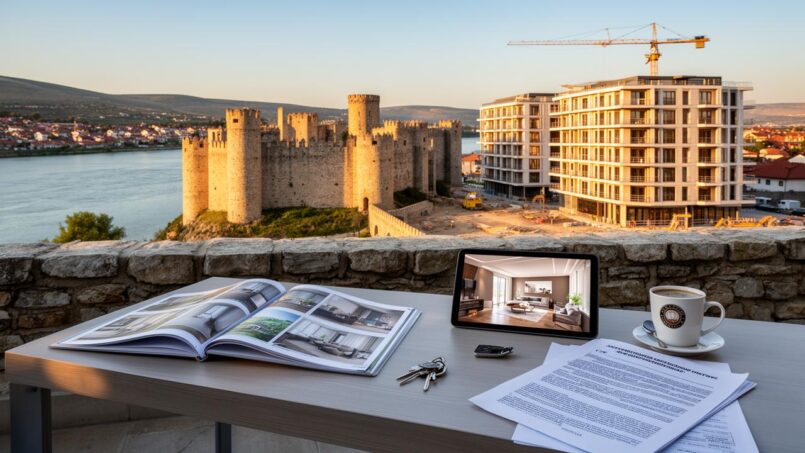
Smederevo is neither Belgrade nor Novi Sad. Prices per square meter are twice as low, construction cranes are significantly fewer, and the rental market is far from saturated. Yet, this former medieval capital, which became a steelmaking bastion of socialist Serbia, is carving out a unique place on the country’s real estate investment map.
Smederevo combines a transforming Danube port and a modernized industrial zone funded by the EU. The short-term rental market is booming, while prices remain very affordable. The city offers a moderate entry ticket, solid economic fundamentals, and appreciation potential driven by major infrastructure corridors, rather than fleeting fads.
An economic context that supports real estate
To understand why investing in real estate in Smederevo is starting to make sense, one must first look at how the city has transformed over recent decades.
After World War II, Smederevo established itself as the main industrial and cultural center of the Podunavlje district. Under socialist Yugoslavia, the state invested massively there: roads, collective housing, factories. Two giants stood out: the Zelvoz railway equipment factory (briefly renamed Heroj Srba) and, above all, the Sartid steel complex, which began full operation in 1971 on the city’s outskirts.
Represents the share of the city of Smederevo’s production ensured by its steel mill, Železara Smederevo.
This industrial base, complemented by dynamic agriculture – orchards, vineyards, cultivation of the famous Smederevka grape variety – gives the city an economic foundation that secures, in the background, any investment in real estate. According to employment data, over 12,000 people work in manufacturing, nearly 4,300 in wholesale and retail trade, 1,500 in transport and logistics, and even though real estate represents only a small niche (48 formal jobs), it benefits from this dynamic.
Within the framework of Serbia’s economic reorganization, Smederevo holds a key position. Located on Corridor X (north-south axis), integrated into the “Danube industrial corridor,” and possessing a major steel site, the city is a major hub for metal production in the national industrial strategy, relying on a network of over one hundred industrial zones.
In this context, buying an apartment or house in Smederevo means placing a bet on a city that lives not only from tourism, nor from a real estate bubble, but from a robust industrial, logistical, and agricultural base.
Still very attractive prices per square meter
The first argument in favor of Smederevo is arithmetic: the level of prices.
The most recent available data provide a clear picture of the price gaps between Smederevo and Serbia’s main urban markets.
Comparison of average prices per m² (apartments and houses)
| City / property type | Average price per m² (approx.) |
|---|---|
| Smederevo – apartment | €1,355 to €1,400 |
| Smederevo – house | ~€740 |
| Belgrade – apartment (average) | ~€2,630 |
| Novi Sad – apartment (average) | ~€2,320 |
| Niš – apartment | ~€1,760 |
| Zaječar – apartment | ~€1,200 |
| Zaječar – house | ~€590 |
| Bor – house | €1,000 to €1,300 |
| Smederevska Palanka – house | €320 to €1,000 |
Concretely, a 50 m² apartment in Smederevo costs around €67,750 (€1,355/m²), which is about half the price of an equivalent property in Belgrade (around €130,000, €2,630/m²) and €50,000 less than in Novi Sad (around €116,000, €2,320/m²).
This differential works in favor of investors looking for:
Investors in Serbia currently have two main strategies. The first involves positioning themselves in the catch-up markets of the Southern and Eastern regions, where apartment sales have increased by over 40% and transaction value by nearly 88% year-on-year. The second strategy aims to diversify a portfolio concentrated on Belgrade or Novi Sad by seeking better returns for a much lower entry ticket in these dynamic regions.
In dinars, local data confirms this gap.
Average prices and rents in dinars in Smederevo
| Indicator | Average value (RSD) |
|---|---|
| Average net monthly salary | 57,500 RSD |
| 1-bed rent – city center | 25,000 RSD |
| 1-bed rent – outside center | 18,000 RSD |
| 3-bed rent – city center | 60,000 RSD |
| 3-bed rent – outside center | 35,000 RSD |
| Purchase price / m² apartment – city center | 140,000 RSD |
| Purchase price / m² apartment – outside center | 72,000 RSD |
| Price-to-income ratio | 9.22 |
| Price-to-rent ratio – center | 22.32 |
| Price-to-rent ratio – outskirts | 17.69 |
Even though the price-to-income ratio remains high (over 9 years of net salary for a standard apartment), Smederevo is still significantly more accessible than the country’s major metropolises, leaving room for price growth in the medium term.
Rental yields: a solid residential market, a niche Airbnb
For an investor, the level of rents and potential yields matter as much as the purchase price. In Smederevo, the emerging picture is that of a relatively balanced residential market, with yields comparable to the Serbian average, and a still underexploited short-term rental micro-market.
Estimated gross yields for long-term rentals
By combining price and rent data, yield indicators are around the national average.
– Average gross yield in the city center: approximately 4.5%.
– Gross yield in the outskirts: around 5.65%.
These figures are consistent with Serbian standards, where residential gross yields generally range around 4.3% to 6.8%, with an average of about 5.3%.
61% of Airbnb listings in Smederevo are one-bedroom accommodations.
The Airbnb market: 18 listings, still untapped terrain
A detailed analysis of Smederevo’s Airbnb market (October 2024 – September 2025) shows a still very uncompetitive environment:
– Only 18 active listings.
– 88.9% entire homes (houses or apartments).
– 72.2% apartments/condos, 27.8% houses.
– Average capacity: 4.3 travelers.
Performance is very heterogeneous, with the top performers being significantly more profitable than the median.
Airbnb performance in Smederevo (2024–2025)
| Indicator | Top 10% | Top 25% | Median | Bottom 25% |
|---|---|---|---|---|
| Monthly revenue | ≥ $1,819 | ≥ $599 | ~$289 | ~$147 |
| Occupancy rate | ≥ 54% | ≥ 35% | ~18% | ~9% |
| Average daily rate (ADR) | ≥ $200 | ≥ $55 | ~$46 | ~$38 |
Seasonality is marked but manageable.
Seasonality of short-term rentals
| Period | Avg. monthly revenue | Avg. occupancy | Avg. ADR |
|---|---|---|---|
| High season (July–Sept.) | ~$1,048 | 28.5% | $83 |
| Shoulder season | ~$553 | 26.7% | $78 |
| Low season (Jan., Feb., Nov.) | ~$248 | 19.5% | $77 |
| Absolute peak month | ~$1,181 | 31.7% | $84 |
| Weakest month | ~$203 | 16.4% | $75 |
Some useful takeaways for an investor:
The Novi Sad rental market presents specific opportunities: it is lightly regulated and unsaturated, with only 18 listings for a city of this size. Premium properties (Danube villas, houses with pools, central apartments) perform particularly well, generating over $1,800 in monthly revenue for the top 10%. The target clientele is young (post-2000) and predominantly foreign, with a strong influx of German visitors. Occupancy peaks in April and rates are highest in July, allowing price strategy to be adjusted according to seasonality.
In other words, there is already proof of concept showing that significant revenue can be generated in Smederevo with a well-positioned short-term offering (Danube waterfront villas like “Private Luxury Pool Danube Vila Mila” or “Vila Sunset Jugovo”, stylish central apartments), even while the overall supply remains microscopic.
For an investor, this opens two paths:
– Settle for a classic long-term model with a gross yield of 4.5–5.5%, relatively modest expenses, and simple management.
– Or attempt a hybrid model (Airbnb during the high season, medium or long-term rental the rest of the year) to approach gross yields of 7–8%, at the cost of more active management or using a professional manager.
Where to invest in Smederevo: center, Danube, vineyard hills
Smederevo is not a homogeneous market. Price data and listings show several micro-segments, each with a different investment profile.
City Center: the safe base
The heart of Smederevo concentrates shops, services, cafes, markets, most cultural events, and a good portion of annual rental demand.
You can find there:
– New or recent apartments close to the shopping center, market, or sports center.
– Older buildings, sometimes needing renovation, with still attractive prices per m².
– Some mixed-use buildings (commercial + residential) interesting for business + rental strategies.
Typical example: a 46 m² T2 apartment in a recent building near the sports center, offered around €95,000, or renovated apartments right in the center around €130,000 for larger spaces.
This sector ticks several boxes:
Main advantages related to investing in a property located in the heart of the city, based on market dynamics.
Easier resale than in distant outskirts, thanks to constant appeal.
Students, young professionals, and industrial employees actively seek proximity to services.
Suitable for long-term rental and part of the Airbnb market (short professional stays, city breaks).
Danube Riverside: tourist potential and future added value
The riverfront is Smederevo’s scenic asset. The city already has an old freight port downtown, slated to be relocated to a new modern port area connected to the railway. The urban plan foresees transforming the current port into an international passenger terminal, combined with a marina and tourist development around the fortress.
A study by the Port Governance Agency clearly identifies Smederevo as a future marina location, with the goal of placing it on European nautical charts. Steps are underway: preparing classification documents, cleaning the waterway, the “Awake the Danube” project to develop river cruising, moving the passenger terminal closer to the fortress.
In this context, properties located:
– Along the Danube promenade.
– In the Jugovo, Plavinac neighborhoods or near future tourist amenities.
These properties benefit from strong potential for appreciation as the marina and tourist infrastructure materialize.
Listings already show a range of products:
– Prestige villas directly on the bank (up to €1,999 million for a turnkey event complex).
– Houses with river views in Jugovo (e.g., 92 m² for €69,000, larger houses around €219,000 to €323,000).
– Raft houses and floating houses on the Danube (150 m² for €70,000–80,000 or small units at €30,000).
For an investor focused on short-term rentals, this is clearly the most promising area, especially for differentiated products: villas with pools, family homes with views, unique water accommodations.
Vineyard hills and nearby villages: low ticket, patrimonial logic
The surroundings of Smederevo – Plavinac, Vranovo, Udovica, Vodanj, Drugovac, etc. – offer a completely different profile: large plots, single-family houses, sometimes with attached orchards or vineyards, often needing renovation.
Examples found there include:
Discover a selection of available properties and land in the region, ranging from small renovated houses to upscale villa projects.
A 60 m² renovated house with a terrace, on a 36-acre plot in Vodanj. Price: €55,000.
Houses “as is” with 10 to 13 acres of land, available in sectors like Jugovo or Plavinac. Prices between €45,000 and €65,000.
Land with building permits for upscale villas on the heights of Plavinac. Example: 25 acres with a permit for a luxury residential complex at €399,000.
These properties appeal more to:
– Investors seeking significant land assets for a low price per m².
– Rural guesthouse, wine tourism, or second home projects.
– Mixed profiles combining personal use and seasonal rental.
Agriculture remains a key element: the region is one of Serbia’s most promising for fruits and vegetables, with nearly 4,500 hectares of orchards (16.6% of local agricultural land) and almost a quarter of the country’s peach orchards. Developing irrigation from the Danube is identified as a major lever to increase yields and export revenue, which enhances the interest in agricultural or vineyard land – even though it is harder for a foreigner to acquire directly (restrictions on agricultural land).
A connected city: port, rail, corridors, and industrial zone
A territory’s real estate appeal increasingly depends on its integration into major transport networks. From this point of view, Smederevo ticks many boxes.
– Direct access to the Danube, with an international freight port authorized for traffic and an annual handling capacity of 1.5 million tons.
– Connection to Serbia’s major road axes and Corridor X.
– Project for a new dedicated railway line for the port, funded to the tune of €9.5 million by the government, to connect the new port terminal to the national network.
– Announced investments of €93 million for a new port terminal.
Number of free economic zones in Serbia, including one in Belgrade since 2017.
At the heart of this strategy is the Smederevo Industrial Park, modernized with support from the European EU PRO program:
– Investment of €325,602 in LED public lighting, video surveillance, and fire protection.
– Construction of two transformer stations, a distribution station, and underground power grids to secure supply.
– Preparation of documentation for a main water pipeline serving the entire industrial zone.
– City co-financing amounting to €49,152.
The results are concrete:
– Six companies already established in the park.
– Three new companies arrived during the two years of work, creating over 350 jobs.
– Over €2.7 million invested by these three companies.
– Ongoing construction of logistics and administrative buildings for about €812,000.
– Sale of three other plots for about €770,000, with promises of additional jobs.
For a real estate investor, these elements have two direct consequences:
– They stabilize rental demand (employees, managers, engineers, subcontractors).
– They lend weight to the hypothesis of gradual asset appreciation in areas well-connected to this productive fabric (neighborhoods close to the industrial zone, the future port, axes linking the city to the free zone).
An environment to monitor, especially around the industrial zone
The dark side of this industrial dynamism is environmental pressure, concentrated around the large steel mill and the industrial zone.
Studies show:
A vast 260-hectare industrial zone, developed without adequate environmental standards, concentrates metallurgy and mechanical engineering. A 350-hectare steel complex, 7 miles from the center, annually emits over 70 billion m³ of waste gases from 89 sources. Models calculate maximum concentrations of sulfur dioxide (SO₂) impacting Smederevo and neighboring villages (Radinac, Ralja, Vranovo). Furthermore, untreated wastewater is discharged into the Ralja river, an ecologically threatened area.
For a buyer, this very concretely means: purchasing a property representative of one’s life project, while taking into account several elements such as budget, location, and nearby services.
To target a residential or tourist clientele, it is advisable to avoid properties located immediately adjacent to the industrial zone and the prevailing winds. Instead, prioritize sectors favored by the urban plan for redevelopment, such as the city center, the Danube banks destined for tourism, as well as hills and green areas. For properties near the steel mill, factor the environmental risk into price negotiation to justify a discount, or target a more industrial clientele (housing for workers, low-cost accommodations for temporary staff).
This environmental constraint, well identified by the authorities, is also a driver for redevelopment: the city is working to relocate the railway that still crosses the center, move the freight port, and convert the historic port into a passenger terminal. Over time, this should strengthen the contrast between industrial sectors and rehabilitated neighborhoods, to the benefit of the latter.
Legal and tax framework: what a foreign investor needs to know
Investing in Smederevo means investing in Serbia. The applicable legal and tax framework is therefore national. It presents several attractive characteristics, but also specificities to master.
Purchase by a foreigner: possible, but subject to reciprocity
Citizens of virtually all Western countries (USA, European Union, UK, Canada, Australia, Switzerland, Norway, etc.) can freely buy apartments, houses, and commercial premises in Serbia, including Smederevo. The key rule is reciprocity: a foreign citizen can acquire a property in Serbia if, in principle, a Serbian citizen can buy a similar property in the foreigner’s country of origin.
Some essential points:
Foreigners can buy apartments, houses, and commercial properties in their own name. However, they cannot directly buy agricultural land or bare land (except a plot attached to a house). To acquire this type of land, one solution is to establish a Serbian company (DOO), considered a domestic entity. The acquisition is done before a notary and must be registered at the Real Estate Cadastre (RGZ), the only authoritative register. Hiring a specialized lawyer is strongly recommended for due diligence (verification of titles, easements, mortgages, permits, etc.).
Good to know: it is possible to conduct the entire transaction remotely via an apostilled and translated power of attorney, with a local lawyer handling signatures, payments, and registration procedures.
Taxation on purchase and ownership
From a tax perspective, Serbia is in a moderate range compared to other European countries.
At purchase, distinguish two cases:
– New housing purchased from a developer: subject to VAT (10% for residential), usually included in the advertised price. No property transfer tax.
– Resale property (existing housing): subject to a property transfer tax of 2.5% of the value, paid by the buyer.
Added to this are:
– Notary fees (approximately 0.1% to 0.5% of the price, typically €300–€500 for a €100,000 property).
– Real estate agency fees (often 2% to 3% of the price, sometimes charged to each party).
– Attorney fees (often 1% to 3% of the price or a flat fee of €500 to €1,500).
– Cadastre fees (€50–€200).
Percentage of the purchase price to budget for ancillary costs for a resale property.
Then, each year, the owner pays a property tax:
– Rate set by municipalities, within a national cap of 0.4% of the cadastral value.
– In Smederevo, as elsewhere, this generally translates to a charge of 0.1% to 0.3% of the market value, meaning for a €70,000 apartment, a few hundred euros per year, no more.
Rental income and capital gains taxation
Rental income earned in Serbia is taxed at 20% after a flat-rate deduction of 25% for expenses, resulting in an effective rate close to 15% of gross rent.
In short, if you receive €6,000 in gross rent per year:
– Taxable base: 6,000 x 0.75 = €4,500.
– Tax: 4,500 x 20% = €900.
– i.e., an effective levy of 15% of gross rent.
Real expenses (maintenance, building fees, insurance) remain your responsibility, but most owners find that taxes + current expenses together represent 15% to 20% of gross rent on a standard rental portfolio.
Real estate capital gains are taxed at 15% for individuals upon resale. However, after 10 full years of property ownership, the sale is completely exempt. This rule offers a major tax advantage for long-term real estate investments.
Finally, inheritance is lightly taxed: transfers between close relatives (parents, children, spouses) are fully exempt from inheritance and gift taxes; other categories are taxed at moderate rates (1.5% to 2.5%).
Real estate as a door to residency
Owning real estate in Smederevo does not automatically grant a Serbian passport, but is a powerful lever to obtain a residence permit:
– Any purchase of a built property (house, apartment, premises) gives the right to apply for a temporary residence permit, generally for one year, renewable, and can extend up to three years.
– After five years of continuous residence, one can apply for permanent residency.
– After three years of permanent residency (and three years of prior temporary residence), one can, under conditions, apply for citizenship by naturalization (this is not a “golden passport” program, but a classic pathway).
This aspect particularly interests non-European investors looking for an anchor in the Balkans, as a base for living or remote work, while capitalizing on a tangible real estate asset.
Financing: possible for non-residents, but selective
Serbian banks lend to foreigners, but cautiously:
– Down payment often 30% to 50% of the price, or more.
– Loan terms 10 to 30 years depending on products.
– Interest rates generally around 5% to 7% in 2026.
– Heavy dossier for non-residents: proof of stable income, credit history, sometimes a local guarantor.
Some banks, like API Bank or Raiffeisen, offer specialized products for non-residents. These offers may not require local income, but often impose conditions such as mandatory insurance, a security deposit, or variable rates indexed to EURIBOR.
In practice, a significant share of purchases in Smederevo are made in cash, notably by the Serbian diaspora, cautious foreign investors, or local households who sold a more expensive property in a big city to relocate.
How to position yourself smartly in Smederevo
Based on these elements, how to build a coherent investment strategy in Smederevo? It all depends on one’s profile and time horizon, but several key trends emerge.
“Quiet residential yield” profile
– Target: Studio or small 2-bed (40–55 m²) in the city center or near main arteries.
– Strategy: Long-term rental to industrial employees, young couples, civil servants.
– Expected gross yield: 4.5% to 5.5%, with moderate taxation and controlled expenses.
– Advantage: Simplified management, relatively low rental risk, demand supported by industrial base and services.
“Touristic – residential hybrid” profile
– Target: Upscale apartment in the center or characterful small house/apartment on the Danube (Jugovo, Plavinac, Danube promenade).
– Strategy: Short-term rental during high season (April–September), medium or long-term rental the rest of the year.
– Potential yield: Up to 7–8% gross for well-managed products, inspired by observed top Airbnb performances.
– Risk: Niche market still unstructured, dependence on the growth of river tourism and events around the fortress. Requires dynamic pricing and marketing management.
“Bet on urban redevelopment” profile
– Target: Properties located near future strategic hubs:
– Neighborhoods close to the future port terminal.
– Buildings near redeveloped railway axes.
– Areas adjacent to the future marina and passenger terminal.
– Strategy: Purchase now at a still reasonable price level, hold for 7–10 years, appreciation as infrastructure projects materialize.
– Investment logic: Focus on capital gains rather than maximum current yield.
“Land / rural / wine tourism” profile
– Target: Houses with large plots in vineyard villages (Vranovo, Plavinac, Udovica, Vodanj…), possibly via a Serbian company to access more land.
– Strategy: Mix of second home, small-scale agricultural activities, rural guesthouses, wine tourism hospitality.
– Appeal: Extremely low land price per plot compared to Western Europe, potential linked to the development of quality agriculture and rural tourism.
Risks and points of vigilance
No market is risk-free. For Smederevo, a few points deserve particular vigilance.
Real estate investment in Smederevo requires particular attention to several critical points. The industrial environment, marked by proximity to the steel mill, can lead to nuisances (pollution, noise) and negative perception, so it is better to target areas already designated for residential or tourist use by urban planning documents. Bureaucracy and the cadastre present historical risks of undeclared constructions, poorly registered titles, and inheritance disputes, making rigorous legal due diligence with a local lawyer indispensable before any purchase. The evolution of short-term rental regulation needs to be anticipated: while the framework is currently not very restrictive, licensing obligations, quotas, or specific taxes, inspired by other European cities, could emerge as the market develops. Finally, the international economic situation directly impacts the city, which is highly dependent on steelmaking and exports; a slowdown in these sectors could affect the local economy and, consequently, rental demand.
In return, other factors act as shock absorbers: the enormous price gap accumulated compared to regional capitals, the chronic insufficiency of new housing supply in Serbia, permanent flows of internal migration towards well-connected medium-sized cities, and the expressed European will to support infrastructure in the South and East of the country.
On the scale of Serbia, Smederevo is one of those “small” cities gaining strength in the shadow of Belgrade. Transaction figures in the Southern and Eastern regions already show acceleration, while prices there remain relatively tame, with moderate annual growth around 6%.
The local real estate market stands out due to:
Main economic and real estate assets of the city of Galati, in Romania, offering interesting investment opportunities.
Approximately €1,355–€1,400/m² for an apartment and €740/m² for a house, representing a low market entry point.
Comparable to the national average, with potential bonus in short-term rental for well-located properties.
Leading sectors: steelmaking, household appliance factory, agri-food, fruit growing and viticulture.
Massive EU-co-funded investments in the port, rail, and industrial parks.
Development projects around the Danube, the fortress, and river tourism growth.
Moderate taxation on ownership, rental, and capital gains, with full exemption after 10 years of ownership.
For an investor willing to venture off the beaten path of Belgrade Waterfront or downtown Novi Sad, investing in real estate in Smederevo amounts to betting on a rare combination: a major industrial territory, a transforming port, a medieval city at the gates of Corridor X, and a real estate market still at a stage where fundamentals trump speculation.
For a successful real estate investment in Smederevo, it is crucial to: choose the right location in the city, surround yourself with reliable professionals to secure the legal aspects, and define a clear strategy (rental yield, capital gains, or mixed use) aligned with the potential of this “hidden value” on the banks of the Serbian Danube.
A wealth management project or a question? Contact us now to speak with a wealth management expert.
Disclaimer: The information provided on this website is for informational purposes only and does not constitute financial, legal, or professional advice. We encourage you to consult qualified experts before making any investment, real estate, or expatriation decisions. Although we strive to maintain up-to-date and accurate information, we do not guarantee the completeness, accuracy, or timeliness of the proposed content. As investment and expatriation involve risks, we disclaim any liability for potential losses or damages arising from the use of this site. Your use of this site confirms your acceptance of these terms and your understanding of the associated risks.

Cyril Jarnias is an independent expert in international wealth management with over 20 years of experience. As an expatriate himself, he is dedicated to helping individuals and business leaders build, protect, and pass on their wealth with complete peace of mind.
On his website, cyriljarnias.com, he shares his expertise on international real estate, offshore company formation, and expatriation.
Thanks to his expertise, he offers sound advice to optimize his clients' wealth management. Cyril Jarnias is also recognized for his appearances in many prestigious media outlets such as BFM Business, les Français de l’étranger, Le Figaro, Les Echos, and Mieux vivre votre argent, where he shares his knowledge and know-how in wealth management.





