
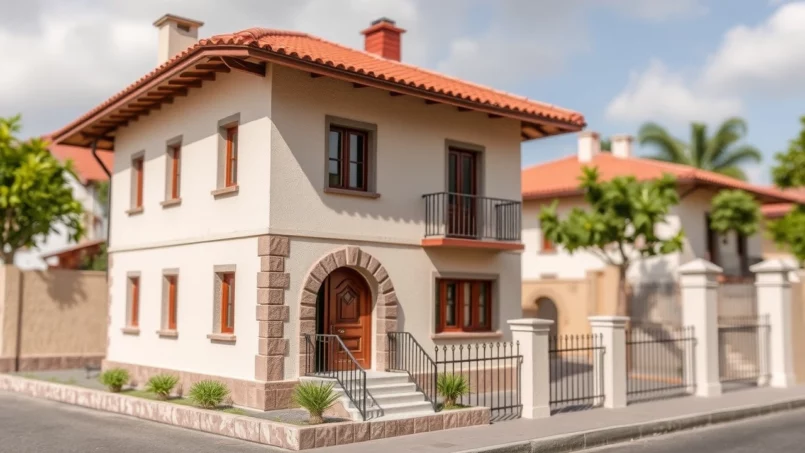
 Published on and written by Cyril Jarnias
Purchasing real estate in Mexico has become the flagship project for many retirees, investors, and digital nomads from North America and Europe. With over one million Americans living in the country—including more than 500,000 property owners—and a nationwide price increase of nearly 9% in one year, the market is attractive. But the dream of an oceanfront home or an apartment in a major Mexican city rests on a very specific legal framework, especially for foreigners.
Good to Know:
To secure your investment, it is essential to understand the purchase process, mechanisms like the fideicomiso, the role of the notary public, applicable taxes in case of resale, and potential risks, especially those related to ejido lands.
A Mexican Real Estate Market Driven by Tourism and Nearshoring
The economic context largely explains the growing interest in Mexican real estate. The market is growing at an annual rate of approximately 4.8% and could reach $183.7 billion USD by 2030, with nearly $17.8 billion in the residential sector. The combination of several drivers creates a very favorable dynamic.
652
Nearshoring has generated over 652 billion pesos in real estate investments in Mexico, attracting more than 450 companies.
Add to that the strength of tourism: over 40 million visitors per year, over 20 million tourists for Cancún alone, more than 2 million for destinations like Tulum or Mérida. This traffic fuels a short-term rental market capable of generating gross returns of up to 15% in some hotspots, with net returns of 8% to 10% for the best properties.
Price indices confirm this upward pressure: an 8.8% increase in national prices in one year, an approximate 9.6% increase in the house price index, and even localized increases of 15% per year in markets like Tulum since 2015.
Where Foreigners Buy: Coastlines, Metropolises, and Colonial Towns
Mexico does not offer a homogeneous market. Figures for price per square meter and rental yield vary greatly by region, as does the type of clientele (vacationers, expats, relocating executives, retirees). Several key areas stand out.
Riviera Maya and Major Beach Resorts
The Riviera Maya concentrates a massive share of international demand: Playa del Carmen, Tulum, Cancún, Puerto Morelos, Bacalar. Cancún welcomes more than 20 million tourists per year, with a hotel occupancy rate close to 80% and an airport that handled over 25 million passengers in 2023. Tulum, which sees over 2 million visitors per year, has seen its prices rise by about 15% per year since 2015, reaching around $2,800 per m². Playa del Carmen trades between $2,000 and $3,500 per m² for well-located properties.
Good to Know:
Gross rental yields are solid in this area, especially for properties intended for vacation rentals.
| Location (Property Type) | Estimated Gross Rental Yield |
|---|---|
| Luxury villas in Tulum | 8% to 15% |
| Condos in Playa del Carmen | 5% to 6% |
| Prime short-term rentals (general) | up to 15% (8–10% net) |
Further south, Bacalar, driven by the famous Laguna de los Siete Colores (Lagoon of Seven Colors), illustrates the emergence of new eco-tourism markets, with increases of about 20% in one year for homes with lagoon views.
Other Pacific coast destinations follow the same trajectory: Puerto Vallarta, Los Cabos, La Paz, Mazatlán. In La Paz, the median condo price jumped from about $221,000 to $406,000 in a few months, while Mazatlán welcomed over 1.5 million visitors.
Dynamic Metropolises and Industrial Hubs
Beyond the coastline, several inland cities attract a clientele of investors more focused on “urban” properties and “stable rental income”. Mexico City, Monterrey, and Guadalajara concentrate economic activity, corporate headquarters, universities, and strong year-round rental demand.
| City | Average Price (USD/m², approximate) | Estimated Local GDP | Approx. Gross Rental Yield |
|---|---|---|---|
| Mexico City (center) | 3,200–3,300 | ~$411 Bn USD | 5.7% to 7.7% |
| Guadalajara | ≈ 2,500 | ~$81 Bn USD | 5.75% to 7% |
| Monterrey | ≈ 1,800 | ~$123 Bn USD | 6.4% to 6.8% |
Airports illustrate this hub role: over 50 million passengers at Mexico City’s Benito Juárez in 2023, over 15 million at Guadalajara’s.
Colonial Towns, Cultural Destinations, and Retirees
Mérida, San Miguel de Allende, Oaxaca, Querétaro, or Valle de Bravo attract a population of retirees and expats seeking a high quality of life. In Mérida, prices hover around $1,200 per m² and a community of about 10,000 expats has formed, supported by over 2 million visitors per year. San Miguel de Allende, a UNESCO World Heritage site, has about 10% foreigners among its residents.
Tip:
In these cities, rental yields remain attractive while offering the prospect of capital appreciation.
| Location | Price or Range (indicative) | Estimated Rental Yield |
|---|---|---|
| Mérida (colonial houses) | ≈ $1,200 USD/m² | 6% to 8% |
| Oaxaca (houses) | $180,000 to $600,000 USD | variable, rising market |
| Querétaro (houses) | strong increase, +11.56% Q1 2024 | booming market |
For a foreign investor, this price and yield data allows them to adjust their budget and strategy—primary residence, long-term rental, high-end short-term rental—before delving into Mexico’s specific legal mechanics.
The Legal Framework: Article 27, the Restricted Zone, and Acquisition Structures
Any real estate purchase by a foreigner in Mexico is based on a key text: Article 27 of the Constitution. This article establishes the famous “restricted zone” and imposes a specific setup for foreigners along the coasts and borders.
The Restricted Zone: 40% of the Territory is Affected
The law defines the restricted zone as any land located within 50 km of a coastline and within 100 km of an international border. This strip covers approximately 40% of the territory and encompasses most sought-after tourist destinations: Cancún, Riviera Maya, Puerto Vallarta, Los Cabos, Tijuana, Ciudad Juárez, among others.
In this zone, a foreigner cannot hold the title deed directly in their name. However, they can acquire an equivalent right through a highly regulated mechanism: the fideicomiso (Mexican bank trust).
Outside the restricted zone, a foreigner can be directly registered as the owner in the deed (escritura pública), like any Mexican citizen.
The Fideicomiso: The Key to Buying in the Coastal Zone
The fideicomiso is a trust established with an authorized Mexican bank. Its principle is simple on paper: the bank is the legal titleholder of the property, but holds it for the benefit of the foreign buyer, the beneficiary of the trust.
Important:
The beneficiary retains all rights of use and disposition of the property (use, rental, sale, transfer). The bank, as trustee, can only act on the property with the written consent of the beneficiary. Furthermore, property held in trust is legally separate from the bank’s assets, protecting it in the event of the institution’s bankruptcy.
The fideicomiso is authorized for an initial term of 50 years, renewable indefinitely in 50-year periods. It can be transferred to another foreigner; it can include multiple beneficiaries and substitute beneficiaries, making it also a succession planning tool, often allowing one to avoid probate proceedings in Mexico.
Important:
To create a real estate trust in Mexico, authorization from the Ministry of Foreign Affairs (SRE) is essential. The applicant must sign a Calvo clause, by which they agree to be treated as a Mexican national for that property and renounce the diplomatic protection of their country in case of dispute, submitting exclusively to Mexican courts. Non-compliance with this commitment can lead to the forfeiture of rights to the property.
The Mexican Company Alternative
For clearly commercial operations—hotels, rental buildings, portfolios of multiple properties—some investors opt to create a Mexican company (S.A. de C.V., S. de R.L. de C.V., among others), which can be 100% owned by foreigners. The company can then be the direct owner of properties, including in the restricted zone, provided it is not for personal residential use.
This structure involves additional obligations (accounting, tax filings, compliance with foreign investment law, Calvo clause in the bylaws) and is subject to a different tax regime, particularly for corporate income tax and capital gains tax.
The Case of Ejido Lands: The Major Risk
A crucial point for foreigners: so-called ejido lands. These are agricultural or community lands, granted to peasant communities under a special agrarian regime. They are not part of the classic domain of private property and, originally, cannot be sold as such.
Example:
Acquiring simple ‘possession rights’ or signing a cesión de derechos on unprivatized ejido land is extremely risky for a foreign buyer. These deeds, not recorded in the public registry and not allowing the creation of a fideicomiso, are the source of many disputes. Scandals, like the massive seizure of homes in Bucerías in the Riviera Nayarit, illustrate the serious consequences. Privatization into dominio pleno (full ownership), while possible, is a complex, lengthy, and strictly regulated process overseen by the Registro Agrario Nacional and community assemblies.
For a foreigner, the rule is clear: never buy on ejido land without irrefutable proof of complete privatization and a title registered by a notary public in the Public Registry.
The Central Role of the Notario Público
In Mexico, the figure of the notary has nothing to do with that in Anglo-Saxon countries. The Notario Público is a seasoned attorney, appointed by the state government after a very demanding exam. They combine civil and criminal responsibilities and hold significant legal authority. The number of notaries is limited by law (e.g., one for every 30,000 inhabitants in some states).
In a real estate purchase, their presence is mandatory and their role extends far beyond simply certifying signatures.
The notary:
Tip:
During a real estate purchase in Mexico, the notary public (notario público) ensures the legal security of the transaction. They verify the legal status of the property and the seller, obtain and review the Certificado de Libertad de Gravamen (certificate of no liens), ensure that local property taxes (predial) and charges are up to date. They prepare, draft, and authenticate the final deed (escritura pública), calculate taxes related to the transaction (acquisition tax, capital gains tax, registration fees), collect them, and remit them to the state, incurring personal liability. Finally, they register the transaction with the Registro Público de la Propiedad and keep the original deeds in their archives.
The timeframe for finalization (signing + registration) is generally 4 to 12 weeks depending on complexity and region, although transcription in the registry can take a few additional weeks after signing. Until the deed is registered, the transaction is not fully enforceable against third parties.
Tip:
It is recommended that the buyer choose their own notary (and not the one proposed by the seller or developer). In parallel, it can be wise to hire an independent attorney to exclusively defend their interests. This advice is particularly relevant during the negotiation phases, thorough document review, and drafting of preliminary contracts.
Concrete Steps for a Foreigner’s Real Estate Purchase
In practice, the typical process revolves around about ten steps. Many foreigners handle part of the procedure remotely, using a power of attorney.
1. Define the Project, Budget, and Area
Before looking at listings, it is useful to settle on three aspects: overall budget (including fees), purpose (primary residence, part-time residence, pure rental investment), and type of area (coastal or inland, restricted zone or not). Suggested minimum amounts are around $75,000 USD for a primary residence in some secondary markets and $150,000 USD or more for a rental investment in a sought-after tourist area.
It is also necessary to factor in transaction costs from the outset: between 6% and 10% of the purchase price depending on location and whether a fideicomiso is needed.
| Type of Purchase | Typical Closing Cost Range (% of price) |
|---|---|
| In non-restricted zone (outside coast/border) | 5% to 8% |
| In restricted zone with fideicomiso | 7% to 10% |
2. Select Professionals
In the absence of a federal license for agents, caution dictates working with a reputable agency, ideally a member of professional associations (like AMPI) and accustomed to foreign clients. A dedicated buyer’s broker can filter properties and immediately eliminate dubious files (incomplete titles, ejido lands, unreliable developers).
In parallel, choose:
– a Notario Público in the region of the property,
– a real estate attorney, for due diligence and negotiation,
– potentially a property manager if the goal is rental.
3. Offer, Preliminary Contract, and Deposit
Once a property is found and the price negotiated, the buyer formalizes their intention with a written offer, often followed by a purchase-sale agreement (promesa de compraventa or contrato de compraventa). This document must specify price, payment schedule, deadlines, conditions precedent (obtaining fideicomiso, due diligence results, etc.), and penalties in case of withdrawal.
Good to Know:
A deposit, typically 5% to 10% of the price (sometimes more for pre-sales), is often paid at this stage. It is recommended to place these funds in an escrow account managed by a trusted third party, not to hand them directly to the seller.
4. Thorough Legal Due Diligence
This is the most sensitive stage. Coordinated by the attorney and notary, it involves:
Good to Know:
Before any real estate purchase in Mexico, it is crucial to: retrieve the existing title deed (escritura); obtain a Certificado de Libertad de Gravamen certifying the absence of mortgages or disputes; verify with the RAN that the land is not ejido or that its privatization is regular; check the latest property tax (predial) payments and the absence of debts for services (water, electricity, fees); examine the cadastral plan, clave catastral, and a topographic survey to confirm area and boundaries; and finally, confirm the land use (uso de suelo) with the municipality, especially for rental or construction projects.
For condominiums, it is necessary to analyze the homeowners association regulations, the history of HOA fees, and any ongoing legal proceedings. In coastal areas, it may be necessary to ensure the existence of a federal concession for the maritime-terrestrial zone (ZOFEMAT) when the property touches the coastline.
5. Setting Up the Fideicomiso or Choosing the Structure
If the property is in the restricted zone and the buyer is a foreigner, the chosen bank acting as trustee (BBVA, Santander, Scotiabank, HSBC, Banorte, etc.) must be instructed to establish the fideicomiso or take over an existing trust.
Typical costs are as follows:
| Fideicomiso-Related Item | Indicative Amount (USD) |
|---|---|
| SRE filing fee (permit) | ~$1,100 |
| Setting up the bank trust | $500 to $2,000 (sometimes up to $3,000) |
| Annual maintenance fees | $400 to $800 (often ≈ $500–$600) |
The timeframe for creating a fideicomiso generally ranges from 2 to 3 months, which can become the limiting factor in the closing schedule. It is important to review the trust contract clauses (primary and substitute beneficiaries, sale procedures, transfers in case of death, various fees).
Outside the restricted zone, the structure is simpler: the foreign buyer is directly registered as the owner in the deed.
6. Obtaining the RFC and Tax Compliance
Even without resident status, the buyer must have a Mexican tax identification number, the RFC (Registro Federal de Contribuyentes), issued by the SAT tax authority. Obtaining this number is practically done with the help of the notary or an attorney.
This RFC will be necessary to:
– appear in the title deed,
– pay the acquisition tax,
– declare future rental income,
– manage, if applicable, the tax on resale.
7. Signing the Final Deed and Payment
When due diligence is satisfactory, and the fideicomiso or company is ready, the notary prepares the final escritura pública. The signing takes place in their presence, either by the buyer or by a representative with a power of attorney legalized and apostilled in the home country then translated, if necessary.
The balance of the price, the notary’s fees, the acquisition tax (ISAI), and registration fees are settled at this time. Typical fees are distributed as follows:
| Type of Fee | Indicative Range |
|---|---|
| Acquisition tax (ISAI) | 2% to 5% of price or fiscal value |
| Notary fees | 0.5% to 2% of price |
| Public registry registration fees | 0.5% to 2% of price |
| Legal fees (attorney, due diligence) | $1,000 to $3,000 USD or 1–1.5% of price |
| Appraisal / survey | $300 to $700 USD |
| Title insurance (optional) | 0.5% to 1% of price |
In total, adding these items and any fideicomiso fees, transaction costs commonly represent between 6.5% and 14% of the price over the entire buy + sell cycle.
8. Registration and Delivery of the New Title
After signing, the notary sends the deed to the Registro Público de la Propiedad for transcription. It is only once this formality is completed that the transfer becomes enforceable against all parties. The timeframe varies by state but is around a few weeks to a few months.
The buyer then receives a certified copy of the escritura or, for a property under fideicomiso, the trust documentation confirming their rights as beneficiary.
Financing Your Purchase: Cash, Mexican Credit, or Cross-Border Financing
In practice, over 90% of purchases made by foreigners in Mexico are paid in cash. The reasons relate both to the level of local interest rates and the often stricter conditions imposed by Mexican banks on non-residents.
However, mortgages available to foreigners do exist, particularly with banks like BBVA, Santander, Scotiabank, HSBC, or Banorte, or through a few cross-border lenders. The typical scheme requires:
Conditions for a Mortgage Loan in Mexico
Main characteristics and requirements for obtaining real estate financing in Mexico.
Down Payment
A down payment of 30 to 50% is required (corresponding to a loan-to-value ratio of 50 to 70%).
Interest Rate
The rate is generally fixed, often between 11% and 14% per year for strong profiles.
Loan Term
Repayment terms can reach 20 to 30 years.
Residency Status
It is mandatory to have a residency status (temporary or permanent) and a tax number (RFC).
Proof of Income
The applicant must provide proof of stable and regular income.
Some international lenders offer loans in dollars, sometimes at rates of 5 to 9%, but for capped amounts (e.g., $100,000 USD) or lower loan ratios (maximum 70% of value).
Given these conditions, many foreign buyers favor alternative solutions:
– reusing the equity in their primary residence in their home country (home equity line of credit),
– seller or developer financing, sometimes starting at 8–10%,
– structuring through a company, when the logic is purely investment.
Recurring Costs: Predial, Fees, Management, Insurance
Once an owner, a foreigner faces relatively modest annual costs compared to many Western markets, but these must be factored into the financial plan.
The property tax (Impuesto Predial) is levied by municipalities, based on the cadastral value, often lower than market value. Usual rates range from 0.05% to 0.3% of this value, with possible peaks around 1.2% in some areas. This means a modest house may generate an annual tax of less than $100 USD, while a high-end property will pay a few hundred dollars.
Good to Know:
Homeowners association (HOA) fees can vary considerably, from a few hundred to several thousand dollars per year, depending on the services offered (like a pool, security, a clubhouse, or private beach). It is important to note that they tend to increase over time.
For non-resident owners, home or apartment management can be entrusted to a property manager for $75 to $100 USD per month for basic oversight, more if rental management (check-in, cleaning, Airbnb marketing) is included.
Finally, homeowners insurance, still not widespread in Mexico (only about 27% of homes are insured), typically represents 0.15% to 0.35% of the insured value per year. In hurricane-prone areas, this ratio often rises to between 0.3% and 0.6%. A typical policy covers fire, water damage, theft, and sometimes earthquake in seismic zones.
Taxation of Rental Income and Capital Gains for Foreigners
Any foreigner who receives rental income or realizes a capital gain upon resale is subject to Mexican tax, even if they are not a tax resident.
Rental Income: Withholding Tax or Net Regime
By default, a non-resident receiving rental income in Mexico is subject to a withholding of approximately 25% on gross rents, with no possibility of deducting expenses. This mechanism can be applied directly by the tenant, by an agent, or automatically by digital platforms like Airbnb, which also withhold the 16% VAT (IVA) for commercial or short-term rentals.
A foreigner can, however, choose a net basis regime, provided they register with the SAT, obtain an RFC, and keep accounting records. In this case, tax is calculated on net income after deducting allowable expenses (maintenance, management, advertising costs, etc.), according to a progressive scale ranging from 0% to 30% for individuals. For non-resident companies, the rate is generally 30%.
Capital Gains on Resale: Options and Exemptions
The taxation of real estate capital gains in Mexico is precise, especially for non-residents. The tax is levied on the gain realized, calculated in Mexican pesos, applying the official exchange rate published on the day of the transaction. This means that even a “break-even” transaction in dollars can generate a taxable gain in pesos if the exchange rate has changed.
Example:
For a non-resident selling a property in Mexico, two main methods exist: the direct sale or the sale through an intermediary. The direct sale involves the seller managing all steps themselves, while the sale by proxy consists of delegating the process to a professional, which can simplify the procedures when done remotely.
– 25% of the gross sales price, with no deductions whatsoever,
– 35% of the net gain, after deduction of allowable costs (purchase price adjusted for inflation, improvements justified by official facturas, 2% acquisition costs paid at purchase, notary fees, agency commissions, transfer taxes, etc.).
In some cases, for a non-resident who appoints a legal representative in Mexico, a rate of 30% on the net gain may apply. The notary always calculates, withholds, and remits the tax at the time of sale; they are responsible for it.
Good to Know:
Tax exemption rules in Mexico are particularly favorable for those who become tax residents there. The law provides specific provisions for this purpose.
– an exemption for a primary residence (once every 3 years), subject to Mexican citizenship or resident status (temporary or permanent) with RFC, and proof that the property is indeed the main home,
– a deduction equivalent to 700,000 UDIs (a unit of account indexed to inflation; in the report’s reference period, this represented about 5 to 5.9 million pesos) from the sales price, which can be doubled in case of co-ownership with a spouse or close relative who also meets the conditions,
– exemption for inherited properties, and sometimes for certain properties received by donation under strict conditions,
– the possibility of offsetting a loss realized on the sale of a primary residence against gains from other sales, spreading it over a maximum of 10 years.
Tip:
For non-residents, the large tax exemptions are not applicable, but it is possible to benefit from deductions on the taxable net basis. This step absolutely requires keeping invoices (facturas) for all significant improvements made to the property, such as building a pool, adding rooms, or replacing flooring.
Double Taxation and International Coordination
Mexico has concluded tax treaties with countries like the United States, Canada, or Spain to avoid double taxation. These treaties sometimes provide for reduced rates or tax credit methods.
A US citizen, for example, must report to the IRS their rental income and capital gains realized in Mexico, but can generally offset them via a foreign tax credit (Form 1116) for tax paid in Mexico. If they sell a primary residence in Mexico where they have lived for at least 24 months of the last 60, they can also benefit from the US exclusion of $250,000 USD ($500,000 USD for a couple) on the capital gain.
Reporting requirements—FBAR for foreign bank accounts exceeding $10,000 USD, FATCA (Form 8938) for foreign financial assets—also apply to US owners.
Residency Status, Taxation, and Living On-Site
It is not necessary to have Mexican residency to buy property: a simple tourist visa is sufficient to sign a deed. However, resident status can, in the long term, offer tax and practical advantages (opening a local bank account, access to credit, eligibility for the primary residence exemption, etc.).
The main statuses are:
Good to Know:
Temporary resident status is valid for up to 4 years and is generally granted upon proof of economic solvency (income or savings) or via investment. Permanent resident status, with no time limit, is accessible either directly for higher financial criteria, or after 4 years of temporary residency. Mexican citizenship can be applied for after 5 years of legal residency (2 years if married to a Mexican citizen), subject to Spanish proficiency and basic knowledge of the country. Mexico permits dual citizenship.
From a tax perspective, becoming a Mexican resident triggers taxation on worldwide income if the center of vital interests or the majority of income is located in Mexico, or if one spends more than 183 days per year in the country. This situation can be attractive for some profiles, but it requires careful planning with a tax advisor knowledgeable about both Mexican and home country legislation.
Securing Your Purchase: Best Practices and Points of Caution
A real estate investment in Mexico can offer a very interesting combination of yield and quality of life, but it is never completely “turnkey.” Several principles emerge from the experience of professionals and past incidents.
On the documentary side, it is essential to always demand:
Important:
For a secure real estate purchase in Mexico, it is imperative to gather several key documents: a notarized escritura pública, a recent Certificado de Libertad de Gravamen, receipts for property tax (predial) payments over several years, and a certificate confirming the land is not ejido (or the complete privatization file). In the case of a condominium, you must also demand the bylaws, the history of HOA fees, and a certificate of no debts.
Using ancillary services—title insurance, escrow account, technical inspection—adds cost but significantly reduces the risk of unpleasant surprises (title disputes, hidden defects, etc.).
On the human side, it is advisable to be wary of:
Important:

Cyril Jarnias is an independent expert in international wealth management with over 20 years of experience. As an expatriate himself, he is dedicated to helping individuals and business leaders build, protect, and pass on their wealth with complete peace of mind.
On his website, cyriljarnias.com, he shares his expertise on international real estate, offshore company formation, and expatriation.
Thanks to his expertise, he offers sound advice to optimize his clients' wealth management. Cyril Jarnias is also recognized for his appearances in many prestigious media outlets such as BFM Business, les Français de l’étranger, Le Figaro, Les Echos, and Mieux vivre votre argent, where he shares his knowledge and know-how in wealth management.





