
 Published on and written by Cyril Jarnias
The Tunisian real estate market is undergoing a major transformation. After a decade marked by political shocks, economic crises, and the pandemic, the sector is experiencing a simultaneous rise in prices, a diversification of supply, and a geographical shift in opportunities. Between the tourism boom, the return of foreign investors, pressure on household purchasing power, and new public policies, the real estate landscape is being profoundly reshaped.
Tunisia presents attractive potential for local and international investors, but its market is characterized by a complexity linked to macroeconomic indicators, financing constraints, and regional disparities, which significantly influence supply and demand.
A recovering, yet still fragile market
The first major trend is that of a residential market gradually strengthening, without a true surge, but with steady growth in prices and transactions. Indicators show the sector has largely overcome the 2020 slump, without erasing all its structural weaknesses.
Price trends illustrate this nuanced recovery. Apartments show a national increase of nearly 7% year-on-year in the third quarter of 2025, while houses rose by nearly 5% over the same period. Adjusting these figures for inflation reveals a more modest reality, with a real increase of about 1.7% for apartments and even a slight decline for houses. In other words, the nominal value is climbing, but real estate purchasing power is not keeping up at the same pace.
The real gain in residential prices over ten years, after adjusting for inflation, is about 20%.
Transaction volume is increasing nonetheless. Between 2023 and 2024, the number of real estate transactions rose from about 100,000 to 110,000, driven notably by strong demand for S+2 type housing (a living room plus two bedrooms), interest in which jumped by over 40%. This rise in demand has not been fully met by supply, sustaining upward pressure on prices.
Slight improvement in macroeconomic indicators
In the background, the Tunisian economy is slowly emerging from several gloomy years. GDP growth went from almost zero in 2023 to 1.4% in 2024, then 3.2% year-on-year in the second quarter of 2025. International institutions project growth around 2.5% to 2.6% the following year, a modest but more sustainable pace than past volatility.
After a peak of over 9% in 2023, inflation in Tunisia is slowing, returning to around 5% by the end of 2025, marking a clear easing despite still high levels. Meanwhile, the unemployment rate remains around 15%, with a particularly dramatic situation for youth. In this difficult economic context, real estate continues to be perceived as a safe haven by many Tunisians, especially as over 80% of the population already owns their home, one of the highest rates in the region.
A highly contrasted price geography
The second major trend lies in the geographical polarization of the market. Tunisia today offers a patchwork of situations where neighborhoods with prices comparable to some Mediterranean cities in Europe coexist with inland regions where real estate remains significantly more affordable but often less dynamic.
Tunis and its northern suburbs, heart of the high-end market
The capital remains the engine of the real estate market. The most sought-after neighborhoods are concentrated in the northern suburbs (La Marsa, Carthage, Gammarth, Sidi Bou Saïd), the city center, and especially the business district of Les Berges du Lac. This is where the highest prices in the country are found.
Average national price per square meter for apartments in Tunisia in 2024.
The following table summarizes some representative price levels in Greater Tunis for apartments for sale.
| Area / Neighborhood | Property Type | Average Price or Range (TND/m²) |
|---|---|---|
| Jardins de Carthage | Apartment | 4,100 – 5,200 |
| Aouina | Apartment | 3,280 |
| Cité El Khadra | Apartment | 2,360 |
| Mourouj 6 | Apartment | 2,410 |
| La Marsa / Carthage / Gammarth (luxury) | High-end apartment | up to 12,000 |
| Ain Zaghouan / South Tunis | Apartment | 700 – 1,500 |
Price dynamics there are particularly vigorous. In Tunis, the median price per square foot for apartments jumped 16% in one year in the third quarter of 2025, while houses gained nearly 19%. This increase far exceeds the national average, a sign that the capital concentrates both local solvent demand, the residential needs of the middle and upper classes, the appetite of expatriates and diplomats, and the growing interest of foreign investors.
Coastal cities, growth relays driven by tourism
Beyond the capital, major coastal cities play a key role in current trends.
Located between Tunis and Sfax, Sousse is experiencing strong seaside and residential momentum. Apartment prices have increased by about 12% year-on-year, and house prices by 6%. The price per square meter for a house is generally between 2,700 and 4,000 dinars, with higher values in tourist sectors like Port El Kantaoui.
Hammamet, another showcase of Tunisian tourism, is among the areas with the most expensive houses in the country. Properties there range between 2,000 and 5,000 dinars per square meter, driven by the city’s reputation as a thalassotherapy and wellness center, but also by strong seasonal rental demand.
Further south, Monastir and Djerba show more moderate but still tourism-supported prices. In Monastir, houses range between 1,800 and 2,800 dinars per square meter; in Djerba, between 1,400 and 2,700 dinars. The port city of Sfax, more industrial and less touristy, remains one of the most affordable markets with houses between 1,000 and 1,500 dinars per square meter.
The coastal panorama can be summarized as follows.
| Coastal City | House Price Range (TND/m²) | Dominant Market Profile |
|---|---|---|
| Hammamet | 2,000 – 5,000 | Seaside and wellness tourism, luxury villas |
| Sousse | 2,700 – 4,000 | Residential + vacation, strong rental demand |
| Monastir | 1,800 – 2,800 | Intermediate market, local/tourism mix |
| Djerba | 1,400 – 2,700 | Long stays, traditional “Menzel” houses |
| Sfax | 1,000 – 1,500 | Affordable market, less tourist pressure |
Gaps between the coast and the interior
This move upmarket in coastal areas contrasts with the relative stagnation, even fragility, of inland regions. Data shows that most economic activity is concentrated along the coast: Tunis, Sousse, and Sfax concentrate the majority of industrial businesses and account for about 85% of GDP. Conversely, governorates like Kasserine, Kairouan, Sidi Bouzid, or Jendouba accumulate development delays, service deficits, and high unemployment.
Median price per square foot for apartments and houses in cities like Jendouba, reflecting low economic momentum.
The issue of regional disparities is thus becoming a real estate challenge in its own right: on one side, coastal metropolises under pressure; on the other, regions with significant development delays, where solvent demand is insufficient to support a comparable construction and investment dynamic.
Tourism pressure and the rise of rental investment
One of the major drivers of current trends is undoubtedly the spectacular rebound of tourism. After the dark years of 2011, 2015, and 2020, Tunisia has recovered and surpassed its pre-crisis levels. International arrivals exceeded 9.7 million in 2024, and projections mention reaching the threshold of 11 million visitors by the end of 2025, then confirmed the following year. Tourism revenues, meanwhile, grew by nearly 8% in 2024 to approach 7.05 billion dinars, before continuing to grow in 2025.
The return of tourists to Tunisia is no longer limited to the classic “all-inclusive” summer model. The country is experiencing diversification towards tourism focused on wellness, health, cultural heritage, and long-term stays. This transformation has a direct impact on the real estate market.
On one hand, demand for quality accommodation exceeds existing hotel supply. The sector records over 12 million overnight stays annually with an occupancy rate around 35%, but a significant portion of tourists prefer renting apartments, villas, or “aparthotels.” On the other hand, this demand creates a very profitable niche for property owners who position themselves in short-term or seasonal rentals.
The average gross rental yield in Tunis in the second quarter of 2025, exceeding the national average of 5.4%.
Thus, a gradual shift towards rental investment is observed, both for the classic residential market and the tourist segment. Many Tunisians see buying an apartment in Tunis, Sousse, or Hammamet as a way to diversify their assets while generating regular rental income. Taxation contributes to this enthusiasm, as unfurnished rentals are not subject to tax, and taxation on furnished rentals remains relatively moderate.
Increasingly selective and high-end demand
Beyond the numbers, the structure of demand is changing. Several underlying trends are emerging in the behavior of buyers and tenants.
The first is the growing attraction to modern, well-equipped housing. Buyers, whether Tunisian or foreign, seek apartments or villas offering amenities such as swimming pools, gyms, green spaces, 24/7 security, underground parking, or home automation. This fuels the development of upscale, often gated residences with integrated services, particularly in the northern suburbs of Tunis, in La Soukra, Ain Zaghouan, Gammarth, La Marsa, or in new neighborhoods like Lac 2.
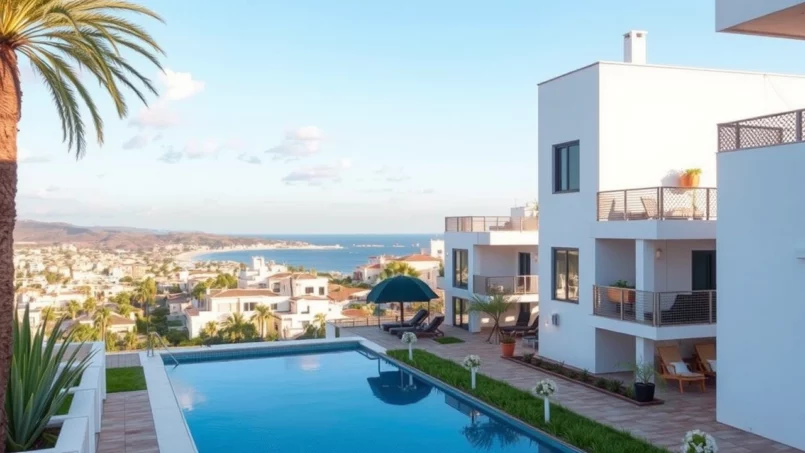
New high-end, contemporary real estate projects are emerging, notably in the Greater Tunis region (La Marsa, El Aouina) and in coastal cities like Monastir and Hammam Sousse. These residences, often 2-3 story buildings, are distinguished by modern architecture and quality finishes.
The second trend is the rise of a more international and diverse audience. At least three main profiles of foreign investors and buyers can be distinguished.
First, retirees and European expatriates, mainly from France, Italy, and Germany. Attracted by the climate, lower cost of living than in Southern Europe, and cultural proximity, they favor coastal areas and “expat-friendly” neighborhoods like La Marsa, Carthage, Gammarth, Sidi Bou Saïd, Les Berges du Lac, or certain seaside resorts.
The revival of the ‘Tunis Sports City’ project, led by an Emirati group, illustrates the interest of strategic Gulf investors (Qatar, Saudi Arabia, United Arab Emirates) in large luxury projects, tourist complexes, and hospitality in Tunisia. This gigantic project, estimated at 5 billion dollars, plans to develop 250 hectares in the northern suburbs of Tunis with luxury villas, golf courses, sports academies, and hotels.
Finally, a new generation of “digital nomads” and mobile professionals, drawn by internet connectivity, cost of living, and the Mediterranean setting. They concentrate in the trendy urban neighborhoods of Tunis and coastal cities like Sousse, seeking a mix of urban life, beaches, and modern infrastructure.
For Tunisians themselves, demand is shifting towards larger and more comfortable housing, often S+2 or S+3, in well-served neighborhoods. But the gap between this aspiration and the reality of purchasing power is widening, which also explains why some households are turning to long-term rental, lacking the means to buy.
Underdeveloped financing that hinders homeownership
While demand is dynamic, households’ ability to translate it into concrete purchases faces a central obstacle: access to credit. Compared internationally, Tunisia remains a country where the mortgage market is shallow and not very inclusive.
Less than 10% of GDP corresponds to outstanding housing loans, and over 70% of housing projects are still self-financed, often by family savings, remittances from Tunisians living abroad, or informal channels. Only a minority of households use a bank loan to build or buy a home.
In a system where half the banks offer housing loans, conditions are demanding: a personal contribution of at least 20% (or more for non-subsidized projects), a loan term often limited to 20 or 25 years, a repayment cap of about one-third of income, and effective rates that can reach 11-12% due to the high key rate, bank margins, and ancillary fees.
The tables below summarize some characteristics of real estate financing.
| Key Indicator | Approximate Value |
|---|---|
| Outstanding housing loans / GDP | ≈ 9.9 % |
| Share of self-financed projects | > 70 % |
| Share of households using a loan to build | ≈ 4 % |
| Central Bank key rate | ≈ 8 % (stable since 2023) |
| Mortgage interest rates | 5 % – 13 % |
| Share of non-performing real estate loans | ≈ 10 % |
Aware of this constraint, the state is multiplying targeted programs. The “First Home” program, for example, targets middle-class families, financing up to 20% of the down payment for homes capped around 200,000 to a little over 230,000 dinars, with a five-year repayment grace period. The FOPROLOS fund offers loans at a preferential rate for employees, while other mechanisms like the National Housing Improvement Fund or the 26-26 Fund support rehabilitation or access to housing for the most modest.
This is the number of families who have actually benefited from the ‘First Home’ program, less than half of the 6,000 initially targeted.
An abundant supply in volume, scarce in affordable housing
Paradoxically, Tunisia officially no longer suffers from a global housing shortage. The latest census shows a stock of about 4.3 million units for 3.47 million households, or nearly 800,000 “excess” homes and a vacancy rate close to 20%. “Rudimentary” housing has virtually disappeared, representing less than 1% of the housing stock.
Yet, this statistical abundance does not translate into easy access to decent housing for all. A large portion of the vacant stock corresponds to homes unoccupied for patrimonial, speculative, inheritance, or unattractive location reasons. At the same time, there is a cruel lack of truly affordable housing in major cities and areas where jobs and services are concentrated.
The following table illustrates this paradox.
| Housing Indicator | Value |
|---|---|
| Total number of homes (2024) | 4,265,636 |
| Number of households | 3,472,000 |
| Approximate excess homes | ≈ 794,000 |
| National vacancy rate | ≈ 19.3 % |
| Share of homes built by households themselves | ≈ 80 % |
| Share of rudimentary homes | ≈ 0.67 % |
The supply produced by developers is, to a large extent, geared towards the mid and high-end segments, where margins are more comfortable and the solvent clientele more visible. Social and affordable housing programs are also multiplying, but their volume is insufficient to make up for the accumulated backlog, especially as the rising cost of cement, steel, or bricks makes each new project more expensive.
The 2026–2030 plan envisages the construction of about 5,000 social housing units in its first phase.
Regulation, taxation, and framework for foreign investors
On the regulatory front, Tunisian real estate remains highly regulated, particularly for foreigners. The latter can buy residential or commercial properties in authorized urban and tourist zones, but not agricultural land, unless reclassified as buildable within development plans.
Any acquisition by a non-resident is subject to a double authorization: from the regional governor, then validation by the Central Bank for the transfer of funds. The procedure generally takes several months, or longer, but it guarantees legal security once the titles are properly registered.
Foreign investors must also contend with a strict foreign exchange control environment: capital inflows and outflows are closely monitored, and converting capital gains or rents into foreign currency requires justifying the origin of the initial funds and the compliance of the operations.
Real estate transactions are subject to several duties and taxes: registration fees (~5% of value), stamp duty (~1%), land registry fees (~1.5%), plus notary and agency fees. For new properties from developers, a 19% VAT applies, the generalization of which to residential sales is a sensitive issue for the sector.
For the foreign investor, taxation on rental income remains manageable, with a progressive scale but accompanied by a standard deduction for expenses, and a total capital gains exemption if the property is held for over ten years. Double taxation avoidance treaties signed with several European and North American countries further limit the risk of double taxation.
A sector under tension between modernization and informality
Behind the big numbers, Tunisian real estate remains a two-faced sector. On one side, a gradual modernization: digitization of some land services, plans for a national sales and rental register, arrival of technologies like virtual tours or specialized platforms, multiplication of detailed studies on neighborhood-by-neighborhood prices. On the other, a reality of high informality, agents without strict professional oversight, fragmented public data, and administrative burdens.
The absence of barriers to entry for real estate agents can lead to abuses such as lack of transparency on commissions, price opacity, and risks of fraud. Although professional associations work to structure the sector, the path towards a fully regulated and digitized market is still long.
Building permits also illustrate this ambivalence. On paper, Tunisia ranks relatively well in international indicators for permit issuance, with controlled administrative costs and a known number of procedures. In practice, delays can lengthen significantly when the land is near a protected area or the development plan is under revision, which weighs on delivery times and final costs for developers.
Outlook: What trajectories for the coming years?
In the short and medium term, several forces will continue to shape the trends of the Tunisian real estate market.
The first is the evolution of the economic and financial situation. As long as growth remains modest, unemployment high, and inflation relatively sustained, the rise in real estate prices risks hitting the real solvency of households. Banks, facing significant non-performing loan rates and a high cost of money, will continue to lend cautiously. The absence of a quick agreement with international financial institutions also limits the state’s room to massively support demand via subsidies or widespread rate cuts.
Growth in tourism in Tunisia, driven by a diversification of clientele (European, Maghreb, North American, Asian) and products (medical, cultural, year-round seaside), exerts increasing pressure on seasonal rental markets in areas like Hammamet, Sousse, Djerba, or Tunis. This dynamic benefits existing owners but can lead to rent increases in some sectors and intensify competition with long-term rentals.
The third lies in public housing policies. The announced social programs, national 2025–2035 strategies, the shift towards public land reserves and lease-to-own mechanisms can, if carried through, gradually improve access to housing for low and middle-income households. But the success of these policies will also depend on the ability to contain material costs, accelerate administrative procedures, and better direct projects towards regions with the strongest demand.
Tunisia positions itself as an attractive destination on the Mediterranean, offering a lifestyle close to Southern Europe at lower prices. A strengthening of political stability and a simplification of administrative procedures could increase investments in residential, tourist, and tertiary real estate. Emerging hubs like Lac 2, the North Urban Center, or flagship projects like ‘Tunis Sports City’ could act as catalysts.
In any case, the Tunisian real estate market is entering a phase where choices will become more complex. For households, the question will no longer be just “buy or rent,” but also “where, at what price, and with what prospects for future value.” For investors, the key will be to correctly read the map of risks – political, monetary, regulatory – while identifying pockets of real growth, whether in the northern suburbs of Tunis, seaside resorts in full rebound, or certain emerging markets along the coast.
Between renewal and constraints, the sector remains one of the most dynamic in the Tunisian economy. Its ability to reconcile attractiveness for capital, real access to housing for the population, and correction of territorial imbalances will say much about the country’s trajectory in the coming years.
Disclaimer: The information provided on this website is for informational purposes only and does not constitute financial, legal, or professional advice. We encourage you to consult qualified experts before making any investment, real estate, or expatriation decisions. Although we strive to maintain up-to-date and accurate information, we do not guarantee the completeness, accuracy, or timeliness of the proposed content. As investment and expatriation involve risks, we disclaim any liability for potential losses or damages arising from the use of this site. Your use of this site confirms your acceptance of these terms and your understanding of the associated risks.

Cyril Jarnias is an independent expert in international wealth management with over 20 years of experience. As an expatriate himself, he is dedicated to helping individuals and business leaders build, protect, and pass on their wealth with complete peace of mind.
On his website, cyriljarnias.com, he shares his expertise on international real estate, offshore company formation, and expatriation.
Thanks to his expertise, he offers sound advice to optimize his clients' wealth management. Cyril Jarnias is also recognized for his appearances in many prestigious media outlets such as BFM Business, les Français de l’étranger, Le Figaro, Les Echos, and Mieux vivre votre argent, where he shares his knowledge and know-how in wealth management.





