
 Published on and written by Cyril Jarnias
Saint Barthélemy is often mentioned for its hillside villas, postcard-perfect beaches, and New Year’s Eve parties on board superyachts. But behind the glossy brochure image lies an extremely structured, rare commercial real estate market that, for investors able to shoulder the high entry costs, can be potentially very profitable in the long term.
Investing in commercial real estate in Saint Barthélemy requires a thorough analysis of its specificities. To properly assess the risk/return profile, it is essential to decipher the real opportunities, understand the economic drivers, tax framework, and regulations unique to this island micro-economy.
A luxury micro-economy, under French law, driven by tourism
On barely 21 to 25 km² of volcanic land surrounded by shallow reefs, Saint Barthélemy concentrates a rare combination of factors that explain the extreme pressure on commercial land.
The island has been an overseas collectivity of the French Republic since 2007, enjoying broad autonomy but operating within the legal and monetary framework of the European Union. Real estate transactions are denominated in euros, conducted before a notary, and fall under the French property regime, with title registration and strong legal security. For an investor, this predictability—far from the uncertainties of some Caribbean jurisdictions—is a pillar of the island’s “confidence premium.”
Number of tourists who visited the island in 2022, nearly 80% of whom were American.
For commercial real estate, this means a steady stream of high-purchasing-power consumers, concentrated in a few specific neighborhoods, with clear needs: luxury accommodation, gourmet dining, duty-free shopping, leisure, and premium services.
One of the world’s most expensive real estate markets, but remarkably resilient
Real estate, both residential and commercial, in Saint Barthélemy ranks among the world leaders in price per square meter, comparable to the most exclusive markets like Monaco. Several structural factors explain this.
Over the past decade, prices per square meter have increased by approximately 70%. After Hurricane Irma in 2017, sales volume dropped by about 55% and average prices fell by around 22% between 2017 and 2018. However, by 2019, sales volumes exceeded those of 2017 and average prices were about 30% higher than their pre-Irma level. The COVID-19 period then boosted demand for secure, isolated refuges, leading to a further increase in values of about 20%.
Transaction statistics show the rise of the ultra-high-end segment. In 2021, the number of sales above 10 million euros was nearly three times higher than in any other year, and the total volume of real estate sales had almost doubled compared to 2017, even though the number of transactions increased by only about 8%. In other words, the market has shifted towards the most expensive segment.
A few recent sales illustrate the scale of the luxury real estate market on the island: the 52-hectare estate in Colombier (originally built for David Rockefeller) was sold in 2023 for about 135 million euros; the ‘Le Girasol’ property in Marigot changed hands for around 65 million dollars after Hurricane Irma; the ‘Camp David’ in Saint-Jean sold for approximately 70 million euros in 2020; and ultra-contemporary six-bedroom villas can reach up to 60 million euros.
For commercial investors, this real estate inflation has two consequences: acquisition costs are colossal, but the preservation—and even long-term appreciation—of invested capital is historically robust, even in times of crisis.
A market currently in a normalization phase… without undermining scarcity
After the post-COVID frenzy, the market began to rebalance from late 2022 onward. The local authorities note a lengthening of sales periods, especially in the highest segments, and price adjustments.
A fairly clear segmentation is emerging:
| Price Segment | Recent Sales Period | Price Trend | Comment |
|---|---|---|---|
| > €10M | 12 → 24 months | -12% to -20% via negotiation | Most slowed-down market, more demanding buyers |
| €5M – €10M | Increasing | Occasional downward adjustments | Sensitive to pullback of ultra-luxury buyers |
| €2.5M – €5M | ≈ 4 months (stable) | Relatively stable | Currently the most liquid segment |
| < €2.5M | 4.5 → 11 months | Downward pressure | Abundant supply, strong competition |
This rebalancing does not signify a structural reversal. It primarily corrects a striking “overheating” between 2020 and 2022. In the long term, expert projections continue to indicate annual appreciation on the order of 8 to 10%, underpinned by land scarcity, tourist appeal, and the island’s high-end brand status.
For an investor, the current market normalization phase represents an interesting entry window. Opportunities are emerging, particularly for mispriced assets in the €5–10M and >€10M segments, where sellers, after long months on the market, are now accepting discounts of 12 to 20%.
Specific factors for commercial real estate
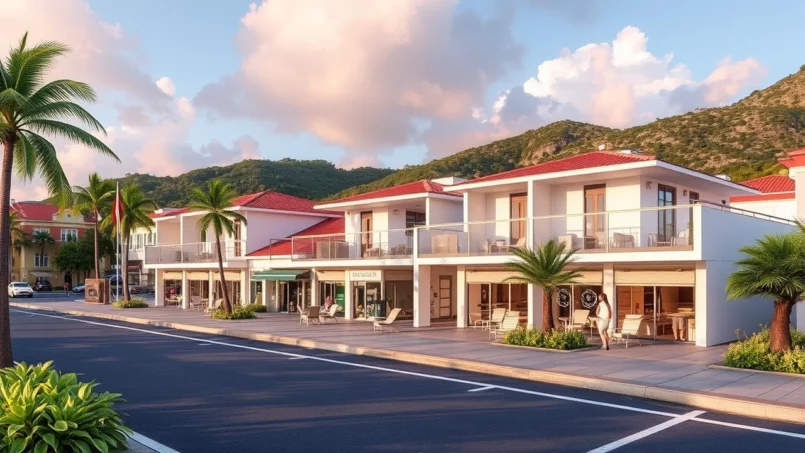
Unlike purely residential property, commercial real estate in Saint Barthélemy mainly revolves around a few themes: luxury retail, high-end dining, hotels/boutique hotels, small service spaces, and mixed-use premises (shop + housing or offices).
An example listing illustrates the valuation level of a small commercial space: a commercial lease for a 9 m² boutique with a 15 m² storeroom was offered for assignment for €286,124, with an annual rent of about €33,600, or €2,800 per month. The rent relative to the size of the space shows the brutal cost of location in premium areas.
The theoretical gross yield calculated on the lease assignment price can be high (example: 11.7%), but it must be qualified by several practical elements: the remaining lease term, renovation obligations, specific business taxation, and the risk profile of the commercial activity. Nonetheless, this calculation illustrates the potential rental pressure in the most sought-after streets.
In the hotel and seasonal rental sectors, the logic is different. It’s closer to an “operational real estate” model where the asset’s value lies as much in the building as in the operational performance (occupancy rate, average price level, services).
| Key Parameter | Observed Data |
|---|---|
| Villas for rent | ≈ 1,000 (of which 650 managed by ~70 agencies) |
| ADR (Seasonal rental, high-end) | Median ≈ $787/night; top 10% > $2,250/night |
| Monthly Revenue (top 10% Airbnb) | > $23,000 |
| Seasonality | Revenue peak in March; lowest month in September |
| Median Annual Occupancy | ≈ 39% (STR); peak ≈ 60% in the best month |
| Typical Gross Yield (villas) | ≈ 2 – 4%/year |
Gross yields may seem modest, but they apply to assets whose patrimonial value has historically grown faster than inflation, which changes the perspective for an investor seeking a capital refuge rather than massive cash flow.
Where are the main commercial opportunities on the island?
Even though Saint Barthélemy is tiny, the commercial market is not homogeneous. Each neighborhood follows a different usage logic and clientele, which shapes the opportunities.
Gustavia: The beating heart of commerce, yachting, and luxury
The administrative and port capital, Gustavia concentrates the bulk of retail and dining. Around its deep-water port, a stop for superyachts and luxury cruise ships, unfold iconic streets like Quai de la République, Rue du Général de Gaulle, or Rue du Roi Oscar II.
Commercial galleries like Carré d’Or or Cour/Cœur Vendôme line up high-end brands: Louis Vuitton, Hermès, Cartier, Dior, Chopard, Rolex, Audemars Piguet, Richard Mille, but also local designers like Poupette St Barth or concept stores like Clic or Varda. These are complemented by cigar shops (La Casa del Habano, Le Comptoir du Cigare), wine merchants with impressive stocks, and several art galleries.
For an investor, Gustavia represents the core of commercial real estate:
Discover the various spaces and services that make up this exceptional marina, designed for a demanding clientele.
Premises dedicated to luxury boutiques and jewelry for exceptional purchases.
Fine dining restaurants and cocktail bars for refined tasting moments.
Small service spaces specially designed to meet the needs of a yachting clientele.
Apartments with views of the marina, combining luxury residence and premium seasonal rental.
Vacancy rates there are extremely low, rents very high, and leasehold assignments are rarely public. This opaque and narrow market requires relying on well-established local agencies to access so-called “off-market” opportunities.
Saint-Jean: A mix of hospitality, beach clubs, and vacation commerce
Two kilometers from Gustavia, Saint-Jean is the other major hub. It is home to the island’s busiest beach, the iconic Eden Rock, beach clubs like Nikki Beach, and commercial areas like Villa Créole, Les Galeries du Commerce, Les Amandiers, or the shops at Le Pelican.
The commercial fabric here consists of beachwear boutiques, concept stores, beauty brands (Passion Beauté, Ligne St Barth), trendy restaurants, and tourist services. It’s also a prime location for high-end condos, small hotel residences, or mixed-use developments combining accommodation, retail, and dining.
The investor focused on “hospitality + retail” will find fertile ground here, especially for repositioning operations: purchasing a small hotel or guesthouse to turn it into a boutique hotel, expanding an existing complex, transforming underutilized commercial spaces.
Other pockets of interest: Beaches, bays, and prestigious residential neighborhoods
Several primarily residential areas present targeted commercial interest, especially for intimate hospitality projects, destination restaurants, spas, or nautical leisure activities:
– Flamands: The island’s longest beach, already home to prestigious hotels like Cheval Blanc. A new 46-room resort is under development on an approximately 8,000 m² plot, proving that hotel potential remains sought after.
– Grand Cul-de-Sac: A bay conducive to water sports, with luxury hotels and potential for wellness or aquatic activity projects.
– Pointe Milou, Lurin, Colombier, Gouverneur: Ultra-luxurious villa neighborhoods with panoramic views, more suited to investment in private estates for event rentals, high-end retreats, or villas managed as mini-hotels.
– Lorient, Corossol, Toiny, Saline: More residential or natural environments, offering opportunities for more intimate, sometimes eco-touristic projects.
In these areas, “commercial” real estate often takes the form of villas operated as luxury accommodations with hotel services (24/7 concierge, private chef, in-home spa), rather than traditional shops.
Hospitality, villas, and seasonal rental: The backbone of profitability
The primary form of “commercial” investment on the island remains owning properties intended for seasonal rental and tourist accommodation. We can distinguish three main asset categories:
– Hotels and resorts (about 25 hotels, most very small, up to a maximum of 58 rooms),
– Boutique hotels and guesthouses under strict license,
– Luxury villas and apartments operated for short-term rentals.
The structure of the short-term rental (STR) market is very telling:
| Indicator (STR, recent data) | Value |
|---|---|
| Active listings | 562 |
| Share “Entire home” | ≈ 94.5% |
| Share “Houses” | ≈ 75% |
| Average capacity per listing | 4.3 people |
| Median ADR | ≈ $787/night |
| Top 10% ADR | > $2,250/night |
| Median Occupancy | ≈ 39% |
| Top 10% Occupancy | > 80% |
| Median Monthly Revenue | ≈ $6,950 |
| Top 10% Monthly Revenue | > $23,000 |
Seasonality follows the Caribbean high season: the best revenue months are generally January to March, with an average occupancy rate around 56% and an average ADR exceeding $1,100. The weakest months, like September, combine a lower ADR and a lower occupancy rate, around 27–31%.
To maximize performance, an investor must aim for the top quartile. The properties that rank there are distinguished by an exceptional location (sea view, direct beach access), very high-end finishes, professional management by major local agencies, and a comprehensive range of ancillary services (private transfers, 24/7 concierge, breakfast delivery, at-home chef service, etc.).
Gross yields of 2 to 4% may seem modest, but they generally cover operating costs (staff salaries, maintenance, electricity, water, agency commissions between 20 and 30%, etc.). The primary gain lies in capital appreciation, making it more of a patrimonial asset than a pure yield product.
An atypical tax and regulatory environment, to decode carefully
One of Saint Barthélemy’s major attractions lies in its tax environment, quite different from mainland France or other Caribbean destinations.
For qualified tax residents (at least five years of presence on the island), there is no local income tax, no wealth tax, no inheritance tax, no annual property tax. The system relies on transactional and sector-specific taxes: registration duties on sales (around 5%), business taxes, tourist tax (about 5% on tourist rentals), customs duties on imports.
For non-residents and foreign investors, several points deserve attention:
Acquisition is open to all nationalities without residency requirements. Purchase is typically in full ownership and for cash, as local bank loans are rare. Notary and registration fees represent about 6 to 8% of the price. A capital gains tax of about 35% may apply on resale within the first eight years, with a decreasing scale thereafter, depending on the investor’s tax regime.
A recent particularity has profoundly influenced the market: the increase in the capital gains tax rate for the first eight years (raised from 20% to 35% in 2017) encouraged many owners of new houses to postpone their sale and opt for seasonal rental instead. As a result, homes less than eight years old now represent only about 20% of transactions, and a “maturity wall” is expected starting in 2024–2025 when these properties reach the eight-year horizon: a possible influx of 2–3 bedroom homes with sea views could then feed supply, creating new acquisition opportunities for commercial repositioning.
In addition to these tax aspects, there is very strict urban planning regulation. The local authority has suspended issuing new permits for major luxury projects to slow growth, improve residents’ quality of life, and promote local housing. Heights, densities, and buildable zones are heavily controlled; some ambitious hotel projects have been blocked for environmental reasons, such as a $170 million complex in Saint-Jean rejected by the courts. “Cyclonic” construction requirements increase construction costs but strengthen asset resilience.
The Collectivity of Saint Barthélemy
For the investor, this means that creating new commercial square footage ex nihilo is becoming increasingly difficult. Therefore, most of the action is focused on:
– Purchasing existing assets (hotels, villas, commercial premises),
– Major restructuring/renovation (reprofiling a hotel into a boutique hotel, a villa into an event estate, a warehouse into retail),
– Land already carrying permits.
Due diligence: Why extreme scarcity demands maximum rigor
In such a restricted market, where assets often trade in the millions or even tens of millions of euros, the temptation to “rush before someone else buys” is real. However, all international commercial real estate practice reminds us of the importance of exhaustive due diligence before committing significant capital.
The process is classically structured around several facets:
Complete evaluation of a real estate asset covering financial, physical, legal, and market dimensions for an informed investment decision.
Audit of revenue (rents, hotel turnover), expenses, investments. Calculation and validation of NOI (Net Operating Income) and stress tests (revenue decline, rising rates, etc.).
Detailed technical inspection: structure, roof, systems, compliance with standards, fire safety. Costing of immediate work and capital expenditures (capex) for 5-10 years.
Verification of title deed, mortgages, easements. Review of leases, urban planning and environmental compliance, operating permits (hotel license, rental permit).
Positioning relative to competitors (hotels, villas, shops). Analysis of local dynamics: traffic, rental demand, seasonality, and dependence on client segments.
In mature markets, it is estimated that a budget of 0.5 to 1% of the acquisition price should be allocated to this due diligence (i.e., €50,000 to €100,000 on a €10M asset). In Saint Barthélemy, where regulatory and climatic constraints are strong, it is prudent to aim for the higher end of this range, by engaging:
To successfully carry out a real estate project overseas, support from local and specialized experts is essential. Here are the four indispensable partners to involve.
Guarantor of title and privileged interface with the local administration to secure deeds and land.
Expert in French and overseas real estate law and taxation for legal structuring and tax optimization.
Accustomed to seismic and cyclonic standards to ensure construction compliance and resilience.
Specialized in hospitality or retail to assess and maximize the operational and commercial potential of the property.
In a micro-market, a defect (roof nearing end-of-life, non-compliance with urban planning rules, weakness of clientele outside high season) can weigh very heavily on actual profitability. Conversely, a good understanding of leases, cash flows, and trends can help identify an underutilized asset for transformation.
Comparison with other Caribbean islands: Why Saint Barthélemy remains a case apart
Many Caribbean islands – Antigua and Barbuda, St. Kitts and Nevis, Grenada, Dominica, St. Lucia, etc. – offer Citizenship by Investment (CBI) programs tied to real estate, with entry costs between $200,000 and $400,000 and advertised rental yields of 2 to 7%.
Saint Barthélemy does not play in this league. No citizenship by investment is offered, entry prices are not comparable (studios starting at around €1M, family villas often between €5 and €10M, estates beyond €50M) and buyers’ objectives are rarely short-term profitability. What they seek:
Discover the main assets of this exclusive investment, combining security, scarcity, and an exceptional living environment.
Benefit from a robust and stable regulatory framework, guaranteed by French and European legislation.
Access an extremely rare asset within a micro-jurisdiction, enhanced by its association with an international luxury brand.
Enjoy a unique lifestyle and living environment, offering exceptional comfort and privileges.
Build a patrimonial refuge designed to withstand and perform through economic cycles and periods of crisis.
In this sense, commercial real estate in Saint Barthélemy resembles more of a “very high-end club deal” than an opportunistic strategy. The investor looking for a constant 8–10% annual return would probably be better off looking at larger markets. The one seeking a combination of prestige/security/long-term capital appreciation, with stable but moderate cash flow, will find a unique territory on the island.
Specific risks: What patrimonial returns don’t reveal
Not everything is rosy, however. Several risks and constraints must be factored in from the outset.
The dependence on international tourism is total. The 200,000 to 300,000 annual visitors, a large majority of whom are North Americans, form the foundation of demand for hotels, villas, restaurants, and shops. A health crisis, a major economic shock, or a sustained disruption of air and sea links would have a direct impact on commercial revenues.
Climate exposure is a central issue. Like any tropical island, Saint Barthélemy is vulnerable to hurricanes and the effects of climate change (sea level rise, beach erosion). Constructions must be reinforced, increasing capex, and urban planning will evolve, especially concerning beachfront construction.
Assets over 10 million euros can remain on the market for one to two years before finding a buyer, illustrating the low liquidity of this niche market.
Tension over resident housing drives political choices. Suspension of permits for large projects, prioritization of local housing, potential changes to urban planning rules: all are factors that could restrict the room for maneuver for purely financial investors.
Finally, the cost of living and operations is high. Salaries, material imports, energy, logistics: everything weighs on operating margins. A restaurant, hotel, or shop must aim for a very qualitative positioning and high prices to absorb these costs.
Towards a “sustainable luxury” model: A strategic angle for new projects
One structural trend is emerging as a strategic opportunity for commercial real estate: the shift towards “sustainable luxury.” More and more hotels, villas, and development projects are highlighting bioclimatic architecture, solar panels, rainwater harvesting, reduction of single-use plastics, and protection of biodiversity (sea turtles, coral, mangroves, seagrass).
Hospitality establishments such as Gyp Sea St Barth, the Christopher Hotel, or Manapany have obtained demanding environmental certifications (like Green Globe, TripAdvisor distinctions, or AAA Diamond) by adopting a sustainable approach. This effort is part of a broader initiative, “Green St. Barths,” which includes the establishment of marine protected areas and programs to replant endemic plant species on the island.
For an investor, positioning a commercial asset—hotel, villa estate, wellness space—in this niche of eco-responsible luxury allows:
– Differentiation in a market saturated with “classic” products,
– Meeting the growing ESG expectations of international clientele,
– Limiting certain costs in the long run (energy, water),
– And potentially benefiting from a more favorable reception from local authorities on the regulatory front.
The future commercial projects best positioned will likely be those that combine architectural signature, landscape integration, environmental sobriety, and an offer of very high value-added services.
How to position oneself concretely in this market?
Given the very specific configuration of Saint Barthélemy, several entry strategies emerge for an investor in commercial real estate:
Main investment axes identified for Saint Barthélemy’s luxury real estate market, combining yield potential and patrimonial strategy.
Acquisition of an existing small hotel or guesthouse in Gustavia, Saint-Jean, or on a major beach, with a project to transform it into a high-end establishment with a strong service component.
Purchase of ultra-high-end villas in neighborhoods like Lurin, Pointe Milou, Gouverneur, or Colombier, for prestige rental exploitation within a patrimonial logic.
Taking a stake in commercial properties in the heart of Gustavia or Saint-Jean, backed by long-term leases with international brands or strong local operators.
Preferred investment in major renovation operations of existing buildings, rather than new developments facing increasing regulatory hurdles.
In all cases, the key to turning theoretical potential into concrete results remains the quality of the local network: specialized real estate agencies, notaries, attorneys, villa managers, hotel operators. In such a restricted market, where “pocket listings” (properties not publicly advertised) represent a significant portion of quality supply, access to information and discreet deals is in itself a competitive advantage.
—
Opportunities exist but differ from standard Caribbean models. Scarcity, legal stability, brand strength, and a consistent wealthy clientele make it a long-term investment. It primarily addresses investors with high financial capacity, prioritizing capital preservation and value over high immediate yield.
Those who accept this framework – demanding, costly, but remarkably resilient – can, provided they conduct rigorous due diligence and surround themselves with the right local partners, transform a commercial asset on this 21 km² rock into a strategic pillar of their international portfolio.
Disclaimer: The information provided on this website is for informational purposes only and does not constitute financial, legal, or professional advice. We encourage you to consult qualified experts before making any investment, real estate, or expatriation decisions. Although we strive to maintain up-to-date and accurate information, we do not guarantee the completeness, accuracy, or timeliness of the proposed content. As investment and expatriation involve risks, we disclaim any liability for potential losses or damages arising from the use of this site. Your use of this site confirms your acceptance of these terms and your understanding of the associated risks.

Cyril Jarnias is an independent expert in international wealth management with over 20 years of experience. As an expatriate himself, he is dedicated to helping individuals and business leaders build, protect, and pass on their wealth with complete peace of mind.
On his website, cyriljarnias.com, he shares his expertise on international real estate, offshore company formation, and expatriation.
Thanks to his expertise, he offers sound advice to optimize his clients' wealth management. Cyril Jarnias is also recognized for his appearances in many prestigious media outlets such as BFM Business, les Français de l’étranger, Le Figaro, Les Echos, and Mieux vivre votre argent, where he shares his knowledge and know-how in wealth management.





