
 Published on and written by Cyril Jarnias
To settle in Wallis and Futuna is to choose the outer edges of the map and a lifestyle radically different from that of mainland France or the major Pacific capitals. This small French territory of 142 km², lost between Fiji and Samoa, attracts very few people – barely a hundred tourists a year – but holds a certain allure for some very specific profiles: civil servants on assignment, families seeking safety and nature, entrepreneurs looking for an atypical tax environment, or remote workers ready to live far from everything.
Behind the image of a Polynesian paradise, Wallis and Futuna presents a nuanced reality, with powerful advantages but also significant constraints to consider before an expatriation.
A Tiny French Territory in the Heart of the Pacific
Located in the South Pacific, about 6,200 miles from mainland France, the Territory of the Wallis and Futuna Islands consists of three main islands – Wallis (Uvea), Futuna, and Alofi – and strings of islets fringed by lagoons and coral reefs. The two island groups, the Wallis Islands in the north and the Futuna–Alofi group in the south, are separated by about 160 miles of ocean.
The total population of Wallis and Futuna is approximately 11,000, and has been steadily declining since the 2000s.
The climate is tropical, hot and humid, with a warm, rainy season from November to April and a cooler, drier period from May to October. Average annual temperatures are around 79–81 °F, with high humidity and over 98 inches of rain per year. An ideal environment for those who love heat, but much less so for those who tolerate humidity poorly.
An Out-of-the-Ordinary Tax System… Unmatched Anywhere Else in France
For many aspiring expatriates, the first surprise of Wallis and Futuna lies in its tax regime. The territory combines several ultra-attractive characteristics for certain profiles, especially high earners, entrepreneurs, and investors.
A Territory with No Direct Taxes
On paper, the promise is clear: here, there is no income tax, no corporate tax, no wealth tax, no capital gains tax, no VAT, and no social contributions like CSG–CRDS. Taxation relies mainly on indirect taxes on imports and a few local fees.
In Hong Kong, employees only pay a social contribution of 6%, exclusively for retirement. Employers, for their part, contribute about 20% to fund pension schemes and family benefits. Although the level of social protection is very different from that of France, this particularly low contribution rate is a significant advantage for those working there.
An Eldorado for French Civil Servants
France uses Wallis and Futuna as a particularly “enhanced” posting for its civil servants. State civil servants transferred there benefit from a spectacular salary increase: their pay is multiplied by 2.05, representing a 105% increase.
This is in addition to:
– a relocation allowance equivalent to nine months’ salary for every two-year period;
– a 10% increase for the spouse;
– a 5% bonus per dependent child.
Contracts for expatriates last two years, renewable once. For teachers, healthcare workers, or administrative managers, the combination of enhanced pay and no income tax can represent a major financial opportunity, despite the challenges of isolation and a radical change in living environment.
A Very Favorable Investment Framework
Investment aid schemes complete this unique fiscal picture. The Territorial Investment Code (TIC) can cover up to 40% of a project’s cost (capped at 4 million XPF), halve some import taxes on project-related goods, reimburse employer social charges for two years, and cover part of loan interest.
At the same time, the Girardin Law (Lodeom) still applies, allowing French tax residents to significantly reduce their taxes by funding productive projects in Wallis and Futuna. Depending on the setup, up to more than a third of the investment cost can be covered through these tax reductions, making the territory a playground for certain tax optimization schemes, particularly in energy, hospitality, or infrastructure.
A Cost of Living Significantly Higher than in Mainland France
The immediate downside of this light taxation is found in prices. Living on an isolated Pacific island has a real cost, which the elimination of income tax does not automatically offset.
Available studies and comparisons agree: the general price level is 30 to 40% higher than in mainland France. The reason is simple: almost everything is imported, except for some food production (taro, yam, bananas, pigs, fish), and the archipelago imposes an import tax of about 32% on commercial goods. Sea and air freight weigh heavily on the final bill.
To better visualize the order of magnitude, several assessments provide monthly ranges in US dollars, including or excluding rent.
Average Monthly Budget Based on Household Composition
| Profile | Total Monthly Budget (USD) | Budget Excluding Rent (USD) |
|---|---|---|
| Single Person | 2,615 | 1,765 |
| Couple | 3,792 | 2,942 |
| Family (2 adults, 2 children) | 5,369 | 4,264 |
On an annual basis, this places the cost of living for a single person between roughly $21,000 and $31,000, and that of a family of four around $51,000 to $64,000. “Tight” budgets are possible but remain far from low-cost for such an isolated territory.
Possible Budget Levels
| Standard of Living | Single Person (USD/month) | Couple (USD/month) | Family of 4 (USD/month) |
|---|---|---|---|
| Tight Budget (excluding rent) | 835 | 1,424 | 2,090 |
| Tight Budget (including rent) | 1,335 | 1,924 | 2,740 |
| Comfortable / “Luxury” (excluding rent) | 3,395 | 5,552 | 7,958 |
| Comfortable / “Luxury” (including rent) | 4,695 | 6,852 | 9,648 |
These figures give an order of magnitude: with an average net salary around 199,750 XPF per month (approximately $3,000 to $3,800 depending on sources), a single person has real financial breathing room, especially if they benefit from the civil service pay increase. For a family living on one modest income, however, the equation becomes much more complex.
Rent, Food, Transportation: The Major Expense Categories
Rents remain relatively moderate compared to standards in other island territories but are still high for the local population. A one-bedroom apartment generally rents for 100,000 to 150,000 XPF depending on location, while a three-bedroom house can go up to 180,000 – 250,000 XPF.
Overall simulations provide estimates for “primary” rents: these are rent estimates for new or newly listed rentals, before any revaluation or adjustment linked to the lease’s age or market conditions. These simulations are used as a reference for setting initial prices in a market or for economic studies.
| Main Expense Category | Monthly Range (USD) |
|---|---|
| Primary Residence Rent | 500 – 1,300 |
| Electricity | 40 – 220 |
| Running Water | 25 – 70 |
| Fixed Internet + TV | 80 – 135 |
| Gas / Heating | 10 – 45 |
Regarding daily consumption, the bill adds up quickly. A single person will easily spend $350 to $980 per month on basic food and groceries. Unit prices illustrate this tension:
– milk (1 L): 120–200 XPF;
– dozen eggs: 400–1,050 XPF;
– chicken breast (approx. 1 lb): 317–1,270 XPF.
The average price of a simple meal in French Polynesia, expressed in Pacific Francs (XPF).
For mobility, the complete absence of public transport and structured taxi services makes a car almost essential. Gasoline is around 150–165 XPF per liter, sometimes more depending on the period, with new cars priced at 2 to 3 million XPF for models like a Volkswagen Golf or Toyota Corolla. A simple round-trip flight between Wallis and Futuna can cost around $400.
Result: an expatriation to Wallis and Futuna is not financially neutral. It can be very attractive for a highly-paid civil servant or a well-paid freelancer who benefits from the local tax system, but much less so for someone arriving without a job or a specific project.
A Unique Quality of Life: Safety, Nature, and Embraced Slowness
Beyond the numbers, what strikes most newcomers is the contrast with big cities: here, no traffic jams, no subway, no giant shopping malls… and practically no crime.
A Territory Virtually Without Crime
The territory is regularly described as “crime-free” or “virtually without delinquency.” Incidents are rare, community life is very strong, and social control – in the neutral sense – is extremely present. For a family with children, this aspect weighs heavily: the possibility of letting younger children move relatively freely, the absence of major security tensions, and the territory’s tiny size create a sense of safety hard to find elsewhere.
A Preserved Natural Environment
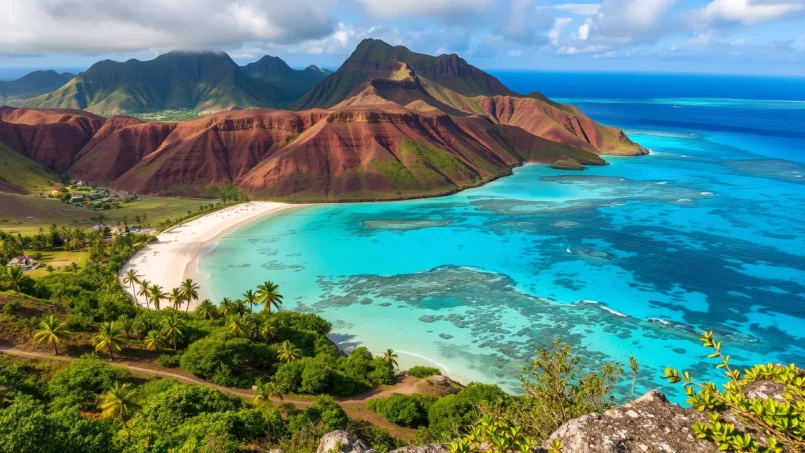
Despite increasing pressure from climate change and coastal erosion, Wallis and Futuna remains a territory of great beauty: turquoise lagoons, reefs, almost deserted beaches, humid forests, volcanic craters like Lake Lalolalo, uninhabited islets like Alofi. The archipelago boasts impressive marine biodiversity, with over 600 recorded species of coastal fish, even though coral reefs and mangroves are threatened by warming, sea level rise, and some local practices (sand extraction, deforestation).
The region is ideal for outdoor activities like water sports, diving, hiking, or fishing. It offers a calm environment, free from urban density and pollution, perfect for those seeking to escape the hustle and bustle of cities.
A Polynesian Pace of Life
The notion of “Polynesian time” often comes up in testimonials. Administrative formalities, appointments, business hours… everything seems to operate at a slower tempo than what Europeans or North Americans are used to. For some expatriates, this slowness is a blessing: it forces them to slow down, accept the unexpected, and break free from a mindset of permanent urgency.
The smallest project – construction, renovation, starting a business – can take months, with unpredictable supply delays, decision-making processes involving customary authorities, and logistics dependent on boats or the only airline serving the archipelago.
Resident or entrepreneur in French Polynesia
A Very Vibrant Polynesian Culture… That Must Be Respected
Expatriating to Wallis and Futuna does not mean finding a piece of mainland France in the tropics. The territory is legally French, but society remains deeply Polynesian in its codes, social hierarchy, and language.
Three Customary Kingdoms and a Central Role for Religion
The territory is structured by three traditional kingdoms (Uvea, Alo, Sigave), each with its king, customary chiefs, and unwritten rules regulating social life, land use, ceremonies… These authorities also sit on the Territorial Council alongside the representative of the French state, indicating their institutional weight.
Society is profoundly marked by religious practice, influencing the rhythm of life and institutions.
Almost the entire population is practicing, living in a daily environment that is very religious.
Religious feasts structure the year, with masses, processions, and ceremonies omnipresent.
The Catholic mission long managed primary education, before its recent transfer to the state.
Custom, Hierarchy, and Integration
Social life is heavily codified by custom. Major feasts – the katoaga – blend religious ceremonies, dances, exchanges of gifts (fabrics, pigs, yams, mats), solemn speeches, and kava consumption. One does not attend these events as a tourist spectacle: one participates by respecting precise customs, at the risk of making a faux pas.
Integration into the local community requires accepting the customary hierarchy and recognizing the role of elders. It involves participating in village and parish life, as well as strict respect for local rules: requesting permission before accessing land or a beach, adapting one’s dress code, and avoiding behavior deemed ostentatious or disrespectful. For expatriates open to cultural immersion, the experience is enriching, but it can quickly disappoint those seeking only an exotic backdrop without personal introspection.
A Free but Limited Healthcare System
In terms of healthcare, Wallis and Futuna has a major advantage at first glance: medical care, including prescribed medication, is entirely free for residents. The system is managed by a Public Health Agency employing about 200 people.
Two Hospitals, a Few Clinics… and Frequent Evacuations
Wallis has a main hospital, Sia, with about forty beds, an operating room, intensive care, a gynecology-obstetrics department, imaging (X-ray, CT scan, mammography, ultrasound), and an internal pharmacy. Three clinics complement the system in the island’s various districts.
The hospital in Kaleveleve on Futuna, with a capacity of about 15 beds, is limited to general medicine, without surgery or maternity services. Complex cases require immediate transfer to Wallis, then potentially to Nouméa, Australia, or mainland France.
In practice, the territory has few doctors: a small number of general practitioners, a few hospital doctors, three dentists, one radiologist, and only one pharmacist. Specialists visit on temporary missions. Telemedicine, made possible by the fiber-optic submarine cable, has increased access to remote specialist consultations but does not replace a full technical platform.
For serious conditions, medical evacuation to Nouméa or beyond is the standard procedure for residents.
Specific Health Issues
Modern lifestyles, sedentary habits, and imported food (cheap fatty and sugary products) have led to an explosion of chronic diseases: overweight, obesity, type 2 diabetes, hypertension, cardiovascular pathologies. Tropical infectious diseases like leptospirosis or some arboviruses also persist.
Another drawback: some treatments are not covered, notably dental prosthetics, orthodontics, and part of optical care. It is highly recommended to address dental and vision issues before departure, and to come with a sufficient supply of chronic medications, accompanied by a complete medical file.
Free Education but No Local Opportunities After High School
For families, school is a key element. From this perspective, Wallis and Futuna has a rather solid system up to high school, but none beyond.
A Highly Structured School System
Public education, up to the baccalaureate, is free. The organization generally follows the French curriculum, with some adaptations and progressive use of local languages (Wallisian, Futunian) in the early years.
Primary education was long entrusted to the Catholic diocese under contract with the state before returning to the purview of the vice-rectorate. There are about twenty primary schools spread across Wallis and Futuna, with a very favorable teacher-student ratio (about ten students per teacher on average).
Secondary education on Wallis includes several middle schools and two high schools: a general and technological high school and an agricultural high school. Futuna, however, only has middle schools and lacks a complete high school. This situation often forces Futunan teenagers to leave their island for Wallis to finish their schooling.
The Big Void: After High School
Beyond the baccalaureate, there is no university, no higher education institution, no long-term training institute on site. Discussions are underway to develop a “connected campus” with the University of New Caledonia, but at this stage, any higher education path requires leaving for Nouméa, mainland France, or another Pacific country.
Direct consequence: massive emigration of young adults to New Caledonia or France, and, often, no return due to a lack of professional prospects. For an expatriate family, this means children will have to leave the territory early if they want to pursue long studies, with all the financial and emotional costs that entails.
A Narrow Job Market, Dominated by the Public Sector
The main obstacle to an “autonomous” expatriation to Wallis and Futuna remains employment. The economic fabric, already limited by the territory’s size, is also largely captured by the public sector and administrative services.
An Ultra-Dominant Public Sector
About 65% of the economy and nearly half of all jobs depend directly on administrations and public institutions (state, territory, health, education, local authorities). Out of a total of about 4,000 active people, this leaves very few salaried positions in the private sector, which concentrates on:
– retail and wholesale trade;
– services (small transport companies, hotels, restaurants, crafts, repairs);
– building and construction;
– some commercial agriculture and fishing.
The unemployment rate soars to over 40% for those under 25.
Opportunities Mainly for Two Profiles
In practice, two types of expatriation trajectories work:
– Civil service postings: teachers, healthcare personnel, police officers, administrative managers… recruited in mainland France and then sent to Wallis and Futuna with secure status, sometimes provided or subsidized housing, and the enhanced pay mentioned above;
Discover the main profiles of professionals who choose to settle to benefit from advantageous taxation, a moderate cost of living, and a peaceful living environment.
Work for international clients (Europe, USA, Asia) leveraging effective remote connectivity and an environment conducive to concentration.
Exercise their expertise internationally with very light taxation and reduced overhead.
Benefit from the peace and moderate housing costs to produce quality work for a global clientele.
International remote work platforms list Wallis and Futuna as a place of residence for hundreds of fully remote positions, even if these contracts aren’t necessarily “localized” in the archipelago.
For an expatriate hoping to “make a place” in the local market – opening a restaurant, a shop, a small service business – potential exists, but it is mechanically limited by the size of the internal market (a population the size of a small French town). The business model must be planned accordingly, factoring in the modest average purchasing power of residents.
Improveable Infrastructure: Transport, Digital, Services
Living in the middle of the Pacific means living far away… and being totally dependent on a few key infrastructures.
Real Isolation, Despite Air Access
Air access depends on a single airline, Aircalin, based in New Caledonia. Connections are mainly via Nouméa (about a three-hour flight), sometimes with a stopover in Nadi (Fiji). From Europe, the journey can exceed 30 hours door-to-door, with several connections.
Between Wallis and Futuna, there is no regular passenger boat, only a small Twin Otter aircraft making a few weekly rotations. The sea is reserved for freight, fishing, and rare charters. In case of technical problems or a crisis (health or otherwise), connections can be severely disrupted, as shown during the COVID period when access to the territory was strictly controlled.
On-site, no public transport: no city buses, no organized taxi network. Everyone moves by personal vehicle, sometimes by scooter, on a limited road network (about a hundred kilometers of roads on Wallis, few of which are properly paved, and even fewer on Futuna).
Digital Connectivity Improving
Long penalized by fragile connectivity, the territory acquired a fiber-optic submarine cable (Tui Samoa) in 2018, which dramatically improved internet access quality. The public operator SPT manages telephones and internet, with a 4G network (Manuia) and high-speed fixed-line offers. The recent arrival of satellite solutions like Starlink has provided an additional backup option for individuals and professionals.
The maximum monthly cost of an unlimited fixed internet subscription in French Polynesia, ranging from 6,000 to 15,000 XPF.
Daily Services: What’s Available… and What’s Missing
Basic services are present but minimalist:
– one sizable shopping center in Mata-Utu (Fenuarama) with a supermarket, bank, travel agency, and a few shops;
– numerous small neighborhood stores, groceries, and family-run businesses;
– a few hotels, guesthouses, and bed & breakfasts, but no giant resorts or international chains;
– one hospital per main island;
– a single bank (BWF) with very few ATMs;
– a postal network without home delivery: everyone uses PO boxes at the post office.
On the other hand, there is no cinema, theater, or large performance venue. Cultural life revolves around churches, customary feasts, sports clubs, associations, and informal gatherings. Rugby, volleyball, athletics, or football enthusiasts will easily find a field to play on: the territory boasts an astonishing density of champions, notably in rugby and javelin throwing.
A Fragile Environment Subject to Climate Shocks
Like many low-lying Pacific islands, Wallis and Futuna is on the front line of climate change. Projections indicate rising air and ocean temperatures, increased rainfall, sea level rise, and heightened acidification. Cyclones are expected to be less frequent but more intense, and sometimes outside the usual “season,” as illustrated by Cyclone Ella in May 2017.
The impacts are multiple: coastal erosion, beach retreat, soil salinization, increased vulnerability of villages, decreased agricultural yields, pressure on coral reefs and mangroves, and reduced coastal fish catches. Only some offshore species, like skipjack tuna, might benefit from these changes.
The territory, heavily dependent on food imports, therefore risks seeing its dependency further reinforced in the medium term, despite projects for developing organic agriculture, integrated coastal management, or mangrove replanting supported by the European Union and regional programs.
For an expatriate, this translates into a splendid but vulnerable natural environment, and the need to accept that certain activities (fishing, diving, coastal hiking) may be occasionally disrupted by climate hazards. It also means the territory’s resilience largely depends on external funding (France, EU, Pacific organizations) and on public policies still under construction.
Expatriating to Wallis and Futuna: For Whom, and Under What Conditions?
Between highly advantageous taxation, high cost of living, extreme isolation, strong customary culture, and limited services, Wallis and Futuna can only suit a limited number of profiles. The key, before taking the plunge, is to compare one’s motivations with the reality on the ground.
Profiles for Whom the Gamble Can Pay Off
– Mid-career or late-career French civil servants wanting an overseas experience, with a clear financial project (building savings, early loan repayment, retirement planning). For them, the trifecta of enhanced pay + no direct tax + relatively contained rents can prove remarkably effective, provided they can cope with distance from family.
– Well-established freelancers and remote workers (engineers, developers, consultants, writers, creatives, international self-employed professionals), able to work for an external clientele, ready to adapt to sometimes imperfect connectivity, and happy to live in a calm, secure environment with few urban distractions.
This option is ideal for families seeking an extremely secure environment, conducive to a childhood very oriented towards the outdoors and within a tight-knit community. It implies accepting from the start that teenagers will likely have to leave this setting to pursue higher education.
Profiles with a High Risk of Failure
– Adventure seekers arriving without a job or a solid economic project, hoping to “find something on the spot.” With a microscopic job market, it is illusory to expect quick hiring, especially for a foreigner.
– People very attached to a rich and diverse cultural, commercial, or leisure offering (performance venues, major brands, museums, cafes, nightlife). The shock of emptiness risks being brutal.
– Expatriates unwilling to accept a strong customary hierarchy, a very present religious environment, and social codes where discretion and modesty trump individualism.
– People with serious or complex pathologies requiring close specialist follow-up: distances, evacuation delays, and the limitations of the local technical platform make this an unsuitable environment, unless regular follow-up elsewhere is organized.
Practical Preparation
A successful expatriation to Wallis and Futuna requires detailed preparation:
For a successful installation overseas, it is crucial to: secure one’s income source beforehand (e.g., via a civil service contract, a remote job, or an already profitable business); anticipate a significant setup budget, notably for purchasing or importing a vehicle and shipping personal effects; update medical, dental, and optical check-ups before departure; thoroughly research local culture, customary rules, the role of the Church, and village structure; and finally, accept that one is settling in a country in its own right, with its political, economic, and environmental complexities, and not merely in a postcard setting.
The archipelago is not – yet – seeking to attract crowds. It sees itself more as a territory with “high human added value,” betting on a few structuring projects: developing responsible tourism, growth of renewable energy, valorization of digital technology and local entrepreneurship, strengthening climate adaptation capacities.
For those ready to play the game, to let themselves be challenged by a different relationship with time, authority, family, and nature, Wallis and Futuna then offers something very rare in the age of globalization: the possibility to live in an island of slowness and proximity, on the margins of the world, without completely breaking ties with the French state and its protections. A demanding gamble, but for some, profoundly transformative.
Disclaimer: The information provided on this website is for informational purposes only and does not constitute financial, legal, or professional advice. We encourage you to consult qualified experts before making any investment, real estate, or expatriation decisions. Although we strive to maintain up-to-date and accurate information, we do not guarantee the completeness, accuracy, or timeliness of the proposed content. As investment and expatriation involve risks, we disclaim any liability for potential losses or damages arising from the use of this site. Your use of this site confirms your acceptance of these terms and your understanding of the associated risks.

Cyril Jarnias is an independent expert in international wealth management with over 20 years of experience. As an expatriate himself, he is dedicated to helping individuals and business leaders build, protect, and pass on their wealth with complete peace of mind.
On his website, cyriljarnias.com, he shares his expertise on international real estate, offshore company formation, and expatriation.
Thanks to his expertise, he offers sound advice to optimize his clients' wealth management. Cyril Jarnias is also recognized for his appearances in many prestigious media outlets such as BFM Business, les Français de l’étranger, Le Figaro, Les Echos, and Mieux vivre votre argent, where he shares his knowledge and know-how in wealth management.





