
 Published on and written by Cyril Jarnias
Imagining Wallis and Futuna’s nightlife as that of a major, ultra-bustling tourist destination would be to completely mistake the setting. Here, there are no electro clubs until dawn, no cocktail bars lined up along a seaside promenade. The night is experienced differently: calmer, more intimate, deeply rooted in Polynesian traditions and Catholic faith, with the lagoon, chapels, and villages as a backdrop.
Nightlife here is not a standardized tourist offering but a reflection of local community life. It’s paced by traditional activities like masses, kava ceremonies, dances, and village gatherings.
A peaceful territory where the night is never raucous
Wallis and Futuna, a French collectivity lost in the heart of the South Pacific, has just over 11,000 inhabitants spread between the island of Wallis (Uvea) and the Futuna–Alofi duo. The capital, Mata-Utu, on Wallis, has barely over a thousand inhabitants. This scale changes everything: when night falls, the atmosphere quickly shifts to quiet.
Businesses close early, and social life concentrates on the family or village sphere, in a valued, serene atmosphere. This tranquility is reinforced by a low crime rate and a ubiquitous Catholic religious practice, where the many churches and chapels deeply structure the social and spiritual life of almost the entire population.
Thus, there are no discos or nightclubs in the sense understood in Europe or major tourist metropolises. The few public places open in the evening are mainly hotel restaurants, snack bars, and community halls used for cultural or religious events.
For a traveler, the first reflex to adopt is to consider the night as a time for relaxation, conversation, and contemplation rather than a festive marathon.
Understanding the codes of a local evening: traditions, religion, and customs
The social life of Wallis and Futuna rests on a powerful triptych: the customary chiefly system, the Catholic mission, and the French administration. The three traditional kingdoms (Uvea, Sigave, and Alo) coexist with the French state, and custom permeates all aspects of daily life, including what happens after sunset.
Major communal evenings don’t arise from commercial initiatives but from customary or religious ceremonies: masses, parish festivals, saints’ anniversaries, national holidays, customary investitures, dance competitions. This is where the night comes alive, through singing, kava, and warrior or ceremonial dances.
The central role of kava in evenings
A traditional beverage shared across the Pacific, kava holds a key place in nocturnal sociability in Wallis and especially Futuna. Prepared from the crushed root of a shrub of the Piper methysticum genus, mixed with cold water, this cloudy-looking drink has an earthy, peppery taste and primarily induces relaxation, mouth numbing, and calmness, without impairing mental clarity like alcohol.
In Futuna, the tauasu is the central institution of evening social life. Each village has a fale tauasu, a large meeting house where men gather every evening. They drink kava, discuss village affairs and current events, sometimes sing, and thereby maintain the community’s cohesion. This practice is considered fundamental to Futunian social harmony.
On Wallis, the equivalent practice is called faikava. It is no longer daily but remains important on holidays. Young men are tasked with preparing the drink according to rituals passed down through generations and serving the cups, often half coconut shells. During certain evenings, particularly before major celebrations, large tauasu gatherings bring together several villages from the same kingdom, with songs and dances that can last for hours.
When invited to a faikava or a large tauasu, consider it a privilege offering a rare glimpse into local culture. It is imperative to respect strict rules: remain seated during the ceremony, wear modest attire, and avoid any loud or inappropriate behavior. Keep in mind that these gatherings are primarily important community moments, not a show for tourists.
Major festivals: when the night lights up with dances and kava
The calendar of Wallis and Futuna is punctuated by events where evenings turn into true communal celebrations, blending religion, custom, and a keen sense of Polynesian hospitality. It is these dates that offer travelers the most opportunities to go out in the evening and experience authentic activity.
Among these celebrations, several stand out for their nocturnal and festive dimension:
| Type of Event | Main Evening Content | Interest for the Visitor |
|---|---|---|
| Religious Holidays (Saints, Assumption, Saint Joseph…) | Masses, processions, kava, katoaga, traditional dances | Immersion in Catholic fervor and customary rites |
| Customary Celebrations (katoaga) | Offerings presentations, banquets, dances, songs | Discovery of the link between chiefly power, food, and dance |
| National Holidays (July 14th, July 29th) | Official celebrations, kava ceremonies, dance shows | A unique vision of a French holiday reinvented Polynesian-style |
| Major Dance Competitions (Soamako, etc.) | Confrontation of dance groups, warrior choreographies, songs | High point of local artistic creation and friendly rivalry |
On these days, a nearly immutable structure organizes the day, which often extends late into the evening: a solemn mass, a kava ceremony, a katoaga with presentations of offerings (pigs, yams, woven mats, tapa), then dances.
Traditional dance evenings
Dances play a spectacular role in these festive nights. The territory has a rich repertoire: the highly renowned Soamako, but also Niutao, Kailao, or Eke, often with warrior inspiration. These choreographies are performed in groups, with very codified gestures, accompanied by percussion and songs composed for the occasion.
The music ranges from a cappella polyphonic singing – the Hua lau, performed by vocal ensembles capable of covering topics as varied as love, war, or historical episodes – to more contemporary styles like pop or reggae, very popular among the youth.
During major occasions, especially when several villages or kingdoms meet, these performances can go on for hours, well after nightfall. For visitors, this is one of the rare moments when one can truly speak of ‘nightlife’ – with the immense advantage that it remains deeply rooted in local culture, far from any artificial folklore.
A Visitor
Religious holidays that extend into the evening
With the population being overwhelmingly Catholic, saints’ feast days, Marian feasts, and parish festivals pace the year. A typical structure of these days – and evenings – is as follows:
| Stage of the Festive Day | Description |
|---|---|
| Solemn Mass | Well-attended religious celebration, homilies, liturgical songs |
| Kava Ceremony | Ritual sharing of the drink within a codified framework |
| Katoaga (offerings presentation) | Laying of pigs, yams, mats, and tapa before chiefs and kings |
| Communal Meal | Large shared banquet, often outdoors |
| Dances and Songs | Series of traditional dances, polyphonic songs, modern music |
These evenings are not necessarily “public” like a paid concert, but a respectful traveler can sometimes attend, especially if staying with a local family or introduced by a local contact. One does not come to “consume” a show but to accept an invitation, participate discreetly, offer a small gift (or a contribution in kind), and observe strict rules of modest attire and respect.
Even if the nightlife offerings are limited, it’s still possible to have pleasant evenings in Wallis and Futuna around the table, with seafood and local cuisine.
On Wallis as on Futuna, you can find some family-run hotels and guesthouses, complemented by pensions and homestays. All hotels offer a dining service for their guests, and some also open their doors to outside visitors by reservation.
Dining out: the heart of the “public” evening
Restaurants and snack bars constitute the bulk of accessible evening spots for a traveler. On Wallis, they are mostly concentrated around Mata-Utu and along the island’s main roads. Futuna has fewer addresses, but a few establishments serve in the evening, mainly for residents and passing travelers.
A cuisine where the riches of the sea, local produce, and unique culinary traditions blend.
Fish, seafood, lobsters, and fresh shellfish, profoundly marking the local gastronomy.
Yam and taro, essential staples of the diet, accompanying traditional dishes.
Roast pork or pork cooked in an oven, often prepared in an *Umu*, an underground oven with heated volcanic stones.
A traditional underground oven, using heated volcanic stones and covered with banana leaves for unique cooking.
A perceptible French influence in some preparations, but ingredients that remain resolutely local and authentic.
It’s not uncommon for a small group of local musicians to perform at a hotel restaurant on special occasions or certain weekends. This remains sporadic and informal but can turn a quiet dinner into a friendly evening, paced by covers of Polynesian songs, reggae, or pop music.
Dining hours generally follow this pattern:
| Type of Establishment | Typical Evening Hours | Main Note |
|---|---|---|
| Hotel Restaurants | Dinner service, often starting 6:30–7 PM | Reservation often advised |
| Snack Bars / Small Eateries | Close relatively early (around 7–8 PM) | More oriented toward the meal than “going out” |
| Markets (Mata-Utu, Futuna) | Activity mainly in the morning | Little to no nightlife |
It’s important to keep in mind that the local goal isn’t to extend the evening late but rather to share a good meal before heading home.
Tasting local cuisine as an evening experience
For many visitors, sampling Wallisian cuisine is in itself a highlight of the evening: raw fish marinated in lime and coconut milk (ota ika), boiled roots, roast pork, preparations of tropical fruits, sometimes presented as part of a traditional meal.
This is the number of types of traditional culinary preparations, the Umu, that visitors can discover during specific excursions.
Evenings in the villages: markets, crafts, and daily life
Markets aren’t really evening outing spots, but they remain essential spaces to feel the territory’s pulse, even if activity is concentrated more in the morning.
In Mata-Utu, the main market offers fruits, vegetables, fish, daily products, and local crafts (pandanus mats, woven baskets, carved wood objects, tapa pieces). On Futuna, markets are smaller and more relaxed but operate on the same principle.
Crafts are often sold directly by artisans in the villages or through small cooperative shops. Buying in the late afternoon, when returning from an excursion, allows for chatting with the creators, learning weaving or carving techniques, and leaving with an authentic souvenir. This isn’t “evening shopping” in the urban sense but a gentle way to extend the day by interacting with residents.
Nature at night: sunsets, lagoon, and peaceful walks
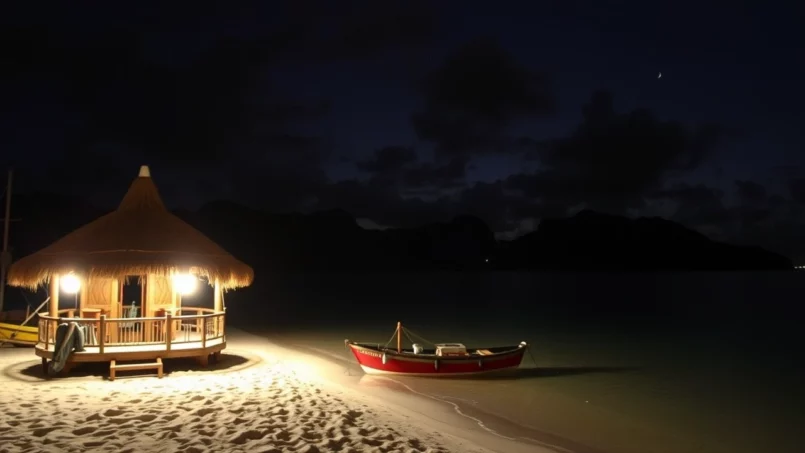
One of the great assets of Wallis and Futuna in the evening is nature itself. Once temperatures drop, beaches and viewpoints become perfect places to end the day.
Several sites are particularly recommended for watching the sunset:
| Recommended Place | Main Evening Characteristics |
|---|---|
| Chapel of Mt. Lulu | Small perched chapel, panorama of the island and lagoon, golden light |
| Vailala Beach (North) | Fine white sand, unobstructed view of the horizon |
| Lausikula Beach (South) | Peaceful beach, ideal atmosphere for a gentle end to the day |
Sitting facing the lagoon, feeling the trade winds, listening to the sound of waves or coconut leaves then becomes a “nighttime activity” in its own right. It’s often these simple moments that leave the strongest impression on travelers, more than any “organized” outing.
Late afternoon walks are recommended to enjoy milder temperatures, especially around the volcanic lake Lalolalo or on the heights of Mt. Lulu. However, actual hiking is preferably done during the day. After nightfall, getting around becomes tricky due to the lack of public lighting, variable road conditions, and the presence of free-roaming animals.
Cultural evenings and museums: when history and art join in
Even though the archipelago lacks a dedicated theater or performance hall, cultural venues contribute to evening life, especially when they organize occasional events.
The Uvea Museum Association in Mata-Utu offers a private museum dedicated to military history, notably WWII. Located in a shopping center, visits are usually by appointment, during the day until late afternoon, and can be followed by dinner in town.
More broadly, cultural events – art exhibitions, presentations of tapa, sculptures, or paintings – can punctuate the year and enrich some evenings, especially in the more active villages, around the cultural service located in Aka’aka, in the Hahake district of Wallis. Detailed information is rarely posted in a classic tourist office (there isn’t always one in the European sense) but rather through local networks, territorial radio and television, or community notice boards.
Evenings paced by events: how to get information and participate
As Wallis and Futuna is not a mass-market destination, event programming is not centralized in a single tourist calendar as found elsewhere. However, there are online resources that list ceremonies, markets, sporting events, religious holidays, and concerts, sometimes with the possibility to filter by island (Wallis or Futuna) and category (markets, sports, music, religious).
To make the most of evenings during a trip, it is advisable to adopt an effective strategy by cross-referencing several sources of information, such as local recommendations, specialized apps, and traveler forums.
| Source of Information | Usefulness for Nightlife |
|---|---|
| Hosts (pension, family, hotel) | Best source to find out what’s actually happening in the evening |
| Local Radio / TV (La Première) | Announcements of events, religious holidays, cultural competitions |
| Village Notice Boards | Information about masses, celebrations, ceremonies |
| Online Event Sites or Pages | List of holidays, markets, sporting competitions |
Again, the human connection is key. Chatting with your hosts, tactfully asking about opportunities to attend a celebration or dance, showing a willingness to participate rather than merely observe, opens many more doors than looking for a fixed “program.”
Atmosphere, safety, and etiquette: what to know for going out in the evening
Even though the islands are considered very safe, some common-sense principles apply after dark. Authorities recommend avoiding isolated places – particularly some beaches – late at night and not carrying large sums of money or flashy jewelry. Assaults are rare, but petty theft exists, as anywhere.
The road network is limited, with few paved roads, especially on Futuna. Driving at night is difficult due to a lack of signage, public lighting, and the presence of animals on the roadway. There is no public transport or taxis; travel is mainly by rental car or with locals, so late returns are not advised.
Regarding customs, society remains conservative:
– Attire covering shoulders and knees is appreciated, especially at religious or customary events.
– Public displays of affection are rare.
– Greeting with a “Hello” or a word in the local language, accompanied by a handshake, is common.
– Asking permission before photographing people or a ceremony is a golden rule.
For women traveling alone, usual caution applies: avoid walking alone at night, prefer outings in a group or with local hosts, especially when not yet familiar with the surroundings.
A different relationship with time: when the night becomes a moment of intimacy
Ultimately, what strikes most about evenings spent in Wallis and Futuna is the place taken by the intimate: family, village, parish, chiefly council. The evening is less a space for consuming entertainment than a crucible for exchange, prayer, rites, and preparation for major celebrations.
For the visitor, this reality invites a revision of expectations. Rather than trying to recreate an imported nightlife model, it’s better to go with the local rhythm:
Enjoying a simple dinner based on seafood, chatting with locals to learn a few words of Wallisian or Futunian, and admiring a sunset over the lagoon or the silhouette of a volcano. Accepting local invitations, like an evening mass, a village meal, or a dance rehearsal. Observing a kava ceremony if invited and tasting this drink in moderation, respecting its social importance.
Summary: where – and especially how – to go out in the evening in Wallis and Futuna?
Rather than listing places in the classic sense (bars, clubs, nightclubs), it’s more relevant to map out the types of nighttime experiences a traveler can expect.
| Type of Outing Sought | Reality on the Ground | How to Enjoy It |
|---|---|---|
| Bars / Nightclubs | Nonexistent | Accept that it’s not a “club” destination |
| Animated Restaurants | A few hotel restaurants, very quiet | Make a reservation, savor local cuisine, enjoy any live music |
| Concerts, Organized Shows | Very rare, often linked to festivals and dance competitions | Inquire locally, participate during important dates |
| Cultural Evenings (kava, dances, katoaga) | At the heart of social life, especially during religious and customary holidays | Make contacts, respect custom, come as a discreet observer |
| Nighttime Walks / Nature | Sunsets, viewpoints, peaceful beaches | Prioritize recommended sites, return before full dark if driving |
| Markets / Crafts | Activity mainly during the day, but possible purchases late afternoon | Take advantage of the last open stalls, chat with artisans |
Nightlife in Wallis and Futuna therefore has nothing “spectacular” in the marketing sense, but it holds a discreet richness: that of a society where each evening can be a moment of custom, prayer, song, or gathering around a cup of kava. Those who accept entering this slow tempo, trusting encounters more than programs, will discover another face of the night: less noisy, more profound, and often unforgettable.
Disclaimer: The information provided on this website is for informational purposes only and does not constitute financial, legal, or professional advice. We encourage you to consult qualified experts before making any investment, real estate, or expatriation decisions. Although we strive to maintain up-to-date and accurate information, we do not guarantee the completeness, accuracy, or timeliness of the proposed content. As investment and expatriation involve risks, we disclaim any liability for potential losses or damages arising from the use of this site. Your use of this site confirms your acceptance of these terms and your understanding of the associated risks.

Cyril Jarnias is an independent expert in international wealth management with over 20 years of experience. As an expatriate himself, he is dedicated to helping individuals and business leaders build, protect, and pass on their wealth with complete peace of mind.
On his website, cyriljarnias.com, he shares his expertise on international real estate, offshore company formation, and expatriation.
Thanks to his expertise, he offers sound advice to optimize his clients' wealth management. Cyril Jarnias is also recognized for his appearances in many prestigious media outlets such as BFM Business, les Français de l’étranger, Le Figaro, Les Echos, and Mieux vivre votre argent, where he shares his knowledge and know-how in wealth management.





