
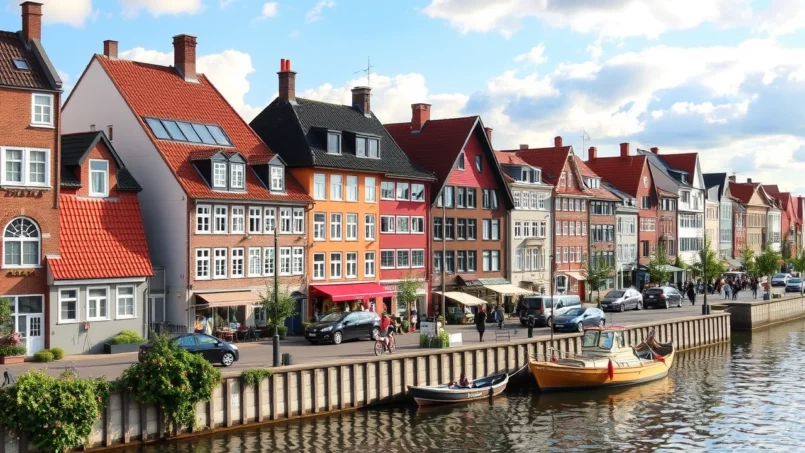
 Published on and written by Cyril Jarnias
Choosing where to settle in Denmark, and particularly in the Copenhagen region, is not just a logistical detail. For an expat, the neighborhood shapes daily life: commute time, access to international schools, housing budget, opportunities to make friends, sense of security, cultural or family life. In a compact capital where you can cross radically different worlds in a ten-minute bike ride, this choice weighs heavily on the expatriate experience.
Copenhagen is home to the majority of expats in Denmark. The city is renowned for its high quality of life, safety, ubiquitous cycling culture, and an atmosphere that is both relaxed and highly organized. However, the cost of living is high, with a very tight rental market, substantial security deposits, and fierce competition for the most attractive housing. In this context, certain neighborhoods stand out as the most sought-after by the foreign community.
This article provides an overview of the neighborhoods most popular with expats in Denmark, with a focus on Copenhagen and its immediate surroundings (Frederiksberg, Hellerup, Gentofte, etc.). The goal is not to create an “absolute” ranking, but to show how each area attracts a different expat profile: young professionals, families with children, executives on assignment, students, digital nomads, or those on a tight budget.
Understanding the Framework: A Compact, Expensive, and Well-Connected Capital
Copenhagen has just over 600,000 inhabitants in the central municipality, about 1.3 million in the urban area. The average age is around 36 and nearly 18% of residents were born abroad. In other words, the city is young, international, yet remains of a manageable size: a large part of commutes take less than 30–40 minutes, many by bike.
Copenhagen boasts over 400 kilometers of bike lanes, facilitating movement for expats.
But this comfort comes at a price. The city is one of the most expensive in Europe, and the rental market often surprises newcomers: security deposit equivalent to three months’ rent, sometimes three months’ rent prepaid on top of that, setup costs that can exceed 50,000 DKK before even unpacking a single box. Leases are mostly for 1 to 2 years, often for unfurnished housing, with additional charges (heating, electricity), typically between 800 and 1,500 DKK per month.
In this context, expats gravitate towards a few main types of neighborhoods:
– historic city center for very comfortable budgets and ultra-urban living;
– gentrified former working-class neighborhoods, appreciated by young professionals and creatives;
– green family districts favored by executives and diplomats;
– new eco-designed waterfronts (Nordhavn, Sydhavnen, Ørestad) where new housing and international schools are concentrated;
– residential suburbs like Hellerup or Gentofte, favorites of families seeking space.
To navigate this, it’s useful to compare the main neighborhoods targeted by expats.
Indre By: The Historic Heart, a Premium Showcase for High-Budget Expats
Indre By, sometimes referred to as Copenhagen K, is the historic core of the capital. This is where the city took shape over 900 years ago and where most iconic landmarks are still concentrated today: Tivoli Gardens, Nyhavn and its colorful facades, Rosenborg and Amalienborg castles, Christiansborg Palace, historic towers like the Rundetaarn, major churches, museums, and theaters.
For an expat, living in Indre By means choosing the nerve center: everything is within walking distance, metro stations (Kongens Nytorv, Nørreport, Marmorkirken, Gammel Strand) serve almost all lines, buses crisscross the streets, and the connection to the airport takes fifteen minutes on the M2 metro. The neighborhood gets a perfect walkability score and remains one of the best-connected in Europe.
Copenhagen’s hyper-center mainly attracts an affluent and mobile population: young professionals with very high incomes, consultants, senior executives of multinationals, diplomats, couples without children, and expats on short-term assignments. These residents prioritize centrality and prestige at the expense of living space. The area also experiences high tourist density, especially in summer, with vibrant nightlife centered on Nyhavn and pedestrian streets like Strøget. The dining scene is exceptional, including a unique concentration of Michelin-starred restaurants in the country.
Regarding housing, Indre By is one of the most expensive sectors in Denmark. Buildings are often old, sometimes magnificent, but not always modernized: many apartments without balconies, elevators, or parking, still-narrow bathrooms, imperfect sound insulation. Those tastefully renovated are obviously the most sought-after.
The average rental levels can be summarized as follows:
| Type of Housing | Average Monthly Rent in Indre By (DKK) |
|---|---|
| 1 bedroom | 12,000 – 16,000 |
| 2 bedrooms | 18,000 – 25,000 |
| 3 bedrooms | 25,000 – 30,000 |
The purchase price is around 55,000 DKK/m² on average, aligned with the city average, but the best-located or fully renovated properties often exceed this benchmark. The price per square meter for rent is around €22/month, placing Indre By in the high range for Europe.
The city center (Indre By) lacks large parks and international schools, making it less suitable for families. The main international schools are located in other neighborhoods (CIS in Nordhavn, Bjørn’s in Østerbro, European School in Carlsberg Byen). Residents of the center with children therefore rely on the highly efficient public transport to access them.
Indre By therefore remains a niche choice: ideal for those who want everything at their fingertips, accept high rents, a certain tourist bustle, and maximum urban density, in exchange for total immersion in the capital’s cultural and gastronomic life.
Vesterbro: From Former Red-Light District to Creative and Hip Neighborhood
Just west of the central station, Vesterbro embodies one of Copenhagen’s most spectacular image reversals. Long a working-class district marked by prostitution and shady bars, it has transformed into a trendy neighborhood, hailed as one of the world’s “coolest.” The transformation, which began 20–30 years ago, drastically reduced crime while retaining a certain edge.
Vesterbro is now a privileged playground for young professionals, creatives, tech workers, freelancers, and digital nomads. The atmosphere is urban, dense, lively, but more “settled” than Nørrebro, with a mix of discreet luxury and traces of a somewhat rough past. Istedgade, the iconic artery, lines up craft beer bars, restaurants of all levels, design boutiques, while still hosting a few sex shops and late-night kebab shops that recall the old red-light district.
The former Meatpacking District (Kødbyen) is now a maze of renovated warehouses, blending trendy restaurants, galleries, clubs, and event spaces. Having become an epicenter of Copenhagen’s nightlife, it is particularly popular with the expat community.
Yet Vesterbro remains surprisingly practical for urban families: large parks like Enghaveparken, Skydebanehaven or the green promenade of Sønder Boulevard redone in 2007, playgrounds for children, “kid-friendly” café-restaurants, well-regarded public schools, and to the west, the presence of the European School Copenhagen in the new Carlsberg Byen district. More and more young couples with children are staying here instead of fleeing directly to quiet suburbs.
In terms of rent, Vesterbro is slightly cheaper than the hyper-center, but still at the high end:
| Type of Housing | Average Monthly Rent in Vesterbro (DKK) |
|---|---|
| 1 bedroom | 10,000 – 15,000 (wide range 5,000–15,000) |
| 2 bedrooms | 10,000 – 16,000 |
| 3 bedrooms | 14,250 – 20,000 |
The price per square meter for rent is around €18–20/month, with a purchase price around 50,000–55,000 DKK/m² and a clear “gentrification premium”: property values have risen sharply in recent years.
This central Copenhagen neighborhood offers a convenient location a few minutes from the center on foot or by bike, with the central station and metro stations (Enghave Plads, København H) nearby. It features a high density of cafes, bars, and restaurants, a strong foreign presence (about a quarter of residents), and very dynamic artistic, musical, and expat social scenes. Drawbacks include evening noise, especially around Kødbyen, and intense competition for quality renovated housing.
Vesterbro is therefore aimed at those who want a very urban daily life, rich in culture and going out, without entirely abandoning the idea of living with children, but with a high tolerance for noise and prices.
Nørrebro: Multicultural Melting-Pot and Alternative Scene
Northwest of the city center, on the other side of the lakes, Nørrebro projects a totally different image of Copenhagen. This is where the city sheds some of its perfectly polished veneer to reveal a more raw, colorful, rebellious, and terrifically lively face. It’s no coincidence that international guides have elected it the “coolest neighborhood in the world”: it offers a unique blend of cultures, cuisine, street art, and community initiatives.
Historically working-class, Nørrebro is now the most densely populated and diverse neighborhood in Copenhagen, with over a quarter of its residents of foreign origin. Its liveliness is concentrated on streets like Nørrebrogade, Jægersborggade, Blågårdsgade, and Ravnsborggade, teeming with street food, neighborhood cafes, intimate bars, vintage shops, artist workshops, and independent boutiques.
For young expats, students, creatives, researchers, or startup workers, Nørrebro is a natural choice. Rents remain, on average, a bit more affordable than in Østerbro or Indre By, even though growing popularity and proximity to the center have driven prices up. Housing is mostly in old buildings, often without elevators or balconies. Renovated, bright apartments with open kitchens are obviously the ones snapped up and come at a premium.
Regarding budget: the total budget is 1 million euros, with an allocation of 500,000 euros for priority projects and 300,000 euros for recurring operations. The remaining 200,000 euros are reserved for contingencies.
| Type of Housing | Average Monthly Rent in Nørrebro (DKK) |
|---|---|
| 1 bedroom | 9,000 – 13,000 |
| 2 bedrooms | 13,000 – 17,000 |
| 3 bedrooms | 17,000 – 21,000 |
| 4 bedrooms | ≈ 19,500 (110 m²) |
The price per square meter rents for around €16–18/month, with a purchase price between 45,000 and 55,000 DKK/m², having appreciated rapidly in recent years.
The Nørrebro neighborhood in Copenhagen offers a distinctive atmosphere that goes beyond economic considerations. It is characterized by eclectic and vibrant public spaces: the stylized urban park of Superkilen, which displays objects from around the world to celebrate cultural diversity; the garden-cemetery of Assistens Kirkegård, where locals come to picnic, notably near the grave of writer Hans Christian Andersen; and the Dronning Louises Bro bridge, which becomes an animated social scene for cyclists when the weather permits.
Families also find their place here: public schools like Nørrebro Park Skole, numerous daycare centers, community atmosphere, neighborhood-level events. But weekend noise, the presence of a few more sensitive “hotspots” in the evening around Blågårds Plads, and a petty crime rate slightly higher than the Danish average require minimal vigilance.
For many expats, especially those from major cities, Nørrebro is still perceived as very safe, lively, and authentic. It’s the choice for those who want to feel they’re in a “real” neighborhood, live amidst diversity, eat for less, frequent alternative bars, basement concerts, and cafes where people speak as much English as Danish.
Østerbro: The Green, Bourgeois Refuge for Expat Families
East of the lakes and north of the center, Østerbro offers a marked contrast to Vesterbro and Nørrebro. Here, the atmosphere is calmer, the streets wider, the facades more bourgeois, the strollers more numerous. It is one of the most sought-after districts for Danish and international families seeking safety, comfort, and greenery without leaving the city.
Østerbro is considered the greenest neighborhood in Copenhagen. It is home to Fælledparken, the city’s largest park, offering sports fields, playgrounds, barbecue areas, and jogging paths. The neighborhood is also close to the waterfront with Svanemølle beach and its piers, as well as walks along the Sortedam lakes.
For expats, Østerbro cumulates several decisive assets: very safe environment, strong presence of embassies and international organizations, good school offerings (notably Bjørn’s International School in the heart of the neighborhood, and quick access to CIS in Nordhavn), long-established community spirit. Cafes and restaurants are plentiful, but the atmosphere is more subdued than in the center: people go out less late, focusing more on weekend brunches and family meet-ups at the park.
The rents reflect this high-end, family-oriented positioning:
| Type of Housing | Average Monthly Rent in Østerbro (DKK) |
|---|---|
| 1 bedroom | 10,000 – 13,000 |
| 2 bedrooms | 15,000 – 20,000 |
| 3 bedrooms | 20,000 – 25,000 |
The cost per m² for rent is close to Vesterbro (€18–20/month), but the presence of larger apartments and a few houses quickly drives up the overall budget. For purchase, prices are around 50,000–55,000 DKK/m², with steady price increases in recent years, partly due to the density of skilled jobs in the area (including the extension towards Nordhavn).
Østerbro offers a calm, family-friendly living environment with many parks, safe streets for children, and quality local shops. The neighborhood is well-served by bike lanes, the metro, and S-train, allowing quick access to the city center in 10 to 15 minutes. It also has sports facilities like Parken Stadium.
Those with a tighter budget, or who seek intense nightlife, will lean more towards Nørrebro or Amager. But for the international executive couple with two children, Østerbro is clearly at the top of the list.
Frederiksberg: The Chic, Green, Family-Friendly “City Within a City”
Frederiksberg is a special case: officially, it is not a neighborhood of Copenhagen but an independent municipality completely enclosed within the capital. In practice, the border is imperceptible to a stroller, but the atmosphere is distinctly different. It is often described as a “green village” or “chic neighborhood,” an enclave of tree-lined boulevards, upscale buildings, villas, and large parks.
This municipality offers immediate proximity to Copenhagen’s center (10-15 minutes by transport), a peaceful residential atmosphere with many green spaces, excellent schools, a strong university and cultural presence, and a very high sense of security. It particularly attracts foreign families, diplomats, and international executives for long-term settlement.
The Frederiksberg Have park, with its palace and lake, is one of the most beautiful in the metropolis. It adjoins the Copenhagen Zoo, another iconic site. Streets like Frederiksberg Allé or Gammel Kongevej line up charming cafes, independent boutiques, refined restaurants, and stylish buildings. Playgrounds and facilities for children are scattered throughout the municipality, which boasts one of the highest greenery rates in the region.
The purchase price per square meter can exceed 70,000 DKK in Frederiksberg, making it the most expensive real estate market in Denmark.
As a guide:
| Type of Housing | Average Monthly Rent in Frederiksberg (DKK) |
|---|---|
| 1 bedroom | 10,000 – 14,000 |
| 2 bedrooms | 15,000 – 20,000 |
| 3 bedrooms | 20,000 – 25,000 |
The town also attracts for its educational offerings: several reputable institutions, including the Lycée Français Prins Henrik, making it a strong hub for Francophone families, as well as many well-ranked public schools. The population is mostly composed of family households, with an average age a bit higher than in Nørrebro or Vesterbro.
For an expat, Frederiksberg is therefore the choice of stability: calm neighborhood, quality infrastructure, a well-established international community, but a very tight and costly market. People rarely come here for a short stay or temporary assignment; it’s a territory for long-term residence.
Nordhavn: Futuristic Showcase and Hub for International Families
North of Østerbro, on former redeveloped docks, Nordhavn embodies Copenhagen’s new urban showcase: a brand-new neighborhood, entirely designed around sustainability, contemporary architecture, and waterfront living. It is also one of the strongest magnets for expats, particularly families, thanks to the presence of the Copenhagen International School (CIS) and the UN City complex.
Nordhavn immediately stands out from the rest of the city by its urban planning: wide streets, recent buildings with balconies, elevators, and underground parking, promenades along canals, swimming basins in the harbor, carefully designed green spaces. The neighborhood is still under development, but the long-term vision plans to house and employ around 40,000 people.
Nordhavn offers an environment easy to navigate with modern housing featuring optimized layouts, perfect accessibility for strollers, new bike lanes, numerous playgrounds, and limited car traffic. This neighborhood is designed as a “5-minute city,” where all essential services are accessible on foot or by bike.
The logical trade-off is a very high price level. The neighborhood has one of the most expensive postal codes in the country, with an average purchase price of about 58,000 DKK/m², and rents that surpass even those in many central areas:
| Type of Housing | Average Monthly Rent in Nordhavn (DKK) |
|---|---|
| 1 bedroom | 11,000 – 15,000 |
| 2 bedrooms | 16,000 – 22,000 |
| 3 bedrooms | 22,000 – 28,000 |
The price per square meter for rent often exceeds €25/month, making it one of the most expensive sectors in the capital. But the recent real estate offerings appeal greatly to expats who don’t want to deal with the drawbacks of old buildings.
The neighborhood, still developing, sees its local life organizing with more and more cafes, waterfront restaurants, supermarkets, and shops. It is served by the M4 metro and harbor bus for waterfront connections. The bike is the most pleasant mode of transport to reach the city center in 15 to 20 minutes.
Nordhavn primarily attracts:
– families with children at CIS, who appreciate living within walking distance of the school;
– employees of international organizations (UN, multinational companies);
– professionals in tech and sustainability, drawn by the eco-friendly image of the district.
Those seeking a more “historic” life or a denser urban fabric will head more towards Østerbro or Frederiksberg. But for a family setup oriented towards modern comfort and proximity to international schools, Nordhavn ticks almost all the boxes.
Amager and Ørestad: The Great Urban Suburb, Between Beaches, Nature, and Contemporary Architecture
Amager is a large island southeast of Copenhagen, connected to the center by bridges and metro. This composite territory includes very different neighborhoods: older, more popular areas, university and creative fringes (Islands Brygge, Amagerbro), modern large-scale developments in Ørestad, and long sandy beaches at Amager Strandpark. For expats, it’s an increasingly attractive area due to its price-to-space ratio and direct access to nature.
This modern neighborhood is an architectural showcase with bold buildings and large open spaces. It benefits from proximity to the Amager Fælled nature reserve and has major facilities like the Fields shopping center (one of the largest in Northern Europe) and the Royal Arena (concert and sports venue). Many housing units here are managed by real estate companies, which can facilitate administrative procedures for foreign residents.
Families appreciate Amager for several reasons: abundance of modern playgrounds, environment considered very safe, proximity to the beach (Amager Strandpark is a gigantic seaside park), nature reserve ideal for jogging, walking with children or dogs, quick access to the airport via metro lines M1 and M2. The international community is notable in areas like Ørestad and Islands Brygge, with many employees of the airport, university, and large companies in the sector.
Rents remain, on average, a bit lower than in Østerbro or Frederiksberg, making it a frequent choice for expats on an intermediate budget, especially young families.
| Type of Housing | Average Monthly Rent in Amager (Øst/Vest/Ørestad) (DKK) |
|---|---|
| 1 bedroom | 9,000 – 12,000 |
| 2 bedrooms | 13,000 – 18,000 |
| 3 bedrooms | 18,000 – 22,000 |
The price per square meter for rent is around €16–18/month, and purchase is around 45,000–50,000 DKK/m². Commute time to the center varies between 10 and 20 minutes depending on the precise location, but the metro connection is very efficient, as are the bike lanes (about 10–15 minutes from Islands Brygge to the city center).
Amager primarily attracts: nature lovers and culture enthusiasts.
– young families seeking more space on a reasonable budget;
– expats working at the airport or for large companies in the south of the city;
– outdoor enthusiasts who want to combine urban life and a beach accessible by bike.
The most frequent criticism concerns the sometimes somewhat “sterile” character of some Ørestad areas, where street life takes time to develop. In return, other, older sectors of Amager have a very local feel, with neighborhood cafes, small shops, and a mixed Danish/foreign population.
Nordvest, Valby, and Sydhavnen: New Frontiers for Tight Budgets and Pioneers
As prices rise in the classic central neighborhoods, expats are turning to areas once less coveted but now in full transition. Three in particular attract attention: Nordvest, Valby (and Carlsberg Byen), and Sydhavnen.
Nordvest, northwest of Nørrebro, still bears traces of its industrial past, with warehouses, wastelands, and sometimes heterogeneous buildings. But the atmosphere is changing rapidly: artists’ workshops, community cafes, alternative cultural venues, urban renewal projects. The neighborhood hosts a very diverse population and rents even lower than in Nørrebro, making it a refuge for students, artists, and budget-conscious expats.
An overview of average rental prices for different types of housing, to help you estimate your budget.
Between €400 and €600 per month for a studio in the city center.
Between €600 and €850 per month for a two-room apartment on the outskirts.
Between €800 and €1200 per month for a three-room apartment in the city center.
Starting at €1000 per month for a house with a garden in the suburbs.
| Type of Housing | Average Monthly Rent in Nordvest (DKK) |
|---|---|
| 1 bedroom | 7,000 – 10,000 |
| 2 bedrooms | 11,000 – 15,000 |
| 3 bedrooms | 15,000 – 19,000 |
Valby, to the southwest, combines an old center with a village-like atmosphere, quiet residential areas, and the booming district of Carlsberg Byen, built on the former Carlsberg brewery site. The latter concentrates new housing, offices, shops, restaurants, and especially the European School Copenhagen, attracting a growing number of expat families. Rents there are still a bit lower than in the center, often for larger spaces.
A former industrial port in transformation, Sydhavnen offers a waterfront atmosphere similar to Nordhavn, with modern large-scale developments, canals, and green spaces, but at more accessible rents, comparable to those in Amager. This neighborhood mainly attracts young professionals and families looking for a modern, peaceful setting near the water.
These “secondary” neighborhoods share several attractive characteristics for expats:
– reasonable access to the center (15–25 minutes) via S-train, bus, or bike;
– significantly lower prices than Indre By, Østerbro, or Frederiksberg;
– strong potential for long-term appreciation, interesting for those considering buying;
– growing international communities, even if less structured than in the “classic” areas.
They require, however, a certain tolerance for urbanism in transition: construction sites, sometimes noisy environments, occasional lack of shops or social spots in areas just emerging from the ground.
Hellerup, Gentofte, Lyngby, and the Affluent Suburbs: The Chosen Exodus of Expat Families
Beyond Copenhagen’s administrative limits, several municipalities in the northern “green belt” have established themselves as bastions for international families. Hellerup, Gentofte, Lyngby, or parts of North Zealand offer a set of advantages hard to match: houses with gardens, very safe environment, renowned international schools, parks and forests, proximity to the sea, all while remaining within 30–40 minutes of the center.
Hellerup, in particular, is a name that constantly comes up in discussions among expat parents. This elegant suburb brings together many upscale villas, a pleasant waterfront, and above all, several major international schools: Rygaards International School, International School of Hellerup, not to mention proximity to CIS in Nordhavn. It attracts an affluent audience, often composed of senior executives, pharma/biotech executives (these industries are very present in Denmark), or NGO leaders.
Gentofte and Lyngby offer similar profiles: a mix of history and modernity, large parks (Charlottenlund, Deer Park…), lakes, quiet residential areas, reputable public schools, and institutions like the DTU technical university in Lyngby, which brings with it a strong international population.
Rents in these peripheral areas are generally comparable to, or even higher than, those in Østerbro and Frederiksberg neighborhoods, particularly for houses. However, the advantage lies in gaining space and improving quality of life, which often compensates for many families. This advantage is even more pronounced when one parent works in corporate or university campuses located in these sectors.
For an expat considering a long-term setup, with children enrolled in international school and a need for outdoor space, these northern suburbs remain one of the most attractive options in Denmark. The flip side is slower integration into Copenhagen’s urban life, and often a very substantial housing budget.
How to Choose Your Neighborhood When Moving to Denmark?
Faced with this mosaic of neighborhoods, each with its identity, sociology, and price level, the question for an expat is not so much “what is the best neighborhood?” but “which neighborhood matches my situation and my priorities?”
A few key lines of thought emerge in light of the available data.
Lifestyle and Job Profile
Young singles or couples without children prioritizing outings, nightlife, culture, and a strong urban anchor massively gravitate towards Vesterbro, Nørrebro, Indre By and parts of Amager (Islands Brygge, Amagerbro). They accept often smaller apartments, a noisier environment, the absence of balconies or elevators, in exchange for total immersion in urban life.
Families, especially expatriates, favor the neighborhoods of Østerbro, Frederiksberg, Nordhavn, Hellerup, Gentofte, and Lyngby, as well as Amager and Valby. Their main criteria are the presence of international or high-level public schools (like CIS, European School, Lycée Français, Rygaards), access to parks, safety, proximity to schools, and the presence of a community of other expat families.
Expats on a tighter budget, whether young graduates, artists, or freelancers, can still find affordable opportunities in Nordvest, parts of Valby, Sydhavnen, or more distant suburbs like Brønshøj or Husum, at the cost of a longer commute and a less “postcard-perfect” ambiance.
Overall Budget, Not Just Rent
Rental tables give a first idea, but other costs must be included: security deposit, prepayment of several months’ rent, agency fees, utilities (1,000–1,500 DKK per month for a medium-sized apartment), transport subscriptions if living far from work. The overall cost of living gap between a hyper-central neighborhood and a more outlying district can exceed 5,000 DKK per month for a single person, and more for a family.
An expat willing to settle in neighborhoods a bit further from the center (like Amager, Valby, Nordvest) or in well-served suburbs can reduce their housing costs. This saving allows for budget to be allocated to other priorities, such as travel, outings, or international schooling.
Access to Quality International and Public Schools
The mapping of international schools strongly illuminates the residential geography of expats. Nordhavn (CIS), Frederiksberg (Lycée Français), Hellerup (Rygaards, ISH), Østerbro (Bjørn’s International), Carlsberg Byen/Valby (European School) become attraction poles where international families concentrate.
Moreover, some municipalities (Frederiksberg, Østerbro/Gentofte) are known for the quality of their public schools, motivating long-term expats to invest there, even accepting a higher price per m², to benefit from the Danish school system without private school fees.
Mobility and Commute Time
In a city as compact and well-equipped as Copenhagen, distance is not measured in kilometers but in door-to-door minutes. An expat working in Indre By can easily live in Østerbro, Amager, or Valby and keep a commute of 15–25 minutes by metro or bike. An airport employee will logically prioritize Amager, Ørestad, or Dragør. A UN or CIS employee will primarily look at Nordhavn, Østerbro, Hellerup.
Before committing to a lease, it’s crucial to test your future daily commutes with a planner like Rejseplanen. You should also account for real weather conditions (rain, wind, winter darkness) which can affect the motivation to bike every day.
Safety and Atmosphere
Denmark ranks among the safest countries in the world, and Copenhagen among the most tranquil capitals in Europe. Nevertheless, perceptions vary by neighborhood. Frederiksberg, Østerbro, Nordhavn, certain parts of Amager and Valby are regularly cited as the most secure and calm areas. Nørrebro and Nordvest, while still largely safe by international standards, require minimal attention in a few particular spots, especially late at night.
For an expat who grew up in a major metropolis, this risk level remains very moderate. But for families less accustomed to urban life, the subjective feeling of safety can strongly steer the choice towards neighborhoods like Østerbro, Frederiksberg, or the northern suburbs.
Conclusion: A Neighborhood Choice at the Heart of the Expatriation Project
The neighborhoods most popular with expats in Denmark cannot be reduced to a handful of trendy names. They reflect the diversity of profiles who choose the country: students, researchers, diplomat families, pharma employees, tech freelancers, artists, wind or logistics engineers.
Indre By, Vesterbro, Nørrebro, Østerbro, Frederiksberg, Nordhavn, Amager and its satellites, Nordvest, Valby, Sydhavnen, but also Hellerup, Gentofte, or Lyngby compose an urban chessboard where each square offers a different compromise between price, space, greenery, services, atmosphere, and access to the international community.
To succeed in your relocation, it’s crucial to define your personal criteria rather than relying solely on a neighborhood’s reputation. Priorities to consider include: proximity to work, desired type of schooling, available budget, tolerance for noise, preferences for heritage or modern architecture, and the desire to integrate into a very Danish environment or to prioritize an international community.
The data shows that, despite a high cost of living, the Danish metropolis offers an astonishingly rich palette of possible living environments. Between the tranquil canals of Sydhavnen, the creative tumult of Nørrebro, the bourgeois gentleness of Frederiksberg, the parks of Østerbro, the futuristic docks of Nordhavn, and the beaches of Amager, every expat can find a neighborhood where the Danish promise – safety, quality of life, work-life balance – takes concrete form, day by day.
Disclaimer: The information provided on this website is for informational purposes only and does not constitute financial, legal, or professional advice. We encourage you to consult qualified experts before making any investment, real estate, or expatriation decisions. Although we strive to maintain up-to-date and accurate information, we do not guarantee the completeness, accuracy, or timeliness of the proposed content. As investment and expatriation involve risks, we disclaim any liability for potential losses or damages arising from the use of this site. Your use of this site confirms your acceptance of these terms and your understanding of the associated risks.

Cyril Jarnias is an independent expert in international wealth management with over 20 years of experience. As an expatriate himself, he is dedicated to helping individuals and business leaders build, protect, and pass on their wealth with complete peace of mind.
On his website, cyriljarnias.com, he shares his expertise on international real estate, offshore company formation, and expatriation.
Thanks to his expertise, he offers sound advice to optimize his clients' wealth management. Cyril Jarnias is also recognized for his appearances in many prestigious media outlets such as BFM Business, les Français de l’étranger, Le Figaro, Les Echos, and Mieux vivre votre argent, where he shares his knowledge and know-how in wealth management.





