
 Published on and written by Cyril Jarnias
Settling in Belarus means entering a country where religion remains discreet in daily life but is deeply rooted in history, architecture, and local identities. For an expatriate, understanding this often subtle religious landscape—marked by Orthodoxy, Catholicism, active small minorities, and a highly present state—helps to avoid missteps, better interpret public life, and, if desired, find one’s place within a community of believers.
This guide provides a concrete overview of the main denominations, religious practices, and legal framework in Belarus. It aims to offer practical keys for living and working in the country while respecting local religious sensitivities.
A majority Orthodox but non-practicing religious landscape
Belarus is officially a multi-confessional country, but the religious structure remains dominated by Christianity, particularly Orthodoxy. In surveys, a very large majority of the population identifies as Christian, even though regular practice is a minority.
Figures vary by source and year, but the major trends are clear: Orthodoxy dominates, Catholicism remains an influential minority, Protestants are very active despite their small numbers, and other religions represent a modest fraction of the population.
Number of major religions studied in public data on religious composition.
| Source / year | Orthodox (in %) | Catholic (in %) | No religion (in %) | Other religions (in %) |
|---|---|---|---|---|
| Ministry of the Interior 2011 | 73.3 | 9.7 | 14.8 | 2.2 |
| Pew Research 2015 | 73 (out of 94% Christians) | 12 | 3 (non-religious) | 3 |
| Survey 2017 (estimate) | 83.3 | 6.7 | 7.8 | ~2.2 (incl. Muslims, Jews, others) |
| Data 2020 (synthesis) | 60 | 10 | 22 (non-religious) | ~8 (other Christians, other religions) |
For an expatriate, two elements really matter: the majority identifies as Orthodox, but that doesn’t mean everyone attends church every week; many Belarusians describe themselves as believers “in their own way”, with occasional practice, marked mainly by major holidays and family rites.
Orthodox, Catholic, Protestant: different practice rhythms
Surveys show a clear contrast between denominations regarding the frequency of weekly practice:
| Denomination | Share of followers attending church weekly (approx.) |
|---|---|
| Orthodox | 8 to 12% |
| Catholic | 25 to 35% |
| Protestant | over 60% in some surveys |
In everyday life, this translates into Orthodox churches often very full on major holidays (Easter, Christmas, etc.), but sometimes sparsely attended the rest of the year, while Protestant parishes, though small, often gather a very committed core. Catholic churches, especially in the west of the country, show an average practice higher than that of Orthodox churches.
For an expatriate, it is more common to encounter “traditional Orthodox” individuals, attached to rites like child baptism, the blessing of Easter baskets, or religious funerals, than regular practitioners. For the majority, religion thus plays more of an identity and cultural role than that of a daily discipline.
Main denominations and where to find them
The country officially recognizes 25 registered denominations or religious movements, comprising more than 3,400 communities. This plurality, however, remains structured around a few major poles.
The Belarusian Orthodox Church: dominant institution and state partner
The Belarusian Orthodox Church (BOC) is the local branch of the Moscow Patriarchate. Legally, it is an exarchate, thus a structure dependent on the Russian Orthodox Church, with limited autonomy. It concentrates the majority of the country’s religious communities.
Recent structural data:
| Indicator (BOC) | Approximate value |
|---|---|
| Communities (parishes) | 1,726 – 1,737 |
| Eparchies (dioceses) | 15 |
| Orthodox churches in service | ~1,878 |
| Monasteries (men and women) | 36 |
| Brotherhoods and sisterhoods | 24 (15 + 9) |
| Theological institutions | 6 |
| Bishops | 17 (including 2 vicars) |
This Church enjoys a privileged status, recognized by law as having a “determining role” in the history and traditions of the state. A framework agreement signed in 2003 with the authorities organizes close cooperation, particularly with the Ministries of Education, Defense, and Health. The BOC has, for example, a specific agreement with the Ministry of Education to intervene in the “moral and spiritual formation” of students according to its traditions.
The status of the Orthodox Church is manifested by the presence of its priests at official events, the blessing of public buildings, support for the restoration of historical monasteries, and the display of its symbols in public spaces. For an expatriate, this indicates that the implicit religious reference in official discourse remains Orthodoxy.
Catholicism: an active minority, especially in the west
Catholicism represents a significant minority, structured around a Latin Church (Roman rite) and a small Greek Catholic Church of the Byzantine rite united with Rome.
Organization of the Latin Catholic Church:
| Element | Main data |
|---|---|
| Metropolitan Archdiocese | Minsk-Mohilev |
| Suffragan dioceses | Grodno, Pinsk, Vitebsk |
| Communities (parishes) | ~500 |
| Monasteries / convents | 9 |
| Missions | 11 |
| Educational institutions | 6 |
Catholics are concentrated mainly in the western regions, particularly the Grodno region, where they can approach a third of the population. A significant part of this community is linked to the Polish and Lithuanian minorities, but it also includes many ethnic Belarusians.
Practice there is generally more regular than in Orthodoxy, and parishes often play a structuring role in local life: charitable activities (via Caritas Belarus), youth movements, pilgrimages, etc. The Church is perceived as rather conservative on liturgical matters: communion in the hand and distribution by laypeople are prohibited, altar servers are traditionally male, and the faithful remain attached to popular prayers like the Rosary or the Novena to the Divine Mercy.
For the Catholic expatriate, it is therefore generally possible to find a Sunday Mass, especially in Minsk and the west, with liturgies in Belarusian, Polish, or Russian depending on the parish.
Greek Catholics (Uniates): a small Church with a symbolic role
The Belarusian Greek Catholic Church, heir to the Union of Brest in 1596, has had a tumultuous history: majority at the end of the 18th century, it was dissolved by the Russian Empire in 1839, its parishes absorbed by Orthodoxy. Restored at the end of the USSR, it remains a small structure today, but its symbolic weight exceeds its numerical importance.
Here are some essential points to know for better orientation and understanding of the contexts covered in the rest of the content.
| Indicator (Greek Catholic Church) | Value (around 2015) |
|---|---|
| Estimated followers | 3,000 to 10,000 |
| Parishes | 20 |
| Priests | 16 |
| Seminarians | 9 |
Parishes are located in Minsk, Polatsk, Vitebsk, Brest, Hrodna, Mahiliou, Maladziechna, Lida. The liturgy, of Byzantine rite, is celebrated in Belarusian and Church Slavonic. The Church is legally attached to Rome but remains without its own bishop; an archimandrite, Jan Sergiusz Gajek, acts as Apostolic Administrator.
For an expatriate, this Church is mainly interesting if one wants to discover an Eastern Christianity that is fully Catholic, with a sung liturgy close to Orthodoxy but in the Belarusian language. Its very minority character, and sometimes perceived with suspicion by part of the Orthodox milieu, also makes it a place of engagement for certain Belarusian intellectual and nationalist circles.
Protestants, Muslims, Jews and other minorities
Beyond these two major Christian poles, Belarus is home to a series of legally registered religious minorities, sometimes very dynamic despite their small numbers.
On the institutional level:
| Denomination / group | Communities / main structures |
|---|---|
| Protestant organizations (13 denominations) | ~1,040 communities, 21 associations, 21 missions, 5 schools |
| Jews (3 unions) | 51 communities, 10 places of worship, 1 educational institution |
| Muslims | 24 communities, 6 to 7 mosques, 2 other places of worship |
| Old Believers | 34 communities |
| Buddhists (Bön tradition) | 1 “Shen Chen Ling” community (since 2015) |
Protestants – Evangelicals, Baptists, Pentecostals, Adventists – represent a few percent of the population. Their practice is very active: weekly services, home groups, strong charitable involvement. But they operate within a demanding legal framework, with constraints on places of worship and missionary activities.
This is the estimated share of the Muslim population in Belarus, a historically established community and primarily Sunni of the Hanafi rite.
Judaism, once very present (Jews made up more than half of Minsk’s population in 1897), was decimated by the Holocaust and waves of emigration. Today, Jewish communities in Minsk and other cities work to preserve memory (notably of the Minsk Ghetto) and develop regular religious life, with the help of NGOs and international partners.
For an expatriate, these minorities can offer anchor points if one is looking for a specific community (mosque, synagogue, evangelical assembly), especially in Minsk, where the concentration of international groups is the greatest.
A very restrictive legal framework for religious communities
The Belarusian Constitution guarantees freedom of conscience and religion, but this freedom is exercised within one of the most restrictive legal frameworks in Europe. Any expatriate involved in a religious organization—or simply wanting to understand why certain initiatives are impossible—must keep in mind several key principles.
The registration requirement and the hierarchy of statuses
Any organized religious activity must go through a registered structure. The Law on Freedom of Conscience and Religious Organizations defines three levels:
| Structure level | Main requirements |
|---|---|
| Religious community | At least 20 adults (Belarusian citizens) living in one (or several) neighboring localities |
| Religious association | At least 10 communities of the same faith, one of which has existed for 20 years |
| National religious association | Presence of active communities in at least 4 of the 6 regions of the country |
Without registration, any common religious activity (celebrations, regular meetings, proselytism) is illegal. The law now provides for penalties of up to two years in prison for participation in an unregistered religious organization. For an expatriate, this means one should not start an autonomous “prayer group” in an apartment or office without a formal link to a recognized structure.
Groups carrying “new” religions or those considered unknown in Belarus must also submit a detailed doctrinal file. An expert commission has up to six months to give an opinion, and registration refusal can occur without real recourse.
Control of activities, locations, and religious personnel
The state, via the Office of the Plenipotentiary for Religious and Ethnic Affairs (OPRRNA), closely regulates activities:
Any religious meeting outside of a registered place of worship is considered a mass event and requires authorization requested at least 15 days in advance. Services in private apartments require the agreement of local authorities and compliance with strict safety standards. The import and distribution of religious literature are subject to prior examination by state experts. Only established religious associations can invite foreign clergy, usually for one year, with no possibility of appeal in case of refusal.
For a believing expatriate, this reality has two practical consequences: first, it is rare to see a foreign missionary or pastor from abroad preaching freely outside of recognized structures; second, some foreign priests or pastors (notably Polish Catholics) have had to leave the country due to unrenewed visas, which can destabilize a community.
A reform adopted at the end of 2023 imposes the re-registration of all religious organizations by mid‑2025 and requires that their leaders be exclusively Belarusian citizens residing permanently, thereby reducing the role of foreigners at the head of these communities.
Religious freedom vs. political control
In official discourse, the state emphasizes its desire to preserve interfaith peace and to fight against “destructive organizations”. Interfaith dialogue bodies exist, such as the Interfaith Advisory Council created in 2008, and the main “traditional” denominations—Orthodoxy, Catholicism, Judaism, Islam, Lutheranism—are recognized as having special historical importance.
But, since the major protests of 2020 and the war in Ukraine, political control has tightened. Priests, pastors, and engaged laypeople who criticized state violence or expressed pacifist positions on the war have been arrested, fined, or pushed into exile. Independent Protestant communities, like the “New Life” Church in Minsk, have been evicted from their buildings and then dissolved by the courts.
For the expatriate, the rule of caution is simple: if one participates in a religious community, it is better to avoid turning services or meetings into political platforms, especially in public spaces or online. The boundaries between religious activity and political expression are interpreted very narrowly by the authorities.
Liturgical languages, identities, and sensitivities
Belarus is a de facto bilingual country (Russian and Belarusian), but the linguistic distribution in churches does not necessarily reflect the street situation. For an expatriate, the language of services is both a practical matter and an identity marker.
Orthodoxy predominantly Russian-speaking
In the Belarusian Orthodox Church, the liturgy follows the Byzantine rite in Church Slavonic, but sermons, announcements, and non-liturgical prayers are most often in Russian. Hierarchs have already indicated they would use Belarusian more if the demand from the faithful was strong, but they estimate—to date—that it remains limited.
For French- or English-speaking expatriates, attending a Russian Orthodox service can be difficult to follow without mastering the language, as sermons are in Russian. However, the immutable liturgical structure and choral singing help with orientation during the celebration.
Catholicism between Belarusian, Polish, and Russian
In the Latin Catholic Church, the situation is more nuanced. Historically, Polish was the dominant language in parishes in the west, where the Polish minority lives. The last decades have seen real efforts to introduce Belarusian: bilingual Masses, readings in both languages, translated hymns.
Concretely, in Minsk and major cities, one often finds:
– Masses in Belarusian;
– Masses in Polish (especially in neighborhoods marked by the Polish minority);
– and, sometimes, elements in Russian.
Some traditionalist communities (like the Society of Saint Pius X present in Minsk) offer the Tridentine Mass in Latin, for example in Vitebsk.
For a Catholic expatriate, the best method to find a service in an understandable language is to ask the parish directly or consult posted schedules. In major cities especially, it is common for the priest or some parishioners to speak English or German.
Greek Catholics and the choice of Belarusian
The Greek Catholic Church is distinguished by the systematic use of Belarusian and Church Slavonic, which has nurtured its reputation as the “national Church.” Historically, it contributed to preserving Belarusian language and culture amidst Polonization and Russification, which still attracts certain circles interested in national identity.
For the expatriate, the main interest is often cultural: to discover a Byzantine liturgy, largely sung in Belarusian, within small-scale communities where welcome is generally very personalized.
Practices and rites: how to behave concretely in a place of worship
Even if codes differ from one denomination to another, entering a Belarusian place of worship follows implicit rules similar to those in the rest of Eastern Europe. A few general principles help one feel at ease, especially in Orthodox churches, where etiquette is particularly codified.
Dress code and general attitude
In Orthodox churches as in more traditional Catholic churches, modest dress is often taken for granted. Without falling into rigorism:
– Avoid bare shoulders, miniskirts, shorts, and sport t-shirts.
– For men, long pants and a clean shirt are appropriate.
– For women, a skirt or dress above the knee may be poorly perceived in some very conservative circles.
– Sports shoes are not prohibited, but closed and clean shoes are preferred.
In Orthodox churches, it is traditional for women to wear a headscarf, a sign of modesty and respect. While this is not a legal obligation and a foreign female visitor without one is generally not turned away, she may feel isolated in a very conservative community. Conversely, men must uncover their heads inside the church.
The use of cell phones, loud conversations, or laughter is perceived as very inappropriate during a service. In practice, most worshippers turn off their devices or keep them on silent mode.
Finding your way in an Orthodox liturgy
For many expatriates, the first visit to a Belarusian Orthodox church is primarily an aesthetic experience: icons, incense, polyphonic singing, absence of pews in the nave… Participation follows a few simple markers:
Upon entry, Christians cross themselves and may light a candle before an icon, leaving a small offering. During the service, it is customary to stand, except due to fatigue or health reasons. One should avoid moving around during the reading of the Gospel, the Eucharistic prayer, or the sermon. The traditional separation of men and women in the nave, by sides, is still practiced but tends to relax, especially in urban settings.
If one is not Orthodox, one should not come forward for communion, as it is reserved for followers baptized and chrismated in the Orthodox Church, usually after confession and fasting. However, it is sometimes possible to receive the blessed bread distributed at the end of the liturgy (antidoron); if in doubt, ask a parishioner discreetly.
Welcome for foreigners and the language barrier
In most churches, the welcome for foreigners remains courteous but reserved. Outside of a few more internationalized Catholic parishes in Minsk, it is rare to find announcements in English or French. On the other hand, a simple “Zdravstvuyte” (hello) or “Dobry dzen'” (hello in Belarusian) is often enough to trigger a smile and minimal help.
Protestant communities are often quicker to offer improvised translation or a summary of the sermon in English, especially when they are accustomed to receiving visitors or foreign NGOs.
Spaces, monuments, and pilgrimages: religion in the landscape
Even if religious practice is limited, the country is full of churches, monasteries, and sanctuaries that structure urban and rural space. For an expatriate, these places are as many keys to reading local history.
In Minsk: between cathedrals, the “Red Church,” and mosque
The capital concentrates some of the most emblematic churches in the country, both Orthodox and Catholic:
Minsk presents rich Orthodox and Catholic religious architecture, but the closure of the Red Church following a fire and a conflict with authorities illustrates possible tensions between the state and some religious communities.
The Minsk Mosque, rebuilt on the site of an old building destroyed in the Soviet era, is a symbol of the revival of Tatar Islam and the official recognition of this minority.
Major pilgrimage destinations
In the west, Catholic sanctuaries attract considerable crowds each year, particularly:
– the Marian sanctuary of Budslav, where a icon of the Mother of God venerated nationwide is kept. Each summer, pilgrims arrive on foot from all over the country;
– the Corpus Christi Church in Niasviž (Nesvizh), former necropolis of the aristocratic Radziwiłł family, a restored Baroque masterpiece.
On the Orthodox side, monasteries like Jirovitchi or Polotsk (St. Euphrosyne Monastery) play a similar role, combining veneration of relics, reputedly miraculous springs, and well-attended patronal feasts.
Religious architecture, whether Gothic, Renaissance, Baroque, or Neo-Gothic, also tells of historical stratifications: union with Poland, Russian domination, the Soviet period, post‑1991 revival. For an expatriate, accompanying Belarusian colleagues or friends to these pilgrimage sites is often an opportunity for frank discussions about faith, history, and politics—themes rarely addressed directly in the office.
Religion, national identity, and geopolitics
One cannot understand religious practices in Belarus without placing them in a three-dimensional interplay: the Orthodox tradition linked to Russia, the Catholic heritage associated with Poland and the West, and the search—sometimes hesitant—for a properly Belarusian identity.
Orthodoxy, Russification, and architecture
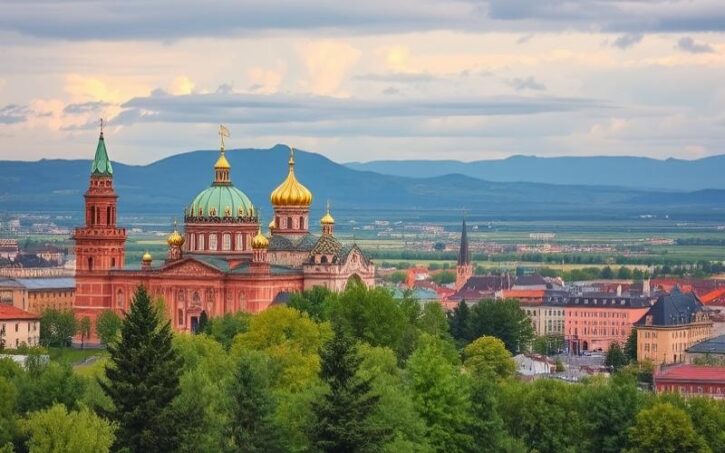
Since the 19th century, religious architecture has often served as a vector for “Russification”. This is seen notably in the construction of churches in Russian-Byzantine style, topped with golden domes, even in towns where ancient architecture was more Gothic or Baroque. This phenomenon continued after 1991: many new Orthodox buildings follow models from Russia (Pskov, Vladimir, etc.) more than historical Belarusian forms.
Belarusian architects are trying to reconnect with local styles, but Russian influence remains strong, reflecting both the canonical dependence of the Orthodox Church on Moscow and the preferences of a large part of the faithful.
Belarusian architects
Catholicism, Polishness, and Belarusianness
Catholicism has long been associated with the Polish nobility and the Polish language. A large part of Belarusian Catholics remain of Polish origin, and ties with the Church in Poland are strong. This also explains regular tensions around Polish priests in Belarus: for several years, authorities have been more reluctant to renew their visas, gradually reducing their numbers.
Simultaneously, a fraction of the Catholic community has engaged in the Belarusian national movement, betting on Belarusian as a liturgical and cultural language. This dimension appears in homilies, hymns, religious publications, and the way some clergy speak out on societal issues.
A delicate political role for the Churches
The events of 2020—disputed presidential election, mass protests, repression—brought back to the forefront the question of the political positioning of the Churches. Some Orthodox and Catholic priests denounced police violence, some took part in peaceful marches or prayed publicly for peace. Others, however, aligned with state rhetoric.
For Catholics, the most emblematic case was the temporary ban on Archbishop Tadeusz Kondrusiewicz’s return to the country after his critical statements. On the Orthodox side, the appointment in 2020 of a new head of the Belarusian Church, Metropolitan Veniamin—the first exarch of Belarusian nationality—was seen as an attempt at appeasement after the missteps of his predecessor.
For the expatriate, these dynamics remain in the background, but they explain why many clergy are very cautious in their public statements. Religious expression is tolerated as long as it does not challenge the legitimacy of power or the official line on Russia and Ukraine.
Practical advice for believing or simply curious expatriates
Beyond the institutional panorama, the central question for an expatriate is often: how to concretely live one’s faith—or simply one’s curiosity—in Belarus without offending sensitivities or breaking the law?
Finding a suitable community
In Minsk, options are more numerous than elsewhere. One finds:
– classical-style Orthodox parishes, sometimes very crowded;
– Latin Catholic parishes and a modest but real presence of Greek Catholics;
– various Protestant assemblies (Evangelical, Baptist, Pentecostal, Adventist);
– the central mosque and reconstituted Jewish places of worship;
– a few small Buddhist communities or other movements that appeared after 1991.
Networks like InterNations or expatriate organizations sometimes mention religious groups in their events, but it is rarely possible to create an autonomous international religious community outside the legal framework.
In the provinces, the offer is more limited: one will almost always find an Orthodox church, often a Catholic church in the west, and sometimes an Evangelical assembly. Non-Christian religious minorities are rarer there.
Respecting the rules without self-censorship
Authorities monitor religious activities, but expatriates who attend a registered church or mosque run no particular risk, as long as they stay within a normal worship framework. A few points of vigilance suffice:
To avoid complications with authorities, it is advisable not to organize regular prayer or Bible study meetings at home without a link to a registered community. Also avoid mass distribution of religious tracts in public spaces (streets, transport, mailboxes), as this can be considered unauthorized proselytism. On social media, if you are identified as responsible for a group of believers, refrain from directly mixing frontal criticism of the government with your religious discourse.
On the other hand, participating in a parish festival, a local pilgrimage, or a charitable action led by a religious community is generally well-regarded and constitutes a good means of integration.
Understanding the calendar of holidays and religious feasts
Belarus has the particularity of recognizing as official days off both Orthodox Christmas (Julian calendar) and Catholic Christmas, but not Easter, which nonetheless remains the country’s greatest religious holiday. However, the day after Orthodox Easter, Radonitsa, dedicated to commemorating the deceased at the cemetery, is a day off.
In practice, this means: the concrete implementation of ideas or theories in real situations.
It is important to note that during certain religious holidays, many colleagues may be absent for practices like blessing baskets, visiting graves, or participating in pilgrimages. Furthermore, some administrations may operate at a slower pace, even if only a portion of these holidays are officially non-working days.
For the expatriate, integrating the local liturgical calendar—whether one is a believer or not—allows one to anticipate absences, occasional closures, and sensitivities (for example, avoid scheduling an important professional meeting on the morning of Radonitsa if one knows the team is accustomed to going to the cemetery).
Religion and professional life
Foreign companies established in Belarus often adopt their own practices (prayer rooms, religious holidays for their Muslim or Jewish employees, etc.). But, outside these islands, society operates on a largely secular model: religion remains a private matter.
It remains rare for a Belarusian employer to officially offer accommodations for minority religious holidays, but superiors can be flexible on a case-by-case basis, especially if the request is anticipated and justified.
In daily relations with colleagues, it is prudent not to engage directly in religious or political debates, unless the interlocutor clearly shows a desire to do so. Many Belarusians see religion as an intimate subject not meant to be discussed in detail with strangers or professional contacts.
As a point of reference: what an attentive expatriate sees
After a few months in Belarus, an attentive expatriate generally distinguishes several layers in the country’s religious experience:
– a visible layer, made of golden domes, Easter processions, Marian pilgrimages, and crosses by the roadside;
– an institutional layer, where the Orthodox Church appears as a privileged partner of the state, even if trust in the institution tends to decline in polls;
– an intimate layer, where many Belarusians—even non-practicing—continue to marry, baptize their children, or bury their loved ones in church, in a mix of tradition, diffuse faith, and respect for ancestors.
Understanding these different layers is not adopting a romantic vision of a “deeply pious people,” nor a cynical reading of a purely decorative religiosity. It is accepting that, in this borderland country between Russian and Polish worlds, between Soviet atheism and post-communist revival, religion plays a flexible and often ambiguous, but very real, role in how inhabitants think of themselves and project into the future.
For an expatriate, this understanding allows one to approach places of worship, holidays, and rites with respect, curiosity, and modesty—three qualities that, in Belarus as elsewhere, almost always open the doors of local communities, whether Orthodox, Catholic, Protestant, Muslim, or Jewish.
Disclaimer: The information provided on this website is for informational purposes only and does not constitute financial, legal, or professional advice. We encourage you to consult qualified experts before making any investment, real estate, or expatriation decisions. Although we strive to maintain up-to-date and accurate information, we do not guarantee the completeness, accuracy, or timeliness of the proposed content. As investment and expatriation involve risks, we disclaim any liability for potential losses or damages arising from the use of this site. Your use of this site confirms your acceptance of these terms and your understanding of the associated risks.

Cyril Jarnias is an independent expert in international wealth management with over 20 years of experience. As an expatriate himself, he is dedicated to helping individuals and business leaders build, protect, and pass on their wealth with complete peace of mind.
On his website, cyriljarnias.com, he shares his expertise on international real estate, offshore company formation, and expatriation.
Thanks to his expertise, he offers sound advice to optimize his clients' wealth management. Cyril Jarnias is also recognized for his appearances in many prestigious media outlets such as BFM Business, les Français de l’étranger, Le Figaro, Les Echos, and Mieux vivre votre argent, where he shares his knowledge and know-how in wealth management.





