
 Published on and written by Cyril Jarnias
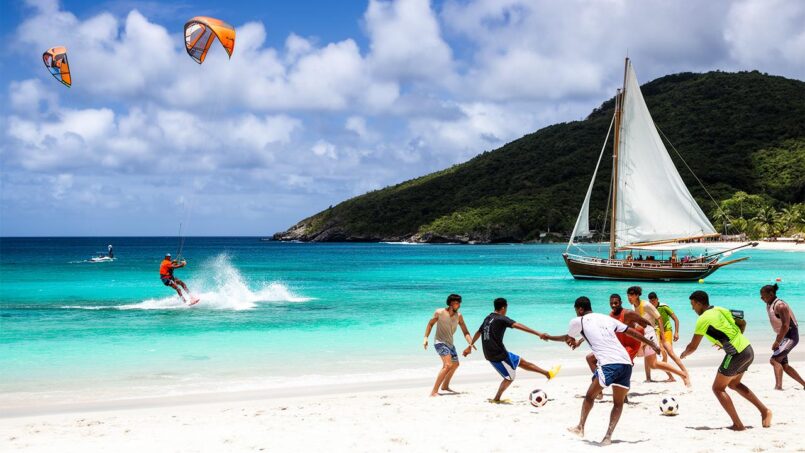
Between turquoise waters, steady trade winds, and dramatic landscapes, the British Virgin Islands offer a sporting playground nearly unmatched in the Caribbean. Far beyond the postcard image, the archipelago is a true hub for water sports, competitive sailing, hiking, diving, surfing, and also for more “land-based” disciplines like tennis, squash, or trail running. A panorama of the most popular sports to enjoy in the British Virgin Islands, and the places to practice them.
Sailing, the King of Sports in the British Virgin Islands
It’s impossible to talk about sports in the archipelago without starting with sailing. The British Virgin Islands unapologetically claim their title as “Sailing Capital of the World”, a slogan that has become a trademark. Everything here seems designed for sailing, from beginner to high-level racer.
The archipelago boasts more than 60 islands and islets, most separated by modest distances and waters that allow for line-of-sight navigation. The Sir Francis Drake Channel, protected by the terrain, remains surprisingly calm even when the Atlantic gets rougher further offshore. Trade winds typically blow between 10 and 20 knots, the swell is manageable, and the tide varies little more than a foot. The result: conditions described as “Level 1,” ideal for learning as well as for tacking between Tortola, Virgin Gorda, Anegada, or Jost Van Dyke.
Regattas and Major Sailing Events
For many sailors, coming to the British Virgin Islands also means participating in – or attending – one of the many regattas that punctuate the year. There are more than twenty sailing and powerboat events, ranging from intimate gatherings to major international celebrations.
This iconic event, based at Nanny Cay Resort & Marina on Tortola, combines two days of “Sailing Festival” and three days of Spring Regatta, totaling five days of racing. The courses offer a panoramic tour of the archipelago between the Sir Francis Drake Channel and iconic anchorages.
The event attracts both international racing yachts, a large fleet of charter boats, and many amateurs who gather aboard monohulls or charter catamarans. The Scrub Island Invitational kicks off the festival, followed by the Nanny Cay Cup around Tortola, then three days of more classic races. The regatta is supported by major brands (Mount Gay Rum, Heineken, Sol, International Motors, etc.) and local institutions, notably the Ministry of Tourism, Culture, and Sustainable Development.
Around a flagship event, a racing calendar is organized primarily by the Royal BVI Yacht Club and the West End Yacht Club. It includes regattas like the Dark and Stormy Regatta, the Latitude 18 Halyard Challenge, the Governor’s Cup, and the BVI Dinghy Championships for dinghies. Others highlight maritime heritage, such as Foxy’s Wooden Boat Regatta for wooden boats and Sweethearts of the Caribbean, while the Foxy’s Cat Fight is dedicated to multihulls.
Beyond pure sailing, the Leverick Bay Poker Run brings together powerboat enthusiasts each year for a festive rally in the North Sound of Virgin Gorda, and events like “Xmas in July” at Pond Bay mix boating, music, and Caribbean culture.
For registrations and information on mid-term or Easter sailing camps for children, contact the Royal BVI Yacht Club, the central point of contact. For a more laid-back atmosphere, the West End Yacht Club embodies the convivial spirit of Caribbean sailing with barbecues, friendly regattas, and evening gatherings on the docks.
Boat Charters, Sailing Schools, and Liveaboard
The British Virgin Islands have established themselves as the Mecca for sailboat charters. Major players like The Moorings, Sunsail, or Horizon Yacht Charters operate impressive fleets of monohulls, sailing catamarans, and power catamarans. Options are numerous: bareboat for those who are self-sufficient, skippered for those who want to learn at a relaxed pace, and fully crewed for a trip focused more on comfort.
Infrastructure follows suit: Nanny Cay, Soper’s Hole, Virgin Gorda Yacht Harbour, Bitter End Yacht Club, and Scrub Island Resort offer marinas, mooring buoys (about 40 to 50 US dollars per night), fuel docks, repair services, provisioning, and beachfront restaurants. A specific permit is sometimes required to use buoys in national parks, especially at diving and snorkeling sites.
Along the bays, sailors often supplement their sailing itinerary with other sports activities: paddleboarding, clear kayaking, kiting at North Sound, wreck diving, or surfing sessions when the wind aligns with the swell on the north coast of Tortola.
Diving and Snorkeling: A Premier Underwater Playground
While sailing reigns on the surface, what lies beneath the waves is equally impressive. The British Virgin Islands boast more than 60 to 75 documented dive sites, often equipped with mooring buoys. Visibility commonly exceeds 20 to 30 meters, and the underwater terrain alternates between coral gardens, drop-offs, caves, and historic wrecks. The archipelago is regularly cited among the world’s top ten destinations for wreck diving.
Marine life is equally abundant: turtles, eagle rays, barracudas, reef sharks, jacks, schools of blue chromis, groupers, parrotfish, moray eels, octopuses, squid… All in warm water that invites both scuba divers and casual snorkelers.
To better visualize the diversity of spots, a quick glance at a sample of sites illustrates the richness of the offerings.
| Area / Island | Iconic Site | Recommended Level | Approximate Depth | Main Feature |
|---|---|---|---|---|
| Salt Island | Wreck of the RMS Rhone | Beginner to Advanced | 15 to 80+ feet | Historic wreck, national marine park |
| Virgin Gorda | Kodiak Queen (Kraken) | Beginner / Intermediate | Up to ~60 feet | Wreck art piece, former Pearl Harbor survivor |
| Norman Island | The Indians | Beginner / Intermediate | 10 to 50 feet | Rock pinnacles, coral garden, great snorkeling |
| Norman Island | The Caves | Snorkeling | 5 to 20 feet | Sea caves, “Treasure Island” atmosphere |
| Dog Islands | The Chimney | Beginner | 15 to 45 feet | Narrow canyons, colorful corals |
| Ginger Island | Ginger Steps / Alice in Wonderland | Beginner / Intermediate | 30 to 90 feet | Very healthy coral, “step” formations |
| Cooper Island | Wreck Alley / Cistern Point | Beginner / Intermediate | 20 to 60 feet | Small wrecks, accessible reefs |
| Anegada | Great Anegada Barrier Reef | All levels | 5 to 60 feet | 18 miles of reef, rays, turtles, ancient wrecks |
| Offshore | Wreck of the Chikuzen | Advanced | ~60 to 75 feet | Exposed site, large fish schools, strong currents |
Iconic Wrecks and Spectacular Reefs
It’s hard to compete, in terms of legend, with the wreck of the RMS Rhone. This 310-foot British mail steamer, which carried the royal mail, sank in 1867 near Salt Island during a hurricane, claiming the lives of over a hundred passengers and crew. The remarkably preserved wreck became the country’s first national marine park and one of the most famous dive sites in the Caribbean. Diving here spans different levels, from the stern accessible to snorkelers to the deeper areas where you can admire the bronze propeller and massive structures encrusted with coral.
The wreck of the Kodiak Queen, one of the few surviving ships from Pearl Harbor, was intentionally sunk off Virgin Gorda. Transformed into an artificial reef with a steel installation evoking a kraken, it serves as a dive site, a memorial, and an art piece to raise awareness about ocean protection.
The reefs of Ginger Island – Ginger Steps, Alice in Wonderland – showcase some of the healthiest coral in the archipelago, arranged in “steps” that attract a profusion of fish. Further north, the vast reef of Anegada stretches for nearly 18 miles, offering endless terrain to explore caves, coral heads, and ancient wrecks.
The Chikuzen is a unique wreck, a refrigerated cargo ship intentionally sunk between Tortola and Anegada, renowned for its impressive pelagic marine life.
Diving, Snorkeling, and Specialized Operators
Most sites cater to both scuba divers and snorkelers. The Indians and The Caves, near Norman Island, appear on almost every charter itinerary, as they lend themselves easily to exploration, even for children.
On the logistical side, the British Virgin Islands have a solid network of professional centers. Operators like Sail Caribbean Divers – a PADI 5-Star Center operating since the late 1970s – offer daily morning, afternoon, and even night dives. Dive BVI, long established on Virgin Gorda and Scrub Island, regularly takes clients to the Rhone, the Kodiak Queen, and numerous reefs. Other operators, such as Sunchaser Scuba in North Sound, Blue Water Divers, or Jost Van Dyke Scuba, round out the offerings.
In parallel, operators like BVI Snuba allow you to explore the seabed without a tank, using a breathing system connected to a surface air supply at a limited depth (about 6 meters). An interesting intermediate option for those who want to go a bit further than simple snorkeling.
Sport Fishing and Sea Excursions: From Marlin to Family Outings
The deep waters bordering the British Virgin Islands offer another major sporting asset: fishing. The archipelago lies on the edge of the Puerto Rico Trench, one of the deepest ocean trenches in the world (about 6 miles deep). Where this fault changes direction, north of Tortola, lies the famous North Drop, a global hotspot for blue marlin.
Deep-Sea, Reef Fishing, and Bonefishing
Offshore fishing – or deep-sea fishing – attracts thrill-seekers willing to venture away from the coast in search of large predators: blue marlin, yellowfin tuna, wahoo, mahi-mahi (dolphin fish). Marlin season generally peaks during the warmer months, with catch rates reputed to be among the highest in the world. The best spots are around the North Drop and in the Anegada Passage, between Virgin Gorda and Anegada, also rich in tuna and wahoo.
Closer to shore, reef fishing appeals to a broader audience, including families. The shallower waters are home to snappers (yellowtail, mangrove), groupers, barracudas, triggerfish, and allow for shorter, gentler outings, ideal for beginners.
Added to this is bonefishing, practiced in shallow waters around small islets and lagoons, especially near Anegada. Chasing bonefish – sometimes compared to ‘silver rockets’ for their power once hooked – lends itself well to fly fishing or light tackle.
Fisherman or Fishing Guide
Price ranges vary significantly depending on the type of trip, boat size, and onboard amenities. Generally, expect:
| Type of Trip | Typical Duration | Approximate Price Range (USD) | Main Target |
|---|---|---|---|
| Deep-sea / offshore | Full day (8 h) | ~1,200 to over 2,500 | Marlin, tuna, wahoo, mahi-mahi |
| Deep-sea / offshore | Half day | Under 1,200 | Large pelagic fish |
| Reef / inshore fishing | Full day | ~500 to 1,200 | Snappers, groupers, barracudas |
| Reef / inshore fishing | Half day | Even more affordable | Varied catches, ideal for families |
Operators based in Tortola, such as Last Virgin Island for offshore trips, or services like Sail Away VI for reef fishing, organize these outings, providing equipment, bait, and sometimes drinks and meals. It’s best to check in advance whether licenses are included and which species can be kept or must be released.
Regulations and Fishing Tournaments
The practice is not entirely unregulated. The Department of Conservation and Fisheries, based in Road Town, oversees licenses, boat registrations, and protected areas. Anglers fishing aboard a charter operated by a duly licensed company generally do not need an individual permit. However, fishing from a private boat or from shore may require a temporary one-month permit, costing about 45 dollars, for which a form of identification is required.
Certain fishing methods are strictly prohibited (spearguns, scuba tanks, explosives, poisons) under penalty of fines up to $15,000. Seasonal moratoriums protect specific species (Nassau grouper, red hind, lobster, conch, whelk, sea turtles), and some areas are either marine reserves completely closed to fishing or priority zones where only licensed fishing activities are allowed.
On the sporting side, sport fishing is also structured around major events. The Scrub Island Billfish Invitational, a series of two tournaments that are 100% catch and release dedicated to billfish, takes place from Scrub Island Resort & Marina, right in the heart of the North Drop. Points awarded heavily favor blue marlin (500 points per release) over other marlin and sailfish (100 points), to encourage species respect.
Scrub Island’s marina has 55 slips, including five capable of accommodating mega-yachts up to 160 feet, and a water taxi service connects the island to Tortola. Teams must provide their release videos, while the organization assists them with all permit and license procedures.
Surfing, Kitesurfing, and Watersports
While the white sandy beaches of the British Virgin Islands are often imagined as millponds, the reality of the north coast, exposed to the Atlantic swell, is quite different in winter. From November to April, swells from the open ocean transform certain spots into serious playgrounds for surfers.
Tortola gets the lion’s share in this regard. Bays like Josiah’s Bay, Cane Garden Bay, Apple Bay, or Cappoons Bay start breaking when the swell picks up enough size. Local schools offer lessons and rentals, in an atmosphere described as very laid-back, far from the frenzy of major global surf spots.
Josiah’s Bay offers an A-frame wave, mainly active in winter, with a more forgiving sandy bottom but still punchy for experienced surfers. Cane Garden Bay, known for its long point break, becomes a learning spot in small conditions and offers good potential for longer rides with a bigger swell. Apple Bay, a reef break, delivers faster and more powerful waves suitable for intermediate to advanced surfers.
Practicing these sports requires a minimum of vigilance. The region’s meteorological services regularly issue high surf advisories, warning of 2 to 3-meter waves that can generate dangerous rip currents, violent backwash, and localized beach erosion. During large swells linked to distant hurricanes, caution is advised for both surfers and ordinary swimmers.
Beyond traditional surfing, the islands offer many newer disciplines like e-foiling, seabob, kneeboarding, wakeboarding, water skiing, flyboarding, and subwings. The turquoise lagoons and steady trade winds, such as at Anegada, are ideal for kitesurfing (now an Olympic sport). The North Sound of Virgin Gorda offers flat water perfect for windsurfing, kitesurfing, and foiling.
Kayaking, Stand-Up Paddleboarding, Snorkeling: Gentle and 100% Accessible Sports
Alongside these sometimes technical disciplines, the British Virgin Islands are perfectly suited for “soft” water sports that almost anyone can try.
Stand-up paddleboarding, for example, combines several advantages: an accessible activity, a full-body workout, improved balance and cardio, all in a postcard setting. Providers like BVI SUPCO, Island Surf & Sail, or Up ‘n’ Under Watersports rent boards and paddles, sometimes with the option of using clear or LED-lit paddles for nighttime outings.
Discover the sheltered bays of the British Virgin Islands by kayak, an activity perfect for observing the seabed and combining a paddle with snorkeling.
Practice traditional kayaking or opt for a clear-bottom model, ideal for observing the seabed without diving gear.
Paddle at your own pace along the protected coastlines of stunning islands like Scrub Island, Peter Island, or Guana Island.
Often, you can enhance your kayak trip with a snorkeling session to explore the underwater life.
Snorkeling remains a top mass-participation sport in the British Virgin Islands. With no special training, all you need is a mask, snorkel, and fins to explore sites like The Baths at Virgin Gorda, The Indians and The Caves at Norman Island, Smuggler’s Cove or Brewers Bay on Tortola, or Loblolly Bay and Flash of Beauty on Anegada. Some sites, like Monkey Point on Guana Island, have long been known for their fish density, although coral health can vary over time. Here too, respect for the environment – not walking on coral, avoiding toxic sunscreens – is essential for preserving the underwater richness.
Hiking, Trail Running, and Canopy Tours: Land-Based Outdoor Sports
While water dominates, the land is not to be outdone. With its volcanic terrain (except for Anegada, which is flat and limestone), dry tropical forests, remnants of cloud forest, and coastal trails, the archipelago lends itself to hiking, trail running, and scenic walks.
Tortola concentrates several notable routes, starting with Sage Mountain National Park, the highest point in the territory. The trails form a main loop that can be completed in one to two hours, under a dense canopy where you’ll encounter ferns, bromeliads, orchids, and large trees. Other routes, like the “back road” leading to Smuggler’s Cove, the Mount Healthy area, or the trails to Shark Bay and Brewers Bay, allow you to combine walking, viewpoints, and discoveries of small coves.
On Virgin Gorda, the Baths National Park offers a short – but playful – route linking the parking lot to Devil’s Bay. You wander between enormous granite boulders, pass through rocky corridors equipped with ropes and wooden stairs, before emerging onto a nearly surreal beach. Further north, Gorda Peak offers two trails leading to a lookout in the form of a treehouse, with a 360° panorama of the archipelago. Other paths start from Bitter End Yacht Club or near Leverick Bay towards Hog Heaven restaurant, via a road or steep tracks.
On Norman Island, trails climb from the main bay of The Bight to Benures Bay, Money Bay, or the summit where a helipad sits. The island, associated with the lore of Robert Louis Stevenson’s “Treasure Island,” lends itself ideally to hikes combined with snorkeling in the many coves.
Jost Van Dyke, the smallest island, offers a hike leading to the “Bubbly Pool,” a natural pool created by waves surging into a rocky opening. Conversely, Anegada, flat and coralline, invites long walks on the sand, like the stroll between Pomato Point and Cow Wreck Beach, along a turquoise lagoon.
For thrill-seekers, Tortola also hosts the Virgin Canopy Tour, a zipline course “at the treetops” consisting of seven crossings, culminating nearly 280 meters above the ground. A different way to enjoy an outdoor sport while taking in spectacular views.
Wildlife, though discreet, accompanies these activities: birds, lizards, mongooses, wild goats, and even a native tree boa, the BVI tree boa, rarely seen during the day. No venomous snake species are recorded, reassuring the most cautious hikers. The only real plant concern: the manchineel tree, which is toxic and should be avoided, though it’s rarely found on marked trails.
Cycling, Running, and Competitive Cycling
Beyond hiking, the terrain of Tortola and Virgin Gorda also lends itself to cycling and running. Mountain biking or road routes, like the one connecting Nanny Cay to Brandywine Bay on Tortola – about 6.5 miles with over 380 meters of elevation gain – offer good training grounds for climbing enthusiasts.
The BVI Cycling Federation organizes competitions like the Tour de BVI, a three-stage race on Virgin Gorda, Anegada, and Beef Island. Elite courses include an ascent of Gorda Peak, a long stage on Anegada, and a time trial on Beef Island. A UCI license is required for certain events. The federation also liaises with regional and international cycling scenes.
Running is also well represented: half-marathons on Virgin Gorda, hill races, charity events combining sport and awareness (e.g., around breast cancer). Athletes like Reuben Stoby or Julius Farley have distinguished themselves on the local scene, helping to popularize road and trail running in the archipelago.
Tennis, Squash, Racquet Sports, and Multi-Sport Centers
Alongside this very “outdoor” world, the British Virgin Islands have several modern facilities for racquet sports and fitness, starting with the Tortola Sports Club in the heart of Tortola. The club offers four lighted tennis courts for night play, squash courts, a gym, and an indoor/outdoor bar-restaurant that makes it a real social hub. Members can book courts up to three weeks in advance, with a limit of four slots over seven days, and benefit from personalized coaching in the gym.
The resort offers a selection of racquet activities on Virgin Gorda, with support services for reservations.
Six tennis courts available, on hard and artificial grass surfaces, some lit for evening play.
Two dedicated pickleball courts, the rapidly growing racquet sport, to vary the fun.
Paid tennis lessons, bookable in advance. A butler assists with organizing all sports activities.
Activities are offered subject to favorable weather conditions to ensure comfort and safety.
Also on Virgin Gorda, Nail Bay Resort and the Nail Bay Sports Club complete the offerings with two squash courts, a lighted grass tennis court, a gym, and even a ping-pong table. Sports equipment is provided to guests, and some accommodations include free access to these facilities. A high-level professional, Joe Kneipp – Commonwealth Games gold medalist in squash – coaches here, giving a quasi-“academy” dimension to this club in the heart of a 148-acre estate overlooking the Sir Francis Drake Channel.
Richard Branson’s private island, Necker Island, offers exceptional sports facilities including championship-level tennis courts, pickleball and paddle courts, and programs led by top-tier coaches. It also hosts the Necker Cup, a Pro-Am tennis tournament. Richard Branson himself practices kitesurfing, cycling (with climbs towards Virgin Gorda), and inter-island swimming here, illustrating how the archipelago allows combining work, vacation, and intensive training in an idyllic setting.
Rugby, Soccer, 3×3 Basketball: A Diversifying Sports Landscape
The archipelago is not limited to recreational sports or aquatic disciplines. Several federations exist for more traditional team sports, often geared towards regional and international competition.
Rugby sevens is supported by the BVI Rugby Football Union, whose men’s selections have participated in international tournaments, such as in Puerto Rico. Meanwhile, 3×3 basketball, a discipline introduced at the Commonwealth Games, was represented by a men’s team from the territory at the One Guyana 3×3 Quest tournament, with players such as Jaquan Hodge, Antwon Robinson, Shakeem Tuson, and Demron Glasgow.
Soccer (football) has its men’s national team, competing in the Concacaf Nations League in League C’s Group C, against opponents like Dominica or the Turks and Caicos Islands. While facilities are more modest than in some larger neighboring countries, the practice of soccer and cricket is part of a Caribbean sports culture where these disciplines remain very popular.
High-Performance Sports and Olympic Presence
The British Virgin Islands do not just offer an ideal playground for recreational sports: they also assert themselves on the international stage. Through the local Olympic Committee (BVIOC), the territory regularly sends delegations to the Olympic Games, Commonwealth Games, Pan American Games, and even the World Athletics U20 Championships.
Athletes like Kyron McMaster – Commonwealth Games champion in the 400m hurdles in Birmingham and Gold Coast – or Rikkoi Brathwaite, Olympic finalist in the 100m sprint, illustrate the level achieved in athletics. Adaejah Hodge, world U20 champion in the 200m, represents the new generation while having served as an ambassador for major Pan-American youth events.
British Virgin Islands Athletes
On the water, sailor Thad Lettsome made history as the first British Virgin Islands mariner to compete in the Olympic Games since 1996, in the ILCA7 class, thus extending the organic link between the archipelago and sailing at the highest level.
The BVIOC also works to anchor sport in local society through a free “Sports Festival” celebrating Olympic Day, with introductions to numerous activities at the A.O. Shirley Stadium, or through multi-sport festivals organized in partnership with the H. Lavity Stoutt Community College. These events, complemented by “Olympic Day Run” races on several islands, encourage the population to move, run, row, throw, play – in short, to embrace the many sporting possibilities the territory offers.
Sports, Culture, and Festivals: An Increasingly Blurred Line
In the British Virgin Islands, sport rarely exists in a vacuum. Most major events are also parties, where music, food, and traditions take center stage. The BVI Emancipation Festival, the Virgin Gorda Easter Festival, or events like the Full Moon Party at Trellis Bay – with steel bands, fire breathers, and Creole buffets – often revolve around the sea: boat races, nautical parades, informal regattas.
The BVI Food Fete organizes gastronomic events like ‘Taste of Virgin Gorda’ or ‘Taste of Tortola’. These can coincide with fishing competitions (wahoo tournaments) or activities like ‘Wreck Week’, which combines diving, tourism promotion, enhancement of artificial reefs, and underwater art.
In the end, practicing a sport in the British Virgin Islands is almost never an isolated activity. Jogging on the road to Smuggler’s Cove means running between flamboyant trees and beach shacks. Participating in a regatta almost certainly means ending the day around a barbecue, with a fungi band and a local rum punch. Perhaps it is this blend of performance, nature, and culture that makes sports in the British Virgin Islands not just an ancillary activity, but the very heart of the archipelago experience.
Disclaimer: The information provided on this website is for informational purposes only and does not constitute financial, legal, or professional advice. We encourage you to consult qualified experts before making any investment, real estate, or expatriation decisions. Although we strive to maintain up-to-date and accurate information, we do not guarantee the completeness, accuracy, or timeliness of the proposed content. As investment and expatriation involve risks, we disclaim any liability for potential losses or damages arising from the use of this site. Your use of this site confirms your acceptance of these terms and your understanding of the associated risks.

Cyril Jarnias is an independent expert in international wealth management with over 20 years of experience. As an expatriate himself, he is dedicated to helping individuals and business leaders build, protect, and pass on their wealth with complete peace of mind.
On his website, cyriljarnias.com, he shares his expertise on international real estate, offshore company formation, and expatriation.
Thanks to his expertise, he offers sound advice to optimize his clients' wealth management. Cyril Jarnias is also recognized for his appearances in many prestigious media outlets such as BFM Business, les Français de l’étranger, Le Figaro, Les Echos, and Mieux vivre votre argent, where he shares his knowledge and know-how in wealth management.





