
 Published on and written by Cyril Jarnias
Madeira is often presented as a paradise for lovers of mild climate, spectacular landscapes, and a tranquil life by the Atlantic. But behind the postcard, the island has also become one of Portugal’s most dynamic real estate markets. Between Funchal, Calheta, Ponta do Sol, Ribeira Brava, Santa Cruz, and São Vicente, the price gaps per square meter are now considerable. Understanding these differences has become essential for any buyer, investor, or future resident.
The market has been transformed by tourism, the arrival of foreign retirees and remote workers, as well as by land scarcity and rapidly rising rents. Madeira remains generally cheaper than Lisbon or the Algarve, but the archipelago shows disparities: some areas now reach the prices of premium sectors on the mainland, while others still offer real opportunities.
Madeira in the Portuguese Real Estate Context
Before comparing the island’s towns, we need to place Madeira within the national housing landscape. In Portugal, residential prices surged over 15% to 18% year-over-year at the end of 2025, with a national median of around €2,000 to €2,100/m². Regions like Lisbon and the Algarve remain at the top, with average prices well above €3,000/m², even €4,000/m² in the most sought-after areas.
This is the percentage increase in real estate prices recorded in Madeira in 2025, the strongest growth in Portugal.
The average value of a property in the region now hovers around €300,000, with a jump of over 40% compared to early 2025. Archipelago-wide, the numbers confirm a simple reality: demand is exploding, supply is struggling to keep up, and the market is entering a clearly “prime” phase, especially in certain municipalities.
Funchal: The Engine and Showcase of Madeira’s Market
As the archipelago’s capital and home to about half the population, Funchal alone concentrates a large portion of Madeira’s real estate activity. It is also the most expensive town on the island, with a market now comparable to that of major Portuguese cities.
Price Levels and Market Structure
The data converge on one point: Funchal sits well above the regional average. The supply is sharply segmented between the coastal city center, historic neighborhoods, seaside areas, and western suburbs around São Martinho. Prices vary significantly from one area to another.
Here is a summary of the listing levels recorded for Funchal:
| Indicator | Indicative Value |
|---|---|
| Average price per m² (overall) | ≈ €3,600 – €3,900/m² (listing prices) |
| Apartments – average price | ≈ €4,300/m² |
| Houses – average price | ≈ €3,700/m² |
| City center (apartments) | ≈ €4,150/m² (observed average) |
| Funchal outskirts | ≈ €2,950/m² |
| Renovated historic district | ≈ €4,200 – €5,000/m² |
| Lido area | ≈ €3,800 – €4,500/m² |
| Western Funchal, São Martinho | ≈ €3,200 – €3,800/m² |
New apartments in the center start at around €3,500/m², while resale properties begin at about €2,500/m². As soon as you add a sea view and a central location, the price tag jumps: for a new apartment with ocean views, starting prices approach €4,000/m², and even €4,500/m² in some premium developments.
The price per square meter can reach €5,000 for ultra-luxury properties on Funchal’s waterfront.
Gap Between New and Existing Homes
One element stands out particularly in Funchal: the gap between new homes and existing ones. The transaction median shows prices around €4,015/m² for new properties versus €2,983/m² for older ones, a difference of about €1,032/m². This is the largest gap observed among major Portuguese municipalities.
In other words, two apartments of comparable size can show a differential of nearly 35% simply based on construction year and level of modernity. This gap is accentuated by the scarcity of buildable land and the concentration of new projects in “prime” locations (sea views, proximity to the center, condominiums with pools and services).
Apartment Typologies in Funchal
Prices per square meter also vary according to the size of the home. Studios and small units generally show the highest unit prices.
| Apartment Type (Funchal) | Indicative per m² Range |
|---|---|
| Studio (T0) | ≈ €5,200 – €5,300/m² |
| 1-bedroom (T1) | often ≈ €3,000 – €3,600/m² (island-wide, more expensive in center) |
| 2-bedroom (T2) | ≈ €4,800 – €4,900/m² (median for Funchal) |
| 3-bedroom (T3) | ≈ €4,500 – €4,600/m² |
| 4-bedroom (T4) | ≈ €4,600/m² |
| 5-bedroom (T5) | ≈ €4,900/m² |
Studios and T1 units represent the segment most favored by investors focused on short-term rentals or by solo digital nomads. T2 and T3 units, meanwhile, constitute the core of the residential and long-term rental market.
Rental Market and Yields in Funchal
With a regional average rent of around €1,700 per month, the archipelago is one of the tightest markets in Portugal. Funchal, as the main urban hub, sits even above this average, especially for quality apartments in the city center.
| Rental Type in Funchal | Average Monthly Rent (approx.) | Estimated Gross Yield |
|---|---|---|
| 1-bedroom city center | ≈ €1,100 – €1,400 | 6–8% (long-term) |
| 1-bedroom outside center | ≈ €1,000 – €1,300 | 6.61% (center average per Numbeo) |
| 3-bedroom (T3) | ≈ €1,750 – €2,230 | 5.3% (Q1 2025, Imovirtual) |
| Short-term rental (T2 with AL license) | up to 7–9% yield | depending on occupancy rate |
| Villa with pool (short-term) | €3,500 – €5,500/month (long-term) or 9–12%/year seasonal |
The data show gross yields of approximately 5.5% to 6.2% for tourist rentals in prime areas, and between 4.2% and 4.8% for traditional long-term rentals. Numbeo estimates that apartment rental profitability reaches 6.61% in central Funchal and 7.74% in the outskirts.
Rental profitability is often higher outside the hyper-center. This is explained by more moderate purchase prices in those areas, while rents remain relatively high, as they attract tenants seeking a less expensive alternative to central neighborhoods.
Calheta: The Booming Seaside Resort
Located on the west coast, Calheta combines an artificial sandy beach, sunny climate, and ocean panoramas. It is also one of the hottest markets in Madeira, both in terms of sale prices and seasonal rental yields.
Recent data places the average asking price around €4,234/m², making it, along with Funchal and Ribeira Brava, one of the most expensive territories in the archipelago. In one year, Calheta recorded a rise of nearly 26%, going from about €3,090/m² at the start of 2024 to more than €4,200/m² for listings in 2026.
| Indicator | Calheta |
|---|---|
| Average price per m² (transactions) | ≈ €3,500/m² (range €2,800–€3,500/m²) |
| Average price per m² (listings) | ≈ €4,234/m² |
| Average house/apartment price | similar, strong presence of villas |
| Average rental yield (district) | ≈ 1.83% (all properties combined, aggregated data) |
On the ground, contemporary villas with sea views sell from €400,000 and can easily exceed €1.3 or even €2 million for the most spectacular properties. Apartments in residential complexes with pools and panoramic views fall into the same price range as Funchal’s high-end properties, but often with a more seaside and less urban atmosphere.
Annual occupancy rate for upscale tourist rentals in Calheta, allowing yields of around 7% for well-managed short-term rentals.
Ponta do Sol: Sunny Village and Nomad Stronghold
Ponta do Sol combines several assets: a very sunny microclimate, a popular beach, a charming historic center, and above all a community of remote workers settled under the “Digital Nomads Madeira Islands” program. The place has become a true digital village, which strongly supports rents and sale prices.
Average prices per square meter range between €2,700 and €3,200/m² for the overall market, with an average transaction price of about €2,884/m² and an asking price around €3,514/m².
| Indicator | Ponta do Sol |
|---|---|
| Average price per m² (transactions) | ≈ €2,884/m² |
| Average price range per m² | ≈ €2,700 – €3,200/m² |
| Average price per m² (listings) | ≈ €3,514/m² |
| Houses – starting price | ≈ €400,000 for a villa |
| Typical range for modern houses | ≈ €350,000 – €900,000 |
Compared to Funchal, Ponta do Sol remains slightly cheaper per square meter, but the gap is narrowing year by year. The presence of luxury villas with infinity pools, highly sought after by foreigners, pushes the high end to levels comparable to the regional capital, with prices that can easily exceed one million euros.
Municipal databases sometimes indicate rental yields close to 0% due to a lack of consolidated data. However, on-the-ground observations show that well-located and well-managed properties can achieve yields of 7% to 9% on short-term rentals, especially with a clientele of digital nomads and long-stay tourists.
Ribeira Brava: Already a Highly Sought-After Market
Ribeira Brava, on the southwest coast, is often cited as one of the most sought-after markets in Madeira, alongside Funchal and Calheta. Prices there are now very high by island standards.
| Indicator | Ribeira Brava |
|---|---|
| Average price per m² (listings) | ≈ €3,912/m² |
| Houses – average price per m² | ≈ €3,600/m² |
| Apartments – average price per m² | ≈ €3,700/m² |
| Starting price for houses | ≈ €400,000 |
| Average rental yield | ≈ 3.88% (district aggregated data) |
Apartments per square meter sometimes exceed €4,000/m², especially for recent developments offering sea views and high-end features. The market primarily targets foreign buyers looking for villas or contemporary homes with pools, which drives prices upward.
Rental profitability in Funchal, while decent, is lower than in more affordable towns like Machico or Santa Cruz. However, the outlook for long-term capital appreciation is favorable, due to scarce land and sustained tourist demand.
Santa Cruz and Caniço: Affordable and Well-Connected East
On the east coast, Santa Cruz is known for housing the airport, gardens, and a fairly peaceful coastal setting. It is one of the preferred options for those who want to stay close to Funchal without paying capital prices.
The figures summarize this mid-range positioning well:
| Indicator | Santa Cruz |
|---|---|
| Average price per m² (transactions) | ≈ €2,276/m² |
| Average price per m² (listings) | ≈ €3,012/m² |
| Houses – average price per m² | ≈ €2,500/m² |
| Apartments – average price per m² | ≈ €2,600/m² |
| Average rental yield | ≈ 4.79% |
Average prices there are significantly lower than in Funchal, while infrastructure remains good (schools, services, roads, proximity to the capital). Santa Cruz is thus mentioned among the island’s areas offering good rental income, especially for properties intended for resident or long-term clientele.
Nearby, the areas of Caniço and Garajau represent a dynamic micro-market. Villas with sea views are offered from €250,000 and can exceed €500,000, particularly attracting foreign families and retirees. For seasonal rentals, a well-located villa with ocean views can fetch around €1,200 per week, a segment highly sought after by German-speaking clientele.
Câmara de Lobos: Between Fishing Village and Funchal Extension
Câmara de Lobos, a former fishing village a few kilometers west of Funchal, has become a transition zone between the capital and more distant seaside resorts. The real estate market there is cheaper than in central Funchal, while still high for the island.
| Indicator | Câmara de Lobos |
|---|---|
| Average price per m² (transactions) | ≈ €2,436/m² |
| Average price per m² (listings) | ≈ €2,995/m² |
| Houses – average price per m² | ≈ €2,600/m² |
| Apartments – average price per m² | ≈ €3,000/m² |
| Average rental yield | ≈ 4.74% |
Prices reflect an attractive positioning for those who wish to stay close to Funchal without paying its highest rates. New residential projects are emerging, often with sea views and modern amenities, which helps sustain prices.
Machico: A Price/Yield Compromise
Machico, a small fishing town on the east coast, is one of the most interesting markets for buyers on a mid-range budget. Prices are clearly below Funchal, but rental demand remains solid.
| Indicator | Machico |
|---|---|
| Average price per m² (transactions) | ≈ €2,800 – €3,000/m² |
| Average price per m² (recent listings) | ≈ €1,552/m² in 2024 (rising) |
| Average rental yield | ≈ 5.99% |
This combination of relatively low prices and yields above the regional average (nearly 6%) makes Machico a prime target for investors seeking good value. Older houses there are significantly more affordable than in Funchal but often need renovation. Budgets from €120,000 to €300,000 can already secure interesting properties, or even renovate traditional homes for rental purposes.
The Rural North: São Vicente, Santana, Porto Moniz
Northern Madeira (São Vicente, Santana, Porto Moniz) contrasts sharply with the south coast. The landscapes are wilder, the climate cooler, and prices significantly lower, even if some isolated per-square-meter values may appear contradictory depending on the segment.
Overall, the observed ranges for the north coast are as follows:
| Municipality | Average price per m² (transactions) | Average price per m² (listings) | Comment |
|---|---|---|---|
| São Vicente | ≈ €1,500 – €1,600/m² (north area) | ≈ €1,300 – €1,400/m² (average listing) | One of the cheapest areas on the island |
| Santana | ≈ €1,461/m² | ≈ €1,800/m² | Very rural, stronghold of traditional houses |
| Porto Moniz | ≈ €2,117 – €2,200/m² | ≈ €2,200/m² | Affordable market, good rental potential |
Despite some isolated very high per-m² figures for certain prestige properties (particularly in São Vicente), the general trend is clear: the north is overall half as cheap as Funchal. This is where the best opportunities lie for those who prioritize tranquility, space, and a reasonable budget, even if it means moving away from the main tourist hubs.
Official databases may show low rental yields due to a lack of robust statistics. However, specific projects such as guesthouses, eco-lodges, or long-term rentals for residents and retirees can generate good income, especially when purchase prices are moderate.
Cross-Comparison: Who is Expensive, Who is Affordable?
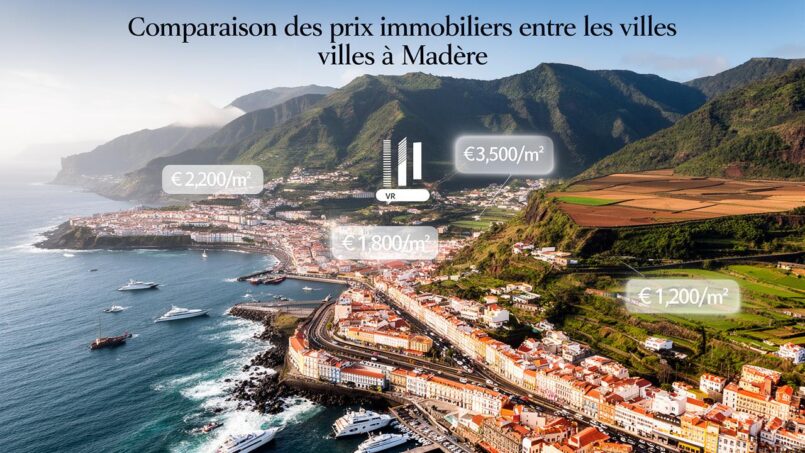
By aggregating data by average listing price per square meter, we can draw a simplified map of Madeira’s main markets:
| Municipality | Average Price per m² (Listings) |
|---|---|
| Calheta | ≈ €4,234/m² |
| Ribeira Brava | ≈ €3,912/m² |
| Funchal | ≈ €3,901/m² |
| Ponta do Sol | ≈ €3,514/m² |
| Santa Cruz | ≈ €3,012/m² |
| Câmara de Lobos | ≈ €2,995/m² |
| Machico | ≈ €2,800 – €3,000/m² |
| Porto Moniz | ≈ €2,200/m² |
| Santana | ≈ €1,800/m² |
| São Vicente | ≈ €1,300 – €1,400/m² |
This hierarchy highlights several realities:
Funchal, Calheta, and Ribeira Brava form the top trio of the most expensive markets, supported by strong international interest, attractive rental prospects, and limited land.
Ponta do Sol is experiencing rapid development, approaching the level of attractiveness of other destinations. This growth is fueled by its official status as a digital nomad village and the proliferation of high-end villas on its territory.
Santa Cruz, Câmara de Lobos, and Machico occupy an intermediate position, with more accessible prices but continuous demand, making them favorable ground for investors seeking solid yields.
The northern facade (São Vicente, Santana, Porto Moniz) remains the “good deal” zone for those who accept a more rural environment and a less liquid market, but with per-square-meter prices significantly lower than the south coast.
Rental Yields: The Most Interesting Towns for Investment
Beyond price levels, investors primarily look at gross rental yield, i.e., the ratio of annual rent to purchase price. At the Madeira district level, the average yield hovers around 4.57%, slightly below the Portuguese national average (5.16%). But this figure masks significant differences between municipalities.
| Municipality | Estimated Average Gross Yield |
|---|---|
| Machico | ≈ 5.99% |
| Santa Cruz | ≈ 4.79% |
| Câmara de Lobos | ≈ 4.74% |
| Funchal | ≈ 4.56% (up to 7.74% outside center per Numbeo) |
| Ribeira Brava | ≈ 3.88% |
| Calheta | ≈ 1.83% |
Machico tops the ranking, thanks to its moderate purchase prices and sufficient rental demand to offer nearly 6% yield. Santa Cruz and Câmara de Lobos follow, with yields close to 4.7–4.8%. Funchal, despite higher prices, maintains yields around 4.5–5.5% depending on the rental type, and even more on the outskirts or in short-term rentals.
Although average yields in Calheta may appear low due to high purchase prices driven by the high-end segment, premium tourist rental projects benefiting from strong occupancy rates can achieve yields comparable to those in Funchal.
Why Such Gaps Between Towns?
Several structural factors explain the differences in price levels and yields between Madeira’s municipalities.
First, geography. The south and southwest coast, sunnier and more sheltered, naturally attracts more tourists and foreign residents. This preference translates into high prices in Funchal, Calheta, Ribeira Brava, or Ponta do Sol, while the north coast, wetter and more isolated, remains significantly cheaper.
Towns close to Funchal or the airport (Santa Cruz, Caniço, Câmara de Lobos, Machico) offer better infrastructure, easier access to employment, and support strong residential and rental demand. More remote locations (like Santana or Porto Moniz) are better suited for niche clienteles or specific tourism projects.
A third factor is the structure of international demand. Funchal, Calheta, Ribeira Brava, and Ponta do Sol particularly attract high-purchasing-power foreigners: European retirees, investors, digital nomads with incomes often higher than locals. According to some studies, nearly 80% of remote workers earn more than $50,000 a year, while the Portuguese national median salary is around €21,500 and average incomes in Madeira stand at about €800/month. This purchasing power gap allows these newcomers to accept higher purchase prices and rents, pushing the market upward.
Price per square meter for premium new real estate developments in Madeira, widening the gap with the existing housing stock.
What Type of Property Per Town?
Beyond location, the property typology strongly influences the price per square meter. In Madeira, the range goes from a studio in a waterfront complex to a traditional quinta or an ultra-luxurious villa with an infinity pool.
A summary table helps visualize some typical segments island-wide:
| Property Type | Price per m² Range | Typical Locations |
|---|---|---|
| Waterfront villa with pool (premium) | €4,500 – €6,500/m² | Funchal, Calheta, Câmara de Lobos |
| Standard detached house | €3,000 – €4,000/m² | Southern residential areas |
| Townhouse | €2,500 – €3,200/m² | Greater Funchal, Machico |
| Bungalow / small house (70–110 m²) | €2,200 – €2,800/m² | Secondary market, suburbs |
| Traditional quinta | €3,500 – €5,000/m² | Historic wine-growing areas |
| Studio (T0) | €2,600 – €3,200/m² | Funchal, urban hubs |
| T1 (1-bedroom) | €3,000 – €3,600/m² | Mainly south coast |
| T2 (2-bedroom) | €3,100 – €3,800/m² | Funchal, Santa Cruz, Machico |
| T3 (3-bedroom) | €3,300 – €4,200/m² | Funchal, Calheta, Ponta do Sol |
| T4/T5 (4/5-bedroom) | €3,200 – €4,800/m² | Family and high-end segments |
Studios and small apartments dominate the investment market oriented toward short-term rentals in Funchal and the most touristy resorts. Townhouses and bungalows on the outskirts offer an interesting compromise for primary residences or long-term rentals.
Minimum amount some wealthy investors are willing to spend to acquire an exceptional waterfront property.
Trends and Outlook: An Island Permanently Expensive?
National projections point to moderate annual price growth in Portugal in 2026 (2 to 6%), with a range of 3 to 7% for prime markets, among which Madeira is included. In the longer term, scenarios suggest a cumulative growth of 20 to 30% over five years and 40 to 60% over ten years nationally, with the possibility that the most sought-after areas will perform even better.
Several factors suggest that Madeira will remain among the most dynamic markets in the country.
The expansion of the housing stock is heavily limited by land scarcity, due to the mountainous terrain, protected areas, and an already densely occupied coastline. This constraint supports prices, particularly in the southern coastal municipalities.
International demand seems durable. European retirees, foreign investors, remote workers under specific visas and favorable tax regimes (like NHR 2.0) continue to direct their choices toward climatically stable and safe destinations with good quality of life. Madeira checks these boxes.
Tourism remains a major economic pillar. With over 2.1 million visitors and more than 11 million overnight stays recorded recently, the archipelago is heavily dependent on this sector. The rise of the “workation” segment (workers combining tourist stay and telework) further increases pressure on the rental stock.
The labor shortage in the construction sector is estimated at over 90,000 workers nationwide.
In this context, towns that are already expensive (Funchal, Calheta, Ribeira Brava, Ponta do Sol) are highly likely to remain so, with price increases that are certainly more moderate but still above the national average. More accessible municipalities such as São Vicente, Santana, or Porto Moniz could catch up some of their lag if buyers increasingly turn to these less costly alternatives.
What This Means for Buyers and Investors
For a buyer looking for a primary residence, the comparison between Madeira’s towns comes down to balancing price, infrastructure, climate, and accessibility. Funchal is ideal for those who want full urban services, at the cost of a higher initial investment. Santa Cruz, Caniço, Machico, or Câmara de Lobos offer interesting compromises to reduce the budget while staying well connected.
Investors seeking yield will favor markets like Machico or Santa Cruz, where the purchase price / rent combination is more favorable than in the most expensive municipalities. Funchal nevertheless remains essential for short-term rentals and for profiles aiming for both yield and liquidity upon resale.
For buyers on a limited budget or nature lovers, the northern towns like São Vicente, Santana, and Porto Moniz offer houses or plots at prices well below the island average. Although these markets are less liquid, the potential for long-term appreciation from low starting levels is significant.
Behind the image of a “tropical paradise”, Madeira has become a complex real estate market, fragmented and highly polarized between its towns. The detailed comparison of prices between municipalities shows one thing clearly: the closer you get to Funchal, the south coast, and tourist hotspots, the higher the price per square meter. Conversely, the farther you move toward the interior and the north, the more the patient investor can still hope to find opportunities at prices not seen for a long time on Portugal’s south coast.
Have a wealth project or a question? Contact us now to speak with a wealth management expert.
Disclaimer: The information provided on this website is for informational purposes only and does not constitute financial, legal, or professional advice. We encourage you to consult qualified experts before making any investment, real estate, or expatriation decisions. Although we strive to maintain up-to-date and accurate information, we do not guarantee the completeness, accuracy, or timeliness of the proposed content. As investment and expatriation involve risks, we disclaim any liability for potential losses or damages arising from the use of this site. Your use of this site confirms your acceptance of these terms and your understanding of the associated risks.

Cyril Jarnias is an independent expert in international wealth management with over 20 years of experience. As an expatriate himself, he is dedicated to helping individuals and business leaders build, protect, and pass on their wealth with complete peace of mind.
On his website, cyriljarnias.com, he shares his expertise on international real estate, offshore company formation, and expatriation.
Thanks to his expertise, he offers sound advice to optimize his clients' wealth management. Cyril Jarnias is also recognized for his appearances in many prestigious media outlets such as BFM Business, les Français de l’étranger, Le Figaro, Les Echos, and Mieux vivre votre argent, where he shares his knowledge and know-how in wealth management.





