
 Published on and written by Cyril Jarnias
Escape from the daily routine of major university cities, study in a preserved Polynesian environment, while remaining within the French academic framework: that is precisely what a study project in Wallis and Futuna enables. Situated halfway between cultural immersion and continuity with the French system, the territory offers a very particular case in the landscape of student mobility.
This article details what it concretely means to go study in Wallis and Futuna for students, whether they come from mainland France, another French territory, a European country, or a third country.
Understanding the context: a French territory in the heart of the Pacific
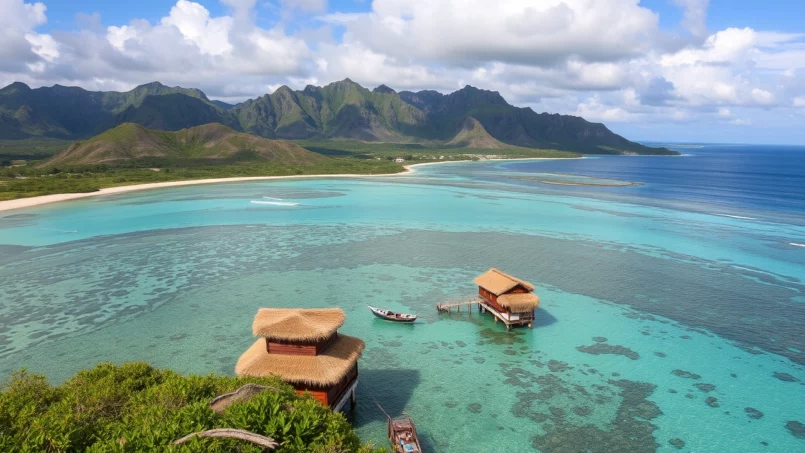
Before discussing programs, visas, or budget, one must grasp the singularity of the setting. Wallis and Futuna is a French overseas collectivity located in Polynesia, between Tuvalu, Fiji, Tonga, Samoa, and Tokelau. The territory consists of three main volcanic islands – Wallis (Uvea), Futuna, and Alofi – surrounded by numerous islets, for a total area of approximately 142 km².
The population of Wallis and Futuna, predominantly of Polynesian culture, is approximately 11,000 inhabitants.
French is the official language, but Wallisian (‘Uvea) and Futunian are very present in daily life. Censuses show that a majority of people over 14 years old speak Wallisian or Futunian first at home, and only a minority speak French as the main language in the household. The social environment is strongly Catholic, with a dense community life, customary festivals (katoaga), the kava ceremony, and a rich heritage of traditional dances (at least sixteen different forms are recorded).
For a foreign student, this means that one remains legally within the French and European space, but in a cultural framework that resembles Samoan or Tongan societies more than mainland France.
A French educational system… adapted to the Pacific
On the institutional level, education in Wallis and Futuna is integrated into the French system, under the authority of a vice-rectorate attached to the Ministry of National Education. The organization follows the major milestones known in mainland France, but with some specificities.
Primary, middle school, high school: French continuity
Primary education was long entrusted to the Directorate of Catholic Education (DEC), under a delegation from the State. This management has been progressively transferred to the vice-rectorate, which reinforces alignment with national standards while preserving a strong local religious and cultural imprint.
The territory has 18 primary schools spread across Wallis and Futuna. Secondary education is managed by the vice-rectorate, with six middle schools (four in Wallis, two in Futuna) preparing for the brevet diploma. Students can then continue at the state high school for a general or technological baccalaureate, or at the agricultural high school.
The names of some institutions – Mataotama middle school in Malae, Alofivai in Lano, Vaimoana in Lavegahau, Tinemui in Teesi, Fiua in Sigave or Sisia in Ono – remind us of how closely the school network follows the geography of the villages. For a student from mainland France, it’s the assurance of finding the major reference points (middle school, high school, baccalaureate), but in a much more intimate setting: fewer students, strong closeness between teachers and families, marked community anchorage.
Free access up to the baccalaureate
The other key point for anyone observing the territory from a study angle: it’s free. Schooling is free up to the baccalaureate diploma on the island of Wallis, and up to middle school level on Futuna. In short, all initial training until entry into higher education is done without tuition fees, within a certified French framework.
For families already settled locally, this system considerably reduces the financial burden compared to a path completed entirely in mainland France or abroad. For a mobile student, it testifies to a system structured around public service, with dense administrative oversight: in 2011, there were about 570 educational staff for just over 4,000 students.
An orientation turned outward
Historically, pursuing studies after the baccalaureate is done mostly outside the territory: mainland France, New Caledonia, sometimes Polynesia or other Pacific countries. Delegations from Wallis and Futuna exist in Nouméa, Papeete, and Paris to assist young people in their procedures for higher education abroad.
This massive choice of mobility is due to the small size of the archipelago and the limited number of fields available on site. But the dynamic is changing: local higher education and vocational training structures are emerging and now allow for considering, at least in part, higher education in Wallis and Futuna.
What higher education institutions are in Wallis and Futuna?
Unlike most territories of similar size, Wallis and Futuna does not settle for just a basic school system: a post-baccalaureate offering has been structured, mixing university programs, professional institutes, and distance learning systems. The whole remains modest, but it opens concrete possibilities for a study or mobility project.
The University of Wallis and Futuna (UWF)
Available information indicates the existence of a University of Wallis and Futuna (UWF), presented as the territory’s only university. It would offer several bachelor’s degrees in key fields:
– law
– economics
– management
– social sciences
– literature and culture
The university also houses a research center specialized in marine biodiversity and sustainable development. Given the island context, this is an obvious strategic axis: coral reefs, fishery resources, climate vulnerability, and coastal erosion provide an ideal study ground for intersecting natural sciences, environmental law, resource economics, and public policy.
Even if UWF does not appear in major international rankings like Times Higher Education, it is part of the French and European university network. For an external student, two points follow:
The degrees awarded follow the LMD (bachelor’s-master’s-doctorate) logic, making them perfectly readable and recognized in the European Higher Education Area. At the same time, the research environment is very specialized. It is characterized by a strong field dimension, operating in an ecosystem akin to an open-air laboratory, thus offering exceptional study and experimentation conditions.
Vocational training institutes
Alongside the university, several structures complete the post-baccalaureate landscape, focusing on professional integration and in-demand professions.
The Wallis and Futuna Training Institute (IFWF) is a public vocational training center. It offers programs in accounting, management, tourism, construction, automotive mechanics, as well as language courses (French, English, Wallisian). For a French-speaking or English-speaking foreign student, it can offer a dual opportunity: train for a profession while developing linguistic and intercultural skills specific to the Pacific.
The Center for Professional Training and Agricultural Promotion (CFPPA), targets agriculture, horticulture, and landscaping. It has a farm that allows learners to confront field reality: livestock management (especially pigs, at the heart of local subsistence), subsistence crops (taro, yam, banana, coconut) and adaptation to climatic constraints.
This professional orientation is consistent with the structure of the local economy, largely based on traditional agriculture, fishing, and some processing activities (copra, crafts).
The Connected Campus: distance higher education, from the archipelago
One of the most original levers of the system is the Connected Campus, integrated into the Digital University of Wallis and Futuna (UNWF). Inspired by connected campuses deployed in mainland France, it allows students to follow distance higher education programs (BTS, DUT, bachelor’s degrees…) offered by partner universities and schools, while physically remaining in Wallis or Futuna.
The campus benefits from partial funding and various supports to ensure its development and excellence.
Partially funded by the Caisse des Dépôts et Consignations, a national public financial institution.
Benefits from the support and infrastructure of a partner higher education institution.
– an official label,
– state financial support (flat-rate subsidy per site and per student during the first years),
– and partnerships with the University of New Caledonia, the Agence universitaire de la Francophonie, the vice-rectorate and the chamber of commerce (CCIMA).
Students find there:
– equipped rooms (high-speed internet connection via the Tui-Samoa submarine cable and, increasingly, via satellites like Starlink),
– supervision (collective and individual tutoring),
– a community of learners that breaks the isolation implied by distance learning followed alone at home.
For a student coming from outside, this system can serve as a pivot for an academic stay project: administrative registration at a French or New Caledonian university, but daily student life in Wallis and Futuna, with the Connected Campus as a work base.
A high cost of living in a preserved setting
Choosing Wallis and Futuna as a study destination means accepting a paradox: life unfolds in a simple, lightly urbanized environment, without shopping malls or major infrastructure… but the cost of living is relatively high.
Why is life expensive?
The main reason is geographical isolation. The majority of consumer goods, equipment, and even a significant part of foodstuffs are imported. Freight shipping connections are limited, as are air connections (the only regular commercial connections are operated by Aircalin from New Caledonia). Transport costs passed on to prices are substantial.
Data compiled by specialized platforms like RocApply show that:
Without rent, the estimated monthly cost of living for a single person in Canada is nearly US $1,800.
Even converted to CFP francs or euros, these figures remain significant for students. In detail, several expense items stand out.
Housing, transportation, food: what to anticipate
Hotel structures are small-scale: there are family inns, guesthouses, a few hotels, and furnished studios. Average monthly rents reported by international comparators give an idea:
| Type of Housing | Estimated Average Monthly Cost* |
|---|---|
| Studio / 1 bedroom (center) | ≈ 97,500 XPF |
| Studio / 1 bedroom (periphery) | ≈ 97,500 XPF |
| 3-bedroom apartment (center) | ≈ 244,000 XPF |
| 3-bedroom apartment (periphery) | ≈ 244,000 XPF |
Estimates from market data; exact values vary by property.
Regarding transportation, the absence of structured public transport often surprises newcomers. There are no buses or official taxis. Solutions are therefore limited:
– car rental (approximately 8,000 XPF per day in some cases, or around US $140);
– chartered boat to reach certain islets;
– rare and expensive internal flights (a round trip can approach US $400);
– no ferry connection between Wallis and Futuna.
The high price of fuel significantly increases the mobility budget. For a student, it is therefore advisable to prioritize housing located near the place of study or a Connected Campus, in order to limit costly travel.
Food reflects the same tension between domestic economy and external dependence. Part of the fresh produce comes from subsistence farming (root vegetables, tropical fruits, pig farming), but the slightest imported product – meat, dairy products, canned goods, alcohol, tobacco – sees its price multiplied. Records show sometimes impressive amounts for common items (bread, eggs, milk, yogurt, wine, cigarettes, etc.). Building a realistic budget therefore requires anticipating a high food envelope, even when cooking for oneself.
Services (electricity, water, internet) represent another item not to be overlooked. A “standard” monthly bill for electricity, gas, and water can be around a hundred euros, to which is added fixed internet access (several tens of thousands of CFP francs for unlimited high-speed) and, possibly, a mobile plan.
To summarize, several comparisons give an interesting order of magnitude:
| Comparison | Cost of Living (incl. rent) | Cost of Living (excl. rent) | Rents |
|---|---|---|---|
| Compared to Singapore | ≈ 44% cheaper | ≈ 4% more expensive | ≈ 72% cheaper |
| Compared to France | ≈ 0.3% more expensive | ≈ 20% more expensive | ≈ 26% cheaper |
Living in Wallis and Futuna costs, overall, as much as in mainland France, or even a bit more excluding rent, but with significantly lower rents. What weighs are imported products and services.
Visa, status, and insurance: the administrative framework
The status of a French overseas collectivity largely simplifies the visa issue for European nationals, while imposing a certain formalism for students from third countries.
Who needs a visa to study in Wallis and Futuna?
For citizens of the European Union as well as Andorra, Iceland, Liechtenstein, Monaco, San Marino, and Switzerland, entry and stay are free, without a duration limit. Simply using the national identity card is sufficient to travel from France or other French departments and collectivities. These groups do not need a visa to come study in Wallis and Futuna.
For nationals of many other countries, a short stay (less than 90 days) may be possible without a visa, depending on lists set by French authorities (Australia, Canada, Japan, United States, several Latin American, Pacific countries, etc.). However, as soon as it concerns a study project longer than 90 days, a long-stay visa is required.
The procedure is done via the France-Visas portal, which allows checking the need for a visa, filling out the online form, then submitting the file to the competent French consulate or embassy. Indicative processing times are:
– at least 5 working days for a short stay,
– approximately 20 working days for a long-stay visa.
There is no “express” procedure: one must anticipate, especially during high season (December to February).
Typical supporting documents
In practice, for a study project in Wallis and Futuna longer than three months, the requirements are close to those for a student visa for mainland France, with some particularities linked to overseas territories. Commonly requested documents include:
– passport valid at least 6 months after the intended end of stay, with enough blank pages;
– completed and signed online application form;
– compliant passport photos;
– proof of enrollment or pre-enrollment in an institution (UWF, institute, partner university via Connected Campus);
– proof of sufficient financial resources to cover the stay (bank statements, sponsorship letter, scholarship);
– proof of accommodation (hotel reservation, lease, hosting certificate);
– insurance covering medical expenses, hospitalization, repatriation, and medical evacuation, with a minimum coverage of €30,000, valid for France and its territories.
Additionally, if applicable, a criminal record certificate, medical certificates (especially in case of a particular health context) and, for some countries, proof of language level if the program follows a Francophone curriculum.
Health: a proficient local system, but caution is still advised
A notable advantage for residents – and, in some cases, for students who settle – lies in the free medical care and medications on site. A health agency manages the Sia hospital on Wallis (42 beds, operating room, intensive care, maternity, radiology, scanner, dental, pharmacy…) and the Kalaveleve hospital on Futuna (9 beds, general consultations, dental, maternity, radiology, gynecology, emergencies).
For complex pathologies, medical evacuations are organized to New Caledonia, Australia, or mainland France, with, since the arrival of fiber optic in 2018, an increasing use of telemedicine. For a foreign student, insurance remains mandatory however and must cover these possible repatriations and evacuations, even if, in practice, many local treatments are covered by the system.
Living and studying in a Polynesian microcosm
Beyond academic and administrative questions, the study experience in Wallis and Futuna is above all an immersion into a small-scale, very close-knit society, where the community takes precedence over the individual.
The place of custom and religion is central. Collective festivals (katoaga) bring together families, villages, and sometimes kingdoms around ceremonies, dances, abundant meals, gifts, and counter-gifts. Music, dance (faive and other forms), textile arts (tapa, mats, necklaces) structure cultural life and even provide employment, notably for making beaten bark cloth (tapa/gatu/siapo).
For a foreign student, participating in local events offers a unique opportunity for intercultural learning. It allows grasping values like respect for elders, solidarity, and reciprocity, which often contrast with the individualism of major Western university cities. Furthermore, learning a few expressions in Wallisian or Futunian is greatly appreciated and greatly facilitates integration.
A safe, but isolated environment
Indicators show an extremely low crime level. Testimonies mention a climate of near-absolute safety, where the risk of assault or delinquency remains marginal. For families, it’s a decisive argument when allowing an adult child to go far from mainland France.
On the other hand, the isolation is felt:
The absence of cinema, theater, and large shopping centers, a limited offering of cafes and restaurants, as well as the lack of public transport and the low number of air connections characterize this place.
The positive counterpart is direct access to lagoons, diving, fishing, hiking, water sports. The climate, tropical humid, averages around 26‑27°C (79‑81°F), with a hot and rainy season (November‑April) and a drier and relatively cooler season (May‑October). For outdoor activities, the dry season remains the most pleasant.
For a student, this environment can be double-edged: ideal for focusing on studies, practicing sports, and living at a slower pace; but potentially generating loneliness or “isolation shock” if one is used to nightlife and large urban campuses.
Combining Wallis and Futuna with international mobility
Another way to think about studies in Wallis and Futuna is not to consider them in isolation, but integrated into a broader path, including subsequent (or parallel) stays in other countries.
Scholarships intended for natives of Wallis and Futuna
For students native to the territory, many international programs exist, notably toward Australia, New Zealand or other Pacific countries and beyond.
The Australia Awards Scholarships target, for example, future leaders from Pacific countries and territories, including Wallis and Futuna. They cover tuition fees, travel, health, and part of living costs for university cycles in Australia, with a mandatory return to the territory after studies. Priority areas for Wallis and Futuna include:
Our main sectors of intervention and specialized competencies for tailored support
Support for small and medium-sized enterprises in tourism, crafts, and primary sectors.
Integration of sustainability and responsibility principles into organizational strategies and operations.
Expertise in marine studies and sustainable management of ocean and coastal resources.
Actions and strategies to combat climate change and preserve biodiversity.
Other programs, like NZAID scholarships (New Zealand), fund technical or university training for young people from Wallis and Futuna, with curricula combining intensive English courses and degree programs.
For an external student who would like to complete part of their curriculum in Wallis and Futuna, these scholarships are not directly accessible, but they show in which fields the territory positions itself: environment, blue economy, climate risk management, sustainable tourism.
A bridge territory for academic exchanges
Wallis and Futuna also serves as a field of study, internship, or immersion for foreign students. A recent example concerns the Australian university of Wollongong, which organized a program for students interested in French and public health, combining a stay in New Caledonia and a visit to Wallis and Futuna, funded by a grant from the Australian government.
This type of initiative illustrates the territory’s potential for research or short-term mobility projects:
– public health studies in an isolated island context;
– observation of educational policies in an overseas vice-rectorate;
– field surveys in social sciences on the coexistence between French administration and traditional chiefdoms;
– community development, risk management, or social economy projects.
In this case, the goal is not necessarily to obtain a local diploma, but to validate credits (ECTS or equivalents) at the home institution, via an exchange program, an internship, or a field thesis.
Language and level of French: a major asset
Because Wallis and Futuna is part of the French Republic, the language of instruction and administration is French. Unlike other English-speaking Pacific destinations, you will not be asked to justify an English level, but rather a sufficient level of French to follow courses.
The reference framework: CEFR and French diplomas
French and Francophone higher education institutions – mainland, overseas included – generally refer to the Common European Framework of Reference for Languages (CEFR) to assess language skills. For integration into a bachelor’s program, a B2 level is often considered a minimum, B1 sometimes being sufficient in certain cases or for specific fields, but with a risk of academic difficulties.
The French Ministry of Education awards several internationally recognized diplomas:
– DELF (A1 to B2);
– DALF (C1, C2);
– DUEF (University Diploma in French Studies, levels A1 to C2).
These certifications are generally accepted as proof of level by universities. In the context of Wallis and Futuna, they may be required or recommended for non-French-speaking students wishing to join UWF or follow distance courses via the Connected Campus, according to the partner university’s criteria.
Preparing your French level before departure
For a future student who is not a native French speaker, several options allow preparing or attesting to their level before submitting an application:
To justify your French level, several certifications are accepted: take a DELF B2 or DALF C1/C2 at one of the over 1,000 accredited centers worldwide; follow a DUEF at a French university offering FLE courses, a diploma often recognized as equivalent to a university language level; or take the TCF or TEF, depending on the specific requirements of the host institution.
Many online learning platforms (like PrepMyFuture for TEF/TCF tests, or Alliance Française tests) offer complete preparations: adaptive exercises, mock exams, grammatical and lexical revisions, etc.
For a study project in Wallis and Futuna, aiming for a solid B2 level in oral/written comprehension and expression is clearly a guarantee of success, especially since academic French will be superimposed on Wallisian/Futunian orality in daily life.
Working alongside studies: what possibilities?
Available information on student employment in Wallis and Futuna remains patchy, but several avenues for part-time jobs appear in sectors related to tourism, services, and the digital sector.
Types of possible jobs
In a context of a small economy, structured offers are limited, but needs exist:
Sectors of activity offering professional prospects, particularly for multilingual and versatile profiles.
Accompanying international visitors, requiring proficiency in French, English, and possibly local languages.
Services for NGOs, institutions, or regional cooperation projects in French, English, and Polynesian languages.
Versatile jobs: service, customer reception, and kitchen assistance.
Salesperson or assistant positions in shops and supermarkets.
Writing, translation, virtual assistance, or surveys, facilitated by high-speed internet.
Support for management and accounting within small businesses.
The small size of the market means that one should not count on an abundance of positions, but rather on occasional, sometimes informal opportunities, to be negotiated case by case. International job search platforms moreover report very few – if any – offers located in Wallis and Futuna.
Work rules for foreign students
The applicable rules depend on the type of visa and status. As a French collectivity, Wallis and Futuna largely follows French residence law: a holder of a student visa for France generally benefits from a possibility to work limited to a certain number of annual hours, under conditions. However, it is advisable to inquire precisely with the consular authorities and the territory’s prefect, as adaptation to local realities may introduce specificities.
Citizens of the European Union have in principle the right to work, but effective access to employment depends primarily on the presence of employers and market needs. Priority is systematically given to local residents and Wallisian and Futunian job seekers.
Building a realistic project: for whom is Wallis and Futuna suitable?
At the end of this overview, a question remains: who is this higher education destination really for?
Profiles for which the territory makes sense
Several profiles emerge:
This section presents the different student profiles for whom a study field in French Polynesia can constitute a unique academic and professional opportunity.
French-speaking students in environmental science, marine biology, geography, climatology, or sustainable development, seeking a concrete island field for a thesis, internship, or observation semester.
Students in social sciences, law, or political science interested in the coexistence of French institutions / customary structures, political anthropology, or overseas governance.
Students from business schools or IAE wishing to analyze island economies, overseas development models, public transfers, fishing licenses, or migrant remittances.
Future teachers, educators, or specialists in comparative education wanting to observe an overseas vice-rectorate and pedagogical adaptations in a bilingual or multilingual context.
Students in public health or medicine wishing to understand healthcare management in an isolated territory, telemedicine, medical evacuations, and prevention.
Students in French languages, culture, and civilization seeking a non-mainland Francophone variant, where French coexists with two Polynesian languages.
For these profiles, a stay of a few months to a year, backed by a university registration (UWF, partner university of the Connected Campus, or foreign university within an exchange) can constitute a highly valuable academic and human experience.
Conditions for a successful stay
Three conditions appear decisive:
Wallis and Futuna is not a suitable destination for a simple leisure semester. A stay in these islands makes full sense when it is part of a research project, field work, or an academic specialization, for example in environment, Pacific studies, or overseas studies.
2. A linguistic and cultural preparation. Mastering French, taking an interest in Wallisian and Futunian, learning about custom, the place of the Church, traditional structures, helps avoid misunderstandings and gain the trust of residents.
3. A solid budget. The high cost of living, rare and expensive transport, the need to have a financial cushion in case of health problems or early return require planning a realistic budget, possibly supplemented by a scholarship or aid.
Conclusion: a mobility against the grain, but rich in meaning
While most students considering higher education abroad first think of major university capitals – Paris, London, Montreal, Sydney, Berlin – choosing Wallis and Futuna is to take the opposite path. It’s preferring a sparsely populated territory, off the beaten track, strongly community-based, where lagoons replace subways and where custom sets the rhythm of life as much as the academic calendar.
For a precise and well-constructed academic project, this destination offers an exceptional field of study. It serves as a full-scale laboratory for environmental and social sciences, an observatory of overseas public policies, and allows the application of knowledge in law, economics, or management applied to a micro-state-territory.
The educational infrastructure – UWF, professional institutes, Connected Campus – offers a sufficient base to anchor this experience in a recognized curriculum. All within a French framework, with the advantages linked to the status of a collectivity of the Republic (language, diplomas, social protection, legal framework).
Studying in Wallis and Futuna is not an obvious choice for everyone, and it is certainly not an easy solution. But for those seeking a mobility with high human and intellectual intensity, far from the beaten path, it can emerge as a profoundly coherent and singular choice in an international study path.
Disclaimer: The information provided on this website is for informational purposes only and does not constitute financial, legal, or professional advice. We encourage you to consult qualified experts before making any investment, real estate, or expatriation decisions. Although we strive to maintain up-to-date and accurate information, we do not guarantee the completeness, accuracy, or timeliness of the proposed content. As investment and expatriation involve risks, we disclaim any liability for potential losses or damages arising from the use of this site. Your use of this site confirms your acceptance of these terms and your understanding of the associated risks.

Cyril Jarnias is an independent expert in international wealth management with over 20 years of experience. As an expatriate himself, he is dedicated to helping individuals and business leaders build, protect, and pass on their wealth with complete peace of mind.
On his website, cyriljarnias.com, he shares his expertise on international real estate, offshore company formation, and expatriation.
Thanks to his expertise, he offers sound advice to optimize his clients' wealth management. Cyril Jarnias is also recognized for his appearances in many prestigious media outlets such as BFM Business, les Français de l’étranger, Le Figaro, Les Echos, and Mieux vivre votre argent, where he shares his knowledge and know-how in wealth management.





