
 Published on and written by Cyril Jarnias
Obtaining a passport of the British Virgin Islands is not an isolated step that can be settled with a simple form. This document is the culmination of a legal and administrative journey that begins well before the “passport” stage itself. Between resident status, Belonger status, naturalization as a British Overseas Territories Citizen (BOTC), and finally the issuance of the passport, the path is marked by several laws, public policies, and practical requirements.
This guide explains in clear terms the steps to obtain a passport, the required statuses, the competent authorities, and the rights granted, both in the British Virgin Islands and internationally.
Understanding the framework: territory, nationality, and local statuses
Before talking about forms and counters, we need to clarify the legal vocabulary that structures the nationality system and residency in the British Virgin Islands.
The British Virgin Islands are a British Overseas Territory. Residents who have a nationality link with the territory are classified as British Overseas Territories Citizens (BOTC) connected to the Virgin Islands. It is this BOTC status that allows for the issuance of the passport of the British Virgin Islands.
BOTC, Belonger, BVIslander: three levels not to be confused
Local law distinguishes several categories, which do not cover the same rights.
The status of British Overseas Territories Citizen (BOTC), defined by the 1981 Act, is the basis for obtaining a passport specific to the Virgin Islands. However, this status does not automatically grant the right of residence in an overseas territory; that right also depends on the local ‘Belonger’ status.
Next, the Belonger status. In the context of the British Virgin Islands, this is the legal status that marks permanent belonging to the territory, either by ancestry or by grant. It gives the right to enter and reside without immigration restrictions, work without a work permit, and acquire real estate without a special license.
Finally, the BVIslander status is considered the “highest” form of local belonging. It requires that at least one grandparent was born in the territory. All BVIslanders are Belongers, but the reverse is not automatic. And an essential detail for the passport: only a BVIslander can hold the passport of the British Virgin Islands in its “local” version that explicitly bears the name of the territory.
The following table summarizes the main differences.
| Status | Main legal basis | Right of residence in the British Virgin Islands | Right to the passport of the British Virgin Islands |
|---|---|---|---|
| BOTC (connected to the Virgin Islands) | British Nationality Act 1981 | Not automatic | Yes, subject to territorial link/BVIslander |
| Belonger | Immigration and Passport Act + Constitution | Yes, unlimited residence | Yes, if also BVIslander for the local passport |
| BVIslander | Constitutional law / local laws | Yes, plus extended political rights | Yes, only they can hold this specific passport |
Thus, one can be BOTC without being a Belonger, or a Belonger without being a BVIslander. To aim for the passport of the British Virgin Islands, one must combine the nationality link (BOTC) and the territorial belonging link (BVIslander).
A system aligned with British law but shaped locally
The legal framework rests on two blocks of texts. On one hand, the British Nationality Act of 1981, which governs nationality and naturalization for all British territories. On the other hand, the Immigration and Passport Act (1977, revised in 2014) and its 2024 amendment, which detail entry, residence, issuance of residence certificates, and Belonger status.
The local government adopted a Belonger Status and Permanent Residence Policy, debated in the House of Assembly. This policy clarifies the criteria, makes procedures more transparent, and serves as a guide for future revisions of the immigration law.
Finally, the Constitution of the Virgin Islands specifies who “belongs” to the territory: BOTC by birth, registration, or naturalization in the territory, or by descent from a parent born locally, as well as certain “settled” persons, i.e., residents without immigration restrictions.
The major steps before the passport: residence, Belonger, BOTC
For a foreigner wishing to one day hold the passport of the country in the British Virgin Islands, it all begins with residence. The system is based on time spent in the territory, integration, and good character.
Permanent residence: the first decisive milestone
The Certificate of Residence (Permanent Residence) is the first major step. The new policy sets a requirement of 10 years of ordinary residence to apply for permanent residence. This period was standardized in the Immigration and Passport (Amendment) Act 2024.
To be eligible, you must:
– have lived “ordinarily” in the territory for at least ten years;
– be at least 18 years old;
– demonstrate good character, evidenced particularly by a clear criminal record;
– show intention to make the British Virgin Islands your permanent residence.
The Cabinet, upon the recommendation of the Board of Immigration, may grant this Certificate of Residence. Once the certificate is issued, the holder can reside indefinitely. Holders of a Certificate of Residence are no longer tracked as simple visitors by the Immigration Department, even if they do not yet have the full rights of a Belonger.
Residence certificates can be renewed every five years to verify compliance with the laws.
From resident to Belonger: twenty years of presence and enhanced integration
For Belonger status, the bar is set higher. The general rule is as follows: 20 years of ordinary residence, including at least 10 years with permanent resident status. This is what the adopted policy and the 2024 amendment establish.
Qualitative criteria are added. The guidelines emphasize:
– participation in community life (associations, volunteering, etc.);
– respect for local laws and culture;
– economic self-sufficiency (ability to support oneself);
– sufficient proficiency in the English language.
Candidates must submit a substantiated file: letters of support from the community, tax evidence, business licenses, property deeds, language certificates, etc. The Board of Immigration sets up a points system to objectify the assessment (length of residence, skills, economic contribution, social integration…).
Even if all criteria are met, granting Belonger status remains discretionary. The Government reserves the right to consider reception capacity in terms of infrastructure, education, health, as well as social and economic balances.
However, there are other entry points:
British Virgin Islands nationality (BOTC) can be acquired primarily in three ways: by marriage to an islander, after a marriage period of three years (or five years depending on the procedure) and subject to valid residence status; by exceptional honor, an extremely rare grant; or by prior naturalization or registration as a BOTC, followed by alignment of local status.
Naturalization as a BOTC: the bridge to British nationality and the passport
To turn a long-term presence into nationality status, the standard path is naturalization as a British Overseas Territories Citizen. The Civil Registry & Passport Office handles these cases, based on the British Nationality Act.
An adult applicant (18 years or older) must generally demonstrate:
– five years of continuous legal residence in the territory, with at least one year under permanent resident status;
– limited absences: no more than 450 days outside the territory over five years, and no more than 90 days of absence in the final year;
– “good character“;
– sufficient knowledge of English and life in the UK/overseas territories.
Once the file is complete, an interview is arranged with an officer, then the file goes through a verification process. The average announced processing time is about six months. If the application is approved, the applicant is summoned to a naturalization ceremony, with an oath of allegiance or a promise of loyalty to the King. Following this, a naturalization certificate is issued, establishing BOTC (British Overseas Territories Citizen) status.
At this stage, the holder has the necessary legal basis to apply for a passport, but to obtain the passport of the British Virgin Islands as a BVIslander, they must also meet the local criteria of belonging.
Special cases: descent, marriage, adoption, historical injustices
The system provides several specific pathways:
– by descent: a child born to a BOTC or a Virgin Islands citizen parent may claim nationality by descent, especially if the parent was themselves born in the territory;
– by marriage: a foreigner married to a Virgin Islands citizen/Belonger for five years or more may apply for nationality, subject to meeting residence and character requirements;
– by adoption: a child adopted by a birth or descent BOTC may also acquire nationality;
– by remedy for “historical injustices” in British law: persons born outside the territories before 1983 to territorial mothers, or before 2006 to unmarried BOTC fathers, may apply for registration as a BOTC and, if they wish, as full British citizens.
In the latter case, applications are made via paper forms downloadable from the UK government website, with originals sent to the Home Office and biometric data collected. The Civil Registry & Passport Office serves as the local biometric center.
Rights attached to statuses: residence, work, property, and politics
Understanding what is gained at each step helps measure the value of the journey leading to the passport of the British Virgin Islands.
Certificate of Residence: security of stay, but limited rights
Holders of a Certificate of Residence may enter and remain indefinitely in the territory without being tracked as simple visitors. They benefit from stability to live and work, but must still obtain work permits, and do not have the hiring priority under the Labour Code for BVIslanders and Belongers.
Immigrants remain subject to immigration quotas, set each year by the Cabinet upon the recommendation of the Board of Immigration. These quotas are determined based on demographic criteria, labor market conditions, and housing availability.
Belonger: full access to the labor market, property, and voting
Belonger status makes one an “insider” of the territory.
A Belonger:
Belongers enjoy specific rights in the British Virgin Islands: freedom of entry and stay, the right to work without a permit, employment priority with BVIslanders, the right to vote as per the 2007 Constitution, the ability to acquire real estate without a special license with a reduced stamp duty of 4%, and lower business license fees compared to non-Belongers.
These economic and political incentives explain why Belonger status is a crucial step for those seeking deep roots, then the passport of the country in the British Virgin Islands as a BVIslander.
BVIslander and passport of the British Virgin Islands
BVIslander status, reserved for those who can trace at least one grandparent born in the territory, effectively confers all the rights of a Belonger, plus access to the passport that explicitly bears the name of the Virgin Islands.
The Constitution specifies that BVIslanders, as Belongers, also exercise local political rights, and it is they who exclusively have the possibility of holding the passport of the country in the British Virgin Islands in its “variant” form (cover with the territory’s name).
The passport of the British Virgin Islands: features and types
Once BOTC status and the territorial link are established, the passport application can be submitted to the Civil Registry & Passport Office, which is the issuing authority.
A British Overseas Territory passport
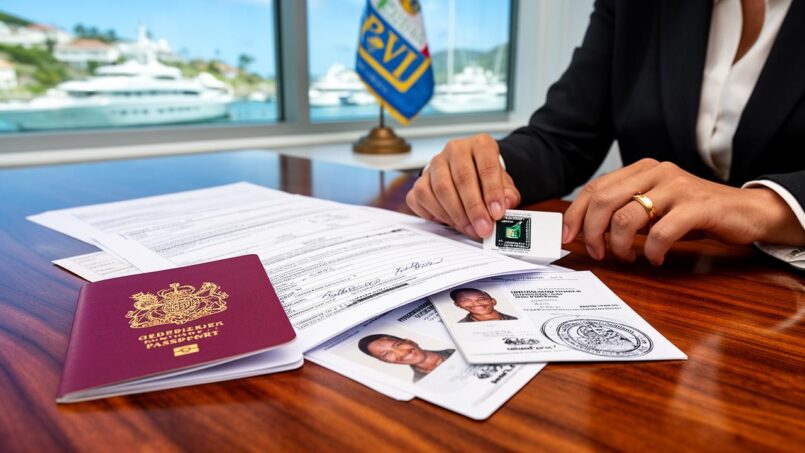
The document is a British passport of the British Overseas Territory Citizen type. Its cover is burgundy, with the wording “British Passport – the Virgin Islands“. The biographical page indicates the nationality “British Overseas Territories Citizen” and specifies “British Overseas Territories – the Virgin Islands“.
Two technologies coexist: e‑passports (with chip) and older non‑electronic models, still valid. For an adult, the standard validity is ten years; five years for a child under 16. Seniors aged 65 and over benefit from a free passport.
Variant vs. non‑variant: depending on place of application
There are two physical formats depending on where the application is made.
When an application is made in the territory, the Civil Registry & Passport Office issues a ‘variant passport’ specific to the British Virgin Islands. The cover then clearly bears the name of the territory.
Civil Registry & Passport Office of the British Virgin Islands
Conversely, if a BVIslander/Belonger is in the UK and renews their passport through His Majesty’s Passport Office using the British form, the booklet issued is a “non‑variant“: it looks visually like a standard British passport, without the “Virgin Islands” wording on the cover. The overseas territory specificity appears only on the biographical page, in the nationality line.
The following table illustrates these differences.
| Type of BOTC passport | Place of application | Cover appearance | Mention of the British Virgin Islands |
|---|---|---|---|
| “Variant” passport (local) | Application made in the territory | Cover with “British Passport – the Virgin Islands” | Yes, in full |
| “Non‑variant” passport (common format) | Application made in the UK | Identical to a standard British passport | No on the cover, yes on the biographical page |
In all cases, the fundamental authorization comes from BOTC status and the established link to the Virgin Islands, but the document’s appearance and the explicit mention of the territory depend on the place of issue.
The passport application procedure: from form to collection
Obtaining a passport follows a standardized administrative process, managed by the Civil Registry & Passport Office, established in 2005 and attached to the Governor’s Group.
Where and how to submit your application
Generally, applications are submitted in person to a Customer Service Representative at the Civil Registry & Passport Office, located in Road Town, with a branch office in Virgin Gorda. An online application system exists via the government portal, but physical presence remains the norm for registration and identity verification.
The official passport application form for BOTC (reference BOT/01/01) must not be printed double‑sided. Instructions specify not to fold the form, staple it, or use paperclips or glue on photos. Any error must be crossed out neatly, without correction fluid; beyond three errors per line or if the signature is illegible, a new form must be completed.
The different application categories are as follows:
– adult passport (16 and over) or child (under 16);
– renewal of a BOTC passport for five or ten years, intact;
– first BOTC passport application (after naturalization or registration);
– replacement in case of loss, theft, or damage;
– extension (for a passport initially issued for one year or less);
– change (name, photo when the holder is no longer recognizable).
In case of loss or theft of a passport, it is imperative to complete and submit form LS01 and attach a police report made at the place where the loss was noted. Furthermore, if the old passport is found after reporting, it must be returned to the authorities and becomes unusable.
Documents to provide and formal requirements
In addition to the form, the authorities generally require:
– the birth certificate, and if applicable the parents’ birth certificates;
– marriage and death certificates if relevant to the civil status history;
– BOTC naturalization or registration certificates;
– Belonger or permanent residence cards/certificates;
– previous passports (current and expired), of all nationalities held;
– documents evidencing any name change (deed poll, judgment, etc.);
– two recent passport‑style photographs, strictly meeting the standards defined on the UK website (size, background, expression, lighting).
For a first local passport application, additional information may be required in some cases about grandparents (names, places and dates of birth, marriage date) to strengthen proof of the territorial link. However, for a simple renewal, this data is generally no longer required.
The form must be completed in capital letters, with a black ballpoint pen, and inside the white boxes. First names and surnames must exactly match supporting documents. Special characters and accents are not included on the passport. Overly long names may be abbreviated to respect the 30‑character limit per block (first names and surname).
The role of the “countersignatory”
In most cases (first application, renewal, replacement, change), a third party must confirm the applicant’s identity: this is the countersignatory.
This person must:
– have known the applicant (or the parent signing for a child) for at least two years;
– not be a close relative;
– hold a valid passport issued by an eligible country (UK, Ireland, another EU state, USA, another British Overseas Territory, or a Commonwealth country);
– indicate their profession, employer’s name and address, and contact details;
– complete the dedicated section of the form (section 10);
– read the application to verify its accuracy;
– sign and date the back of one of the photos, with the appropriate certification wording.
The applicant must specify on the form which country issued the countersignatory’s passport and provide their email address.
Declaration, timelines, and collection
Section 9 of the form contains the declaration that the applicant must sign. For a child under 16, a parent or guardian signs, stating their name and relationship to the child. The signature on the form will be reproduced on the passport, hence the importance of staying within the designated box and writing legibly.
Discover the eight key steps that structure our internal process to ensure efficiency and quality.
Initiation and definition of project or task objectives.
Analysis of needs and available resources.
Detailed planning and schedule development.
Implementation and execution of planned actions.
Regular monitoring and progress tracking.
Review and adjustment of strategies if necessary.
Finalization and closure of main activities.
Evaluation of results and lessons learned (post-mortem).
1. submission of the application at the counter; 2. initial completeness check (screening); 3. formal acceptance of the file; 4. payment of fees and issuance of a receipt; 5. thorough processing, verification, and passport printing; 6. notification to the applicant (by phone or email); 7. collection of the passport at the counter; 8. verification by the holder, signing the passport, and entering into a delivery register.
The announced timeframe for a standard passport is approximately two weeks. Replacement applications after loss or theft may take longer. The administration stresses that no firm time commitment is given and strongly advises against booking travel before receiving the new passport.
How much does the passport of the British Virgin Islands cost?
The fees are clearly established for BOTC passports of the Virgin Islands.
| Type of passport or service | Age group / situation | Amount (USD) |
|---|---|---|
| BOTC passport – adult | 16 years and over | 125 |
| BOTC passport – child | 15 years and under | 105 |
| BOTC passport – senior | 65 years and over | Free |
| Temporary passport | Issued in an emergency | 65 (supplement) |
To these amounts may be added, at other stages of the journey, naturalization or registration fees. For example, for naturalization as a BOTC, locally announced fees include “stamp fee” components and processing fees, with different scales depending on whether the applicant has a Certificate of Residence, Belonger status, or is the spouse of a BOTC.
Temporary passport and travel emergencies
In exceptional circumstances, it is possible to obtain a temporary passport. These documents, printed locally, are only issued for humanitarian reasons (death, serious illness, etc.) or for urgent government missions.
To qualify, the applicant must:
– demonstrate the urgent and legitimate nature of the request with strong evidence;
– submit a full validity passport application in parallel.
A supplement of USD 65 is added to the usual fees to obtain a temporary passport. This document serves as a transitional solution while waiting for the definitive passport to be issued.
From the UK: applying for or renewing your passport
Many BVIslanders and Belongers live or study in the UK. They can renew their BOTC passport there, provided they use the UK route.
The procedure requires: all necessary steps to achieve the desired outcome.
To renew a British Virgin Islands British Overseas Territories Citizen (BOTC) passport via the UK system, proceed as follows: obtain the application form at a Royal Mail post office or online at the HM Passport Office (HMPO) website. Fill it out, clearly indicating in section 8 (or via an attached note) that it is a renewal of a BVI BOTC passport. Adapt instructions by replacing ‘UK’ references with ‘BVI/BOTC’ where applicable. Submit your application according to UK procedures: secure postal submission or an appointment for urgent service. The finalized passport can be collected at a designated Royal Mail post office.
In this case, the document issued will be a “non‑variant” booklet with a cover identical to that of a standard British passport, without the “Virgin Islands” wording on the front cover. The BOTC specificity appears only in the “nationality” field of the electronic page.
Residents in the UK can use the expedited services offered by HMPO: Online Premium (very fast issuance, by appointment) or 1 Week Fast Track, payable online by bank card. However, it is impossible to obtain a “UK” passport remotely: for that, even a BVIslander/Belonger must be physically present in the UK at the time of application.
What the passport allows: international mobility and access to the UK
The passport of the British Virgin Islands opens doors, but its power is not equivalent to that of a British citizen passport. It remains a recognized identity document, offering various visa regimes.
Visa‑free travel, eVisa, or visa on arrival
Holders of this passport have visa‑free access to a small number of countries or territories, for varying durations. These include:
– Cook Islands;
– Dominica;
– Haiti;
– Mexico (up to 180 days);
– Micronesia;
– as well as some African countries like Tanzania or Zambia, with conditions reported as fluctuating.
Number of additional destinations accessible to French passport holders through eVisa and visa on arrival.
This freedom of movement is, however, more limited than that attached to the British citizen passport, which gives access, visa‑free or with visa on arrival, to over 180 countries and territories.
Access to the UK and British citizenship
Since 2002, all Virgin Islands citizens, as BOTCs, have been granted full British citizenship. This means a BVIslander holding a BOTC passport can also apply for a standard British passport as a British citizen, subject to the steps at HM Passport Office. The rules even allow holding multiple British passports (BOTC and citizen).
For travel to the UK with a BOTC passport linked to the Virgin Islands, no Electronic Travel Authorization is required for visitor stays of up to six months. To work, study long‑term, or settle, however, an appropriate visa or a Biometric Residence Permit (BRP) must be applied for.
Entry to the British Virgin Islands and formalities in reverse
To return to or enter the British Virgin Islands, all travelers must present a valid passport. Local rules require validity covering the entire stay for visitors, and at least three months beyond arrival for residents. Entry is refused to those attempting to use a passport declared lost or stolen.
As of January 1, 2025, an immigration and customs form must be completed online within 72 hours prior to arrival. It requires travel information and a digital copy of the passport’s biographical page, and generates a QR code to present upon arrival. This new system gradually replaces paper forms.
Visitors generally receive a one‑month stay stamp , extendable up to six months by decision of the Chief Immigration Officer , upon proof of financial means, accommodation, and an outbound ticket.
Why the government strictly controls statuses and passports
The 2024 amendment and the new policy on residence and Belonger status are part of a broader reflection: how to manage population growth and immigration without unbalancing the economy or overburdening infrastructure?
The authorities set annual quotas for certificates of residence and Belonger status. These quotas are established after analysis of demographic data, the labor market, and housing stock, in coordination with ministries, the Board of Immigration, and the Department of Labour. The goal is to balance economic development (attracting investors and skilled workers) with the sustainability of public services such as schools, hospitals, roads, and housing.
This context explains the selectivity of access to Belonger status, a key step before being able to fully claim the passport of the country in the British Virgin Islands as a BVIslander. The administration also emphasizes social integration, community participation, and respect for local culture as acceptance criteria.
In summary: a long, structured, but clear path
Gaining access to the passport of the country in the British Virgin Islands is the ultimate step in a journey with several concentric circles.
Obtaining permanent resident status (Belonger status) in the Turks and Caicos Islands is a gradual process. It first requires ten years of residence for a Certificate of Residence, then twenty years of roots or a strong family link (marriage, descent). Concurrently, naturalization as a British Overseas Territories Citizen requires meeting strict conditions of physical presence, good character, and English language proficiency.
Once these milestones are reached, the actual passport process is relatively standard: form, photos, countersignatory, in‑person submission, then collection about two weeks later, for reasonable fees with scrupulous attention to administrative details.
At the end of the road, the passport of the British Virgin Islands materializes not only a legal status but a genuine belonging to a territory that claims the right to choose, with clarity and transparency, who can become a full member.
Disclaimer: The information provided on this website is for informational purposes only and does not constitute financial, legal, or professional advice. We encourage you to consult qualified experts before making any investment, real estate, or expatriation decisions. Although we strive to maintain up-to-date and accurate information, we do not guarantee the completeness, accuracy, or timeliness of the proposed content. As investment and expatriation involve risks, we disclaim any liability for potential losses or damages arising from the use of this site. Your use of this site confirms your acceptance of these terms and your understanding of the associated risks.

Cyril Jarnias is an independent expert in international wealth management with over 20 years of experience. As an expatriate himself, he is dedicated to helping individuals and business leaders build, protect, and pass on their wealth with complete peace of mind.
On his website, cyriljarnias.com, he shares his expertise on international real estate, offshore company formation, and expatriation.
Thanks to his expertise, he offers sound advice to optimize his clients' wealth management. Cyril Jarnias is also recognized for his appearances in many prestigious media outlets such as BFM Business, les Français de l’étranger, Le Figaro, Les Echos, and Mieux vivre votre argent, where he shares his knowledge and know-how in wealth management.





