
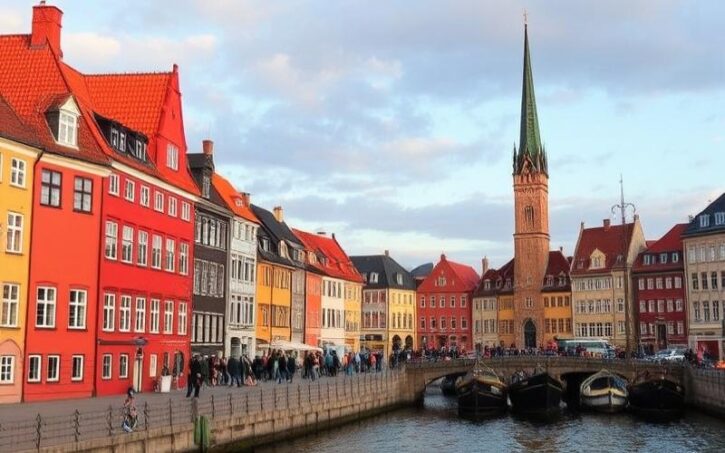
 Published on and written by Cyril Jarnias
Settling in Denmark means entering a paradoxical country: officially Lutheran, largely secularized, very tolerant yet rather reserved when it comes to faith. For an expatriate, religion will not structure daily life as it does in other parts of the world, but it remains deeply interwoven with national identity, the calendar, family rituals, and certain societal debates. Understanding this landscape helps to avoid missteps, better read local news, and, if one wishes, find a community of believers.
This guide is based on recent research data, including statistics, the legal framework, the practices of the Folkekirken (People’s Church), the life of religious minorities, as well as holidays and social codes related to religion.
A very Lutheran country… with very little religious practice
Denmark is one of the most secularized countries in the world, while still officially being a state church nation. The Evangelical Lutheran Church, called the Folkekirken or Church of Denmark, is inscribed in the Constitution as the Church of the people and enjoys a special status.
From an administrative point of view, the majority of residents are members. In 1984, over 91% of the population was registered with the Folkekirken; by 2024, this proportion had fallen to about 71.2%. The trend is clearly downward, but even today, being a “church member” remains the default situation.
Only 19% of Danes consider religion important in their daily lives.
In practice, the Folkekirken functions both as a religious institution and a civic infrastructure: it keeps the vital records, manages a large portion of cemeteries, hosts major life milestones (baptisms, confirmations, weddings, funerals), and runs social or cultural activities. One can pay an optional church tax (kirkeskat) to fund this structure, maintain the buildings, and have easy access to rites.
A few key figures
The table below gives an idea of the trend in membership of the Church of Denmark and the place of major religions in the country.
| Indicator | Approximation / Result | Source / Period |
|---|---|---|
| Members of the Folkekirken (1984) | 91.6% of the population | Official statistics |
| Members of the Folkekirken (2019) | 74.7% | Official statistics |
| Members of the Folkekirken (2024) | 71.2% | Recent estimates |
| Share declaring themselves atheist (2013) | Just under 20% | National polls |
| Religion “important in life” | 19% | Gallup 2009 |
| Believe in God | 28% | Eurobarometer 2010 |
| Believe in a force or spirit | 47% | Eurobarometer 2010 |
| Believe neither in God nor a spirit | 24% | Eurobarometer 2010 |
| Muslims (2020, central estimate) | ~4.4% of the population (≈ 256,000) | Researcher estimates |
| Catholics (2017) | 47,673 members | Catholic Church in Denmark |
| Jews (population of Jewish origin) | Approximately 6,000 | Jewish community |
| Practicing Buddhists (2009) | ~20,000 | Aarhus University |
| Hindus (2020) | ~40,000 | Demographic estimates |
| Sikhs | ~4,000 | Estimates |
| Neopagans Forn Siðr | ~500 registered members | Official data |
For an expatriate, this means two important things. On one hand, mentioning one’s own beliefs is not shocking, but don’t expect faith to structure everyday interactions. On the other hand, religion remains a marker of national identity: being “Danish and Lutheran” is still part of the collective narrative, even for non-believers.
The legal framework: freedom of religion but a state church
The Danish constitution guarantees freedom of worship. Everyone may gather to practice their religion, as long as it does not offend public order or decency. No one may lose civil rights because of their religious convictions, and no one can be imprisoned for their beliefs.
Several constitutional articles grant a privileged status to the Evangelical Lutheran Church of Denmark. It is recognized as the people’s church, supported by the state. The monarch is required to be a member, a Minister for Ecclesiastical Affairs is responsible for it, and bishops are public officials partly paid by state funds.
Other religious communities do not need to be recognized to exist, but the status of a “recognized” or “approved” community offers concrete advantages: performing marriages with civil validity, managing specific cemeteries, obtaining residence permits for religious leaders, benefiting from certain tax breaks or grants from national lottery funds. An expert body attached to the Ministry of Justice assesses applications for recognition.
A point that often surprises expatriates from strictly secular countries: all taxpayers indirectly contribute to the funding of the *Folkekirken* (the Danish People’s Church), even if they are not members. This is because the Church carries out non-confessional functions, such as registering births and deaths, and managing cemeteries. A state subsidy covering these tasks corresponds to a small average annual contribution from every citizen, members and non-members alike.
Furthermore, several recent laws have directly or indirectly a religious dimension, particularly concerning Islam: a general ban on face coverings in public spaces, regulation of slaughter without prior stunning, legislation on hate speech in a religious context, criminalizing the “inappropriate treatment” of religious texts (which in practice targets Quran burnings). For a Muslim, Jewish, or simply religiously observant expatriate, these laws are part of the context to be aware of.
The Folkekirken from the inside: worship, rituals, and parish life
Even though regular practice is low, Lutheran churches still structure the landscape and the symbolic life of the country. There are about 2,200 parishes and over 2,300 places of worship, many of which are old medieval churches perched on hills, visible from afar and surrounded by landscaped cemeteries.
Parishes are grouped into deaneries, themselves part of 10 dioceses on mainland Denmark, plus one diocese in Greenland. The Diocese of Copenhagen has a special historical place, its bishop being considered primus inter pares among the others.
What does a typical Sunday service look like?
The main Sunday service, called højmesse (high mass), is open to all. It follows a relatively stable pattern: bell ringing, prayer, several biblical readings (Gospel, Epistles and, since the 1990s, an Old Testament text), hymn singing, the pastor’s sermon, intercessory prayer, and, very often, celebration of Holy Communion. It is not uncommon for a baptism to take place during the same service.
During services, the pastor wears a black robe with a ruff, a large white pleated collar, an outfit prescribed by law and inherited from post-Reformation fashion. The congregation’s body language is codified: people stand for biblical readings as a sign of respect for the Word, and remain seated during prayers and hymns to foster reflection. The pastor alternates his position: he turns towards the congregation to speak “on behalf of God” (reading, preaching) and towards the altar to address God on behalf of the faithful (prayer).
A practice that sometimes surprises newcomers: the importance of singing. Hymns are chosen by the pastor, sometimes in consultation with the church musician, and the official hymnbook is part of the common culture. Many non-believing Danes know at least the major Christmas or Easter songs. Furthermore, historic organs and the work of organists hold a central place.
Etiquette and small sociology of Sunday morning
The Sunday service is often held around 10 a.m., a habit rooted in the time when farmers’ milking and the midday lunch had to be considered. In some places, the congregation leaves the church quickly after the service; in others, parish coffee (kirkekaffe) or a light lunch extends the moment.
Donations collected during the service are allocated transparently to specific projects each week.
Support for charitable and social actions, in Denmark or abroad.
Funding for initiatives and activities dedicated to young people.
Support for evangelization and missionary actions.
For an expatriate, participating in a service is not a problem, even if you are not a church member. Simply follow the gestures of the rest of the congregation: stand up, sit down, sing if you wish. Take communion or not according to your conscience and tradition. Pastors are generally used to briefly explaining the liturgy to newcomers, especially in large cities.
A highly feminized and rather inclusive Church
The Folkekirken is distinguished by a strong presence of women in the clergy: more than half of the pastors are women, and several dioceses are led by female bishops. Female ordination has been permitted since 1948, with the first woman bishop consecrated in the 1990s.
Since 2012, same-sex marriages can be celebrated in Lutheran churches. The law allows a margin of conscience for pastors, who may refuse to officiate such a marriage, but the institution as a whole offers an official ritual for these unions. In practice, a majority of pastors declare themselves in favor of these celebrations, while a minority conservative current opposes them.
Lutheran Church
For LGBT+ believing expatriates, this means it is possible, depending on the parish, to find a relatively welcoming liturgical framework, in a country where public discourse is largely in favor of equal rights.
Major religious holidays in the Danish calendar
Even if faith is discreet, the Danish calendar remains largely structured by major Christian holidays. Official holidays mark the year, administrations close, stores follow restricted hours, and many popular customs, sometimes very secularized, retain a religious anchor.
From Christmas to Easter: a very marked cycle
The Christmas season is certainly the most important. Advent begins on the fourth Sunday before Christmas: families light a candle on the Advent wreath each week, use calendars (paper, chocolate, television) to count the days, and cities light their large Christmas tree on the first Sunday of Advent. The notion of hygge — a cozy atmosphere, soft light, conviviality — is everywhere associated with this time.
On December 13th, the feast of Saint Lucia, originating from Sweden, gives rise to processions of children carrying candles and singing a specific hymn. Then comes the heart of the Christmas holidays, which in Denmark takes place on the evening of December 24th, not the 25th. Most families attend a service in the afternoon, often the most attended celebration of the year, before sharing a traditional dinner consisting of roast pork, duck, or goose, caramelized potatoes, red cabbage, and brown gravy.
The dessert, risalamande (sweetened rice pudding) served with hot cherry sauce, hides a whole almond. The person who finds it receives a small gift, often a marzipan pig. After the meal, the family holds hands and walks around the lit Christmas tree singing Christmas carols, before opening the presents. In this context, the iconography of Santa Claus (Julemanden), supposedly coming from Greenland, mixes with that of domestic elves (nisser) for whom a bowl of porridge is sometimes left out.
Throughout December, the season of Julefrokoster (Christmas lunches/parties) is in full swing: companies, associations, and families organize these highly codified meals, with buffets of specialties, Christmas beer (Juleøl), mulled wine (gløgg), and a sociability that blends diffuse religious tradition and secular celebration.
At Easter, several days are public holidays: Maundy Thursday, Good Friday, Easter Sunday, and Easter Monday. Danes often use this period for family or friend lunches, with traditional dishes like fish, eggs, lamb, and snaps (aquavit). For children, activities include egg hunts and decorating hard-boiled eggs. A typically Danish tradition is sending gækkebreve, anonymous, cut-out letters accompanied by a poem. If the recipient doesn’t guess the sender, they owe them a chocolate egg.
Explicit religious symbols — Resurrection, Passion — remain present in sermons and some songs, but for a large part of the population, these days are mainly synonymous with vacation, meals, and leisure, which does not prevent the maintenance of customs like flying flags at half-mast on Good Friday.
Public holidays, national memory, and religion
Several other days mix religious reference and historical commemoration. The Ascension of Christ is a holiday, as is Pentecost, which liturgically marks the birth of the Christian Church. Other days, such as Constitution Day or the country’s liberation in 1945, involve the official use of the flag and may be accompanied by religious services or special prayers.
‘Great Prayer Day’ (Store Bededag), celebrated on the fourth Friday after Easter, is no longer a public holiday in Denmark as of 2024. This former religious holiday was marked by eating hot cross buns the evening before and walks on Copenhagen’s ramparts to listen to the bells. Although the holiday has been abolished, some of these gastronomic and cultural traditions persist, illustrating the transition from a religious holiday to a popular custom.
For an expatriate, the message is simple: even if you are not interested in religion, these dates govern the organization of work, school, transportation, and structure many invitations or social events. Public holidays are not moved if they fall on a weekend. It is therefore useful to keep an eye on the liturgical calendar, if only to plan your trips or understand why everything is closed.
Religious minorities: Islam, Judaism, Catholicism, and other presences
Behind the Lutheran facade, today’s Denmark is religiously diverse. Islam is the second religion, followed by Catholicism, various free Protestant churches, Judaism, Buddhism, Hinduism, Sikhism, and neopagan currents.
Islam: the country’s second religion
Islam represents around 4 to 5% of the population, or about a quarter of a million people. Most live in large cities, particularly the Copenhagen area, Aarhus, and Odense. Historically, the massive Muslim presence dates back to the 1960s-1970s, with the arrival of workers from Turkey, Pakistan, Morocco, or Yugoslavia, followed by refugees from Iran, Iraq, Somalia, Bosnia, and Afghanistan.
Denmark now has nearly 185 mosques or prayer rooms.
For a Muslim expatriate, it is therefore not difficult to find a place of prayer in large urban areas, especially since apps like HalalTrip list mosques and prayer rooms. The five daily prayers can be performed in any clean place, with a simple rug in an office or park, which is entirely possible in the Danish context. The Friday prayer (jumu‘a) is held in mosques, led by an imam, often in the language of the community of origin or in Danish.
Religious practice varies, but available studies show that a significant portion of Danish Muslims attaches importance to prayer and transmitting the faith to children. At the same time, a notable proportion declare themselves non-practicing, and a growing number of Muslims were born in Denmark, sometimes with a dual Danish and religious identity.
Freedom of worship is protected, but several recent laws regulate certain practices: ritual slaughter without prior stunning is prohibited, face coverings (niqab, burqa) in public spaces are banned and can result in a fine, and texts punish hate speech in a religious context. Wearing the hijab, however, remains legal and common.
Judaism: a very old, small community
The Jewish community has been present since the 17th century. It remains numerically modest – around 6,000 people of Jewish origin, of which about 1,700 are members of the official Jewish Community – but its history is deeply linked to that of the country. The Great Synagogue of Copenhagen, inaugurated in 1833, remains a major religious center.
A defining episode in national history is the escape of the majority of Danish Jews to Sweden during the German occupation, with the help of many non-Jewish Danes. This episode still contributes to the country’s self-representation as a tolerant refuge, even if the current situation is more nuanced, with necessary vigilance against antisemitism, particularly in the international context.
For a Jewish expatriate, Copenhagen thus offers an organized community life with synagogues, institutions, and associations, while the rest of the country offers only occasional presences.
Catholicism, free Protestant churches, and other traditions
Catholics constitute the largest Christian minority: nearly 50,000 members in 2017, with a growth of over 25% in ten years, mainly due to immigration (Poles, Filipinos, Latin Americans, etc.). They have parishes in major cities and freely practice their sacraments.
A specific census identified over 200 “migrant churches” operating in various languages and traditions in Denmark.
Buddhists – approximately 20,000 practitioners according to some estimates – are both Western converts attracted to Tibetan or Zen Buddhism, and refugees or immigrants from Vietnam, Sri Lanka, China. There are temples and meditation centers, including a Thai Theravada temple near Copenhagen. Hinduism numbers about 40,000 people, mainly from Sri Lanka and India, with temples and cultural associations. Sikhs, around 4,000, have gurdwaras and community networks.
Finally, a neopagan current, Forn Siðr, obtained official recognition as a religious community in 2003. It brings together a few hundred people interested in ancient Norse cults and notably manages a place of worship on the island of Funen. For an expatriate, this element reminds us that Danish religious diversity is not limited to a simple face-off between Lutheranism and Islam.
Being a believing expatriate in Denmark: practices and resources
The key question for many expatriates is practical: how to continue living one’s faith in a highly secularized but legally open country?
Joining a local community
For Christians, the simplest is often to approach a Lutheran parish, even if one is of another denomination. Many churches offer open activities: concerts, discussion groups, children’s catechism, language cafes, community meals. In large cities, some parishes have services or events in English or other languages, specifically designed for internationals.
There are also structures explicitly geared towards migrants, such as Christian intercultural centers and migrant church networks. Conferences, intercultural meals, multilingual services, Bible study groups, and language cafes there foster encounters between Danes and newcomers.
For Muslims in Denmark, urban mosques are the main anchor point, often offering Arabic and religious classes and youth activities. They present a diversity of congregations, ranging from mono-ethnic mosques (Turkish, Somali, Bosnian…) to more cosmopolitan assemblies. Regarding funerals, seven Danish cemeteries have Muslim sections, and a separate Islamic cemetery exists in a Copenhagen suburb, facilitating their organization.
Other religious traditions – Jewish, Hindu, Buddhist, Sikh, Bahá’í – have their own places and associations, mainly in and around Copenhagen. University and administrative databases list recognized communities, which can help identify them.
Using Lutheran venues for private events
Many Danes, including non-believers, want to mark major life stages in a Lutheran church: children’s baptisms, teenage confirmations, weddings, funerals. Expatriates can in theory do the same, subject to the conditions set by the parish.
To use a Lutheran church for a wedding or baptism, it is generally necessary to be a registered member or to pay a contribution. Paying the church tax facilitates access to these services, as it contributes to operating costs. Pastors are open to dialogue with mixed couples (e.g., Lutheran-Catholic, believer-non-believer) and can adapt the ceremony within the limits allowed by the official liturgy.
For funerals, the vast majority of Danes – including non-practitioners – still choose the Lutheran formula. In 2022, over 80% of deaths were followed by funerals celebrated by a Folkekirken pastor. Resident expatriates can, if necessary, use this option, or turn to their own religious community if it has funeral rituals and cemetery plots.
Social norms around religion: what you need to know
Beyond texts and statistics, what most often disconcerts newcomers are the implicit social codes. Denmark combines a rhetoric of tolerance and freedom with a strong preference for discretion in the private sphere, especially when it comes to religion.
It is generally impolite to immediately bring up questions about faith, income, or family situation. In a professional context or with acquaintances, it’s best to avoid sensitive topics like religion, politics, and money. This isn’t a legal taboo, but a politeness convention. This reserve is also influenced by the informal cultural law of *Janteloven*, which discourages standing out, including spiritually.
Danes also value personal distance: people stand about two arm’s lengths apart when conversing, keep a calm tone, and use often dry, ironic, even self-deprecating humor. Outbursts of emotion or highly visible religious demonstrations can be surprising.
For a believing expatriate, this does not mean having to renounce one’s convictions or hide one’s faith at all costs, but rather that it is advisable to avoid aggressive proselytizing, respect the plurality of positions (including atheism), and engage in a calm dialogue. Interfaith neighborliness charters developed by some organizations emphasize mutual respect, courtesy, and honesty in theological discussions, without caricaturing others’ beliefs.
Religion, integration, and public life
The Danish religious landscape is not limited to the private sphere. There are also collective issues where religion, particularly Islam, is highlighted in political debate.
Denmark sees itself as a very egalitarian social democracy, with strong trust in institutions and a robust welfare state. The arrival of migrants from more religious regions – especially Muslims – has revived the country’s awareness of its Lutheran heritage and its secularized values: freedom of speech, gender equality, LGBT+ rights, individual autonomy. These values are often presented as “essential” to modern Danishness, sometimes in opposition to stereotypical representations of Muslim societies.
The Muhammad cartoons affair, published by the Danish newspaper Jyllands-Posten in 2005, illustrates how some political formations, like the Danish People’s Party, link the defense of national values to criticism of Islam and immigration. This case highlights the invocation of freedom of speech to criticize religions, including through provocative symbolic acts. It fits into broader debates, such as those on the ban on full-face veils or the tightening of conditions for welcoming foreign imams to Denmark.
However, other actors – the Lutheran Church included – work towards interreligious cooperation: friendship dinners organized with Muslims during Ramadan or at Christmas, Islamic-Christian study centers, joint charitable actions. Integration projects led by Lutheran parishes, migrant churches, and intercultural Christian organizations aim to create meeting spaces, language training, social support, transcending religious or ethnic boundaries.
The majority of Danes are tolerant of individual religious choices and do not interfere in their neighbors’ practices. However, some visible religious signs, particularly related to Islam, can spark controversy in the media or political sphere. Understanding this climate helps in adapting how to present one’s faith and in decoding local controversies.
Practical tips for believing expatriates or the simply curious
Living your faith in Denmark, or simply understanding how others live theirs, requires a few simple adjustments.
It is useful first to note the religious public holidays, as the country’s economy directly adapts to them: most stores, banks, public services are closed on major Christian holidays, and even some transportation (like Copenhagen buses on the evening of December 24th) is interrupted for several hours.
Even without subscribing to its Lutheran theology, parishes of the People’s Church (Folkekirken) offer opportunities for local encounters. They organize conversation cafes, concerts, parent groups, and children’s activities. It’s a gateway to expanding your network and discovering an aspect of Danish culture.
For those who practice another religion, the density of communities in large cities facilitates integration. Mosques, temples, synagogues, and association centers are not only places of worship but also spaces for meeting, language learning, social support. Public authorities formally recognize a number of these communities, giving them institutional legitimacy.
It is recommended to approach the subject of religion with caution in personal relationships, especially in a professional environment. A good principle is to let colleagues themselves bring up, if they wish, their beliefs or lack of faith, rather than inquiring directly. To maintain harmonious exchanges, favor consensus topics like culture, nature, food, sports, or non-controversial news, which also aligns with the Danish quest for *hygge* and pleasant conversation.
Finally, if you want to participate in public debates on secularism, the place of Islam, or the future of the Folkekirken, it is useful to remember that these topics are already very emotionally charged for Danes themselves. An expatriate would do well to first listen to the diversity of local viewpoints – from the atheist activist to the Lutheran pastor, from the imam to the Muslim student born in Denmark – before projecting onto the country the categories from their own context of origin.
In conclusion: weak religiosity, deep religious culture
In Denmark, religion is not in your face: no mass processions, little explicitly religious political speech, a very secular daily life. Yet, once you scratch the surface, you discover a society steeped in Christian references, a calendar largely organized by liturgical holidays, churches omnipresent in the landscape, and public debate where Islam, the freedom to criticize religion, and the Lutheran heritage regularly resurface.
For an expatriate, it is important to understand ‘cultural Christianity’ and the advanced secularization of France, while recognizing the real diversity of religious practices (Muslim, Jewish, Buddhist, Hindu, Neopagan, Catholic, free Protestant). This knowledge facilitates integration and helps navigate between respect for local traditions and fidelity to one’s own religious conscience.
Ultimately, the Danish system rests on a dual bet: that the state supports a historical Church without imposing a faith, and that everyone can live their convictions or lack thereof in a climate of trust, protection of freedoms, and mutual discretion. For those arriving from abroad, this combination may require an adjustment period, but it also opens a unique space to serenely inhabit one’s difference in a country where religion is discreet but has never completely disappeared from the landscape.
Disclaimer: The information provided on this website is for informational purposes only and does not constitute financial, legal, or professional advice. We encourage you to consult qualified experts before making any investment, real estate, or expatriation decisions. Although we strive to maintain up-to-date and accurate information, we do not guarantee the completeness, accuracy, or timeliness of the proposed content. As investment and expatriation involve risks, we disclaim any liability for potential losses or damages arising from the use of this site. Your use of this site confirms your acceptance of these terms and your understanding of the associated risks.

Cyril Jarnias is an independent expert in international wealth management with over 20 years of experience. As an expatriate himself, he is dedicated to helping individuals and business leaders build, protect, and pass on their wealth with complete peace of mind.
On his website, cyriljarnias.com, he shares his expertise on international real estate, offshore company formation, and expatriation.
Thanks to his expertise, he offers sound advice to optimize his clients' wealth management. Cyril Jarnias is also recognized for his appearances in many prestigious media outlets such as BFM Business, les Français de l’étranger, Le Figaro, Les Echos, and Mieux vivre votre argent, where he shares his knowledge and know-how in wealth management.





