
 Published on and written by Cyril Jarnias
Relocating to Wallis and Futuna for work means accepting a rather atypical wager: a micro-job market dominated by the public sector, an expensive and isolated island life, yet a peaceful living environment, virtually non-existent taxation, and a real need for skills. For an expatriate – especially French, but also European or non-European – the territory can represent either a very well-paid career interlude or a base for an entrepreneurial project or a “digital nomad” lifestyle in the South Pacific.
This article details the local job market, material living conditions, the various administrative statuses available for expatriates, as well as the skills needed for successful adaptation in the territory.
A tiny territory… and a highly regulated economy
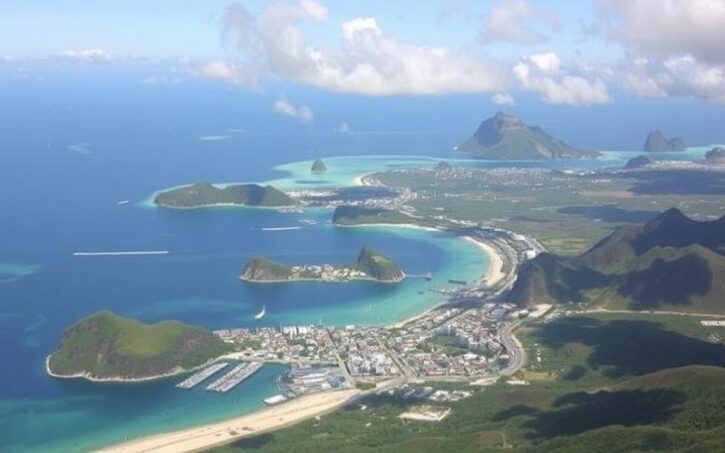
Wallis and Futuna is a French overseas collectivity lost in the middle of the Pacific, about 10,000 km from mainland France. Three main islands (Wallis/Uvea, Futuna and Alofi, largely uninhabited), around twenty islets, just over 11,000 inhabitants, a capital – Mata‑Utu – and three traditional kingdoms (Uvea, Alo, Sigave) that coexist with the institutions of the Republic.
The local economy is poorly diversified and heavily dependent on French public funds, with formal jobs concentrated in administration and non-market services. At the same time, a subsistence economy (family farming, fishing, crafts) remains vital for a large part of the population.
Key figures
The narrowness of the job market is better understood by looking at the key figures.
| Indicator | Approximate Value |
|---|---|
| Total population | ≈ 11,200 inhabitants |
| Employed workforce | ≈ 4,000 workers |
| Registered employees | 2,065 |
| Public sector share of employment | ≈ 60–70 % |
| Employment rate (15–64 years old) | 46 % (54 % men, 39 % women) |
| Official unemployment rate | 13.1 % |
| Youth unemployment (under 25) | 42.7 % |
| GDP per capita | ≈ 12,000 USD |
| Minimum wage (SMIG) | 93,500 XPF / month (≈ 930 USD) |
Only about 20% of inhabitants have a paid job. Two-thirds of salaried employees work in the public or para-public sector. The private sector exists, but in narrow niches: commerce, services, construction, crafts, agriculture and fishing.
For an expatriate, this means one simple thing: local salaried jobs, especially in the private sector, are rare and highly limited. The real entry points lie elsewhere: in the civil service (especially for the French), in major institutions (health, education) or via entrepreneurship and remote activities.
Cost of living and salaries: a delicate balance
Before talking opportunities, one must look at the bottom line: what does it cost to live there, and what income can an expatriate expect?
A high cost of living for a remote territory
Life in Wallis and Futuna is generally expensive, which is logical for a very isolated archipelago that is ultra-dependent on imports. International comparisons show an overall price level close to mainland France, or even slightly higher, but with a very different structure: lower rents, significantly more expensive food and imported goods.
According to available data, for a “medium” lifestyle, budgets in US dollars are as follows:
| Profile | Monthly with rent | Monthly without rent | Yearly with rent | Yearly without rent |
|---|---|---|---|---|
| Single person | 2,615 USD | 1,765 USD | 31,380 USD | 21,180 USD |
| Couple | 3,792 USD | 2,942 USD | 45,504 USD | 35,304 USD |
| Family (2 adults + 2 children) | 5,369 USD | 4,264 USD | 64,428 USD | 51,168 USD |
On a “tight budget,” a single person can get by on around 1,335 USD per month (rent included), a family of four on about 2,740 USD. At the other end of the scale, a comfortable or “premium” lifestyle can easily climb to 4,700–9,600 USD per month depending on household size.
Main monthly expense items fall within specific price ranges.
| Expense item | Monthly range (USD) |
|---|---|
| Rent for primary residence | 500 – 1,300 |
| Electricity | 40 – 220 |
| Running water | 25 – 70 |
| Internet + TV | 80 – 135 |
| Mobile phone | 60 – 160 |
| Food | 350 – 980 |
| Transportation | 30 – 320 |
| Entertainment / going out | 60 – 560 |
| Health (insurance, care, medication) | 95 – 600 cumulative |
Imported products can cost three to four times more than in mainland France. A few examples, converted from the Pacific Franc (XPF):
| Product | Average price (XPF) | Average price (USD) |
|---|---|---|
| 1.5 L water bottle | ≈ 488 | ≈ 4.29 |
| Standard cappuccino | ≈ 854 | ≈ 7.51 |
| Coca‑Cola 0.33 L | ≈ 610 | ≈ 5.36 |
| Inexpensive restaurant meal | ≈ 1,220 | ≈ 10.73 |
| Dinner for 2 at a mid-range restaurant | ≈ 12,199 | ≈ 107.25 |
| Pack of Marlboro cigarettes | ≈ 1,830 | ≈ 16.09 |
| Levi’s 501 Jeans | ≈ 24,397 | ≈ 214.50 |
Comparison with other territories is telling: overall, the cost of living (rent included) is about 37% lower than in French Polynesia, but almost at the same level as mainland France (0.3% more expensive). Rents, however, are much lower than in Polynesia or Singapore, while food and certain goods are more expensive than in mainland France or most European countries.
Average salaries and purchasing power
The average gross salary in Wallis and Futuna revolves around 3,800 USD per month (observed range: 1,500 to 7,500 USD). The average net salary after taxes – a particular concept in a territory with no income tax – is estimated at about 3,217 USD.
This income is:
– about 115% higher than the average monthly cost of living for a single person excluding rent;
– over 3.5 times higher than the estimated “minimal” budget for a single person excluding rent.
In other words, a salaried employee paid at the average level who benefits from reasonable housing can achieve significant savings capacity, especially thanks to the absence of income tax.
For French civil servants posted there, the situation is even more favorable: thanks to overseas supplements, their remuneration is practically more than doubled. On this point, the territory clearly becomes attractive for those willing to accept isolation and the cost of living.
Major feature: (almost) non-existent taxation
This is one of the key selling points for high-income expatriates and investors: in Wallis and Futuna, there is no direct taxation.
Concretely:
– no income tax;
– no corporate tax;
– no VAT (Value-Added Tax);
– no wealth tax, nor capital gains tax.
Annual public revenue, primarily from customs duties, amounts to approximately 2.5 billion XPF.
Employees only pay 6% in social security contributions, allocated exclusively to pensions. Health and education expenses are, however, fully covered by public funds.
For an expatriate taxable in France or elsewhere, this configuration opens up maneuvering room, although it is obviously necessary to verify one’s tax residence and applicable treaties. Furthermore, the Girardin Law (Lodeom) offers until 2025 tax reduction niches for those who invest in productive projects in the territory, through arrangements that can finance nearly 36% of a project’s cost.
Where are the jobs for expatriates?
In such a restricted market, not all opportunities are equal. Several channels emerge depending on the profile: national civil service, local recruitment in health or education, private sector placement, business creation, or remote work.
Civil service and French expatriate positions
For French citizens, Wallis and Futuna is arguably one of the most financially advantageous postings within the overseas territories, offset by extreme insularity and a very particular environment.
Education: a major source of jobs
The education system is a large employer. There are about 570 staff in education, including 397 teachers, for just over 2,700 students from primary to high school. The ratio is very favorable: 10.4 students per teacher. A majority of teachers come from mainland France on secondment, for two-year terms renewable once.
The benefits for these seconded teachers are considerable:
– application of a 2.05 coefficient on the base salary, the residence allowance, and family supplements, resulting in an increase of about 105% of the base remuneration;
– a reinstatement allowance equivalent to 9 months’ salary for each two-year period;
– a 10% supplement for the spouse and 5% per dependent child.
Secondment does not interrupt the career: promotion through the pay scales continues normally, and return to mainland France is generally to the original academy.
Teaching positions in Wallis and Futuna are limited and in high demand. Information on job openings is disseminated by the Ministry of National Education. For a school year starting in February (Southern Hemisphere calendar), it is advisable to inquire from the preceding spring.
Health: a small, very public system
The Wallis and Futuna Health Agency employs about 200 people. The system is based on:
– 8 general practitioners (5 in Wallis, 3 in Futuna),
– 5 hospital doctors,
– 1 radiologist,
– 3 dentists,
– 1 pharmacist,
– 1 biologist,
– nursing and paramedical staff.
There is no private practice medicine: all professionals work within the public framework, at Sia Hospital in Wallis (42 beds, operating room, intensive care, maternity, imaging, pharmacy), at Kaleveleve Hospital in Futuna (16 beds, no surgery or maternity), or at district clinics.
Again, the profiles are overwhelmingly French, with specific contracts. The combination of a higher salary, relatively reasonable housing costs, a free healthcare system for the family, and non-existent taxation makes these positions sought after, especially for doctors, dentists, or nurses wanting an overseas experience.
Administration, justice, technical services
Beyond education and health, the State and territory administrative apparatus employs many civil servants: prefecture, state services (finance, customs, security, justice), local authorities, public institutions.
Public employment figures vary by source, but it is estimated that including State jobs and local contracts, nearly two-thirds of salaried employees work in the public or para-public sphere.
For a French executive or public servant, Wallis and Futuna presents itself as a possible posting in the course of an overseas career, often for periods of two to four years, with the same mechanisms of salary supplements.
Local private sector: commerce, services, construction, crafts
Outside public structures, a few private sectors employ salaried workers, mainly locals but sometimes open to experienced expatriate profiles.
Overview of company diversity by size and legal status
Companies with fewer than 10 employees, representing the vast majority of the economic fabric.
Companies employing between 10 and 249 employees, driving employment and innovation.
Companies with between 250 and 4999 employees, playing a key role in exporting.
Companies with 5000 employees or more, often international groups.
Self-employed workers under a simplified regime, experiencing strong growth.
Breakdown between unlimited liability structures and incorporated companies (LLC, SAS, etc.).
| Sector of activity | Share of companies | Approximate share of employment |
|---|---|---|
| Commerce | 31 % | ≈ 31 % |
| Other market services | 28 % | ≈ 28 % |
| Agriculture / livestock / fishing | 19 % | ≈ 19 % |
| Productive crafts | 12 % | ≈ 12 % |
| Construction | 11 % | ≈ 11 % |
Commerce and market services represent over half of the companies (57.5%). This covers:
– distribution and import-export,
– garages and auto repair,
– hotels and restaurants,
– transport, logistics,
– business services (accounting, IT, consulting).
Positions open to expatriates often concentrate on management, administrative, or expert functions (accounting, management, IT, human resources) when local skills are lacking. But it must be kept in mind that the market is tiny: in 2018, there were only 303 salaried employees in commerce and 428 in market services.
Tourism, agriculture, fishing: more potential than reality
Tourism is frequently cited as a “strategic sector” for the future of Wallis and Futuna. Indeed, the archipelago has preserved lagoons, a very lively Polynesian culture, and an almost complete absence of mass tourism (barely a hundred visitors per year). But in practice, the activity remains embryonic, hampered by weak air links and the small size of the market.
On Wallis, there are only three hotels, one boarding school, one guesthouse, and a few B&Bs, for less than 200 tourist beds. Futuna has no hotel. Opportunities exist for those wishing to develop small-capacity accommodation, diving tours, hiking, or ecotourism, but these are clearly niches to be patiently built, rather than existing sources of structured salaried employment.
In Oceania territories, the agriculture and fishing sectors are primarily oriented towards subsistence, with local products like taro, yam, cassava, tropical fruits, pig and goat farming, and lagoon or deep-sea fishing. Although there is export potential for certain products (fruit, vegetables, fish, copra, crafts), it is limited by major constraints: high logistics costs, the small scale of production, and strong regional competition.
For an expatriate, these sectors are mainly promising if one comes with a solid entrepreneurial project (innovative farming, product processing, short supply chains, “premium” value-added exports) and good investment capacity.
Remote jobs and international telework
An often underestimated aspect of the territory is its digital connectivity. Since 2018, the Tui Samoa submarine cable provides high-speed internet access, complemented by 4G mobile coverage. This changes the game for digital professions and remote freelancers.
Major international platforms already list Wallis and Futuna in their eligible countries for 100% remote work positions. Listings include offers for:
– developers (front-end, back-end, DevOps, cloud, Linux),
– security engineers,
– machine learning engineers,
– product designers,
– writers and content creators,
– translators,
– customer support or customer success specialists,
– consultants.
These offers are not specifically linked to the local market, but the possibility of working from the archipelago as an employee (or freelancer) for a company based elsewhere opens a realistic path for highly qualified expatriates who want to combine an international career with island life.
For these profiles, two major advantages:
– a timezone compatible with part of Asia-Pacific;
– the local tax regime (no tax) subject to tax residence status, to be handled cautiously and with specialized advice.
Starting your own business: constraints and support
In a territory where salaried jobs are limited, entrepreneurship is often a more realistic option, provided the market size and costs are carefully considered.
Administrative framework and obligations
Any business project requires obtaining a business license, issued by the Chamber of Commerce, Industry, Trades, and Agriculture (CCIMA). This license conditions the right to operate and is subject to an annual fee, which varies by sector.
The process includes:
– registration with the Trade and Companies Register (which allows obtaining a Kbis extract);
– publication of a notice in an official bulletin;
– registration with local funds for (very limited) contributions;
– possibly applying for investment aid.
For a French national, starting a business abroad follows logic similar to mainland France, but in a often simplified legal and fiscal environment. For a citizen of another country, it is necessary to have a valid residence permit and, in some cases, a specific work permit.
Financial aid and incentives
The territory has implemented several schemes to encourage productive investment:
– the Territorial Investment Aid Code (CTAI), which can finance up to 50% of a project, limited to 5 million XPF per file;
– a freight subsidy program, covering part of the extra transport costs for imported raw materials or shipping products to France or between Wallis and Futuna;
– the Girardin Law, which allows mainland investors to benefit from tax reductions by financing overseas projects, including those in Wallis and Futuna.
These mechanisms are particularly relevant for capital-intensive activities, like workshops, agri-food processing, tourist facilities, or logistics, where surcharges related to transport and importation can be a major obstacle.
Market size: asset or handicap?
The main challenge remains the minuscule size of the domestic market: barely 11,000 inhabitants, of which a limited number are affluent households. Many young adults emigrate to New Caledonia or mainland France, further reducing the consumer base.
This means that:
– business models solely focused on the local market must be extremely targeted and lean on fixed costs;
– the ability to sell externally (export of goods, provision of remote services, international tourism) is crucial to surpass the saturation of the internal market.
In this context, ideas with potential are often hybrid: a base of local clientele coupled with regional outlets (New Caledonia, Fiji, Samoa, Australia, New Zealand) or metropolitan ones.
Living conditions: a very particular “package”
Beyond salary or career prospects, daily life in Wallis and Futuna is a decisive factor for an expatriate – and often the point that makes the difference between a successful experience and a premature return.
Housing, transport, settling in
Rents are relatively moderate compared to other Pacific territories. One can find, for example:
– standard houses or apartments around 80,000 to 120,000 XPF per month;
– a furnished 3-room apartment around 100,000 XPF.
For a single person, local estimates suggest a typical monthly budget:
– 80,000–100,000 XPF for rent,
– 50,000 XPF for food,
– 10,000–20,000 XPF for utilities (water, electricity).
For a family of four:
– 100,000 XPF for rent,
– 140,000 XPF for food,
– 15,000–25,000 XPF for utilities.
Purchasing a vehicle is practically essential in the absence of public transportation (aside from school buses). Gasoline fluctuates around 180–200 XPF per liter. Authorities recommend planning an initial setup budget of 25,000 to 35,000 USD, mainly for the vehicle and furnishings. Shipping furniture by sea freight takes several weeks, even a few months.
Health and education: two major strengths
For families, two dimensions carry significant weight: school and health. On both these subjects, Wallis and Futuna stands out clearly.
Education is entirely free from kindergarten to high school, following the French system and sometimes including teaching of local languages. Healthcare is also completely free for residents (care, medication), with medical evacuations covered for serious conditions.
In return, specialized healthcare is limited, and certain procedures (dental prostheses, orthodontics, over-the-counter medication) are not covered. But for a family expatriate, the combination “free public healthcare system + free quality French schooling” weighs heavily in the economic equation.
Isolation, psychological cost, and cultural adjustment
Research on expatriation shows that failures stem less from the work itself than from difficulties in personal and family adaptation. Globally, nearly half of overseas assignments are thought to fail mainly due to reasons of personal, marital, or family adaptation, well before questions of professional skills.
In Wallis and Futuna, these factors are amplified:
– extreme geographical isolation (over 30 hours of travel to reach Paris, few flight rotations, absence of regular passenger maritime links);
– a very community-oriented and very Catholic society, where “custom” structures social life;
– a feeling of disconnection from the rest of the world, especially if the internet connection is not optimal or if one is used to major cities.
Research on expatriate adjustment identifies three main dimensions of adaptation:
– work adjustment (understanding professional expectations, management styles, rhythms);
– interaction adjustment (quality of relationships with colleagues and the local population);
– general adjustment (housing, food, transportation, leisure, cultural norms).
Several non-technical traits are predictive of good adaptation abroad: cultural empathy, flexibility, the ability to manage one’s emotions, extraversion, and open-mindedness. Conversely, low tolerance for cultural uncertainty or a strong dependence on a certain level of urban services can make isolation difficult to bear.
Studies on “culture shock” often describe a three-phase curve:
1. “honeymoon” phase: initial euphoria, discovery of the scenery, exoticism; 2. crisis phase: frustrations linked to practical difficulties (shopping, procedures, digital isolation, healthcare, local pace), cultural misunderstandings, potential withdrawal; 3. adjustment phase: understanding social codes, building a friendship network, establishing life routines.
In Wallis and Futuna, the transition between these phases can be accentuated by:
– the slowness of procedures (mail, supplies, work);
– the importance of the customary structure (chiefdoms, ceremonies, social obligations);
– the low availability of “urban” leisure activities (restaurants, cinemas, shopping centers).
Expatriates who succeed in anchoring themselves there long-term are often those who:
– get involved in community life (associations, parishes, sports clubs);
– agree to learn a few words of Wallisian or Futunian;
– adopt a pace of life less centered on consumption and more on human relationships, nature, family.
Entry conditions: nationality, visas, work permits
Administratively, the rules for access to work are directly linked to the status as a French collectivity.
French citizens: free access, no visa or permit required
French citizens can enter, reside, and work in Wallis and Futuna without a visa or work permit, with a passport or a simple ID card. They are subject to French law (adapted locally) regarding employment contracts, minimum wage, working hours, leave, etc.
EU / EFTA citizens: free stay, regulated work
Nationals of the European Union and EFTA (Switzerland, Norway, Iceland, Liechtenstein) can also enter without a visa with a valid ID card or passport and stay as long as they wish. However, engaging in salaried work requires obtaining a work permit issued by the prefecture of Wallis and Futuna.
Other nationalities: specific visas and work permits
Nationals of many countries (United States, Canada, Australia, New Zealand, Japan, Singapore, several Pacific countries) benefit from visa exemption for short stays (up to 90 days within six months) for tourism or non-salaried business purposes. Beyond that, or to work, a specific visa and work permit are required.
A visa issued for Wallis and Futuna does not allow entry into the Schengen Area or mainland France, and vice versa. Applications must be made through French embassies or consulates. Requirements can include a passport valid for at least six months and sometimes a yellow fever vaccination certificate for travelers coming from at-risk areas.
What skills and profiles fare best?
Given the market size and constraints, certain categories of expatriates have a better chance of finding attractive conditions in Wallis and Futuna.
Civil servants and public contractors
– Teachers (primary and secondary, especially in general or technical subjects where needs are regular).
– Doctors, surgeons, anesthetists, dentists, pharmacists, nurses, midwives, radiology technicians.
– Executives in national and territorial civil service: public finance, customs, justice, engineering, civil security, public health.
For the relevant profiles, the archipelago offers a set of significant advantages: a substantial salary supplement, potential housing coverage, as well as free schooling and healthcare, all within a very favorable tax framework. However, this environment comes with constraints to anticipate, particularly regarding family mobility, post-secondary education (necessarily outside the territory), and geographical isolation.
Private sector executives and technical experts
In the private sector, there are occasional needs for:
– accounting, audit, management control,
– construction and public works project management,
– hotel or tourist facility management,
– telecommunications and information systems experts,
– commerce / retail management.
These positions are very limited in number, but they appear during infrastructure projects or modernization phases (ports, hospitals, telecoms, energy).
Entrepreneurs and freelancers
Profiles that can best “create” their own opportunity are:
Two types of profiles are particularly suited: entrepreneurs capable of developing a viable project in a restricted local market (such as agri-food production, processing workshops, specialized services, or micro-tourism) and/or oriented towards export; as well as digital freelancers, consultants, engineers, and creatives who already work remotely with clients and simply wish to relocate their living base to the Pacific.
For the latter, the challenge is not access to the local market, but practical management (connectivity, time difference, tax residence, social security) and integration into a small community.
In summary: a discreet yet selective El Dorado
The job market in Wallis and Futuna resembles neither that of a major capital nor that of an offshore tax haven saturated with financial services. It is a public micro-market, backed by France, with few positions but very advantageous conditions for those who fit the right boxes: civil servants, healthcare workers, teachers, specialized executives, solid entrepreneurs, or highly qualified remote workers.
Its attractiveness rests on a triptych as powerful as it is demanding:
Material advantages are significant: highly boosted public salaries, quasi-non-existent taxation, free healthcare and education, and moderate rents relative to income. However, heavy constraints exist: high cost of living, strong dependence on imports, extreme geographical isolation, a very restricted local market, and limited career prospects on-site. The living environment is singular, marked by a vibrant Polynesian culture, a strong customary structure, a very tight-knit community, and preserved nature, but with very little urban life and a pace of life far removed from metropolitan standards.
For an expatriate, the real question is therefore not just “is there work?”, but rather:
– do I have the profile that matches the few open positions, or the ability to create my own job?
– am I prepared to live on an island of 8,000 inhabitants (Wallis) or 3,000 (Futuna), over 10,000 km from my home country?
– is my family ready for this radical change, and for how long?
If the answer is yes, Wallis and Futuna can become much more than an exotic line on a CV: an intense life experience, financially advantageous, culturally disorienting, that forces one to reinvent their relationship to work, time, and community.
Disclaimer: The information provided on this website is for informational purposes only and does not constitute financial, legal, or professional advice. We encourage you to consult qualified experts before making any investment, real estate, or expatriation decisions. Although we strive to maintain up-to-date and accurate information, we do not guarantee the completeness, accuracy, or timeliness of the proposed content. As investment and expatriation involve risks, we disclaim any liability for potential losses or damages arising from the use of this site. Your use of this site confirms your acceptance of these terms and your understanding of the associated risks.

Cyril Jarnias is an independent expert in international wealth management with over 20 years of experience. As an expatriate himself, he is dedicated to helping individuals and business leaders build, protect, and pass on their wealth with complete peace of mind.
On his website, cyriljarnias.com, he shares his expertise on international real estate, offshore company formation, and expatriation.
Thanks to his expertise, he offers sound advice to optimize his clients' wealth management. Cyril Jarnias is also recognized for his appearances in many prestigious media outlets such as BFM Business, les Français de l’étranger, Le Figaro, Les Echos, and Mieux vivre votre argent, where he shares his knowledge and know-how in wealth management.





