
 Published on and written by Cyril Jarnias
Located in the municipality of Sintra, in the heart of the Lisbon metropolitan area, the parish of Rio de Mouro is increasingly attracting investors looking for a compromise between reasonable prices, accessibility to Lisbon, and a developing living environment. Between ambitious infrastructure projects, urban requalification, and a still affordable real estate market, the local area offers interesting opportunities for a first purchase, a rental investment, or a longer-term asset project.
This article details price levels, property types, and potential yields in Rio de Mouro. It also presents major public projects underway and explains the legal and tax steps to buy real estate in Portugal, whether you are a resident or a foreigner.
A real estate market more affordable than Lisbon, but under pressure
Rio de Mouro directly benefits from the dynamism of Sintra, one of the most populous municipalities in the country, experiencing strong demographic and tourist growth. Yet prices remain significantly lower than in Lisbon, making it a closely watched secondary market for buyers.
Data from platforms like Properstar and indices based on listings show an already dense market, with several hundred properties for sale at any time. According to sources, there are between approximately 266 and over 1,000 properties listed, reflecting an active and varied market, ranging from one-bedroom apartments in condominiums to villas with gardens and farms needing renovation.
Price levels: apartments vs. houses
Available figures allow a fairly accurate idea of the entry price in Rio de Mouro. At the median, apartments and houses fall into very different ranges.
| Property type | Median price per m² | Median price per ft² |
|---|---|---|
| Apartment | €2,705 / m² | €267 / ft² |
| House | €3,159 / m² | €304 / ft² |
In other words, a 100 m² area costs around €270,000 for an apartment, and €315,000 for a single-family home. The differential reflects the relative scarcity of land and the appeal of family villas with outdoor space, especially in quiet residential neighborhoods.
This price per square meter marks the entry threshold into the premium segment of the new construction and high-end condominium market.
Prices by apartment type
The apartment market is structured around T2 (two-bedroom) and T3 (three-bedroom) units, highly sought after by both local families and rental investors. Medians by number of rooms help position a project:
| Apartment in Rio de Mouro | Median price per m² | Median price per ft² |
|---|---|---|
| T2 | €2,699 / m² | €251 / ft² |
| T3 | €2,730 / m² | €272 / ft² |
| T4 | €2,639 / m² | €258 / ft² |
| T5 | €2,751 / m² | €272 / ft² |
Differences between T2, T3, T4, and T5 remain relatively limited, indicating a market where price is determined as much by location, condition, and year of construction as by size alone. The T3 appears as the pivot type, around €2,700 / m².
For a 115 m² T3, the median asking price is around €2,707/m² (€310,000), but actual transactions in the last quarter show a lower price per m², around €1,993/m², indicating room for negotiation for buyers.
Prices by house type
Houses present a different picture: 4 to 5-bedroom properties form the core of the market, but the price per square meter decreases as the number of rooms increases, explained by larger overall areas and sometimes older homes needing renovation.
| House in Rio de Mouro | Median price per m² | Median price per ft² |
|---|---|---|
| 4 bedrooms | €3,415 / m² | €359 / ft² |
| 5 bedrooms | €3,379 / m² | €350 / ft² |
| 6 bedrooms | €2,846 / m² | €267 / ft² |
| 7 bedrooms | €2,525 / m² | €242 / ft² |
| 8 bedrooms | €2,833 / m² | n/a |
An investor targeting a large divisible house or a villa to convert into coliving can thus find interesting opportunities on large areas at lower square meter prices.
Comparison with neighboring municipalities
Within the Lisbon belt, Rio de Mouro remains slightly more affordable than some direct neighbors. Massamá–Monte Abraão, for example, has a median of about €2,781 / m², roughly 5% higher. Casal de Cambra exceeds €2,840 / m², about 7.5% more expensive.
| Area | Median price per m² | Difference vs. Rio de Mouro |
|---|---|---|
| Rio de Mouro | €2,645–€2,705 | — |
| Massamá–Monte Abraão | €2,781 | ≈ +5.1% |
| Casal de Cambra | €2,844 | ≈ +7.5% |
For an investor, this difference means the area remains relatively cheap compared to other hubs in the first ring, with catch-up potential if public and private investments continue.
Examples of properties illustrating the diversity of supply
Examining a few listings helps understand how these price levels translate on the ground.
In the highly sought-after Rinchoa–Quinta de Fitares area, several new T2 units on Avenida de Fitares sell between €360,000 and €394,000, for areas between 91 and 98 m², with parking and elevator. Other T2 units in older buildings, sometimes without an elevator, are priced closer to €256,750 for 88 m² (Serra das Minas).
In the center of Rio de Mouro, a 95 m² T3 apartment, located near the train station and including a parking space, is listed for €299,000. Additionally, on Avenida Infante Dom Henrique, an 86 m² T3 on the first floor without an elevator is offered at €236,500. The latter is already rented for €950 per month with a three-year lease, representing an immediate and operational rental investment.
In more residential sectors, T3 units of about 100 m² with an elevator can be found around €298,500, while renovated T3 units of 88 m², close to the station and services in Rinchoa, are offered at €295,000.
The supply is not limited to apartments. You can also find:
Discover our selection of exclusive properties in the region, ranging from contemporary villas to unique rehabilitation projects.
Such as in Quinta do Brilhante: private garage, large terrace, and access to a shared pool.
Example: single-story villa renovated in 2021 on 1,000 m², original design from the 1960s by architect J. Castel‑Branco, with pool.
Opportunities such as a 4,754 m² farm in Paiões, or an 18-unit complex in an ARU zone (11 rented, 7 to renovate), ideal for funds or investors.
Finally, some high-end properties in the municipality of Sintra, such as villas in Quinta da Beloura or historic farms, are well over one million dollars. They are not always strictly in Rio de Mouro, but show the growing positioning of Sintra in the high-end residential and tourist market.
Strategic neighborhoods: from Rinchoa to Paiões
Rio de Mouro is not a homogeneous block. Certain sub‑areas clearly stand out for an investment project.
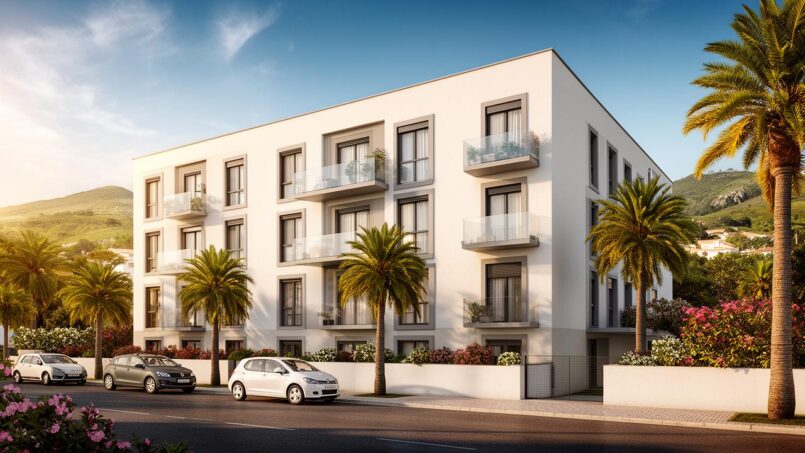
Rinchoa and Quinta de Fitares concentrate a large share of new developments. Avenida de Fitares and Avenida do Parque are seeing new contemporary buildings with elevators, parking, balconies, sometimes in private condominiums, targeting an upper-middle-class family clientele and investors looking for easy-to-rent properties.
The center of Rio de Mouro, especially around the train station and Rua Francisco Costa, Rua Pedro Cintra, or Rua Mário Graça, is a prime area for rental investment. Its attractiveness is based on optimal accessibility: immediate proximity to the train to Lisbon, schools, shops, and a health center. The neighborhood also benefits from an excellent road network, with easy access to the IC19 and A16.
Serra das Minas and Mercês, in the immediate vicinity, combine older buildings without elevators and some recent residences. The area attracts households looking to stay near the train line while benefiting from slightly lower rents than in newer neighborhoods.
These quieter residential areas illustrate the upscaling of certain segments of Rio de Mouro. They include recent projects like “Os Jardins da Encosta,” private condominiums with large landscaped areas, located near Tagus Park and about ten minutes from Parque dos Poetas. They also feature large villas, such as a 268 m² living space example on a 445 m² plot, offering five bedrooms, six bathrooms, a large living room, a big kitchen, a generous basement, and a view of the Palácio da Pena.
Paiões and Vale Mourão
Rental: what yields to expect in Rio de Mouro?
Available data on rents is more fragmented than for sale prices, but still allows sketching potential yields.
For a T2, monthly rents outside the center are around €616 median, with a range of €500 to €750. In the city center, a T2 rents for about €800 per month. For a T4, median values are around €1,000 in the center, and about €1,167 on the outskirts, with fairly wide ranges (€700 to €1,700) depending on condition, exact location, and the presence of parking or outdoor spaces.
Gross annual yield for a 86 m² T3 in the center, rented at €950 per month for a sale price of €236,500.
If we take a median T2 at €169,750 (about 79 m²) and a rent of €700 per month, the gross yield approaches 4.9%. On already rented properties, well positioned and with reasonable bank financing, the yield generally falls within the range observed across Portugal, around 5% gross on average.
At the national level, data shows an average gross profitability of 5.16%, an average property price of €355,000, and an average rent of €1,400, for a return on investment period of about 21 years. Rio de Mouro seems slightly below in absolute value, but close in terms of ratio.
Local dynamics: infrastructure, mobility, and urban requalification
One of the major advantages of Rio de Mouro for the investor lies in the public investment policy. The municipality of Sintra is simultaneously undertaking several major projects that could support real estate demand and improve the area’s attractiveness.
The “Circular Poente ao Cacém”: a key axis for Rio de Mouro
A major ring road project, the “Circular Poente ao Cacém”, has been officially validated. It provides a direct link between the A16 highway to Cascais and the IC19 expressway to Lisbon, at the Paiões interchange. The initial investment exceeds €3 million, complemented by a much larger budget of €70 million for the entire operation.
The route is designed to divert through traffic from the centers of Cacém and Agualva–Mira Sintra, while greatly improving access to several parishes, including Rio de Mouro. The plan includes two viaducts over the Western and Sintra railway lines, a tunnel under the IC19 at Paiões, and a viaduct at Vale Mourão.
For an investor, this ring road changes the game: it reduces travel times to major employment hubs (Amadora, Odivelas, Oeiras) and strengthens connections to the Catholic University campus and the Tagus Park technology park. In the long term, this could lead to a gradual appreciation of the neighborhoods it crosses, especially Paiões and Vale Mourão.
Strengthened public transport network
Since the arrival of the new Carris Metropolitana metropolitan bus network, Sintra has been part of Zone 1, along with Lisbon, Amadora, Oeiras, and Cascais. In this area, 192 bus lines are planned, including 41 new ones and 83 reinforced ones, with over 480 routes and extended schedules. More than 460 buses will be operated, including 410 new vehicles and 9 different models.
The municipal council has allocated nearly €5 million to this mobility plan, complemented by a tender for the installation of 1,200 bus shelters. Innovative solutions complete this system, such as “BICIbox” stations for cyclists, an on-demand “Electric Minishuttle” service, a bike-sharing system, and electric charging stations.
Added to this is the “Green and Blue Axis” project carried out with Oeiras, Amadora, and Parques de Sintra–Monte da Lua, which aims to create continuous green spaces and soft paths (pedestrians, bicycles), connecting the Sintra and Cascais train lines, the IC19, and the A5. In addition to environmental benefits (water quality, flood management), such projects strongly enhance the residential appeal of the served neighborhoods.
Requalification of Rio de Mouro Velho and public spaces
On the urban level, several projects directly concern Rio de Mouro:
Total amount in euros of municipal investments announced for three urban development projects in Sintra.
A financing program called “Reaviva” also offers non-repayable grants of up to €30,000 for building rehabilitation, targeting energy efficiency, accessibility, social inclusion, and renovation of common areas. Since 2019, 190 applications have been submitted, 99 of which were accepted. This opens opportunities for investors looking to buy and renovate, especially in ARU zones.
More broadly, the “Sintra Greening Plan” aims to weave green spaces throughout the municipality, reduce urban pollution, and create genuine ecological refuges, indirectly contributing to residential property value.
Local economic environment: income, salaries, and demand
The average net salary in the area is around €775 per month, which remains modest. This level partly explains why rents, although pushed upward by demand pressure, remain lower than in Lisbon, and why the issue of housing affordability remains sensitive.
Sintra is the municipality in its region with the most schools, students, and the highest absolute population growth. It attracts about 5 million tourists annually, benefits from UNESCO heritage, and is developing rural tourism and business parks. The new mayor, Marco Almeida, plans an urgent revision of the Municipal Master Plan to redefine zoning and expand the supply of public and private housing.
For an investor, this demographic and tourist dynamic combined with still reasonable prices in Rio de Mouro creates a favorable context for medium to long-term rental investment, especially if the mobility and requalification projects are completed as planned.
Buying in Rio de Mouro: the step-by-step legal procedure
The process of acquiring a property in Portugal is considered simple and transparent, including for foreigners, who face no special restrictions. To secure a purchase in Rio de Mouro, it is nonetheless essential to follow a number of steps.
1. Obtain a NIF (Tax Identification Number)
The NIF is the cornerstone of any procedure: it is mandatory to sign a purchase promise, buy a property, open a bank account, pay taxes, or sign up for utility contracts. It is obtained from the Tax and Customs Authority (Finanças), at a Loja do Cidadão or a tax office. Residents present a passport or ID card and proof of address.
Non‑residents can delegate this process to a tax representative (lawyer, specialized company) with a power of attorney. Some companies, such as Portugal Homes or specialized agencies, assist foreigners in this phase.
2. Open a Portuguese bank account
Even if the law does not formally require a local account, in practice it is highly recommended, even required by banks when taking out a loan. It facilitates payment of the price, taxes (IMT, Imposto de Selo), condominium fees, and regular bills.
For a credit application, in addition to the standard documents (ID, NIF, proof of address, bank statements, and proof of income), you must provide additional documents such as pay slips, tax returns, and a credit report.
3. Choose a lawyer and conduct due diligence
In Portugal, the notary does not have an advisory role like in France, for example: they merely check the formal validity of the deed at the time of signing. Therefore, the lawyer handles the legal review and defends the buyer’s interests. Their involvement is strongly recommended, even if not legally mandatory.
The lawyer will in particular:
Before acquiring real estate in Portugal, it is crucial to check several documents: the Registo Predial to confirm ownership and absence of liens, the Caderneta Predial to know the tax value, the Licença de Utilização for post-1951 buildings, the Ficha Técnica de Habitação for constructions after 2004, the mandatory energy certificate, as well as urban planning compliance with the PDM and building permits.
Since a reform that came into effect in early 2024, some documents (habitation license, technical data sheet) are no longer required at the time of the reservation contract, but remain necessary before the final deed.
4. Reservation and negotiation
Once the property is chosen, it is common to sign a reservation form and pay a deposit, often around €5,000 to €6,000, held in an escrow account managed by the lawyer or agency. This payment encourages the seller to remove the property from the market while legal checks and negotiations are finalized.
During this phase, the lawyer conducts initial checks(absence of debts, license compliance, etc.). The final price, any contingency conditions(e.g., obtaining credit) and items included in the sale (furniture, parking space, cellar) are discussed.
5. The CPCV: promise to buy
The Contrato de Promessa de Compra e Venda (CPCV) is the equivalent of a purchase promise. It is a preliminary contract, widely used in Portugal, that firmly commits both parties. It specifies:
A pre-sale contract, such as a promise, must contain: the full identity of the buyer and seller; a precise description of the property; the sale price and payment schedule; the amount of the earnest money deposit (typically between 10% and 30% of the price, minus the reservation deposit); the deadline for signing the final deed at the notary; and the penalties foreseen in case of breach of commitments.
This contract can be signed in person or by power of attorney. Legally, if the buyer withdraws without a reason provided for in the contract (e.g., loan refusal if a clause allows it), they lose their deposit. If it is the seller who backs out, they must return double the deposit to the buyer.
6. The final deed (Escritura) and registration
The final step is the signing of the Escritura Pública de Compra e Venda, before a notary, at a notary office, at a Conservatória counter, or at a “Casa Pronta.” The notary performs a final document check, especially proof of payment of the IMT (transfer tax) and stamp duty.
At the time of signing, the buyer pays the balance of the price to the seller, usually by bank check or blocked transfer. The notary then registers the transaction and issues certified copies. The lawyer or notary handles the registration of the property in the Registo Predial and with the tax authority. Once this formality is completed, the buyer becomes the full owner.
Acquisition costs and real estate taxation
To calculate the budget for an investment in Rio de Mouro, it is essential to include ancillary costs: taxes, notary fees, lawyer fees, etc. In practice, these extras often represent between 6% and 10% of the purchase price.
IMT: transfer tax
The Imposto Municipal sobre Transmissões Onerosas de Imóveis (IMT) is the main tax when purchasing. It is applied to the higher of the price declared in the deed and the tax value. Rates are progressive by bracket. For a primary residence in mainland Portugal, for example:
| Taxable value bracket | IMT rate | Amount to deduct |
|---|---|---|
| Up to €101,917 | 0% | €0 |
| €101,917 – €139,412 | 2% | €2,038.34 |
| €139,412 – €190,086 | 5% | €6,220.70 |
| €190,086 – €316,772 | 7% | €10,022.42 |
| €316,772 – €633,453 | 8% | €13,190.14 |
| €633,453 – €1,102,920 | 6% | €0 |
| Beyond €1,102,920 | 7.5% | €0 |
The calculation is done with the formula: Taxable value × Rate – Amount to deduct. For example, for a property at €250,000, IMT amounts to €250,000 × 7% – €10,022.42 = €7,477.58. Exemptions exist, in particular for certain renovation projects, buy-to-sell, or for first-time buyers under 35 (IMT Jovem), subject to conditions.
Stamp duty (Imposto de Selo) and fees
The stamp duty on the transaction is generally 0.8% of the acquisition price. On a loan exceeding €5,000, it also applies to the capital, at 0.6%. Notary and registration fees remain moderate, often below €600 for a standard transaction.
Lawyer fees typically represent between 1% and 2% of the transaction price, depending on the complexity of the case.
IMI: annual property tax
The Imposto Municipal sobre Imóveis (IMI) is the annual property tax. The rate varies from 0.3% to 0.8% of the tax value (VPT) depending on the municipality. Sintra sets its own rates within this range, sometimes with surcharges for very high-value properties (and an additional AIMI tax for large real estate assets).
For an apartment with a tax value of €150,000, a rate of 0.4% would result in €600 in IMI per year.
Taxation of rental income and capital gains
Rental income received by a non‑resident is generally subject to a flat rate of 28% on net income (after certain deductible expenses). Residents, however, can choose between this flat rate of 28% or inclusion in income tax according to the progressive scale (13.25% to 48%), which can be advantageous for moderate total incomes.
Capital gains from property sales are taxable. For tax residents, only half of the gain is subject to the progressive income tax rate. For non-residents, the proportional rate of 28% generally applies to the entire gain, subject to specific cases and the provisions of international treaties.
Certain exemptions exist, for example if the proceeds from the sale of a primary residence are reinvested in a new primary residence within a specified period, or for properties acquired before a certain date.
Financing and profitability: what can an investor expect in Rio de Mouro?
Portuguese banks generally finance up to 70% of the property value for non‑residents, subject to a strong file (income, credit history, tax status). Fixed rates over 20 years hover around 5%, which is significant but remains compatible with gross rental profitability around 5%.
For an investor in Rio de Mouro, the analysis must incorporate two key dimensions: immediate profitability through cash flow (balance between loan payments, charges, taxes, and rents collected) and long-term appreciation potential, linked to the foreseeable increase in price per square meter in this area undergoing transformation.
Massive public investments in mobility, creation of green spaces, requalification of urban centers, and the revision of the PDM aimed at increasing housing supply create conditions for gradual market appreciation, especially in the best-connected neighborhoods (proximity to train station, IC19, A16, future roads).
Why Rio de Mouro is increasingly interesting to investors
Several factors explain the growing interest in this parish in Sintra:
Rio de Mouro remains significantly cheaper than Lisbon and other neighboring municipalities, while being about 25 minutes from the capital center and Humberto Delgado Airport. The beaches of the Cascais coast, such as Santo Amaro or the Cascais marina, are accessible in 20 to 30 minutes by car.
The infrastructure network (IC19, A16, CP station of Rio de Mouro, numerous Carris Metropolitana bus lines) makes daily commuting to employment hubs and universities relatively easy, fueling a sustained rental demand, especially for T2 and T3 units near transport.
Several development projects (Circular Poente ao Cacém ring road, Green and Blue Axis, requalification of Rio de Mouro Velho, Reaviva grants) enhance the area’s appeal. Local policy also aims to increase housing supply while protecting natural spaces.
The presence of new developments (Quinta de Fitares, Os Jardins da Encosta, new projects on Rua Francisco Costa, etc.) shows that developers are betting on Rio de Mouro’s future. These projects often offer parking, elevators, balconies, and sometimes private green spaces, aligned with the expectations of a young and family clientele.
Finally, the broader context of Sintra, with its UNESCO status, its 5 million annual tourists, its development of business parks, and its biodiversity protection policy, creates a favorable backdrop for the appreciation of residential properties throughout the municipality.
Conclusion: how to structure an investment project in Rio de Mouro
Investing in real estate in Rio de Mouro requires combining several parameters: a fine understanding of the local market, mastery of the Portuguese legal framework, projection on the evolution of neighborhoods and infrastructure, and anticipation of taxation at purchase and during ownership.
A savvy investor first defines their strategy: buy-to-let (targeting students, young professionals, families, or retirees), a renovation project in an ARU zone to benefit from grants, or a long-term asset investment in a villa with appreciation potential. They then choose the neighborhood accordingly: proximity to the station for standard rentals, residential areas like Paiões or Vale Mourão for a villa, or neighborhoods being requalified like Rio de Mouro Velho to bet on urban transformation.
On a practical level, the process will necessarily involve obtaining a NIF, opening a bank account, hiring a lawyer specialized in Portuguese real estate law, and following the classic steps: purchase promise (CPCV) with deposit, then Escritura and registration.
By realistically including ancillary costs (IMT, Imposto de Selo, IMI, lawyer fees, notary, financing) and relying on reliable market data (actual prices by type, observed rents, local salary levels), it is possible to build a solid project in Rio de Mouro, in a market that is still accessible but driven by territorial and infrastructure dynamics that should continue to support prices and demand in the coming years.
Disclaimer: The information provided on this website is for informational purposes only and does not constitute financial, legal, or professional advice. We encourage you to consult qualified experts before making any investment, real estate, or expatriation decisions. Although we strive to maintain up-to-date and accurate information, we do not guarantee the completeness, accuracy, or timeliness of the proposed content. As investment and expatriation involve risks, we disclaim any liability for potential losses or damages arising from the use of this site. Your use of this site confirms your acceptance of these terms and your understanding of the associated risks.

Cyril Jarnias is an independent expert in international wealth management with over 20 years of experience. As an expatriate himself, he is dedicated to helping individuals and business leaders build, protect, and pass on their wealth with complete peace of mind.
On his website, cyriljarnias.com, he shares his expertise on international real estate, offshore company formation, and expatriation.
Thanks to his expertise, he offers sound advice to optimize his clients' wealth management. Cyril Jarnias is also recognized for his appearances in many prestigious media outlets such as BFM Business, les Français de l’étranger, Le Figaro, Les Echos, and Mieux vivre votre argent, where he shares his knowledge and know-how in wealth management.





