
 Published on and written by Cyril Jarnias
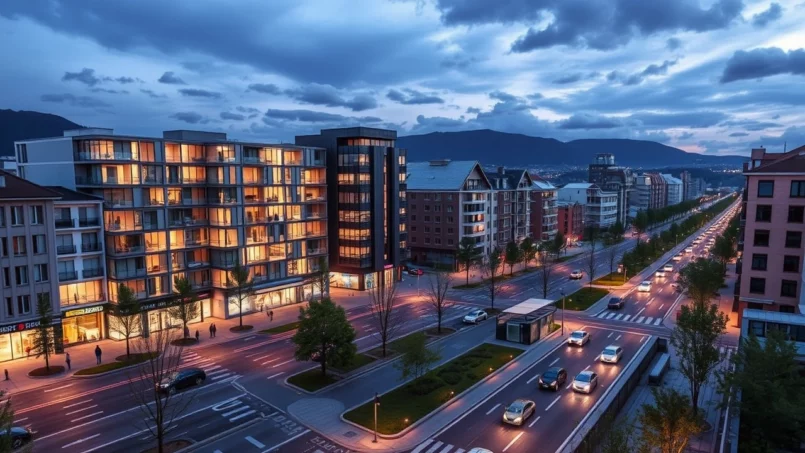
Slovakia is changing its face. Long marked by diffuse urbanization, abandoned industrial wastelands, and a near-systemic dependence on European funds, it is now entering a phase where major cities – and primarily Bratislava and Košice – are redesigning their neighborhoods, their transport networks, and their public spaces. Behind this transformation lie national strategies, local urban plans, and an impressive series of real estate projects, infrastructure upgrades, and brownfield redevelopments.
This article provides a structured overview of Slovakia’s upcoming major urban projects, organized around three levels: national and European strategy, major metropolitan directions, and the concrete projects that will impact residents’ daily lives in the coming years.
A Nationally Reorganized Strategic Framework
Urban development in Slovakia is no longer just the sum of private real estate projects. Since the adoption of “The Urban Development Policy of the Slovak Republic by 2030“, the country has had a framework document that sets common principles: strengthening the role of cities in national development, improving the performance of urban authorities, coordinating stakeholders, and anchoring planning in major international references, from the UN’s 2030 Agenda to the EU’s Pact of Amsterdam.
This policy is led by the Ministry of Transport and Construction in cooperation with other ministries and a multi-stakeholder working group. It is based on three pillars: a long-term strategic vision, an integrated approach (urban planning, mobility, social, environment), and the development of functional urban areas beyond administrative boundaries.
This policy is complemented by an avalanche of sectoral plans: transport development strategy by 2030, building energy renovation policy, climate change adaptation strategy, cohesion policy and 2021‑2027 European programs, not to mention the National Recovery and Resilience Plan which alone injects around 6.4 billion euros in grants into the country, with a strong focus on climate and digital transition.
The Decisive Role of European Funds
Almost all major Slovak urban projects rely on European money. Two-thirds of public investments are financed by Structural and Investment Funds, and successive programming periods structure the project calendar. The “Slovakia 2021‑2027” program now brings together the former sectoral and regional operational programs and massively channels funding towards directly urban themes: sustainable transport, energy renovation, local social services, inclusion, digitalization of public services, and modernization of schools and hospitals.
Amount in millions of euros from the recovery plan allocated to sustainable transport, including railway modernization, cycle paths, and charging stations.
In this heavily funded landscape, the difficulty is no longer so much finding money as knowing how to use it effectively. An analysis of the 2014‑2020 period showed that no significant reduction in regional disparities was achieved, despite the billions invested. Hence a new emphasis on integrated projects, a focus on urban brownfields, and the need to better link urban planning, transport policy, and climate strategies.
Bratislava: From Fragmented Urban Planning to a 2030 Vision
Bratislava concentrates a large part of Slovakia’s flagship projects. The capital, long subject to fragmented real estate development, has acquired several structuring tools that change the background for all major projects.
The foundation is the Urban Plan (Územný plán) approved in 2007 and regularly amended. This document, which replaced a 1976 plan, was at the center of heated debates, particularly regarding the place of skyscrapers and the consideration of transport issues. Towers are now prohibited in the historic center (height limited to 21 m) and are only allowed in certain central rings near transport hubs, excluding peripheral neighborhoods.
Above this regulatory plan, Bratislava has developed an economic and social development program, “Bratislava 2030”, prepared with the Metropolitan Institute of Bratislava (MIB). The vision, presented to the public in 2022, describes a “kind, accessible, resilient” capital organized as a “15-minute city”, where essential services are accessible on foot or by bicycle. This document is structured in three parts – vision, analysis, strategy – around eleven major themes corresponding to municipal responsibilities.
Simultaneously, the citizen initiative “Platforma pre Bratislavu“, led notably by Matúš Vallo, developed a “Plan B” – or “Bratislava Plan” – which has significantly fueled public debate about the city’s future. These tools serve as a compass for a series of spectacular projects transforming the Danube riverfront, the old industrial sites in the center, and major transport junctions.
The New Danube Waterfront: Eurovea City and the Bratislava Skyline
The most visible transformation is taking place along the Danube. On the old Apollo refinery, Ballymore developed the vast Eurovea complex, which has become a symbol of converting industrial brownfields into high-end mixed-use neighborhoods. The current extension, grouped under the Eurovea City label, continues this logic: retail, offices, housing, leisure, parks, and public squares.
The flagship building is EUROVEA TOWER, Slovakia’s first true high-rise tower, standing at 168 meters with 45 floors and 408 apartments, including about twenty luxury units. This project has structured the densification of the riverbank with buildings like Panorama Towers (Building of the Year 2016), additional residential towers, and office buildings (Pribinova 19, Landererova 12, Pribinova 34 and 40). It is accompanied by a 25,000 m² extension of the shopping mall and an expanded leisure hub with cinemas, restaurants, and entertainment.
Available data on this complex illustrates the scale of the riverfront transformation:
| Eurovea City Sub‑project | Main Function | Notable Elements |
|---|---|---|
| EUROVEA TOWER | Residential | 45 floors, 408 apartments, 168 m |
| Panorama Towers | Residential | “Building of the Year 2016” award |
| Eurovea Riverside | Residential | 96 new apartments |
| Pribinova 4‑6‑10 | Offices | 24,500 m² of offices |
| Pribinova 19 | Offices | Headquarters of Johnson Controls International |
| Landererova 12 (L12) | Offices | Corner of Landererova / Apollo Bridge |
| Pribinova 34 & 40 | Offices | Extension of Eurovea Gallery, youthful profile |
| Tower 115 (T115) | Offices | 28 floors, administrative landmark |
The ambition is clear: to create a new “center on the river” that capitalizes on Bratislava’s exceptional position in the Vienna–Bratislava–Győr triangle and its proximity to Brno and Budapest. In this highly competitive corridor, the skyline becomes an economic and symbolic argument.
And the movement is not over. J&T Real Estate is preparing two new residential towers in the same area, designed by the Dutch agency KCAP. One, at 260 m in height, could become the second tallest building in the European Union, the other rising to 184 m. Together, they would add more than 1,000 housing units to the market.
New Centralities: Mlynské Nivy, Košická, Downtown Yards
Other brownfields near the center are being converted to form a veritable “New Downtown”, particularly around Mlynské Nivy, Pribinova, Košická, and Chalupkova. On a former industrial site bordered by Košická, Prístavná, Plátenícka, and Mlynské Nivy, a mixed-use project plans for 650 housing units, of which 135 were already sold in pre-sales, buildings of 8 to 27 stories along Košická, and lower volumes on Plátenícka.
The project illustrates its evolution through a strong environmental commitment and meticulous site rehabilitation. It is characterized by the creation of over 6,100 m² of green spaces, including a reconstructed tree-lined avenue, and the installation of over 2,000 m² of green roofs in the first phase. These developments are complemented by rainwater harvesting systems and heat recovery ventilation, aiming for an A0 energy certification. The process is preceded by nearly two years of preparatory work, dedicated to decontamination and soil preparation, demonstrating a responsible consideration of the site’s industrial past.
A few blocks away, Penta is developing “Chalupkova Offices” on another brownfield, with two office phases totaling more than 33,000 m² of tertiary space. JTRE is preparing “Downtown Yards”, which is set to add 671 apartments and a 35‑story tower, while completing the network of retail and office spaces.
In this area, the logic is twofold: densify near the center and major transport axes, and reuse already urbanized sites rather than further expanding the city onto agricultural land, in line with the European goal of “zero net land take” by 2050.
Reinventing Junctions: Nový Istropolis and Vydrica
Parallel to this eastern front, the capital is tackling major urban nodes. At Trnavské Mýto, Immocap’s “Nový Istropolis” project will replace the old cultural complex with a mixed-use neighborhood of nine buildings, with about 600 apartments, offices for 5,000 people, squares, a park, cycle paths, and especially a large, adaptable multifunctional hall capable of hosting 3,000 people standing or 1,800 seated.
The project is designed as a new urban center connected to the train station, tram, and buses. It incorporates a centralized energy strategy with heat pumps and energy sharing to meet ambitious ESG criteria. The zoning permit is obtained, construction will begin in summer 2025 with a first phase of three buildings over 2.5 years. DELL will relocate its local headquarters there.
Consortium KCAP, Cityförster, Pantograph and Marko & Placemakers
On the Danube bank, but on the historic center side, the “Vydrica” project by Lucron illustrates another approach: reconnecting urban fabrics separated by infrastructure and re-establishing the link between the old town and the riverbanks. The first phase, with 207 apartments, 19 retail units, and two new streets, is set to open progressively, while the second and third phases will add more than 140 housing units by the end of the decade. Here, the challenge is as much urban as it is identity-related: rebuilding a neighborhood that disappeared under socialism at the foot of the castle.
Industrial Brownfields, Heritage, and the 15‑Minute City
Bratislava is also a laboratory for heritage conversion. The MIB is managing the restoration of the Grössling Baths, a large late 19th‑century thermal establishment, to turn it into a complex mixing baths, a library, and a park. The operation involves removing over 1,500 tons of rubble and illustrates the technical and financial complexity of such projects, which are nonetheless central to a 15‑minute city strategy.
Another emblematic project is the transformation of the Pradiareň 1900 spinning mill, on the site of the former Cvernovka, into a high-quality environmental office building (BREEAM certified) for Takeda. This project is part of the mega‑complex “Zwirn”, developed by YIT Slovakia, which will eventually offer 846 housing units, 26,000 m² of offices, 6,000 m² of retail, and a large 6,500 m² public square. The third phase, Zwirn 2, currently under construction, includes 384 apartments scheduled for delivery in 2028.
Some key figures help gauge this wave of projects in Bratislava:
| Major Residential Project | City | Planned Units (relevant phase) |
|---|---|---|
| Slnečnice (ongoing phases) | Bratislava | 1,540 under construction |
| EUROVEA TOWER | Bratislava | 408 |
| Zwirn (total eventual) | Bratislava | 846 |
| Downtown Yards | Bratislava | 671 |
| Stockerka | Bratislava | 271 |
| Galvania Residence | Bratislava | 302 |
| Florian Residence | Bratislava | 314 |
| Sky Park Tower | Bratislava | 393 |
| Two new Eurovea towers (estimate) | Bratislava | >1,000 |
To this list are added more discreet projects that reveal targeted densification: Thurzovka, Malý Dunaj, Penthouses with castle views, complexes like Južanka in Poprad or Kvetnica in Žilina. The market remains very concentrated around the capital, but large-scale operations are also emerging in regional cities, notably Kvetnica (241 units) in Žilina or Gerlach Resort in the High Tatras (519 units over two phases).
Košice: Conversions, Public Spaces, and the Creative City
Slovakia’s second city, Košice follows a different but equally structuring path. The former industrial capital of the east, close to the Polish, Ukrainian, and Hungarian borders, is betting on brownfield conversions, greening of collective housing neighborhoods, modernization of public transport, and creative industries.
A Territory of Transforming Brownfields
Košice has already successfully completed several emblematic conversions. The old city center brewery gave birth to the Cassovar Komplex, a 2.4‑ha mixed‑use neighborhood where Class A offices (over 29,000 m² for about 2,450 employees), retail, housing, and public spaces coexist. A 60‑m chimney from the old factory was preserved as a visual landmark.
The Mlynská Bašta project transformed a section of old ramparts and then industrial facilities into a building with 134 apartments and several retail units, while restoring the façade under the control of the regional historical monuments office and installing a green roof.
Other operations, like the conversion of obsolete administrative buildings into small residential buildings (Villa Košice) or the transformation of an old municipal swimming pool into a Kunsthalle for contemporary art, illustrate a progressive urban recycling strategy.
Košice benefits from several national and European programs for identifying and revitalizing its industrial and urban brownfields.
Led by the Slovak Environmental Agency, this initiative identified over 570 sites covering nearly 2,000 ha in 125 towns, with a significant concentration in the urbanized and industrialized east.
The city is engaged in this program dedicated to brownfield regeneration, allowing it to benefit from studies and methodologies at the European scale.
Košice is the only Slovak case in the International Urban and Regional Cooperation initiative, which focuses on urban regeneration and social cohesion.
Public Spaces, Nature in the City, and Neighborhood Projects
Beyond major conversions, Košice is investing heavily in the public spaces of the collective housing neighborhoods built during the socialist era. A program to regenerate the “vnútrobloky” – these large, often barren and under‑equipped inner courtyards – aims to restore vegetation, install street furniture, improve the microclimate, and create convivial spaces.
Three sites are concerned in the neighborhoods of Ťahanovce, Juh, and Sídlisko KVP, for a total projected area of 37,382 m² of redesigned open spaces. While the first completed works only represented about 1,924 m² by early 2024, construction continues, funded by the Integrated Regional Operational Program (IROP).
Around the “Stará Jazdiareň” (old riding school) site, a major project funded by the “Slovakia 2021‑2027” program aims to strengthen green and blue infrastructure in the Staré Mesto district. It plans for reduction of impervious surfaces, planting of trees and shrubs, creation of fountains, installation of coherent street furniture and appropriate lighting. Budget: nearly 1.9 million euros, of which over 1.6 million are European funds.
Number of projects funded by Structural Funds already approved for the city of Košice.
A small project like installing a concrete picnic table with benches in the Západ district, funded by the region for just over 1,000 euros, may seem anecdotal. But it shows that urban quality of life is also played out at this local scale.
Urban mobility is another field of transformation. A project to modernize 13 bus stops is underway, co‑financed by the “Slovakia 2021‑2027” program for over 2.1 million euros. It includes making them accessible, installing LED information panels, creating specific bus bays, and renewing signage. The concerned stops range from service hubs (polyclinics) to entry points to the center (Mlynská Bašta, Jakabov palác).
In the same spirit, several shared pedestrian–cyclist routes are appearing, notably on Gemerská and Pod šiancom streets, funded by the European Recovery Plan (NextGenerationEU). The first connects the west of the city to the center and south, with widened sidewalks, ramps and stairs, and accessible pedestrian crossings. The second secures a link in the Sever neighborhood, with renovated sidewalks, new signage, and bike racks.
Košice is also preparing a public transport service plan for the period 2026‑2036, with a budget of half a million euros and largely funded by the “Slovakia” program. This document must plan the service and articulate buses, trams, and trolleybuses with sustainable mobility goals.
Finally, several structuring road projects, like the modernization of Kavečianska cesta (near the Crow Arena stadium), improve connections between neighborhoods (Sever, Kavečany) by widening the road, constructing retaining walls, and renovating hydraulic structures.
Creative, Digital, and Experimental City
Košice is also investing in the field of the smart city and urban innovation. The “Košice 2.0” project, funded by the Urban Innovative Actions initiative, aims to transform the city into a laboratory for citizen‑centered solutions: a Citizen Experience (CX) Institute to analyze data, innovation programs for start‑ups, a multifunctional “Bravo” hub (coworking, fablab, community space, audiovisual), academies for elected officials, students, and residents, an open data platform, artistic interventions in public space, and a “Mobile Urban Lab” – a laboratory vehicle to explore and co‑design public space.
In the new period, the city is piloting the SAM‑SUD project (Smart Asset Management for Sustainable Urban Development), supported by the European Urban Initiative. This involves using advanced digital tools and artificial intelligence to identify under‑used buildings, create a digital twin of municipal heritage, and transform neglected buildings – starting with Hlavná 57 – into high‑energy performance spaces with high social utility.
This strategy is accompanied by smart mobility projects (information panels at stops, transport apps, free Wi‑Fi, traffic management systems) comparable to those implemented or planned in other major Slovak cities, like Bratislava, Prešov, Žilina, Nitra, Banská Bystrica, or Poprad.
A Still Sparsely Urbanized Country, but in a Phase of Selective Re‑urbanization
To understand the scope of current projects, it must be recalled that Slovakia remains, by European standards, sparsely urbanized. According to the harmonized EU/OECD definition, only 10 towns are recognized as such. National law lists 140 towns and cities, less than 5% of the 2,890 municipalities, but these urban municipalities concentrate over 54% of the population. Two of them, Bratislava and Košice, are governed by special laws organizing their districts.
Since 1989, urbanization has been marked by suburban sprawl (residential and commercial) onto agricultural land and the simultaneous decline of many small and medium‑sized towns, particularly in the center and east of the country. These towns suffer from population contraction, aging, deindustrialization, as well as problems of unemployment, poverty, and accessibility.
Strategic documents now mention entering a phase of “selective re‑urbanization”: major cities and some attractive regional towns (Nitra, Žilina, Trnava, Prešov, Banská Bystrica, Poprad…) concentrate investments and densify, while other territories continue to lose population and services.
The housing projects identified at the country level confirm this concentration. Developments like Slnečnice in Bratislava (1,540 units under construction), Kvetnica in Žilina (241 units), Gerlach Resort in Gerlachov (219 units in first phase, 305 planned in second), Južanka in Poprad (120 apartments), or the BYTY PANORÁMA series around Bratislava outline an investment geography where the capital dominates widely, followed by a few regional poles near major transport axes and job basins.
Transforming Transport to Support Densification
Densifying without strengthening transport would be suicidal. The country has long suffered from a massive shift in mobility towards private cars and heavy trucks, resulting in traffic jams, lost time, and increased pollution. In 1995, the performance of public transport and individual transport was roughly equivalent; by 2014, public transport represented only a quarter of the supply, while rail lost ground to trucks.
The strategy aims for an integrated, multimodal, and sustainable transport system. For roads, the priorities are: completing the D1 and D3 motorways, constructing bypasses for Sabinov, Šaľa and Prievidza, modernizing bridges, and securing dangerous intersections. For rail, massive investments are committed on the Bratislava–Žilina axis and then eastwards, with funding from the CEF mechanism to modernize the Žilina–Košice and Košice–Čierna nad Tisou connections.
In cities, the effort focuses on modernizing trams and trolleybuses, renewing fleets (hybrid, electric, low‑floor), introducing intelligent systems to manage traffic lights, inform travelers, and promote intermodality. Bratislava is extending the tram line towards Petržalka (3.9 km additional), modernizing several radial routes (Karloveská–Dúbravská, Vajnorská, Ružinovská, Račianska), and preparing a new line in the “New Center” between Pribinova, Chalupkova and Nové Nivy, where up to 200,000 people could travel daily.
A single ticket (named “Metropolis”) will be implemented for trains, urban and suburban buses, with possible future integration of private and shared mobility services. This platform aims to simplify fares, guarantee price transparency, and ensure fair revenue distribution among operators. Its deployment will take place within the recovery plan, building on Polish experience.
In this context, densification around train stations, tram stops, and major intermodal hubs – what is observed in Bratislava in neighborhoods like Mlynské Nivy, Nové Lido or Southbank, or in Košice around structuring facilities – is not just an aesthetic or speculative choice: it is a condition for the economic and ecological viability of the transport system.
Urban Brownfields: From a Structural Problem to a Project Resource
The presence of hundreds of brownfields – industrial sites, barracks, mines, agricultural complexes, disused transport infrastructure, obsolete sports facilities – is one of the paradoxes of contemporary Slovakia. Even as sprawl continues, these degraded spaces remain largely unused, often due to fragmented ownership, untreated pollution, high rehabilitation costs, or lack of an economic model.
Total number of sites recorded by the Slovak Environmental Agency, including industrial brownfields, mixed zones, and other land.
Another lesson is the diversity in levels of degradation and contamination: many sites are not listed in polluted soil registries, others are potentially contaminated or already identified as such, a few have been remediated. Size varies from small pockets of 0.1 to 0.5 ha to very large complexes of over 10 ha, often former industrial sites.
Several projects in Slovakia illustrate successful rehabilitation of industrial or military brownfields: the Eurovea shopping center in Bratislava on the site of the old Apollo refinery, the Tatra Gallery in Poprad in a former steam power plant, Košice’s Kulturpark in former Austro‑Hungarian barracks, the restored synagogue in Lučenec, the halls of the former ZTS factory in Martin, the Slovunit site in Bratislava, as well as conversions in Bánovce nad Bebravou, Jaklovce and Kojšov.
The 2021‑2027 policy now states in black and white the intention to make brownfields a preferred lever for sustainable urban development, in line with climate goals and the protection of agricultural land. Specific studies, funded by the Ministry of Transport and Construction, have analyzed obstacles and formulated tools: official definition of the term brownfield, economic instruments (tax on under‑used land, tax incentives), pilot projects, mechanisms for temporary use, capacity building for small towns, etc.
In practice, in the coming years, a growing share of new urban neighborhoods in Slovakia – whether housing, offices, or facilities – will be built on these already urbanized lands, provided cities have the engineering and resources needed to structure these complex operations.
Smart Cities, Climate, and Social Justice: The New Matrix for Projects
Finally, future urban development projects can no longer be conceived without integrating the dimensions of “smart city“, climate, and social inclusion.
On the digital front, only about a dozen cities currently have a genuine smart city strategy (Bratislava, Kežmarok, Liptovský Mikuláš, Spišská Nová Ves, Bardejov, Galanta, Senica, Lučenec, Dunajská Streda, Sládkovičovo, Šaľa, Snina). But nearly one‑third of municipalities have integrated “smart” elements (sensors, digital management, open data, connected lighting, digital parking, etc.) into their development program, and a third plan to deploy them within five years. The identified obstacles are recurrent: insufficient funding, lack of qualified staff, cumbersome public procurement and administrative burdens.
Bratislava adopts a comprehensive approach with its “A smart city 2030” strategy, covering mobility, energy, circular economy, public space, and services. Other Slovak towns, like Galanta or Kežmarok, focus on more targeted areas such as smart waste management, lighting, traffic, as well as promoting soft mobility and renewable energy.
On climate, Slovakia is committed to carbon neutrality by 2050. Cities like Banská Bystrica are setting up departments dedicated to climate change, experimenting with green roofs, rain gardens, or municipal photovoltaic plants. Prešov is developing cycle paths and bike shelters, installing solar on its buildings. Bratislava is working towards more circular waste management.
The German foundation DBU is funding a project to help cities of over 40,000 inhabitants transform brownfields into “Plus‑Energy Districts”, neighborhoods that produce more renewable energy than they consume. This project combines developing a national methodology and networking urban practitioners.
Finally, the social dimension remains at the heart of many programs: European poverty reduction targets (70,000 fewer people at risk of exclusion by 2030 thanks to the European Social Fund Plus), investments in nurseries, local healthcare centers, neighborhood social institutions, particular attention to marginalized Roma communities. The major urban renewal projects to come will be judged not only by their energy performance or economic attractiveness, but also by their ability to offer affordable housing, accessible services, and inclusive public spaces.
Conclusion: A Decisive Decade for Slovak Cities
The next ten years will be decisive for Slovakia’s urban face. Between Bratislava which is completely redesigning its expanded center on the Danube riverfront and its industrial brownfields, Košice which is reinventing itself as a creative metropolis and laboratory for building reuse, and regional towns which are multiplying housing, greening, and soft mobility projects, the country is moving towards a form of denser, greener, more connected re‑urbanization.
Success depends on the ability to move beyond isolated projects to work at the scale of neighborhoods and urban systems (transport, climate, social, economy). This requires credible strategic planning and rigorous management of significant European financial flows. Slovakia now has the tools, means, and experience necessary to develop this new generation of projects.
Disclaimer: The information provided on this website is for informational purposes only and does not constitute financial, legal, or professional advice. We encourage you to consult qualified experts before making any investment, real estate, or expatriation decisions. Although we strive to maintain up-to-date and accurate information, we do not guarantee the completeness, accuracy, or timeliness of the proposed content. As investment and expatriation involve risks, we disclaim any liability for potential losses or damages arising from the use of this site. Your use of this site confirms your acceptance of these terms and your understanding of the associated risks.

Cyril Jarnias is an independent expert in international wealth management with over 20 years of experience. As an expatriate himself, he is dedicated to helping individuals and business leaders build, protect, and pass on their wealth with complete peace of mind.
On his website, cyriljarnias.com, he shares his expertise on international real estate, offshore company formation, and expatriation.
Thanks to his expertise, he offers sound advice to optimize his clients' wealth management. Cyril Jarnias is also recognized for his appearances in many prestigious media outlets such as BFM Business, les Français de l’étranger, Le Figaro, Les Echos, and Mieux vivre votre argent, where he shares his knowledge and know-how in wealth management.





