
 Published on and written by Cyril Jarnias
Settling in Togo as an expatriate almost always means unpacking your bags in Lomé. The capital concentrates most of the economic activity, infrastructure, and the small international community. But within the city itself, the atmosphere, rents, safety, and services vary enormously from one neighborhood to another. For someone arriving from abroad, choosing the right area can make the difference between a smooth setup and a complicated daily life.
Good to know:
In Lomé, data on the rental market, safety, schools, and lifestyle reveal several major hubs that shape the map of neighborhoods most sought after by expatriates.
Understanding Lomé’s geography from an expat perspective
Lomé is a coastal city stretched along the Gulf of Guinea. Most expatriates are concentrated in a strip running from the sea inland, with some extensions into developing peripheral neighborhoods. There are three main types of sought-after areas.
First, the central and historic neighborhoods, close to administration, shops, and cultural sites. These notably include Centre‑Ville, Nyékonakpoè, and certain parts of Tokoin, attracting those who want to do almost everything on foot.
Example:
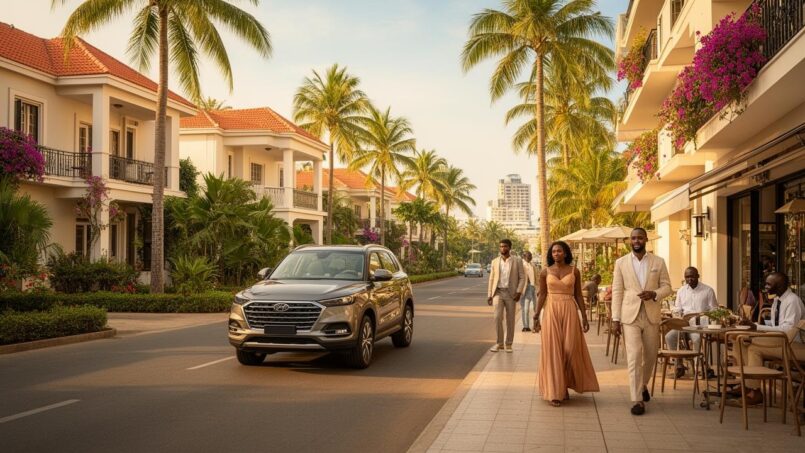
Neighborhoods like Kodjoviakopé, Baguida, or Amoutivé offer a quieter living environment, with beach access and a resort-like atmosphere, while remaining connected to the city center.
Finally, rapidly expanding areas like Adidogomé, Agoè, or certain secure housing developments (Résidence du Benin, Cité OUA, Cité Millenium, Forever, Ablogame), where you find modern villas, very variable rents, and often a mixed crowd of international professionals, affluent Togolese, and mixed families.
This all fits into an urban landscape where the cost of living remains much lower than in major African capitals, even if the bill quickly adds up when you combine high-end housing, reliable internet, international schools, and “Western-style” leisure activities.
Centre‑Ville: Lomé’s beating heart and ideal starting base
Lomé’s Centre‑Ville is both the administrative and commercial engine of the country. Ministries, offices, banks, major retailers, markets, and historical sites coexist here. For an expatriate arriving without knowing the city well, it’s often the simplest anchor point.
The area is considered mid-range: not the most luxurious, but far from the most affordable either. It offers a variety of options from furnished studios to family apartments, with a good density of services. It’s also one of the most suitable areas for digital nomads, as it combines cafes, coworking spaces, and relatively decent internet connections for the region.
Lifestyle profile and budget in Centre‑Ville
A furnished studio in the center typically rents between 150,000 and 250,000 XOF per month, about 245 to 410 USD according to market data. A two-bedroom apartment in a nearby residential area goes for around 300,000 to 600,000 XOF (about 490 to 985 USD), while a 3–4 bedroom villa with garden in a good central neighborhood can reach 600,000 to 1,500,000 XOF (about 985 to 2,460 USD), or even more if targeting very high-end secure residences.
1200
The maximum monthly budget for a single expatriate living locally, including housing, is 1,200 USD.
A simplified overview of possible rents in Centre‑Ville and its immediate surroundings is summarized below.
| Type of housing | Monthly rent range | Approximate equivalent in USD |
|---|---|---|
| Furnished studio in center | 150,000 – 250,000 XOF | 245 – 410 |
| 2-bedroom residential apartment | 300,000 – 600,000 XOF | 490 – 985 |
| 3–4 bedroom villa with garden | 600,000 – 1,500,000 XOF | 985 – 2,460 |
Beyond housing, the center stands out for accessibility. Shared taxis ply the main roads for a few hundred CFA francs per trip, and it’s possible to get around on foot within a relatively wide perimeter. Those on a tight budget benefit from this urban density to drastically reduce transportation costs.
Tip:
For a first stay, Centre‑Ville remains one of the best choices: you get your bearings, discover the markets, and identify quieter or greener neighborhoods to move to later.
Nyékonakpoè: neighborhood life, international schools, and expat atmosphere
Nyékonakpoè lies at the heart of Lomé, at the crossroads between the commercial city, residential area, and diplomatic hubs. It’s a lively neighborhood with a very active market, many shops, and restaurants. Several embassies are also located here, explaining the significant presence of diplomats and foreigners.
A key element for expat families is the proximity to several international schools. Consequently, Nyékonakpoè particularly attracts households with children enrolled in Anglo-Saxon or international Francophone systems.
Housing and safety in Nyékonakpoè
Popular rental properties in this neighborhood range from comfortable furnished apartments to family villas. Nyékonakpoè is often cited among recommended areas for expatriates, with rents generally between 850 and 1,700 USD for good-quality homes, sometimes with a garden or small pool.
Caution:
This positioning places it in the upper-mid price range: more affordable than hyper-secure enclaves like Résidence du Benin or Cité OUA, but more expensive than popular neighborhoods like Bè or some parts of Adidogomé and Agoè.
The presence of embassies and international schools contributes to a higher level of surveillance, although, as everywhere in Lomé, caution remains necessary in the evening and on the busiest roads.
A table allows comparison of Nyékonakpoè with other recommended neighborhoods on a purely rental basis.
| Recommended neighborhood | Indicative rent range (USD/month) | Typical housing profile |
|---|---|---|
| Nyékonakpoè | 850 – 1,700 | Furnished apartments and villas |
| Baguida | 850 – 1,700 | Villas near beach, garden |
| Forever | 850 – 1,700 | Recent villas, housing developments |
| Ablogame | 850 – 1,700 | Secure apartments/villas |
For a couple with children attending an international school, Nyékonakpoè thus offers an interesting compromise: real neighborhood life, nearby services, reduced commute times, and a level of amenities suited to an urban lifestyle.
Kodjoviakopé: the seaside showcase, between embassies and coworking spaces
Kodjoviakopé is emblematic of the city by the sea. Located along the coastline, it embodies the cliché of expat life in Lomé: beachfront villas, ocean views, proximity to diplomatic missions, and an atmosphere that is both relaxed and international.
Historically, the neighborhood mixed traditional buildings with more modern houses. Today, it also features recent apartment buildings, secure residences, and a few coworking spaces, like Impact Hub Lomé, reinforcing its appeal for self-employed workers and telecommuting employees.
Why Kodjoviakopé attracts so many foreigners
On one hand, it offers what many expatriates come looking for: enjoying the sea while remaining within reach of the administrative offices, banks, and shops of the center. On the other hand, the presence of embassies reinforces the feeling of safety and naturally attracts diplomats, NGO employees, and international consultants.
In practice
What you’ll find in this section
Documents, tools, and ready-to-use templates
Recommendations and best practices to follow
Concrete cases and application illustrations
– villas with gardens and sometimes pools, highly sought after by families and international organizations;
– high-standard apartments suitable for couples and singles;
– a network of cafes, bars, and restaurants frequented by the expat community.
Rents vary according to proximity to the beach, size, and amenities, but Kodjoviakopé is generally in the upper bracket of the Lomé market, comparable to other sought-after enclaves.
For those who want to work locally, the combination of coworking spaces (Impact Hub, among others) and fixed internet connection, around 15,000 to 30,000 XOF per month for a plan advertised at 50–60 Mbps, is an asset, even if the actual speed is often closer to a few megabits per second.
Kodjoviakopé is thus a natural choice for a profile of expatriate executive, digital nomad, or couple without children who prioritize sea views, international networks, and comfort.
Tokoin and Tokoin Hôpital: history, diplomacy, and French schools
Tokoin is one of Lomé’s old residential neighborhoods. From an expat perspective, its most interesting part is Tokoin Hôpital, a more institutional area home to École Arc en Ciel, a French school offering curriculum from kindergarten to high school. For French-speaking families, this school presence is a major argument.
The Tokoin neighborhood also houses numerous embassies and international organizations. This results in a rental market dominated by secure villas, with high rents, but also a more controlled security environment.
Living in Tokoin as an expatriate
Homes here are rather spacious, often with gardens, sometimes with pools. Rents follow suit: they are at the upper end for 3–4 bedroom villas in a good neighborhood, consistent with general figures for this type of property in Lomé (600,000 to 1,500,000 XOF, or more depending on features).
The strengths of Tokoin for foreigners are multiple:
– proximity to a recognized French school (École Arc en Ciel) in the Tokoin Hôpital area;
– concentration of embassies and international structures;
– image as a historic and residential neighborhood, with quieter streets than in some highly commercial areas.
On the flip side, housing costs are much higher than in popular or peripheral neighborhoods. Tokoin clearly falls into the category of neighborhoods that are “overpriced” for local wallets, but perfectly suited for expatriates with a housing package or comfortable budget.
Adidogomé: rapid expansion and a compromise between calm and access
Adidogomé well illustrates Lomé’s second ring: a fast-expanding neighborhood with an increasingly wide range of villas, apartment buildings, and small housing developments. Many expatriates now seek it as an alternative to the rents of the center and diplomatic zones.
Adidogomé is described as rapidly growing, offering a good balance between tranquility and access to amenities. You find spacious houses, often with gardens, at more affordable prices than on the coast or in hyper-secure neighborhoods.
Rents in Adidogomé and similar neighborhoods
In Adidogomé and neighborhoods targeted by expatriates like Agoè, Djidjolé, Baguida, or Avedji, the observed price ranges give a good idea of the market:
| Type of property in these neighborhoods (Adidogomé, Agoè, Djidjolé, Baguida, Avedji) | Monthly rent (XOF) | Comment |
|---|---|---|
| Studio / small furnished unit | From 115,000 XOF | For single person or young couple |
| Furnished 2–3 bedroom apartment | 230,000 – 450,000 XOF | Good value for size |
| Furnished 3–4 bedroom villa with garden, sometimes pool | 500,000 – 1,000,000 XOF | Family segment / expat executives |
Within Adidogomé itself, micro-areas like Adidogomé Atilamonou offer high-end villas: a large furnished villa with nine bedrooms, for example, can be listed around 1,000,000 XOF per month, sometimes negotiable.
Good to know:
Adidogomé is suitable for families and long-term expatriates seeking more daily comfort, even though the neighborhood is far from the city center. A vehicle is strongly recommended for getting around outside the main roads.
Agoè: attractive prices, green spaces, and suburban life
Agoè is another peripheral area highly targeted by foreigners. It combines greener spaces, still available lots for large houses, and prices considered attractive compared to central Lomé.
Example:
The neighborhood is growing rapidly and mixes single-family homes, modern apartment buildings, and semi-rural areas. It attracts both expat families wanting a large garden, as well as students and young professionals due to the proximity of several universities.
The downside is distance from the center. Living in Agoè almost requires having a car or at least relying daily on taxis and moto-taxis, which slightly increases the transport budget and lengthens commute times.
For expatriates with a mid-range rental budget, Agoè represents a good compromise: you can rent a furnished villa between 500,000 and 1,000,000 XOF in the most sought-after sectors, while enjoying softer rents for modest-sized apartments.
Baguida and the coastal neighborhoods: the lure of the beach
Baguida is one of the names that consistently comes up when talking about seaside neighborhoods recommended for expatriates. Situated on the beachfront but quite far from the city center, Baguida attracts those who want to live literally with their feet in the sand, in a quieter environment than the immediate outskirts of the capital.
850-1700
Rents for a good-quality house intended for expatriates range between 850 and 1,700 USD, including security.
The flip side is remoteness from the administrative center and major international schools. For an expatriate employee working in Lomé, the daily commute can become tiring, especially during the rainy season or rush hour. For a freelancer or retiree, however, Baguida is often seen as an ideal compromise between sea, tranquility, and access to the city.
Other coastal areas like Amoutivé or Bè‑Kpomassè have a similar profile: a mix of traditional and modern buildings, close proximity to the beach, and gradual upgrading with the construction of villas and small tourist complexes.
Ultra-secure enclaves: Résidence du Benin, Cité OUA, Cité Millenium
For some international organizations, certain companies, and a few foreign families, the absolute priority is neither the beach nor the charm of an old neighborhood, but maximum security. This is where enclaves like Résidence du Benin (often called “Lacaisse”), Cité OUA, or Cité Millenium come into play.
These three neighborhoods are described as the safest in Lomé. They share one feature: access is controlled by soldiers who monitor all entrances and exits, for both pedestrians and vehicles. De facto, these are real enclaves, functioning as gated communities.
Cost and housing profile in these neighborhoods
Enhanced security comes at a price. In these three zones, the average rent for a three-room house with garden and pool is around 2,500 USD per month. This is clearly the top end in Togo, aimed at profiles with a company-paid housing budget or very high incomes relative to local standards.
Example:
The market in these enclaves, in order of magnitude, is more distinct and often more expensive than in neighborhoods simply popular with expatriates, illustrating a noticeable difference in price and prestige.
| Neighborhood | Typical rent for a 3-room house with garden/pool | Security level |
|---|---|---|
| Résidence du Benin / Cité OUA / Cité Millenium | ≈ 2,500 USD / month | Very high (guards, control) |
| Forever / Ablogame / Nyékonakpoè / Baguida | 850 – 1,700 USD / month | Good, but less militarized |
These gated communities often house, besides homes, proximity services (small supermarkets, sometimes schools or private clinics), reducing the need to go out daily.
They are particularly suitable for families who want to minimize exposure to urban crime, or for people whose employer insists on a maximum security level.
Bè and more popular neighborhoods: reasonable budget, urban vibe
Faced with the high cost of enclaves and certain coastal areas, many expatriates – notably freelancers, volunteers, or young employees – turn to more popular neighborhoods like Bè. Located near the center, Bè is described as very lively, noisy, but also much more affordable in terms of rents.
Good to know:
In this type of neighborhood, a “clean and decent” two-bedroom apartment rents for between 60,000 and 100,000 XOF per month, or a bit more if recently renovated. It’s not luxury, but a livable home in a dense urban environment with noise, traffic, and street commerce.
In practice, this means that some expatriates can house themselves in Lomé for the equivalent of a few hundred dollars a month, while keeping good flexibility in their overall budget. These neighborhoods are also where you live most “the Togolese way”: street markets, cheap eateries, public transport by shared taxi.
Kmountcho Digital Park and new hubs for tech profiles
East of the city, another hub attracts a very specific audience: Kmountcho Digital Park. This “digital park” is located on the outskirts, on the eastern fringes of Lomé. It positions itself as a technology hub, hosting numerous IT startups and some large international companies.
The site is presented as a heart of the city’s digital community. Many young expatriates, developers, designers, digital marketing specialists, or tech freelancers are interested in it, drawn by the proximity to companies and a stimulating professional environment.
Rents in the area remain variable depending on proximity to the city and construction quality, but generally stay below those of diplomatic neighborhoods. The main drawback remains the distance from the center and historical services: you often need to rely on a vehicle or private transport to get around.
For a digital nomad or employee of a startup based at Kmountcho Digital Park, settling nearby can nevertheless make sense, provided you accept a more peripheral lifestyle.
Tsévié: the high-end suburban choice away from the capital
Beyond Lomé, some expatriates choose more affluent peripheral communes, like Tsévié, often described as an upscale suburb of the capital. This is no longer a neighborhood of Lomé per se, but a connected city, with a rather family-oriented foreign community.
Good to know:
Tsévié offers a peaceful setting with quality shops and restaurants. Security is considered high, and access to Lomé by car is easy.
This type of location attracts families who want a quieter life than in the big city, while remaining within reach of their offices, schools, or medical facilities in the capital. Rents are consistent with this high-end positioning, without however reaching the peaks of the militarized enclaves of Lomé.
Housing, security deposits, and rental practices
Whatever area is chosen, expatriates need to account for a few local practices regarding rentals. Security deposits often correspond to two or three months’ rent, and it’s not uncommon for landlords to demand quarterly or semi-annual advance payment.
2,000,000
Rents for high-end furnished villas aimed at the international market frequently exceed 2 million XOF per month in secure complexes.
However, moving away from Lomé, prices drop by 30 to 50% on average. An expatriate based in Kara or another inland city can therefore house much more cheaply, at the cost of much more limited access to international-type services.
To summarize, the main categories of cost in areas sought after by foreigners can be schematized as follows.
| Type of area / neighborhood | Typical rent level | Primary expat audience |
|---|---|---|
| Ultra-secure enclaves (Rés. du Benin, Cité OUA, Cité Millenium) | ≈ 2,500 USD for 3 rooms with garden/pool | Diplomats, NGO executives, large companies |
| Popular neighborhoods (Nyékonakpoè, Kodjoviakopé, Tokoin, Baguida, Forever, Ablogame) | 850 – 1,700 USD for good-level houses/villas | Families, couples, executives and freelancers |
| Expanding periphery (Adidogomé, Agoè, Djidjolé, Avedji) | 230,000 – 1,000,000 XOF (apartments to large villas) | Families, long stays, mid-range budgets |
| More popular neighborhoods (Bè and similar) | 60,000 – 150,000 XOF for simple apartments | Volunteers, young workers, tight budgets |
Services, schools, and healthcare: decisive criteria by neighborhood
Beyond rent alone, three elements weigh heavily in an expatriate’s choice of neighborhood: children’s schooling, access to acceptable quality healthcare, and connectivity (internet and transport).
Regarding schools, the international offering is concentrated in Lomé. It includes the American International School of Lomé, a newer British school (British School of Lomé), and Francophone institutions like École Arc en Ciel in Tokoin Hôpital. Nyékonakpoè, which is not far from several of these institutions, is therefore advantageous for families.
Good to know:
Although the Togolese hospital system is fragile, Lomé has the best healthcare facilities for expatriates, including private clinics, hospitals, and specialized centers. It is recommended to reside in central neighborhoods or nearby residential areas to minimize travel time in case of emergency.
For internet and remote work, the situation is mixed. Fixed plans advertise speeds of 50 to 60 Mbps for a cost of 15,000 to 30,000 XOF per month, but in practice, observed speeds often hover around 2 to 4 Mbps. Power outages are frequent, so many expatriates invest in a UPS or small generator, especially in peripheral neighborhoods.
Coworking spaces are still rare and concentrated where foreigners live and work: Impact Hub in Kodjoviakopé, Woelab near Agbalépédogan, Epitech in Lomé. This further reinforces the attractiveness of coastal and central neighborhoods for tech profiles.
Safety: adapting your neighborhood choice to your risk tolerance
Overall, the crime rate in the country is considered moderate, but Lomé concentrates the majority of incidents targeting foreigners, including theft, pickpocketing, and burglaries. Tourist areas (beaches, Grand Marché) and some central zones require constant vigilance, especially at night.
Tip:
The choice of a neighborhood for an expatriate depends on their own risk tolerance. A person comfortable in an African urban environment can live in neighborhoods like Bè or Adidogomé, provided they follow the usual precautionary rules: don’t go out alone at night, avoid showing signs of wealth, and secure your home.
Conversely, families unaccustomed to the continent, or employers strict about security, will prefer closed enclaves like Résidence du Benin or Cité OUA, even if it means dedicating a very large portion of their budget.
In intermediate neighborhoods like Nyékonakpoè, Kodjoviakopé, or Tokoin, the presence of embassies, international organizations, or private schools contributes to increased surveillance, without eliminating all risk.
Living “well” in Lomé: matching the neighborhood to your lifestyle
For an expatriate, there is no single ideal neighborhood in Lomé, but several very different options depending on personal priorities.
Those seeking urban intensity, markets, culture, and on a limited budget will naturally gravitate towards Centre‑Ville or nearby popular neighborhoods like Bè. There they will find low rents, very affordable food, and easy access to daily services.
Families with children and comfortable incomes will rather aim for Nyékonakpoè, Kodjoviakopé, certain parts of Tokoin, or developments like Forever and Ablogame, which offer a good balance between comfort, safety, and proximity to schools.
Caution:
Profiles demanding high safety standards or linked to international organizations will favor the highly secure enclaves of Résidence du Benin, Cité OUA, or Cité Millenium, while accepting rent levels comparable to much more expensive capitals.
Finally, those wanting space and quiet, without giving up reasonable access to the capital, will look towards Adidogomé, Agoè, or even Tsévié, at the cost of longer commutes and the nearly mandatory need for a vehicle.
In the end, the richness of Lomé’s offering and its periphery allows almost all expatriate profiles to find a neighborhood that suits them. The key is to get well informed in advance about actual rents, rental practices, internet connection quality, and safety in each area, then visit in person, neighborhood by neighborhood, before committing long-term.
A wealth planning project or a question? Contact us now to speak with a wealth management expert.
Disclaimer: The information provided on this website is for informational purposes only and does not constitute financial, legal, or professional advice. We encourage you to consult qualified experts before making any investment, real estate, or expatriation decisions. Although we strive to maintain up-to-date and accurate information, we do not guarantee the completeness, accuracy, or timeliness of the proposed content. As investment and expatriation involve risks, we disclaim any liability for potential losses or damages arising from the use of this site. Your use of this site confirms your acceptance of these terms and your understanding of the associated risks.

Cyril Jarnias is an independent expert in international wealth management with over 20 years of experience. As an expatriate himself, he is dedicated to helping individuals and business leaders build, protect, and pass on their wealth with complete peace of mind.
On his website, cyriljarnias.com, he shares his expertise on international real estate, offshore company formation, and expatriation.
Thanks to his expertise, he offers sound advice to optimize his clients' wealth management. Cyril Jarnias is also recognized for his appearances in many prestigious media outlets such as BFM Business, les Français de l’étranger, Le Figaro, Les Echos, and Mieux vivre votre argent, where he shares his knowledge and know-how in wealth management.





