
 Published on and written by Cyril Jarnias
Understanding how to get around Togo, especially in the capital Lomé, is essential for planning a trip, a business trip, or everyday life. The country relies heavily on road transport, with a strong presence of informal transport such as motorcycle taxis, bush taxis, and tricycles, while the structured bus offering remains limited but is undergoing a modernization overhaul. This practical guide compiles the main available information to help you choose the right means of transport, estimate your costs, and travel safely.
Overview of transport in Togo
The transport sector plays a central role in Togo’s economy: over 80% of trips for people and goods are made by road. The country has approximately 7,520 km of roads, of which just over 2,300 km are paved. Road transport overwhelmingly dominates, ahead of air, rail (almost exclusively freight), and waterways.
Good to know:
The flexibility of road transport allows service to remote areas and offers door-to-door service, while carrying both passengers and goods. However, the sector suffers from deteriorated infrastructure, irregular maintenance, inadequate technical inspections, strong informality, and limited regulation.
In urban areas, particularly in Lomé, the landscape is quite typical of large West African cities: a majority of trips on foot, private motorcycles and motorcycle taxis as the main motorized modes, a very modest share for urban buses, and a network of taxis and bush taxis that completes the picture. According to mobility data for Lomé, the modal split is telling.
| Mode of transport in Lomé | Estimated modal share |
|---|---|
| Walking | 51% |
| Private motorcycle | 20% |
| Motorcycle taxi (zemidjan, “z”) | 19% |
| Shared taxi (car) | 4% |
| Private car | 3% |
| Bicycle | 1% |
| Urban buses (SOTRAL) | 1% |
This structure reflects the reality of a young country (average age around 17), where the majority of city dwellers walk long distances and where two-wheelers dominate the motorized transport landscape.
Navigating the jungle of urban transport
In Lomé as in other large cities, several major categories of public or shared transport must be distinguished: zémidjans (motorcycle taxis), car taxis (shared or private), urban minibuses, and the SOTRAL bus company. Each has its advantages, limitations, and preferred uses.
Motorcycle taxis (zémidjans, “z”)
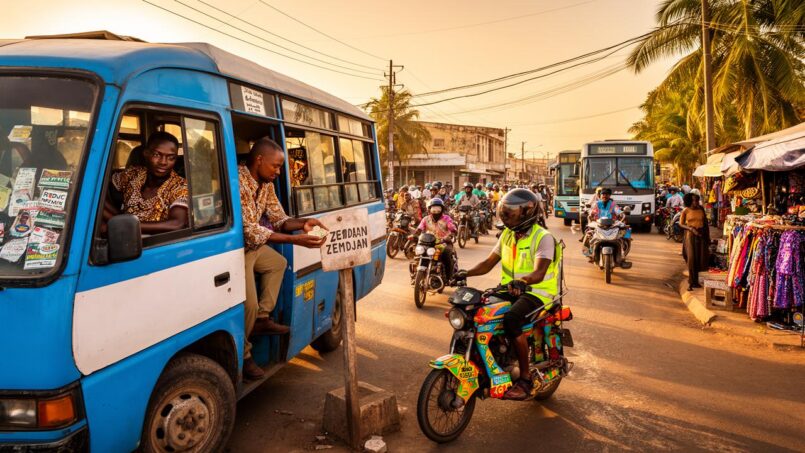
Motorcycle taxis, nicknamed “zémidjans” or simply “z”, are everywhere on the streets of Lomé and other Togolese cities. They first appeared in the early 1990s and exploded due to economic crises, youth unemployment, and the lack of formal public transport.
The principle is simple: you hail a driver by the roadside, tell him your destination, negotiate the price, then ride behind him, possibly with a second passenger for short distances. For a few hundred CFA francs, he will drop you almost anywhere in the city.
Zémidjans are particularly appreciated because they weave through traffic, avoid congestion, and have very low fares. In cities, a typical ride costs between 500 and 2,000 FCFA (about €0.80 to €3) depending on distance and time. For very short distances, some trips can go as low as 100 or 300 FCFA.
| Feature | Zémidjans (motorcycle taxis) |
|---|---|
| Location | Everywhere in the city, at intersections, markets |
| Number of passengers | 1 to 2 (excluding driver) |
| Urban price range | ~300 to 2,000 FCFA per trip |
| Speed / travel time | Very fast in the city, avoids traffic jams |
| Ease with luggage | Low (not suitable for large bags) |
| Safety | High accident risk, caution required |
Wearing a helmet is theoretically mandatory for the driver since a 2015 decree, and more and more zémidjans offer a passenger helmet, though it is not systematic. In practice, many drivers do not have a valid license and have poor knowledge of traffic rules. The sector remains highly informal, and worrying abuses occur: consumption of tramadol or cannabis by some young drivers, overloading, excessive speeding, endless trips that fatigue drivers.
Tip:
For the user, a few simple rules apply: negotiate the fare before getting on, refuse excessive speeds, prefer drivers who offer a helmet, avoid night trips or remote outskirts where accident and theft risks increase. Motorcycle taxis are ideal for a quick trip without luggage, during the day, over a few kilometers.
Car taxis: shared or private
Car taxis are the other pillar of Togolese urban transport. In Lomé, they are easy to spot: yellow license plate, registration number painted on the doors, and often a yellow roof marked “taxi.” They operate under two distinct formulas: shared taxi (or “line” taxi) and private taxi.
In shared mode, the car follows a fixed route, stops along the road to pick up and drop off passengers, and the price is set per passenger according to the segment. The trip is not direct: the driver continues to take passengers as long as a profitable seat remains. In private mode, the taxi functions almost like a ride-hailing service: it takes only you, drops you where you want, and the fare is negotiated as a flat fee.
| Car taxi type | Shared mode | Private mode |
|---|---|---|
| Occupancy | Shared with other passengers | Reserved for the client |
| Route | Predetermined route, frequent stops | Tailored to the client |
| Pricing | Per seat, fixed on the line | Negotiated flat fee |
| Comfort | Variable, often older vehicles | Better, but depends on the car |
| Typical urban trip price | ~300 to 1,000 FCFA per person | ~500 to 1,500 FCFA (or more) |
In Lomé, a short taxi ride may cost about 500 FCFA, while longer trips across the city climb to 1,500 to 2,500 FCFA. Between the airport and the city center (about 6 km), expect between 2,000 and 5,000 FCFA depending on negotiation, time of day, and type of service (street taxi, reservation, hotel shuttle).
Some fare benchmarks for orientation:
| Urban / peri-urban trip | Indicative fare (ceiling or typical) |
|---|---|
| Lomé Airport – city center | ~2,000 to 5,000 FCFA |
| Short city ride | ~500 FCFA |
| Long crossing of the city | 1,500 – 2,500 FCFA |
| Lomé – Tsévié (intercity) | 500 to 800 FCFA (revised ceiling) |
| Lomé – Aného (intercity) | 1,000 FCFA |
Taxis do not have meters in Togo. It is therefore essential to agree on a price before departure to avoid surprises. Negotiation is part of the local culture, but being massively overcharged is relatively rare; discreetly asking a local or your hotel receptionist what fare is “normal” for a given trip remains the best protection.
Caution:
To book a car taxi in Lomé, you can ask your hotel, contact a central like “Tele Taxis Togo,” or use the Gozem app, which allows you to order cars and motorcycles.
Urban minibuses and paratransit
Beyond taxis, a multitude of private minibuses ply the capital and major cities. They are most often owned by individuals or driver unions. Their license plate is yellow, like taxis, but they operate more like collective transport: relatively fixed routes, official fares on major lines, numerous stops.
These minibuses, often 16- to 20-seat vehicles, are a spontaneous response to the inadequacy of formal public transport. They operate along major arteries, connect bus stations, markets, and densely populated neighborhoods. Comfort is basic: older vehicles, overcrowded, little or no seatbelts, and haphazard maintenance that contributes to urban pollution.
Good to know:
The main advantage is the low price (a few hundred CFA francs to cross a large part of the city). Disadvantages include the lack of reliable maps or schedules, risks of overcrowding and pickpocketing, as well as numerous stops and detours through bus stations or markets.
SOTRAL urban buses: a network in transition
To structure the collective transport offering in the capital, the authorities created the Société des Transports de Lomé (SOTRAL). This public company operates a bus network of about fifteen lines covering approximately 235 km and serving nearly 195 neighborhoods in the metropolis. With 85 vehicles, SOTRAL runs about 500 trips per day and carries roughly 26,000 passengers daily.
Relative to the urban area (over two million inhabitants on 333 km²), this remains very modest: the market share of SOTRAL buses is estimated at only 1% of trips. In other words, buses exist but are insufficient to absorb demand and struggle to compete with motorcycle taxis in terms of frequency and proximity.
Nevertheless, SOTRAL fares are very attractive, especially since the generalized price reduction in December 2024, linked to the reduction in diesel prices at the pump.
| SOTRAL ticket type (Lomé) | Fare before reduction | New indicative fare |
|---|---|---|
| Short distance (formerly 150 FCFA) | 150 FCFA | 100 FCFA |
| Standard trip (formerly 250) | 250 FCFA | 200 FCFA |
| Long trip (formerly 300) | 300 FCFA | 250 FCFA |
| Longest distance (formerly 350) | 350 FCFA | 300 FCFA |
| Student fare (campus line) | 150 FCFA | Maintained / preferential |
Payment is traditionally made in cash at the ticket counter or on board upon boarding. Buses can be very crowded, especially during peak hours, and overcrowding increases the risk of pickpocketing; keeping your belongings firmly on you is essential.
Starting in 2026, a quiet revolution will change habits: the Ministry of Transport has announced the complete digitalization of SOTRAL tickets. After a successful trial at the end of 2024 on certain student lines, all tickets will be purchased via a USSD code on mobile phones, in partnership with operator Yas Togo. The stated goal is to make bus access simpler, faster, and more secure, while improving flow monitoring and combating fraud.
Intercity travel: bush taxis, buses, and coaches
Leaving the capital or traveling between Togolese cities essentially relies on two options: bush taxis (taxis-b) and long-distance bus companies. Rail offers no regular passenger service.
Bush taxis (taxis-b)
The bush taxi is the backbone of intercity connections in Togo. They are most often sedans, station wagons, or minivans, sometimes pickups or large vans depending on the line’s popularity. These collective vehicles carry as many passengers as possible, along with their luggage, sometimes in impressively cramped conditions: in a minivan designed for seven seats, a dozen people may be loaded, not counting loads on the roof.
Example:
Bush taxis are found at bus stations in major cities, such as in Lomé where departure areas are organized by destination: Grand Marché or Hollando for Aného, Kodomé district for Kpalimé, Agbalépédo for Kara, Sokodé, Dapaong, etc. There is no fixed schedule: the vehicle departs when the driver deems it full, which can lead to a long wait, especially outside market days.
As a general rule, the fare is set per 100 km, around 3,000 FCFA. Authorities have recently regulated and capped prices on many routes, particularly after the fuel price drop. New scales were defined by an interministerial decree, which now serves as a reference for intercity trips.
| Example of capped intercity fares (from Lomé) | Price cap (FCFA) |
|---|---|
| Lomé – Tsévié | 500 to 800 |
| Lomé – Kpalimé | 2,000 |
| Lomé – Atakpamé | 2,700 |
| Lomé – Blitta | 4,500 |
| Lomé – Sokodé | 5,000 |
| Lomé – Kara | 5,850 |
| Lomé – Mango | 7,500 |
| Lomé – Dapaong | 8,500 |
| Lomé – Cinkassé | 9,000 |
| Lomé – Aného | 1,000 |
Bush taxis are the cheapest option but also the most “adventurous.” Safety is not optimal: overloading, approximate adherence to traffic rules, speed, poor secondary roads… To slightly improve comfort and safety, travelers often pay for multiple seats, especially in the front, to have space and avoid being squashed. Another tip: leave early in the morning to avoid driving at night, when accidents are more frequent.
Intercity bus companies
For longer trips and a higher level of comfort, many bus companies connect the country’s major cities to each other and to neighboring capitals (Accra, Cotonou, Lagos, Ouagadougou…). Among the operators mentioned in the documents are Rakieta, Etrab, ZST, Kilimandjaro, SNTV, TSR, BK Lines, Rimbo Transport, and the Post Office buses (“Le Courrier”).
Good to know:
Buses are often recent and air-conditioned, with company-specific stations. Although departures are at fixed times, the bus may wait until full. Buy your ticket at least 48 hours in advance, and earlier in high season (dry season, holidays, Evala).
Prices remain affordable, but higher than bush taxi fares for short distances.
| Typical bus trips from Lomé | Average price (approx.) | Indicative duration |
|---|---|---|
| Lomé – Kara | ~6,000 FCFA | 7–8 h |
| Lomé – Dapaong | ~8,000 FCFA | 9–10 h |
| Lomé – Cinkassé | ~9,000 FCFA | 10–11 h |
| Lomé – Cotonou (Benin) | ~€23 (~15,000 FCFA) | ~7 h |
| Lomé – Accra (Ghana) | ~€30 (~20,000 FCFA) | ~14–15 h |
| Lomé – Lagos (Nigeria) | ~€39–50 | ~15 h |
On the coast, frequent lines connect Lomé to Aného, with prices ranging from 1,000 to 3,000 FCFA depending on the mode (taxi, bus, bush taxi). The Post Office buses (“Le Courrier”) also serve major cities with fares between 2,000 and 9,000 FCFA, with tickets sold at post offices.
Tip:
As with bush taxis, avoid night trips, keep your luggage within sight, and watch your belongings at every stop. At roadblocks, buses are swarmed by vendors selling water, skewers, fruit, or bread: a lively experience but disorienting for unaccustomed travelers.
What about the train?
Togo historically had railway lines connecting Lomé to Kpalimé, Aného, Atakpamé, and Blitta, but rail has virtually disappeared for passenger transport. The network (about 500 to 560 km of meter-gauge tracks) is now mainly used for freight, particularly for phosphate export via the port of Kpémé.
Projects for railway rehabilitation and expansion are regularly mentioned. Some documents refer to ambitious projects for regional lines and tourist loops, but in the current reality, there is no regular passenger service. Occasional chartered trains may run, but their schedules are uncertain. For the user, bus or bush taxi remains the only reliable option.
Renting a car and driving yourself
Car rental is possible in Lomé, particularly through major international rental companies present at the airport (Avis, Europcar) or local agencies. Daily rates for a small city car range roughly between 20,000 and 55,000 FCFA per day, while a 4×4 typically rents for between 60,000 and 80,000 FCFA. These rates do not include fuel or mileage (charged extra).
| Vehicle type | Price range/day (FCFA) | Recommended use |
|---|---|---|
| City car / small sedan | 20,000 – 55,000 | City and main roads |
| 4×4 / SUV | 60,000 – 80,000 (up to 100,000) | Secondary roads, tracks, rural north |
The law sets the minimum driving age at 18, but you generally need to be at least 21 (or older depending on the agency) to rent a vehicle. A valid driver’s license is required, and an international driving permit is strongly recommended. A guarantee (deposit or card imprint) is standard.
Caution:
Renting a car offers great freedom, but the road network is mostly in poor condition, especially during the rainy season, with potholes and muddy tracks. Driving is dangerous due to the density of motorcycles, pedestrians, animals, and the unpredictable behavior of some drivers.
Recommendations converge: avoid driving at night, keep doors and windows locked, plan enough fuel (stations are sometimes spaced far apart in rural areas), travel in multiple vehicles on very isolated stretches, and in case of an accident, notify the police rather than trying to handle the situation alone in front of a potentially hostile crowd.
Good to know:
For visitors, renting a vehicle with a driver is often safer. Many agencies and some hotels offer this service, often at the same daily rate as a simple rental or slightly higher, with the advantage of a driver who knows the road, roadblocks, and local customs.
Cost of mobility: what to budget
Togo is a cash-heavy economy: card payments are the exception outside hotels and a few restaurants. For transport, you should rely almost exclusively on cash in CFA francs. ATMs are available in major cities but rare in rural areas. Before leaving Lomé or another big city, it’s best to withdraw enough cash, especially in small denominations to facilitate payment for taxis, motorcycle taxis, minibuses, or bush taxis.
20
In Lomé, transport expenses can account for up to 20% of family income, encouraging the use of low-cost transport like walking or zémidjans.
For a visitor, the following ballpark figures can help you get a sense:
– Daily urban trips by taxi or motorcycle: a few thousand FCFA per day is enough for several rides.
– A round-trip intercity bus ride (e.g., Lomé–Kpalimé or Lomé–Atakpamé) comes to a few thousand FCFA.
– A one-week car rental can quickly amount to several hundred thousand FCFA, not counting fuel (600–700 FCFA/liter on average for gasoline or diesel).
Safety and traffic conditions
The issue of road safety is crucial in Togo. Official statistics report thousands of accidents and several hundred deaths each year, with a heavy involvement of motorcycles and motorcycle taxis. Holidays and festive periods see a peak in incidents. The causes are multiple: density of motorcycles, narrow or deteriorated roads, lack of nighttime lighting, overloaded or poorly maintained vehicles, insufficient adherence to traffic rules.
Pedestrians are particularly vulnerable: sidewalks are rare or obstructed, crossings unprotected, street lighting deficient in many neighborhoods. Yet more than half of trips in Lomé are made on foot. Walking is often done over long distances, along the edge of the roadway, amid motorcycles and taxis.
Observations on mobility in Lomé
For users of public and informal transport, a few basic principles significantly improve safety:
Tip:
Prefer daytime trips on intercity routes. Buckle up in a car whenever possible, as the law requires it. Wear a helmet on a motorcycle, at least for the driver and ideally for the passenger. Avoid overloaded or dilapidated vehicles. Negotiate firmly but calmly to avoid fare abuse. Watch your personal belongings in markets, stations, and crowded buses.
The risk of assault or theft targeting travelers exists, particularly at night, on certain beachfront stretches in Lomé or in poorly lit neighborhoods. It is generally advised to use known taxis and limit nighttime trips on foot. Carjackings and highway robberies are reported, especially on certain routes between major cities or in border areas, but remain less common than accidents.
Accessibility and inclusion: a major challenge
People with disabilities face significant accessibility barriers in Togo. According to accessibility experts cited during a roundtable, about 80% of public buildings in the country are not adapted: lack of ramps, stairs without alternatives, non-adapted signage, etc. Public transport is no exception: few buses are equipped with ramps or wheelchair platforms, stops are not adapted, sidewalks are often impassable.
Caution:
The United Nations Committee on the Rights of Persons with Disabilities has highlighted that persons with disabilities face obstacles in accessing the physical environment, transport, information, and communications, particularly in rural areas, due to a lack of implementation of existing laws and insufficient budgets.
For a traveler with reduced mobility, getting around by public transport in Togo remains an obstacle course. The most realistic solution is often to use a private adapted vehicle or a pre-negotiated taxi with specific assistance. Reforms are under discussion to gradually improve accessibility, but they will take time to translate on the ground.
Major ongoing reforms: toward more structured mobility
Faced with a system described as “chaotic, informal, and unsafe” by some international assessments, Togolese authorities have launched several reform projects.
A new transport framework law
With support from the World Bank and the IRU, Togo has adopted a transport framework law aimed at formalizing and professionalizing the sector. This framework law is intended to clarify the rules of the game, secure the exercise of transport professions, better control safety conditions (e.g., on taxis, motorcycle taxis, tricycles), and make the country more attractive as a regional logistics hub.
Good to know:
A decree adopted by the Council of Ministers now regulates taxis, motorcycle taxis, and tricycles. Drivers must obtain a permit from the Ministry of Transport and an authorization from local authorities. Goals: improve road safety and service quality, while moving out of informality. Operators have two years to comply.
The Sustainable Urban Mobility Plan (SUMP) for Lomé
Another structuring component: the development of a Sustainable Urban Mobility Plan (SUMP) for the Lomé metropolitan area. This plan, co-financed by the European Union and the Covenant of Mayors for Sub-Saharan Africa framework, mobilizes international experts (SYSTRA, CETUD, Egis, etc.) and about fifty local stakeholders (ministries, city halls, driver unions…) around a vision for 2040.
The broad outlines of this strategy are known:
Key areas for urban mobility
Structure and modernize urban transport, from infrastructure to governance, for more efficient and sustainable mobility
Strengthen collective transport
Give a central role to structured collective transport by strengthening SOTRAL on the busiest routes and developing services in major secondary cities.
Organize transport cohabitation
Organize cohabitation between formal (buses) and informal (motorcycles, taxis, tricycles) transport by clearly defining the areas and service types for each.
Promote active modes
Improve infrastructure for pedestrians and cyclists to secure and promote active modes, while reducing the environmental and health impact of mobility.
Create a transport authority
Create a metropolitan transport authority capable of coordinating all stakeholders, steering investments, and setting up dedicated financing mechanisms (transport fund, conditional subsidies).
The SUMP is based on eleven “strategic lines” covering governance, finance, land use, network development, regulation of the informal sector, promotion of alternative modes, and extending infrastructure lifespan.
Digitalization and service modernization
Among the concrete projects already underway, the digitalization of SOTRAL tickets is emblematic: it aims to simplify purchase, reduce cash handling, better monitor passenger flows, and lay the groundwork for integrated ticketing in the future. Similarly, studies are underway on the complete reorganization of SOTRAL (line plan, depots, fleet), the creation of dedicated bus lanes on certain routes, and the digital regulation of motorcycle taxis (registration, geolocation, driver control via apps).
Practical tips for getting around Togo
In practice, how do you make the most of this offering, while limiting risks and managing your budget? Some benchmarks can serve as a guide.
For urban trips, especially in Lomé, a flexible combination works well: walking for short distances, zémidjan for quick trips without luggage, shared or private taxi for longer or nighttime rides, SOTRAL bus when the line is convenient for your route and schedule. The Gozem app can help you order more reliable and traceable motorcycles or taxis than street vehicles.
Tip:
For intercity travel, a reputable bus company offers the best safety/comfort/price compromise on major routes. Bush taxis remain essential for reaching certain towns or villages, but warrant a few precautions: choose a decent vehicle, accept waiting for it to fill up, refuse obvious overloading. In all cases, planning an early morning departure limits night-related risks and leaves a margin in case of unforeseen events (breakdown, road closure during rainy season).
For remote rural areas and exploring the north, renting a 4×4 with a driver is often the safest and most efficient solution. Secondary roads are frequently impassable in the rainy season, and even in the dry season, a local driver’s experience on the tracks can make all the difference.
Good to know:
Transport in Togo is flexible and informal, with no fixed schedules, offering an authentic immersion into local life. To navigate it, patience, caution, and preparation are needed.
A heritage project or a question? Contact us now to speak with a wealth management expert.

Cyril Jarnias is an independent expert in international wealth management with over 20 years of experience. As an expatriate himself, he is dedicated to helping individuals and business leaders build, protect, and pass on their wealth with complete peace of mind.
On his website, cyriljarnias.com, he shares his expertise on international real estate, offshore company formation, and expatriation.
Thanks to his expertise, he offers sound advice to optimize his clients' wealth management. Cyril Jarnias is also recognized for his appearances in many prestigious media outlets such as BFM Business, les Français de l’étranger, Le Figaro, Les Echos, and Mieux vivre votre argent, where he shares his knowledge and know-how in wealth management.





