
 Published on and written by Cyril Jarnias
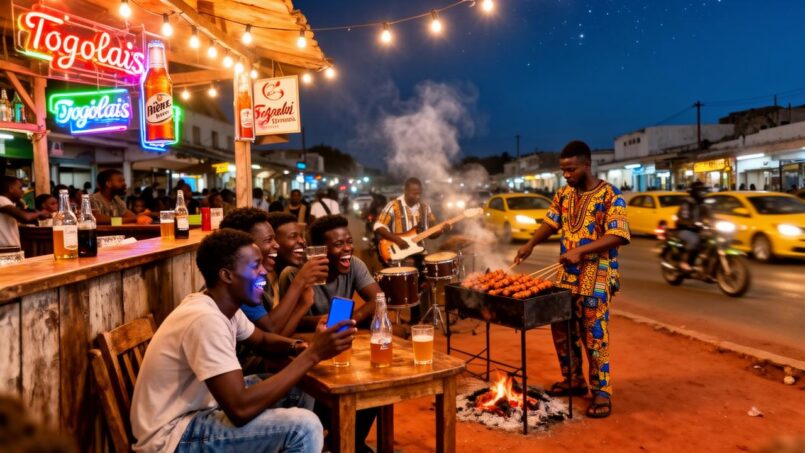
When the sun sets over the Gulf of Guinea, Togo changes its face. On the beaches of Aneho or Baguida, pirogues still glide over the swell, the aroma of skewers rises in the warm air, and already, on the rooftops of Lomé, the first cocktails clink to the sound of afrobeat. Nightlife in Togo is not just about nightclubs or bars: it blends beach parties, urban carnivals, jazz festivals, rooftop soirées, night markets, voodoo rituals, and traditional dances that stretch long after midnight.
Good to know:
In Togo, going out at night blends Ewe, Kabyè, or Mina cultural traditions with vigilance recommendations from foreign authorities, especially after dark. It’s advisable to enjoy the festive atmosphere while staying cautious.
Lomé, capital of Togolese nightlife
Lomé concentrates most of the country’s nightlife. The capital and largest city, it brings together bars, clubs, rooftops, lively beaches, festivals, and late-night markets. It’s also where most of the emerging LGBT+ scene is found, though forced into great discretion by a repressive legal framework.
The city is often described as safe for a first immersion into West African nightlife, provided you follow a few simple rules: avoid isolated areas (unsecured beaches, Boulevard du Mono late at night, the outskirts near the Ghana–Togo border), favor busy and well-known venues, and use taxis or private vehicles rather than walking alone in poorly lit areas.
Major clubs: From V8 Night Club to Privilege Night Club
Nightclubs are the beating heart of Lomé’s nights. Afrobeat, hip-hop, electronic sounds, Togolese classics, and international hits play one after another until dawn.
Among the standout addresses, V8 Night Club stands as one of the symbols of this energy. Located in Lomé, this club is touted as a very popular nightlife destination, accessible and suitable for both locals and tourists. It’s open Thursday through Sunday, from 10 PM to 5 AM, with a state-of-the-art sound system, spectacular light shows, and a mix of local and international DJs. The atmosphere is described as electrifying, at the crossroads of cultures, with programming blending afrobeat, hip-hop, and electronic music. Its modern and stylish interior, bathed in dynamic lights, is often cited as one of the best showcases of Togolese clubbing culture.
Other venues have achieved almost legendary status among night owls:
– Privilege Night Club is called “legendary” in Lomé, almost synonymous with nightlife in the capital. Also boasting very powerful sound and a light show worthy of a spectacle, it attracts a diverse crowd, driven by sets mixing Togolese hits and global chart-toppers.
– Byblos Club targets a more sophisticated audience, with a chic décor, an elaborate wine and spirits menu, and sometimes live music sessions. People come as much for the atmosphere as to rub shoulders with the local elite.
– Paparazzi Nightclub focuses on the “fashion” side: polished design, VIP spaces, birthday parties, and private events, often hosted by guest DJs.
– Le Phenix is described as one of Lomé’s hottest spots, alternating between DJs and live bands for ever-different nights.
– Club 228, a nod to the country’s telephone code, aims to be a tribute to Togolese identity, with a strong emphasis on local artists and national cultural influences.
Even if the exact address of some clubs isn’t always highlighted in listings, one thing is consistent: many clubs are concentrated in and around central thoroughfares (Boulevard du 13 Janvier, streets near the waterfront, lively neighborhoods like Nyékonakpoé or Agoè). Late hours are the norm: dancing rarely starts before 11 PM–midnight, and many venues stay open until 5 AM, or even 7 AM for some establishments listed as “open until 07:00 AM” on Ave Nicolas Grunitsky or in Atakpamé.
Example:
To better visualize the opening hours of a few iconic venues, it can be summarized like this: the place is open from 8 AM to 8 PM, giving an operating window of 12 hours.
| Venue | City | Main opening days | Typical hours |
|---|---|---|---|
| V8 Night Club | Lomé | Thursday – Sunday | 10 PM – 5 AM |
| Le ROOFTOP (bar) | Lomé | Wed – Sunday | 6 PM – 2 AM (until 4 AM on weekends) |
| i’Top Rooftop Lounge | Lomé | Tue – Sunday | 5 PM – midnight/4 AM/2 AM depending on day |
These hours reflect a nightlife scene that truly kicks into high gear after 10 PM and stretches well into the early morning.
Themed clubs and live music: Havana Club, Oasis, Le Caveau, Le Vieux Port
Alongside the big clubs, Lomé is home to venues with strong identities. Oasis Night Club, for example, focuses on a “under the stars” party concept with an open-air dance floor, a bar by the pool, and a near-tropical atmosphere. Some don’t hesitate to compare it in spirit to Ibiza’s party spots, transplanted into the heart of the Togolese capital.
Havana Club plays a different card: the Latin night. A full-on Cuban atmosphere, mojitos front and center, salsa nights or Latin music that fills the dance floor. Couples dancing find an ideal playground here, far from the more classic afro-urban sets.
For live music enthusiasts, Le Caveau stands out. It’s a haven for jazz lovers, West African music, or more intimate sounds, with a programming that swings between jazz, traditional Togolese music, and other styles. The atmosphere is more laid-back than in the big clubs, perfect for listening to a concert without being swallowed by a dense crowd.
Attention:
At Le Vieux Port and La Nouvelle Station, open stages welcome traditional artists, afro-fusion, and emerging talents. After a decline due to lip-syncing, live music is reborn thanks to promoters and artists like Toofan, King Mensah, or Almok, who fill venues like Espace 54, Sunset, or La Rumba, perpetuating a musical tradition dating back to the 1950s with Bella Bellow and Sassamasso.
This “concert” dimension is an essential part of evenings in Lomé: going out doesn’t just mean dancing in a club, but often listening to a band, discovering a new singer, or following an urban festival.
Bars, terraces, and bistros for quieter nights
Not everyone wants to end the night on a packed dance floor. For those who prefer conversations, tastings, and more subdued atmospheres, the capital offers a network of bars and terraces.
Le Bar à Vin is known for its extensive wine selection and cozy atmosphere, sometimes punctuated by intimate concerts. L’Afrik’Bar, much appreciated by Lomé locals, blends cocktails, live music, and a large outdoor terrace, perfect for long evenings. Le Gondwana, with its “arty” vibe and creative drinks, attracts a curious crowd mixing artists, students, and expats. La Terrasse, as its name suggests, charms with its ocean view, a major asset for a sunset aperitif or a last drink facing the waves.
In a similar vein, Le Phare stands out with a weekly program of karaoke, quizzes, and various activities, while Bellevue, on the beach, regularly hosts DJs and bands for evenings by the water.
These places draw another geography of the night: less focused on the dancefloor trance, more oriented toward exchange, encounters, and participatory entertainment.
The rooftop trend: drinking above Lomé
A global trend, rooftop bars have found a natural home in Lomé: open skyline, ocean breeze, golden light of sunsets over the Gulf of Guinea. Several hotels and buildings in the capital have turned their roofs into bars and lounges, becoming landmarks for after-work drinks as well as more festive evenings.
Le ROOFTOP and i’Top Rooftop Lounge
Le ROOFTOP, located on Avenue Nicolas Grunitzky, is one of the hottest spots. Perched in the heart of the city, it offers an unobstructed view of Lomé and the Atlantic. The place is described as lively and convivial, with a menu of refreshing cocktails and programming designed for evening relaxation. It opens at 6 PM and closes between 2 AM and 4 AM depending on the day, with peak attendance on weekends. Regulars recommend arriving early to snag a table with the best view, especially on Fridays and Saturdays.
Tip:
This rooftop offers a similar experience with wines, crafted cocktails, and a panoramic view of the city. Open from 5 PM, it’s ideal for a romantic date or an evening with friends. Sunset is the prime time, when the light fades and the city lights come on. A first drink here makes a good prelude before heading to a club.
Hotel rooftops: Radisson Blu, Golden Tulip, King Faisal, Estrella
Several major hotels in Lomé have turned their roofs into genuine nightlife spots, not reserved solely for their guests.
The rooftop of the Radisson Blu offers an impressive view over both the city and the Gulf of Guinea. It quickly became a meeting point for Lomé locals and travelers alike, who come to sip a drink in an elegant setting before or after dinner.
The Golden Tulip rooftop adopts a modern aesthetic: polished décor, dimmed lights, comfortable armchairs. People come as a couple or with friends for a “classy” evening with the city’s rooftops, alleys, markets, and beaches bordering the gulf as a backdrop. The contrast between the bustle below and the relaxation above is part of the charm.
King Faisal Rooftop
Infinity pool offering an experience blending panorama, gastronomy, and daytime leisure, before giving way to a lounge atmosphere in the evening.
Enjoy a stunning view of the surroundings from the rooftop.
Savor refined cuisine while relaxing in the sun during the day.
Once night falls, the rooftop transforms into a place for extended evenings.
Finally, Estrella Rooftop, in Nyékonakpoé (Rue des Cocotiers and Avenue François Mitterrand), illustrates how some rooftops have become true “cultural stages”. Described as a cozy spot with a very nice view of bank buildings, major corporate offices, and the silhouette of the Hôtel 2 Février, Estrella hosts a series of events: after-work drinks every evening, Larry Art Club cabaret presented by Julio Teko every first Saturday of the month, live barbecue every Friday. The programming team emphasizes a mix of music, arts, and conviviality, with hours stretching from noon to 3 PM, then 5:30 PM to 11 PM.
To compare a few major rooftops in Lomé at a glance, it can be summarized as follows:
| Rooftop | Main strengths | Audience & vibe |
|---|---|---|
| Le ROOFTOP | City + ocean view, cocktails, downtown | After-work, lively evenings, busy weekends |
| i’Top Rooftop Lounge | Wines & cocktails, panorama, “vibrant” atmosphere | Couples, friend groups, tourists |
| Radisson Blu Rooftop | View of Lomé and Gulf of Guinea, elegant setting | Business travelers, urban residents |
| Golden Tulip Rooftop | Modern décor, dimmed lights | Evenings with friends, “chic” dates |
| King Faisal Rooftop | Infinity pool, gastronomy, spectacular view | Daytime relaxation, lounge evenings |
| Estrella Rooftop | Cultural programming, view of the center | After-work, cabaret, live BBQ, mixed crowds |
These places all offer a gentle entry into Togolese nightlife, often safer and more controlled than isolated bars in the outskirts.
Beaches and nighttime events: Baguida, Aneho, Lomé Beach
Going out at night in Togo also means turning toward the sea. The beaches form a central backdrop for evenings, whether for one-off events or regular habits.
Baguida, Aneho, Kodjoviakopé: beaches that come alive at night too
Baguida Beach, just outside Lomé, is described as a good place to get away from the crowd and spend a peaceful day. But the site also transforms during major events: this is where Lomé Jazz à la Plage takes place – a free weekend musical event with a stage on the sand, vendors selling grilled shrimp skewers with lemon-ginger butter, and a crowd blending young urbanites, families, and travelers. The Togo Surf Open, a free competition, also brings a very festive atmosphere: judges, afropop music from the tents, smoke from grilled lobsters rising from the thatched huts.
Aneho Beach, near the historic town of Aného, comes alive each year with the Christmas Beach Regatta, a colorful pirogue race at Christmas time. Decorated boats race over the waves while spectators drink ginger bissap or coconut rum on the sand. At night, the event turns into a large informal party on the beach, with music and dancing.
Christmas Beach Regatta
In Lomé itself, Kodjoviakopé Beach is known for its evening walks and picnics, with restaurants and bars nearby. By day, people swim or sunbathe; by night, it’s a place to gather, chat, share a meal, and watch the sea. The beach in front of the Onomo hotel offers a similar scene, peaceful on weekdays under the coconut trees, then very lively on weekends, to the rhythm of music and fishermen’s activity.
Lomé Beach and the long stretches of sand all the way to Aného are also favored spots for night-time picnics, especially at New Year’s, when families and groups of friends set up with food, games, sometimes fun booths (like ring-toss games for a few dozen francs) or makeshift photo studios.
Beach safety: enjoy without putting yourself at risk
The beauty of beach evenings should not make us forget the reality of the risks. Several warnings concur: public beaches and Boulevard du Mono (nicknamed “beach road”) are areas where theft, assault, and armed robbery are common, especially at night. Some consular services even strongly advise foreign nationals not to go there after dark, or at any time if no security is provided.
Attention:
Assaults and thefts have been reported on the beach, even during the day, but especially at night. Strictly avoid unlit areas after 10 PM. The Ghana-Togo border area is particularly risky after nightfall.
Add to this a natural dimension: the sea currents along the Togolese coast can be very strong, causing drownings every year. Some beaches have high waves where swimming is not recommended for non-swimmers. It’s advised to ask locals for advice before going into the water, and to avoid swimming in areas without lifeguards or warning signs.
The key to enjoying beach evenings safely is to choose secure locations (beaches in front of hotels, organized events like Lomé Jazz à la Plage), move in groups, limit valuables, and opt for a taxi ride back rather than walking.
Night festivals: when the night becomes a cultural stage
Togolese nightlife is not only festive, it is deeply cultural. Throughout the year, the country pulses with festivals that fill towns and villages with sounds, colors, and rituals, often until the middle of the night.
Carnivals, fireworks, and major urban celebrations
In Lomé, several major events transform the urban space into a vast nocturnal stage. The Independence Day celebration, held each year, features spectacular fireworks along the beach road. Fireworks explode over the Gulf of Guinea while reggae sound systems line the road, as dancers and onlookers crowd onto the sand. This period from late March to early April, also marked by gastronomic events by the lake at Agbodrafo or culinary festivals, is considered a “peak” of cultural activity.
Good to know:
In December, the Lomé Carnival enlivens the main avenue with parades, costumes, floats, and nighttime concerts. The Lomé Popo Carnival, more modern, takes place before Lent (February or March) and mixes traditional and contemporary rhythms with parades, masked dancers, and decorated vehicles near the cathedral.
Among other urban festivals with a nighttime dimension, there is a rich list of events in Lomé:
– International Road of Jazz, held every February, scatters concerts in cafés, public squares, and venues, with a blend of Togolese jazz, West African jazz, and international guests.
– Togo BD (comic and caricature festival) in November, BAARE (traditional and contemporary dance) or Africa Rythmes (music) in May, multiply concerts, performances, and parties late into the night.
– FESCILOM, RECITEL, FIFIVIL, FIFE, and Festival International Très Court mark the year with outdoor screenings, nighttime debates, and film gatherings.
– Noel at the Enchanted Museum enlivens the year-end period with theater, dance, and night visits to Lomé’s museums.
0
Free or low-cost events foster intense social mixing by taking over diverse locations such as streets, squares, universities, and beaches.
Ritual nights and traditional festivals
In the rest of the country, many traditional festivals also have a strong nocturnal side. Voodoo rituals and festivals of the Ewe, Kabyè, Batammariba, Kotokoli, Moba, or Bassar communities sometimes feel like stepping into another time.
Among the most spectacular, ceremonies related to Epe-Ekpe and Vodun in general see carved masks, feathered and shell costumes, bounding dancers, and fast drums take over villages. At night, paths are lit by fires, adding to the mystical atmosphere.
The Zangbeto, “night guardians” among the Ogu people, embody another facet. These figures entirely covered in straw spin around in the darkness, symbolizing order, protection, surveillance against evil spirits. Their dances, often nocturnal, draw crowds and cheers, in a mix of exaltation and sacred awe.
Example:
Among the Bassar, the tibol is a nocturnal ritual dance where the initiate walks barefoot on hot coals between 11 PM and 6 AM, under the gaze of clan figures and a cantor who tests his spiritual strength. Among the Kabyè, the habiês illustrates this symbolic power. The new yam festivals (Gadao, Deon, Edak) include dancing vigils to thank ancestors and harvest deities.
In the south, the agbadza, atsia, kinka, akpese (borborbor), gadzo dances, or the dance of the virgins in some communities, paint a fresco where percussion, call-and-response singing, and choreographed movements occupy the space until late. Many of these practices are accessible to respectful visitors, especially during open festivals like the Fiesta des Cultures in Lomé, the Koutammakou Festival, or village celebrations in the Kpalimé region.
These ritual nights are not experienced as “entertainment” but as deeply rooted social practices. They require a respectful attitude: ask permission before filming or photographing, dress modestly, follow the instructions of organizers and traditional chiefs, and avoid gestures perceived as sacrilegious.
Going out on foot: night markets and lively streets
Nighttime in Togo also means markets still active, bustling streets, and small shops open late.
In Lomé, the Grand Marché (Lomé Grand Market) operates mainly during the day, from 8 AM to nearly 7 PM, but the neighborhood remains lively later, with vendors, stalls, and traffic. However, it is not a recommended spot in the evening for solo foreigners, due to pickpockets and theft: several sources advise avoiding the area entirely after dark and never going there alone even during the day.
Tip:
Marché Djidjolé, open from 6 AM to 10 PM, is a colorful and fragrant night market where you can shop, snack, and bargain. As crowds attract thieves, stay vigilant: carry your bag in front, keep your phone away, and spread out your money.
A specific night market is noted at the Akodessawa Fetish Market, with stalls lit by red bulbs and a nearly cinematic atmosphere. A key place to understand certain aspects of voodoo (ritual objects, herbs, talismans), it sometimes also operates after sunset. However, caution is stressed: don’t flash large sums, don’t be led by impromptu “guides,” and remember that the rituals and objects on display have a strong spiritual dimension.
Attention:
In Lomé’s neighborhoods, bars, maquis, and clubs with late closing hours (until 11:59 PM or 7 AM) are numerous on arteries like Avenue François-Mitterrand, Rue Kokéti, or Avenue Nicolas Grunitsky. It’s essential to adopt safety reflexes: move in groups, choose reputable venues, avoid poorly lit areas, and negotiate your taxi fare before getting in.
LGBTQ+ nightlife: discreet conviviality and community networks
The LGBT+ issue is unavoidable when discussing contemporary nightlife, but in Togo, it remains particularly sensitive. The law criminalizes same-sex relations, with prison sentences and fines stipulated in the Penal Code. No recognition of same-sex couples, no specific protection against discrimination exists.
Good to know:
In Lomé, there is no openly gay or gay-friendly bar or club, although venues like Hôtel 2 Février or Cocobeach hotel are recommended for same-sex couples for their inclusive hospitality. The queer scene is emerging and dynamic, with a growing LGBT+ community, events supported by the Goethe-Institut, and dating platforms creating safe spaces, but this growth faces a risky legal environment.
– The reality of queer nightlife thus plays out mostly in private or community networks:
– Associations like LGBT-TOGO serve as an entry point to find out about safer venues, community events, and protection strategies.
– Meetings happen via dating apps, private social media groups, with strong precautions (choose a first date in a busy public place, inform a trusted contact, avoid sharing sensitive information).
– Cultural venues like the Goethe-Institut in Lomé act as beacons, hosting artistic events that give visibility to queer themes without going through the clubbing lens.
Good to know:
As an LGBT+ traveler in Ibiza, you can enjoy the same venues as everyone else (bars, rooftops, clubs), but it’s recommended to remain discreet about your orientation or gender identity in public spaces and to rely on networks and associations rather than openly identified venues.
Safety: enjoying the night without naivety
All safety advice converges: if you truly want to taste Togolese nightlife, you must combine enthusiasm with caution. The main risks noted by several reports include:
Attention:
Togo exposes travelers to high urban crime (theft, pickpocketing, violent assaults including armed robbery and attacks with machetes or firearms), particularly in Lomé, Sokodé, Kara, on beaches, and in markets. Sensitive areas include Boulevard du Mono and the beaches at night, Grand Marché after dark, borders, intercity roads in the evening, and the north near Burkina Faso with high terror risk. Common scams include fake business deals, romance online, “good Samaritan” thieves, and unofficial guides. Transportation poses dangers: poorly lit roads, improvised checkpoints, unofficial taxis or shared rides with strangers, and reckless Zemidjan moto-taxis.
A few practical principles for going out at night, especially in Lomé:
Tip:
For your safety, avoid walking alone at night in poorly lit areas. Frequent reputable establishments, keep your personal belongings secure, negotiate the taxi fare in advance, choose secure beaches, and limit your alcohol consumption to stay alert.
For women traveling alone, the dominant recommendation is to not move around alone at night, choose accommodations with security (24-hour reception, adequate lighting, controlled access), ask the front desk about areas to avoid, and stick to formal transportation circuits.
In summary, nightlife in Togo offers an impressive range of places and experiences – vibrant nightclubs, beach bars, panoramic rooftops, urban festivals, and ancestral rituals. By approaching it with the necessary precautions, choosing recognized venues, and respecting local codes, you discover an essential facet of the country: a deep love for music, dance, and social gathering that does not fade with the setting sun.
A heritage project or a question? Contact us now to speak with a wealth management expert.
Disclaimer: The information provided on this website is for informational purposes only and does not constitute financial, legal, or professional advice. We encourage you to consult qualified experts before making any investment, real estate, or expatriation decisions. Although we strive to maintain up-to-date and accurate information, we do not guarantee the completeness, accuracy, or timeliness of the proposed content. As investment and expatriation involve risks, we disclaim any liability for potential losses or damages arising from the use of this site. Your use of this site confirms your acceptance of these terms and your understanding of the associated risks.

Cyril Jarnias is an independent expert in international wealth management with over 20 years of experience. As an expatriate himself, he is dedicated to helping individuals and business leaders build, protect, and pass on their wealth with complete peace of mind.
On his website, cyriljarnias.com, he shares his expertise on international real estate, offshore company formation, and expatriation.
Thanks to his expertise, he offers sound advice to optimize his clients' wealth management. Cyril Jarnias is also recognized for his appearances in many prestigious media outlets such as BFM Business, les Français de l’étranger, Le Figaro, Les Echos, and Mieux vivre votre argent, where he shares his knowledge and know-how in wealth management.





