
 Published on and written by Cyril Jarnias
Settling in Togo means entering a country where religion permeates almost every aspect of daily life, yet is not imposed by the state. Between Christianity, Islam, and traditional religions, Togolese society has developed a very unique way of believing, celebrating, and coexisting. For an expatriate, understanding this world is not just cultural curiosity: it’s a prerequisite to avoiding missteps, building trust, and grasping what truly structures social life.
This guide provides factual data on religions in Togo (statistics, legal framework, main traditions) and practical recommendations for behavior during ceremonies, visits to sacred sites, or religious festivals.
A plural and strongly syncretic religious landscape
Togo is both a secular state and one of the most religious countries in West Africa. The denominational diversity is impressive, but the most characteristic feature is syncretism: many Togolese combine several belief systems.
Data vary by source and year, but the broad orders of magnitude remain consistent.
Who believes in what? Some numerical benchmarks
Recent estimates, notably from international sources and national censuses, give the following picture:
| Source / approximate year | Christianity | Traditional religions / animism (including Vodun) | Islam | Other / no religion |
|---|---|---|---|---|
| U.S. government estimate (2023) | 42.3% | 36.9% | 14.0% | < 1% other, remainder unspecified |
| General census 2014 | 47.7% | 33.2% | 18.3% (majority Sunni) | < 1% |
| University estimates (Lomé, 2000s) | ~28–30% Catholic, 10% Protestant, 10% other Christian | ~33–36% | ~14% | 5% other religions |
| Local media and researchers | Up to 51–60% involved in Vodun / indigenous cults, including Christians and Muslims | – | 14–20% depending on study | – |
Two points are essential for an expatriate:
Religious categories frequently overlap: the same person may identify as Catholic in the census, pray at the mosque out of family solidarity, and participate in village Vodun rituals. Open atheism remains very rare; nearly the entire population is at least culturally connected to a religious universe.
Geographic distribution: Christian south, Muslim north, traditions everywhere
Territorially, the broad balances are quite clear:
| Region of the country | Dominant religions | Particularities for an expatriate |
|---|---|---|
| South (Lomé, coast, major coastal cities) | Christianity majority (especially Catholicism and Protestantism), strong presence of Vodun cults | Visible coexistence of churches, evangelical temples, and traditional altars; syncretism very much embraced |
| Center | Mix of Christianity, Islam, and animism | Transition zones, hybrid practices very common |
| North and far north | Sunni Islam (Maliki school) heavily established, ancestral religions still present | Mosques at the heart of social life, growing influence of Islam from Sahelian trade routes |
In practice, an expatriate stationed in Lomé will mainly see large churches (especially Catholic and Protestant), a multitude of evangelical communities, and, sometimes discreetly, Vodun altars. On assignment in the north, they will come into more contact with mosques, the call to prayer, and local animist traditions.
Legal framework: a secular state that protects but regulates religion
For someone arriving from a context where religion is either strictly private or, on the contrary, a state religion, Togo can be surprising. The Constitution clearly proclaims the country’s secularism, while granting broad freedom of worship.
What the Constitution says
Several guarantees are explicitly written into the fundamental text:
– The state is secular and does not favor any religion.
– All citizens are equal before the law, regardless of their religion.
– All beliefs are protected; religious discrimination is prohibited.
– Freedom of conscience, religion, and worship is guaranteed.
– Every person has the right to practice their faith, convert, or not participate in a worship service.
– Religious groups have the right to organize and carry out their activities, provided they respect public order, the law, and the rights of others.
International reports, such as those from Freedom House, note that this freedom is generally respected, with a level of religious freedom considered relatively high (3/4 in their recent assessments).
Registration of religious groups: a heavily administrative process
Beneath this freedom, practice is more regulated than it appears. Any religious group – including traditional groups – must declare itself to the Directorate of Religious Affairs (DRA), attached to the Ministry of Territorial Administration.
To be recognized as a full-fledged “religious association,” a group must meet the required conditions.
– Submit articles of association, a statement of doctrine, and internal regulations.
– Provide the list and addresses of leaders.
– Prove the religious qualifications of its leaders (review of diplomas).
– Present a site occupancy agreement, a plan of places of worship, and financial information.
– Pay registration fees (150,000 CFA francs, about 250–260 USD).
The DRA notably checks that:
– The group does not have behavior considered contrary to ethics.
– It does not threaten public order.
The registration receipt serves as provisional recognition, but final authorization can take… several years. Nearly 900 files have been pending for a long time, and the state has not accepted new applications since 2013, while more than 22,000 places of worship are reportedly in an irregular situation.
For the expatriate, this translates as: you will see many small “informal” churches or temples, very active, but administratively in limbo.
Authorization of places of worship and managing “religious noise”
Another peculiarity: only the Ministry of Territorial Administration can authorize the opening of new places of worship, and only for legally registered denominations. Mayors and prefects have the power to close places deemed illegal.
Faced with numerous complaints about the volume of worship services (powerful sound systems, very noisy vigils, nighttime prayers), the DRA has set a stricter framework:
– “Official” worship days: Sunday for Christians, Friday for Muslims, Saturday for Seventh-day Adventists.
– Prohibition of noisy worship from Monday to Saturday (except on designated days for certain groups).
– Curfew at 8 p.m. for funeral vigils and night prayers.
– Calls to prayer (adhan) allowed only for large neighborhood mosques.
– Recommendations for “acceptable” sound levels (no precise law on decibels, but with the threat of sanctions).
For an expatriate, this explains why the municipal police or local authorities can intervene on a noisy place of worship, even though the country is very religious. Publicly demanding the closure of a neighboring church because of noise is, however, delicate: it is better to go through the town hall or the neighborhood chief, with tact.
Christianity: majority, visible, and highly diverse
Christianity is the most widely professed religion in Togo. The dominant branch is Catholicism, which alone accounts for about a quarter of the population, but the Christian landscape is extremely varied.
The main Christian families
Statistics converge on the predominance of Catholicism, followed by a large “bloc” of Protestantism and Evangelicalism:
| Christian tradition | Approximate weight | Presence and specificities |
|---|---|---|
| Catholicism | ~25–28% of the population | Highly structured, large parishes, major role in education and healthcare, well-attended liturgical feasts |
| Historical Protestantism (Lutheran, Methodist, Baptist…) | ~10% | Long-established, school networks, worship often sober but socially engaged |
| Evangelical and neo-charismatic churches | Several % (strong growth) | Numerous small communities, emotional worship, amplified music, healing, prophecies |
| Other Christians (Adventists, Jehovah’s Witnesses, The Church of Jesus Christ of Latter-day Saints, African Independent Churches…) | A few % | Often very dynamic, sometimes strongly contextualized to local cultures |
So-called “syncretic” or “African Independent” churches (e.g., The Celestial Church of Christ, some Aladura churches) willingly mix Christian symbols, Protestant heritage, and Vodun references.
Christian syncretism: saints, ancestors, and spirits
For an expatriate used to a more “rationalized” Christianity, Togolese religiosity can be surprising. It is common that:
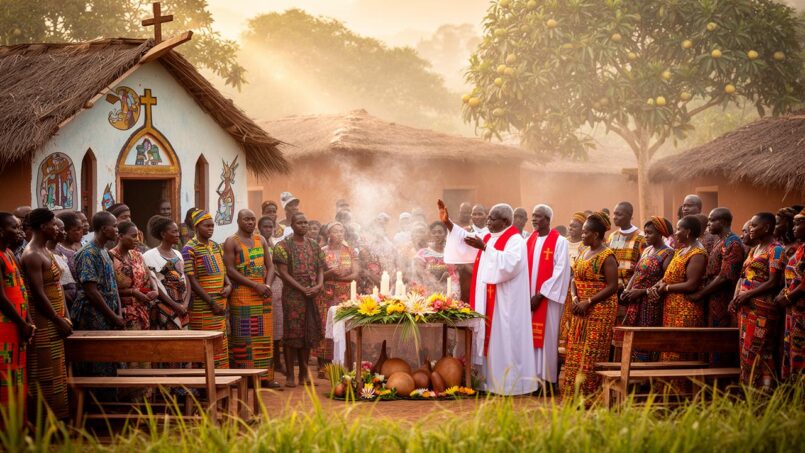
Faithful attend both Sunday Catholic mass and an ancestor ritual during the week. Catholic saints are sometimes renamed with attributes close to Vodun spirits, such as female saints assimilated to fertility goddesses. Parish feasts incorporate traditional drums, ritual dances, and sometimes symbolic offerings derived from village ceremonies.
In some families, a small Christian altar (cross, pious images) shares the same room as an ancestral altar with calabashes, gin bottles, or “fetish” objects. This is not experienced as a contradiction, but as complementary layers of protection and blessing.
How an expatriate can participate in Christian life
As a foreigner, you will often be invited to:
Attend a mass, especially during major feasts like Christmas, Easter, the Assumption, or All Saints’ Day. Take part in Protestant or evangelical services, which are often long and lively. Also join family celebrations such as a baptism, wedding, or funeral.
Some behavioral guidelines:
– Attire: shoulders and knees covered, even in hot weather; avoid too tight or transparent clothing.
– Punctuality: services often run longer than announced, but arriving grossly late gives a bad impression.
– Participation: you will likely be invited to stand, sing, sometimes dance – participating simply is appreciated, even if you don’t know the songs.
– Money: a collection is almost always taken; giving a small contribution is well-regarded, with no obligation to give a large amount.
If you are then asked to attend a more “traditional” ceremony (libation for ancestors, for example), it is acceptable to observe from a distance if you do not wish to participate actively, as long as you remain respectful and silent.
Islam: deep roots and local adaptation
Islam in Togo is not a recent import. The religion was introduced by Berber and Hausa traders along trans-Saharan routes, and by groups like the Tchokossi settled in the north as early as the 17th century.
Today:
– About 14% of the population is Muslim according to several international sources.
– Other estimates go up to 16–20%, reflecting continued growth.
– The vast majority of Muslims are Sunni of the Maliki school, as in much of West Africa.
Muslim practices and local traditions
In the center and north of the country, Islam structures the social rhythm:
Two Muslim holidays, Eid al-Fitr and Eid al-Adha, are national public holidays in Burkina Faso.
But here again, syncretism is very common:
– Muslim families continue to consult traditional healers for health, fertility, or protection issues.
– Birth, marriage, or funeral rituals sometimes include offerings or sacrifices to ancestors, alongside Islamic prayer.
– The concept of baraka (spiritual blessing) combines with beliefs that ancestors influence success, health, and protection.
Some Muslim scholars contest these practices as contrary to orthodoxy, but in daily life, many faithful make room for their cultural heritage.
Codes of conduct around mosques
In a predominantly Muslim environment, a few simple rules allow an expatriate not to give offense:
In or near a mosque, cover shoulders and legs; women ideally cover hair and arms. Remove shoes before entering the prayer hall. Never take photos of the interior of a mosque, worshippers at prayer, or the call to prayer without explicit permission. During Ramadan, avoid conspicuously eating, drinking, or smoking in public during the daytime in highly observant areas.
Relations between Christians and Muslims in Togo are generally marked by cooperation: reciprocal visits for major holidays, interfaith iftars, peace march initiatives in northern cities like Dapaong, etc. An expatriate who shows respectful interest in both worlds will be very well perceived.
Even if official statistics refer to “traditional religions” or “animism,” it is not a homogeneous bloc, but a galaxy of belief systems rooted in each people (Ewe, Mina, Kabiyè, Tem, Batammariba, etc.).
Vodun (often called “voodoo” abroad) is its most visible and publicized manifestation, but it does not cover all practices.
What traditional religions believe
Some constants are found from one group to another:
– Belief in a supreme creator God, often distant (e.g., Mawu among the Ewe).
– Central role of ancestors, seen as protectors, mediators, and guarantors of moral order.
– Presence of multiple spirits or deities linked to nature (water, lightning, forest, earth, disease, fertility).
– Animistic view: objects, places, animals are carriers of a vital force.
Ancestors are not gods, but elders who have become spirits watching over the family. They protect their descendants but can also sanction in case of failure, for example through illness, bad luck, or repeated conflicts.
Rites, offerings, and the role of healers
Practices are extremely varied, but often include:
– Family altars with calabashes, bowls, bottles, sometimes figurines or “inhabited” stones.
– Libations (water, alcohol poured on the ground) accompanied by prayers or songs, calling on deceased ancestors by name.
– Offerings of food or drink symbolically shared with the spirit world.
– Animal sacrifices (chickens, goats, sometimes sheep) during major events (initiation, healing, protection, big village festivals).
Healers (often called “fetish priests”) occupy a key place:
Practitioners diagnose the spiritual causes of problems (illness, failure, infertility) through divination (cowrie shells, knucklebones). They prescribe remedies (plants, powders, ritual baths, talismans) and may blend a Vodun or Christian framework (psalms, crosses).
For an expatriate, it is not uncommon to hear a colleague explain that, despite a doctor’s consultation, they will still go “see the elder” (a respected healer) to check the spiritual dimension of the problem.
Vodun: beyond the clichés
Contrary to images portrayed abroad, Togolese Vodun is neither folklore for tourists nor a universe obsessively centered on witchcraft.
It is structured around :
– Specific deities (lightning, sea, earth, disease, fortune, etc.), each with its priests, colors, days, and dietary restrictions.
– Complex ceremonies where dance, trance, music, songs, sacrifices, and offerings intersect.
– A strong communal dimension: rituals stage and reinforce village, lineage, and trade solidarities.
Political authorities now recognize the place of Vodun. National and international festivals are supported to “revitalize” these traditions, and places like the Akodessewa fetish market in Lomé have become showcases of this spirituality, while remaining fully functional for practitioners.
How to behave toward Vodun practices
An expatriate is not expected to be a believer, but someone who respects. Some red lines:
Never touch an altar, sacred object, or fetish without invitation. Always ask permission before photographing, especially in convents, sacred groves, or during rituals, as the photo is often seen as capturing energy or the soul. If refused, accept without insisting and put away the device. When faced with disturbing scenes such as sacrifices or trances, withdraw discreetly without showing rejection.
In some villages in the north or south, a visitor may be asked to bring a bottle of gin or a chicken as a collective offering to access a ritual site and ask questions. This is both a mark of respect and a contribution to the community’s expenses. If this bothers you, it is best to discuss it in advance with a local guide.
Festivals, rituals, and the religious calendar: what to expect
In Togo, the calendar is punctuated by major Christian and Muslim national holidays, but also by a multitude of local traditional ceremonies (yam festivals, Vodun festivals, initiation rituals, etc.).
Public holidays and major celebrations
Several religious holidays are recognized as national public holidays, for example:
– Christmas and Easter, with Easter Monday and Whit Monday.
– All Saints’ Day and Assumption, widely observed by Catholics.
– Muslim holidays like Eid al-Fitr (end of Ramadan, sometimes called Korité) and Eid al-Adha (Tabaski).
Around these dates, travel can be disrupted, markets busier, transport overcrowded. It is wise to:
To avoid scheduling conflicts, plan important trips outside of major feast days, anticipate that colleagues or employees may request time off to participate, and avoid scheduling crucial meetings on Eid days in Muslim areas, or major Christian holidays in the south.
Life ceremonies: births, weddings, funerals
Life transitions (birth, marriage, death) give rise to rituals often marked by an overlap of Christianity / Islam / traditions.
Birth:
– Naming ceremonies with religious blessing (prayer at church or mosque).
– Traditional protective ritual for the newborn, sometimes with libation and invocation of ancestors.
Wedding:
Civil union sometimes followed by a religious ceremony (church or mosque). Customary negotiation between families, with payment of a dowry (often in goods, not just money). Traditional rites of blessing for the spouses, invocation of ancestors from both lineages.
Funerals:
– Major event, can last several days, with vigils, songs, dances, sometimes sacrifices.
– Religious ceremony (mass, Muslim prayer) combined with rites accompanying the soul to the world of ancestors.
– Strong community expectations of financial and moral participation.
For an invited expatriate:
– Coming, even briefly, is a sign of great respect.
– Bringing a small financial contribution (in an envelope) or a symbolic gift (drinks, food) is well-regarded.
– Respect the dress code: in Togo, funerals are often very colorful, but it is best to let the family guide you on appropriate colors.
Understanding the religious dimension helps immensely in deciphering certain behaviors that, without it, can seem disconcerting.
Greeting, asking how someone is: a near-sacred ritual
Togolese politeness has an almost ritual dimension. Not greeting someone you meet can be perceived as a serious rudeness. In many regions, the simple “hello” is followed by a mini-litany:
– How are you?
– And the family?
– And your health?
This emphasis on relationship, health, family directly reflects a worldview where the person is embedded in a network of ancestors, the living, and descendants.
For an expatriate, starting any interaction with a calm greeting, a smile, a few words in French or a local language (Ewe, Mina, Kabyè…) immediately sets the tone.
Taboos and symbolic gestures
Certain gestures have more than simply “cultural” significance:
The left hand is considered impure; avoid giving or receiving with it. Do not take photos without permission, especially in rural or ritual areas, as this can be seen as symbolic theft. Avoid openly discussing witchcraft, church conflicts, or religious scandals in front of people you do not know well.
Even if these elements do not directly derive from a specific dogma, they are rooted in a religious worldview where every gesture has a spiritual resonance.
Interfaith, tolerance, and tensions: a delicate balance
Togo is often cited as an example of peaceful coexistence between Christians, Muslims, and adherents of traditional religions. In daily life:
– People of different religions willingly attend each other’s ceremonies.
– Mixed marriages are common.
– Religious leaders visit each other during major holidays (e.g., an archbishop shares iftar with the Muslim Union, which in turn offers him a bull for Tabaski).
Structured initiatives to counter extremism in the north, including joint marches, youth training, and regional forums.
Organization of marches bringing together various communities to promote peace and tolerance.
Training programs in interfaith dialogue aimed at young people, intended to consolidate a culture of tolerance.
Holding regional forums to strengthen social cohesion and prevent the spread of extremist violence.
For an expatriate, this implies two things:
1. It is entirely possible to talk about religion, to ask questions, if you show genuine curiosity and sincere respect. 2. On the other hand, it is very ill-advised to denigrate local beliefs, mock them, or seek to “correct” the syncretic practices that many Togolese live as natural.
Practical advice for expatriates: what to do, what not to do
To conclude, a few very practical guidelines, drawn from the entire Togolese religious landscape.
Visiting a place of worship or sacred site
– Always ask:
– the guardian, priest, imam, or head of family if your presence is possible.
– if there are specific rules (shoes, veil, photos, silence, offering).
– Attire:
– shoulders and knees covered, avoid overly tight or transparent clothing;
– carrying a light scarf can be useful (mosque, altar, Vodun convent).
– Attitude:
– observe first, imitate others only if you understand the gesture;
– refrain from any speech during prayer or incantation;
– keep a respectful distance during trances or sacrifices.
Participating in a religious ceremony
– If you are invited to a worship service, village festival, or ritual:
– ask your host what is expected: simple presence, active participation, financial contribution.
– don’t be caught off guard by the duration: some celebrations last well over three hours.
– Offerings and gifts:
– a small amount of money, drinks, or food can serve as a contribution;
– avoid giving money directly to children or beggars around religious sites: if you wish, prefer to support an association or local project.
Talking about religion
– Asking open-ended questions (“how does it work?”, “what does it mean?”) is often appreciated.
– Avoid:
– value judgments (“that’s superstition”, “that’s not Christian”);
– aggressive theological debates;
– overt proselytizing, especially if you are there to work, teach, or cooperate.
Managing your own limits
It is possible that certain rituals (sacrifices, trances, beliefs linked to past violence) may shock you. It is important to keep in mind:
You do not have to believe to respect. You can choose not to attend certain moments, simply explaining that it makes you uncomfortable. The key is to withdraw without hurtful comments or public moral judgment.
In summary: a multifaceted faith, a relational society
Understanding religious practices in Togo means accepting that the boundary between religious, social, and cultural is porous. The same person can:
– Go to mass or an evangelical service.
– Observe the Ramadan fast out of family solidarity.
– Participate in an ancestor ritual or a Vodun festival for the village.
– Consult a healer while taking their children to the health center.
For the expatriate, faith is not a labyrinth to solve, but a reality to observe with patience. By greeting, listening, and asking questions tactfully, you will discover how faith structures solidarities, conflicts, acts of generosity, and moments of crisis.
Knowing that the country is secular does not prevent seeing that, for most Togolese, living, working, raising children, or facing an ordeal is inconceivable without a reference – explicit or implicit – to the world of gods, spirits, and ancestors. It is this depth that this guide invites you to approach with respect, curiosity, and humility.
A heritage project or a question? Contact us now to speak with a wealth management expert.
Disclaimer: The information provided on this website is for informational purposes only and does not constitute financial, legal, or professional advice. We encourage you to consult qualified experts before making any investment, real estate, or expatriation decisions. Although we strive to maintain up-to-date and accurate information, we do not guarantee the completeness, accuracy, or timeliness of the proposed content. As investment and expatriation involve risks, we disclaim any liability for potential losses or damages arising from the use of this site. Your use of this site confirms your acceptance of these terms and your understanding of the associated risks.

Cyril Jarnias is an independent expert in international wealth management with over 20 years of experience. As an expatriate himself, he is dedicated to helping individuals and business leaders build, protect, and pass on their wealth with complete peace of mind.
On his website, cyriljarnias.com, he shares his expertise on international real estate, offshore company formation, and expatriation.
Thanks to his expertise, he offers sound advice to optimize his clients' wealth management. Cyril Jarnias is also recognized for his appearances in many prestigious media outlets such as BFM Business, les Français de l’étranger, Le Figaro, Les Echos, and Mieux vivre votre argent, where he shares his knowledge and know-how in wealth management.





