
 Published on and written by Cyril Jarnias
wp:paragraph
Settling in Togo is attracting more and more expats looking for an affordable, French-speaking country offering a relatively quiet lifestyle. But “affordable” doesn’t mean “cheap in every situation.” Between a very economical local lifestyle and a Western daily routine, the bill can vary by a factor of four.
Good to know:
Based on national data and those from Lomé, the cost of living in Togo for expats (single, couple, family, or digital nomads) can be estimated accurately.
How much should you budget per month?
The figures converge: Togo is generally an inexpensive country on a global scale. The cost of living for a single person, including rent, is around $779 per month, roughly one and a half times less than the global average. But behind this figure lie several realities.
For the main household configurations, the following orders of magnitude emerge for all Togolese cities.
Average monthly costs nationwide
| Household type | Average cost with rent (USD) | Average cost without rent (USD) |
|---|---|---|
| Single person | 956.0 | 706.0 |
| Couple (2 adults) | 1,369.4 | 1,119.4 |
| Family of 4 (2 adults + 2 children) | 1,927.9 | 1,602.9 |
These averages include both very modest lifestyles and more comfortable styles across different cities. They are therefore useful for getting a sense of your position, but not for building a budget down to the last penny.
Example:
According to sources close to expats, the estimated monthly budget for a comfortable local lifestyle is $350 to $600 for a single person and $900 to $1,700 for a family of four, including housing, with no luxury but no deprivation.
Example of a “realistic expat” budget
Several summaries provide a “typical basket” view for a single person living in a Togolese city with a good level of local comfort:
– Comfortable monthly total for a single person: approximately €755
– Rent (1 bedroom in city center): €280
– Groceries (home cooking): €95
– Public transportation: €25
– Electricity/water (85 m²): €75
In other words, a foreign salary of €2,000 to €3,000 per month allows you to live very comfortably in Togo, save money, and easily cover unexpected expenses (health, travel, international schooling, etc.).
Living in Lomé: a bit more expensive, but still affordable
Lomé concentrates most of the economic activity and the majority of expats. The capital remains cheap by the standards of major African cities, but it is slightly above the Togolese national average.
For Lomé, several data sets exist with different methods. However, they converge on a few key figures.
Overall ranges in Lomé
– Single person, with housing:
– Usual estimates: between $700 and $1,200 per month depending on the neighborhood and lifestyle.
– Other more detailed sources: about $1,025/month (including $725 excluding rent).
– Couple:
– On average around $1,466/month, including $1,166 excluding rent.
2102
The estimated monthly cost of living for a family of four is approximately $2,102, including $1,712 excluding rent.
We can see that in Lomé, moving from an “upgraded local” lifestyle to very Western comfort (large house, international schooling, frequent outings, imported products) makes the budget skyrocket.
Lifestyle scenarios in Lomé: tight budget, standard, comfortable
To better project yourself, we can distinguish three typical scenarios for Lomé.
| Profile in Lomé | With rent (USD/month) | Without rent (USD/month) | Main characteristics |
|---|---|---|---|
| Tight budget – single person | ~428 | ~308 | Modest studio, home cooking, local transport, few outings |
| Standard – single person | ~700–800 | ~450–500 | Decent 1-bedroom, mix of home-cooked/eating out, reliable internet |
| “Expat” comfort – single person | 1,000–1,500 | 650–1,000 | Nice apartment/villa, many outings, imported products, private health subscription |
Families of three or four see these amounts increase mainly due to rent, food, and possibly schooling.
Housing: the biggest expense for an expat
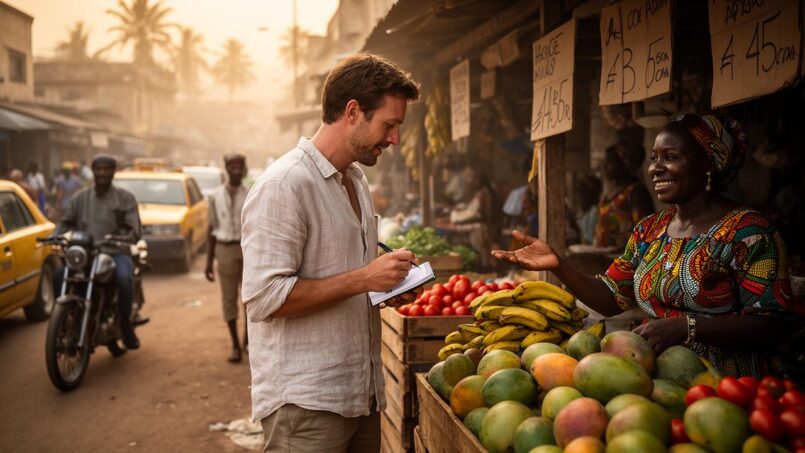
Housing is almost always the big budget item. The national range for monthly rent is between $100 and $500 (60,000 to 300,000 XOF), but the reality for an expat in Lomé often exceeds these amounts, especially if they are looking for an “international standard” environment.
Average rents nationwide
| Type of property | City center (average) | Outside center (average) | Remarks |
|---|---|---|---|
| Studio/1 bedroom – medium city | 100–200 USD | 60–120 USD | Simple accommodation, local comfort |
| 1 bedroom – overall average (from UK data) | ~£145 | ~£76 | Varies by city |
| 3 bedrooms – overall average (from UK data) | ~£548 | ~£260 | Same, large spaces |
For expats, especially in Lomé, useful benchmarks are higher.
Rents in Lomé for expats
Detailed data on the capital show the following orders of magnitude:
– Furnished studio (~45 m²)
– “Normal” neighborhood: ~91,000 XOF/month
– Expensive neighborhood: ~112,000 XOF/month
– 1-bedroom apartment
– In the capital, many sources indicate between 160,000 and 260,000 XOF (about $250 to $430) depending on the neighborhood and condition.
– Other surveys mention 173,000 XOF on average in the center, with extremes between 70,000 and 300,000 XOF.
– 2-bedroom apartment
– Between 240,000 and 520,000 XOF ($380 to $870).
Rents in Lomé: houses and large apartments
Price range for a house or large apartment (3 bedrooms or more) in Lomé, depending on neighborhood and overall data.
In sought-after areas (beach, NGOs, embassies), expect 700,000 to 900,000 XOF per month ($1,150 to $1,500) for a family villa with garden, sometimes a pool.
A 3-room apartment in the center of Lomé rents for an average of 365,000 XOF, with a range from 213,000 to 600,000 XOF per month.
Villas, neighborhoods, and choice strategy
Expats often settle in a few specific neighborhoods in Lomé (Adidogomé, Agoè, Djidjolé, Baguida, Avedji, areas near embassies and the coast). In these areas:
– a studio or small accommodation starts around 115,000 XOF;
– a furnished 2–3 room apartment costs between 230,000 and 450,000 XOF;
– a large family house with garden goes for between 500,000 and 1,000,000 XOF.
Moving a bit away from the center or giving up certain “Western” amenities (pool, private generator, 24/7 guarded parking) can significantly reduce rent.
Utilities and services: electricity more expensive than rent in some local budgets
Once you have found housing, you need to add several charges that are often not included in the rent: electricity, water, gas, waste collection, internet, mobile phone.
Electricity, water, gas: what an expat really pays
Figures vary greatly from household to household, but the following orders of magnitude are common:
| Item (typical 85 m²) | Monthly range (XOF) | Range (approx. USD) |
|---|---|---|
| Electricity, water, garbage | 70,000 – 125,000 | ~100 – 175 |
| Electricity bill alone (entire country) | 9,000 – 25,000 | ~15 – 40 |
| Running water alone | 3,000 – 6,000 | ~5 – 10 |
| Gas/cooking | 7,000 – 30,000 | ~7 – 30 |
In Lomé, a two-person household in an 85 m² apartment can easily pay around 98,000 XOF per month for all utilities (electricity, water, etc.), with a reported range between 71,000 and 100,000 XOF.
For an expat who works remotely with air conditioning, computers, and possibly an UPS or small generator, the electricity bill rises quickly. It is therefore prudent to plan for the higher end of the range.
Internet and telephony: a cost not to be underestimated for a nomad
Internet access and mobile telephony represent a significant expense, especially for online workers.
Tip:
Some benchmarks
– Unlimited fixed internet (50–60 Mbps advertised):
– 15,000 to 30,000 XOF per month (about $45 to $65).
– Offers around 25,000 XOF (about $41–$45) are common.
– Actual speed observed:
– Often well below commercial promises, around 2 to 4 Mbps in practice, with possible outages.
– Mobile plan with calls and at least 10 GB of data:
– About 12,500 XOF per month ($20–$22).
– Other surveys show an average around $22 for more generous plans, with a range from $12 to over $90 depending on options.
For an expat or digital nomad, combining a fixed line with a good mobile plan (as a backup solution) is almost essential, bringing the “connectivity” bill to between $35 and $80 per month in practice.
Food: very affordable if you eat local
This is one of Togo’s big advantages: eating properly by favoring the market and local products costs much less than in Europe or North America. As soon as you switch to imported products and “international” restaurants, prices go up.
Grocery and food budget
Nationwide:
– A person cooking at home with local products:
– About €95 per month (reference figure for a simple basket).
– Other sources mention $100 to $250 in monthly food expenses per person.
– For an adult in Lomé, a realistic grocery budget is between $65 and $220 per month, with an average around $110.
For a family of four:
Warning:
For a varied diet mixing local and imported products, the monthly budget for food and basic necessities is estimated between $800 and $820.
The minimum recommended cost to eat properly, calculated based on a caloric intake of 2,200 to 2,400 kcal per day, ranges between 3,700 and 4,800 XOF per person per day depending on the city, or about 115,000 to 148,000 XOF per month.
Prices of some basic products
Surveys in CFA francs provide a very concrete idea:
| Product (about 1 kg, unless specified) | Average price (XOF) | Remarks |
|---|---|---|
| White rice | 1,100 – 1,020 | About $1.8/kg |
| White bread (500 g) | 450 – 650 | $0.75–$1.2 |
| Milk (1 liter) | 1,100 – 1,400 | $1.8–$2.4 |
| Eggs (12) | 1,000 – 1,300 | $1.7–$2.1 |
| Chicken (1 kg) | 3,600 – 4,800 | $6–$8 depending on source |
| Beef (1 kg) | 4,200 – 5,300 | ~$7–$9 |
| Bananas (1 kg) | 800 – 1,200 | ~$1.5–$2 |
| Apples (1 kg) | 1,500 – 1,800 | ~$2.5–$3 |
| Bottled water (1.5 l) | 500 – 540 | $0.8–$0.9 |
The gaps between regions are significant. For example, according to statistical data:
471
The price per kilo of tomatoes in the Savanes region is less than half the price charged in Lomé (992 XOF).
For imported rice, we observe the same trend: 636 XOF/kg in Greater Lomé versus 415 XOF/kg in the Plateaux-Est region.
In other words, living outside the capital significantly reduces the grocery bill, with equivalent product quality.
Eating out: from local eateries to “expat” restaurants
Meals taken outside also reflect this contrast.
Some national benchmarks:
| Type of meal or drink | Average price (XOF) | Approximate in USD |
|---|---|---|
| Simple meal in an inexpensive restaurant | 1,400 – 1,800 | ~$2.2 – $3 |
| Typical fast-food combo | 3,000 – 3,500 | ~$4.5 – $5.5 |
| Full 3-course meal for two (mid-range restaurant) | 18,000 (10,600 to 25,000) | ~$25–$30 |
| Local draft beer (0.5 l) | 500 – 1,000 | < $2 |
| Cappuccino at a “trendy” café | 3,200 – 3,800 | $4–$5 |
| Bottle of mid-range wine | 2,800 – 4,600 and up | $4–$7 (excluding fine wines) |
An expat who very often eats in “Westernized” restaurants, regularly buys coffees at $4–$5 and consumes imported products will quickly see their food budget match European standards, or even exceed them.
On the other hand, someone who alternates between markets, small local eateries, and restaurants from time to time can eat properly for a truly moderate cost.
Transportation: cheap but sometimes slow and informal
Transportation is one of the pleasant budget surprises in Togo, even though the offering is far from being as structured as in Europe.
Daily transportation
The most common options are:
– shared taxi or “bush taxi”;
– motorcycle taxi;
– minibus on intercity routes;
– car rental for trips outside major cities.
For urban trips:
| Mode of transport | Typical fare (XOF) | Comment |
|---|---|---|
| Bus/minibus ticket | 300 – 1,000 per trip | $0.5–$1.5, depending on distance |
| Shared taxi in town | 500 – 1,500 | Price negotiable, depends on route |
| Motorcycle taxi | 200 – 500 | Very common, fast but riskier |
| Monthly local pass (global data) | ~30,000 | About $50 for some structured networks |
Nationally, a single ticket on a local network is often around 200 XOF ($0.3). A monthly pass for a more formal system can reach 30,000 XOF (about $64 in some surveys).
Personal car and fuel
Fuel diesel or gasoline is around 600 to 700 XOF per liter, approximately $1 to $1.1. A gallon costs between $3.1 and $4.
Good to know:
Car rental, especially from Lomé, is an expense item to factor into your budget.
– Compact car: 20,000 to 40,000 XOF per day ($30–$60);
– SUV or 4×4: 40,000 to 60,000 XOF per day, or more depending on season and agency.
For an expat who lives in the city and only uses a car occasionally (weekends, missions, vacations), budgeting around $25 to $70 per month for transportation (fuel, taxis, buses) is consistent. A regular driver will inevitably see this figure rise, but fuel prices remain reasonable.
Healthcare: cheap care, essential insurance
Seen from abroad, healthcare in Togo may seem inexpensive: a basic consultation can cost between $3 and $10, a visit to a private clinic between $15 and $40. The downside is the uneven quality and availability of equipment, especially outside Lomé.
Monthly healthcare cost for an expat
In terms of recurring expenses, data indicate:
| Type of monthly expense | Range (USD) | Average observed |
|---|---|---|
| Private health insurance (local/regional level) | 20 – 100 | 50–55 |
| Medication and pharmacy | 10 – 85 | ~35 |
| Doctor, dentist, other consultations | 15 – 120 | ~55–75 |
For a single expat who opts for decent local private coverage and consults occasionally, a monthly budget of $80 to $130 is common. For a family, this figure can easily double or triple, especially if adding international insurance covering evacuations and hospitalizations abroad.
Why international insurance is still recommended
Several factors lead expats to choose international coverage rather than relying solely on the public system or local insurance:
Good to know:
The public system is underfunded, many medications and specialized tests are only available in expensive private clinics, and in case of a serious problem, evacuation to another country (Europe, North Africa, South Africa, etc.) is often necessary.
Indicative costs for certain treatments in private clinics in Lomé show the potential size of the bill:
– 48-hour hospitalization for infection: about 800,000 XOF (~$1,320);
– Tibia fracture (X-ray, cast, materials): 450,000 XOF (~$740);
– Appendectomy (consultation + surgery): 1,500,000 XOF (~$2,470);
– Medical evacuation abroad: around 12,000,000 XOF (~$19,700).
Faced with such amounts, a well-sized insurance contract including evacuation and repatriation is not a luxury but a key element of the expat budget.
Schooling: the real “game changer” for families
For expat families with children, schooling weighs extremely heavily on the cost of living. Togolese public school is free at the primary level, but most foreigners turn to private or international schools, especially in Lomé.
International and French schools
The major international schools in the capital (British School of Lomé, American International School of Lomé, French schools like Lycée français de Lomé or École Arc en Ciel) charge annual fees of several thousand euros or hundreds of thousands of CFA francs.
As an illustration:
– some international schools charge between 1,500,000 and 5,000,000 XOF per year per child (about $2,500 to $8,000), depending on the level and program (IB, British, French, etc.);
2 to 3 million
Annual fees at the Lycée français de Lomé can exceed 2 to 3 million CFA francs depending on the child’s nationality and school cycle.
– these amounts are supplemented by registration fees, cafeteria costs (about 300,000 to 350,000 XOF per year, depending on the level and number of meal days), exam fees (brevet, baccalaureate, preliminary exams), and extracurricular activities.
In practice, for an expat couple with two children enrolled in a reputable international school, schooling alone can represent several thousand euros per year, i.e., a monthly extra cost of $400 to $800, sometimes more.
This is often the item – even more than rent – that makes the difference between a “comfortable and controlled” budget and a cost of living comparable to that of some European countries.
Local salary vs. expat budget: a wide gap
Another point to keep in mind is the gap between local salaries and the typical expat budget. Nationwide:
– the average net salary after tax is often cited around $138 per month,
– other surveys mention 150,000 XOF as the average monthly net salary, a little over $200, depending on sector and source.
Example:
The average salary covers only a small fraction of needs, about 0.2 months of expenses based on an estimated cost of living of $779/month for a single person, illustrating the gap in living standards between an expat paid in strong currency and the majority of the population.
For a foreigner paid at the local salary level, it is therefore illusory to hope to live with the same “international” standards as colleagues from NGOs or multinationals. Conversely, a remote worker paid €2,000–€3,000 per month can afford a level of comfort far superior to what they would have in their home country.
Living outside Lomé: 20 to 40% cheaper
Official data clearly show that prices decrease as you move away from the capital, especially for basic foodstuffs (rice, corn, tubers):
– the kilo of imported rice can cost more than 50% less in some inland regions than in Greater Lomé;
– white maize, tomatoes, or yams follow the same logic, often much cheaper in the north than in the capital.
Good to know:
Rents are generally 20 to 40% cheaper outside Lomé, but with fewer expat-standard accommodations, services (private clinics, international schools, supermarkets), and less reliable internet.
For an expat on a tight budget or a retiree seeking a quiet life, settling in a medium-sized city or a more rural area can nevertheless halve the cost of living compared to a major Western capital, while ensuring decent comfort.
Lifestyle: what really makes the bill vary
Two expats living in Togo can have monthly budgets that are completely different, simply because they don’t make the same choices.
The “localized” profile
– Modest housing, outside the most sought-after neighborhoods;
– Grocery shopping mostly at markets and small shops;
– Limited outings, local eateries rather than Westernized restaurants;
– Transportation by bush taxis, motorcycle taxis, and buses;
– Local health insurance supplemented by a small precautionary savings;
– Little international schooling (children in the local system or no children).
With this lifestyle, a single person can actually live on $350–$500 per month, even in Lomé, and a family of four on $900–$1,200.
The “Western expat” profile
– Villa or large apartment in an upscale neighborhood of Lomé;
– Air conditioning, generator, high-speed internet, cleaning service;
– Regular purchases of imported products (cheeses, brand-name cereals, wines, Western beers, cosmetics, etc.);
– Frequent restaurants and cafés;
– Personal car (with fuel and maintenance);
– International health insurance covering evacuation;
– Children in international school.
2,000
The minimum monthly budget a family can reach including schooling, rents, and insurance.
The cost of living in Togo is therefore not “objectively” low or high: it depends mainly on the degree of integration into the local lifestyle and the demand for comfort and “imported” services.
Summary figures: how much to budget according to your profile?
By grouping the main data and adapting them to typical expat profiles, we can propose the following summary table.
| Expat profile in Togo | Overall monthly budget (USD, including housing) | Lifestyle comment |
|---|---|---|
| Strong localization – single person | 350 – 500 | Very local lifestyle, simple housing, few outings |
| Strong localization – couple | 550 – 800 | Same logic for two, shared rent |
| Strong localization – family of 4 | 900 – 1,200 | Local schooling, very few imported products |
| “Standard” expat – single person (Lomé) | 700 – 900 | Decent 1-bedroom, internet, some restaurants, local insurance |
| “Standard” expat – couple | 1,000 – 1,400 | 2 rooms or small house, regular leisure activities |
| “Standard” expat – family of 4 | 1,600 – 2,000 | Decent house, mix local/imported, enhanced insurance |
| “Western comfort” expat – single person | 1,200 – 1,500+ | Sought-after neighborhood, frequent restaurants, lots of imported goods |
| “Western comfort” expat – family of 4 | 2,000 – 3,500+ | Large villa, international school, car, international insurance |
These ranges remain orders of magnitude, but they reflect the detailed data available: on one side, the observed average costs, on the other, the minimums and maximums depending on lifestyle.
In conclusion: an affordable destination, but with nuances
The cost of living in Togo for expats is generally attractive: you can live well on a budget that would be hardly sufficient in Western Europe or North America. Reasonable rents (excluding luxury villas), cheap local food, and economical transportation all work in the country’s favor.
But several nuances must be noted:
Good to know:
The capital is significantly more expensive, especially for housing and imported food. Healthcare is affordable day-to-day, but international insurance remains essential and weighs on the budget. International school fees, Western comfort standards (villa, imported products, private schools, outings) drive expenses up to levels comparable to Western countries. The gap between the cost of living and local salaries is large: expats paid in foreign currency live very comfortably, unlike those paid at the Togolese level.
For a student, a young professional working remotely, or a retiree with a stable foreign income, Togo offers a rare combination: a moderate cost of living, strong cultural immersion, and, for those who wish, the possibility of a comfort far superior to what they could afford in their home country.
The whole challenge, before settling, is therefore to clearly define the lifestyle sought and adjust your budget accordingly, integrating from the start the large items sometimes underestimated: housing, healthcare, schooling, and connectivity.
A wealth management project or a question? Contact us now to speak with a wealth management expert.
Disclaimer: The information provided on this website is for informational purposes only and does not constitute financial, legal, or professional advice. We encourage you to consult qualified experts before making any investment, real estate, or expatriation decisions. Although we strive to maintain up-to-date and accurate information, we do not guarantee the completeness, accuracy, or timeliness of the proposed content. As investment and expatriation involve risks, we disclaim any liability for potential losses or damages arising from the use of this site. Your use of this site confirms your acceptance of these terms and your understanding of the associated risks.

Cyril Jarnias is an independent expert in international wealth management with over 20 years of experience. As an expatriate himself, he is dedicated to helping individuals and business leaders build, protect, and pass on their wealth with complete peace of mind.
On his website, cyriljarnias.com, he shares his expertise on international real estate, offshore company formation, and expatriation.
Thanks to his expertise, he offers sound advice to optimize his clients' wealth management. Cyril Jarnias is also recognized for his appearances in many prestigious media outlets such as BFM Business, les Français de l’étranger, Le Figaro, Les Echos, and Mieux vivre votre argent, where he shares his knowledge and know-how in wealth management.





