
 Published on and written by Cyril Jarnias
Long reduced to its popular cafes and family gatherings, the Algerian night has quietly undergone a transformation. Between panoramic lounges in Algiers, beach clubs in Oran, bars in luxury hotels, and lively cafes open late, nightlife in Algeria is far richer and more nuanced than one might imagine. It remains shaped by a predominantly conservative society and strict rules regarding alcohol, but in major cities, a new generation of venues and habits has emerged, driven especially by a very young and largely urban population.
Algerian nightlife is concentrated in Algiers, Oran, Béjaïa, and Constantine. You need to know the local cultural codes, safety issues, and the specific role of women. As an alternative to nightclubs, cafes and shopping malls play a central role in evening outings.
A young, urban country… with livelier nights than you’d expect
Three-quarters of Algerians are under 35 and more than seven out of ten people live in cities. This youthful population, often facing difficulty accessing their first job and housing, heavily occupies urban spaces. Free time, especially in the evening, becomes a central issue: it can encourage creativity and sociability, but also, at times, problems like street crime or the formation of highly territorial local gangs.
In this context, the night is not just about partying. It is also a time to meet up in cafes, stroll through markets, escape to air-conditioned shopping malls, or go see a show or a match. Society remains conservative and marked by Islam, which influences daily rhythms, gender separation, and codes of modesty in dress, especially for women. But the end of the dark decade and the decline of terrorism have revived a clear desire to “enjoy life,” to go out, to mingle, to discover more modern forms of entertainment.
Social context
Major cities – Algiers, Oran, Constantine, Béjaïa – have become laboratories for this coexistence of tradition and modernity. Here, a very masculine cabaret; there, a designer rooftop with fruity cocktails and a DJ; elsewhere, a tea salon packed after night prayer, alcohol-free but with endless pastries. Understanding Algerian nightlife means accepting this plurality.
Algiers at night: rooftops, hotel clubs, and lively cafes
In Algiers, the night experience differs depending on whether you are along the bay, in the chic hillside neighborhoods, or in the alleyways of the Casbah. The capital remains marked by strict laws regarding alcohol sales: licenses are limited, many traditional bars have closed, and drinking remains expensive. Yet, the options for going out at night have clearly expanded, especially around major hotels, lounges, and shopping malls.
Hotel bars and iconic clubs
A large part of the “wet” nightlife takes place in upscale hotels, where bars and nightclubs often function as bubbles relatively shielded from outside social pressures. Here you’ll find both expats and affluent young urbanites.
A glimpse of some iconic venues in Algiers:
| Venue | Type | Address / Neighborhood | Key Features |
|---|---|---|---|
| 1001 Nuits | Bar-club in resort | Sheraton Club des Pins, Staoueli | Live music (rai, rock, pop), varied cocktails, direct beach access |
| Oasis Bar | Chic hotel bar | Sofitel Hamma Garden, Rue Hassiba Ben Bouali | Views of gardens and sea, live piano, signature martinis |
| Pacha Club / Bar El Dey | Club + hotel bar | Hotel El-Djazair, El Mouradia | Very festive club, quieter alternative at Bar El Dey |
| Le “cielo” by Ralf | Rooftop lounge | Hôtel Ralf, Bd Colonel Krim Belkacem | Panoramic view of Algiers, chic ambiance, continuous mixed music |
| L’AMIRAL Night Club | Hotel nightclub | Hilton Pins maritimes, Mohammadia | Hotel nightclub with license, frequented by a mixed clientele |
At 1001 Nuits, located in the Sheraton Club des Pins in Staoueli, the evening often has a permanent vacation vibe. The venue combines a well-stocked cocktail bar (beers, wines, mojitos, premium spirits) with a musical stage featuring traditional Algerian songs, pop, and rock. Being by the sea allows you, after a few hours of dancing, to step out for fresh air along the beach, in a setting much more intimate than the downtown streets.
At the opposite end of the bay, the Oasis Bar at the Sofitel Hamma Garden plays a more subdued register. Nestled near the Botanical Garden and a short walk from the Martyrs’ Memorial, this hotel bar offers a combined view of lush greenery and the Mediterranean. People often come here at aperitif hour, when a pianist accompanies conversations, to enjoy a house martini or Mediterranean-style tapas before heading back to the city center or returning to their hotel.
Pacha Club, located within the historic Hotel El-Djazair, embodies the nightclub scene Algiers-style. People dance until dawn to sets by popular local DJs, champagne flutes in hand, in an environment that contrasts sharply with the calm gardens surrounding the palace. For those who prefer conversation over noise, Bar El Dey, in the same complex, offers a dimly lit ambiance, a selection of wines and whiskies, and more classic cocktails.
Finally, in the city center, the rooftop Le “cielo” by Ralf, atop the Hôtel RALF, has established itself as a gathering spot for those wanting to enjoy a panoramic view of Algiers, drink in hand. Contemporary decor, ambient music, chic urban clientele: the place sums up a certain aspiration of Algiers’ youth for a cosmopolitan lifestyle, while staying within society’s boundaries.
Panoramic lounges and shisha bars
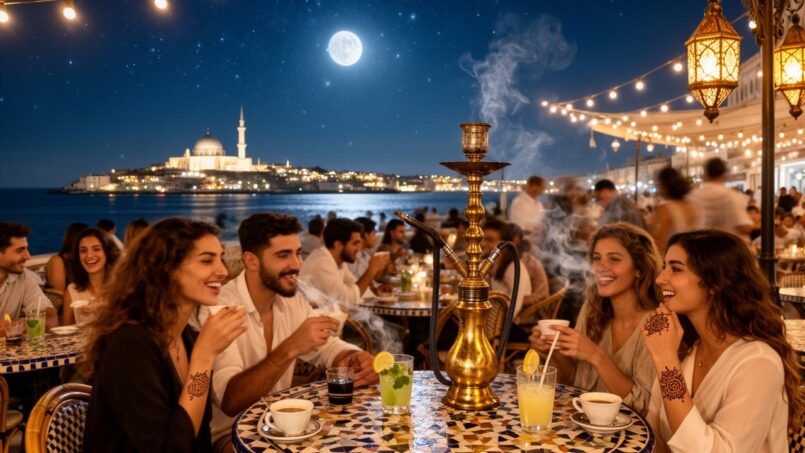
The rooftop trend is not limited to hotels. In the residential neighborhood of El Biar, especially safe and quiet at night, Diamond Lounge has built its reputation on its terrace with an unobstructed view of the city. People come here preferably at sunset, when the light gilds the rooftops of Algiers, to sip fruity drinks, share a hookah, and devour a burger or pizza, in a more “lounge” than truly late-night atmosphere. All without necessarily consuming alcohol, which makes the place more acceptable for certain audiences.
In Hydra, El Madania, and Bordj El Kiffan, restaurant-lounges like PianoPiano.dz, Cosmopolitain, L’ARQ, Club gentleman, or Les Arcades Sixteen 16 offer dinner, music, dancing, shisha, and cocktails, with or without alcohol, for a modern nighttime experience.
Shopping malls and “fake” romantic dates
A striking feature of contemporary nightlife in Algiers: the rise of shopping malls like Bab Ezzouar or Ardis, which in less than fifteen years have become true enclosed public squares. At Bab Ezzouar, opened in 2010 near the airport, the bowling alley’s atmosphere, with dim lighting and loud music, sometimes feels more like a nightclub than a classic family activity. Cafes and fast-food outlets stay open late, attracting a mixed crowd where young men and women can meet away from neighbors’ eyes.
In these shopping malls, young Algerians, especially girls, use shopping as a pretext to go out in the evening, flirt, and break free from family constraints, in a globalized setting that contrasts with traditional values.
The following table provides an overview of different types of nightlife venues in Algiers and what they offer:
| Type of venue | Example in Algiers | Main nightlife features |
|---|---|---|
| Rooftop lounge | Diamond Lounge, Le “cielo” | Panoramic view, cocktails / juices, shisha, lounge music, sunset |
| Club / Nightclub | Pacha Club, L’AMIRAL | DJ, dancing, alcohol, very late nights, upscale clientele |
| Chic hotel bar | Oasis Bar, Bar El Dey | Attentive service, cocktails, sometimes piano or live music |
| Shopping mall | Bab Ezzouar, Ardis | Cafes, restaurants, bowling, cinema, discreet flirting, mixed family atmosphere |
| Traditional cafe | City center, Bab El Oued… | Tea, coffee, football matches on TV, discussions, sometimes live music |
Culture, shows, and quieter nights
It would be reductive to limit Algiers’ nightlife to bars and clubs alone. Culture plays an important role. The Algiers Opera, recently inaugurated in Ouled Fayet, programs concerts, ballets, and festivals that run late. The Symphony Orchestra or the National Ballet perform regularly, and on popular performance nights, tickets sell out quickly. The modern architecture and detailed interior also make it a site worth visiting outside of shows.
The Mahieddine Bachtarzi National Theater offers Algerian and international plays. Between dinner at a romantic restaurant like Le Bardo, Signature, Jenina, or Tantra Restaurant & Lounge, and then a show at the theater, many couples thus compose a “European-style” evening, but respecting the limits set by local norms (modest attire, discreet displays of affection, alcohol consumption limited to certain venues).
Cafes remain pillars of nightlife. In central neighborhoods like Didouche Mourad or in more popular areas like Bab El Oued, they are packed in the evening. People mostly drink Turkish coffee and mint tea, sometimes until late at night, especially in summer or during Ramadan, when nights stretch out around iftar and prayers.
Oran: the Corniche, beach clubs, and waterfront bars
In western Algeria, Oran has a distinct nightlife identity, more oriented toward the sea and beachside partying. The city, birthplace of rai, has built part of its reputation on music and nightlife. Its Corniche, stretching from the waterfront to Aïn El Turk, Bou Sfer, and El Ançor, hosts an impressive number of bars, clubs, cabarets, and nightclubs.
The Corniche, backbone of the party scene
Along this coastal strip, many establishments stay open all night. Some, integrated into upscale hotels like the Sheraton, focus on international DJ lineups; others, more popular, pulse to the rhythm of rai until dawn. A club like Atmosphère, located at the Sheraton, has hosted renowned DJs and caters to a clientele willing to pay a premium for a very festive night.
A range of nightlife options in Oran includes Sun House Night Club in Aïn El Turk (open until 4 AM), NEPTUNE CLUB, Les Pins d’Or, and bars like Le Cintra, Le QG lounge Oran, Las Palmas, Le Modjo lounge, and Penelope lounge. This diverse scene spans from exclusive clubs to upgraded fisherman bars and private event halls for weddings and large gatherings.
Within the city itself, bars like Le bar le mélomane or The bar Box complete the offering, while restaurants like Rendez Vous des Pêcheurs in Aïn Turk allow for extending dinner on a lively terrace.
Night souks and lively markets
But Oran’s nightlife is not limited to the Corniche. The market on Rue des Aurès, better known by its old name La Bastille, illustrates the nighttime vitality on the commercial side. Located near the Grande Poste, in the heart of Oran, this historic market, born in the colonial era, turns into a veritable anthill day and night, especially during Ramadan.
During Ramadan, activity starts early in the morning, stops for iftar, then resumes late with vendors offering clothing, shoes, imported goods, Ramadan pastries (zalabia, qalb el louz, qtaïf, chamia), dates, and ingredients for Eid cakes. During major national team matches, stalls display flags, jerseys, and caps in the colors of the Fennecs, in a constant hubbub that recreates the typical atmosphere of a souk.
This pattern repeats in other local markets (“jiwari” markets) organized by the wilaya, especially during the holy month, to offer food products at regulated prices into the evening. Oran thus shows another facet of its night: less focused on alcohol and clubs, more on shopping, family walks, gastronomy, and urban bustle.
Béjaïa and the east coast: clubs, lounges, and intimate rooftops
On the northeast coast, Béjaïa has a more discreet but surprisingly structured nightlife for a medium-sized city. It features a network of clubs, bars, and lounges, ranging from a simple port bar to a flashy branded club.
Discover a selection of nighttime establishments spread between the city center, waterfront, and hotels, including clubs and bars blending tradition and modernity.
Club Atlantis, Lounge Bambou, Club Nuit Blanche, Night Club Méditerranée, Club Le Jardin, Club Lune Rouge, Club La Citadelle, Club Le Jardin des Lumières
Bar Matisse, Bar du Port, Bar La Plage, Bar des Amis, Bar La Terrasse, Bar Le Rocher, Bar La Voile
The same logic applies here as in Algiers and Oran: nights with alcohol are concentrated in well-identified places, often frequented mostly by men, while the more family-oriented or conservative population prefers seaside strolls, cafes, and ice cream in the evening.
Constantine: between shisha clubs, jazz festival, and late-night cafes
In Constantine, a city of suspended bridges and spectacular ravines, nightlife is more cautious, marked by conservative social norms. Bars are rare and alcohol is not very visible on the surface. This doesn’t mean the city goes to bed at nightfall, but activities take place elsewhere and differently.
The Chicha Club and the rare festive spots
Among the best-known addresses for night owls is The Chicha Club, presented as an “electrifying hotspot” of the city. It offers a lively atmosphere, music blending Algerian rhythms and international hits, a young mixed crowd, and of course shisha. It functions as a sort of compromise: no big dance floor like a nightclub, but a setting that still allows you to feel a club atmosphere.
In Constantine, nightclubs are almost non-existent due to local norms and a strict relationship with mixed-gender spaces and alcohol.
Strolls, cafes, theater, and festivals
Residents prefer walks along main avenues like Rue Didouche Mourad or on Place 1er Novembre, cafes where they sip tea or coffee late into the evening, and long family dinners. The city also stands out for its cultural programming: the Regional Theater hosts Algerian and foreign plays, while the Royal Cultural Residence Mohamed Laïd Al-Khalifa sometimes hosts traditional music concerts.
Constantine hosts a major jazz festival, attracting around 3,000 spectators each evening for six days. At night, the city becomes cosmopolitan, mixing local enthusiasts, tourists, and curious visitors around the performance venues.
Cafes, tea salons, and the alcohol-free evening culture
Talking about nightlife in Algeria without dwelling on cafes would miss the essential. They structure evenings far more broadly than alcohol-serving bars. They open early, often close late, and are filled with men, but also increasingly with women in major cities.
In coastal cities and central neighborhoods, cafes and tea salons stay lively late into the night in summer and during Ramadan. People watch football, play cards, discuss family or politics, while enjoying a strong coffee or mint tea, often accompanied by date or honey pastries. In the south, tea preparation is a one-hour ritual, requiring you to drink two or three glasses, each sweeter than the last.
In cities like Tlemcen, addresses open 24/7, such as Break Time Tlemcen, offer a continuous service, from coffee to pastries to late-night meals. This 24/7 dimension remains a minority in the country, but it signals the emergence of a stretched nighttime schedule, especially in tourist areas.
The contrast between regions is striking: in the south and rural areas, social practices (tea, coffee, family gatherings) remain largely confined to the home. In the urban coastal strip, these same rituals have partly moved into public spaces—cafes, tea salons, terraces, under the stars.
The question of women’s place in the Algerian night is central. Traditionally, men and women formed almost two separate societies, rarely crossing paths in public spaces, especially after nightfall. Increased schooling, women’s growing participation in economic and political life, and urbanization have changed this pattern, but the weight of norms remains.
In clubs and bars serving alcohol, the clientele remains largely male, with women present but in the minority, often perceived through ambiguous stereotypes. In shopping malls, however, mixed-gender interaction has become the norm: groups of friends, veiled or not, wander around, sometimes temporarily removing their veil inside, as a young woman from Constantine quoted in a survey admits, before putting it back on when leaving.
Young woman from Constantine
Malls, with their cinemas, bowling alleys, cafes, and play areas, have become discreet theaters for teenage flirting. People come “to stroll,” but really to catch someone’s eye. A mall manager admits that “it’s the perfect place for that”: young girls can tell their parents they’re going shopping, which appears more acceptable than declaring a nighttime outing with no specific purpose.
Flirting and self-display are massively shifting to social networks, especially TikTok. A class and taste divide separates the *meryūl*, who embrace dancing videos set to modern rai, from the *ʿamīq*, who reject this style for a more “middle-class” identity, based on aesthetics, music, and fashion deemed more refined. Even in these virtual spaces, the echo of urban nightlife (club lights, cafe terraces, crowd noise) serves as a sound backdrop for performances.
Ramadan, safety, and codes to follow when going out at night
Nightlife in Algeria varies greatly depending on the time of year, with Ramadan playing a structuring role. During the holy month, the day slows down, alcohol almost completely disappears from public places, and conversely, the nights take on the air of a vast open-air market. Markets come alive after iftar, cafes and tea salons fill up, some shopping malls adjust their hours to stay open later. Eating, drinking (non-alcoholic), strolling, and praying then punctuate the nighttime hours.
Algiers and Oran are relatively safe, especially in central neighborhoods and tourist areas with a police presence, but petty crime (pickpocketing, theft) is a main risk, while authorities enforce zero tolerance and advise against certain areas or practices.
– Avoid walking alone at night in poorly lit alleyways, especially in the more remote parts of the Casbah or in certain working-class neighborhoods;
– Prefer taxis recommended by your hotel or reputable services for nighttime travel;
– Do not flaunt conspicuous signs of wealth (jewelry, luxury watches, large amounts of cash) on the street or in less frequented areas.
Women, especially those perceived as Western, may experience persistent stares or verbal harassment in very male-dominated areas. It is recommended to wear modest clothing (shoulders and knees covered), avoid walking alone at night on isolated streets, and travel accompanied by friends or local acquaintances.
Alcohol is strictly regulated: being drunk in public is illegal, and visible intoxication can lead to serious trouble. Establishments with a license serve alcohol and cocktails indoors; drinking on the streets or on the beach is strongly discouraged and often forbidden. During Ramadan, alcohol sales are even more restricted and bars may close or significantly reduce their activity.
Beyond bars and clubs: a night of markets, music, and stadiums
Reducing Algerian nightlife to only places where alcohol is drunk would distort reality. The country is first and foremost a land of cafes, tea, and markets, where the night often serves as an extension of the day rather than a plunge into wild partying.
Night markets, especially during Ramadan, are among the most striking experiences: you breathe in the smells of honey pastries, grilled meat, and spices; you hear vendors shouting their promotions; you see entire families shopping at an hour that, elsewhere, would be the time for leaving a nightclub.
Stadiums are catalysts for emotions and tensions, illustrated by the riots that occurred in Oran following the relegation of a local club, where going to the stadium at night or watching a match in a cafe remains a weekly ritual for many young people.
Finally, music permeates the Algerian night, whether it’s rai in Oran’s clubs, chaâbi in some Algiers cabarets, jazz in Constantine, or contemporary music at festivals and evening concerts. While large concert halls are still few, they complement more traditional venues like theaters or the Opera.
Where to go out at night, in summary?
Nightlife in Algeria operates on several levels, whether you are a resident or a visitor. It can be summarized into a few main practices:
Discover different atmospheres for your outings: party, romantic, local, or family-friendly.
Go for bars and clubs in international hotels in Algiers (Sheraton Club des Pins, Sofitel Hamma, Hilton Pins Maritimes, Hotel El-Djazair, Hôtel RALF, Legacy Luxury Hotel), the Corniche in Oran, beach clubs in Aïn El Turk, or certain clubs in Béjaïa and Tlemcen. These places offer alcohol, DJs, dancing, and a nighttime atmosphere.
Choose rooftops (Diamond Lounge, Le Cielo), restaurant-lounges (PianoPiano.dz, L’ARQ, Cosmopolitain, Le Bardo, Tantra, Signature, Jenina), a show at the Algiers Opera or the National Theater, followed by a stroll along the Bay of Algiers.
Sit in a neighborhood cafe in Algiers, Oran, Constantine, or Béjaïa; explore souks and night markets (especially during Ramadan); sample pastries and mint tea; attend a football match or discover a music festival.
Head to shopping malls (Bab Ezzouar, Ardis, malls in Sétif or Oran) open in the evening with cinema, bowling, restaurants, and cafeterias, or take a walk along the waterfronts (Zéralda, Sidi Fredj, Oran’s Corniche, Zeralda beach, or Sidi Ferris near Algiers).
Ultimately, the Algerian night cannot be told in a single story. It oscillates between conservatism and modernity, between black coffee and martinis, between rai and jazz, between illuminated souks and designer rooftops. For those willing to discover it without systematically comparing it to Ibiza or Berlin, it holds a multitude of human and soundscapes, where the most spectacular is not always where you expect it.
A heritage project or a question? Contact us now to speak with a wealth management expert.
Disclaimer: The information provided on this website is for informational purposes only and does not constitute financial, legal, or professional advice. We encourage you to consult qualified experts before making any investment, real estate, or expatriation decisions. Although we strive to maintain up-to-date and accurate information, we do not guarantee the completeness, accuracy, or timeliness of the proposed content. As investment and expatriation involve risks, we disclaim any liability for potential losses or damages arising from the use of this site. Your use of this site confirms your acceptance of these terms and your understanding of the associated risks.

Cyril Jarnias is an independent expert in international wealth management with over 20 years of experience. As an expatriate himself, he is dedicated to helping individuals and business leaders build, protect, and pass on their wealth with complete peace of mind.
On his website, cyriljarnias.com, he shares his expertise on international real estate, offshore company formation, and expatriation.
Thanks to his expertise, he offers sound advice to optimize his clients' wealth management. Cyril Jarnias is also recognized for his appearances in many prestigious media outlets such as BFM Business, les Français de l’étranger, Le Figaro, Les Echos, and Mieux vivre votre argent, where he shares his knowledge and know-how in wealth management.





