
 Published on and written by Cyril Jarnias
wp-block
Settling in Algeria remains, on paper, one of the most affordable options in the world for an expatriate. Rent is much lower than in Europe or North America, transportation is subsidized, local food remains inexpensive, and basic healthcare is accessible. But this attractive picture also hides realities you need to understand: modest local salaries, wide disparities between cities, the very high cost of international education, and heavy administrative procedures.
Based on recent data (Numbeo, comparison sites, tax and school fee schedules, 2025-2026 statistics), here is a detailed overview of the cost of living in Algeria, with concrete implications for different expatriate profiles.
A country that is generally cheap, but very unequal
All databases agree: Algeria is one of the cheapest countries in the world for a foreigner arriving with an income in foreign currency.
The main cost-of-living indicators consistently place the country well below Western standards. Compared to the United States, for example, the levels are spectacularly low.
Algeria vs. the United States and other countries
International comparisons give a good order of magnitude.
| Comparative Indicator | Algeria vs. United States |
|---|---|
| Overall cost of living index | ~38 (US = 100) |
| Consumer prices (excluding rent) | ≈ 61% lower |
| Cost of living with rent | ≈ 71% lower |
| Average rent | ≈ 91% lower |
Globally, Algeria ranks around 90th–100th place (depending on the database) in terms of cost of living, far behind major Western capitals. In Africa, Algiers is considered one of the cheapest major cities on the continent, with a cost of living index about 36% lower than the African average.
This relatively low cost is due to several factors: modest local salaries, heavy subsidies for energy and transportation, basic food items largely produced locally, and a real estate market that is still well below global metropolises.
On the other hand, it is important to keep in mind that the average Algerian income remains low: the average net salary hovers around 260–400 USD per month depending on the source and city, with an official minimum wage barely above 140 USD. In other words, for an expatriate paid at a European standard, life is cheap; for a local employee, it is not necessarily so.
How much do you need to live in Algeria?
Estimates vary depending on lifestyle, city, and family situation. By aggregating different sources, we get a fairly consistent range.
National averages by profile
Taking all Algerian cities into account, cost-of-living platforms yield the following orders of magnitude (average amounts across all cities):
| Profile | Monthly with rent | Monthly without rent |
|---|---|---|
| Single person | ≈ 1,024 USD | ≈ 650 USD |
| Adult couple | ≈ 1,463 USD | ≈ 1,088 USD |
| Family of 4 (2 adults + 2 children) | ≈ 2,045 USD | ≈ 1,558 USD |
For a more “tight” lifestyle (a so-called “frugal” budget), the same sources give:
| Profile | Frugal monthly budget with rent |
|---|---|
| Single person | ≈ 448 USD |
| Couple | ≈ 643 USD |
| Family of 4 | ≈ 904 USD |
At the other end of the spectrum, for a “high-end” level of comfort (modern housing, frequent dining out, leisure activities, private healthcare, etc.):
| Profile | Comfortable / Luxury lifestyle with rent |
|---|---|
| Single person | ≈ 2,012 USD / month |
| Couple | ≈ 2,917 USD / month |
| Family of 4 | ≈ 4,074 USD / month |
These ranges align with specific estimates for expatriates in Algiers: a single person can live comfortably for around 180,000–250,000 DZD per month (approximately 1,200–1,650 USD), can get by on 120,000–150,000 DZD for a more frugal lifestyle, and should aim for 300,000–450,000 DZD (2,000–3,000 USD) for a “high-end” level in the best neighborhoods (Hydra, El Biar, Ben Aknoun…).
Impact of city choice
The main determinant of the budget is not the expatriate’s nationality, but the chosen city. Large metropolises, particularly the capital, have the highest rents.
Comparisons in euros between the three major cities make this clear
| City (1-bedroom city center) | Average monthly rent | Total monthly cost single person | Total monthly cost family |
|---|---|---|---|
| Algiers | ~170 € | ~1,024 € | ~1,966 € |
| Oran | ~156 € | ~986 € | ~1,870 € |
| Constantine | ~150 € | ~952 € | ~1,836 € |
Smaller towns and the interior of the country are generally 20 to 40% cheaper than the capital, especially for housing. The rent difference for the same type of apartment between Algiers and a city like Constantine or Annaba can range from 1 to 3 times.
For an expatriate paid in euros or dollars, living in Oran, Constantine, or a mid-sized city can therefore significantly reduce the monthly budget while maintaining the same level of comfort.
Housing: the biggest line item in the budget
As everywhere, housing weighs most heavily on an expatriate’s budget. The good news is that, even in popular neighborhoods of Algiers, rents remain far from Parisian or London prices.
National orders of magnitude
Across the country, the following averages emerge, across all neighborhoods:
| Type of housing | Average monthly rent (EUR) | Typical range (EUR) |
|---|---|---|
| 1-bedroom, city center | ~131 € | 80–250 € |
| 1-bedroom, outside center | ~90 € | 55–150 € |
| 3-bedroom, city center | ~231 € | 160–450 € |
| 3-bedroom, outside center | ~156 € | 101–300 € |
In dollars, the same orders of magnitude translate to approximately 150–260 USD for a 1-bedroom in the center, 100–140 USD outside the center.
Data converted to British pounds confirms this trend: a 1-bedroom in the center runs around 112 £ per month, a 3-bedroom around 198 £.
The special case of Algiers
The capital has the highest rents in the country, especially in neighborhoods popular with expatriates (Hydra, El Biar, Ben Aknoun, Dely Ibrahim, Chéraga…).
Algiers is the capital of Algeria, a key city in North Africa.
– Studio: 35,000–40,000 DZD per month on average (≈ 200–300 €).
– 1-bedroom:
– Average: 50,000–55,000 DZD (≈ 330–370 €).
– Realistic range: 40,000–65,000 DZD (≈ 270–430 €).
– High-end versions, furnished, with parking and security, can go up to 110,000 DZD.
– 2-bedroom:
– Average: 70,000–75,000 DZD (≈ 470–500 €).
– Range: 55,000–90,000 DZD (≈ 370–600 €).
– In upscale guarded residences, some 2-bedroom units exceed 140,000 DZD.
– Typical expat rents in Hydra and neighboring areas: 80,000–200,000 DZD (≈ 530–1,330 USD) for a furnished apartment, often 1 or 2 bedrooms.
Here again, the price per square meter illustrates the differential: the rent per m² in Algiers often ranges between 700 and 1,200 DZD, potentially reaching 1,500–1,800 DZD/m² in very premium pockets. Nationally, the average is around 500 DZD/m², with lows of 350 DZD/m² in cities like Constantine or Annaba.
Buying property: still well below major capitals
For expatriates considering a real estate investment, prices per m² are, once again, very far from Western standards, even if accessing the market is not always legally straightforward for a foreigner.
Key indicators at the national level
Average household taxable income
Share of the active population without a job
Estimated average age at birth
Share of higher education graduates
| Apartment purchase | Average price per ft² (EUR) | Range (EUR) |
|---|---|---|
| City center | ~94 € / ft² | 46–232 € / ft² |
| Outside center | ~61 € / ft² | 28–121 € / ft² |
In Algiers, the average prices in euros per m² (converted data) are around:
– In the city center: approximately 2,600–2,700 USD/m² (with a wide range depending on the neighborhood).
– Outside the center: around 1,400 USD/m².
Acquisition costs (registration, notary, etc.) amount to roughly 3.5 to 9.5% of the value, with the largest portion being registration fees (about 5%, in principle shared between buyer and seller).
For an expatriate, renting remains the norm, especially since homeownership can face administrative hurdles and uneven quality of available properties.
Utilities, water, electricity, internet: moderate costs
Basic utility costs remain largely affordable, especially for someone coming with a foreign salary. However, these amounts should be viewed in the context of local salaries, which explains why a cost that is “reasonable” for a European can be a heavy burden for an Algerian earning the minimum wage.
For an apartment of about 80–90 m², the major databases converge:
| Item | Average monthly cost |
|---|---|
| Electricity + gas + water + garbage (85–90 m²) | 30–45 € (about 5,000–6,500 DZD) |
| Fixed internet (ADSL / fiber, speed ≥ 50–60 Mbps, unlimited) | 16–20 € (≈ 2,300–2,700 DZD) |
| Mobile plan (calls + 10 GB data or more) | 9–10 € (≈ 1,300–1,450 DZD) |
In dollars, we find amounts on the order of 30–45 USD for utilities, 20 USD for high-speed internet, 10–20 USD for a monthly mobile plan.
On the ground, an expatriate living alone in a 45 m² apartment can expect various practical and financial considerations.
– 5,500–9,300 DZD in utilities (depending on heating/air conditioning usage).
– 2,000–2,700 DZD for internet.
– 1,400–2,000 DZD for a mobile plan.
These costs are far lower than in Europe or North America, but not insignificant compared to a local net salary of around 260–300 USD.
Food: very cheap if you cook local
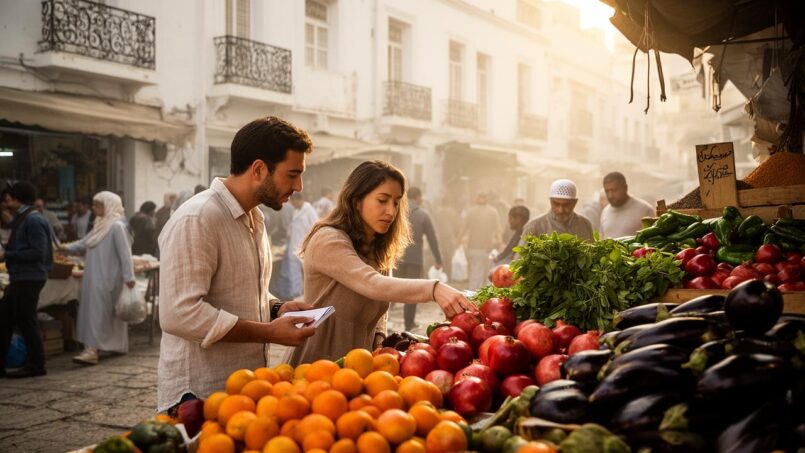
This is one of Algeria’s great advantages for an expatriate: eating well costs little, provided you favor local products and neighborhood markets. Price comparison tools show a massive gap with Western countries, especially for basic items.
Prices of common items
– Some benchmarks in euros for supermarket purchases:
– Bread: 1-2€
– Milk (1L): 0.80-1€
– Eggs (12): 2-3€
– Chicken (1kg): 7-10€
– Pasta (500g): 1-2€
– Rice (1kg): 1-2.50€
– Fruit (kg): 2-5€
– Vegetables (kg): 1-3€
| Product | Average price |
|---|---|
| Milk (1 L) | ~0.80 € |
| White bread (≈ 500 g–1 lb) | ~0.13–0.16 € |
| Rice (1 lb, ≈ 450 g) | ~0.55–0.64 € |
| 12 eggs | ~1.5 € |
| Local cheese (450 g–500 g) | ~3.4–3.5 € |
| Chicken breast (1 lb, ≈ 500 g) | ~1.8–2.2 € |
| Beef (1 lb) | ~6–6.5 € |
| Apples (1 lb) | ~1.2–1.3 € |
| Potatoes (1 lb) | ~0.22–0.26 € |
| Tomatoes (1 lb) | ~0.30–0.35 € |
In dinars, local panels from early 2026 give, for example, for Algiers:
– Liter of milk: 90–130 DZD.
– Dozen eggs: around 200–230 DZD.
– 1 kg of rice: ≈ 200 DZD.
– 1 kg of chicken breast: ≈ 800 DZD.
– Bread for two people (one day): about forty dinars.
A typical basket of fruits and vegetables costs 20 to 40% less at neighborhood markets than in supermarkets
Overall, the major databases converge on a monthly grocery budget on the order of:
– 120–200 USD for a single person.
– 250–400 USD for a family of four.
A single expatriate who cooks regularly can therefore feed themselves comfortably for less than 200 euros per month, which is very competitive internationally.
Eating out: still affordable
Restaurant meals remain moderate for someone with a foreign-currency income, even if the gap widens between local eateries and more international restaurants.
On average:
Price ranges observed in DZD and euros (€) for different types of meals and drinks in the country.
About 2 to 3 € per dish, or 350 to 400 DZD.
Around 900 to 950 DZD, or about 2.8 to 3 €.
From 3.5 to 4 €, corresponding to 600 to 700 DZD.
From 17 to 20 €, or about 3,000 DZD.
Cappuccino: 0.70–0.80 € (150–300 DZD). Soda 33 cl: 0.50–0.60 €. Local beer: 1.3–2 € per pint. Decent wine: local bottles are cheaper; alcohol remains expensive for the local population.
For an expatriate, it is possible to eat out very regularly without blowing the budget. The real difference lies between an “eat out all the time” lifestyle and a mixed one (home cooking + a few weekly outings): in the latter case, the monthly food bill can drop by 60–70% compared to someone who eats exclusively out.
Transportation: metro, bus, and fuel are ultra affordable
Urban transportation and fuel are another of Algeria’s strong points in terms of cost.
Urban transportation
Regardless of the comparison site, the conclusions are identical: public transportation is among the cheapest in the world.
Order of magnitude:
| Transport fare | Average price |
|---|---|
| Single bus / tram / metro ticket | 0.15–0.25 € (≈ 30–50 DZD) |
| Monthly public transport pass | 6–12 € (≈ 1,600–2,100 DZD) |
| City taxi ride (5 miles ≈ 8 km) | ≈ 3.5–4 USD (400–500 DZD), often negotiated |
| Taxi per km | 0.20–0.60 USD, typically 70–80 DZD/km in 2025 |
In Algiers, the metro and tram are modern and efficient; the bus is even cheaper but less user-friendly for a newcomer. Ridesharing and local VTCs (Yassir, Heetch) allow you to avoid negotiation, as the fare is set in advance in the app, though payment is often still in cash.
Fuel and private car
Fuel is heavily subsidized:
– Gasoline (1 L): around 0.30–0.32 € (≈ 43–45 DZD).
– In gallons, that works out to ≈ 1.28 USD per gallon, far from the 3–4 USD frequently seen in North America.
This low price makes car ownership very affordable for an expatriate. On the other hand, buying a new vehicle, especially a European brand, is expensive:
– Standard Volkswagen Golf: ~27,000–32,000 €.
– Toyota Corolla: ~30,000 € on average.
For intercity travel, long-distance buses, shared taxis, and a few domestic flights round out the options. A round-trip domestic ticket to the Sahara (Djanet, Tamanrasset…) typically costs between 60 and 120 USD.
Typical transportation budget
For an expatriate living in Algiers who primarily uses public transportation:
– 1 monthly pass: 1,600–2,000 DZD.
– A few taxis or VTCs: 3,000–6,000 DZD.
– That’s a monthly budget of about 40–70 USD.
An expatriate with a car will need to add: vehicle registration, car insurance, a valid driver’s license, and customs fees depending on the country of residence.
– Fuel: 20–60 USD depending on usage.
– Insurance + maintenance: variable, but generally much more reasonable than in Europe.
Healthcare: free public care, affordable private care for an expatriate
The Algerian healthcare system is based on a large public sector, free at the point of use for residents, and a rapidly developing private sector that is more expensive but better equipped.
Public system (CNAS): nearly free, but not perfect
The public system broadly covers basic care:
– Public hospitals and clinics accessible with the social security card (CNAS).
– Funded by the state and social security contributions (about 9% of salary).
– For most procedures, CNAS reimburses 80% of the official rate, and 100% for chronic illnesses.
Recurring issues:
Under-funding for modern equipment, a shortage of specialists in some regions, sometimes long waiting lines, and quality that varies greatly depending on the hospital and region: well-equipped services in big cities, much more limited in the interior.
For an expatriate employed by a local company, enrollment in the social system is in principle mandatory and allows access to these nearly free services. But many expatriates, accustomed to Western standards, turn to the private sector for consultations, specialized exams, or minor surgery.
Private sector: very attractive for a foreign income
In 2026, typical rates for an expatriate are as follows:
| Service at a private clinic | Rate in DZD | Equivalent (EUR) |
|---|---|---|
| General practitioner consultation | 2,000–3,000 DZD | ~12–20 € |
| Simple specialist consultation | 3,000–5,000 DZD | ~18–31 € |
| Standard blood test | 10–40 USD depending on facility | |
| Simple X-ray | 15–60 USD depending on facility |
Consultations at public hospitals with foreigner rates remain extremely cheap (800–1,800 DZD, or 5–11 €).
The monthly cost of international health insurance for expatriates is generally between 40 and 80 USD.
Healthcare budget to plan for an expatriate
A single expatriate with good international insurance can expect:
– 40–80 USD / month in insurance premiums.
– 10–30 USD / month for occasional visits and medications, on average over the year (barring any particular issues).
For a family, the cost adds up quickly if children are in private school and you want expanded health coverage including care outside Algeria. But compared to healthcare costs in many countries, healthcare in Algeria remains financially accessible for a household paid in foreign currency.
Education: free in the public system, very expensive in the international system
On this item, the divide is sharp: public school is free, but high-level or French/English-language education at international schools is very expensive.
Public schools: free, but quality varies
– Compulsory schooling from ages 6 to 15.
– Public schools are free (excluding supplies, transportation, uniforms…).
– Language of instruction: Arabic, with French as the first foreign language.
– Facilities are often modest, classes can be overcrowded, and quality varies greatly depending on the neighborhood and city.
For an expatriate whose children are proficient in Arabic and who accepts this system, it is a solution with virtually no direct cost. But the majority of foreign families prefer international schools.
Expatriate
International and private schools: a major expense
The major international schools in Algiers (and their branches in Oran and Annaba for some) have fees comparable to those of international schools in other countries:
| Type of school / institution | Annual fees (DZD) | Equivalent (USD / EUR) |
|---|---|---|
| French network schools (e.g., LIAD) | 800,000–1,500,000 DZD | ~5,300–10,000 USD; 4,900–9,200 € |
| US-style schools (AISA) | 1,800,000–4,000,000 DZD | ~12,000–26,500 USD; 11,000–24,500 € |
| Bilingual Algerian private schools | 100,000–400,000 DZD | highly variable |
Some British or Italian schools charge fees in euros or pounds, sometimes exceeding 8,000–10,000 € per year. Schools like the British School Algiers or Italian schools in Algiers have complex fee structures (sibling discounts, specific rates for nationals and foreigners, etc.), but the rule remains simple: quality international schooling easily costs 5,000–15,000 USD per child per year.
For an expatriate on a company contract, housing is often partially or fully covered by the employer. If it is personally funded, this expense can exceed the monthly rent and become the largest line item in the budget.
Higher education
For international students, Algeria is, on the other hand, cheap:
– University fees for foreigners: generally 1,000–3,000 USD/year.
– Student cost of living: 300–500 USD/month for housing, food, transportation.
– Student health insurance: 300–600 USD/year.
Compared to Europe or North America, Algeria positions itself as an inexpensive university destination.
Leisure, clothing, services: little impact on an expatriate’s budget
The “ancillary” items (leisure, sports, clothing, domestic services) remain modest, especially relative to an expatriate income.
Some benchmarks in dollars:
– Gym membership: ~17–20 USD / month.
– Tennis court hour on the weekend: ~8–10 USD.
– Movie ticket: ~3.5–4 USD (two tickets around 1,500 DZD).
– Cocktail at a club: ~3–4 USD.
– Simple dinner for two at a neighborhood pub: ≈ 2,900–3,000 DZD.
– Hourly house cleaning: about 580 DZD (less than 4 USD).
– Pack of imported cigarettes: 2.5–3 USD.
International brands cost less than in Europe, but the selection is more limited.
– Brand-name jeans (e.g., Levi’s): 30–35 USD.
– International brand dress: 40–45 USD.
– Nike/Adidas sports shoes: 65–70 USD.
– Men’s leather shoes: ~70–75 USD.
Most spending structure studies show that Algerian households devote the bulk of their budget to food (nearly half), then housing and transportation. Clothing and leisure represent a smaller share, and telecom expenses remain low thanks to low rates.
Salaries, taxation, and expatriate purchasing power
The perception of the cost of living obviously depends on income. For an expatriate paid at their home country’s standard, Algeria is very cheap. For a local employee, the situation is more tight.
Local salaries and purchasing power
Available data indicates:
– Average net salary: around 260–370 USD per month.
– Legal minimum wage: about 140–230 USD depending on the source and conversion method.
– Many households therefore live on less than 400 USD per month.
However, average cost-of-living estimates for a single person, excluding rent, are around 300–450 USD. This means that:
– The average salary just covers a simple life in modest rental accommodation.
– Achieving an “expatriate” level of comfort is out of reach for the majority of residents.
For an expatriate, this contrast translates into very high purchasing power as soon as they are paid in a strong currency.
Expatriate compensation
Packages for foreigners vary greatly by sector:
– Typical expat net salary: 250,000–900,000 DZD per month (≈ 1,650–6,000 USD).
– For entry-level or mid-level positions: 250,000–450,000 DZD (1,650–3,000 USD) is enough for a comfortable standard of living in Algiers.
– For senior positions in energy, engineering, or finance: 500,000–900,000 DZD (3,300–6,000 USD), often with benefits (housing, car, school).
A single expatriate earning between 2,000 and 3,000 EUR net per month can enjoy a high level of comfort in Algiers, thanks to rents that are much lower than in major European cities, and can save a significant portion of their income.
Income tax
The Algerian tax system is progressive:
– IRG (global income tax) schedule with brackets starting at 0% for low salaries and going up to 35% on the highest portion.
– For a so-called “average” income, the effective rate is generally between 10 and 20%, thanks to deductions and the progressive nature of the schedule.
– Tax is withheld at source by the employer.
For an expatriate, this means that a package negotiated net of tax retains a significant advantage, and the tax burden remains moderate compared to some highly taxed European countries.
Safety, quality of life, and non-financial dimensions
The cost of living is not everything. To assess the relevance of an expatriation, you need to factor in safety indices, quality of life, and administrative constraints.
Safety: fairly good in cities, something to watch in certain regions
2025-2026 data indicates:
Algeria’s intentional homicide rate is moderate by global standards. Major urban centers like Algiers, Oran, and Constantine are generally safe for residents and expatriates, with the main concerns being petty crime, pickpocketing, and bag snatching in crowded areas, especially at night. The serious risks of terrorism and kidnapping are concentrated in certain border areas and remote Saharan regions, rarely affecting the daily lives of expatriates in cities.
Quality of life and safety indices, around 50–53 out of 100, indicate an environment that is decent but not without challenges (infrastructure, heavy traffic, regional disparities).
Expatriate community and bureaucracy
Another element indirectly related to the cost of living: Algeria does not function as an “expat hub” like Dubai or Casablanca.
The expatriate community in Algeria is small and mostly consists of professionals (engineers, energy executives, diplomats, NGOs) and their families, with very few retirees or digital nomads. Obtaining residence permits for non-salaried individuals is complex, and there is no digital nomad visa. Administrative procedures are cumbersome: work visas, residence permits, and CNAS registration often take several weeks to months. Finally, internet quality remains below the standards of major digital capitals, which can be a problem for professions heavily reliant on high bandwidth.
These points do not directly increase the financial cost, but they weigh on the “opportunity cost” and comfort of living.
Typical profiles: how much do you really need?
Based on all this data, we can outline a few typical expatriate profiles for 2026.
Single young professional in Algiers
– Expat salary: 250,000–350,000 DZD net (≈ 1,650–2,300 USD).
– Decent 1-bedroom rent in a safe neighborhood, sometimes just outside the hyper-center: 50,000–70,000 DZD.
– Utilities + internet + mobile: 10,000–15,000 DZD.
– Food (mix of groceries and simple restaurants): 30,000–40,000 DZD.
– Transportation: 5,000–10,000 DZD.
Realistic total monthly budget: 120,000–150,000 DZD (≈ 800–1,000 USD) for a reasonable lifestyle; 180,000–250,000 DZD (1,200–1,650 USD) for a higher level of comfort with frequent outings and leisure activities.
Couple with no children
– 2-bedroom rent in a sought-after but not ultra-premium neighborhood: 70,000–100,000 DZD.
– Utilities and telecoms: 15,000–20,000 DZD.
– Food: 50,000–70,000 DZD.
– Transportation and leisure: 20,000–30,000 DZD.
Total monthly income in DZD (2,300–3,000 USD) allowing a couple to live comfortably in Algiers, including regular outings and some domestic travel.
Family of four with international school
Here, the low cost of living in Algeria is largely offset by the price of education:
– 3-bedroom rent in an expat neighborhood (Hydra, Ben Aknoun, Chéraga…): 100,000–160,000 DZD.
– Utilities, internet, mobile: 20,000–30,000 DZD.
– Food: 70,000–100,000 DZD.
– Transportation, leisure, clothing: 40,000–60,000 DZD.
– International school for two children (depending on the school): on the order of 1.6 to 3.0 million DZD per year, which is 130,000–250,000 DZD per month on average per child if annualized.
Very quickly, the “schooling” item becomes the heaviest, often covered by the employer. Without this coverage, a family expat income above 700,000–900,000 DZD monthly (4,500–6,000 USD) becomes almost essential to maintain a comfortable standard of living.
Summary: a financially very attractive destination, with conditions
From a strictly financial standpoint, Algeria offers a very favorable cost-of-living-to-purchasing-power ratio for an expatriate:
– Rent significantly lower than most comparable markets.
– Groceries, transportation, electricity, internet: all well below Western standards.
– Affordable healthcare, especially through a public/private mix.
– The possibility of living comfortably, or even very comfortably, on 2,000–3,000 USD per month in Algiers, even less in other cities.
The main reservations are not financial:
The complex bureaucracy for visas and residence permits, the lack of affordable international schools, infrastructure that is inferior to major metropolises, and a very small expatriate community make Algeria poorly suited to the current expatriate lifestyle.
For a professional seconded in energy, construction, telecommunications, or international education, with housing and schooling potentially covered, the calculation is obvious: the cost of living in Algeria is a major asset, allowing either a very comfortable lifestyle or a significant savings capacity.
The low cost of living does not compensate for the difficulty of obtaining a stable legal status, the language barrier (Arabic and French dominant), and services that are poorly adapted to long-term stays.
Still, for those with a good income in foreign currency who accept these constraints, Algeria combines a very low cost of living, generally acceptable safety in cities, and a unique environment ranging from the Mediterranean to the Sahara. Financially, few destinations offer such potential for quality of life at this level of expenditure.
A wealth planning project or a question? Contact us now to speak with a wealth management expert.
Disclaimer: The information provided on this website is for informational purposes only and does not constitute financial, legal, or professional advice. We encourage you to consult qualified experts before making any investment, real estate, or expatriation decisions. Although we strive to maintain up-to-date and accurate information, we do not guarantee the completeness, accuracy, or timeliness of the proposed content. As investment and expatriation involve risks, we disclaim any liability for potential losses or damages arising from the use of this site. Your use of this site confirms your acceptance of these terms and your understanding of the associated risks.

Cyril Jarnias is an independent expert in international wealth management with over 20 years of experience. As an expatriate himself, he is dedicated to helping individuals and business leaders build, protect, and pass on their wealth with complete peace of mind.
On his website, cyriljarnias.com, he shares his expertise on international real estate, offshore company formation, and expatriation.
Thanks to his expertise, he offers sound advice to optimize his clients' wealth management. Cyril Jarnias is also recognized for his appearances in many prestigious media outlets such as BFM Business, les Français de l’étranger, Le Figaro, Les Echos, and Mieux vivre votre argent, where he shares his knowledge and know-how in wealth management.





