
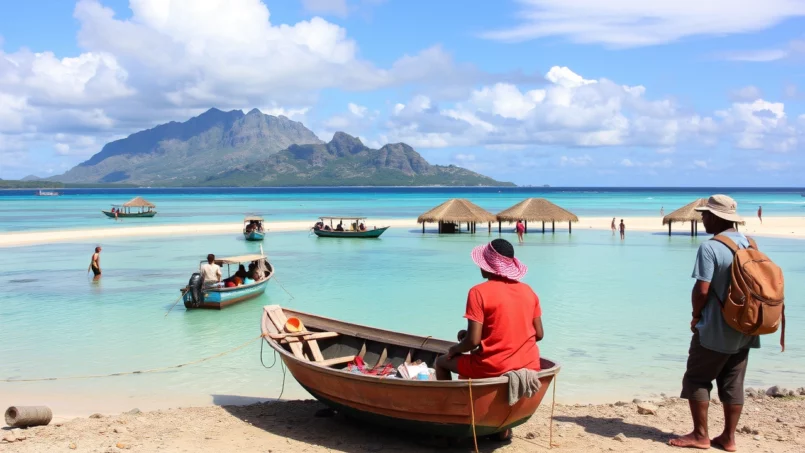
 Published on and written by Cyril Jarnias
Nestled in the heart of the Western Pacific, Micronesia often captivates with its turquoise lagoons, its World War II shipwrecks, and its tropical rainforests. But behind the postcard image lies a far more complex job market, where opportunities for expatriates exist but remain narrowly targeted, demanding, and heavily constrained by the local economic reality.
Before relocating to work in the Federated States of Micronesia (Pohnpei, Chuuk, Yap, Kosrae), it is essential to research the local economic structure, salary levels, cost of living, key employment sectors, and the prevailing legal framework.
A Modest Economy, Heavily Dependent on External Aid
Micronesia operates on a fragile economic model that is largely supported from outside. The national GDP is approximately $331 million, with a per capita GDP around $2,500 to $2,572. The economy rests on a few well-identified pillars: tuna fishing (licenses and exports), subsistence agriculture (taro, breadfruit, coconut), the public sector and services, with a still underdeveloped but growing tourism industry.
The unemployment rate in the Marshall Islands is around 16%, well above OECD averages.
This creates a paradoxical situation for foreigners: on one hand, a large local pool of labor struggling to integrate into the formal market; on the other, real needs for technical and managerial skills that the domestic workforce cannot always meet, particularly in health, tech, infrastructure project management, or specialized education.
Local Salaries, Expatriate Salaries: A Very Marked Duality
On paper, salary figures in Micronesia can seem contradictory. According to sources, the average monthly salary ranges from $400 to $950, and, in equivalent gross annual terms, around $22,000 (or about $1,833 per month). These discrepancies are explained by the difference between skilled local wages, salaries for certain supervisory positions, and broader estimates encompassing various types of jobs.
To get your bearings, it is useful to distinguish between major job categories.
Statistical Portrait of the Salary Market
The following data provides an overview of the salary structure for the FSM, across all sectors.
| Indicator | Approximate Value (USD) |
|---|---|
| Average annual salary | 15,300 – 22,000 |
| Median annual salary | 16,720 |
| Lowest annual salary | 2,420 |
| Highest annual salary | 74,940 |
| Bottom 25% range | < 10,380 |
| Top 25% range | > 47,180 |
| “Standard” gross monthly salary | 655 – 2,009 |
| Average net monthly salary | ≈ 1,500 (≈ 18,000 net annual) |
In addition to this global overview, there are more detailed statistics by job level.
| Job Category | Indicative Annual Range (USD) |
|---|---|
| Entry-level / Support positions | 8,000 – 15,000 |
| Skilled trades (e.g., electricians) | 12,000 – 25,000 |
| Technical professions / mid-level managers | 18,000 – 40,000 |
| Management / Director level | 25,000 – 50,000 and above |
For management or high-responsibility roles, several monthly estimates illustrate the gap with the base salaries of the local population:
| Function (example) | Average Monthly Salary (USD) |
|---|---|
| Financial Manager | 2,870 |
| General Manager | 2,440 |
| Business Development Manager | 2,240 |
| Project Manager | 1,570 |
| Financial Analyst | 1,740 |
At the other end of the scale, many Micronesians earn between $300–400 net per month, up to $900–950 in better-paid cases. The official currency being the US dollar, there is no exchange rate risk for an expatriate paid in USD.
Differences in Experience, Education, and Gender
Salary gaps follow classical patterns: experience and education level significantly increase compensation.
An employee with 2 to 5 years of experience earns on average 35% more than an entry-level worker.
Simultaneously, a gender gap persists: men earn on average 7% more than women, with average annual salaries of approximately $18,780 for men compared to $17,620 for women.
Public vs. Private Sector: A Slight Advantage to the Private Sector
The private sector offers on average slightly higher salaries than the public sector, but the gap remains moderate.
| Sector | Average Annual Salary (USD) |
|---|---|
| Public sector | 15,700 |
| Private sector | 16,400 |
| Indicative gap | ≈ –4% for the public sector |
For an expatriate, however, many positions are at the intersection of these two worlds: consultants and technical experts working on public projects but paid through international donors or NGOs.
A Cost of Living Less Low Than One Might Imagine
Many imagine that with modest salaries, life in Micronesia must be extremely cheap. The reality is more nuanced. Local products (fish, fruit, certain vegetables) remain affordable, but imported goods – which represent a large part of modern consumption – are expensive due to geographical isolation and freight costs.
Cost of living aggregates provide relatively high benchmarks for those based on an urban lifestyle with independent housing, frequent dining out, high-speed internet, and regular travel between islands.
| Household profile (with rent) | Average Monthly Expenditure (USD, all FSM cities) |
|---|---|
| Single person | ≈ 2,381 |
| Couple | ≈ 3,481 |
| Family of four | ≈ 4,936 |
These amounts include rent. Excluding housing, monthly costs are estimated at around $984 for a single person and $3,421 for a family, according to some sources.
Housing: The Primary Expense
Rent varies significantly depending on the island, neighborhood, and housing standard, but remains high relative to local salaries. In Pohnpei or Palikir, you find ranges similar to some mid-sized American or Asian cities.
| Type of Housing (Palikir / Pohnpei) | Monthly Range (USD) |
|---|---|
| Furnished studio in “normal” area (≈45 m²) | 400 – 550 |
| Furnished studio in expensive area | 1,200 |
| 1 bedroom downtown | 700 – 1,200 (average ≈ 966) |
| 1 bedroom outside center | 470 – 1,000 (average ≈ 754) |
| 3 bedrooms downtown | 755 – 3,000 (average ≈ 1,439) |
| 3 bedrooms outside center | 800 – 1,950 (average ≈ 1,163) |
| Villa | 710 – 2,800 |
The rent-to-average-income ratio is estimated at around 32%, with a range of 22% to 42%. This means a large part of household budgets is concentrated on housing, except for expatriates benefiting from partial or full housing coverage by their employer, which is common for some skilled positions.
Daily Consumption, Transportation, and Services
Some daily expenses remain reasonable, others are surprising in their level. The prices below provide an order of magnitude:
| Expense Item | Average Price (USD) |
|---|---|
| Inexpensive restaurant meal | 15 – 30 |
| Meal for two, mid-range restaurant | 45 |
| Typical fast-food meal | ≈ 6.75 |
| Local beer (bar) | ≈ 1.00 |
| Bread (1 lb) | ≈ 2.78 |
| Eggs (12) | ≈ 7.25 (high variance) |
| Chicken (1 lb) | ≈ 2.18 |
| Apples (1 lb) | ≈ 2.48 |
| Banana (1 lb) | ≈ 1.73 |
| Water 1.5 L | ≈ 1.37 |
| High-speed internet subscription | ≈ 220 per month |
| Electricity + water + garbage (85 m²) | ≈ 116.67 per month |
| Mobile plan (voice + data) | ≈ 31.67 per month |
| Cinema (one ticket) | ≈ 7 |
| Gasoline (1 gallon) | ≈ 11.39 (very wide range) |
| Local transport monthly pass | ≈ 27.87 |
Access to reliable and fast internet is one of the most costly items, which matters a lot for remote workers and tech profiles. Healthcare services can remain affordable on a day-to-day basis, but medical evacuations (to Guam, Hawaii, the Philippines, Fiji, New Zealand) are extremely expensive, hence the need for expatriates to have international insurance covering repatriation.
Where are the Real Opportunities for Expatriates?
Despite a tight job market and high unemployment, Micronesia is not closed to foreigners. Simply put, positions accessible to expatriates are concentrated in niches where the foreign added value is clearly demonstrable and where the local supply of skills is limited.
International Cooperation, NGOs, and UN Agencies
The presence of international organizations and NGOs is particularly structuring. Offices and projects of multiple institutions can be found:
– UNICEF
– World Health Organization (WHO)
– International Organization for Migration (IOM)
– UNFPA, UN Women, World Bank, SPC (Pacific Community), RCS (Resident Coordinator System), among others.
These organizations recruit for positions ranging from administrative assistant to head of mission, in areas such as public health, water and sanitation (WASH projects), gender and gender-based violence, program management, monitoring and evaluation, project finance, ICT.
Job titles posted recently illustrate the profiles sought: National Programme Officer, Senior Programme Assistant, Project Manager WASH, Monitoring, Evaluation and Learning Assistant, Administrative Associate, Senior ICT Assistant, Gender Based Violence Specialist, Team Assistant, Head of Resources Management, etc.
These positions are demanding in terms of qualifications (often a master’s degree, international experience, fluent English at a minimum), but they generally offer salaries and benefits significantly above local standards, often indexed to international scales (UN, World Bank). For an expatriate, these are among the few jobs that allow for comfortable living while saving.
Public Projects Funded by Donors
Simultaneously, the federal administration and state governments regularly publish positions related to donor-funded projects: public financial management (PFM), infrastructure, climate and environment, education, ocean resources.
Positions such as Project Manager, Contracts Administrator, Procurement Specialist, Finance Officer, Communications Officer, State Project Coordinator, or Environmental and Social Officer are sometimes aimed at foreign profiles, particularly when they involve rare skills in international project management, public procurement, environmental and social safeguards, or information systems.
Tourism and Maritime Activities: Real Possibilities, but Not “Golden”
Tourism remains a key sector, with steady growth, but still far from the mass tourism seen elsewhere in the Pacific. The clientele consists mainly of divers, hikers, and ecotourism enthusiasts attracted by Chuuk Lagoon, the ruins of Nan Madol, Yap and its traditional culture, Kosrae and its preserved landscapes.
In this context, jobs for expatriates are concentrated in:
– Hotels and resorts (management, high-end reception, marketing)
– Dive centers (certified instructors, guides)
– Nautical and tour operators (boats, excursions, kayaking, snorkeling)
These positions are not always numerous and competition can be strong, but for experienced profiles (PADI dive instructor, accommodation manager with regional experience, digital tourism marketing specialist), the added value can convince an employer to initiate work permit procedures.
Salaries, however, often remain aligned with the local market, with in-kind benefits (housing, meals, sometimes a vehicle). They must be weighed against the cost of living, especially in tourist areas where rents and prices for imported goods are higher.
Teaching: Constant Demand for English Teachers
Teaching English represents one of the most classic pathways for expatriates, particularly in the local school network and in higher education.
Opportunities are divided among:
– Public and private schools
– Religious or independent high schools (like Xavier High School in Chuuk, very oriented towards foreign volunteers)
– College of Micronesia-FSM (COM-FSM), which sometimes recruits teachers of English, computer science, sciences, or management
– Private tutoring
Typical salary ranges for English teachers vary according to the type of institution.
| Type of Institution | Indicative Gross Monthly Salary (USD) |
|---|---|
| Public / Government schools | 600 – 1,000 |
| Local private schools | 800 – 1,200 |
| Private language schools | 700 – 1,100 |
| International schools | 1,200 – 1,800 |
| Universities / COM-FSM (instructors) | 900 – 1,500 |
| Private tutoring (per hour) | 10 – 25 |
A university position for an English Instructor at the COM-FSM (Kosrae campus), for example, was posted with an annual salary of approximately $18,177, with potential entitlements to housing and partial transport coverage. The requirements were high (master’s in English, TESOL, linguistics or ESL, two years of full-time experience).
For many teachers, the key to a successful expatriation lies in evaluating an overall package including salary, subsidized housing, possible insurance, and airfare. Relying solely on a salary at the lower end of the usual ranges can prove financially tight, especially if supporting a family.
Technology and Cybersecurity: The Big Wave to Come
This is one of the areas where the contrast between needs and local skills is the most stark. Micronesia is investing in telecommunications, renewable energy, public information systems, and cybersecurity. The FSM Telecommunications Corporation, FSM Telecom, Micronesian Renewable Energy, the Federated State’s Information Technology Office, as well as financial and health institutions, are seeking advanced profiles.
The relevant professions range from developers and systems administrators to cloud and cybersecurity specialists. Local training, notably at the College of Micronesia-FSM (programs in Computer Information Systems, cybersecurity, data assurance), is improving, but demand far exceeds supply.
On a regional scale, the figures are telling: thousands of additional tech jobs are expected in the coming years in the Pacific, a global shortage of 4.8 million cybersecurity professionals is mentioned, and cyberattacks already cost Micronesian businesses about ten million dollars per year. The government has adopted a six-year cybersecurity roadmap aiming to create a national CERT, modernize legislation, and protect critical infrastructure.
The local minimum monthly salary in the tech sector in Micronesia can go as low as $711.
Construction, Technical Trades, and Foreign Labor
Another area of employment for foreigners, often overlooked by Western expatriates, concerns the building and public works trades. There is already a significant presence of Filipino workers in construction, electricity, plumbing, welding, heavy equipment maintenance, due to the perceived reliability and productivity of these profiles.
Typically sought-after functions include carpenters, masons, electricians, plumbers, welders, drivers and equipment mechanics, foremen. These trades are particularly in demand for infrastructure construction and periodic real estate booms, with salaries certainly above unskilled local standards but rarely comparable to the “full package” expatriate remuneration of international cooperation.
Remote Work and Digital Nomadism: Beware of a Mirage
The rise of global remote work does not spare Micronesia. Several remote job platforms list “remote-first” positions accessible from the FSM, often in software development, technical support, marketing, writing, design, product management. Some display monthly salaries far above local norms ($5,600 to $7,500, sometimes up to $11,200).
However, it is important to note that these offers are not dependent on the Micronesian economy: the employer is foreign, the work is fully offshored, and Micronesia is just a landing spot like any other for a remote worker. In this case, the question is no longer “finding a job in the local market” but verifying whether the country is truly suitable for 100% online activity: connection quality, internet cost, network stability, a legal framework still poorly adjusted to remote work, difficulties accessing certain services (banks, healthcare, etc.).
For a digital nomad, Pohnpei and Kosrae can offer an acceptable compromise between scenic beauty and connectivity, but the very high cost of fast internet plans, island dispersion, and fragile infrastructure require testing on the ground before committing long-term.
A Legal Work Framework to Master Well
Working in Micronesia requires dealing with labor law that is relatively simple on paper, but sometimes incomplete and heterogeneous from one state to another. Some standard protections in developed countries are not systematically provided by law, which places much reliance on individual employment contracts.
Working Hours, Social Minimums, and Taxation
The standard weekly working hours are generally around 40 hours, i.e., 8 hours per day over five days. The federal minimum wage is $3 per hour, but states can set their own floors (often between $2 and $3 per hour), sometimes lower in the public sector. Overtime must be paid at least 1.5 times the normal rate, with, in some cases, a starting point around $4.50 per hour for public agents.
Income tax is moderate: 6% up to $11,000 annually, then 10%. A VAT of about 5% applies. Employer social contributions are about 7.5%, funding pensions (from age 65, subject to minimum contributions), disability, and child support for low-income families or in case of a parent’s death.
Leave, Maternity, Dismissal: Much Left to Negotiation
Micronesian labor law does not uniformly provide for mandatory paid leave or sick leave. In many situations, individual contracts or internal employer policies (especially international ones) set the rights to annual leave, sick days, etc. The only explicit protection concerns maternity leave, set at 8 weeks per 12-month period. Paternity leave arrangements exist in some frameworks but without national harmonization.
Contracts often include a probation period of 6 to 12 months. Termination can be initiated by the employer or employee, with notice on the order of one week to one month depending on seniority. Legislation provides for a severance payment of 15 days’ salary per year of service. Dismissal for economic reasons (redundancy) is explicitly provided for.
There is no legal obligation to pay a 13th-month bonus. This bonus, like year-end or performance bonuses, is at the employer’s discretion. Its amount varies considerably by industry, with finance, architecture, sales, or business development generally being more generous than construction or transport.
Remote Work: Legal Gray Area
Remote work is not covered by a specific law. It operates through interpretation of general texts and contractual agreements (addenda, internal charters). An employer remains responsible for the safety and health of its employees, even at home, but in practice, this translates mainly into recommendations and informal policies on ergonomics, equipment use, data security.
The protection of personal data is not governed by an overarching text equivalent to the European GDPR. Nevertheless, employers are required to maintain the confidentiality of professional and personal information. In an increasingly digital context, serious organizations impose cybersecurity policies: VPN, multi-factor authentication, device encryption, employee awareness.
Work Permits and Immigration: The Mandatory Passage Point
For most nationalities, working legally in Micronesia involves obtaining two elements: a work permit (Alien Worker’s Permit) and an entry permit or temporary residence visa linked to employment. These procedures are managed by the FSM Department of Resources and Development, with processing generally announced as taking four to six weeks, but which can vary depending on applications and states.
Thanks to the Compact of Free Association, U.S. citizens can live, work, and study in Micronesia without time limits or the need for a specific visa. For travel and stay, they simply need a valid passport and complete the required immigration forms upon arrival.
For other foreigners, the procedure is more standard:
To work in the FSM, a firm job offer from a local employer is required. The employer must provide a file proving the regularity of their business, describing the position and the absence of qualified local candidates. The employee must assemble a complete file including: application form, valid passport (often 6 months beyond the entry date), diplomas, CV, medical certificate, police clearance, proof of funds, proof of temporary accommodation, health insurance, passport photos, and a return ticket or confirmed itinerary.
Once the permit is granted, the employee must comply with the conditions of their visa and contract (work only for the sponsoring employer, notification in case of change of situation, departure from the territory at the end of the contract unless renewed).
Dependents (spouses, minor children) can obtain dependent stay authorizations, linked to the validity of the main permit, but are not authorized to work without their own permit. As for permanent residence and citizenship, they are described as extremely difficult for foreigners to obtain, including for spouses of citizens.
A Communal Society, Cultural Codes to Integrate
Professional integration in Micronesia is not just about a contract. Society is very communal, structured around extended kinship ties, traditional hierarchies, and a strong importance placed on chiefs, elders, and religion.
Communication prioritizes consensus and relational harmony over the contract, and the notion of “island time” implies great flexibility in schedules and deadlines, which can surprise expatriates used to a very formal framework.
However, a foreigner respectful of customs, willing to participate in community life, to learn a few phrases in local languages (in addition to English, the official administrative language), and to accept a less individualistic lifestyle will be perceived positively. Many expatriates present for 10, 20 years or more highlight the richness of the bonds formed, while acknowledging that they often remain “outside” the central circle, due to the lack of a fully integrated legal status.
Opportunities Yes, but for Which Profile and with What Strategy?
Betting on Micronesia is not suitable for all types of expatriates. In summary, the following profiles have the best chance of finding their place:
Discover the five categories of professionals particularly sought after to contribute to the development of the FSM, with skills adapted to the specific needs of the territory.
In understaffed fields: cybersecurity, information systems, engineering, specialized healthcare, public finance, environmental and social safeguards, management of donor-funded projects.
Familiar with multi-donor project logic and island environments.
Especially in English, computer science, sciences, management, with a good level of budgetary flexibility and adaptability.
Diving, ecotourism, independent hospitality, already experienced and ready to negotiate packages including housing and in-kind benefits.
With a high external salary, ready to deal with expensive internet but living their job in an economy other than that of the FSM.
For freelancers, low-skilled workers, or young graduates without experience or institutional support, the bet is much more delicate. The local market does not have the capacity to absorb foreigners en masse in positions also accessible to Micronesians, and the authorities are careful that available jobs benefit nationals first.
For eligible profiles, a lucid approach is crucial: analysis of the cost of living, meticulous verification of the contract (housing, insurance, tickets, clauses), anticipation of administrative delays, evaluation of infrastructure (internet, transport, healthcare), and preparation for deep cultural immersion in a welcoming society with well-established codes.
Micronesia then offers a professional and human experience hard to find elsewhere: working at the intersection of global challenges (climate, cybersecurity, sustainable development) and an exceptional island environment, while contributing directly to the skills development of a country that, despite its small size and fragility, occupies a strategic place at the heart of the Pacific.
Disclaimer: The information provided on this website is for informational purposes only and does not constitute financial, legal, or professional advice. We encourage you to consult qualified experts before making any investment, real estate, or expatriation decisions. Although we strive to maintain up-to-date and accurate information, we do not guarantee the completeness, accuracy, or timeliness of the proposed content. As investment and expatriation involve risks, we disclaim any liability for potential losses or damages arising from the use of this site. Your use of this site confirms your acceptance of these terms and your understanding of the associated risks.

Cyril Jarnias is an independent expert in international wealth management with over 20 years of experience. As an expatriate himself, he is dedicated to helping individuals and business leaders build, protect, and pass on their wealth with complete peace of mind.
On his website, cyriljarnias.com, he shares his expertise on international real estate, offshore company formation, and expatriation.
Thanks to his expertise, he offers sound advice to optimize his clients' wealth management. Cyril Jarnias is also recognized for his appearances in many prestigious media outlets such as BFM Business, les Français de l’étranger, Le Figaro, Les Echos, and Mieux vivre votre argent, where he shares his knowledge and know-how in wealth management.





