
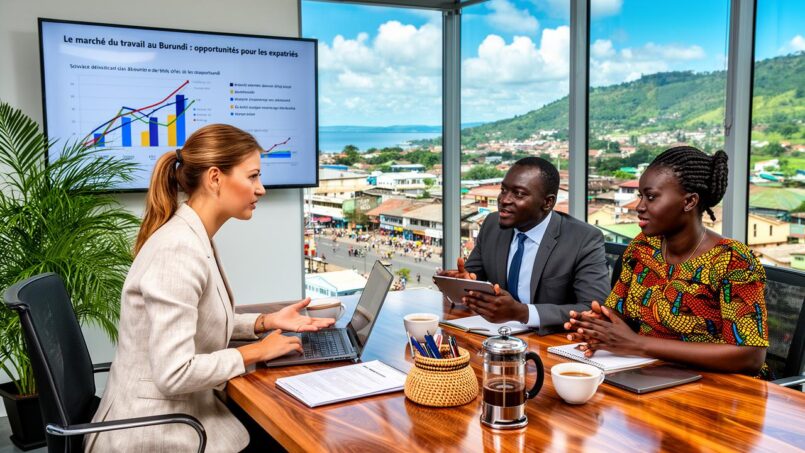
 Published on and written by Cyril Jarnias
Moving to and working in Burundi is neither an “African El Dorado” nor an impossible mission. The country combines a fragile economy, massive youth underemployment, a paradoxical cost of living, and, at the same time, strong demand for rare skills in certain sectors. For a well-prepared expatriate, fluent in French and with a solid professional project, opportunities are very real, especially in Bujumbura.
This article provides a comprehensive analysis of the job market, salary levels, and cost of living in Burundi. It also highlights promising economic sectors, as well as the administrative, cultural, and security challenges to consider before settling there.
A contrasting but recovering economic context
Burundi remains one of the poorest countries in the world, with a very low GDP per capita (around $154 to $260 depending on the source) and a poverty rate estimated at over 60% of the population. Most Burundians live off subsistence farming, in a territory highly exposed to climate shocks.
Real GDP growth rate targeted by the country for 2025, driven by the mining revival and major public investment projects.
This momentum does not erase the fragilities: very high inflation (with projections exceeding 30%), still significant budget deficit, extremely volatile Burundian franc, slow structural reforms, and unstable political climate. But for foreign companies and professionals, this restart opens a window of opportunity, provided you know which sectors to position yourself in and with what level of risk.
Explosive demographics, a saturated… and incomplete labor market
With approximately 13.8 million inhabitants and nearly 65% of the population under 25, Burundi has an impressive labor pool. The labor force participation rate exceeds 78%, but this statistic is misleading: it includes the large mass of subsistence agriculture workers.
In reality, the country simultaneously faces:
– an almost non-existent official unemployment rate (around 1%),
– massive underemployment,
– and youth unemployment estimated at about 65%.
The majority of jobs are concentrated in agriculture, which employs 85 to 86% of the workforce, often informally. Industry, including construction and mining, employs only 3.5% of active workers, while services account for about 10%.
This structure means two things for an expatriate:
The volume of skilled jobs for locals is limited, creating strong internal competition. At the same time, serious companies suffer from a critical shortage of highly qualified profiles, particularly in technical and managerial fields.
Universities graduate students every year, especially in economics, management, and public administration. However, the gross enrollment rate in higher education remains extremely low (just over 6%), educational infrastructure is fragile, and the link between training and labor market needs is clearly insufficient. Hence a dual reality: many unemployed young graduates… and a shortage of specialists in engineering, advanced IT, energy professions, compliance, or certain medical specialties.
Bujumbura, the economic heart and main employment hub
For most expatriates, the Burundian job market boils down to one city: Bujumbura. The former political capital, still the economic capital and the country’s main port, it concentrates:
In many countries, the capital concentrates the majority of formal companies, the headquarters of banks and insurance companies, the bulk of international NGOs and UN agencies, the main higher education institutions, and almost all international schools. This centralization illustrates geographical imbalances in terms of economic development, financial services, international aid, and high-level education.
Opportunities in the formal sectors – banks, telecoms, services, construction, renewable energy, technology – are essentially found there. Gitega, the political capital, offers positions mainly in administration, education, and some development projects, but with a significantly smaller expatriate presence.
Salaries in Burundi: understanding the gaps and figures
Before discussing opportunities, you need to understand the local pay scale, because the gap between salaries and the cost of living structures the entire discussion.
National salary levels
On average, an employee in Burundi earns about 14,158,800 BIF per year, or around 1,179,900 BIF per month. Statistical extremes roughly range from 298,000 to over 5.2 million BIF monthly, including housing and transport allowances. The median annual salary is around 15 million BIF.
To get a rough idea in dollars, several sources estimate that the average net monthly salary fluctuates, depending on calculation methods, from less than $100 to over $500. This dispersion reflects the duality of the market: low wages in the informal sector or small structures, significantly higher wages in large companies, the banking sector, telecoms, NGOs, and international organizations.
Some key figures in US dollars (approximations) can be summarized:
| Indicator | Approximate Monthly Amount |
|---|---|
| National average salary (BIF → USD) | ~$568 |
| National salary median (BIF → USD) | ~$520 |
| Average salary in 2024 | $110 (source in USD) |
| Average salary in 2025 | $120 (source in USD) |
The gap between these estimates clearly shows that everything depends on the type of job, the sector, and the statistical source. For an expatriate, the important thing is to be in the upper part of the scale, often outside the levels observed for local employees.
Salaries by company size and sector
In 2025, a dollar analysis highlights another gap: the size of the employer.
| Type of Employer | Average Monthly Salary (USD) |
|---|---|
| Micro-enterprises (≤ 15 employees) | $69 |
| Small enterprises (≤ 100 employees) | $100 |
| Medium enterprises (> 100) | $130 |
| Large enterprises (> 250) | $160 |
| Public sector | $92 |
Thus, large companies offer, on average, more than double the salary of micro-structures. In Bujumbura, these gaps widen further:
| Type of Employer (Bujumbura) | Average Monthly Salary (USD) |
|---|---|
| Micro-enterprises | $76 |
| Small enterprises | $110 |
| Medium enterprises | $140 |
| Large enterprises | $180 |
| Public sector | $100 |
Salaries also vary strongly by sector. In BIF, average monthly gross remunerations are, for example, around:
| Sector / Function | Average Monthly Gross Salary (BIF) |
|---|---|
| Information Technology | 1,970,360 |
| Law & Legislation | 1,523,090 |
| Banking | 1,444,120 |
| Human Resources | 1,304,820 |
| Insurance | 1,352,520 |
| Journalism, printing, media | 1,107,930 |
| Administration | 1,058,240 |
| Agriculture & agri-food industry | 1,031,590 |
| Arts & culture | 1,067,790 |
| Unskilled labor | 779,142 |
Unsurprisingly, IT and financial or legal professions are among the best paid.
Salaries by profession: some useful benchmarks
For an expatriate considering a local position (excluding an international package), it is instructive to look at the salaries of certain professions, in Bujumbura and nationally, in dollars:
| Field | Position | Average Monthly Salary (USD, Burundi) | Salary in Bujumbura (USD) |
|---|---|---|---|
| Education | University professor | 150 | 160 |
| High school teacher | 140 | 150 | |
| Elementary school teacher | 120 | 130 | |
| IT | Go / Java developer | 210 | — |
| iOS developer | 190 | — | |
| C# developer | 180 | — | |
| Data scientist | 180 | — | |
| PHP developer (Bujumbura) | — | 170 | |
| Accounting / Finance | Trader | 180 | — |
| Chief Accountant | 130 | 150 | |
| Auditor | 140 | 150 | |
| Financial Analyst | 110 | — | |
| Law | Judge | 620 | 680 |
| Notary | 290 | 320 | |
| Lawyer / bankruptcy attorney | 120–130 | 130 | |
| Medicine | Chief Medical Officer | 200 | 220 |
| Department Head | 150 | 170 | |
| Dentist / Surgeon | 130 | 140 |
These amounts show that some highly skilled positions in law or medicine reach several hundred dollars monthly, while most functions remain well below Western living standards.
Gender gap
Data indicates that on average, men earn about 15% more than women, with annual salaries on the order of 15.36 million BIF for men compared to 13.32 million for women. Female expatriates should therefore expect to encounter, at least partially, these disparities in local structures.
For a salaried employee (local or expatriate) on a Burundian contract, taxation follows relatively simple brackets:
Threshold in Burundian francs (BIF) per year below which the income tax rate is 0%.
Social security contributions represent about 4% of the salary, capped at 450,000 BIF per month. In case of layoff, severance pay is indexed to seniority, from 50% of one month’s salary for less than three years, up to three months’ salary after ten years.
For an expatriate, it is crucial to include the issue of the Burundian franc (BIF) volatility in salary negotiation, especially if the contract is denominated in that currency. For skilled positions, it is common for employers to agree to index remuneration to the US dollar to hedge against exchange rate fluctuations and ensure salary stability.
Cost of living: an “inexpensive” city… but much more expensive than local salaries
Bujumbura is ranked among the 26% least expensive cities in the world, with a cost of living about 1.5 times lower than the global average. Seen from Paris, Brussels, or Montreal, life seems cheap there. But this overall view hides a paradox: for a Burundian paid the median salary, city life is extremely expensive.
Compiled figures for Bujumbura give the following orders of magnitude:
| Type of Monthly Budget in Bujumbura | Average Amount (USD) |
|---|---|
| Total cost of living, single person (with rent) | 754 |
| Total cost of living, family of 4 (with rent) | 1,937 |
| Without rent, single person | 510 |
| Without rent, family of 4 | 1,548 |
Another indicator summarizes the gap: the net median salary in Bujumbura is estimated at about $89.4 per month, barely enough to cover 10% of a month’s “standard” expenses in the city. Hence a very strong contrast between the lifestyle of expatriates, often paid in foreign currency, and that of residents.
Housing: main expense for expatriates
For an expatriate, housing is generally the primary budget item. Rents vary enormously depending on the neighborhood, security, the presence of a garden, a generator, or a swimming pool.
Some benchmarks:
| Type of Housing (Bujumbura) | Average Monthly Rent (USD) |
|---|---|
| 1 bedroom, city center (≈ 40 m²) | ~$381 |
| 1 bedroom, outside center, simple | ~$112 |
| 3 bedrooms, city center (≈ 80 m²) | ~$703 |
| 3 bedrooms, outside center, simple | ~$205 |
| Range for simple expatriate housing | $150 – $250 |
| Secured family house, good neighborhoods | $500 – $1,000+ |
| High-end villa | $1,500+ |
Neighborhoods favored by expatriates – Rohero, Kiriri, Mutanga Sud, Kinindo, Kinanira, Gihosha, etc. – offer a compromise between security, proximity to services, view of Lake Tanganyika or the hills. International organizations often negotiate higher rents for villas with guarding, generator, and water tank.
Housing options for a short-term stay, with a wide price range.
A common choice for temporary installation, often found through local agencies. Prices around €30 to €50 per night for an equipped studio.
Villas and small houses available for rent for short periods. Prices can reach €200 per night for the most luxurious villas.
Food, transport, services: affordable for an expatriate, heavy for a local
On average, a single person spends around $347 USD per month on food in Bujumbura, a family of four nearly $935. Base prices testify to a certain expensiveness for common products:
– bread (0.5 kg): ~$1.35,
– rice (1 kg): ~$1.55,
– dozen eggs: ~$3.12,
– cheese (1 kg): ~$10.6,
– chicken breast (1 kg): ~$11.3.
The average price of a meal at a fast-food or small local restaurant in Uzbekistan.
Transport is another significant expense. Public transport (minibuses, motorcycle taxis) are very cheap ($0.5 to $1 per trip) but unsafe and very informal. An average monthly pass can be estimated at $20–30, while a taxi for 8 km can approach $28, making it a luxury for most residents.
Essential services remain relatively affordable:
– electricity + water: $11 to $17 per month depending on household size (excluding recurring outages),
– high-speed internet (50 Mbps): about $67 per month,
– mobile plan with 10 GB of data: around $2.60.
For an expatriate, these costs remain reasonable, but the quality of service (power outages, unstable mobile network outside the capital) must be taken into account.
Education and health: crucial costs for expatriate families
For an expatriate family, two items completely change the game: international schooling and healthcare.
Bujumbura’s international schools (École Belge du Burundi, Burundi American International Academy, The King’s School, Bujumbura International Montessori School, Cubahiro International School, etc.) charge annual fees that can reach or exceed $10,500 per child in primary school, and this amount does not include all costs.
– enrollment fees,
– uniforms,
– school transport,
– extracurricular activities.
For a couple with two children in international school, tuition often becomes the very first expense, ahead of housing. Many NGOs and UN agencies therefore include, wholly or partially, these fees in their expatriation packages. This point is central during contract negotiation.
Regarding health, the gap with Western standards is clear. The public system remains under-resourced. A consultation in a public hospital often costs less than $10, but with obvious quality limits. Private clinics or internationally-oriented facilities (Prince Régent Charles, CHUK, CHUB, etc.) charge more between $50 and $100 per consultation or basic care. Medical evacuation to Nairobi, Kigali, or further remains a very real possibility in case of serious problems. International health insurance with evacuation coverage is therefore almost essential for an expatriate.
Where are the real opportunities for expatriates?
Faced with the mass of available local workers and regulations limiting the proportion of foreigners in the workforce, expats only have real room for maneuver in certain niches: highly skilled positions, managerial functions, expert missions, and internationally funded projects.
A strict quota: at least 80% local employees
Burundian regulations require that at least 80% of a company’s workforce be nationals, with only 20% allowed to be foreigners. This is the core of local employment policy. For an employer, hiring an expatriate therefore implies being able to demonstrate:
– that the position cannot be filled by a qualified Burundian,
– that the skills sought are rare or non-existent locally.
Authorities frequently require proof of unsuccessful attempts to recruit locally (labor market tests).
In this context, positions open to foreigners are concentrated in:
– general, financial, technical management,
– coordination of large projects,
– certain highly specialized expert functions (advanced IT, cybersecurity, specific engineering, compliance, etc.),
– program management for international NGOs and UN agencies.
Most promising sectors for an expatriate
Several blocks stand out.
International NGOs, development agencies, and the United Nations
Burundi hosts over a hundred officially registered foreign NGOs, not to mention the many British, American, European organizations that deploy projects there in agriculture, nutrition, health, education, governance, and peacebuilding.
Among the major players:
Major international organizations engaged in crisis response and long-term development worldwide.
Present on the ground since the 1960s, this organization is dedicated to humanitarian aid and community development.
International humanitarian agency of the Catholic community in the United States.
Organization providing emergency healthcare and medical services in crisis contexts.
International non-governmental organization fighting extreme poverty.
Development and emergency aid organization based in the Netherlands.
Includes major UN agencies such as UNHCR, WFP, WHO, UNICEF, and UN Women.
These organizations have a recurrent need for:
– project managers,
– monitoring, evaluation, and learning (MEL) specialists,
– experts in nutrition, public health, gender, climate-resilient agriculture,
– logisticians, finance managers, HR managers,
– coordinators of humanitarian or development programs.
Expatriate positions are often accompanied by packages including:
– remuneration in foreign currency,
– housing or housing allowance,
– comprehensive health insurance,
– partial or full schooling for children,
– airline tickets and regular holidays outside the country.
This is one of the main entry points for an expatriate in Burundi.
Mining, energy, infrastructure
The revival of strategic mineral exploitation and massive investments in roads, electricity, and infrastructure create a demand for high-level technical and managerial skills:
– engineers (mining, civil, electrical, environmental),
– HSE specialists, compliance, community relations,
– infrastructure project managers,
– renewable energy experts (solar, hydro, mini-grids).
These projects are subject to regulations requiring local content: hiring of national workers, subcontracting to Burundian companies, etc. Expatriates are therefore expected for skills transfer and structuring functions, more than for basic operational execution.
Information technology and digital services
The Burundian government is banking on a national ICT policy (PNDTIC) and digital infrastructure projects to foster a technology ecosystem. Hubs and incubators are appearing in Bujumbura, while demand is exploding in:
– systems administration,
– software and mobile development,
– cybersecurity,
– data science,
– IT product and project management,
– digital marketing.
Local salaries for these profiles are certainly well below European standards, but remain high compared to other sectors in the country. Indicative scales for 2026 suggest the following dollar ranges:
| IT / Tech Position Level | Monthly Salary Range (USD) |
|---|---|
| Entry-level | $350 – $600 |
| Intermediate | $600 – $1,200 |
| Senior / Expert | $1,200 – $2,500+ |
Some specialized developers (Go, Java, iOS, C#, data) are remunerated around $180–$210 according to national sources, but these figures reflect local averages more than possible packages for experienced expatriates.
Finance, banking, insurance
The financial sector recruits profiles capable of structuring products, managing risks, implementing compliance systems, or improving financial inclusion. Needs are particularly strong for:
– financial directors,
– auditors, management controllers,
– compliance / AML specialists,
– branch managers, middle-management executives.
Again, expatriates are often placed in managerial or technical assistance positions, with an explicit mandate for strengthening local capacities.
Agribusiness and agricultural value chains
While Burundian agriculture remains largely subsistence-based, a movement of structuring value chains is emerging, supported by donors and NGOs:
– coffee, tea, sugar, horticultural products, improved food crops,
– climate-smart agriculture projects,
– development of cooperatives and value chains.
Organizations such as Catholic Relief Services and Concern Worldwide work in the country to improve smallholder incomes through rural microfinance and entrepreneurial training. For expatriates specialized in agronomy, rural economy, or agricultural value chains, this represents prospects for expertise and project coordination.
Expatriate remuneration: packages beyond local salaries
Available data mention an average “expatriate package” around certain amounts ($475, $640, $950) but without specifying if this is base salary or components (housing, bonuses, etc.). In practice, qualified expatriate remunerations are well above local average salaries, often entirely or largely indexed to the dollar.
A seasoned professional recruited on an international contract in Burundi can, depending on the sector and organization, fall into very variable ranges, but commonly:
– at a minimum above $1,500 to $2,000 net per month,
– often much more for managerial positions, with significant benefits in kind.
The key, for an expatriate, is to think in terms of total cost of living (housing, schooling, healthcare, security, airfare) and to ensure the package accounts for local specificities: monetary volatility, inflation, security constraints, power outages, etc.
Working legally: visas, work permits, and residence
Burundi has a highly regulated legal framework for the presence of foreigners on its territory. To settle and work, several steps are mandatory.
Entry visas
For most nationalities, a visa is required. Several options exist:
– tourist or business visa for short stays (15 to 30 days, often issued on arrival or via e-visa),
– long-stay visa (over 3 months), necessary before any work permit application.
Nationals of the East African Community (Rwanda, Tanzania, Uganda, Kenya, DRC, South Sudan) benefit, for certain categories, from exemptions up to 90 days. Exemptions also exist for holders of diplomatic or service passports from countries like China, Brazil, Russia, Singapore, or Turkey.
Work permit: a process to anticipate
To work legally, a foreigner must imperatively obtain:
– a work permit,
– then a residence permit (residency).
The local employer – NGO, company, international organization – acts as the sponsor and must be legally registered in Burundi. The typical process unfolds in several steps:
To work legally in Burundi, a foreigner must follow several administrative steps. They start by signing an employment contract with a local entity. The employer must then submit a complete file to the Ministry of Labor or the Directorate General of Migration. The authorities process the file, checking in particular that the position cannot be filled by a Burundian. If the processing is favorable, a work permit is issued for a duration of 1 to 2 years, sometimes more depending on status. If the candidate is still abroad, they must apply for a work visa at a Burundian embassy or consulate. Upon arrival in the country, they must apply for a residence permit within 15 days at the Commissariat Général aux Migrations in Bujumbura.
Required documents generally include: identification documents, proof of residence, bank statements, and tax documents.
– valid passport (at least 6 months),
– completed forms,
– employment contract,
– CV, diplomas, experience certificates,
– criminal record extract,
– medical certificate from an approved facility,
– proof of employer registration,
– letter justifying the need for a foreign worker,
– proof of fee payment.
Processing times are variable: 3 to 6 weeks for the work permit, up to 12 weeks in complex cases; 1 to 4 weeks for a long-stay visa. It is recommended to start the procedure at least one to two months before the desired start date.
Indicative fees, in US dollars, for an initial work permit or its renewal in Burundi.
Family and spouses
A work permit holder can generally bring:
– their spouse,
– their dependent children.
But being a “dependent” does not automatically grant the right to work. A spouse wishing to engage in paid employment will themselves need to apply for a work permit, with an employer sponsor.
Families should plan for:
– marriage and birth certificates,
– financial proof (ability to provide for needs),
– medical certificates and criminal record extracts.
Remote work and digital nomadism
Burundi does not have any specific visa for digital nomads. A foreign freelancer working remotely from Bujumbura, paid by a foreign company, is in a gray area: in practice, many countries tolerate this type of situation with a simple tourist visa, but it remains legally fragile.
Beyond a few weeks or months, the safest approach is to explore a regular status (business visa, residence permit) and assess the tax implications.
Work culture, intercultural adjustment, and daily challenges
The success of an expatriation does not depend solely on the job description or pay. The ability to adapt to a new cultural environment is decisive, in Burundi as elsewhere.
Social codes and professional life
Burundian society is characterized by:
– a very dense social fabric, structured around the extended family, clans, hill cooperatives (“Sangwe”),
– a strong culture of solidarity and sharing,
– marked respect for elders and hierarchies,
– significant religiosity.
In the world of work, this translates into often hierarchical organizations, great importance given to formal respect, tone used, and the way criticism is formulated. Communication can be less direct than some Westerners are used to. As elsewhere, some topics remain sensitive, even taboo in office conversations: remuneration, politics, public criticism of a superior, etc.
For an expatriate, mastering French is almost essential to work, with rare exceptions in exclusively English-speaking environments (some NGOs, tech companies oriented internationally). Learning even the basics of Kirundi greatly facilitates daily integration.
Culture shock, stress, and risk of burnout
Research on expatriates shows that culture shock often follows a cycle:
The process of adapting to a new culture generally follows four key stages, each marked by specific emotions and challenges.
An initial phase where everything seems new, exciting, and full of promise.
Marked by misunderstanding, frustration, and sometimes a sense of loneliness in the face of differences.
The individual begins to adjust, understand the codes, and find their bearings.
Final phase of understanding and ease in the new culture, with a sense of belonging.
In Burundi, this shock can be accentuated by: political tensions, socio-economic inequalities, ethnic conflicts, climate change, and the effects of the pandemic.
– fragile infrastructure (water, electricity cuts, degraded roads),
– a healthcare system well below Western standards,
– insecurity and latent political tensions,
– highly visible poverty,
– distance from family remaining in the home country.
Studies highlight four components of “cultural intelligence” that help navigate these phases: the cognitive dimension (knowing the culture), metacognitive (analyzing one’s own reactions), motivational (wanting to adapt), and behavioral (actually adapting one’s gestures, words, management style). The more an expatriate is motivated to understand the country, the more open they are, the lower their risk of burnout.
The main identified stress factors are:
– heavy workloads in difficult contexts,
– poorly defined tasks,
– tensions within the team,
– family difficulties (children, spouse who cannot find their place),
– feeling of isolation,
– uncertainty about career progression after the assignment.
Conversely, known protective elements are:
– advance preparation (information about the country, intercultural training),
– a social network on site (colleagues, expatriates, Burundians),
– a management style adapted to the context,
– family support (schools, activities, psychological support if needed).
Security: a parameter not to be underestimated
Western countries classify Burundi as a high-risk destination, with official advice ranging from “avoid all non-essential travel” to “do not travel” in some border provinces (Cibitoke, Bubanza, areas near the DRC, some parts of Kibira Park, etc.). Attacks by armed groups, crime (theft, robberies, kidnappings), and periodic political instability require constant vigilance.
For an expatriate, this implies: adapting to a new culture, learning a new language, establishing a social network, understanding local laws and regulations, and managing lifestyle differences.
– following the security instructions of their employer and embassy,
– limiting nighttime travel and travel to certain areas,
– adopting cautious habits (not displaying valuables, avoiding walking alone at night, checking taxi routes, etc.),
– planning fallback scenarios in case of a sudden deterioration of the context.
Major international organizations generally have security protocols and well-established evacuation plans. For a freelancer or isolated entrepreneur, security issues must be considered with maximum seriousness.
How to look for a job in Burundi as an expatriate?
The market structure makes the classic “I send out CVs en masse” approach ineffective. What works best boils down to a few key strategies.
Bet on networking and relationships
In Burundi, as in many countries, personal recommendation remains a major lever, especially for positions of responsibility. Studies on the local market show that combining networking and direct application significantly increases the number of interviews.
Concretely, for an expatriate:
To effectively establish yourself in a new country like Burundi, it is crucial to develop a relevant professional network. Join specialized online groups, like LinkedIn communities of Burundian professionals. Reach out informally to key players: NGO managers, executives of local companies, and diplomats. Actively participate in on-site professional events (conferences, workshops, coworking spaces in Bujumbura). Finally, integrate into networks of already established expatriates, who often have valuable information about emerging market needs.
Use the right platforms
Some targeted platforms are particularly useful:
– Emploi.bi, Burundijobs.bi or Burundijob for local offers,
– ReliefWeb and UN Jobs for humanitarian and UN positions,
– LinkedIn for searches for specialized profiles, especially in IT, finance, engineering,
– the websites of major NGOs and cooperation agencies.
In addition to general tools, specialized recruitment agencies for Africa, like JobnetAfrica, exist. They manage mandates to recruit executives destined to work on the continent, including for positions based in Burundi.
Adapt your profile to local needs
To maximize your chances, it is useful to:
– highlight your experience in low-resource contexts, in Africa or elsewhere,
– value your skills in capacity building, skills transfer, intercultural management,
– demonstrate mastery of French (and possibly Kirundi or English depending on positions),
– emphasize your ability to commit for the long term, in a country where the rapid turnover of expatriates is a real cost for organizations.
Should you try the professional adventure in Burundi?
The answer depends deeply on each person’s profile and motivations.
Burundi is not a “comfort” expatriation destination for those simply seeking an interesting salary in the sun. The level of human development, political instability, security constraints, weak infrastructure, and the lifestyle gap with the local population require real personal and professional maturity.
On the other hand, for a professional who is:
– committed to humanitarian or development fields,
– passionate about agricultural, energy, digital transformation issues,
– willing to live in a country where social cohesion and hospitality remain strong despite difficulties,
Burundi offers something that few markets can provide: the possibility to see, very concretely, the impact of your work.
From a strictly professional standpoint, the most solid opportunities for expatriates lie in:
– international NGOs and the UN system (health, nutrition, education, agriculture, governance),
– mining, energy, major infrastructure,
– information technology and digital services,
– structuring agricultural value chains and inclusive financial systems.
Provided you obtain a properly sized package, covering housing, healthcare, mobility, security and, for families, schooling, an expatriation to Burundi can be both economically sustainable and humanly enriching.
The key is to arrive prepared: understand the reality of the job market, negotiate a contract adapted to the real cost of living, research immigration procedures, anticipate family support, and accept that cultural and security adaptation is an integral part of the experience.
Disclaimer: The information provided on this website is for informational purposes only and does not constitute financial, legal, or professional advice. We encourage you to consult qualified experts before making any investment, real estate, or expatriation decisions. Although we strive to maintain up-to-date and accurate information, we do not guarantee the completeness, accuracy, or timeliness of the proposed content. As investment and expatriation involve risks, we disclaim any liability for potential losses or damages arising from the use of this site. Your use of this site confirms your acceptance of these terms and your understanding of the associated risks.

Cyril Jarnias is an independent expert in international wealth management with over 20 years of experience. As an expatriate himself, he is dedicated to helping individuals and business leaders build, protect, and pass on their wealth with complete peace of mind.
On his website, cyriljarnias.com, he shares his expertise on international real estate, offshore company formation, and expatriation.
Thanks to his expertise, he offers sound advice to optimize his clients' wealth management. Cyril Jarnias is also recognized for his appearances in many prestigious media outlets such as BFM Business, les Français de l’étranger, Le Figaro, Les Echos, and Mieux vivre votre argent, where he shares his knowledge and know-how in wealth management.





