
 Published on and written by Cyril Jarnias
Traveling in Burundi means accepting to enter a transport system that is both rudimentary, inventive, and rapidly changing. No subway, no trains, very few actually operational public buses… and yet, hundreds of thousands of trips are made every day thanks to a network of minibuses, taxis, motorcycles, bicycles, boats, and a few buses from the national company. Understanding how it all works is essential to plan your trips, avoid unpleasant surprises, and keep control of your time—and your budget.
This guide provides a clear and practical analysis of public transport in Burundi, focusing on Bujumbura. It combines technical studies, official data, and field feedback to offer concrete and accessible advice.
Understanding the context: a country without trains, dependent on roads and the lake
To grasp the logic of transport in Burundi, one must start with the geography and recent history. The country is landlocked, squeezed between Tanzania, Rwanda, and the Democratic Republic of Congo, far from any seaport. No railway is in operation, so all internal mobility relies on roads, and part of the commercial trade depends on Lake Tanganyika.
The country’s official road network extends over a total length of about 12,000 to 14,000 kilometers.
The table below provides a simplified overview of the network structure:
| Road type | Approximate length | Paved portion | Primary role |
|---|---|---|---|
| National network (RN) | ~ 3,000 to 4,000 km | Minority | Connect provinces, the capital, borders |
| Provincial roads | ~ 3,000 km | Very low | Connect communes to the provincial capital |
| Classified unpaved network (various) | ~ 3,400 km | 0% | Secondary grid |
| Unpaved urban roads | ~ 360 km | 0% | Local streets in cities |
In this context, public authorities and international donors are pushing major projects—road rehabilitation, modernization of the port of Bujumbura, feasibility studies for railway lines with Tanzania—but for now, daily life relies mostly on very modest and very local solutions.
The overall public transport landscape: very few official buses, lots of private initiative
Officially, Burundi has a national bus company, the Office des Transports en Commun (OTRACO). On paper, OTRACO owns about 90 buses. In reality, only a small portion still runs, due to a lack of funds for maintenance, spare parts, and management.
A field study in Bujumbura reveals an overwhelming dominance of private vehicles in passenger transport. Out of approximately 118,000 daily passengers recorded in the capital, 98% used private minibuses and midibuses, compared to just 2% for the public company OTRACO’s buses. This service is primarily provided by a multitude of private operators, often organized into professional associations like ATRABU (Association des Transporteurs).
The main categories of collective transport in Burundi can be summarized as follows:
| Primary mode | Dominant role | Manager | Key remarks |
|---|---|---|---|
| OTRACO buses | Intercity lines, some urban | Public company | Reduced fleet, limited services, degraded image |
| Private minibuses / midibuses | Urban and intercity transport | Private operators, associations | Core of the system, very present in Bujumbura |
| Large international coaches | Regional links (Rwanda, Uganda, Tanzania…) | Private companies | Often better standard, tickets require booking |
| Moto-taxis, bicycles, tuk-tuks | Local short-distance complements | Informal private | Widely used outside central Bujumbura |
| Car taxis | On-demand trips | Independent drivers | More expensive, more comfortable |
This hybrid network, massively informal but extremely active, is what travelers must learn to use.
Getting around Bujumbura: minibuses, moto-taxis, and car taxis
Bujumbura concentrates most passenger flows. This is where the system appears both the most dense… and the most chaotic. The urban study conducted with support from JICA highlights several structural issues: degraded roads, growing congestion in the center, saturation of the only large bus parking lot in front of the old Central Market, and the absence of an officially published route map.
Minibuses: the backbone of urban travel
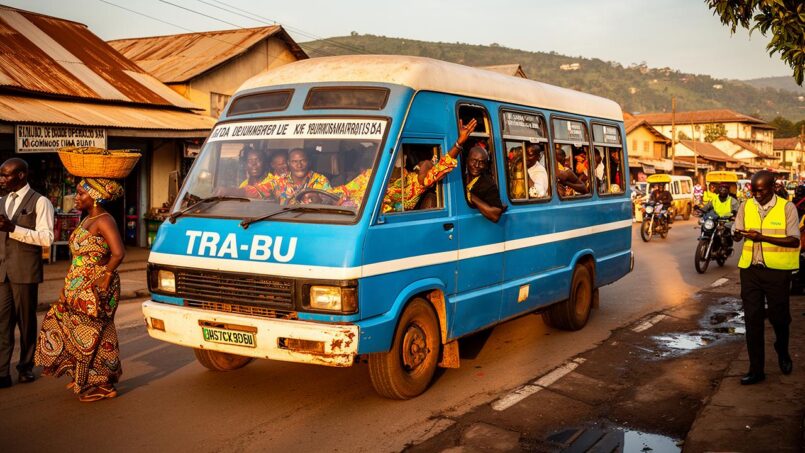
In the capital, the bulk of collective travel is done in private minibuses or midibuses, often Toyota Hiace or Coaster models. They are sometimes called “matatus.” They run on predetermined routes, but without a strict schedule or posted map. The principle is simple: the vehicle fills up at the starting terminal or parking lot, then departs once deemed sufficiently full.
Around the Central Market, the organization of transport vehicles is not intuitive for visitors. Vehicles serving the north of the city usually park near the market entrance, while those heading to southern neighborhoods and suburbs park at the back, near the Interbank. It’s therefore advisable to ask regulars or shopkeepers which line corresponds to your destination.
Urban fares remain low compared to other modes. Within Bujumbura, a minibus trip often costs between 500 and 2,000 Burundian francs depending on distance, equivalent to a few dozen euro cents. The government’s regulatory increase in urban fares (from 380 to 400 BIF for some city trips) hasn’t upended this scale.
The following table gives an order of magnitude, purely indicative:
| Type of urban trip | Most common means | Typical price range |
|---|---|---|
| Short intra-neighborhood distance | Minibus, sometimes taxi | 500 – 1,000 BIF |
| Center – peripheral neighborhood link | Minibus / Coaster | 1,000 – 2,000 BIF |
| Car taxi (short city trip) | Individual taxi | 5,000 – 15,000 BIF |
The trade-off for the low cost is well known: overcrowding, discomfort, unscheduled stops, sometimes rough driving, and very variable mechanical upkeep. Standing, cramped trips are the norm during rush hour. Add to that road safety issues—stops in the middle of the road, doors opening on the traffic side—and petty crime, with pickpocket risks in crowded vehicles.
Moto-taxis, bicycles, and tuk-tuks: fast, practical… but regulated
Another pillar of short-distance travel: moto-taxis, also called boda-boda or simply motos. They are appreciated for their speed and ability to weave through traffic jams. In the peripheral neighborhoods of Bujumbura and in other towns, they are everywhere.
For security reasons, particularly following grenade attacks and numerous accidents, authorities have progressively banned moto-taxis, bicycle-taxis, and tuk-tuks from the heart of Bujumbura. These measures, strengthened in 2022 by the Ministry of Security, now restrict the center to buses, car taxis, and ride-hailing services, relegating other modes to the peripheries.
Bicycle-taxis, meanwhile, remain very present in rural areas and small towns, where they transport people and luggage over short distances. They are cheap and eco-friendly, but slow, and sometimes require dismounting on hills.
Colorful motorized tricycles, an essential complement to urban and peri-urban transport in Indonesia.
Colorful, noisy motorized tricycles, known for their stability in traffic.
Especially common in inland towns and the outskirts of the capital, Jakarta.
Offer more comfort than a motorbike. The fare is between minibus and taxi, to be negotiated before departure.
Car taxis: the choice of comfort and safety, especially at night
In central Bujumbura, especially in administrative and business districts, car taxis are the most direct alternative to buses. They are numerous near hotels, major intersections, and the airport. Urban rides typically cost a few thousand Burundian francs, with a wide margin for negotiation.
Taxis rarely use a meter. The rule is therefore to agree on the price before departure, especially from the airport. Depending on distance and time, the ride between the international airport and the center can be around 15,000 to 20,000 BIF. For short intra-urban trips, amounts often range from 5,000 to 10,000 BIF.
Several local apps are trying to structure this market, such as Wasili or DUMA TAXI. They allow ordering a vehicle from a smartphone, but these services are still far from the reach of Uber or Bolt in other African capitals. As a result, travelers still rely heavily on taxis recommended by their hotel or local contacts.
Intercity connections: minibuses, coaches, and “proboxes”
Leaving Bujumbura for Gitega, Ngozi, Kirundo, or other regional centers usually means going to a bus station or a busy parking lot where intercity departures are organized. Here again, the offer is mainly structured around minibuses, midibuses, and some larger coaches.
Minibuses and midibuses between cities
For domestic connections, it is still Toyota Hiace or Coaster-type vehicles that dominate. They serve almost all major towns and many smaller centers. Since the roads are sometimes long and in poor condition, comfort varies and travel times can be significant, especially since the common practice is to depart only when the vehicle is full, not at a fixed time.
They remain low in absolute value but represent a significant cost for many Burundians.
| Intercity route (examples) | Indicated official fare | Practices observed during crisis |
|---|---|---|
| Bujumbura – Ngozi | 12,500 BIF | Up to 20,000 BIF per passenger |
| Bujumbura – Gitega | 38,000 BIF (full car) | Fuel cost around 80,000 BIF |
Pressure on fuel prices and the multiplication of taxes and fees (parking, technical inspections, licenses, various tolls) push many transporters to deviate from official fares. Cases of massive overcharging have led to police intervention, with buses redirected to the station, heavy fines, and refunds demanded from passengers via mobile money.
A significant portion of intercity travel is also done via shared cars, often five-seat sedans called “proboxes.” Their operation is similar to minibuses: passengers gather at a starting point, the car only sets off when full, then drives directly to the destination without picking up along the way.
These shared taxis are appreciated for their relative speed and, sometimes, superior comfort to an overcrowded minibus. They serve routes such as Bujumbura – Gitega, with regular departures during the day. The fare is higher than a minibus but remains competitive for those who prioritize travel time.
Shared taxi service in Burundi
Large coaches: for long distances and international travel
For the longest connections, especially to neighboring countries, coach companies provide more organized and comfortable services, with numbered seats and tickets to be purchased in advance at the company office.
Several names come up regularly:
| Company | Main routes from Bujumbura |
|---|---|
| Taqwa Coach Bus | Dar es Salaam, Lusaka, Lilongwe via Tanzania |
| Jaguar | Kampala (Uganda), daily service |
| Yahoo Car Express | Kigali (Rwanda) |
| East African Car | Kigali |
| Volcano Express | Kigali, but also domestic lines (Gitega, Kobero, Ngozi, Kirundo, Muyinga) |
| Burugo Travel | Kigoma (Tanzania) |
These companies often offer the best comfort/safety/predictability compromise in the region, but require travelers to adapt to their logic: ticketing at the agency (no reliable online booking), very early departures, strict baggage checks, and sometimes the need to change vehicles at the border, especially for Tanzania or DRC.
The special case of fuel shortages: when everything stops
For several years, Burundi has experienced a chronic fuel crisis. In Bujumbura, this has meant entire weeks where gas stations didn’t open, or only briefly. In June 2024, the situation peaked with a near-paralysis of public transport: empty bus parks, endless lines, residents walking in groups after dark for lack of transportation.
The price of gasoline on the black market was multiplied by 5 compared to the official rate.
During these shortage phases, walking becomes the main mode of travel, even for schoolchildren and entire families. Many residents leave home before dawn to wait for a hypothetical bus for hours, or to cover distances usually traveled by transport on foot. Private vehicles that manage to fill up optimize every trip, pool errands among neighbors or relatives, and limit back-and-forth as much as possible.
For a visitor, this means always checking the fuel situation before planning an intercity trip, and never assuming that gasoline will be found along the way.
Boat transport on Lake Tanganyika: a limited but strategic alternative
In terms of economic exchanges, Lake Tanganyika plays a major role. The port of Bujumbura can handle up to about 500,000 tons of goods per year, and a large part of imports and exports—especially mining products and foodstuffs—transit through waterway connections and then rail or road to Dar es Salaam, Kigoma, Mpulungu, or Uvira.
For passengers, the offer is much more modest. A mixed ferry, the MV Mwongozo, operates rotations between Bujumbura and Kigoma in Tanzania, but services are known for their irregularity and the lack of published schedules. The experience can be memorable, almost timeless, but is not suitable for a tight schedule.
Options break down roughly as follows:
| Type of boat | Primary use | Advantages | Limitations |
|---|---|---|---|
| Ferry like MV Mwongozo | Passengers + regional freight | Large capacity, interesting cost per kilo | Unreliable schedules, slowness, variable comfort |
| Fast speedboats | Passengers | Fast, practical for shorter distances | High price, sensitive to weather |
| Pirogues / small boats | Local short-distance transport | Inexpensive, accessible | Low safety, life jackets often absent |
For any trip on the lake, it is recommended to check for actually usable life jackets and avoid overloaded vessels.
Organization, reforms, and projects: toward a more readable system?
Faced with this fragmented landscape, the Burundian government, with support from international partners, has initiated several reform and planning processes.
A commission proposed a system overhaul, involving sector stakeholders. Avenues include: structuring private operators into cooperatives for the acquisition of large buses, clarifying roles between OTRACO (main lines and underserved areas) and private transporters (local coverage), reorganizing terminals, and renewing the fleet with newer, less polluting vehicles.
In parallel, the “Emergency Study on Urban Transport in Bujumbura” conducted with support from JICA resulted in a master plan for the city: strengthening a north-south axis, creating ring roads around the center, a project for a new coastal road, and redevelopment of major terminals in the north (Carama), south (Nyabaranda), and heart of the city (former stadium). The idea is to organize flows, avoid all buses converging on the same saturated parking lot, and reduce waiting times.
The ATRABU association supports sector reforms but simultaneously calls for road rehabilitation, construction of adequate stations, and better consultation on pricing, given the sharp rise in fuel and spare parts costs.
Still, many of these plans require heavy investments, and the current reality remains dominated by informality, hustling, and the daily trade-offs drivers make just to keep their vehicles running.
Accessibility, safety, and practical tips for travelers
Burundian public transport suffers, as in many Sub-Saharan African cities, from a major blind spot: accessibility. Buses, minibuses, taxis, and motorbikes are almost never adapted for people with reduced mobility. Sidewalks are often degraded, bus stops poorly marked, or even non-existent. For travelers with a disability or mobility difficulties, the most realistic solution remains renting an adapted vehicle with a driver, in coordination with an experienced local intermediary.
On the safety front, several tips emerge from international assessments and practices adopted by NGOs and embassies based in the country:
To get around safely, it is advisable to avoid collective transport at night, even in Bujumbura, and to favor known or recommended taxis. In crowded minibuses, stay alert and keep your phones and wallets securely stowed. In a car, keep windows up and doors locked. Be wary of gatherings, demonstrations, and areas subject to travel restriction advisories. In case of an accident, do not stay if the crowd becomes hostile and head to a police station.
Road checkpoints are frequent and can be conducted by both police and the military. Documents to carry include at least an ID and, for drivers, a valid driver’s license (an international license is recommended) and vehicle papers.
Renting a vehicle or hiring a driver: for whom, how, and at what price?
Given the condition of the roads, sometimes aggressive driving, and lack of signage, most seasoned travelers advise against driving solo, especially on a first visit. The safest and most comfortable option is to rent a vehicle with a driver.
International rental companies are scarce. The offer relies mainly on local agencies and service or travel companies, such as Phoenix Company, which combine transport and trip organization. Another company, General Rental LMT, is mentioned among rental players.
Price range in US dollars per day for renting a 4×4 with driver in Laos, excluding fuel.
The major advantage of a local driver is not limited to driving. They know:
– the actual road conditions and the best routes,
– fuel supply points still stocked during shortages,
– the “invisible” times when transport is scarce (e.g., during lunch break or in the evening),
– informal practices (where to wait for a probox on a given route, how to negotiate without offending, etc.).
For a short stay, this extra cost is largely offset by the time and energy saved.
How to practically use public transport in Burundi
To conclude, it is useful to summarize a few practical reflexes that make life easier within the Burundian system, keeping in mind that every situation remains unique.
First, almost everything is paid in cash. The Burundian franc (BIF) is the reference currency. Drivers rarely have change, especially for small amounts. So plan to have modest denominations. Bank cards are almost never accepted for transport, and ATM withdrawals are made at the official rate, which is less favorable than the unofficial rate offered by street or shop money changers.
There are no strict schedules like ‘9:10 am bus.’ Departures happen in the morning and then according to vehicle fill-up. For both urban minibuses and intercity coaches, it is advisable to arrive early at the departure point to maximize your chances of getting a seat and leaving sooner.
Local habits also play a role. Residents observe lunch break strictly, with many services closing between noon and 2 pm; traffic can slow down as a result. Long-distance walking is rare under normal circumstances, which can draw attention if a foreigner chooses to walk where everyone takes transport. During major holidays, demand skyrockets, fares rise, and tickets become scarce: it’s best to book early for long-distance coaches.
Don’t hesitate to ask Burundians for help. The local culture, based on values of ubumwe and ubuntu, prioritizes mutual assistance. Many residents enjoy conversation and language exchange with visitors. To get information about a route or fare, start with a few greetings in Kirundi or French. This approach often opens the door to detailed explanations and can even lead to spontaneous help, like an improvised carpool.
In summary: an imperfect but living system
Public transport in Burundi is far from the comfort, safety, and readability standards of many capitals. No route map, few public buses, motorbikes banned from the center of the main city, a fuel shortage that periodically paralyzes the entire country. Yet hundreds of thousands of people manage every day to go to work, send their children to school, and visit their families, thanks to an ecosystem of minibuses, shared cars, bicycles, tuk-tuks, ferries, and taxis.
For important trips, prepare carefully (map, identify bus companies, reliable driver, time buffer). For daily trips, accept a degree of improvisation by relying on the kindness and experience of locals. This approach makes travel not only possible but also a privileged gateway into local life.
Disclaimer: The information provided on this website is for informational purposes only and does not constitute financial, legal, or professional advice. We encourage you to consult qualified experts before making any investment, real estate, or expatriation decisions. Although we strive to maintain up-to-date and accurate information, we do not guarantee the completeness, accuracy, or timeliness of the proposed content. As investment and expatriation involve risks, we disclaim any liability for potential losses or damages arising from the use of this site. Your use of this site confirms your acceptance of these terms and your understanding of the associated risks.

Cyril Jarnias is an independent expert in international wealth management with over 20 years of experience. As an expatriate himself, he is dedicated to helping individuals and business leaders build, protect, and pass on their wealth with complete peace of mind.
On his website, cyriljarnias.com, he shares his expertise on international real estate, offshore company formation, and expatriation.
Thanks to his expertise, he offers sound advice to optimize his clients' wealth management. Cyril Jarnias is also recognized for his appearances in many prestigious media outlets such as BFM Business, les Français de l’étranger, Le Figaro, Les Echos, and Mieux vivre votre argent, where he shares his knowledge and know-how in wealth management.





