
 Published on and written by Cyril Jarnias
Traveling across a country five times the size of France without a personal car might seem daunting. Yet, public transportation in Kazakhstan is extensive, affordable and, for those who know how to use it, surprisingly efficient. This practical guide compiles essential information from official reports, NGO studies, and traveler feedback to help you get around both in major cities and from one end of the country to the other.
Understanding the Transportation Context in Kazakhstan
Kazakhstan is the ninth-largest country in the world, with over 2.7 million km² and a low population density. Cities are hundreds, sometimes thousands of kilometers apart. As a result, the country has developed a dense public transport network, primarily focused on rail and long-distance coaches for intercity travel, and buses for urban transport.
Getting around on foot is often impractical due to urban sprawl, uneven sidewalks, and a continental climate with very cold winters and scorching summers. Therefore, it is essential to familiarize yourself with and master the public transport system for your travels.
Another reality to keep in mind: accessibility for people with reduced mobility remains a weak point, despite ambitious legislation. Train corridors too narrow for wheelchairs, buses without ramps or lifts, poorly adapted sidewalks and public buildings… We will come back to this later.
Getting Around the City: Buses, Metro, Trolleybuses, and Marshrutkas
In major cities – Astana, Almaty, Aktau, Aktobe, Shymkent – the core of the system remains the city bus. Depending on the city, this is supplemented by trolleybuses, trams, metro, and private minibuses (marshrutkas).
Urban Networks: A Dense and Inexpensive Web
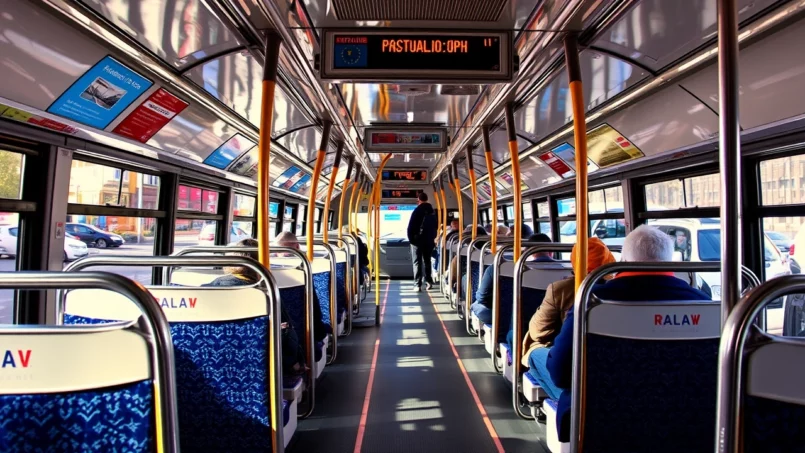
Bus networks are described as reliable in major cities, with services typically running from 6 AM to 10–11:30 PM. Rush hours, between 7 AM and 9 AM in the morning and 5–7 PM in the evening, are very crowded; the heat inside vehicles can become oppressive in summer.
Fares remain extremely low by European standards. In most cities, a bus or trolleybus ride costs between 80 and 150 tenge (approximately 0.20 to 0.35 USD). The difference between cash payment and transport card payment can be significant, as seen in Almaty.
| Type of Urban Trip (examples) | Payment Method | Indicative Fare (₸) |
|---|---|---|
| Standard bus in a major city | Card / electronic system | 80–110 |
| Standard bus in a major city | Cash on board | 150–220 |
| Almaty Metro – single trip | Card / token | 80–120 |
| Bus + metro Almaty – unlimited monthly pass | ONAY Card (Almaty) | 7,200–7,500 |
In practice, using a transport card or a mobile app is increasingly essential, while paper tickets are gradually disappearing, particularly in Almaty where cash payment on board has been eliminated for security reasons.
Almaty: Buses, Metro, and Trolleybuses at the Foot of the Mountains
The former capital and largest city in the country, Almaty is also the national laboratory for mobility.
The city has a public transport network consisting of 88 bus lines and 8 trolleybus lines.
Recent data gives an idea of the system’s scale:
| Indicator (Almaty) | Recent Approximate Value |
|---|---|
| Daily bus trips (2022) | 1.4 million |
| Share of trips by public transport + active modes | ≥ 59% of trips |
| Number of subsidized regular urban/suburban lines (2022) | 159 |
| Annual subsidies bus + trolleybus (end 2021) | ~45.4 billion ₸ |
| Annual subsidies metro (end 2021) | ~4.5 billion ₸ |
The Almaty Metro
Almaty is currently the only city in the country with an operational metro. It is a single east-west line, modernized, air-conditioned, and known for the architectural quality of its stations.
The metro has 11 stations over approximately 13.4 km. The first section opened in 2011 with 7 stations, two more were added in 2015, and another two in 2022. New extensions are being prepared, with the goal of connecting the line to major bus (BRT/LRT) interchange hubs and park-and-ride facilities.
Operating hours are extensive: from 6:20 AM to midnight. Frequency is around 10 minutes on weekdays, 13 minutes on weekends. Ridership has exploded in a decade, increasing from about 30,000 passengers/day to 70,000 and then 85,000 in 2023. A future extension to the Kalkaman district and the West bus station is planned.
For the traveler, the metro has two major advantages: cleanliness and safety. On the other hand, its coverage remains centered on the city center and does not yet reach the southern districts popular with tourists (hotels, restaurants, bars). Therefore, it is often necessary to combine metro with bus or taxi.
The ONAY Card and Payments
Almaty uses the ONAY electronic system for all its buses, trolleybuses, and metro. The plastic card costs around 400–500 tenge, often with an initial trip included. Travelers can also create a virtual card in the ONAY app, linked to a bank card.
Overview of typical prices for common goods and services in Almaty, Kazakhstan. These rates are average indicators and may vary.
Bus/metro ticket: ~90 KZT (0.18€) | Taxi (short ride): ~500-700 KZT (1-1.5€)
Budget meal: ~1500 KZT (3€) | Meal for two at a mid-range restaurant: ~10000 KZT (20€)
Monthly rent (studio, city center): ~150,000-250,000 KZT (300-500€) | 3-room apartment (outside center): ~200,000-350,000 KZT (400-700€)
Cappuccino: ~700 KZT (1.4€) | Milk (1L): ~450 KZT (0.9€) | Bread: ~150 KZT (0.3€)
| Product / Payment Method | Indicative Fare (₸) | Key Details |
|---|---|---|
| Bus trip paid with prepaid card | 110 | Reduced price vs. cash |
| Bus trip paid in cash (before elimination) | 220 | More expensive, now eliminated in the city |
| Metro trip – single ticket | 100–120 | Token or ONAY card |
| ONAY paper ticket (single trip) | 150 | Must be requested from the driver |
| Unlimited monthly bus + metro pass | 7,200–7,500 | Drivers and inspectors accept ONAY |
For the visitor, two constraints: first, the ONAY app requires a Kazakh phone number for registration; second, many top-up terminals or local banking apps assume the possession of a Kazakh bank account and a national identification number (IIN). Tourists usually manage by purchasing a physical card and topping it up via Qiwi or Kassa24 terminals with cash.
Astana: A Massive Bus Network and an Announced LRT
In the capital, city buses handle the majority of trips. Over one million passengers use Astana’s buses daily, and ridership reportedly increased by nearly 37% recently. The city has deployed about 140 km of dedicated bus lanes, with an additional 30 km planned.
Astana has also launched a Light Rail Transit (LRT) project intended to relieve congestion on major arteries (Kaldayakova, Syganak, Kabanbai Batyr) in the Esil and Nura districts. Trains have begun testing, stations are being finished, and commercial operation is promised in the near term. The stated goal: reduce traffic jams and structure bus-LRT connections around future interchange hubs.
The price of a bus ticket in Astana, in tenge, according to sources and fare changes.
Marshrutkas: Private Minibuses with Variable Reliability
Marshrutkas – minibuses with 15 to 30 seats – complement the official network in small towns, suburbs, and for medium-distance intercity trips. They depart from bus stations (avtovokzal), but can also be hailed by the roadside.
Their operation is more informal: some routes follow an approximate schedule, others only leave when they are full. Fares remain low, often in the same range as a regular bus, but service quality is random: little legroom (especially over the rear axles), heat, music chosen unilaterally by the driver, no real passenger information.
For short intercity trips – for example between Astana and Karaganda – these minibuses remain a popular solution, especially when trains are full or infrequent.
Trams, Trolleybuses, and Other Urban Networks
Beyond the two metropolises, a few electric networks remain. Pavlodar operates an 86 km tram network, representing about 60% of local transport, with around twenty lines. Temirtau has two tram lines. Ust-Kamenogorsk (Oskemen) and Almaty once had tram networks, closed in 2018 and 2015 respectively.
Trolleybuses remain in Almaty and Shymkent, offering a slightly more eco-friendly alternative to diesel buses. Overall, however, diesel or compressed natural gas (CNG) buses remain the workhorse of urban transport.
Tickets, Cards, and Apps: How to Pay for Your Trips
Kazakhstan has switched very quickly to electronic ticketing. Alongside local cards (ONAY in Almaty, systems inspired by Avtobys in many cities), mobile applications play an increasing role.
The ONAY and Avtobys Systems
ONAY is specific to Almaty, while Avtobys functions as an electronic wallet and validation system in many cities: Aktau, Aktobe, Astana, Atyrau, Pavlodar, Semey, Shymkent, Zhezkazgan, but also Osh in Kyrgyzstan. A transport card registered with Avtobys can be used in all cities where the system is deployed.
Important nuance: the app balance and the physical card balance are separate. When topping up via a terminal (Kassa24, Yurta, Qiwi) or online banking (Kaspi, Sberbank, Eurasian Bank, ForteBank, Halyk, etc.), be sure to check which medium (app or card) the credit is added to.
In case of loss of an Avtobys card, the holder can have it blocked via support, then transfer the balance to a new card – provided it was previously registered in their name.
Subsidies and Discounts: Who Travels at a Reduced Fare?
The Kazakh system provides targeted discounts, especially in Almaty, for several categories:
– free travel on the urban network (excluding taxis) for war veterans and equivalents, pensioners over 75, disabled persons of groups I and II, and disabled children;
– 50% discount for students over 15, full-time university students, age-based retirees, mothers of large families (at least four children under 18).
In Almaty, a special card allows non-resident schoolchildren aged 7 to 15 to benefit from half-fare on transport. Significant discounts also apply on rail travel for several categories: disabled persons, seniors, youth, mothers of large families, and war veterans. These benefits are accessible via specific cards such as Zhastar, Kurmet, Kamkor, Ardager, and Ardakty ana.
Practical Problems for Tourists
For a foreign visitor, the main pitfall is the imperfect integration of temporary travelers into a system designed first for residents: apps requiring a Kazakh number, sometimes a local bank account and ID number, terminals only accepting cash or local cards, rarely translated interfaces.
Many foreign travelers report some frustration, even a sense of a system that is “too digital” but not very open. A pragmatic solution is to purchase a physical transport card, top it up with cash at a terminal, and keep it carefully, having some change on hand for the rare situations where cash payment is still possible.
Trains: The Backbone of Long-Distance Travel
With over 16,600 km of railway lines (of which just over 4,200 km are electrified), rail structures long-distance travel. The lines serve more than 57% of the territory, which, on the scale of such a vast country, is considerable.
The network uses the Russian gauge of 1,520 mm. The national operator Kazakhstan Temir Zholy (KTZ) oversees most of the traffic, with several subsidiaries and private operators. Rail accounts for about 68% of passenger and freight traffic and carries over 14 million passengers annually.
Types of Trains and Comfort Classes
Kazakhstan combines modern Talgo-type trains, fast and more expensive, and classic trains of Soviet heritage, slower but very affordable.
Notable distinctions include:
– fast Talgo trains (average speed around 130 km/h) with Grand class (2 berths + shower/toilet), Business (2 berths), Tourist (4 berths);
– classic trains with Lyux or SV cars (2 berths), Kupé (compartments of 4 berths), Platzkart (open dormitory with berths), or seated cars (Obshy).
All passengers receive bedding, a pillow, and a blanket for overnight trips. Lower berths are highly sought after, as they allow comfortable sitting during the day and offer more space for luggage under the bed. It is not uncommon for them to be reserved over a week in advance on busy lines.
The price of a first-class sleeper ticket for a 15 to 20-hour journey between Astana and Almaty.
Booking and Buying Tickets
Tickets can be booked in several ways:
– online, via the official site bilet.railways.kz (with English interface) or private platforms like Tickets.kz, Aviata.kz, Chocotravel.kz, Tutu.ru;
– at train stations, at ticket offices;
– at licensed agencies or via machines.
Tickets for China are an exception: they are generally only sold at agencies, due to complex border procedures. Another nuance: departure times are displayed in Astana local time, which complicates conversion for the western part of the country, which is one hour behind.
At stations, staff rarely speak English, and payments for some international connections may only be accepted in cash. Online, it is sometimes possible to use a foreign bank card, but not all platforms accept them.
Given the popularity of overnight trains and seasonality (holidays like Nauryz, summer), booking at least a week in advance is highly recommended. For those aiming for a lower berth in a compartment, booking even earlier is prudent.
Experiencing a Train Journey: From Samovar to Dining Car
The Kazakh train experience is part of the journey. On long trips, a dining car serves Central Asian specialties (plov, laghman, etc.) and drinks. Each car has a samovar – a supply of boiling water – for making tea or instant noodles. Vendors regularly board the train or wait on the platform to offer fruit, snacks, drinks.
On classic trains, toilets are locked approximately 15 minutes before and after each station stop. This constraint is less on modern Talgo trains. Power outlets are available but do not always work; it is advised to bring an external battery. The atmosphere is generally friendly, with a frequent custom of sharing food with compartment neighbors.
Regarding luggage, most travelers slide suitcases and bags under the lower berths. Regulations allow for a significant volume of checked baggage (up to 200 kg), rarely used by tourists. Dismantled bicycles are in principle accepted if properly packed.
Main Domestic and International Routes
Major railway arteries structure the country: Astana–Almaty, Astana–Shymkent, Almaty–Shymkent, but also connections from Karaganda, Atyrau, Aktobe, Pavlodar, or Kostanay. A direct Almaty–Astana takes about 11 to 14 hours by fast train, much longer by classic train (up to over 20 hours depending on stops). Other emblematic journeys: Nur-Sultan–Petropavl (just over 6 hours), Pavlodar–Aktobe (over 40 hours).
Some railway lines inherited from the Soviet era briefly pass through Russian territory. This may require a Russian transit visa, even for trips internal to Kazakhstan. It is essential to check this point carefully when purchasing your ticket.
The Almaty–Ürümqi train link was suspended after the pandemic, although sleeper buses still run between Almaty and Ürümqi and a bus also connects Almaty to Yining.
Rail Accessibility for Persons with Disabilities
On paper, Kazakh regulations set precise requirements for adapted cars: minimum corridor widths, wheelchair spaces facing forward, level floors in dedicated areas, wheelchair restraint systems, audible and visual signaling activatable from reserved seats, etc. The national plan aims to increase the number of specialized cars for disabled persons, for example from 98 to 122 by 2022, and all trains are supposed to have wheelchairs on board and trained staff.
In practice, the reality is more nuanced. A report highlights that 57% of tracks are worn and adapted cars remain a minority. The NGO “Accessible Kazakhstan” and other organizations point to a gap between standards and their real-world application.
For travelers with reduced mobility, it is therefore highly recommended to:
– state your needs when booking;
– prioritize trains with adapted cars;
– consider a two-berth compartment (more expensive but more manageable);
– travel with a companion if possible, or use a taxi or private transport service between station and accommodation.
Intercity Buses, Marshrutkas, and International Connections
For medium distances or when trains are not practical, intercity buses take over. Kazakhstan has 33 main bus stations and 114 secondary ones. According to authorities, 32 stations and 98 bus stops meet accessibility requirements, although NGOs sometimes contest the reality of these figures.
Long-Distance Coaches
Coaches provide links between almost all towns and cities. In Almaty, the large Sayran bus station serves most distant destinations: Bishkek (5 hours), Taraz (8 hours), Shymkent (13 hours), Karaganda (18 hours), Astana (20 hours), Taldykorgan (4 hours), Oskemen (over 20 hours), etc. Another station, Sayakhat, focuses on shorter trips.
For a bus journey between Almaty and Astana, the duration is about 17 to 20 hours. The price ranges between 10,000 and 20,000 tenge, depending on comfort level (standard coach or more comfortable ‘VIP’ bus, sometimes air-conditioned and heated), timing, and demand.
An important point: schedules for some routes are irregular or vary by day. Some lines have a few daily departures, others where buses leave only when full. Checking at the station the day before remains the safest method.
International Bus Connections
Kazakhstan’s position on the “New Silk Road” and at the heart of Central Asia is reflected in the international bus offerings:
– comfortable coaches between Almaty and Bishkek (Kyrgyzstan), about 4 to 5 hours;
– buses Almaty–Yining (China), around 10 hours journey;
– sleeper buses between Almaty and Ürümqi (capital of Xinjiang);
– connections to Tashkent (Uzbekistan) complementing Talgo trains.
Border controls can significantly lengthen journey times. However, many nationalities can now enjoy a 14-day visa-free stay in China, increasing the appeal of these overland connections.
Intercity Minibuses: Flexibility vs. Comfort
As in cities, marshrutkas provide a fine network between medium-sized towns, villages, and metropolises. They are popular for trips such as Astana–Karaganda. However, the lack of reliable scheduling and limited comfort make them a choice reserved for travelers flexible on timing and not particular about personal space.
To limit unpleasant surprises, it is better to:
– avoid, if possible, seats over the wheels (reduced legroom);
– check at the station for the first departure time and frequency;
– keep your valuables bag with you rather than in the luggage compartment.
Taxis and Ride-Hailing Apps: Yandex Go and InDrive
Taxis are omnipresent in Kazakh cities, whether official drivers, private cars acting as taxis (“gypsy cabs”), or ride-hailing services. Fares are generally very reasonable, making them a choice solution to complement public transport use, especially in the evening, in snow, or when carrying luggage.
Yandex Go, the Essential App
Yandex Go is by far the most used app, resulting from the merger of Uber with the Russian group Yandex in the region. It is available in English and allows:
Discover the main features available to plan and manage your trip with ease.
Benefit from a fixed and transparent price before departure, with no unpleasant surprises.
Track your vehicle’s position in real-time throughout your trip.
Select the service that suits you: Economy, Comfort, Comfort+, Business, or Minivan.
Pay for your ride according to your preference, in cash or by bank card.
In practice, some foreign users struggle to validate their international cards, and Apple Pay is not systematically accepted. A simple way to overcome the language barrier is to enter the address in Cyrillic; the app does not always accept Latin characters for destinations.
Yandex Go is not limited to taxis: it is also used for package delivery, food ordering, even scooter rentals, and can display the real-time position of some buses.
InDrive and Other Services
InDrive (formerly InDriver) works on a different model: the user proposes a price and drivers decide to accept, negotiate, or refuse it. This system is appreciated for longer trips or peak hours, where classic pricing algorithms can surge. Services like Maxim Taxi also operate in smaller cities.
Uber and Lyft ride-hailing services are not available in Kazakhstan. For similar travel, it is recommended to use the Yango app, a version of the Russian Yandex Taxi service, which is registered in the Netherlands and offers equivalent features.
Typical Fares and Common Rides
The base fare for a city taxi is around 400–600 tenge, with a per-kilometer rate between 150 and 300 tenge. In practice, a short ride often costs between 500 and 1,000 tenge (1–3 USD).
A few standard trips give an idea of the scale:
| Taxi Trip (examples) | Price Range (₸) |
|---|---|
| Short ride within a city (Almaty or Astana) | 500–1,000 |
| Astana Airport → city center | 3,500–4,500 |
| Almaty Airport → city center | ~2,500 |
| Almaty → Shymbulak ski resort | 2,100–4,000 (per trip) |
Private transfers, pre-booked via specialized platforms, are significantly more expensive – about 9,000 tenge per hour, or 180,000–300,000 tenge for an Almaty–Astana car with driver – but interesting for small groups seeking maximum flexibility.
Airports, Shuttles, and Domestic Flights
To cover the enormous distances between major cities, air travel remains unbeatable in terms of journey time. The country has 132 airports, including major international hubs in Astana, Almaty, Shymkent, Atyrau.
An Almaty–Astana flight takes about 1 hour 40 minutes, compared to 11 to 20 hours by train and up to 20 hours by bus. Price-wise, tickets typically range between 20,000 and 65,000 tenge depending on season, airline, and booking lead time. Air Astana and its low-cost subsidiary FlyArystan dominate the market, with SCAT Airlines and Qazaq Air as complements.
Since the lifting of European restrictions in 2016 and a positive ICAO audit in 2021 (84% compliance, 15% above the global average), the country’s aviation safety is considered adequate.
Airport Shuttles
The two major metropolises offer regular bus services from their airports:
– Almaty: buses between 6 AM and 9 PM to the city center, for a very low fare compared to taxis;
– Astana: buses from 6 AM to 11 PM to the center.
Local transport (bus, metro) are the most economical options but require understanding the local payment system (ONAY, Avtobys cards…). Note: free Wi-Fi is often unavailable without a local SIM card, complicating taxi booking via app. Mobile operator booths in the arrival hall can be useful for getting a connection.
Counters for “official” taxi companies exist at Astana and Almaty airports, with card payment, but rates are higher than with Yandex.
Accessibility: Between Ambitious Standards and a Difficult Reality
For several years, Kazakhstan has shown a willingness to make its transport more inclusive. The country ratified the UN Convention on the Rights of Persons with Disabilities in 2015, adopted a law on social protection for persons with disabilities, and integrated the notion of “reasonable accommodation” into a National Plan until 2025.
Detailed technical rules govern adapted buses (aisle widths, ramps or lifts, wheelchair spaces, horizontal bars, audible and visual signaling, requirement for suitable doors, etc.) and mandate that at least one taxi in 30 in large fleets be accessible. A specific service, Invataxi, offers free trips for wheelchair users (groups I and II) to get to work, school, hospitals (excluding emergencies), or government offices, with over a hundred local services and several hundred vehicles funded by public contracts.
Worrying Statistics
Despite this framework, the figures remain concerning. Over 696,000 people with disabilities live in Kazakhstan, a significant proportion of the population, split roughly evenly between city and countryside. It is estimated that at least 40% of the population needs an accessible environment, including the elderly, parents with strollers, etc.
Only 30% of the over 10,600 urban buses in France meet accessibility requirements.
Authorities mention “adaptation” rates of nearly 98% for certified infrastructure, but citizen surveys like the “Accessible Kazakhstan” project tell a different story. In Ust-Kamenogorsk, for example, out of 3,200 establishments assessed, only 11 were deemed accessible to wheelchair users, 10 to the hearing impaired, and none to the visually impaired. In Shymkent, many pharmacies have ramps that are too steep, thresholds too high, doors too narrow. Pavlodar is touted as a model, but a field study found only one accessible building out of 24 examined.
| Accessibility Indicators (selection) | Value / Observation |
|---|---|
| Persons with disabilities (2021) | > 696,000 |
| Estimated share of population needing accessibility | ≥ 40% |
| Official rate of “adapted” objects (certified) | ~97.9% of 24,939 certified sites |
| Urban buses meeting requirements | ~30% of 10,623 buses |
| Invataxi services | 119 services, 375 vehicles (past data) |
NGOs highlight several causes: lack of effective control, weak accountability for violators, incompetence of some designers, absence of accessibility expert training in universities, and contradictions between official data and users’ lived experience.
Strategies for Travelers with Reduced Mobility
Concretely, a visitor in a wheelchair or with significant limitations would do well to:
To facilitate your travels in Kazakhstan, prioritize private transport (like Yandex Go, transfers, or a driver with a car). Book trains with adapted cars and state your disability when booking. Use Invataxi services if you are eligible and they are available. Finally, preferably choose cities rated better on the ‘Accessible Kazakhstan’ map, like Pavlodar, though accessibility there remains limited.
For other groups – seniors, parents with strollers, travelers with heavy luggage – anticipate uneven sidewalks, stairs without handrails, buses without low floors, especially outside major capitals.
Practical Tips, Safety, and Culture in Transport
Beyond purely technical aspects, using transport in Kazakhstan is also a cultural immersion and requires respecting a few simple codes.
Recommended Behavior in Transport
Kazakh society is very respectful of elders. On buses, metro, or trains, giving up your seat to an older person, a pregnant woman, or a person with a disability is expected. Priority seats should not be occupied by able-bodied individuals when these passengers board. Generally, avoid talking loudly on the phone, especially in overnight compartments.
Backpacks should not block an entire seat when the bus is full. Let older people board and exit first. This attention to hierarchy and respect is found everywhere and helps you integrate more easily.
Safety and Minor Scams
Public transport is generally safe, but crowds attract pickpockets, especially on crowded buses, in stations, and at markets. It is recommended to:
For safe travel, it is recommended to keep your documents and money on you in a hard-to-reach pocket, lock your train compartment door at night, prefer ATMs inside banks rather than on the street, and avoid unofficial taxis, especially at night, always agreeing on a price before getting in.
Assaults remain rare but do occur, especially late at night near bars and clubs. At airports and stations, unlicensed drivers may approach tourists with rates up to five times the normal fare. The safest reflex: order via Yandex Go or use official taxi stands, even if they are a bit more expensive.
Road Conditions and Driving
For those considering car rental, a few realities deserve mention: roads sometimes very degraded off major highways, stray animals, aggressive local driving, rare gas stations in remote areas, dangerous winters (snow, ice, blizzards). Authorities also acknowledge the existence of sometimes “creative” police checks, with requests for bribes from foreigners.
For excursions outside cities, like into the steppes, desert plateaus, or mountains, a 4×4 vehicle is essential. It is often simpler and safer to hire a local driver, who is familiar with the tracks and the habits of law enforcement.
When to Prioritize Which Mode of Transport?
For solo travelers staying in a major city like Almaty or Astana, the combination of public transport + taxis/apps is largely sufficient, simple, and economical. For a couple or small group wishing to explore the surroundings (lakes, canyons, ski resorts), car rental can become more interesting financially and in terms of freedom, provided you accept the road risks.
For long journeys between major cities, the overnight train offers the best balance between cost, comfort, and cultural experience, especially by choosing sleeper classes. Air travel, however, takes the advantage when time is limited.
Finally, in truly remote areas – national parks, high plateaus, mountain valleys – it is often a combination of car with driver + horse that is required, with daily packages including guesthouse accommodation and full board.
Conclusion: Making the Most of Public Transport in Kazakhstan
From the brand-new metro of Almaty to overnight trains crossing endless steppes, from rickety marshrutkas to the LRT and BRT of the capital, public transport in Kazakhstan paints a picture of a country in transition: rapid modernization, advanced digitization, but also glaring delays in accessibility and infrastructure outside major axes.
For the informed traveler, these systems offer tremendous potential. Fares remain low, coverage is wide, and digital tools – Yandex Go, Avtobys, ONAY, Tickets.kz, 2GIS – increasingly facilitate trip planning.
For a successful stay, plan your itinerary by understanding the transport card and app systems, and book your trains in advance. Have some cash on hand for situations where electronic payment is not possible. Respect local courtesy codes and anticipate long distances and the harsh climate.
In return, letting yourself be carried by these networks, sharing a scalding tea in a railcar across the plains, negotiating the price of an InDrive trip, or riding a tram in Pavlodar, is to touch a living, everyday Kazakhstan, far from standardized tourist circuits – and that is undoubtedly where the true interest of its public transport lies.
Disclaimer: The information provided on this website is for informational purposes only and does not constitute financial, legal, or professional advice. We encourage you to consult qualified experts before making any investment, real estate, or expatriation decisions. Although we strive to maintain up-to-date and accurate information, we do not guarantee the completeness, accuracy, or timeliness of the proposed content. As investment and expatriation involve risks, we disclaim any liability for potential losses or damages arising from the use of this site. Your use of this site confirms your acceptance of these terms and your understanding of the associated risks.

Cyril Jarnias is an independent expert in international wealth management with over 20 years of experience. As an expatriate himself, he is dedicated to helping individuals and business leaders build, protect, and pass on their wealth with complete peace of mind.
On his website, cyriljarnias.com, he shares his expertise on international real estate, offshore company formation, and expatriation.
Thanks to his expertise, he offers sound advice to optimize his clients' wealth management. Cyril Jarnias is also recognized for his appearances in many prestigious media outlets such as BFM Business, les Français de l’étranger, Le Figaro, Les Echos, and Mieux vivre votre argent, where he shares his knowledge and know-how in wealth management.





