
 Published on and written by Cyril Jarnias
Leaving your country, your language, your habits to settle in Lebanon—whether in Beirut, Tripoli, Jounieh, or a mountain village—can be both exciting and unsettling. For many expats, students, humanitarian workers, or members of the diaspora who “return” without ever having really lived there, homesickness is not the exception but almost the rule. International studies estimate that between half and three-quarters of people who move abroad experience a deep longing for their “home” at some point.
Good to know:
In the Lebanese context marked by economic crisis, fragile infrastructure, political tensions, and cultural distance, homesickness can be intense. However, it is possible to transform this stay into a structuring and even healing experience by adopting concrete strategies.
Understanding homesickness to better tame it
Homesickness is not a whim, let alone a personal failure. Researchers describe it as a normal psychological reaction to the loss of familiar bearings. You suddenly leave places, people, and routines that defined you. Result: the brain desperately seeks to regain that feeling of security.
Example:
Cultural shock manifests on several levels. Emotionally, it can lead to sadness, irritability, a feeling of emptiness or loneliness. Cognitively, it is characterized by recurring thoughts and idealization of the home country, constant comparisons, and a negative view of the new environment. Physically, the body expresses this malaise through fatigue, sleep disorders, headaches, muscle tension, or digestive issues.
Studies show that these symptoms sometimes appear from the start, but they are often strongest after a few weeks or months, once the initial phase of euphoria has passed. Among expats, up to 70% report experiencing this type of discomfort in the first year. Knowing it is common, universal, and documented already helps to defuse the situation. You are neither “too sensitive” nor “not strong enough”: you are human.
The specific challenge of Lebanon: love, chaos, and contradictions
To manage this homesickness, you also need to understand the environment you are stepping into. Lebanon is not a “neutral” destination. It is a country marked by a deep economic crisis since 2019, a history of conflicts, divisive political life, and strained infrastructure.
Attention:
Despite failing infrastructure (electricity, internet, banking system) and a dollarized economy forcing cash use, a dynamic social and commercial life—embodied by trendy cafés, luxury spas, and nightclubs—persists and seems to evolve in parallel with the crisis.
This duality—private beach and extreme poverty, rooftop party and gas station lines—can create a moral shock for a newcomer. Add to that the fact that society largely operates on the “wasta” system (networks, connections), which can make you feel doubly foreign: foreign to the country and foreign to the social codes.
Homesickness, in this context, often takes the form of a feeling of uprootedness: you do not yet feel integrated in Lebanon, but you no longer have a foothold in your home country either. Hence the importance of rebuilding reference points.
Building a solid routine to regain stability
In an environment as shifting as Lebanon, establishing a routine becomes an act of psychological protection. Psychologists explain that a structured daily life reduces mental load, provides a sense of control, and facilitates cultural adaptation. Concretely, it begins with a few simple elements: wake-up time, meal times, bedtime, dedicated slots for work, exercise, outings, and rest.
Good to know:
To ease the transition in a new environment, create a consistent morning ritual that links your old life to the new one. It could be a simple moment like having coffee while listening to local sounds, writing in a journal, or a short walk to observe daily life. This daily anchor helps your brain adapt by starting each day with a familiar element in a new setting.
An “evening ritual” plays the same role in calming the nervous system: reading, meditation, a warm shower even in generator mode, some stretching, soft music. In a country where electricity can cut out, these rituals also teach you to embrace the unexpected without tipping into anxiety.
To stay on track, many specialists suggest visually displaying this routine (on the fridge, above the desk), even modifying it over the weeks. The goal is not rigidity, but predictability: even if everything changes outside, certain pillars remain stable.
Taking care of your body to protect your mind
When facing homesickness, we often underestimate the role of the body. Yet public health data is clear: regular physical activity, sufficient sleep, and a balanced diet are major factors in emotional resilience.
International recommendations suggest about 150 minutes of moderate physical activity per week. In Lebanon, this can take very concrete forms: climbing the steep streets of Gemmayzeh on foot, walking the Corniche every evening, joining a local gym or yoga class, hiking in the Chouf or the Qadisha Valley.
7 to 9
That’s the number of hours of sleep per night most adults need, according to the National Sleep Foundation.
On the nutrition side, many expats fall into two extremes: either consuming massive amounts of imported, expensive “comfort food”, or the opposite: a highly disorganized diet of snacks and late deliveries. Yet Lebanese cuisine, if you practice it “home-style” rather than endless banquet version, is an ally: vegetables, legumes, olive oil, seasonal fruits, reasonable amounts of meat.
Tip:
The neighborhood market can become a wellness tool, beyond its shopping function. Drawing on research about the gut-brain connection, which shows that microbiome balance influences mood, it is beneficial to prioritize fresh, local produce. To stabilize emotions, it is also advisable to limit excess sugar and alcohol, and to stay well-hydrated by drinking at least 2 liters of water per day, especially during hot weather.
A “food emergency plan” for tough days is useful: knowing which simple dishes (lentil soup, a plate of rice and vegetables, a light homemade mezza) comfort you without weighing you down avoids the junk food + guilt combo that fuels unease.
Using the power of social networks… without getting lost
Lebanon is paradoxical: its internet infrastructure is fragile, but the population is massively connected. With about 1.8 million Facebook users out of roughly 4 million residents, the country is among the most active in the Middle East. WhatsApp, in particular, has become the basic communication tool, especially since regular phone calls remain very expensive.
Good to know:
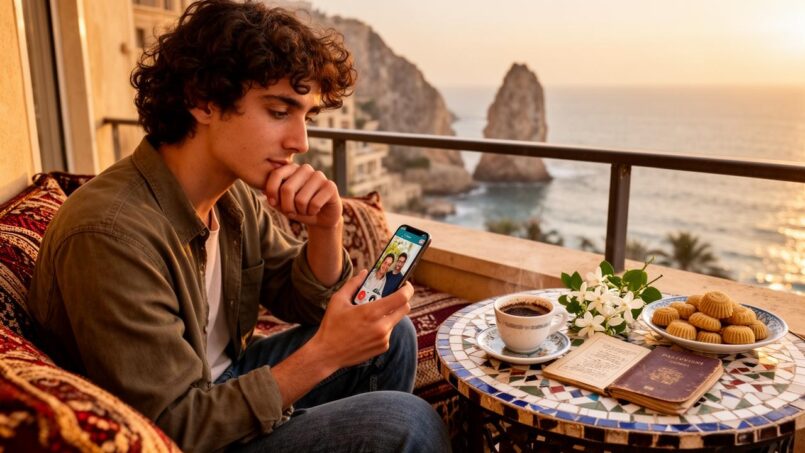
For expatriates, digital communication tools (video calls, voice messages, WhatsApp groups) allow frequent contact with family and friends back home. According to a survey, this practice significantly reduces feelings of disconnection and nostalgia among the vast majority of international travelers.
On the other hand, time zone differences, constant comparison via social media, and the “fear of missing out” on what is happening back home sometimes fuel frustration. Scrolling through Instagram feeds of birthdays, weddings, parties where you are no longer physically present can reinforce the feeling of exclusion.
Tip:
For beneficial use of social networks, it is advisable to plan and limit your online time. For example, set a weekly video call with family and join common discussion groups, while deciding to limit “doomscrolling” and time spent watching others’ stories. A good benchmark: each connection should ideally make you feel good, reassure you, or energize you. If you consistently feel sadder after an online session, that’s a sign to rethink how you use these tools.
Staying connected to loved ones without getting stuck in the past
To turn these long-distance ties into real support rather than a constant reminder of what you have lost, several small strategies work well. Instead of only exchanging about difficulties, many benefit from also sharing their discoveries: photos of a Tripoli souk, a video of a sunset over Jounieh Bay, an audio recording of a street vendor shouting. The goal is to invite your loved ones into this new reality, not just keep them posted on your state of mind.
Creating shared memories at a distance
Ideas and tools to plan synchronous, shared moments to strengthen bonds despite geographic separation.
Watch a movie together
Use a shared viewing app to watch a movie or series at the same time, as if you were side by side.
Cook via video call
Prepare the same recipe during a video call to share a fun, creative moment at a distance.
Celebrate a birthday
Celebrate a birthday or special event via video conference to be present despite the distance.
Organize with a calendar
Use a shared calendar to easily plan these meetings and schedule them in your respective agendas.
Choose the right tool
Opt for free and accessible video conferencing tools to facilitate real-time connection.
Manage time zones
Remember to check and adjust for time zone differences to find a suitable slot for everyone.
In the other direction, encouraging your loved ones to visit you in Lebanon, when the situation allows, radically changes your relationship with the host country. The day you show a parent or friend the Corniche, the alleys of Byblos, or a small neighborhood restaurant, it is no longer just “your exile,” but a shared place. Many people describe this moment as a turning point in how they experience expatriation.
Creating a “chosen family” in Lebanon
All research on mental health converges: the quality of social bonds protects against anxiety, depression, and trauma. In Lebanon, where the biological family is central, arriving alone can be intimidating. But the culture of conviviality and the importance of networks also make meeting people easier than in other countries, provided you dare to take the step.
Good to know:
Platforms like InterNations and social media groups offer expats an initial social circle, organizing various activities (parties, hikes, themed events) to combat initial isolation. However, limiting yourself exclusively to these circles can maintain a constant feeling of homesickness and create a social bubble disconnected from local life.
The challenge is therefore to build a hybrid network: compatriots or other foreigners with whom you share the same expat experience, and Lebanese people who open doors to local society. Several channels work particularly well for this: coworking spaces, Arabic language classes, sports clubs, hiking groups, volunteering with local NGOs.
In Lebanon, civil society is very active despite the crises. Small organizations have learned to use social media and digital tools to mobilize, inform, and launch campaigns. Spending a few hours a week with an association in Beirut, Tripoli, or the Bekaa is both a way to be useful, understand the country deeply, develop your Arabic vocabulary, and build relationships that go beyond simple “networking.”
The key role of language in feeling less foreign
Lebanon is officially Arabic-speaking, but the linguistic reality is much richer. A large part of the population also speaks French and/or English, especially in cities and among educated circles. Young people often switch between all three languages within the same sentence: “Hi, kifak, ça va?” is a typical greeting. For a newcomer, this flexibility greatly eases the first months.
Why learning a little Lebanese changes everything
Even if many Lebanese will answer you in English or French, learning a few phrases of the Lebanese dialect makes an immense difference psychologically. Saying “marhaba” instead of “hello,” “kifak/kifik?” for “how are you?,” “shukran” to say thank you shows that you are making an effort toward the other. Sociolinguistic studies emphasize that mastery—even limited—of the dominant dialect in an urban space strengthens the feeling of belonging.
Good to know:
The Levantine Institute of Tripoli (LEVIT) offers, beyond language courses, an ecosystem integrating cultural activities (debates, music, cooking) and volunteering opportunities with local NGOs. This comprehensive framework, located in the Zehrieh district, is ideal for learning, being useful, building a network, and thus reducing homesickness.
Managing language frustration
Even in a trilingual country, language remains a source of frustration at first: misunderstanding in a taxi, mix-ups at a supermarket, administrative papers in Arabic. Recognizing that this frustration is a classic trigger of homesickness helps put it in perspective. Researchers insist on the idea that you should not interpret every misunderstanding as proof that you “will never make it,” but as a normal part of the “cultural shock” phase.
Example:
To limit the emotional impact of communication mishaps, it is helpful to prepare a few backup phrases like “ma fehmet” (I didn’t understand), “btihki inglizi?” (do you speak English?), or counting “wahed, tnén, tlaté…” (one, two, three…). These simple expressions can be reassuring. Additionally, occasionally using translation apps or asking a local friend to review an important message are effective strategies to reduce stress related to the language barrier.
Immersion programs for the diaspora: transforming longing into roots
For members of the Lebanese diaspora who grow up abroad, the relationship with Lebanon is sometimes paradoxical: nostalgia for an idealized country known only through family stories, guilt for being far away, but also fear of confronting a harsher reality than the memories. Some programs have been designed precisely to turn this dilemma into an opportunity.
Good to know:
The “Jouzour” (Roots) program, led by the Lebanese American University (LAU) and the organization Lebanon & Beyond, offers a five-to-six-week immersion in Lebanon for young adults worldwide with Lebanese ancestry. Participants stay in university residences in Beirut, Byblos, or Balamand. The program allows them to discover the country, work with local NGOs, and share their experience with other diaspora youth from Africa, Europe, Australia, North or South America.
This type of initiative directly addresses a deep dimension of homesickness: the question of roots and identity. By giving concrete content to the idea of “returning home,” by allowing personal memories to anchor in the places they have always heard about, these stays often reduce the diffuse pain linked to feeling “neither here nor there.” They also show that you can contribute to Lebanon in ways beyond mere nostalgia.
Relying on landscape, culture, and well-being
Lebanon is a country tiny in size but immense in diversity: sea, mountains, villages, monasteries, cedar forests, valleys, ancient sites. This compactness is a blessing for those suffering from homesickness: in one or two hours, you can completely change scenery and thus your state of mind.
Good to know:
For expats, staying too long in a noisy, polluted urban neighborhood can trigger spikes of nostalgia. Regularly allowing yourself trips to the mountains, the Bekaa, or the coast helps calm the nervous system and regain a new perspective.
Wellness traditions in Lebanon—hammams, herbal treatments, olive oil massages—can also play a role. Wellness centers like Kimantra Spa, for example, blend local techniques (olive oils, herbs like zaatar) with modern approaches. Testimonials from diaspora members mention the importance of these spaces as places of emotional respite during often intense family reunion stays. Allowing yourself this kind of pause is not indulging in luxury; it is investing in your capacity to handle the emotional rollercoaster of the country.
Mental health in Lebanon: don’t face distress alone
In a context as charged as Lebanon, homesickness can sometimes turn into depression, severe anxiety, or adjustment disorders. Many studies remind us that if nothing is put in place, these symptoms tend to strengthen over time rather than magically disappear. Hence the importance of knowing that resources exist on the ground.
1564
National emotional support and suicide prevention hotline, operated by Embrace in Lebanon.
Several NGOs and specialized centers—like Médecins Sans Frontières on the outskirts of Beirut or the NGO IDRAAC in Achrafieh—offer free or low-cost consultations, especially for vulnerable populations (refugees, precarious Lebanese). Private practices like Cognitive Analytica offer therapy in Arabic, English, or French, in person or online, for those who prefer a more personalized setting.
Attention:
For expats and foreign students, seeking help is simpler. Specialists recommend consulting if symptoms like persistent sadness, isolation, sleep disorders, or dark thoughts interfere with daily life for several weeks. Homesickness should be a warning signal, not a foregone conclusion, despite incomplete healthcare coverage and persistent stigma in some communities.
Finding a balance between integration and staying true to yourself
A common fear when trying to “integrate” into a new country is losing a part of yourself. In Lebanon, where community, religious, and political identities are very pronounced, this fear can be amplified: how do you open up to a culture whose codes you may not fully share, without betraying yourself?
Integration is not the dissolution of self, but the expansion of one’s identity. Rather than telling yourself “I have to become Lebanese,” the goal can be to add a layer to who you already are: adopting certain local practices that suit you (the conviviality of meals, the importance given to hospitality, the sense of resourcefulness), while keeping other elements of your native culture.
Expatriation specialists
In daily life, this translates into very concrete choices: continuing to celebrate your national holidays or religious ones, organizing a dinner with dishes from your country, staying in regular contact with childhood friends, but also accepting an invitation to iftar, a Maronite Christmas dinner, a Druze wedding, an “arguileh” evening even if it’s not your habit. Each experience then becomes an enrichment, not a loyalty test.
Anticipating homesickness triggers
Research on cultural shock describes fairly constant phases: an initial “honeymoon” where everything seems fascinating, a period of frustration where difficulties take over, an adjustment phase, and then, over time, a certain form of acceptance. In Lebanon, these stages can be disrupted by external events: power cuts, political tensions, episodes of violence, worrying news from home.
Tip:
Identifying in advance the situations likely to trigger homesickness helps limit their impact. Critical moments are often holidays (Christmas, Eid, New Year…), birthdays, missed family gatherings, watching online videos of your hometown, conflicts at work or university, as well as boring days with no planned activity.
Preparing a personalized “crisis plan” is then useful. It can include: a list of people to call, a few activities that ground you (running, hiking, spa, writing), a budget set aside for a wellness treatment or weekend getaway, a comforting meal. The idea is not to eliminate the pain—it is part of the experience—but to give yourself tools so it doesn’t take over completely.
The role of budget and cost of living in homesickness
Financial stress is a powerful amplifier of homesickness. Even if, compared to many Western cities, Lebanon may seem affordable for someone earning foreign currency, the reality of prices, inflation, and dollarization complicates daily life. For an expat in Beirut, a budget of around $1,000 to $1,500 per month is estimated for comfortable living (housing, food, transport, leisure). In Jounieh, quieter and slightly cheaper, the range drops to about $800 to $1,200.
Good to know:
A sudden increase in regular expenses (rent, generator electricity, internet) can lead to financial distress. This pressure has a direct effect on mental health and can revive thoughts of returning to the home country, seen as a simpler solution.
Building a realistic budget, with a safety margin of 10 to 15% for unforeseen events (price fluctuations, health issues, administrative procedures), helps reduce this anxiety. Many expats, for example, choose to keep the equivalent of one to two months of expenses in cash in a safe place, given the banking constraints. Conversely, taking advantage of the cheaper aspects of Lebanese life—local fruits and vegetables, public transport, shared housing, neighborhood markets—also restores a sense of control.
Including a “wellness” line item in this budget (sports classes, outings, treatments, getaways) is not a luxury: it is an investment in your ability to last over the long term.
Giving yourself the right to suffer… and to change your mind
At its core, managing homesickness in Lebanon rests on a permanent tension: accepting that the experience is difficult without concluding that it is necessarily a failure. Many Lebanese themselves describe their relationship with the country as a “love/hate relationship”. You can admire the warmth of the people, the beauty of the landscapes, the energy of the youth, and at the same time be exhausted by power cuts, corruption, political uncertainty.
For a newcomer, recognizing this ambivalence—in yourself and others—is liberating. You can be deeply attached to your home country while making room for this new territory. You can decide to stay for a few years, then leave, without either decision invalidating what you experienced.
Tip:
Specialists recommend planning regular check-ins (at six months, one year, two years) to honestly evaluate what the host country, like Lebanon, brings you, what it costs you, and what you have built there. If, despite your adjustments, homesickness remains unbearable, considering a return or a new project does not mean you have failed. It simply acknowledges that the fit between a person and a place does not depend solely on willpower.
Conversely, many discover that by going through this period of longing, they acquire valuable skills: adaptability, resilience. In Lebanon, these qualities are almost superpowers. They stay with you, whether you remain for ten months or ten years.
—
Experiencing homesickness in Lebanon, then, is not just about regretting what you left behind. It is learning to make room, both inside yourself and around you, for a complex reality, sometimes brutal, but rarely indifferent. Between video calls with family, walks on the Corniche, improvised candlelit power cuts, mountain hikes, debates in cafés, Arabic lessons, and perhaps a session at an olive oil spa, something that resembles another “home” gradually weaves itself together. Not perfect, not final, but solid enough that homesickness is no longer a chasm, only a nostalgia you learn to live with.

Cyril Jarnias is an independent expert in international wealth management with over 20 years of experience. As an expatriate himself, he is dedicated to helping individuals and business leaders build, protect, and pass on their wealth with complete peace of mind.
On his website, cyriljarnias.com, he shares his expertise on international real estate, offshore company formation, and expatriation.
Thanks to his expertise, he offers sound advice to optimize his clients' wealth management. Cyril Jarnias is also recognized for his appearances in many prestigious media outlets such as BFM Business, les Français de l’étranger, Le Figaro, Les Echos, and Mieux vivre votre argent, where he shares his knowledge and know-how in wealth management.





