
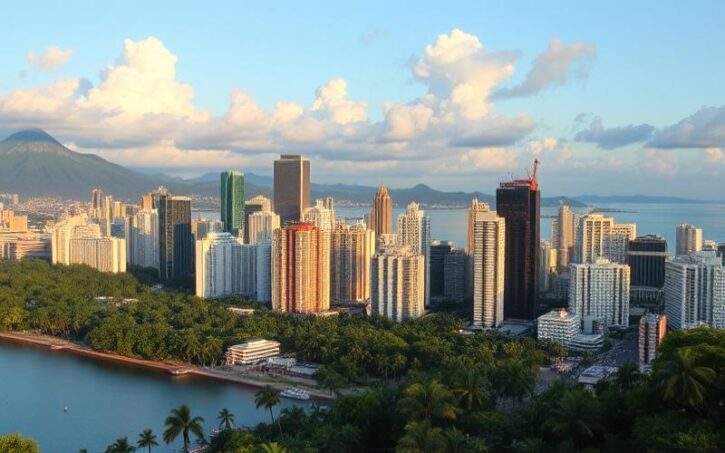
 Published on and written by Cyril Jarnias
Faced with rapidly rising housing costs, micro-apartments are emerging as an innovative solution for Panamanians on tight budgets. These spaces, often under 30 square meters, appeal with their optimized design that maximizes every inch, offering a practical and affordable alternative in densely populated urban areas.
By blending modern design and functionality, they meet the growing needs of urban workers and young professionals who want to live in the heart of the city without compromising their financial comfort.
In a country where housing affordability is a constant challenge, these compact homes could well be the key to a new balance between urban planning and accessibility.
Understanding the Micro-Apartment Phenomenon in Panama
Definition of Micro-Apartments and Typical Size in Panama
A micro-apartment is a self-contained, single-room dwelling that integrates a living space, sleeping area, bathroom, and kitchenette within a surface area typically ranging from 14 to 35 m². In Panama, although the market is still emerging, micro-apartments typically fall within this size range, sometimes around 18 to 30 m² in modern urban neighborhoods.
| Feature | Description |
| Typical Size | 14 to 35 m² |
| Composition | Single room, bathroom, kitchenette |
| Location | Central urban neighborhoods |
| Furniture | Built-in or fold-away furniture |
Economic and Social Reasons for the Rise
- Rapid urbanization and population concentration in city centers.
- Rising real estate prices making traditional housing less accessible.
- Need for affordable housing for a young, mobile, or budget-limited population.
- Economic development attracting expats, students, and young professionals.
- Adaptation to new urban lifestyles where practicality and location outweigh size.
Main Target Populations
- Young professionals wanting to live near their workplace.
- Students, especially international or domestic students from outside the city.
- Expats attracted by economic opportunities or short/medium-term assignments.
- Investors seeking good rental returns on small spaces.
Perceived Benefits for Residents
- Reduced cost for both purchase and rent.
- Minimal maintenance due to the small size.
- Central location close to services, transport, and workplaces.
- Possibility to access common areas (gym, coworking, shared terraces).
- Often furnished and optimized to maximize comfort despite the size.
Potential Challenges of Micro-Apartment Living
- Limited comfort due to restricted space.
- Lack of privacy, especially when living with a partner or working from home.
- Difficulty hosting guests or storing bulky personal items.
- Possibility of feeling claustrophobic or frustrated in the long term.
Role of Real Estate Developers and the Government
Real estate developers are increasingly developing micro-apartment projects, betting on profitability per square meter and appeal to younger generations.
Some projects include shared services and layout innovations to attract the target clientele.
The government supports this movement, sometimes through incentives or regulations that facilitate the construction of small homes, in order to address the urban housing crisis and support worker mobility.
Current and Future Market Trends in Panama
- Growth in the number of micro-apartment projects in strategic urban areas.
- Increased demand from young professionals, students, and expats.
- Trend towards maximizing space with modular and multifunctional layout solutions.
- The market is expected to continue growing, driven by urbanization and the ongoing rise in traditional real estate prices.
Statistics or Case Studies
In several major Latin American cities, micro-apartments now account for up to 10 to 20% of new residential projects in certain central neighborhoods.
Example: in urban neighborhoods of Panama City, developers offer units of 18 to 30 m² at prices 30 to 50% lower than traditional studios, providing easier access to homeownership or rental for first-time buyers and young workers.
The micro-apartment embodies the response of modern cities to the shortage of affordable housing and the evolution of urban lifestyles.
Good to know :
Micro-apartments in Panama, often 15 to 30 square meters, are the result of economic and social factors, meeting needs for budget accessibility and rapid urbanization. Primarily popular with young professionals, expats, and students, these compact spaces offer advantages such as reduced cost and minimal maintenance. However, they pose challenges in terms of comfort and privacy. The development of these homes is strongly supported by real estate developers and the government, who see them as a solution to increasing urban density. Market outlook indicates continued demand, with a trend towards an increase in the number of micro-housing complexes, supported by urban planning policies. According to a recent study, approximately 20% of new urban constructions in 2023 involved micro-housing, reflecting their growing popularity.
The Reasons Behind the Rise of Studios and Microliving in Panama
Economic and Sociocultural Factors Behind the Rise of Studios and Microliving in Panama:
- Rapid Urbanization
- The accelerated growth of Panama City has led to urban densification, favoring the development of compact apartments in sought-after central neighborhoods.
- Modern infrastructure (shopping centers, bilingual schools, hospitals) attracts a young, international population seeking proximity to services.
- Population Growth
- The constant increase in the number of inhabitants in the capital stimulates demand for accessible and well-located housing.
- Many young professionals, expats, and singles prefer small spaces to benefit from a central location while limiting their expenses.
- Lifestyle Evolution
- The modern urban lifestyle values flexibility, connectivity, and time savings.
- Innovative common spaces (pools, coworking spaces, fitness rooms) compensate for the reduced size of the apartments.
- Pressure on the Real Estate Market
- The continuous rise in price per square meter makes it difficult to access large homes in desirable neighborhoods.
- Studios/micro-apartments represent an affordable solution for accessing central neighborhoods without going heavily into debt.
| Factor | Impact on Microliving |
|---|---|
| Rapid Urbanization | Increased density = need to optimize every space |
| Population Growth | Sustained demand = diversification of housing stock |
| High Real Estate Prices | Active search for affordable alternatives |
| Rising Cost of Living | Priority given to economy over private space |
- Changing Lifestyle Preferences
- Young professionals primarily seek:
- Easy access to work and leisure
- Controlled costs
- A secure environment
- The studio/microliving format perfectly meets these expectations thanks to:
- Lower rents
- Strategic location
- Shared services
- Young professionals primarily seek:
Government and Urban Planning Initiatives
- Promotion of urban renewal through:
- Local plans encouraging vertical construction to combat urban sprawl
- Tax incentives for real estate investors in certain key sectors
- Institutional support for compact residential development:
- Facilitation of administrative procedures for mixed-use projects (residential + commercial)
- Implementation or improvement of public infrastructure (rapid public transit)
In summary:
Microliving has become popular mainly because it combines financial accessibility, strategic location, and adaptation to new urban needs. This phenomenon is amplified by strong urbanization coupled with increasing pressure on housing costs.
Good to know :
The rise of studios and microliving in Panama is largely influenced by rapid urbanization and population growth, which exacerbate the demand for affordable housing. Faced with rising real estate prices and the cost of living, young professionals and singles prefer these compact housing options, which offer the advantage of reduced costs without sacrificing proximity to dynamic urban centers. These preferences are part of a shift in lifestyles towards greater flexibility and mobility. Panamanian authorities are also encouraging this trend through urban policies favoring the construction of microliving, thus meeting growing demand while optimizing the use of space in high-density areas.
Micro-Apartments: A Promising Investment Opportunity
The recent evolution of the Panamanian real estate market highlights strong urbanization, the digitalization of transactions, and the development of major infrastructure (metro expansion, new airports), which enhances peripheral areas and opens up new investment opportunities. Average apartment prices in Panama City range around $2,500 to $3,500 per square meter for central neighborhoods. Regions like David or Taboga Island show notable growth potential with still attractive prices.
Micro-apartments are particularly appealing to new investors thanks to:
- Low entry cost: access to dynamic neighborhoods from $1,800/m² in emerging areas.
- High rental potential: growing demand from expats, young professionals, and digital nomads seeking affordable and well-located housing.
- Attractive profitability: gross yield often higher than traditional apartments due to the optimized price/rent ratio on small spaces.
Accessible Financing Options:
- Mortgage loans offered by local banks for residents and non-residents.
- Specific solutions for foreign investors, including loans in foreign currencies or partnerships with international real estate agencies.
- Possibility of direct financing through real estate developers on certain new projects.
Main Regions with High Potential:
| Region | Average Price/m² | Key Factors |
|---|---|---|
| Panama City | ~$2,500 | High rental demand |
| Costa del Este | ~$2,500 | Dynamic business center |
| David | Project delivered in special economic zone; occupancy rate >90%; estimated annual net profitability between 7% and 9%, rental stability ensured by the increased presence of international companies. |
Micro-Apartments Costa del Este
Moderate initial investment (15% after two years while benefiting from continuous rental income).
Summary List – Key Advantages:
- Low entry ticket
- High yield
- Growing demand (expats/digital nomads)
- Enhanced legal security
- Accessible regional diversity
Structured opportunity in a stable market supported by the state and driven by accelerated urbanization, allowing for rapid appreciation in the micro-apartment segment. Economic outlook: long-term return on small spaces.
Economic Outlook: Long-Term Returns on Small Spaces
Recent Evolution of Real Estate Prices in Panama
- In 2025, the Panamanian residential market shows a moderate but sustainable recovery, with an annual increase of 2.38% in the average price in Panama City, reaching $1,804 USD/m² in March 2025, a +7.38% increase from the low point in 2021.
- Neighborhoods with the highest demand for micro-apartments (San Francisco, Casco Viejo, El Cangrejo) see new construction prices per m² ranging from $2,720 USD (San Francisco) to $4,150 USD (Casco Viejo).
- Luxury apartments in central areas range between $2,500 and $3,500 USD/m².
| Neighborhood | Average New Price (USD/m²) | Average Resale Price (USD/m²) | 2025 Trend |
|---|---|---|---|
| Casco Viejo | 4,150 | >3,000 | Rising |
| San Francisco | 2,720 | ~2,000 | Rising |
| El Cangrejo | 2,500 – 3,000 | 1,800 – 2,200 | Stable/Rising |
Occupancy Rates and Demand Dynamics
- The rental occupancy rate remains high in central neighborhoods, especially for micro-apartments, thanks to demand from expats, young professionals, students, and remote workers.
- Tourism growth, the rise of remote work, and the arrival of new residents boost the rental of small spaces, with rental absorption above average in this segment.
- In premium neighborhoods (Punta Pacifica, Santa Maria), the absorption rate is slowing and rental yields are decreasing, while “mid-market” neighborhoods like El Cangrejo show better occupancy rates.
Economic Projections for Micro-Apartment Yields
- Gross rental yields for micro-apartments in Panama City range between 6% and 8% depending on location and property management.
- Rents remain attractive for investors, with growing demand for small spaces, especially in high-density, well-served neighborhoods.
- The rise in new construction prices, combined with a slowdown in resale sales, suggests sustainable appreciation of compact properties, subject to prudent management of the risk of oversupply.
Advantages of Investing in Micro-Apartments
- Structural demand: Adapted to evolving urban lifestyles, international mobility, and the growth of single-person households.
- Accessibility: Lower entry ticket than larger spaces, facilitating real estate portfolio diversification.
- Rental flexibility: Suitable for long-term rentals, short-term rentals (Airbnb), or co-living.
- High yield: Occupancy rates and profitability generally above the residential market average.
Risks and Limitations
- Vacancy risk: In case of overproduction or economic downturn, small spaces may be more sensitive to vacancy, especially if expat demand contracts.
- Price volatility: Micro-apartments are more exposed to rapid market fluctuations, particularly during supply and demand adjustments.
- Obsolescence: Requirements for comfort and services evolve quickly, which can affect resale value or the ability to maintain high rents.
- Regulation: Changes in rules regarding short-term rentals can impact profitability.
Integration into Long-Term Urban Development
- Micro-apartments fit into the strategy of urban densification, revitalization of central neighborhoods, and sustainable development.
- This trend favors the creation of mixed-use urban hubs, with a diversified offering of housing, shops, and services nearby.
- In the long term, the growth of micro-apartments could contribute to a more resilient Panamanian real estate market, provided supply remains aligned with real demand and quality of life is preserved.
Key takeaways:
Micro-apartments in Panama offer attractive yield potential and resilience in the face of demographic and economic changes. However, investment success depends on rigorous location selection, appropriate management, and active monitoring of demand and regulatory developments.
Good to know :
Real estate prices in Panama have seen a significant increase in recent years, especially in urban areas where micro-apartments are increasingly popular. In Panama City, for example, the average cost per square meter has increased by 5% annually, reaching approximately $2,800 USD. These small homes often have occupancy rates exceeding 90%, reflecting strong demand, especially among young professionals and expats. Economic projections indicate that micro-apartments could offer attractive long-term returns, although it is essential to consider potential risks related to local regulations and market saturation. Investing in these compact spaces offers the advantage of simpler management and greater flexibility to adapt to rental fluctuations, but requires careful evaluation of current urban development trends and changing tenant preferences.
Disclaimer: The information provided on this website is for informational purposes only and does not constitute financial, legal, or professional advice. We encourage you to consult qualified experts before making any investment, real estate, or expatriation decisions. Although we strive to maintain up-to-date and accurate information, we do not guarantee the completeness, accuracy, or timeliness of the proposed content. As investment and expatriation involve risks, we disclaim any liability for potential losses or damages arising from the use of this site. Your use of this site confirms your acceptance of these terms and your understanding of the associated risks.

Cyril Jarnias is an independent expert in international wealth management with over 20 years of experience. As an expatriate himself, he is dedicated to helping individuals and business leaders build, protect, and pass on their wealth with complete peace of mind.
On his website, cyriljarnias.com, he shares his expertise on international real estate, offshore company formation, and expatriation.
Thanks to his expertise, he offers sound advice to optimize his clients' wealth management. Cyril Jarnias is also recognized for his appearances in many prestigious media outlets such as BFM Business, les Français de l’étranger, Le Figaro, Les Echos, and Mieux vivre votre argent, where he shares his knowledge and know-how in wealth management.





