
 Published on and written by Cyril Jarnias
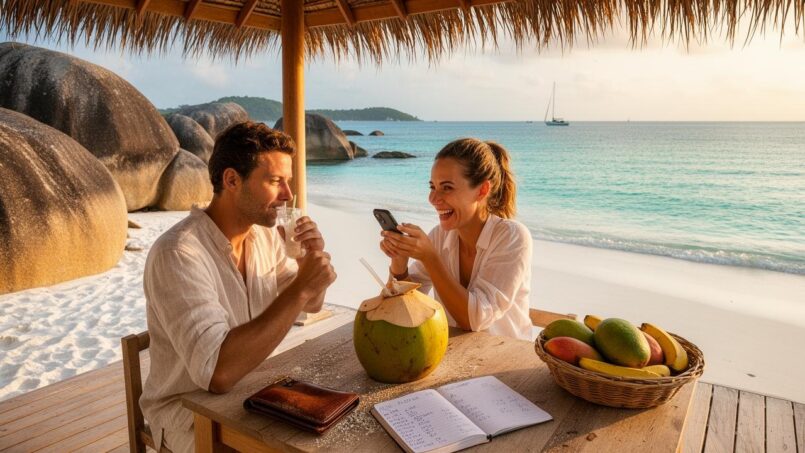
In the eyes of many, the Seychelles evokes a postcard-perfect setting: turquoise lagoons, white sand, granite rocks sculpted by the ocean. This paradise, regularly presented as a luxury destination, attracts more and more French people seeking sun, a slower pace, and for some, a new life. But behind the beauty of the landscapes lies a more complex reality: a high cost of living, an island economy ultra-dependent on imports, services far from the standards of major metropolises… and a daily life that has nothing to do with a long stay at a hotel.
This article covers the necessary budget, housing conditions, healthcare, education, living environment, and testimonials from French expats already settled in the Seychelles, with comparisons to France.
Cost of Living: A Paradise That Comes at a Price
Before packing your bags, you need to start by looking closely at the numbers. On almost every expense category, the Seychelles ranks in the high end, especially on a continental scale where the country is often rated as the most expensive in Africa for cost of living.
Indices and Budget Ranges
According to various cost of living indices, the Seychelles scores between approximately 48 and 58 on a base of 100, with New York as the reference at 100. Concretely, this means the archipelago is about 42% cheaper than New York, but more expensive than many European countries and most Southeast Asian destinations.
Recent studies mention an amount of $100 as a relevant order of magnitude for a global overview.
| Profile | Average monthly cost including rent | Monthly cost excluding rent |
|---|---|---|
| Single (average) | $3,079 | $1,629 |
| Couple (2 adults) | $4,219 | $2,769 |
| Family (2 adults + 2 children) | $5,897 | $4,012 |
At the other end, in a tight budget scenario, some calculations of a minimum budget give, still per month:
| Profile | Tight budget including rent | Tight budget excluding rent |
|---|---|---|
| Single | $1,515 | $765 |
| Couple | $2,069.50 | $1,319.50 |
| Family (4 people) | $2,906.50 | $1,931.50 |
The same sources estimate that a comfortable / high-end standard of living can climb much higher:
| Profile | Comfortable budget including rent | Comfortable budget excluding rent |
|---|---|---|
| Single | $6,070 | $3,270 |
| Couple | $8,232 | $5,432 |
| Family (4 people) | $11,391 | $7,751 |
In euros, several summaries converge on a range of €1,800 to €2,700 per month for a single person depending on comfort level, and at least €3,500 to €5,500 for a couple who don’t want to deny themselves too much.
Seychelles vs. France: Which Is Really More Expensive?
Comparisons with France are less straightforward than they appear, as studies don’t all reach the same overall conclusion. Some estimate that the Seychelles cost of living is about 7% higher than in France, others mention 5% lower, or even an average gap of –1.9%. However, all reports agree on two points:
Local purchasing power is about 69% lower than in France, and some expense categories can be up to 100% higher.
Some telling comparisons (in 2026):
| Item | Seychelles | France | Indicative gap |
|---|---|---|---|
| Average net monthly salary | ≈ €660 (≈ $886 or SCR 11,100) | > €2,000 in many cities | Much lower |
| Simple lunch at a restaurant | €14.5 | €15 | Slightly cheaper |
| 3-course dinner (per person) | €30 | ~€30 | Comparable on average |
| Fast-food combo McDonald’s-style | €10.2 | €12 | About 15% cheaper |
| Domestic beer 0.5L | €7 | €6 | 17% more expensive |
| Imported beer 0.33L | €4.6 | €2.84 | ≈ +62% |
| Cappuccino | €4 | €3.3 | ≈ +23% |
| Small bottle of water | €2.1 | €1.95 | Slightly more expensive |
| Night in a 3* hotel | €296 | much less | ≈ +50% for hotel stays in general |
For housing, the gap is just as significant:
| Housing (monthly) | Seychelles | France (excluding Paris) | |
|---|---|---|---|
| 1-bedroom city center | ≈ €877–1,150 | ≈ €650 | Significantly more expensive |
| 3-bedroom city center | ≈ €2,200 | often < €1,500 | Much more expensive |
In summary, living in the Seychelles is not synonymous with saving money. Even if some aggregators show an overall index slightly lower than France, the combination of low salaries + high prices makes the cost of living heavy for residents, whether locals or expats.
Housing: The Item That Busts the Budget
All testimonials converge: finding housing is the number one expense. The reason is simple: the archipelago is small, tourist demand is high, and the supply of long-term rentals is quite limited, especially in sought-after neighborhoods.
Rent Levels and Key Areas
Numerical data varies by source, but the orders of magnitude remain consistent. In dollars:
| Type of property | City center | Outskirts / outside center |
|---|---|---|
| 1-bedroom | ≈ $951 ($872–$1,090) | ≈ $853 ($654–$1,110) |
| 3-bedroom | ≈ $2,181 ($1,818–$2,690) | ≈ $1,711 ($1,300–$2,181) |
In euros, other studies detail by location on Mahé:
| Location (Mahé) | 1-bedroom center | 1-bedroom outskirts | 3-bedroom center | 3-bedroom outskirts |
|---|---|---|---|---|
| Victoria | ≈ €850 | ≈ €600 | ≈ €1,700 | ≈ €1,550 |
| Anse Royale | ≈ €900 | ≈ €650 | ≈ €1,750 | ≈ €1,300 |
| Beau Vallon | ≈ €1,050 | ≈ €700 | ≈ €1,850 | ≈ €1,200 |
The differences between islands and neighborhoods are marked:
– Mahé is the most expensive island, especially Victoria, Beau Vallon, and Eden Island, which are highly sought after.
– Praslin is often 15 to 30% cheaper than Mahé for equivalent properties, but the supply is more limited.
– La Digue is paradoxically more affordable for some monthly rents (around $490–$850 for a room), but the scarcity of housing makes any search complex.
The monthly rent ranges (in dollars) for a 1-bedroom apartment illustrate these differences well:
| Area | Monthly range 1-bedroom (USD) |
|---|---|
| Victoria / English River | $850–$1,300 |
| Beau Vallon | $1,000–$1,550 |
| Eden Island | $1,400–$2,500 |
| Anse Royale (south Mahé) | $560–$920 |
| Praslin – Anse Volbert | $560–$1,000 |
| Praslin – Grand’Anse | $450–$700 |
| La Digue | $490–$850 |
On top of this, there is generally a 1 to 2 month security deposit, rarely negotiable.
For a French expat, Beau Vallon and Anse Royale are the most recommended neighborhoods on the island of Mahé. They offer dream beaches, proximity to the capital or international schools, and a notable French-speaking community.
Real Estate Purchase and “Luxury” Rentals
For those considering buying, prices per square meter range, according to some reports, around:
– ≈ $727/m² in city center
– ≈ $912/m² outside
These figures should be taken with caution: properties actually accessible to foreigners, especially on Mahé or in upscale projects like Eden Island, can far exceed these averages. Studios or small apartments in sought-after areas trade rather between $200,000 and over $500,000, while prestige villas with sea views can easily climb beyond the million mark.
On the luxury rental market, independent villas with 3 to 6 bedrooms show weekly rates that set the tone:
| Villa type | Low season (per week) | High season | Peak period (holidays) |
|---|---|---|---|
| 3 bedrooms | $7,000–$14,000 | $12,000–$24,000 | $20,000–$40,000 |
| 4 bedrooms | $11,000–$22,000 | $18,000–$38,000 | $32,000–$60,000 |
| 5 bedrooms | $18,000–$36,000 | $30,000–$60,000 | $52,000–$100,000 |
| 6+ bedrooms | $30,000–$65,000 | $55,000–$120,000 | $100,000–$220,000+ |
These are mainly very high-end seasonal rentals, but these amounts illustrate the positioning of the Seychelles as a luxury destination, with a mechanical effect on the entire rental market.
Testimonials: “Finding Housing, a Real Obstacle Course”
Several French people tell the same story: finding a roof is often the most stressful step of the move. Caroline, who left for her first expatriation with her partner, calls it “a real challenge” to find a decent apartment at a reasonable price. According to her, classified ads are not enough: “It’s really word of mouth that makes the difference. Without a local network, you miss out on the rare good opportunities.”
“Without a lawyer who knows the system well, you get lost in the formalities, delays, and administrative subtleties.”
Anne, homeowner
Food and Daily Expenses: Importing Costs a Lot
The archipelago imports about 90% of consumer goods. Result: food and everyday products are significantly more expensive than in many African or Asian countries, and frequently above French prices for goods imported from Europe.
Restaurants and Cafés
Eating out is not cheap, especially in establishments aimed at tourists. Some benchmarks (in dollars or Seychellois rupees, SCR):
| Product / Service | Average price |
|---|---|
| Simple meal at a small local restaurant | ≈ $19 or SCR 250 |
| Fast-food combo McMeal | ≈ SCR 100 |
| 3-course meal for 2 at a mid-range restaurant | ≈ $73 or SCR 953 |
| Domestic beer (draft) at the bar | ≈ $3–5 or SCR 80 on average |
| Imported beer (bottle) | ≈ SCR 68 |
| Cappuccino | ≈ $4 or SCR 70 |
| Small soda bottle | ≈ €1.9 or ~SCR 29 |
| Small bottle of water | ≈ €2.1 or ~SCR 26 |
Travelers and residents alike note, however, a significant gap between tourist spots and local Creole cuisine. A meal of fish and rice at a “takeaway” or small local eatery often runs between $6 and $12, much cheaper than dinner at a beach restaurant for international visitors where the bill easily climbs to $50–$80 per person.
Groceries and Supermarkets
For monthly grocery shopping, studies give varying figures depending on the basket chosen, but the orders of magnitude are as follows, for one person:
The monthly food budget for an expat in Japan can reach €700, especially with imported products.
– The reasons are clear:
– European products (cheeses, cured meats, wines, French brand biscuits, etc.) incur markups of 40 to 60% due to transport, taxes, and the small size of the market.
– Basic local or regional staples can be much more affordable, especially fish (tuna, jobfish, marlin…) or certain seasonal tropical fruits.
Caroline says she had to relearn how to shop, giving up the habits of French supermarkets. She started cooking with fresh ginger, coconut milk, and unknown fruits, which became a pleasure, even though she sometimes misses finding an affordable good French cheese.
Energy, Water, Internet: The Subscriptions That Sting
Regarding utility bills, the gaps with France are marked:
– Electricity: up to €0.32/kWh, almost double the average French rate.
– Water: about €4.5/m³, compared to ~€3.5 in France.
– High-speed Internet: often over €100/month, nearly three times the typical bill in mainland France.
For an apartment of 80–85 m², several sources suggest:
| Item | Average monthly cost |
|---|---|
| Electricity, water, garbage (85 m²) | ≈ $132–$180 or €150–€250 |
| Internet | ≈ $134 or > €100 |
Again, these are averages: a family using a lot of air conditioning can see their electric bill skyrocket. A French woman who has been living there for several years admits she was “truly surprised” by some bills during the hot season.
Transport: Cheap Buses, Expensive Cars
The advantage of the Seychelles is that the inhabited islands remain modest in size: you never cover hundreds of kilometers at a stretch. But the available means of transport and their costs can clearly influence the monthly budget.
Public Transport
The bus network on Mahé and Praslin allows you to get around at very low cost:
| Ticket type | Average price |
|---|---|
| Single bus ticket | $0.87 or SCR 10–12 |
| Monthly bus pass | $36 or ≈ SCR 430 |
For an expat with a more “local” profile, this solution remains unbeatable. However, the buses are sometimes crowded, not always punctual, and not very suited to certain work schedules or family life.
Taxi, Rental, and Gas
Taxis and car rentals, on the other hand, approach tourist standards:
Overview of prices for taxis, car rentals, and gas in the Seychelles
Between $15 and $25, or about SCR 250 to 600
Around $50 to $80
From $45 to $70 per day, or $200 to $400 per month for regular rental
Approximately €1.3 per liter, more expensive than in France at moderate prices
Ultimately, a bus pass at $36 or €45 per month remains the best ally for those looking to keep expenses down. But many expats end up buying or leasing a car for greater independence, which easily adds €200–€300 to the monthly transport budget.
Healthcare: A Decent System, but Limited for Serious Care
The Seychelles has a universal public healthcare system for citizens and legal residents, with a quality index of around 63–75/100 according to rankings. For the local population, basic consultations, routine emergencies, and some medications are free or very inexpensive.
For expats, the reality is different.
Good Basic Coverage, but Few Specialists
The main hospital, located in Victoria on Mahé, covers most standard needs: emergencies, maternity, basic surgery, pediatric care. There are also secondary hospitals on Praslin and La Digue, as well as a network of health centers.
However, the system faces several limitations:
Shortage of specialists in oncology, specialized surgery, and interventional cardiology. Aging heavy equipment leading to referrals abroad for complex analyses. Limited capacity and public-private disparities in comfort and waiting times.
A significant portion of medical staff are actually foreign professionals (about 65% of doctors according to a recent report), proof of both the recruitment effort and the difficulty in training and retaining enough local specialists.
Medical Evacuation as an Essential “Plan B”
In practice, the norm for expats is to:
– Use the local system for minor emergencies, everyday medicine, and certain straightforward hospitalizations.
– Arrange for strong international insurance covering medical evacuation to medical hubs such as South Africa, Mauritius, India, or sometimes Europe.
A medical evacuation by air ambulance can cost $50,000 to $100,000 without insurance, making this protection almost essential. Many contracts for healthy adults range between $100 and $200 per month, but premiums increase with age and coverage level.
The recommended annual health budget for a family of four, including insurance and basic medical expenses.
Expat Feedback: “Decent for Day-to-Day, Fragile for the Rest”
– In testimonials, the tone is generally nuanced:
– “For a fracture, a few stitches, a common infection, it’s okay,” says a long-term resident.
– “For anything like a heart problem, cancer, or major surgery, we immediately turn to insurance and a trip abroad.”
– For the French, the most solid solution often combines:
– membership in the Caisse des Français de l’Étranger (CFE), to maintain a base of rights at French rates;
– an international top-up “first euro” policy, covering excess local costs and, above all, evacuation.
Education: A Real Challenge for French Families
For families, the question of schooling for children is central. The Seychelles has a public system inspired by the British model, with free education from kindergarten to secondary school. Public education is multilingual: English, Seychellois Creole, and French, with French used as a language of instruction in some subjects and as a foreign language.
Local, International, and French Schools
Several options are available to parents:
Schools in Seychelles offer free public education in three official languages as well as private and international options for expatriate families.
Free, class sizes from 25 to 35 students, use of the three official languages.
International school on Mahé, British curriculum, IGCSE and A-Levels, about 1,100 students. Top choice for English-speaking expat families.
Follows the French curriculum, located on Mahé. Reference for French families wishing to stay within the French system.
Includes Independent School (Mahé), Vijay International School (Praslin), and several bilingual structures.
Enrollment fees at international schools generally range between €6,000 and €12,000 per year per child, depending on grade level. At ISS, primary fees are around $7,500 per year, excluding one-time registration fees. Additionally, waiting lists are common: it is advisable to submit an application 6 to 12 months in advance.
School Choices of French Expats
Surveys conducted among French families abroad show that:
Distribution of educational systems adopted by families for their children in a situation of international mobility.
About 60% of families choose the French system for at least one child, mainly to ensure continuity in case of frequent mobility.
About one third opt for the local school system of the host country, often for reasons of proximity, personal development, and language integration.
Nearly 20% turn to an international curriculum like IB or British School.
In the Seychelles, the presence of EFS and ISS makes these institutions true social hubs for expat families: places where networks are built, where parents find reference points, practical information, and even professional opportunities through word of mouth.
Testimonials from French families in Victoria emphasize that, despite this structured school fabric, social isolation can remain strong, especially outside the school environment. The overall number of expats is limited, the French community is relatively small, and spontaneous encounters are less frequent than in mainland France or in major hubs like London or Dubai.
Work, Income, and Visas: A Sensitive Area to Approach with Caution
On paper, the Seychelles aims to be welcoming to foreigners: you can enter without a paid tourist visa, some remote work schemes exist, and the country promotes its status as a financial hub and “workcation” destination. But the reality of the local job market is much more selective.
Local Employment: Few Opportunities Outside Tourism and Finance
The sectors that hire foreigners are well known:
– Tourism and hospitality: hotel management, executive chefs, marketing managers, spa management, dive instructors, etc.
– Financial services and offshore: analysts, bankers, compliance and anti-money laundering specialists, tax specialists.
– Healthcare: doctors, nurses, specialists hard to find locally.
– Education: teachers for international or private schools.
– Environment, technology, sustainable development projects.
Salaries vary greatly:
| Type of position | Indicative range |
|---|---|
| “Standard” job (SCR) | SCR 10,000–25,000/month (≈ $700–$1,750) |
| Senior / specialist position (SCR) | SCR 30,000–60,000/month (≈ $2,100–$4,200) |
| Overall average net salary | ≈ $1,350 or SCR 11,000–11,500 |
At the top of the scale, some luxury hotel managers or international finance executives can earn several thousand euros per month (€5,000 to €15,000 for an executive chef, hotel general manager, or bank director). But these cases remain a minority and almost always come with very demanding conditions and specific contract packages (housing, company car, etc.).
Experienced French expats recommend not coming to the Seychelles without a solid job offer, as the job market is small, priority is given to Seychellois, and obtaining a work permit (GOP) is difficult, especially outside growth sectors.
Telework and “Workcation” Visas
For self-employed individuals, freelancers, or remote employees, the Seychelles has developed specific visas like the Workcation Retreat. They allow you to reside for several months while working remotely for a company or clients abroad, without entering the local job market.
This scheme targets an affluent clientele, notably executives or entrepreneurs with comfortable incomes, due to the cost of living on site, the need for a good internet connection (improved but inferior to major European cities), and the price of housing suitable for telework.
Marcus, a French entrepreneur, explains that he chose the archipelago to “combine work and beach”. He even claims that the idyllic environment boosts his productivity. But he acknowledges that this comfort comes at a cost and requires “a business that’s already solid,” capable of absorbing the expenses of a country where little or nothing is produced locally.
Quality of Life: Between Postcard and Possible Isolation
What emerges from all the testimonials is that quality of life in the Seychelles can be exceptional… provided you accept the trade-offs.
The Enormous Positives
On one hand, French people living in the archipelago highlight: the advantages of their culture, the economic benefits, and the preservation of the French language.
The Seychelles offer a stable tropical climate without major cyclones, spectacular natural surroundings, remarkable safety (index 61-67), a warm but discreet population, and a low-stress pace of life with the concept of “island time.”
Jean, a French retiree, often sums up his experience in one sentence: “The kindness of the people helps a lot in dealing with the little hassles. We feel safe, surrounded, and this incredible nature changes our way of living.”
The Less Idyllic Sides
On the other hand, several downsides come up regularly:
A feeling of social isolation affects some profiles like singles or couples without children, who struggle to create lasting bonds outside work or family. The geographical distance makes trips back to France expensive and rare. Daily life, simpler and more basic on some islands or neighborhoods, offers fewer services and culture than in Europe. Administrative frustrations stem from the slowness of formalities and red tape. Finally, the high cost of the European lifestyle (TV subscriptions, restaurants, imports, travel) weighs heavily to maintain the comfort of the mainland.
A French family based in Victoria says they suffered greatly from the lack of expat network at the beginning: few opportunities for “spontaneous” meetings and the feeling of living in a bubble. They emphasize, however, that “the scenery more than makes up for it, with this ‘feeling of simple daily happiness from seeing the sea and the light’.”
Integration: Learning to Say “Bonzour” and to Slow Down
In the Seychelles, the success of an expatriation largely depends on the ability to embrace the local culture rather than trying to bypass it.
Languages and Social Codes
Most business, administration, and education is conducted in English and French, which is an asset for Francophones. But Seychellois Creole (Kreol Seselwa) remains the language of the heart. A few basic words like “Bonzour,” “Mersi,” or “Ki manyer?” (how are you?) make a noticeable difference in how you are received.
In a small island society:
Saying hello is the norm in Spain. Ignoring someone is perceived as arrogance. Avoid public debates on sensitive topics like religion or politics, and dress appropriately away from the beach, especially on Sundays and in churches. Take time to ask about the family, share a meal, or bring a small gift when invited.
The French expats who integrate best are those who adapt easily to the local culture and take the time to understand the customs and social practices of the host country.
– Frequent markets, local eateries, neighborhood events rather than staying confined to the expat sphere.
– Get involved in local associations, clubs (diving, sailing, soccer, basketball, beach cleanups, etc.).
– Accept slowing down, waiting at the counter, not constantly comparing everything to France.
French-Language Networks: Invaluable Support
Several structures act as a “social safety net” for newcomers:
– Alliance Française: courses, cultural events, associative network.
– Welcome associations (like Victoria Accueil): activities, meetups, practical exchanges.
– École Française des Seychelles and ISS: places where parents, teachers, children from multiple nationalities intersect.
Many expats say they found their first job, housing, or valuable practical advice through these associations or online groups. Far from trivial, these networks often help navigate the first, sometimes disorienting, months of settling in.
Sample Budgets: What to Expect in Practice?
To give an idea to potential expats, several studies offer sample monthly budgets for a comfortable lifestyle.
Single Expat, “Standard European” Lifestyle
A European overview estimates that a single person living in the center of a major Seychellois city needs about:
– €1,542 per month all-inclusive, in a rather “localized” average approach.
– Other more cautious sources mention €1,799 for true comfort (including €1,150 rent).
– A more detailed estimate suggests:
– €1,150 rent (1-bedroom center),
– €280 groceries,
– €45 transport (pass),
– €180 utilities,
– €150–€200 outings and leisure.
Total approximate: €1,700 to €1,800 per month.
This monthly amount in euros reflects the cost of living in Prague for a Western lifestyle including modern housing, regular outings, and a car.
Expat Couple
For a couple, several ranges come up frequently:
| Scenario | Indicative monthly budget |
|---|---|
| Moderate comfort, no excess | ≈ €2,700 |
| More upscale lifestyle | €3,500–€5,500 |
| Very comfortable version (villa, car, frequent leisure) | $4,200–$8,000 (or equivalent €) |
A typical breakdown for a comfortable couple:
– Housing (2–3 rooms): €800–€1,300 (or more near the beach).
– Food: €500–€700.
– Transport: €200–€300.
– Health and insurance: €200–€300.
– Leisure and outings: €300–€400.
– Miscellaneous (telecoms, clothing, services): €300–€400.
This amount represents the estimated total cost of a stay, which can quickly increase with options like sea view housing or costly activities.
Family with Children
For a family of four, international data suggests:
– ≈ $70,764 per year, or about $5,897 per month all-inclusive.
– Excluding rent, nearly $4,000 per month for current expenses.
In euros, some calculations specific to European families give:
– €4,589 per month for a family of four living in the center of a major Seychellois city, compared to €4,779 in France – but without factoring in the effect of lower wages and local purchasing power.
In reality, enrollment in an international school (€6,000 to €12,000/year per child) and comprehensive health insurance can easily increase the bill by several hundred, even thousands of euros per month.
French Testimonials: Between Love at First Sight and Daily Complexity
Individual stories shed light on what the numbers don’t say.
An incredible climate all year round and nature that puts things into perspective. But you have to be flexible with the scarcity of certain products, the slow pace, and high rents.
Caroline, who left for her first expatriation
All of them, however, come back to the same advice: if possible, come first for a few weeks or months for a reconnaissance trip, test several islands (Mahé, Praslin, La Digue), neighborhoods, schools, and modes of transport, before committing to a long lease or a purchase.
Verdict: Who Is Life in the Seychelles For?
Living in the Seychelles is not an unattainable fantasy, but it is not a permanent postcard either. The archipelago can offer an exceptional quality of life to those who:
To succeed in your expatriation, you need sufficient income for the local cost of living, accept a certain material simplicity with fewer choices and more simplicity, truly integrate by learning the local language and frequenting local networks, and seriously anticipate health and education aspects.
Conversely, the country risks disappointing those who hope to find both a Western lifestyle, high salaries, a moderate cost of living, and infrastructure of a major metropolis. The Seychelles remains a small island state: magnificent, safe, warm, but expensive, sometimes slow, and inevitably limited in certain services.
For a certain profile of French person – retirees seeking sun, remote-working entrepreneurs, families ready to reinvent their daily lives – the archipelago can become a true “second home.” Provided you arrive informed, budgeted… and open enough to say “Bonzour” to the neighbor down your street, every morning, facing the ocean.
A wealth management project or a question? Contact us now to speak with a wealth management expert.
Disclaimer: The information provided on this website is for informational purposes only and does not constitute financial, legal, or professional advice. We encourage you to consult qualified experts before making any investment, real estate, or expatriation decisions. Although we strive to maintain up-to-date and accurate information, we do not guarantee the completeness, accuracy, or timeliness of the proposed content. As investment and expatriation involve risks, we disclaim any liability for potential losses or damages arising from the use of this site. Your use of this site confirms your acceptance of these terms and your understanding of the associated risks.

Cyril Jarnias is an independent expert in international wealth management with over 20 years of experience. As an expatriate himself, he is dedicated to helping individuals and business leaders build, protect, and pass on their wealth with complete peace of mind.
On his website, cyriljarnias.com, he shares his expertise on international real estate, offshore company formation, and expatriation.
Thanks to his expertise, he offers sound advice to optimize his clients' wealth management. Cyril Jarnias is also recognized for his appearances in many prestigious media outlets such as BFM Business, les Français de l’étranger, Le Figaro, Les Echos, and Mieux vivre votre argent, where he shares his knowledge and know-how in wealth management.





