
 Published on and written by Cyril Jarnias
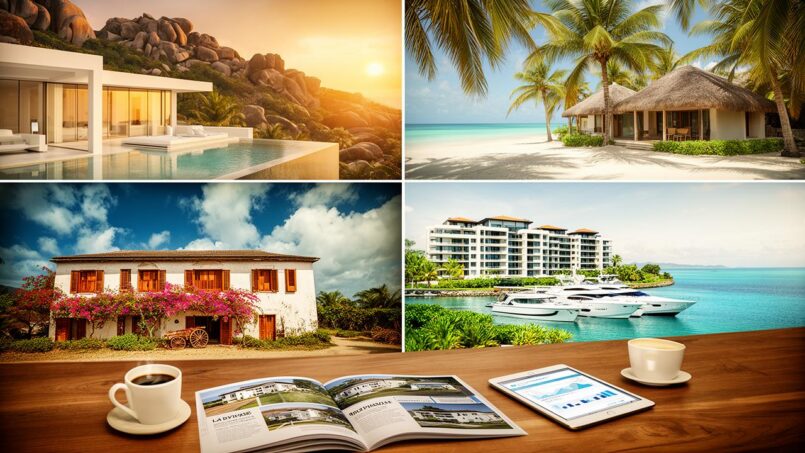
The Seychelles have long been associated with postcard-perfect beaches. In 2026, the archipelago has also become a sophisticated real estate market, segmented and closely watched by international investors. Between Mahé, Praslin, La Digue and Eden Island, differences in price, rental yield, and buyer profile are now pronounced, to the point of creating four almost distinct micro-markets.
According to 2026 data from CMC Global Estates Research, real estate in the Seychelles shows marked differences between local and foreign properties. The article details actual costs, potential returns, and public policies aimed at balancing housing pressure while allowing foreign investment.
A market under tension in 2026, but driven by growth
The macroeconomic backdrop largely explains the price level. The Seychelles economy still relies on the tourism–fisheries duo, but real GDP growth is projected around 3.3% over the medium term, with a similar pace in 2026. The real estate sector is one of the drivers, alongside construction and information technology.
Buildable land in the Seychelles increases by about 15% per year due to the scarcity of available plots and environmental constraints.
In this context, the consumer price index for housing, water, electricity, and gas shows pressure on the cost of living. Between 2007 and 2026, the “Housing & Utilities” index rose from 44.14 points to a peak of 145.65 points in August 2022, and still stood at 140.87 points in January 2026 and 140.72 in February. Even though the curve seems to be stabilizing, past inflation has durably increased construction and renovation costs.
The table below summarizes the recent evolution of this sectoral index, providing an overview of the observed variations.
| Period | Housing & Utilities Index (points) |
|---|---|
| February 2007 (low point) | 44.14 |
| Average 2007–2026 | ~104.40 |
| August 2022 (record) | 145.65 |
| December 2025 | 141.11 |
| January 2026 | 140.87 |
| February 2026 | 140.72 |
At the same time, the Seychelles government remains very active in social and affordable housing, to offset the surge in private prices. The 2026 budget thus allocates 489 million Seychelles rupees (SR) to deliver over 200 affordable homes and 120 apartments for professionals, while more than 150 plots will be allocated via the “land bank,” with over 100 additional lots announced for 2027. Overall, the government aims to deliver 2,500 homes by 2028, with ongoing operations on Mahé, Praslin, and La Digue.
Mahé: the heart of the market, expensive but solid
Mahé concentrates the capital Victoria, the international airport, main services, the majority of the population, and most infrastructure. Unsurprisingly, it is also the heart of the real estate market.
Price levels and yield
According to the Property Price Index 2026 by CMC Global Estates Research, Mahé shows an average price of 10,920 SCR per square meter, with an estimated gross rental yield of 4.2% and annual capital growth of +14%. The buyer profile is described as “UHNW, International”—that is, ultra-high-net-worth, often foreign.
| Area studied | Average price per m² (SCR) | Gross rental yield | Annual capital growth | Buyer profile |
|---|---|---|---|---|
| Mahé | 10,920 | 4.2% | +14% | Ultra‑High‑Net‑Worth, International |
In certain specific areas, levels rise well above this average. The Cascade district, for example, reaches 104,969 SCR/m² for houses, with an annual increase of about 2%. Areas like Bel Ombre or the hills of northern Mahé are categorized as high-end, while Beau Vallon and Glacis have become benchmarks for investors combining second homes and tourist rentals.
In terms of budget, the ranges observed in 2025 give a scale still relevant in 2026:
Overview of prices for different property types in the region
Approximately $220,000 to $450,000 depending on view, proximity to the sea, and quality of the residence.
From $600,000 to over $2.5 million in the most sought-after areas.
Often between $2 and $6 million, with a higher ceiling for exceptional properties.
$100 to $300 per m², depending on zoning (residential, tourist) and topography.
Rental market: sustained demand
Mahé benefits from dual rental demand: local population and expatriate workers on one side, and tourists on the other. Average rents reflect the tension in the market.
For a one-bedroom apartment in the city center, the monthly rent averages around 13,670 SCR, with a range from 12,000 to just over 20,500 SCR. On the outskirts, a one-bedroom typically rents for about 11,700 SCR, with a low end of 9,000 SCR.
Zooming in on certain coastal neighborhoods, rents are more often quoted in dollars:
– Beau Vallon: for a one-bedroom, between $1,000 and $1,550 per month.
– Anse Royale and Takamaka: rather $500 to $800 monthly, positioned as “budget” options for residents and some expats.
These amounts combine with a very active short-term rental market via Airbnb or other platforms, with rates from $50 to $150 per night for a well-located apartment, depending on the season.
Construction supply: deliberate policy choices
For the residential sector, the public strategy on Mahé directly influences the price landscape. New publicly funded programs mainly target social or affordable homeownership, with construction costs meticulously calculated: a three-bedroom house of 93 m² is priced around 837,000 SCR, while a more compact version of 81.5 m² drops to 733,500 SCR. Reducing the average size of homes allows more houses to be built with the same budget, increasing the potential from 2,000 units to nearly 2,342 without additional funding.
This policy translates into a network of construction sites across Mahé: 64 units at Cap Bonn Zan, 72 at Béolière, 81 at Barbarons financed through the Abu Dhabi Fund for Development, as well as subdivisions at Anse Aux Pins, Aux Cap, Pascal Village, Les Mamelles, and Ex‑Desaubin. In the medium term, this could moderate price pressure in certain segments, but the luxury sector remains driven by land scarcity, political stability, and a stable regulatory environment.
Praslin: higher yield, “lifestyle” atmosphere
The second island of the country, Praslin combines iconic beaches (Anse Lazio, Anse Volbert), natural heritage (UNESCO-listed Vallée de Mai), and a more relaxed vibe than Mahé, while still having a solid base of tourist infrastructure. It is also one of the most dynamic markets at the moment.
Price and yield indicators
In 2026, Praslin is clearly below Mahé in price per square meter, but above it in rental yield.
| Area studied | Average price per m² (SCR) | Gross rental yield | Annual capital growth | Buyer profile |
|---|---|---|---|---|
| Praslin | 8,736 | 5.9% | +14% | High‑Net‑Worth, Lifestyle |
With an average price of 8,736 SCR/m², the island is roughly 20% cheaper than Mahé, which is consistent with rents: generally, rentals on Praslin are estimated to be 20 to 30% cheaper than on Mahé. The gross yield of 5.9% is significantly higher, a sign that tourist rental demand compensates for lower purchase prices.
The price ranges recorded for 2025, still indicative, show a wide range:
Very high-end villas can reach over $5 million for exceptional properties along the most famous beaches.
Recent transactions confirm this: for example, a large family estate at Cote Dor (Praslin) with 260 m² of living space and 3 bedrooms at $830,000, and prestige properties like an architect’s villa at Anse Takamaka listed at €2.4 million.
Tourist rentals: a powerful engine
The rental market on Praslin is dominated by tourism. Holiday villas typically rent for between $300 and $800 per night in high season, depending on size, pool, and immediate beach proximity. Over the year, the combination of the dry high season (May to October), peak periods (Christmas, Easter), and lower occupancy in the off-season allows gross yields of 4 to 7% for well-managed properties.
Monthly rents for long-term rentals aimed at expats, NGOs, or retirees range from $1,000 to $3,000 for comfortable accommodation.
Micro-markets within the island
Praslin is far from homogeneous. Several key areas structure the market:
– Anse Lazio: one of the world’s most famous beaches, ideal for ultra-luxury villas, where land is almost impossible to find.
– Anse Volbert (Côte d’Or): main tourist hub, with hotels, restaurants, and shops, perfect for rental projects.
– Grand Anse: flatter terrain, larger plots, proximity to the airport, a playground for investors looking to combine boutique hotels, residences, or mixed-use programs.
– Baie Sainte Anne: the island’s port and marina, suitable for mixed residential/commercial projects.
The resale segment is also well structured: renovated Creole-style villas on Côte d’Or, contemporary houses on hills overlooking the ocean, small condominiums in Grand Anse with a communal pool and fitness center. These products, already integrated into seasonal rental programs, often offer net yields in double digits for the best ones, provided professional management is in place.
La Digue: small market, big yield
La Digue holds a special place. The island, with no airport and very few cars, remains the quintessential image of an “unplugged” paradise. This uniqueness is reflected in the 2026 figures from CMC Global Estates Research.
Lower prices, record yields
| Area studied | Average price per m² (SCR) | Gross rental yield | Annual capital growth | Buyer profile |
|---|---|---|---|---|
| La Digue | 7,280 | 9.8% | +7% | Investors, Expats |
The average price per square meter, at 7,280 SCR, is lower than Mahé and Praslin. However, it is on La Digue that gross rental yields are the highest, flirting with 10%. Capital growth is more moderate (+7% per year) but still places the island in a phase of sustained appreciation, driven by very strong tourist demand and extremely limited supply.
On La Digue, monthly rents for a one-bedroom apartment range from $490 to $850. Combined with a lower acquisition cost than Mahé, they offer more attractive yields for patient investors, while recent land prices illustrate the diversity of offerings.
– Buildable land at Grosse Roche of 2,500 m²: $395,000.
– Plot at Anse Gaulette of 4,000 m²: $1.2 million.
– Waterfront land at Anse Reunion of 584 m²: $345,000.
– Large land at Anse Banane over 30,000 m²: price “on request,” a sign of very high valuation.
The scarcity of supply combined with large areas creates strong capital appreciation potential, subject to respecting environmental constraints and limitations for foreign investors.
A clientele of expats and niche investors
The buyer profile identified for La Digue in 2026 is “Investors, Expats.” These are often people looking for an investment in a very exclusive destination, with a less speculative and more wealth-preservation logic. Projects range from vacation homes rented out a few weeks a year to the creation of small upscale eco-tourism accommodation.
Unlike Mahé or Eden Island, La Digue remains difficult to access on a daily basis for workers, which limits the growth of a “classic” residential rental market aimed at families and employees. The high yield therefore comes primarily from tourist flows and the extreme scarcity of new approved projects.
Eden Island: international showcase and regulatory exception
Eden Island holds a unique status in Seychelles real estate. This artificial residential marina, connected to Mahé by a bridge, is one of the few places where foreigners can buy freehold property without a specific approval procedure. It is also one of the most expensive and most liquid markets.
Purchase prices: from high-end to ultra-high-end
Cross-referenced data from 2025–2026 gives a fairly precise picture of the price grid on Eden Island.
General ranges mentioned for the archipelago place Eden Island apartments between $400,000 and $3 million, houses or townhouses between $1.2 and $2 million, and individual villas from $2.5 to $4.5 million. Some listings exceed these ceilings, for example a 470 m², 6-bedroom villa at $4.5 million.
Detailed surveys by basin show the range of resale prices for apartments:
| Eden Island sector | Typical size (m²) | Bedrooms | Indicative price (USD) |
|---|---|---|---|
| Apartments Basin 1 | 87–210 | 2 | $450,000 to $785,000 |
| Apartments Basin 2 | 141 | 2 | $595,000 |
| Apartments Basin 3 | 140–143 | 2 | $550,000 to $645,000 |
| Apartments Basin 4 | 88–178 | 2–3 | $435,000 to $825,000 |
| Apartments Basin 5 | 88–215 | 2 | $435,000 to $900,000 |
| Apartments Basin 6 | 457 | 2 | $2,950,000 |
| Peninsula 2 | 126–173 | 2 | $615,000 to $880,000 |
For houses (townhouses):
| Eden Island sector | Typical size (m²) | Bedrooms | Indicative price (USD) |
|---|---|---|---|
| Houses Basin 2 | 234 | 2 | $1,100,000 to $1,200,000 |
| Houses Basin 4 | 197–317 | 2 | $1,350,000 to $1,950,000 |
| Houses Basin 5 | 271–317 | 2 | $1,400,000 to $2,250,000 |
| Houses Basin 6 | 271 | 2 | $1,550,000 |
| Peninsula 7 | 356–437 | 2 | $2,200,000 to $2,400,000 |
And for villas:
| Eden Island sector | Size (m²) | Bedrooms | Indicative price (USD) |
|---|---|---|---|
| Villa Basin 5 | 317 | 2 | $2,895,000 |
| Villa Peninsula 3 | 371 | 2 | $3,500,000 |
At the island-wide level, 2025–2026 estimates indicate that:
Overview of price ranges for different types of residential properties.
From about $450,000.
Between $650,000 and $1.1 million.
Mostly between $1.2 and $2 million.
Between $2.5 and $4.5 million, or more for peninsula properties.
The entry prices mentioned elsewhere (a 1-bedroom from $350,000, villas from $800,000) refer more to the early phases of development; on the current resale market, levels are significantly higher.
Price stability and appreciation
Unlike other segments where new supply regularly dilutes scarcity, Eden Island is a completed development with no possibility of expansion. This characteristic, combined with constant demand from Europe, the Middle East, and Africa, helps maintain high and stable prices.
The inventory of about 25 properties for sale at any given time reflects favorable liquidity for this type of niche asset.
Rentals: among the highest in the country
Eden Island tops the “luxury budget” segment in rental classifications. Long-term rents frequently exceed $2,500 per month, alongside the Four Seasons residences and exclusive properties in northern Mahé. Vacation rentals listed on international platforms illustrate these levels: a one-bedroom can rent from $120 to over $350 per night depending on the season, with some very high-end products approaching $1,000 outside peak season.
This positioning allows wealth-preserving investors to combine personal enjoyment, rental yield, and long-term capital appreciation, within a legal framework clarified for foreign clients.
Structured comparison: Mahé, Praslin, La Digue, Eden Island
To summarize the main differences in price and yield between the three main inhabited islands and the micro-destination Eden Island, the table below presents the key 2026 indicators from CMC Global Estates Research (for Eden Island, the national average is not isolated in the source table, but it falls within the high end of the luxury segment).
| Market | Average price per m² (SCR) | Gross rental yield | Annual capital growth | Dominant buyer profile | Typical budget level (USD) |
|---|---|---|---|---|---|
| Mahé | 10,920 | 4.2% | +14% | UHNW, International | Villas: $600,000 – $5M+; Apartments: $220,000 – $450,000+ |
| Praslin | 8,736 | 5.9% | +14% | HNW, Lifestyle | Villas: $700,000 – $2M (up to $5M+ luxury); Apart.: $250–500k |
| La Digue | 7,280 | 9.8% | +7% | Investors, Expats | Houses, land: $345,000 – $2M+ |
| Eden Island (segment) | — | $2,500+/month (rent) | 3–5% (estimated appreciation) | Very wealthy international investors | Apartments: $450,000 – $3M; Houses: $1.2–$2M; Villas: $2.5–$4.5M+ |
Several takeaways emerge:
Mahé and especially Eden Island have the highest prices, with advantages such as marina access and simplified regulations. Praslin is cheaper to buy than Mahé but offers a better gross yield, appealing to lifestyle profiles. La Digue shows the highest yield, but its market is narrow and access is complex, making it a niche for specialized investors.
A state that strongly regulates property access
One of the particularities of the Seychelles market is the dual public framework: on one hand, a massive effort on affordable housing for Seychellois; on the other, a system of sanctions, rights, and limitations designed to contain the impact of foreign capital on prices.
Affordable housing: house sizes and budget envelopes
The 2026 budget figures illustrate the scale of public housing policy:
– 489 million SCR is allocated to over 200 affordable homes and 120 apartments for professionals.
– 126 million SCR further finances over 150 plots via the land bank.
– 10 million SCR is reserved for infrastructure needed for 128 mid-range apartments.
– 75 million SCR funds 81 homes in Barbarons, via an $8.7 million agreement with the Abu Dhabi Fund for Development.
– Several tens of millions of SCR are distributed across Cap Bonn Zan, Béolière, Anse Aux Pins, Aux Cap, Pascal Village, Les Mamelles, Ex‑Desaubin, Corgat Estate, Union Vale.
The size of a three-bedroom house is reduced from 93 m² to 81.5 m² to build more homes with a constant budget.
Eligibility and conditions for Seychellois
Access to social or affordable housing is based on a set of financial and social criteria. For loans from the main social financing institution, Home Finance Company (HFC), income must be below 30,000 SCR monthly, with credit installments between 30 and 40% of income. For social housing, the maximum income threshold is 15,000 SCR per month. The new policy also imposes a minimum financial capacity of 1.2 million SCR for certain schemes, reflecting a gradual shift toward more self-financing.
Land allocation rules require, once the input is obtained, to develop the plot within five years at most and to complete 75% of construction within that timeframe. Resale is prohibited before 15 years. These measures aim to prevent speculation on subsidized land.
Foreign investors: a more open but selective framework
Until January 2025, a moratorium limited certain residential purchases by non-Seychellois. Its lifting marked a turning point. Now, foreigners can again acquire land and residential properties, but only in “Designated Areas” or approved developments.
Conditions are strict
– Minimum value of 10 million SCR for a built residential property.
– For vacant land, minimum value of 4,000 SCR per m², with a size between 2,000 and 4,000 m².
– For a single-family house, plot of 1,000 to 4,000 m².
– For a condominium apartment, minimum value of 30,000 SCR per m² for non-Seychellois.
The procedure involves applying for “sanction” from the Ministry of Lands and Housing, accompanied by a file including identity documents, proof of funds, police certificates, and for companies, statutes and registers. Processing fees are fixed (3,000 SCR for a purchase, 2,000 for a lease, 1,000 for acquiring shares in a property-holding company).
If approved, several layers of levies apply to non-Seychellois:
– Stamp duty of 5% of the property value.
– Sanction processing fee of 1.5%.
– Sanction duty of 12% for residential properties outside the “Villas” policy.
Total transaction costs for a foreigner can reach or exceed 18 to 20% of the purchase price
Once a property owner, a non-Seychellois must also pay an annual property tax of 0.5% of the property value (rate doubled since 2024). A one-year exemption is, however, granted to first-time foreign buyers since 2020.
The example of Eden Island illustrates how a fully private development can bypass part of these constraints, being pre-approved and offering freehold land without individual sanction. This exception remains limited to this type of integrated complex, with the aim of channeling foreign demand toward certain areas without draining housing stock for Seychellois.
Inflationary pressures, financing, and 2030 outlook
Beyond the 2026 snapshot, several deep trends shed light on the probable evolution of prices on Mahé, Praslin, La Digue, and Eden Island.
First, demographic dynamics. The total population is estimated at about 132,800 inhabitants in mid-2025, with urbanization projected beyond 71,000 inhabitants in urban areas by end of 2026. The urbanization rate should gradually increase to around 55% by 2030. This concentration in a few inhabited pockets, particularly Victoria and its outskirts (including Eden Island), maintains constant pressure on land prices.
Over 3,200 people are waiting for affordable housing through housing savings schemes.
Finally, monetary policy remains relatively accommodative, with the key interest rate kept at 1.75% in 2025 and an environment where inflation, though stabilized around 2.5–3% over the medium term, remains positive. Credit growth to the private sector, particularly for households and mortgages, hovers around 19 to 24% year-on-year for certain segments, evidence of sustained appetite for real estate debt.
Prices are expected to rise sharply in Victoria and Anse Royale on Mahé, driven by major infrastructure investments (roads, ports, facilities). On Praslin and La Digue, annual growth will be more moderate than on Eden Island, where supply scarcity is extreme.
For investors, the challenge is to arbitrate between:
– Mahé, for the combination of capital appreciation (+14% per year currently), legal security, market liquidity, and possible use as a primary residence.
– Praslin, for an attractive price/yield couple and greater exposure to resort tourism.
– La Digue, for record rental yield and a niche positioning, at the cost of lower liquidity.
– Eden Island, for easy foreign access, brand image, and extremely rare high-end supply, but with a high entry ticket and substantial transaction costs.
Conclusion: a segmented but coherent market
As a whole, the Seychelles real estate market in 2026 resembles neither a speculative eldorado without rules nor a fortress closed to foreign capital. The four poles studied – Mahé, Praslin, La Digue, and Eden Island – draw a coherent landscape: at the center, Mahé, expensive but deep and liquid; around it, Praslin and La Digue, more affordable or more profitable depending on the case, but subject to strong supply constraints; finally, Eden Island, an international micro-market polarizing a large share of ultra-high-end demand.
The state, for its part, tries to hold together two sometimes contradictory objectives: protecting access to property for Seychellois through an ambitious housing policy and regulation of public land sales, while maintaining the archipelago’s attractiveness for private capital that finances a large part of infrastructure and tourism-related jobs.
Analysis of Seychelles policy
In this balancing act, the 2026 figures argue for a continuation of price increases in key areas, even if progress may slow compared to post-pandemic years. For anyone looking at Mahé, Praslin, La Digue, or Eden Island today, the question is therefore not so much whether prices will fall, but rather where, in ten years, the new equilibrium points will lie between a scarce coastline, global demand for seaside luxury, and a state determined to keep the Seychelles dream accessible to its own citizens.
A wealth planning project or a question? Contact us now to speak with a wealth management expert.
Disclaimer: The information provided on this website is for informational purposes only and does not constitute financial, legal, or professional advice. We encourage you to consult qualified experts before making any investment, real estate, or expatriation decisions. Although we strive to maintain up-to-date and accurate information, we do not guarantee the completeness, accuracy, or timeliness of the proposed content. As investment and expatriation involve risks, we disclaim any liability for potential losses or damages arising from the use of this site. Your use of this site confirms your acceptance of these terms and your understanding of the associated risks.

Cyril Jarnias is an independent expert in international wealth management with over 20 years of experience. As an expatriate himself, he is dedicated to helping individuals and business leaders build, protect, and pass on their wealth with complete peace of mind.
On his website, cyriljarnias.com, he shares his expertise on international real estate, offshore company formation, and expatriation.
Thanks to his expertise, he offers sound advice to optimize his clients' wealth management. Cyril Jarnias is also recognized for his appearances in many prestigious media outlets such as BFM Business, les Français de l’étranger, Le Figaro, Les Echos, and Mieux vivre votre argent, where he shares his knowledge and know-how in wealth management.





