
 Published on and written by Cyril Jarnias
Buying a house with your toes in the sand on the Pacific coast, investing in a villa with a pool in Monterrico, or securing a lot in a large waterfront project in Chulamar: the dream is accessible in Guatemala, but it comes with very specific rules. Between restrictions for foreigners near the coastline, state leases via OCRET, and purchases through a Guatemalan corporation, it’s best to understand the lay of the land before signing anything.
This guide details the process of buying a beachfront property in Guatemala, including market figures, property examples, the legal framework, real costs, potential risks, and strategies for navigating this specific real estate sector effectively.
Understanding the Context: A Still-Emerging Coastal Market
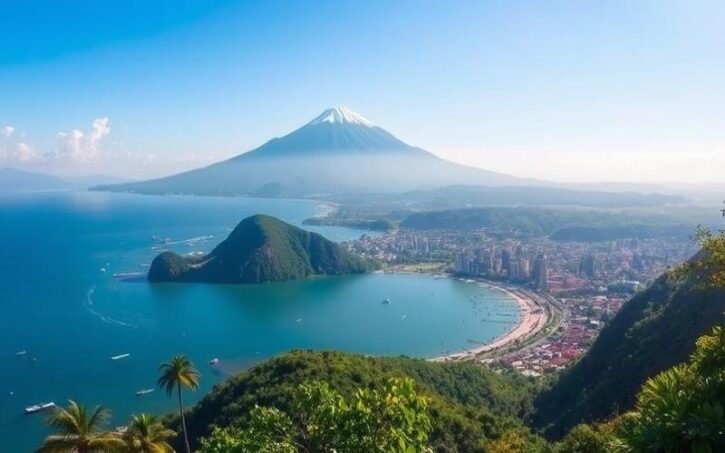
Guatemala’s Pacific coastline stretches approximately 155 miles, from the Mexican border in the west to El Salvador in the east. It’s a coast of volcanic black sand, mangroves, and sugarcane, coffee, and banana plantations, connected by the Pan-American Highway and secondary roads to ports and fishing villages.
Unlike other more well-known Central American countries like Costa Rica or Panama, Guatemala’s Pacific coast remains underdeveloped. This situation presents an interesting opportunity for investors, with many still-quiet beaches, prices significantly lower than its neighbors, and real potential for tourism growth around spots like Monterrico, Puerto de San José / Chulamar, Likin, Iztapa, or Tecojate.
The country as a whole boasts a cost of living 18% below the global average and real estate prices still largely below many competing Latin American markets. On the macro side, Guatemala is the largest economy in Central America, with a diversified GDP (agriculture, tourism, services, textile industry) and a relatively stable currency, the quetzal (GTQ), around 7.7 GTQ to 1 USD.
In this context, the Pacific coast is seen as an “emerging” area: rising tourism, new residential and resort projects, and potentially high rental yields on beach houses intended for Guatemalans’ weekends, travelers, and foreign retirees.
Key Beachfront Areas to Know
Although the entire coastline is Pacific, not all areas offer the same investment profile or type of properties.
Monterrico and the Santa Rosa Coast
Monterrico is probably the most frequently mentioned name when talking about the beach in Guatemala. This laid-back village is located about two and a half hours from Guatemala City, bordering a wide volcanic sand beach. On weekends, the town fills with city dwellers coming for surfing, sunsets, and seafood; during the week, the atmosphere becomes relaxed again.
The area is near the Monterrico-Hawaii Nature Reserve, which houses mangroves, beaches, and protected species like sea turtles (leatherback and olive ridley), birds, and caimans. This natural wealth enhances its eco-tourist appeal but also imposes strict environmental constraints on any development project.
The property offering is varied, from simple vacation homes to luxury beachfront villas:
| Example Property (Monterrico & surroundings) | Asking Price | Lot / Construction Size | Key Features |
|---|---|---|---|
| Beach house in El Garitón (Monterrico road) | 130,000 USD | 600 m² lot / 350 m² built | Pool, vacation home, near beach |
| Two-story chalet in El Garitón | 350,000 USD | 3,000 m² lot / 292 m² built | 5 bedrooms, parking for ~20 cars |
| Penthouse at Villa Los Cabos, Monterrico | 169,000 USD | Duplex, 3rd floor | 4 bedrooms, 2 bathrooms, furnished |
| Furnished bungalows (Los Alacranes, Monterrico) | 415,000 USD | ~4,267 m² | Bungalow complex, intended for rental |
| Villa “Blanc Monterrico” | 800,000 USD | Not specified (large lot) | Large kitchen, 2 living rooms with bar, ranch, pool with lagoon and jacuzzi |
| Luxury beachfront house, Aldea Candelaria | 800,000 USD | 4,096 m² lot | Infinity pool, jacuzzi, on the beach |
You can also find oceanfront lots, for example, a corner lot of 810 m² in Playa de Monterrico (Aldea La Candelaria), in an already consolidated residential area.
Puerto de San José, Chulamar, and Likin
Further west, around Puerto de San José and Puerto Quetzal port, the atmosphere is more “resort and condominium.” Several gated residential communities (condominios) dominate the market, often with private beach access, common pools, 24/7 security, and property management favoring Airbnb use.
In the San José / Chulamar / Likin area, the offering illustrated in recent listings is quite telling:
| Location / Project | Asking Price | Approximate Size | Notable Details |
|---|---|---|---|
| House Altamar II, San José | 1,350,000 GTQ (~295,000 USD) | 260 m² built | A few steps from the sea, near shops & restaurants |
| Furnished house, Villas del Pacífico | 295,000 USD | 420 m² | 4 bedrooms, 3.5 bathrooms, air conditioning |
| House with pool, Condominio Alta Mar | 325,000 USD | 350 m² over 2 levels | Pool, residential environment |
| Equipped house in Likin, facing a mangrove | 950,000 USD | 660 m² on a lot of approx. 1,746 sq yds | Nature reserve view, high-end |
| Etnika Beach House, Las Olas (Chulamar) | 650,000 USD | 700 m² | 2 levels + 2 bungalows, 7 bedrooms |
| House in Chulamar (5 min from beach) | 330,000 USD | 356.4 m² on 606 sq yds | 4 bedrooms with bathroom, pool, pergola, garden, “Airbnb friendly,” private beach access in gated residence |
| Beach house in Chulamar | 295,000 USD | 423 m² on 606 sq yds | 4 bedrooms, family / rental home |
| New beachfront apartment project, Chulamar | 1,407,624 GTQ | 83 m² | Apartments under construction, beachfront |
This area particularly attracts buyers looking to combine personal use (weekends, vacations) and short-term rental for a local and foreign audience.
Escuintla, Iztapa, Tecojate, and Other Pacific Coast Points
Still around Puerto Quetzal and in the department of Escuintla, several beach condominiums are moving upmarket, such as San Marino, Marina del Sur, or some complexes in Likin.
A few indications from listings:
– Furnished house in San Marino, Puerto Quetzal: 325,000 USD for 577 m².
– New house in Marina del Sur, Juan Gaviota: 2.4 million USD for 1,314 m², 5 bedrooms (very high-end level).
– Beachfront house in Tecojate: 225,000 USD for a lot of 1,520 m², in a rapidly developing tourist area.
Several villas in Iztapa and Taxisco, often on large lots (1,800 to over 3,000 m²), complete this mosaic, with houses ranging from 260,000 to 345,000 USD, sometimes just a few dozen meters from the beach.
A Very Specific Legal Framework Near the Coastline
Before even looking at pools or ocean views, a foreign investor must understand a crucial point: in Guatemala, the law strongly differentiates between “normal” areas and areas near borders and coasts.
What Foreigners Can (and Cannot) Buy
As a general rule, a foreigner can buy real estate in Guatemala with nearly the same rights as a citizen: houses, apartments, agricultural or commercial land, in their own name, without a residency requirement or specific visa, and with no minimum investment amount imposed.
But there are two major categories of restrictions:
In a 50 km zone from the coasts and a 3 km zone along land borders, foreigners cannot hold land directly in their name. To acquire a property in these areas, the usual solution is to create a Guatemalan corporation of the Sociedad Anónima (S.A.) type, which becomes the property owner. The foreigner then holds the shares of this corporation.
– 2. State Reserve Zone in Direct Contact with the Water (OCRET) This is a second level of constraints, this time concerning all owners, Guatemalan or foreign. The Constitution and the Territorial Reserve Law stipulate that:
– Within a radius of 3 kilometers from the ocean coast,
– Within a 200-meter strip along lake shores,
– And 100 meters on each side of navigable rivers,
the land belongs to the State and cannot be owned in full fee simple. These waterfront strips are managed by OCRET (Oficina de Control de Áreas de Reserva del Estado – Office for the Control of State Reserve Areas). So you don’t buy the land but a right of use via a lease (arrendamiento) OCRET, renewable, for an annual rent generally under 100 USD.
Concretely, a “beachfront house” often combines:
For a lot partly outside the nature reserve zone and partly within the coastal strip, regulations may require two separate regimes: a standard property title for the part outside the reserve zone, and an OCRET lease (Constitución de Derecho Real de Ocupación) for the part within the coastal strip itself. This lease, specific to the maritime public domain, allows private occupancy while recognizing State ownership.
For a foreigner, if the property is within the 50 km strip, this title + lease combo must additionally be held by a Guatemalan S.A. corporation.
OCRET: An Administrative Detail… That Can Cost You Everything
The OCRET system is often misunderstood by foreigners. Yet it is a vital point by the sea. The OCRET lease comes with a modest annual fee, but if payment is not made, the State has the right to confiscate the reserve land and any constructions on it.
When purchasing, it is therefore essential to: ensure the quality of the product, verify prices and consumer reviews, and choose a secure payment method.
– Verify that the property is properly registered, and clearly identify the part under full ownership and the part under OCRET lease.
– Obtain copies of the current OCRET contracts.
– Confirm, via the lawyer and with OCRET, that all fees are paid up to date.
This is one of the most critical due diligence points for a beachfront project.
The Legal Structure: Buying Directly or Through an S.A. Corporation?
For an apartment in downtown Antigua, buying in your own name is generally not a problem. For a villa with your toes in the sand, the situation is different.
Sociedad Anónima (S.A.): The Nearly Indispensable Tool on the Coast
Due to the prohibition of foreign ownership within the 50 km strip around the coasts, using an S.A. is the standard solution. In practice:
Typical annual accounting and legal maintenance fees for a Guatemalan S.A.
This tool also has advantages in terms of asset structuring (succession, transfer of shares rather than the real estate asset, etc.), but introduces an additional layer of complexity: bylaws, registers, reporting obligations, and of course lawyer fees for creation and management.
OCRET Lease: What You Really Own
Even with an S.A., you must keep in mind that within the OCRET strip (the first meters from the sea), you do not own the land outright. You benefit from a real right of use, in exchange for paying an annual fee.
One element does not necessarily disqualify an investment, but it fundamentally changes its nature. Therefore, the value analysis should consider expanded criteria beyond traditional financial aspects alone.
– The price paid to the seller,
– Ancillary costs (transfer taxes, notary, lawyer, registration),
– Annual charges (IUSI property tax, OCRET, S.A. maintenance),
but also the fact that you are on a renewable administrative lease regime, not a classic freehold.
The Purchase Process: Steps, Documents, Timelines
Even for a beachfront property, the basic process remains that of any real estate purchase in Guatemala, with a few additional steps related to the S.A. and OCRET.
1. Thorough Due Diligence
Guatemalan land registries have modernized, but errors or gray areas are common, especially in rural and coastal areas. A local real estate attorney is virtually indispensable. Their typical tasks:
– Title search at the Registro General de la Propiedad (RGP), covering at least 30 years of history.
– Verification of absence of liens, mortgages, litigation, community, or indigenous claims.
– Confirmation of zoning (residential, tourist, protected, etc.) and any necessary permits in the coastal zone.
– Verification of OCRET contracts and payments for the waterfront portion.
– Checking actual access to the land, easements, and utility connections (water, electricity, road).
Lawyer fees for this phase and transaction support generally range from 1,000 to 3,000 USD.
2. NIT, Passport, and, If Applicable, Formation of the S.A.
For a foreigner, the basic documents are:
To finalize the acquisition of real estate in Guatemala, it is necessary to prepare the following documents.
A valid travel document is mandatory to identify the foreign buyer.
Issued by the tax administration (SAT), this number is essential for transactions.
Bank statements or certificates to present to sellers, banks, or notary to demonstrate financial capacity.
If the property is within the 50 km coastal strip, a Guatemalan S.A. must be formed in parallel. The lawyer prepares the bylaws, registers the company, and obtains its own NIT. This phase can take several weeks.
3. Promissory Sale Agreement and Escritura Pública
Once preliminary checks are satisfactory, the next step is signing a promissory sale agreement (Contrato de Compraventa), drafted by a notary (who, in Guatemala, is also a lawyer). This contract sets out:
– The price,
– The payment schedule (deposit, balance),
– The conditions precedent (result of due diligence, obtaining financing, etc.),
– The details of included items (furniture, equipment, OCRET rights, S.A. shares if the company is being sold).
At closing, the notary draws up the Escritura Pública, the official deed of transfer. This is the document that will be registered with the Property Registry.
4. Registration with the Registry and Timelines
The Escritura is filed with the Registro General de la Propiedad. The process generally takes 15 to 30 days, sometimes longer depending on the region and workload. Once registration is complete, the new buyer (or the S.A.) officially becomes the owner of the property.
From start to finish, a cash purchase typically closes in 30 to 60 days, provided titles are clear and the legal structure (S.A., OCRET) is well managed from the outset.
Real estate transaction expert
Remote Purchase and Power of Attorney
It is entirely possible to buy a beachfront property without being present, via a Power of Attorney given to a lawyer or local representative. This power of attorney must be notarized, often legalized by a Guatemalan consulate in the buyer’s country of residence.
On paper, everything can thus be done remotely. In practice, refraining from visiting the site at least once carries a real risk: unpleasant surprises regarding the condition of buildings, difficult access, easement issues, or physical boundaries that do not match the cadastral plan.
Acquisition Costs: Taxes, Fees, and “Real” Prices
In addition to the listed purchase price, there are a series of administrative and tax costs. On the coast as elsewhere, you need to factor them in from the start to avoid unpleasant surprises.
Transfer and Registration Taxes
There are two main situations:
– Resale property (existing property) In this case, the buyer mainly pays:
– 3% stamp tax (Impuesto de Timbres Fiscales) on the declared value,
– Approximately 0.15% registration fees at the Registry.
– New construction If you buy a new house directly from the developer, the sale is subject not to the 3% stamp tax but to the 12% VAT on the value of the construction.
In addition:
Notary fees generally represent 1% of the declared value of the property.
In practice, for a resale beachfront property worth 300,000 USD, a realistic estimate of buyer-side transaction costs typically falls between 4% and 7% of the price, depending on complexity (S.A., OCRET, etc.).
Example Cost Structure for a 300,000 USD Resale Property
| Item | Estimated Amount | Comment |
|---|---|---|
| Sale price | 300,000 USD | Negotiated price |
| Stamp tax (3%) | 9,000 USD | On the declared value (declare accurately to avoid future issues) |
| Registration (0.15%) | 450 USD | Registry fees |
| Notary (1%) | 3,000 USD | May vary |
| Lawyer / Due diligence | 1,500 – 3,000 USD | Title search, OCRET, S.A., etc. |
| Miscellaneous / Registry expenses | 500 – 1,000 USD | Filing fees, stamps, certifications |
| Total ancillary costs | Approx. 14,450 – 16,450 USD | i.e., 4.8 – 5.5% of the price |
For a new construction at 300,000 USD (construction portion declared at that level), the 12% VAT pushes overall costs much higher, around an additional 13% for that part. So you must closely examine how the price is structured between land value and construction value.
Annual Costs: Taxes, OCRET, S.A.
Once the villa is purchased, there are recurring charges:
Overview of the main taxes and recurring fees for property owners and companies in Guatemala.
Progressive tax, between 0.2% and 0.9% of the cadastral value (often lower than market value).
Generally less than 100 USD per year for land in the reserve zone (verify case by case).
Between 200 and 500 USD per year for accounting, filings, and basic legal fees.
Trash and other services: a few dozen quetzals per year (approx. GTQ 50 to 300).
For a beach house with a market value around 300,000 USD, the IUSI + OCRET + S.A. package is reasonable relative to the investment, but must be included in profitability calculations.
Financing: A Market Very Much Oriented Toward “Cash”
The Guatemalan banking system remains conservative, especially towards foreigners. Historically, most real estate purchases by non-residents are done in cash, without local credit.
Borrowing in Guatemala: Possible but Complicated
A few major banks (Banco Industrial, G&T Continental, Banco de los Trabajadores, among others) may finance a foreigner, but under demanding conditions:
– Down payment of 35 to 40% minimum,
– Proven stable income, ideally connected to the country (local income, remittances managed through Guatemalan accounts, etc.),
– Annual interest generally between 8 and 12%, sometimes higher depending on the profile,
– Terms rarely exceeding 15 years.
A major obstacle is that banks often require documentation specific to the local system (DPI, NIT with history, Guatemalan tax returns, etc.), which most foreigners do not have.
Approximately 85% of land and property acquisitions by foreigners are done in cash.
– From a real estate or mortgage loan in the home country (e.g., pledging the primary residence),
– Or seller financing (the owner agrees to staggered payments, with interest and a mortgage on the property).
Impact on Purchase Strategy
This context favors cash buyers, who can:
– More easily negotiate a price reduction (sometimes 5 to 10%),
– Speed up the transaction (30 – 45 days possible),
– Avoid the uncertainties of often lengthy and uncertain credit applications.
For a rental investment project, you often need to think in terms of return on equity, rather than local credit leverage.
Investing to Rent by the Sea: Potential and Figures
The Guatemalan Pacific coastline is already a popular destination for residents of Guatemala City for weekends, and increasingly attracts foreign travelers seeking an still-authentic coast. This opens the door to rental strategies, especially via Airbnb and similar platforms.
A Market Driven by National and Regional Tourism
The main current clienteles:
– Families and friend groups from the capital looking for a house with a pool for the weekend,
– Foreign tourists passing through Antigua or Lake Atitlán who extend their stay with a few days at the beach,
– Small groups for wellness retreats or surf trips.
The most sought-after properties are those offering multiple bedrooms, a private pool, a pergola, a large fenced garden, and direct or close access to the beach. It is also advantageous to check if the listing mentions an “Airbnb-friendly” positioning, which indicates that the condominium explicitly allows and facilitates this type of rental.
Potential Returns: Indications and Orders of Magnitude
Average rental returns in Guatemala, across all markets, fall between:
– 5.7% and 8.4% gross in standard residential areas,
– Higher in tourist areas with high turnover, such as Lake Atitlán (up to 8.4 – 12% gross).
On the Pacific coast, there are not yet as many statistics as in Antigua or Guatemala City for Airbnb, but the parameters are comparable to a nascent tourist market:
Daily rates for a 4-bedroom house with a pool are comparable to those in the local market, adjusted for season, equipment, and proximity to the sea. Demand is very high during school holidays, long weekends, Holy Week, Christmas, and New Year’s, while it is more variable off-season. A well-located and well-managed property can achieve a comfortable occupancy rate in high season but experiences lulls during the rainy season and outside weekends.
For a property around 300,000 USD, occupied mostly on weekends and holidays, it is reasonable to target a medium-term gross return in the 6 – 10% range, provided:
– Management is well handled (cleaning, check-in/check-out, maintenance),
– Prices are set appropriately for the local market and not copied from Costa Rica,
– Quality is maintained (air conditioning, reliable water, WiFi, security, maintained pool).
Operating expenses (cleaning, utilities, maintenance, platform commissions, management) easily consume 35 to 50% of gross income, as in other markets in the country. Net profitability therefore often centers around 4 – 7% over the long term for a well-managed property.
Quality of Life and Daily Costs on the Coast
Beyond investment, many buyers are tempted by significant personal use: living several months a year by the sea, teleworking, or spending their retirement there.
Cost of Living: Benchmarks
Guatemala has an overall cost of living 18% lower than the global average. Some illustrative figures:
– A simple lunch in a business district: ~82 GTQ.
– A meal at an inexpensive restaurant: ~40 GTQ.
– A dinner for two at a mid-range restaurant: ~392 GTQ.
– A liter of gasoline: about 1.02 USD for regular unleaded.
Average monthly expenses (all cities combined) give an idea:
| Profile | Average Monthly Budget (USD) Excluding Property Purchase |
|---|---|
| Single person (incl. rent) | ~1,376 USD |
| Single person (excl. rent) | ~856 USD |
| Couple (incl. rent) | ~1,934 USD |
| Family of 4 (incl. rent) | ~2,692 USD |
By the sea, rent disappears if you own, but you must factor in costs:
The monthly electricity cost for standard usage in Singapore, which can increase with heavy air conditioning use.
Life can be very affordable if you consume locally (agricultural products, fish), while keeping in mind that some imported goods or high-end services remain at international prices.
Water, Electricity, and Infrastructure: Points of Vigilance
Drinking water and wastewater treatment remain major challenges in Guatemala. Approximately 90% of watersheds are polluted, and only 5% of wastewater receives treatment. In rural and coastal areas, reliance is often on:
– Wells, cisterns, or local networks managed by the municipality,
– Septic tanks,
– Private water treatment initiatives.
Before buying, it is vital to:
Before a real estate purchase, it is crucial to: understand precisely the water source (private well, municipal network, tanker truck) and its reliability during the dry season; verify the presence of a septic tank or compliant sewage system; and inquire about municipal or community projects for water and sanitation improvement.
Regarding electricity, the country has made a significant effort in rural electrification, with thousands of villages connected in recent decades. On the coast, most tourist areas are supplied, but there are:
– Risks of occasional outages,
– Grid voltage issues during heat peaks.
Many upscale properties include:
– Backup generators,
– Or supplementary solar installations.
Again, you must verify these systems during the property inspection.
Taxation, Residency, and Long-Term Use
Buying a beachfront property does not automatically open the door to residency, but can be part of a broader strategy.
Taxation of Rent and Resale
For rental income generated by a beach villa:
– Non-residents are subject to a 15% withholding tax on gross rents, in practice.
– Some schemes allow declaring net income with expense deductions, but this requires tax planning with a local accountant.
Upon resale, a 10% capital gains tax applies on the net gain (sale price minus acquisition price and documented improvement costs).
VAT at a rate of 12% applies to commercial rents as well as certain ancillary services. This rate particularly concerns more structured operations such as hotels, resorts, etc.
Residency by Investment
A real estate investment of at least 100,000 USD, used productively (development, rental, job creation, etc.), can serve as a basis for an investor visa. This visa:
– Generally grants temporary residency for two years,
– Upon renewal, allows application for permanent residency,
– Then opens the possibility to apply for citizenship after about five years of residency, subject to speaking Spanish and passing a civics exam.
Many retirees or semi-residents however choose a simple tourist visa or a “pensionado” visa based on regular monthly income, without necessarily pursuing citizenship.
Main Risks and Mistakes to Avoid
The Guatemalan coast is promising, but it is not a “plug-and-play” environment like a turnkey program in a North American resort. Some recurring dangers:
In rural and coastal areas, ensure you have a clear title registered with the RGP, as incomplete, overlapping, or contested titles are common. Also verify that OCRET payments are up to date to avoid any risk of confiscation of the coastal strip. For purchases within the 50 km coastal strip, use a Sociedad Anónima (S.A.) structure rather than buying in your own name to stay compliant with the law.
How to Concretely Approach a Beachfront Project
To conclude, a few practical guidelines to maximize your chances of success:
1. Start with several exploratory stays Rent first, in Monterrico, Chulamar, Likin, or Tecojate, at different times of the year. Experience the climate, the crowds, weekend nights, mosquitoes, power outages, and the reality of travel from Guatemala City.
2. Clarify your main objective Family vacation home, rental investment, future part-time or full-time residence, hotel development? The location, type of property, lot size, and optimal budget will not be the same.
The Turkish real estate market is fragmented, without a centralized MLS, and has many lightly regulated agencies. It is therefore crucial to choose your partners carefully. Take the time to verify the reputation of professionals, ask for references, and talk with other foreigners already established there to ensure their reliability.
4. Demand transparency and complete documentation Full property title, cadastral plan, OCRET payment history, utility bills, articles of incorporation of the S.A. if buying through an existing company, etc. Refuse “we’ll see later” or verbal promises.
5. Simulate profitability conservatively For rental income assumptions, use prudent scenarios for occupancy rates and seasonality, and include 35–50% operating expenses. Your project must remain viable even below ideal occupancy.
The Pacific coast is in a development phase where conditions can change quickly (new roads, real estate projects, environmental changes). An isolated property today could become more urbanized in the future, and vice versa.
Buying a beachfront property in Guatemala is not a trivial move, but it is not an insurmountable adventure either. With a good understanding of the OCRET framework and coastal restrictions, serious legal work, and a realistic approach to costs and returns, it is possible to secure a beach villa or coastal lot with an excellent price-quality ratio, hard to find elsewhere in Central America.
The country combines a still-pristine Pacific coast, an affordable cost of living, a growing real estate market, and a rich cultural environment. For the patient and methodical investor, the sea in Guatemala can become much more than a postcard: a true asset, both for wealth and enjoyment.
Disclaimer: The information provided on this website is for informational purposes only and does not constitute financial, legal, or professional advice. We encourage you to consult qualified experts before making any investment, real estate, or expatriation decisions. Although we strive to maintain up-to-date and accurate information, we do not guarantee the completeness, accuracy, or timeliness of the proposed content. As investment and expatriation involve risks, we disclaim any liability for potential losses or damages arising from the use of this site. Your use of this site confirms your acceptance of these terms and your understanding of the associated risks.

Cyril Jarnias is an independent expert in international wealth management with over 20 years of experience. As an expatriate himself, he is dedicated to helping individuals and business leaders build, protect, and pass on their wealth with complete peace of mind.
On his website, cyriljarnias.com, he shares his expertise on international real estate, offshore company formation, and expatriation.
Thanks to his expertise, he offers sound advice to optimize his clients' wealth management. Cyril Jarnias is also recognized for his appearances in many prestigious media outlets such as BFM Business, les Français de l’étranger, Le Figaro, Les Echos, and Mieux vivre votre argent, where he shares his knowledge and know-how in wealth management.





